
Common Starlings (introduced into Australia)
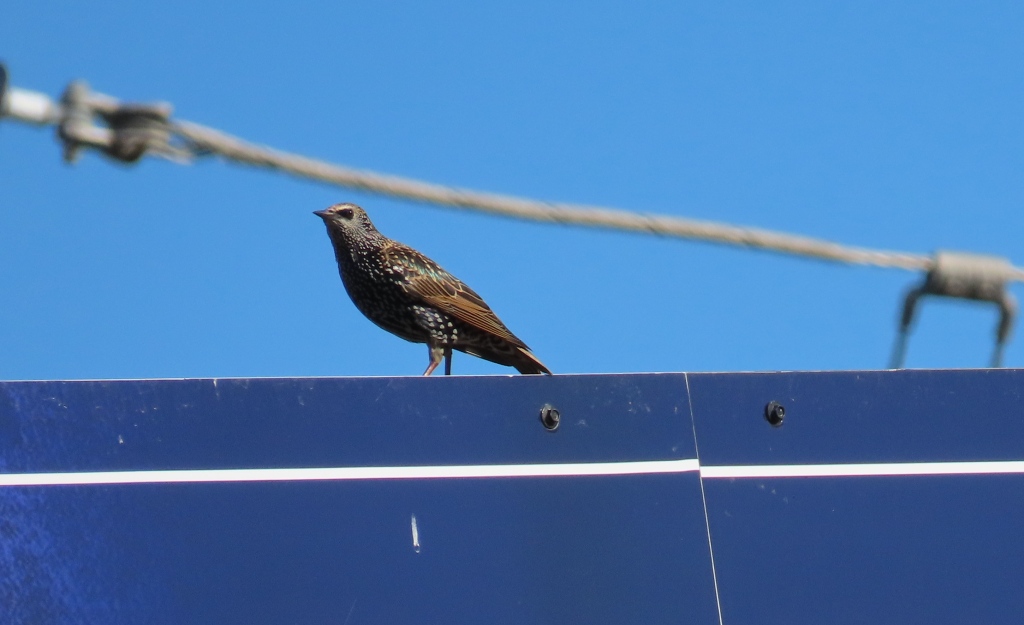
A couple of weeks ago I was passing through Bathurst, which is about three hours’ drive west of Sydney. On top of a very large advertising board were some colourful birds. The markings on their feathers reminded me of Little Wattlebirds, but the colours and demeanour of the birds were quite different:
Here’s another of the birds:
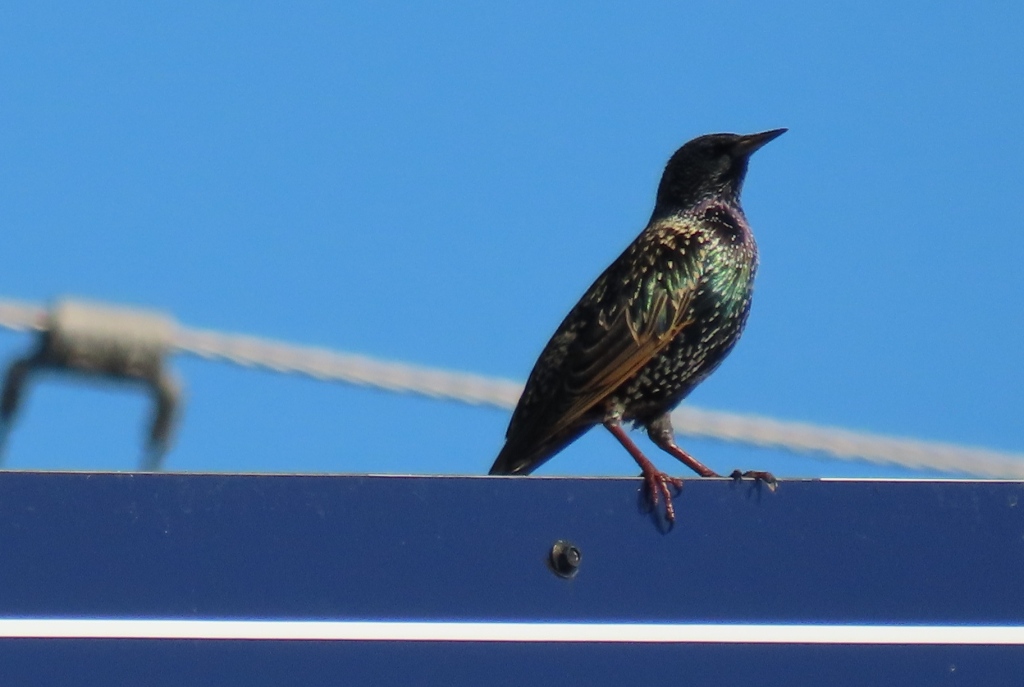
After some research, I’ve concluded that these are Common Starlings. These birds were introduced into Australia in the second half of the 19th century. They’re now widespread across the south eastern areas. They don’t go too far north of Brisbane, because the climate up there doesn’t suit them. And Western Australia has managed largely to keep these birds out.
Common name: Common Starling
Scientific name: Sturnus vulgaris
Length: 20-21 cm
Date spotted: 13 April 2024 (autumn)
Location: Maffu Parking Lot, Bathurst, New South Wales, Australia: 33°23’43.3″S 149°35’40.8″E

Plant Hopper on my window
(Not a bird, but probably of interest to birds as well as birders.)
A couple of days ago, this tiny little creature appeared on my window pane:

The creature is tiny (a few millimetres long), it’s on the inside of the window pane but on the other side of a gauze netting that we use to keep the insects out, and it’s in silhouette because of the light coming in from the outside. I was pleased that my mobile phone’s camera managed to get any shot at all.
After a bit of research, I think the creature is most likely a Plant Hopper — my best bet: the Passionvine Hopper, Scolypopa australis. Alternatively, it could be a Leaf Hopper.
The creature moves in a strange way. It’s wings remain entirely still, and the whole creature kind of glides across the surface:
It’s odd how the wings appear to be transparent ovals, with what looks like other wing patterns imprinted on them. At one point, the creature made a short, very quick jump from one spot to another — so quick that I didn’t see the movement. I just saw that it had gone from one place and appeared a few inches away. I didn’t catch that movement on video.
This shorter video shows the creature moving more slowly:
If you have a positive identification or know more about this little insect, I’d love to hear it.

My first Wedge-tailed Eagle
I was super excited to see my first Wedge-tailed Eagle a few days ago. This is Australia’s largest bird of prey, measuring about 1 metre from head to tail and with a wingspan of 1.8 to 2.5 metres. The females weigh up to 4.2 kilograms, while the male is smaller and weighs up to 3.2 kg.

We were camping at Mary Flynn Reserve on the Bridle Track in NSW, Australia. This bird was high up over the hills above a Turon River valley. Evidently these eagles can fly as high as 2 kilometres above the ground.
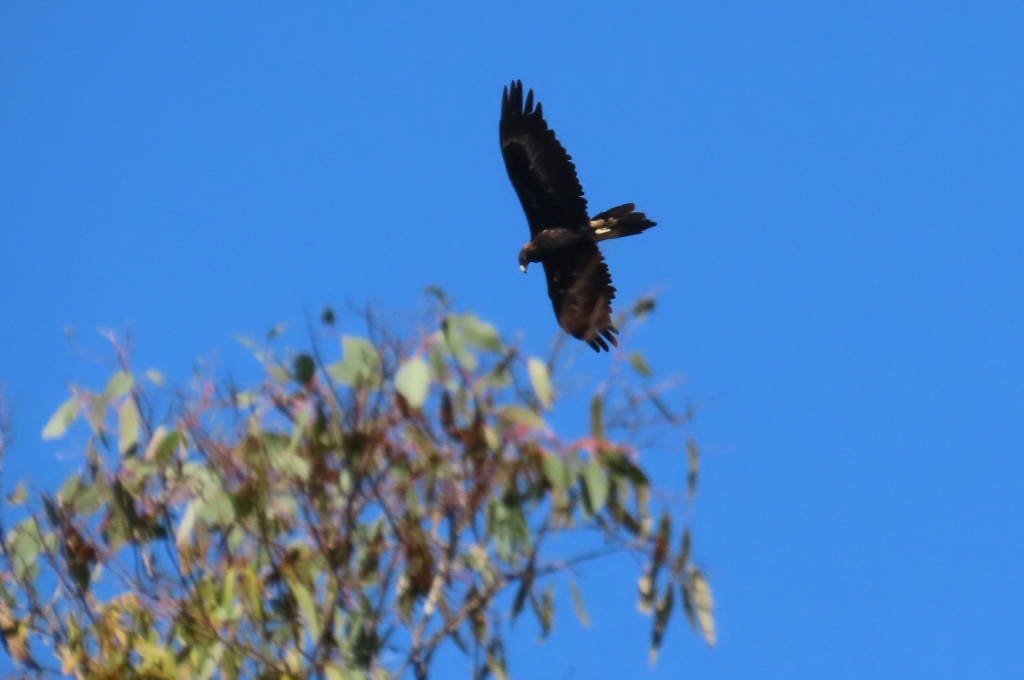
I was struck by the long, widely-separated wing feathers, and the ease with which the bird was gliding. At times it soared high, at others it dipped down to the tree tops, which from my perspective were still high on the hills above the valley.

These photos are all of the same bird at the same time of day. Later in the day, I saw another bird (or maybe the same one) taking off from a hillside. It was interesting to see the slow, heavy flaps of the wings that the bird needed to become airborne.
Here’s my final picture of the bird:
Common name: Wedge-tailed Eagle
Scientific name: Aquila audax
Approximate length: 0.9-1.1 m; wing span 1.8-2.5 m
Date spotted: 13 April 2024 (autumn)
Location: Mary Flynn Reserve, Bridle Track, New South Wales, Australia: 33°04’51.0″S 149°23’57.6″E

Bad hair day and goofy look from this Kookaburra
Yesterday I encountered a Kookaburra. It sat still on a branch, as they do, letting me take copious photos, as they do. (Why don’t other birds take a leaf out of a Kookaburra’s book?) Here’s the bird in half profile, looking cute and kind of noble:

However, the other profile gives a different impression. A twig is tangled in the feathers on the Kookie’s head. Bad hair day?

Here’s a shot of that goofy look they have when they gaze right at you:

Common name: Laughing Kookaburra
Scientific name: Dacelo novaeguineae
Approximate length: 47 cm
Date spotted: 8 April 2024 (autumn)
Location: Manly Dam park, New South Wales, Australia: 33°46’52.4″S 151°15’08.3″E

Little Wattlebird bathing in the tree tops
A Little Wattlebird, high in the gum trees, dives through the leaves. I’ve seen birds doing this a few times. They’re taking advantage of the early-morning dew to freshen up their feathers.
Here’s a still photo of the Little Wattlebird:

Common name: Little Wattlebird
Scientific name: Anthochaera chrysoptera
Approximate length: 30 cm
Date spotted: 1 April 2024 (autumn)
Location: Manly Dam Park, New South Wales, Australia: 33°46’39.6″S 151°14’55.7″E

So cute! Juvenile Red-browed Finches
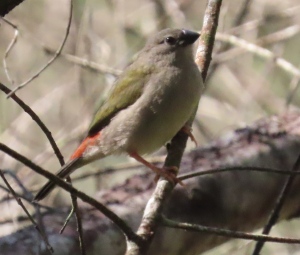
I was wandering around a new area of the bush, to the west of Sydney near the Blue Mountains, when I saw a couple of little birds that I couldn’t at first identify:
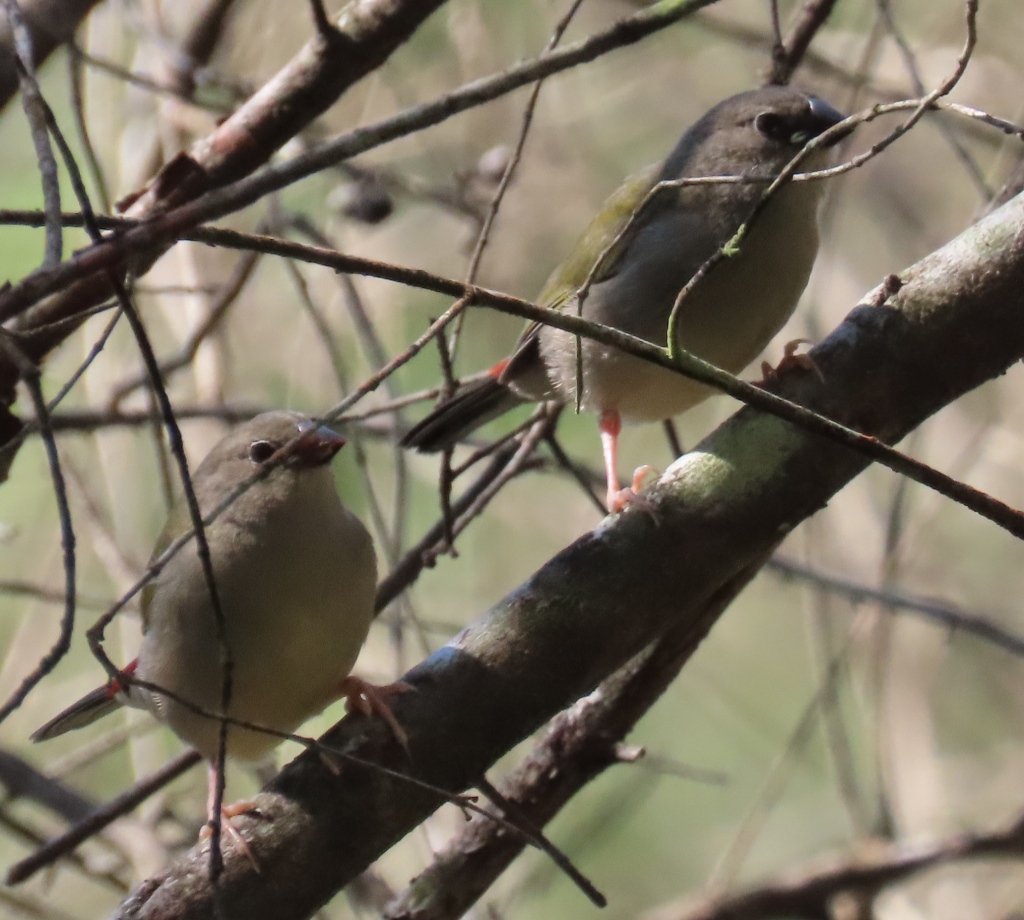
From the red in their tails, I thought they might be Red-browed Finches, but they didn’t have the characteristic red stripes above their eyes.
Then I saw an adult with them:
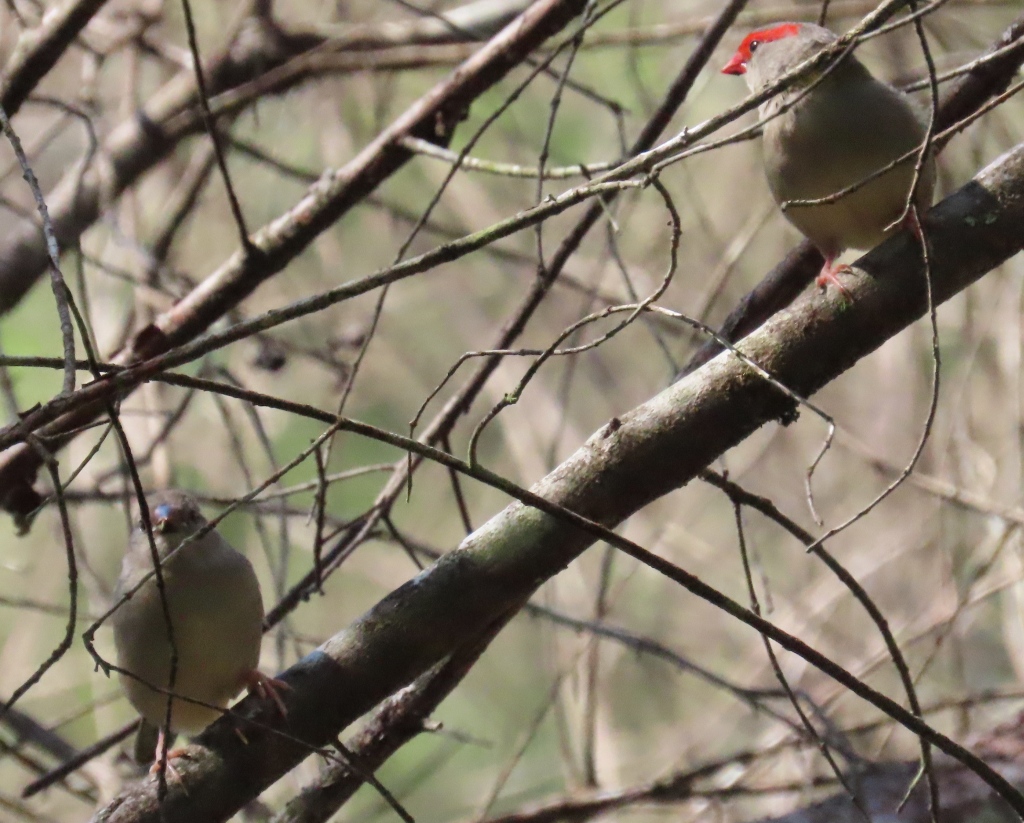
They were juveniles, yet to develop the red brows.
Common name: Red-browed Finch
Scientific name: Neochmia temporalis
Approximate length: 12 cm
Date spotted: 30 March 2024 (summer)
Location: Bulcamatta Falls Track, The Devils Wilderness, NSW, Australia: 33°33’19.4″S 150°36’04.8″E

Colourful Oriole singing
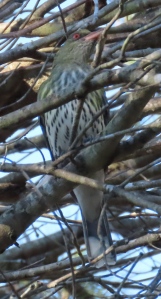
The colours on this Olive-backed Oriole are gorgeous: bright red eyes, olive green neck and shoulders, white underbelly with black stripes. The bird was uttering its typical ringing call, interspersed with the sounds of other birds that it was mimicking. The music in the background is from some nearby picnickers.
The sound that first drew me to look for this bird was the call of a Black-faced Cuckoo-shrike. Instead, I found an Olive-backed Oriole mimicking the call! (I didn’t catch that particular sound in the video, alas.)
The bird was on a Casuarina tree, looking for insects among the seed pods. Here’s a still photo:
Common name: Olive-backed Oriole
Scientific name: Oriolus sagittatus
Approximate length: 25-28 cm
Date spotted: 25 March 2024 (summer)
Location: Manly Dam Park, New South Wales, Australia: 33°46’52.3″S 151°15’07.9″E

Birds galore at Long Reef Aquatic Reserve, Collaroy
Last week I spent a couple of hours at Long Reef Aquatic Reserve in Collaroy, NSW. I was there just for a walk with my partner, but I was delighted at the number and variety of birds we encountered.
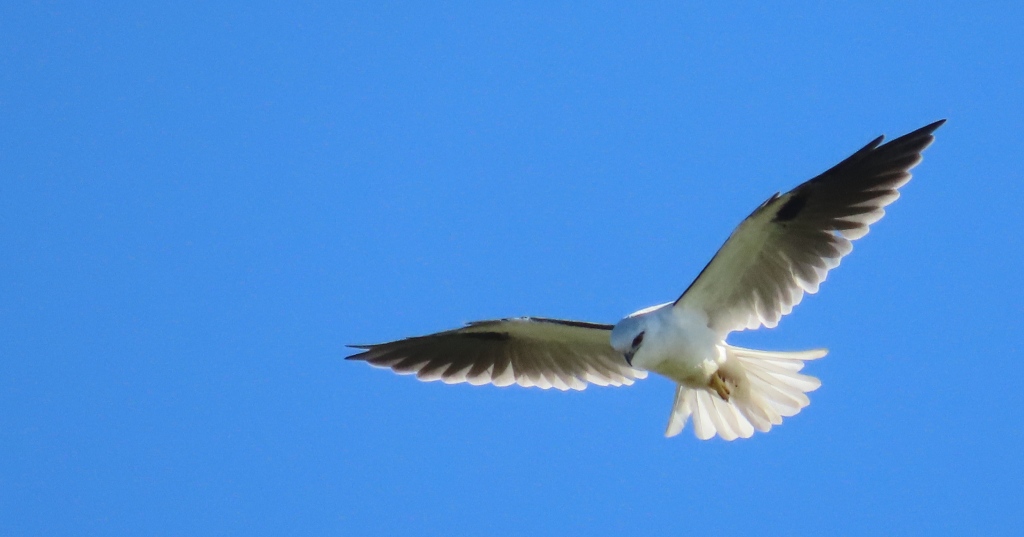
First up were two raptors, a real treat to see. A Black-shouldered Kite (Elanus axillarus) hovered in the air, effortlessly riding the currents and looking out for prey:
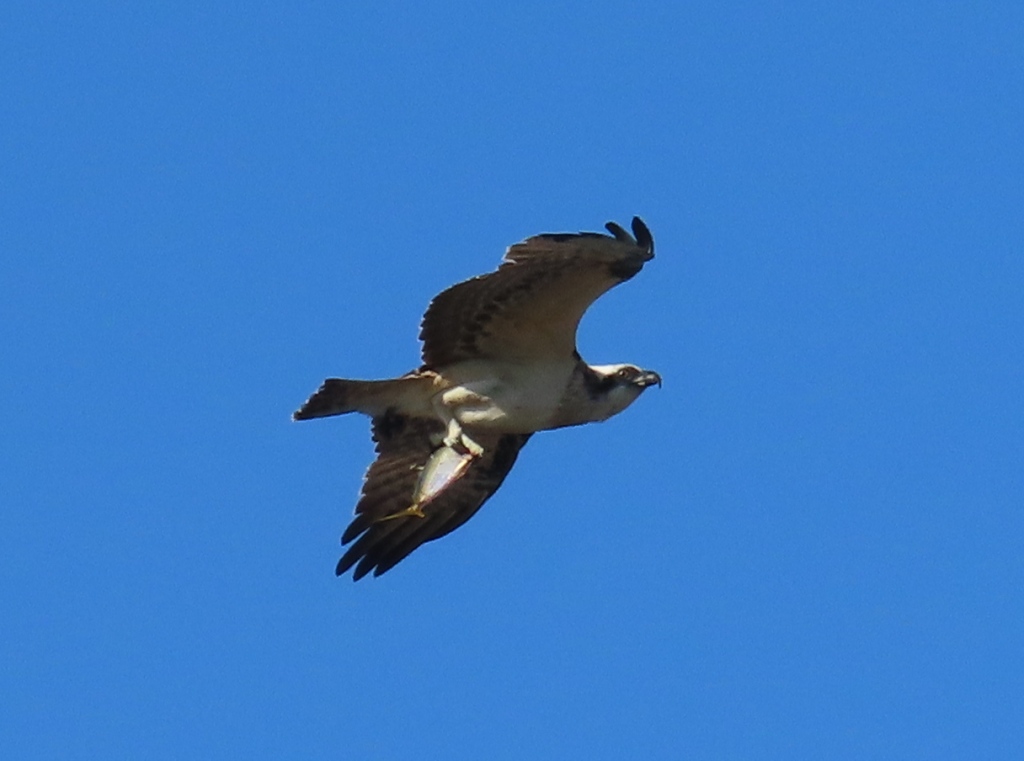
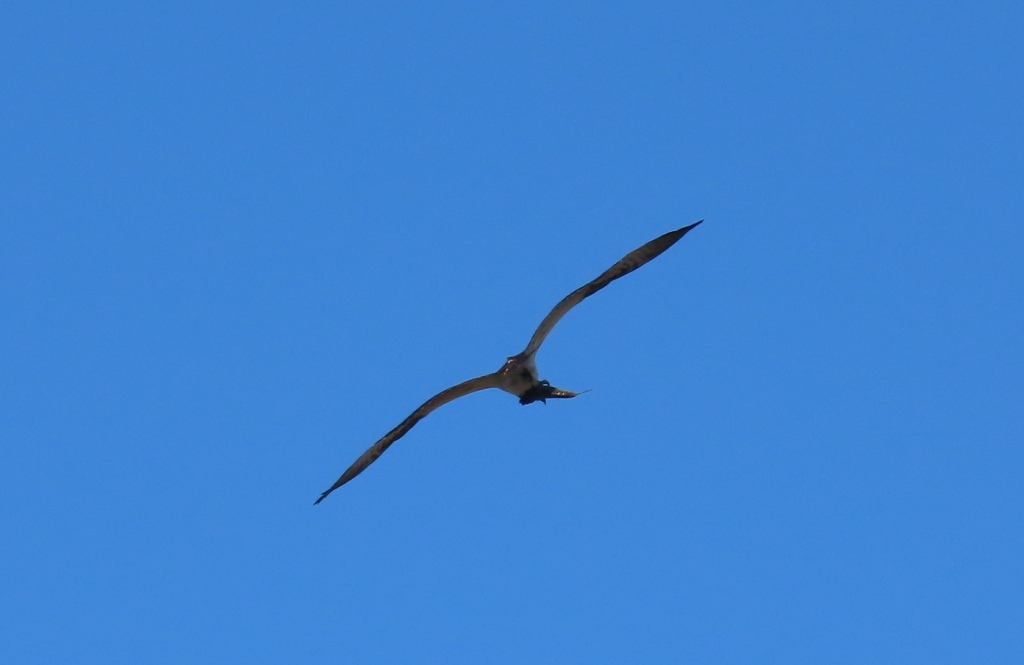
An Eastern Osprey (Pandion cristatus) soared in circles, grasping a half-eaten fish in its feet:
I’ve written a separate post about these two birds, a third raptor, and some paragliders who shared the air currents with the kite: Three raptors in one day.
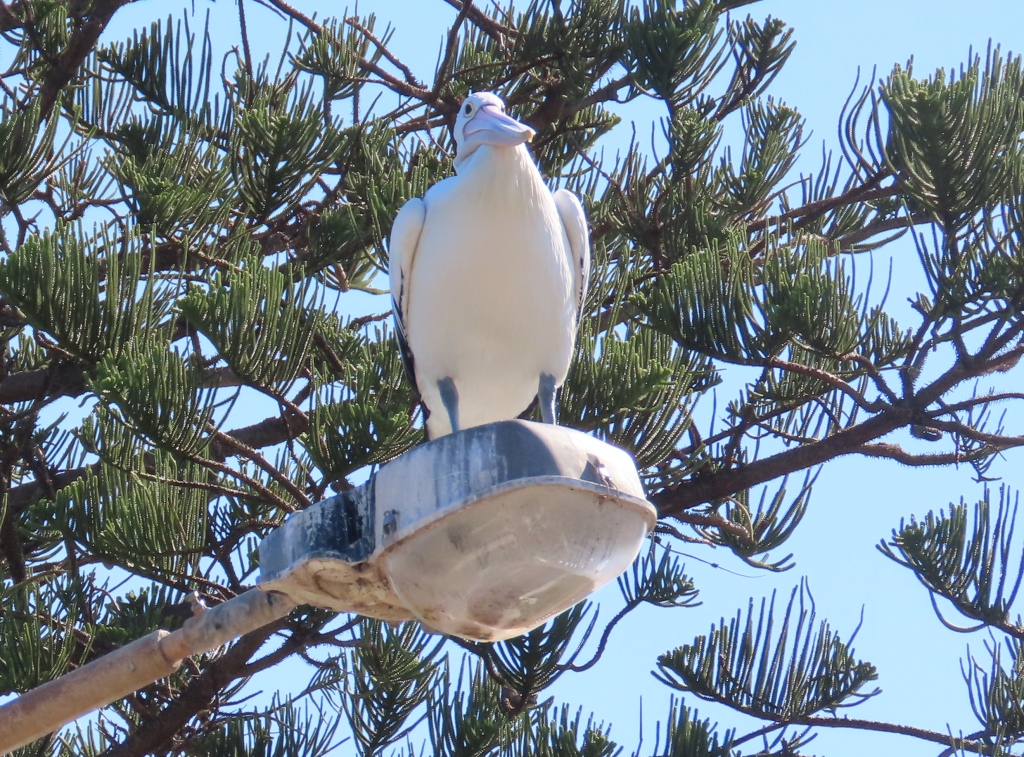
Huge Pelicans (Pelecanus conspicillatus) perched on the lampposts and glided above my head. Here’s one of them, looking sad and wise:
Another post has more pictures of these magnificent birds: Three pelicans on a lamppost.
A female Darter (Anhinga melanogaster) sat on a metal structure above the beach, surveying all the action with a cautious eye:

Silver Gulls (Larus novaehollandiae) wheeled around the fishermen at the edge of the rock plate:

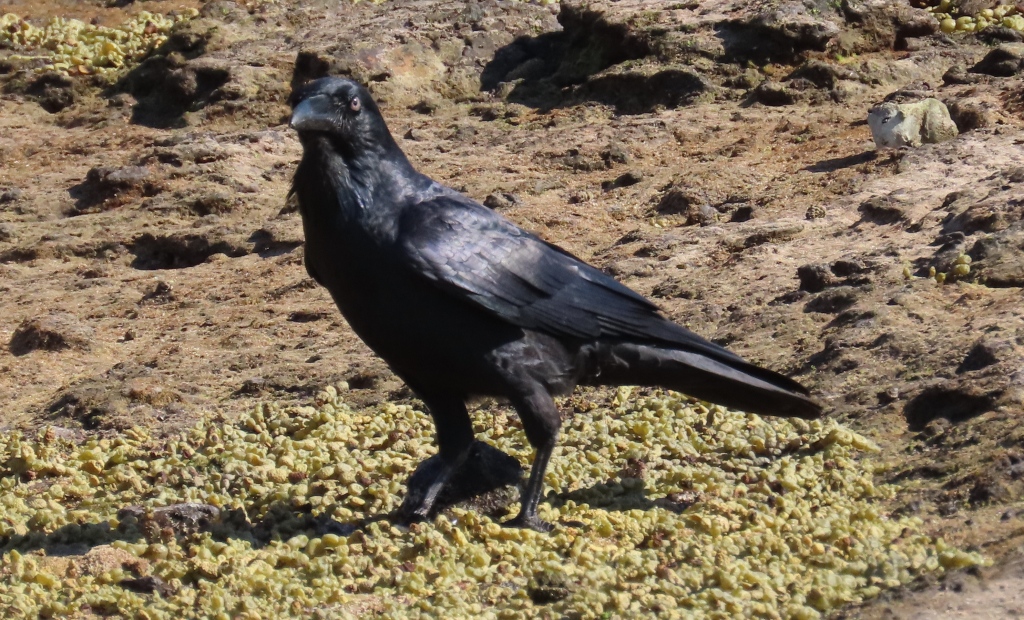
Australian Ravens (Corvus coronoides) picked through the stranded seaweed in search of a snack:

Here’s a close-up of one of the ravens:
Fish skulked in a nearby rock pool:

A crab came out from under a rock, ready to dash back in at the slightest sign of danger:

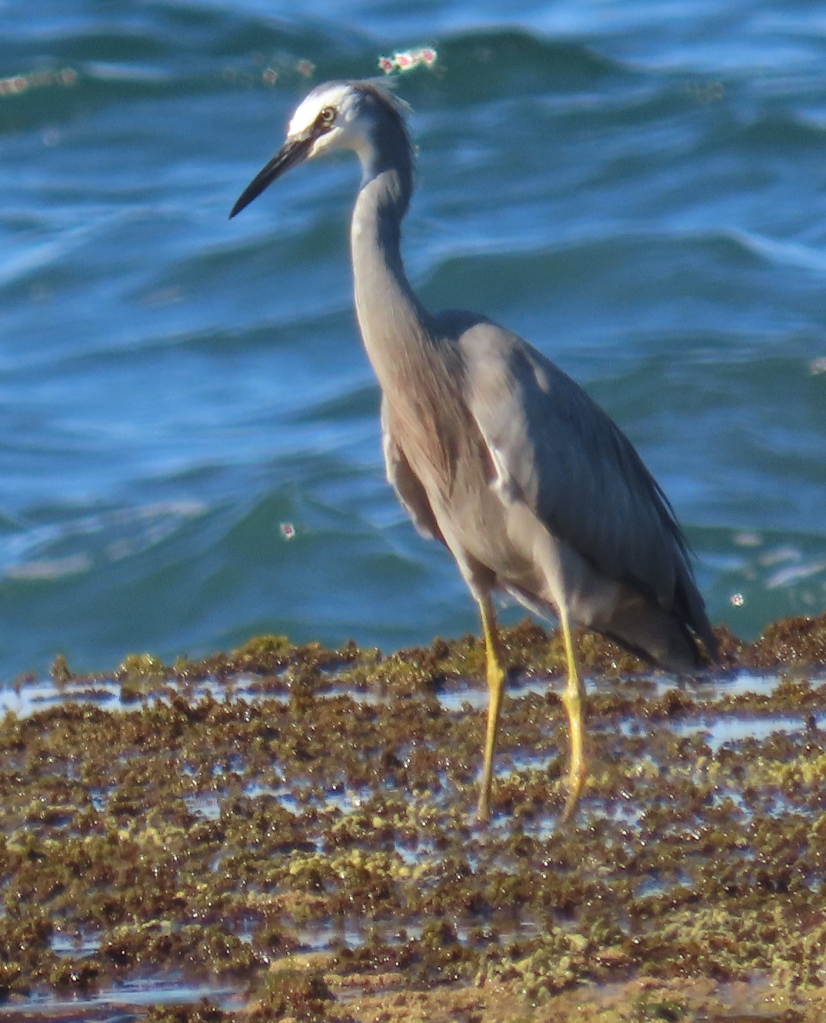
A White-faced Heron (Ardea novaehollandiae) patrolled the border between land and sea:
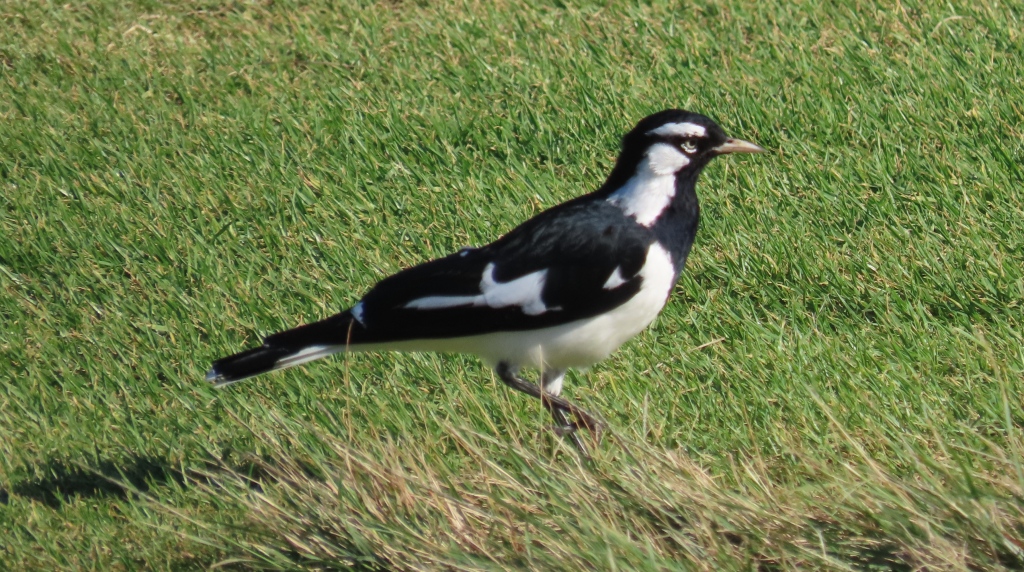
On the grassy headland above the beach, a Magpie-lark (Grallina cyanoleuca) owned the land. These birds are also called Peewees, because of the loud shrill call (peeee-wheee) that they make whenever a person or anything else comes too close:
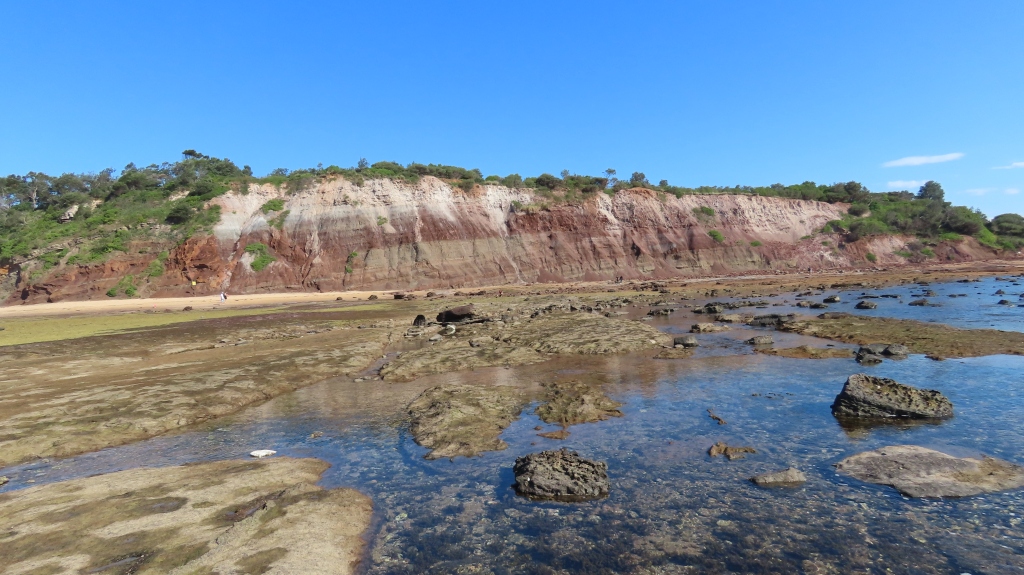
To close off with, here are a couple of shots showing the colours and serenity of the Long Reef Aquatic Reserve that afternoon. First, looking from the rock plate towards the land:
Then looking out to sea:


Three pelicans on a lamppost
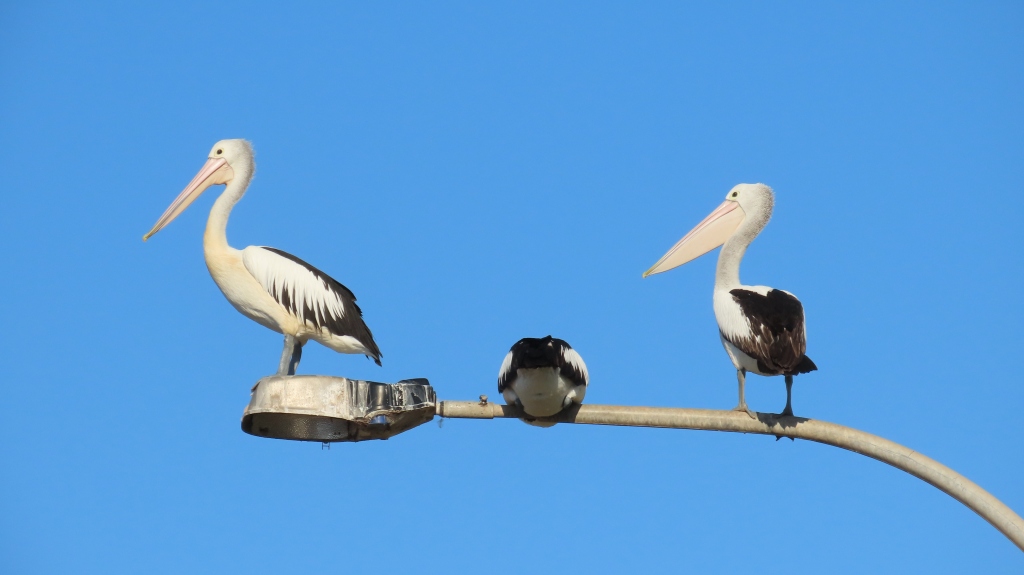
Pelicans are very large and weighty birds: 1.7 metres from head to tail, weighing up to 13 kilograms. So, not a bird that you’d expect to see perched on a street lamp. The idea of three of them perched on the same lamp at the same time sounds unlikely, if not bizarre.
Yet, when I arrived at Long Reef Aquatic Reserve in Collaroy, I was greeted by this sight:

No wonder the street lamps are of sturdy construction!
What a face! A little glum, a little world-weary, but so wise:
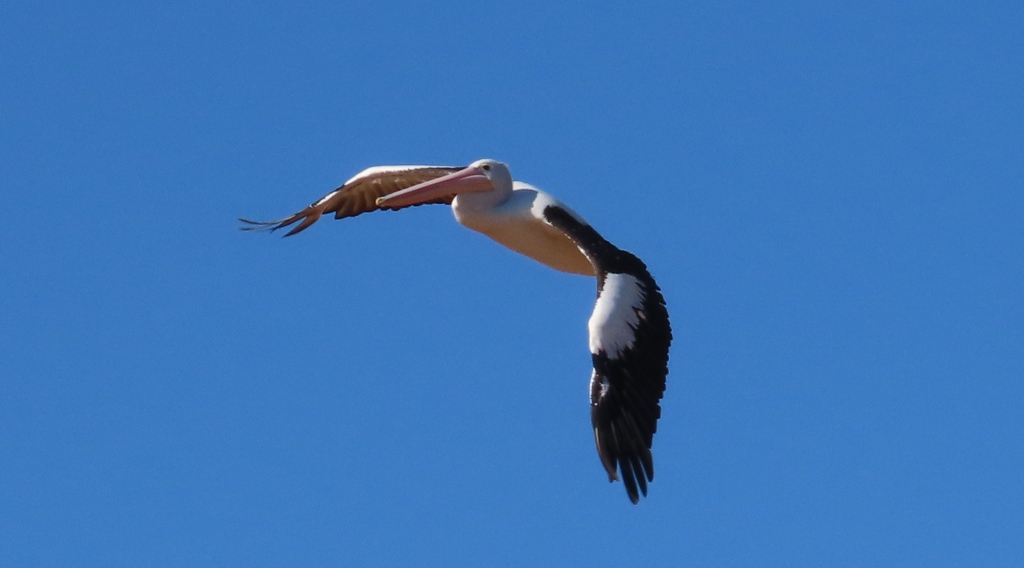
When flying, a pelican is graceful and beautiful. Even so, it reminds me of an armchair in the sky:
Three Australian Pelicans head off towards the ocean, with a White-faced Heron in the distance:

Common name: Australian Pelican
Scientific name: Pelecanus conspicillatus
Approximate length: 170 cm
Approximate wingspan: 2.5m
Date spotted: 24 March 2024 (summer)
Location: Long Reef Aquatic Reserve, Collaroy, New South Wales, Australia: 33°44’19.7″S 151°18’42.0″E

Three raptors in one day
A few days ago, I was super lucky: I saw three birds of prey in one afternoon. The first was an Eastern Osprey, holding a fish in its claws. The second was a Black-shouldered Kite, hovering above the grasslands near the beach. For a short time, there were two of these birds quite close to each other. The third was a Peregrine Falcon, soaring in the sky above the suburbs.
Eastern Osprey
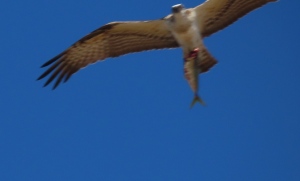
The Eastern Osprey was exciting to see. It was quite large, flying high in the sky above Long Reef Aquatic Reserve in Collaroy. At first I thought this large bird was one of the pelicans that were floating about. When I saw it through my camera lens, I spotted the fish in the bird’s grip.
The next picture is fuzzy and only a partial shot of the bird, but it gives a good idea of the colouring of the underside:
The next picture shows the Osprey’s long wingspan — about 1.5 metres. The bird is flying away from the camera:
Common name: Eastern Osprey
Scientific name: Pandion cristatus
Approximate length: 57 cm
Date spotted: 24 March 2024 (summer)
Location: Long Reef Aquatic Reserve, Collaroy, New South Wales, Australia: 33°44’19.7″S 151°18’42.0″E
Black-shouldered Kite
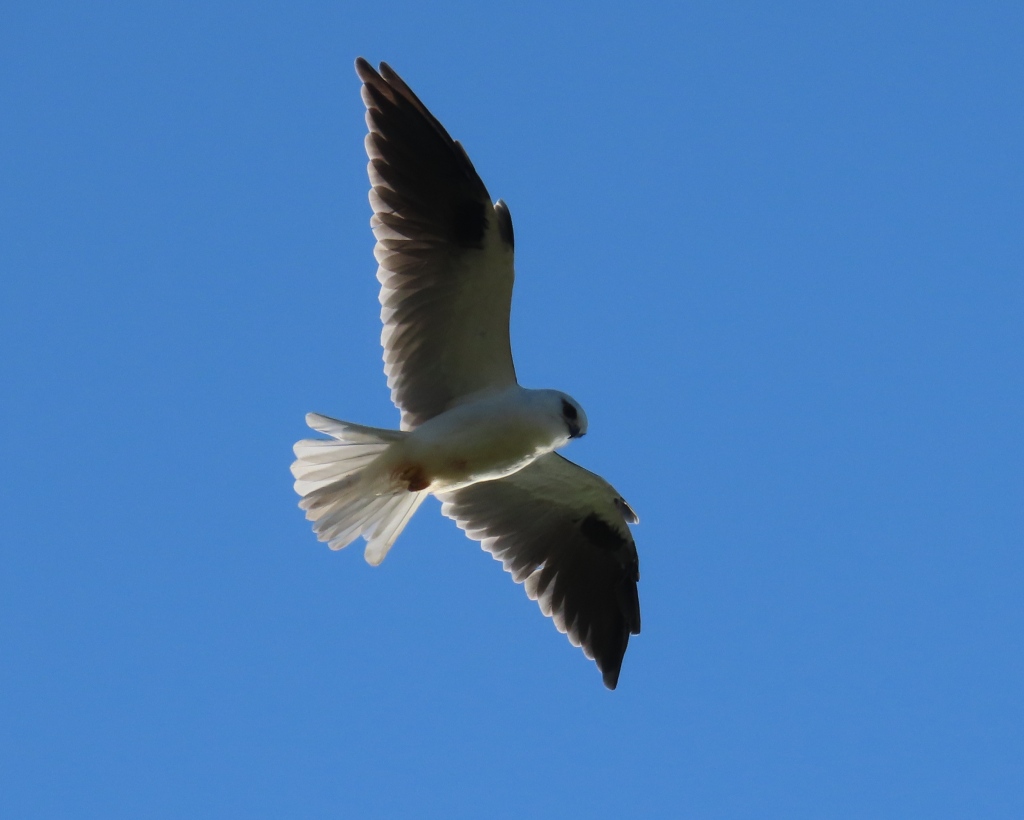
Nearby, a Black-shouldered Kite hovered above the grassy, bushy stretch that runs along the coast. It was amazing how the bird hung almost motionless in the air, held aloft by the air currents:
The next photo shows a slightly different angle. It might be the same bird or a different one, as there were two in the area:
Also in the area were some paragliders, enjoying the same up currents as the birds. The gliders kept a respectful distance, and the birds didn’t seem worried at all, as you can see in the next video. The second Black-shouldered Kite makes a brief appearance part-way through:
Common name: Black-shouldered Kite
Scientific name: Elanus axillarus
Approximate length: 35 cm
Date spotted: 24 March 2024 (summer)
Location: Long Reef Aquatic Reserve, Collaroy, New South Wales, Australia: 33°44’19.7″S 151°18’42.0″E
Peregrine Falcon
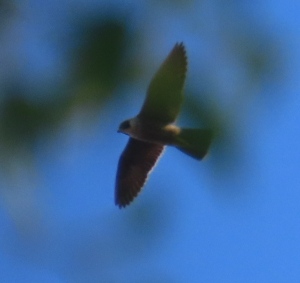
On my way home, I saw a Peregrine Falcon soaring high in the sky. As I took the photo, the bird turned its head and looked down at me:

The images are fuzzy because my camera isn’t super powerful, but you can still make out the features of the Peregrine Falcon:
Common name: Peregrine Falcon
Scientific name: Falco Peregrinus
Approximate length: 42 cm
Date spotted: 24 March 2024 (summer)
Location: Allambie Heights, New South Wales, Australia: 33°46’18.2″S 151°15’39.4″E
It’s not often that I see one of Australia’s birds of prey. To see three different types in one day was a raretreat.


 Sydney Birder