Blog Archives

Galahs have pink or dark eyes
What a setting for this gorgeous Galah! She looks dozy and very floofy, framed by the blue blue Outback sky:
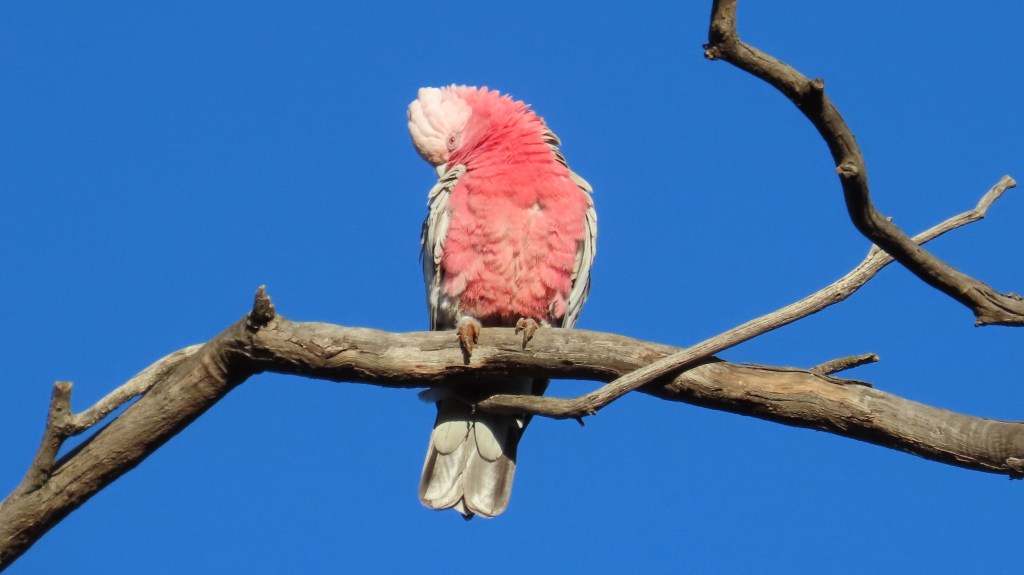
Male and female Galahs are very similar. The easiest way to tell a female from a male is that the females have pink eyes, like the one in my photo, whereas the males have dark eyes. (You can see the difference in this post, which has both male and female birds.)
Common name: Galah
Scientific name: Cacatua roseicapilla
Approximate length: 35-38 cm
Date spotted: 11 September 2026 (spring)
Location: Bendleby Ranges in the Flinders Ranges, South Australia: 32°21’13.7″S 138°47’34.8″E

Yellow Crimson Rosella at Wagga Wagga
At first, when the Merlin Bird app identified this bird as a Crimson Rosella, I thought, “Pfff! That’s not a Crimson Rosella!” But a bit of research revealed that there’s a yellow morph of the so-called Crimson Rosella and this bird is it:
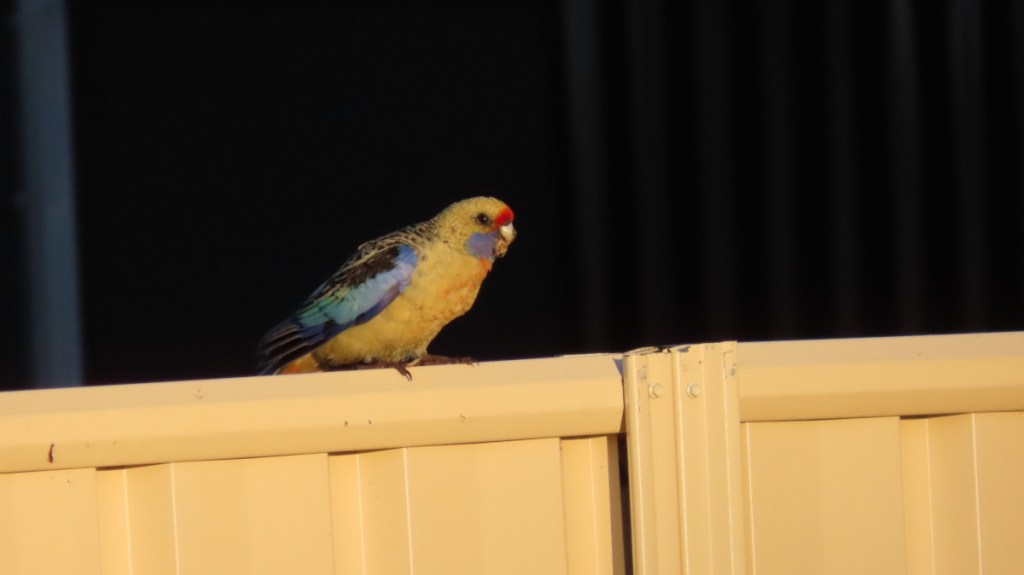
In my usual birdwatching area, on the east coast of Australia near Sydney, the Crimson Rosellas are really crimson. Their feathers are mostly deep red, with a blue shoulder patch, a blue and white tail, and a black back with crimson scalloping. The yellow morph is mostly yellow, with a blue shoulder patch and tail, and a red band above the beak. The back is black with yellow scalloping.
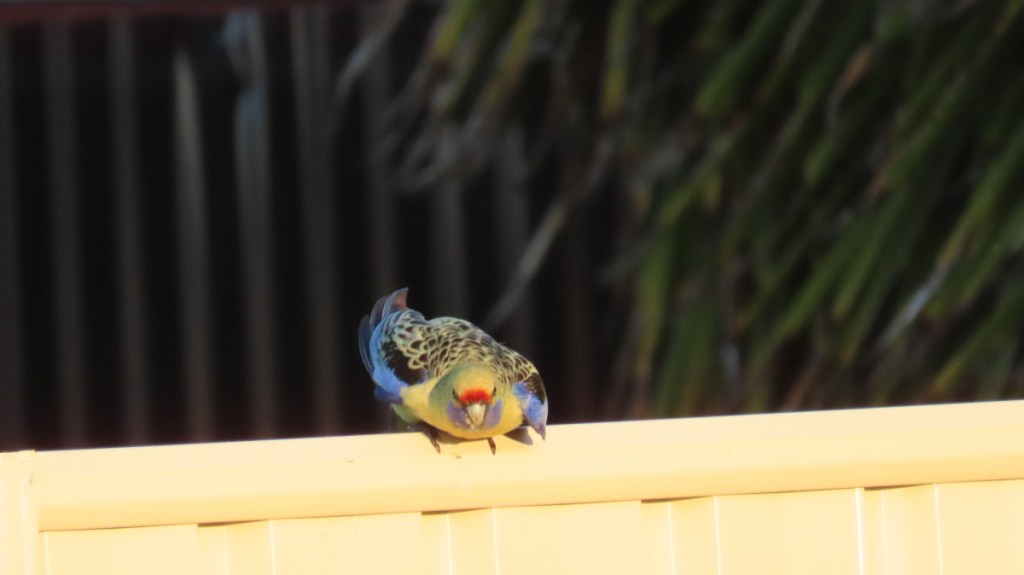
Here’s the same bird, about to launch into flight:
Common name: Crimson Rosella (Yellow)
Scientific name: Platycercus elegans
Approximate length: 35 cm
Date spotted: 5 September 2026 (spring)
Location: Wagga Wagga, NSW, Australia: 35°09’14.5″S 147°28’44.4″E

Red-rumped Parrots, male and female
Red-rumped Parrots are pretty little birds. Their colours are a shimmering mix of blue, green, and yellow. So, why the name “red-rumped”? If you manage to see the male bird at the right angle, you’ll spot a patch of red between his wings, above his tail.
We don’t see Red-rumped Parrots in my area, on Australia’s east coast just north of Sydney. I saw these birds while on a recent trip westwards. Both sightings were on the Barrier Highway, a 1000-kilometre road that leads west from Nyngan to Broken Hill and beyond.
The first two were feeding on the grass at a rest stop between Wilcannia and Cobar. Here’s the female, followed by the male:


The second pair were at Nyngan Riverside Tourist Park, located in the town of Nyngan at the eastern end of the Barrier Highway.


Common name: Red-rumped Parrot
Scientific name: Psephotus haematonotus
Approximate length: 26-28 cm
Date spotted: 22 July 2026 (winter)
Location: Barrier Highway and Nyngan, New South Wales, Australia: 31°33’33.1″S 147°10’51.7″E

Australian Ringneck parrot at Wilpena Pound
During a recent trip out west of Sydney, I spent a night at Wilpena Pound in the Flinders Ranges. Early the next morning, I went for a walk and spotted this lovely parrot sitting on a fence. It’s an Australian Ringneck.
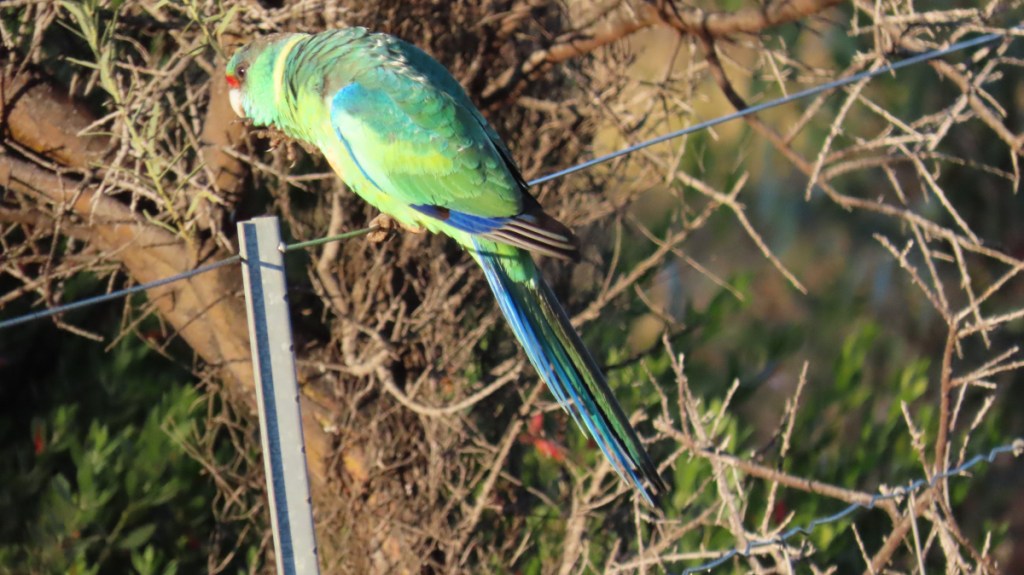
The name “ringneck” comes from the yellow collar on the back of the bird’s neck. This particular variety of Australian Ringneck is called a Mallee Ringneck. It has a green and blue head, whereas other races have a dark blue head. “Mallee” comes from an Australian aboriginal word meaning water, and is used to describe terrain covered in low-growing scrubby Eucalyptus trees.
Scientific name: Barnardius zonarius barnardi
Approximate length: 34-38 cm
Date spotted: 19 July 2026 (winter)
Location: Wilpena Pound, Flinders Ranges, South Australia: 31°31’36.5″S 138°36’11.6″E

Little Corellas are brown in Broken Hill
They’re not really brown. They just look that way because they spend time rolling in the outback mud and in tree hollows. This Little Corella is examining the architecture in Argent Street, Broken Hill:
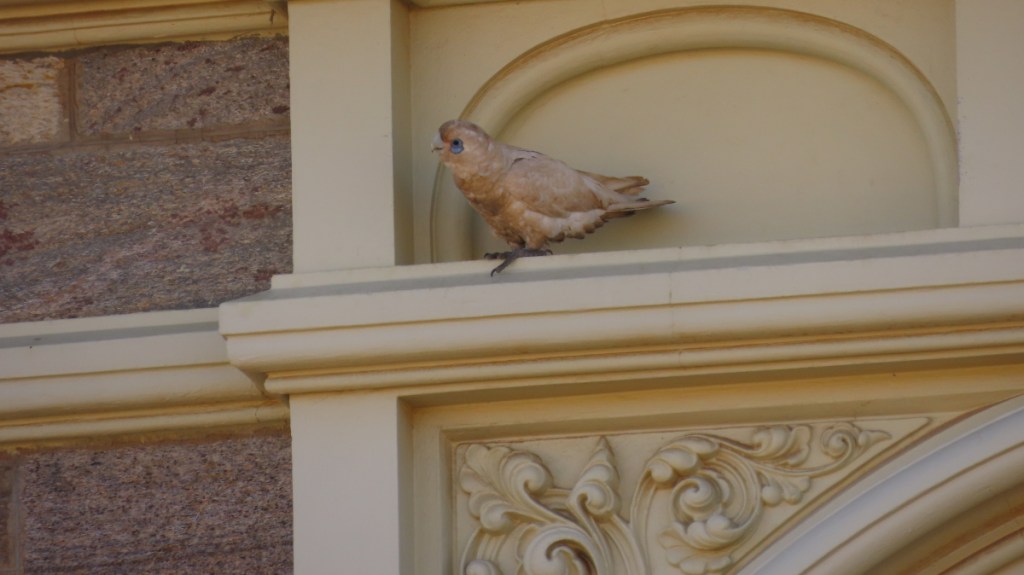
I haven’t seen such a soiled Corella before. The colouring brings out the blue around the bird’s eye. It does look rather dishevelled though!
Common name: Little Corella
Scientific name: Cacatua sanguinea
Approximate length: 36-39 cm
Date spotted: 21 July 2026 (winter)
Location: Broken Hill, NSW, Australia: 31°57’30.7″S 141°27’54.3″E
Local group of Glossy Black-Cockatoos now six strong!
Every now and then over the last few years, I’ve seen a group of Glossy Black-Cockatoos on the banks of Manly Dam. They have a few favourite spots, always where the Casuarina trees are in seed.
For the first couple of years, there were always three birds in the group. I don’t know if they were the same birds each time. Then suddenly there were five. And yesterday, for the first time, there were six. Glossies are rare compared to the other types of cockatoos in our area (Sulphur-crested, Yellow-tailed Black, and Corellas), so it’s wonderful to see this group growing in size.
Yesterday was a muggy, grey day. My camera kept misting up due to the high humidity. Every now and then the mist turned to light, drifting rain that settled into blotches on the lens. Still, the video gives you and idea of the gentle, calm presence of these large birds.
Glossies are a type of parrot. In Australia we have 56 species of parrots, including cockatoos, lorikeets, rosellas, ringnecks and budgerigars. Check out my previous sightings of Glossy Black-Cockatoos.
Common name: Glossy Black-Cockatoo
Scientific name: Calyptorhynchus lathami
Approximate length: 50cm
Date spotted: 19 March 2026 (autumn)
Location: Manly Dam Park, near Sydney: 33°46’23.8″S 151°14’39.5″E

Red-rumped Parrots in Merriwa and Denman
Recently, I spent a couple of days in the area around Denman and Merriwa, New South Wales. The bird life there is abundant, with some birds that we don’t see in my area (the eastern coast near Sydney). Among those are Red-rumped Parrots. This is my second sighting of these birds, and this week I was lucky enough to see three groups of them.
My first sighting was in Denman, in the early morning when the lighting was too dim for good photographs. I’ve posted just one photograph, because it’s my only shot of a female Red-rumped Parrot:

In Merriwa, the birds were busy in the middle of the day, when the lighting was much brighter. First, a video of a male bird foraging amongst the grass stalks:
Here’s a still photo of the same male bird:

Red-rumped Parrots get their name from the red patch on their backs, near the base of the tail. This photo shows the red rump nicely:
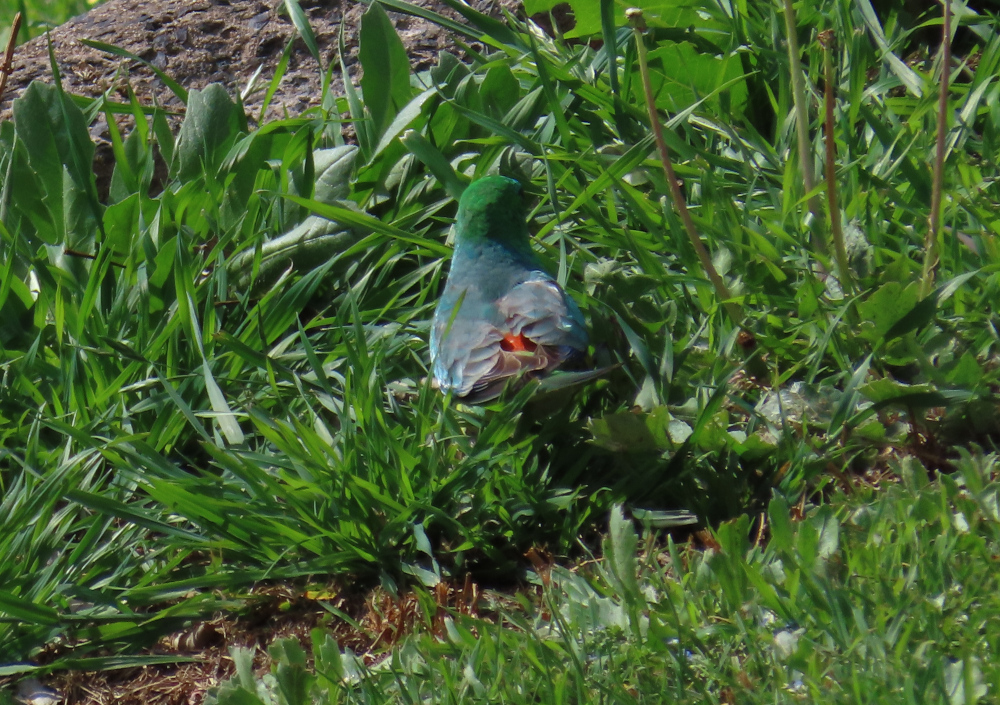
These little parrots are small and hard to spot when they’re on the ground. Often, all that you see is an eye looking at you:

Common name: Red-rumped Parrot
Scientific name: Psephotus haematonotus
Approximate length: 26-28 cm
Date spotted: 12 September 2025 (spring)
Location: Merriwa, New South Wales, Australia: 32°08’18.7″S 150°20’58.8″E

Wild cockatoos come up close for a chat
This morning, I was out for a walk in the bush near Sydney, Australia, when I spotted two Sulphur-crested Cockatoos on a bush overhanging the path. As I came along the path, I spoke softly to the birds, as I often do. It’s partly because they’re so friendly-looking (anthropomorphism, I know!) and partly in the hope that I won’t scare them unduly. Many birds seem to respond well to being spoken to.
When I was close, the two cockatoos glided down to join their mates on the bank of a creek just below. I crouched down to take some photos. After a couple of minutes, the group of birds fluttered up and joined me on my rocky outcrop. They were on the ground next to me, just a foot or so away. It was a lovely, though slightly daunting, experience.
In the video, you can hear some Grey Fantails and a Golden Whistler, as well as the cockatoos.
Here’s one of the cockatoos on the bush overhanging the path, before the bird dropped down to join the gang on the bank of the creek. It’s enjoying an Acacia seed pod:

Common name: Sulphur-crested Cockatoo
Scientific name: Cacatua galerita
Approximate length: 50 cm
Date spotted: 29 August 2025 (winter)
Location: Manly Dam Reserve, New South Wales, Australia: 33°46’50.9″S 151°14’52.3″E
Learning how to be a Yellow-tailed Black Cockatoo
Strolling along a path at Manly Dam, I came across a group of Yellow-tailed Black Cockatoos. It’s always a treat being with these birds. They’re the quiet giants of the cockatoos in south eastern Australia. They sit on Banksia trees or, in this case, Casuarinas, chewing the seeds and chuntering to each other. Occasionally, one of the birds floats up into the air and glides to another branch.
In the group were two juveniles, making that almost-constant crooning noise that characterises them. I think it’s partially a request for food, and partially a reminder to the adult birds of where the little ones have got too.
This youngster hasn’t quite figured out what to do with a Casuarina seed pod. He finds one on the ground, touches it to his beak, then drops it. Nearby, an adult shows him how it’s done:
A little later, the youngster has climbed into a tree. Instead of tackling those hard seed pods, though, he practices wielding his beak on the bark:
Common name: Yellow-tailed Black Cockatoo
Scientific name: Calyptorhynchus funereus or Zanda funereus
Length: 58-65 cm
Date spotted: 24 July 2025 (winter)
Location: Manly Dam Reserve, New South Wales, Australia: 33°46’42.5″S 151°14’59.1″E

Crimson Rosella looking gorgeous
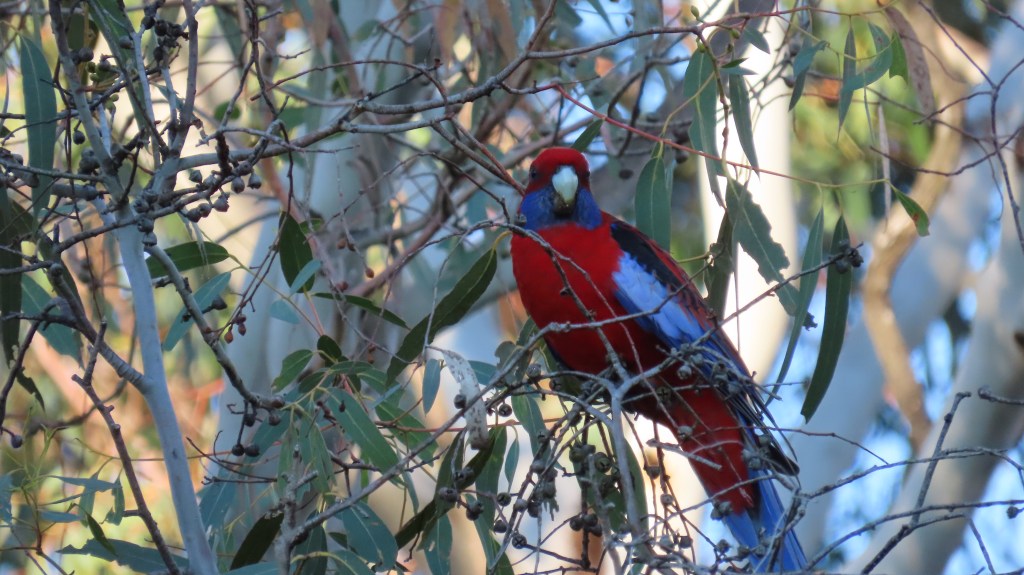
This stunning Crimson Rosella was browsing on the seeds of a gum tree late one afternoon. We were at the Macquarie Woods Forestry Reserve Campground, to the west of the Blue Mountains in New South Wales. These parrots are quite common in eastern Australia. Even so, their beauty is always amazing.
This bird is a male, with his purple and crimson colouring. The females have more green on their bodies and wings, like the one I saw a few months ago in Whitfield, Victoria.
Common name: Crimson Rosella
Scientific name: Platycercus elegans elegans
Approximate length: 35 cm
Date spotted: 16 May 2025 (autumn)
Location: Macquarie Woods Forestry Reserve Campground, Vittoria, NSW, Australia: 33°24’29.0″S 149°18’41.8″E


