Category Archives: Honeyeater

Call of the Singing Honeyeater
I spotted this Singing Honeyeater at Bendleby Ranges in the Flinders Ranges area of South Australia. It’s only my second sighting of a Singing Honeyeater, and the first time I managed to record its call. I believe that these birds make a variety of sounds, of which I’ve captured only one.
Singing Honeyeaters are found across most of Australia, except the eastern and northern coastal regions. This means that I don’t see them very often, as I live on the east coast.
Here’s a photo of the bird:
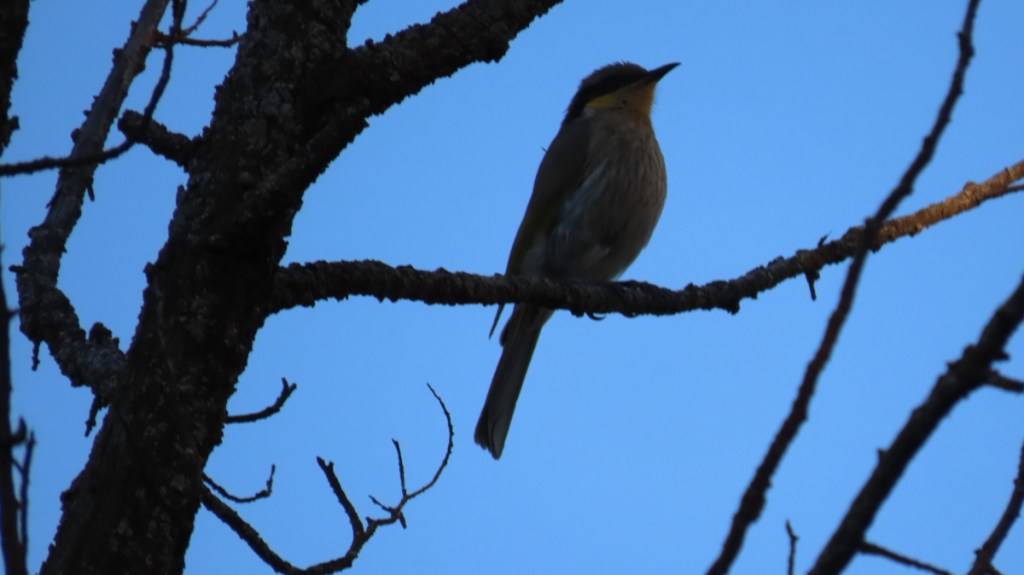
Apologies for the poor quality of the photo. If you’d like to see a better one, check out my first sighting of a Singing Honeyeater.
Common name: Singing Honeyeater
Scientific name: Lichenostomus virescens
Approximate length: 18-22 cm
Date spotted: 10 September 2026 (spring)
Location: Bendleby Ranges in the Flinders Ranges, South Australia: 32°21’13.7″S 138°47’34.8″E

White-plumed Honeyeater in Nyngan
This White-plumed Honeyeater looked at me curiously while I figured out what type of bird it was! The name “white-plumed” describes the strip of white between the bird’s head and shoulders:
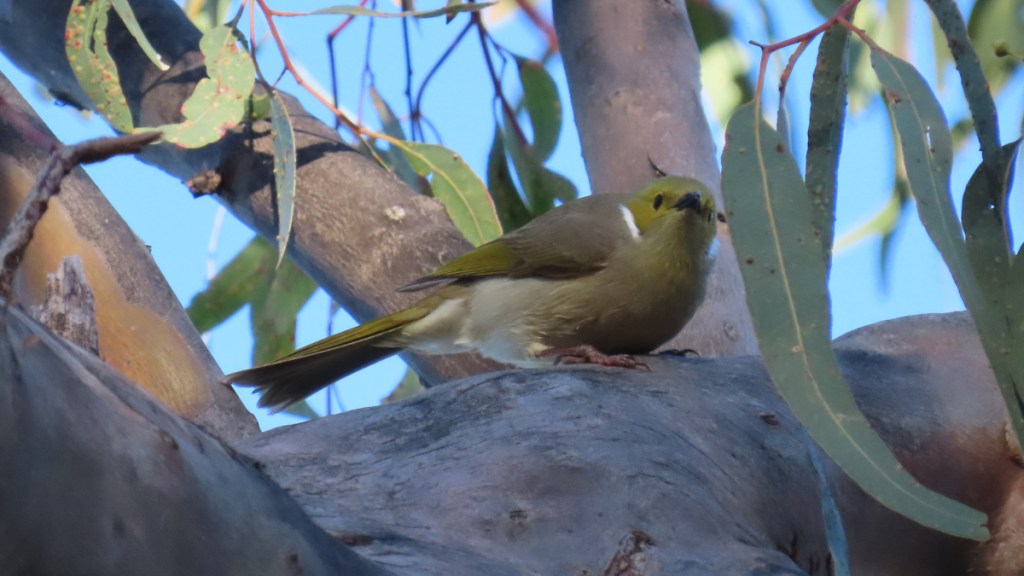
White-plumed Honeyeaters were reclassified in 2011, moving from Lichenostomus penicillatus to Ptilotula penicillata. The reason was that these birds, along with a few other types of honeyeaters, shared a different ancestor from others in the Lichenostomus group.
Common name: White-plumed Honeyeater
Scientific name: Ptilotula penicillata, formerly Lichenostomus penicillatus
Approximate length: 15-17 cm
Date spotted: 22 July 2026 (winter)
Location: Nyngan Riverside Tourist Park, New South Wales, Australia: 31°33’33.1″S 147°10’51.7″E

Singing Honeyeater unusually ruffled
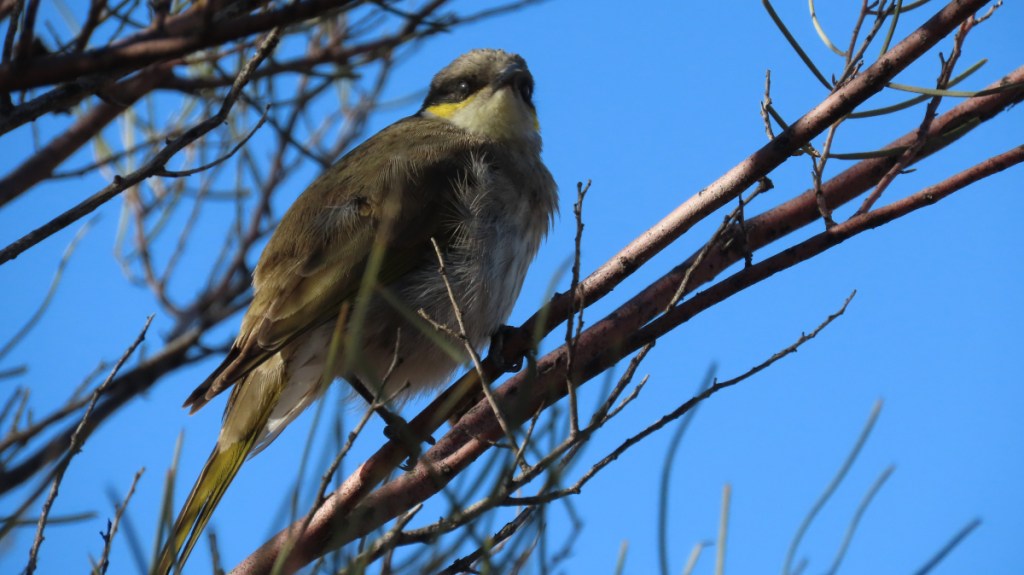
This is my first sighting of a Singing Honeyeater. According to my bird book, they’re abundant and widespread, but not on the east coast of Australia where I live.
Australia has many species of Honeyeater. So many that I wonder if I should split up the category of Honeyeater on this blog, to make them easier to find. My bird book lists 56 species under “Honeyeater” and there are more, like the Miners which are listed separately.
Most of the Honeyeaters that I see look suave and confident. This particular Singing Honeyeater, though, looks as if it’s awakening from a bad night. Or maybe it’s going for a raptor look:
Common name: Singing Honeyeater
Scientific name: Lichenostomus virescens
Approximate length: 18-22 cm
Date spotted: 21 July 2026 (winter)
Location: Living Desert State Park near Broken Hill, NSW, Australia: 31°54’03.2″S 141°26’23.1″E

Spiny-cheeked Honeyeater near Broken Hill
I’ve been out west of Sydney, in western New South Wales and South Australia. I’ll be posting a few birds that I spotted along the way!
Just outside the Living Desert State Park near Broken Hill, the melodious whistles of some Spiny-cheeked Honeyeaters carried above the chirrups of other birds.

This photo shows the bird’s characteristic pink bill and gape, with a black tip on the bill. Its front is mottled cream and grey with a yellow blush on the chest.
I’ve seen these birds on a previous trip out west, near Mungo Lake, where I managed to get a recording of the birds’ song: Evocative call of the Spiny-cheeked Honeyeater.
Common name: Spiny-cheeked Honeyeater
Scientific name: Acanthagenys rufogularis
Approximate length: 23-26 cm
Date spotted: 21 July 2026 (winter)
Location: Outside the Living Desert State Park near Broken Hill, NSW, Australia: 31°53’12.1″S 141°25’20.5″E

Brown Honeyeater in Brisbane
I’m in Brisbane for a few days. Early yesterday, I went for a walk along the banks of the Brisbane River. A Brown Honeyeater perched for long enough for me to get a picture. It’s a small, neat bird, with a curved beak and buff-coloured front. The wings and back are olive to brown, with yellow on the wing edges. I think the most striking feature is the dark stripe around the eye, with a yellow touch behind the eye when the light catches it just right.
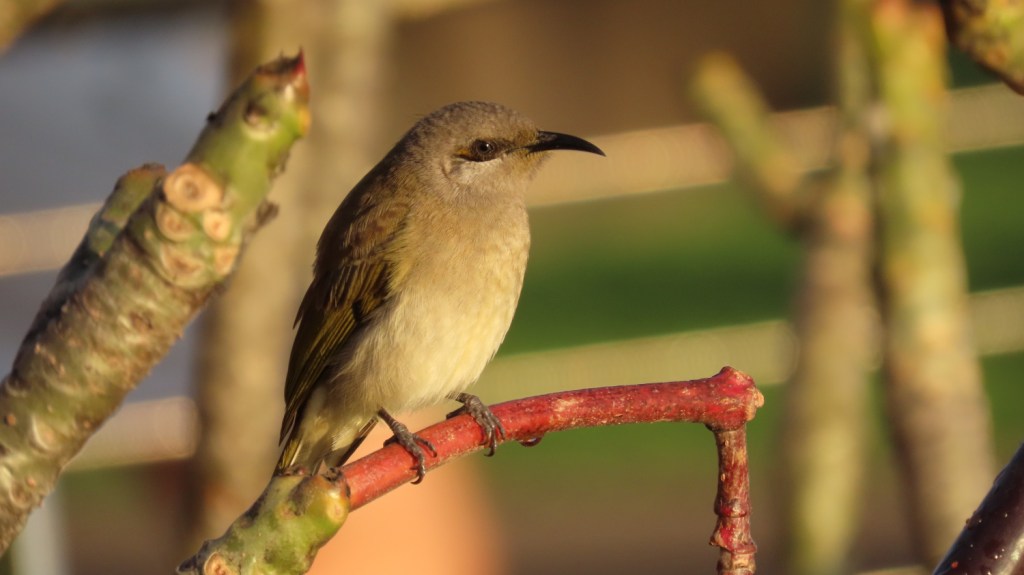
This is only the second time I’ve spotted a Brown Honeyeater, although they’re quite common. The first one that I saw was also in Queensland, at the botanical gardens in Maleny.
Common name: Brown Honeyeater
Scientific name: Lichmera indistincta
Length: 12-16 cm
Date spotted: 27 June 2025 (winter)
Location: Brisbane River, New Farm, Brisbane, Australia: 27°27’55.3″S 153°03’09.6″E
Tongue of the White-cheeked Honeyeater
A White-cheeked Honeyeater feeds off the flower of a Banksia bush. At 19 to 24 seconds into the video, you can see the bird’s long, thin, white tongue flicking quickly in and out of its beak. The bird chirps every now and then, no doubt commenting about me to the other birds in the area.
Like most honeyeaters, these birds feed on nectar from flowers and also will snap up a handy insect every now and then. Their tongues are long enough to stick out beyond the end of their beaks, making it easier to lap up nectar from a flower.
Common name: White-cheeked Honeyeater
Scientific name: Phylidonyris nigra
Approximate length: 16-19 cm
Date spotted: 25 February 2025 (summer)
Location: Manly Dam Reserve, New South Wales, Australia: 33°46’28.7″S 151°14’46.3″E

Another White-plumed Honeyeater
This is my second-ever White-plumed Honeyeater, spotted this time in Denman NSW, about three hours’ drive north west of my usual haunts on the east coast of Australia. The picture shows nicely the white stripe that gives the bird the name “white-plumed”. As I remarked when posting my first sighting of a White-plumed Honeyeater, I’d expect a grander plume to match the name. Something along the lines of an ostrich’s tail feathers, perhaps!
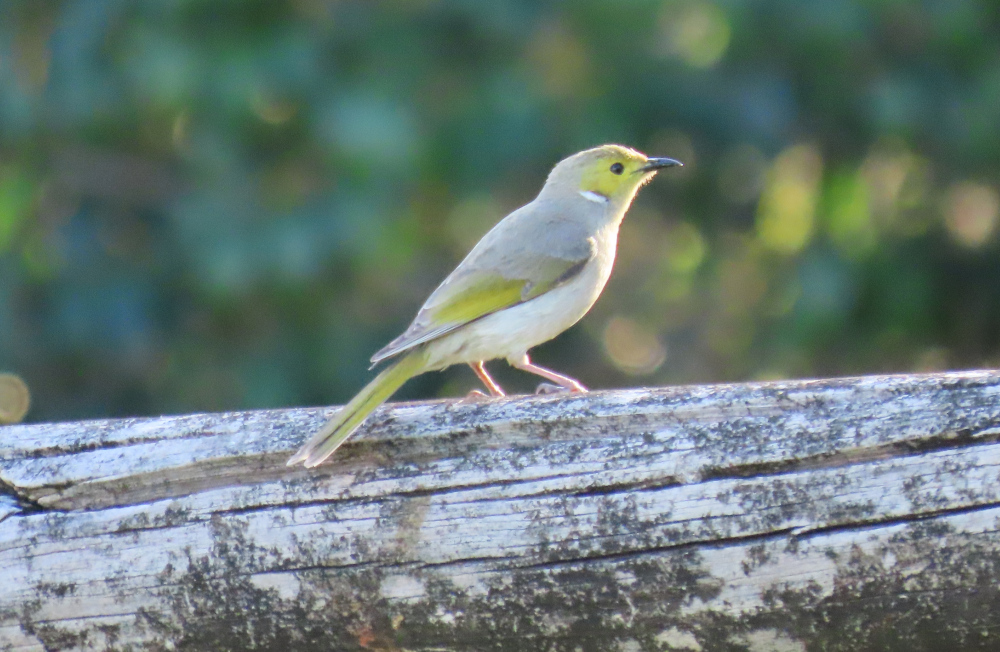
Common name: White-plumed Honeyeater
Scientific name: Lichenostomus penicillatus
Approximate length: 15-17 cm
Date spotted: 12 September 2025 (spring)
Location: Denman, NSW, Australia: 32°23’35.5″S 150°41’08.9″E

My first White-plumed Honeyeater
White-plumed Honeyeaters are common and wide-spread, according to my bird book, but this is the first one I’ve identified. I spotted it at Mary Flynn Campground on the Turon River in New South Wales. It’s an unassuming little bird, with plumage of soft greys and yellows, and quite large eyes relatively speaking.
In the photo, below the yellow face, you can just make out the white stripe that gives the bird the name “white-plumed”. Personally, I’d expected a grander plume to match the name, but there you go.

Common name: White-plumed Honeyeater
Scientific name: Lichenostomus penicillatus
Approximate length: 15-17 cm
Date spotted: 17 May 2025 (autumn)
Location: Mary Flynn Campground on the Turon River, NSW, Australia: 33°04’46.6″S 149°23’55.6″E

Lewin’s Honeyeater, dark green and yellow
I watched this little honeyeater for a while, but it was adept at keeping parts of itself hidden. Still, I got a shot of the bird drinking from some bell flowers:

The bird is overall quite dark in colour, with olive-green back and wings and a dark head. A light yellow streak runs alongside its beak — I think this is called the gape. Behind the eye is a yellow tuft covering the bird’s ear.
Here’s a photo from a slightly different angle:

This is only the second time I’ve spotted a Lewin’s Honeyeater. The other one was nearby, just over a year ago (June 2023).
Common name: Lewin’s Honeyeater
Scientific name: Meliphaga lewinii
Approximate length: 19-22 cm
Date spotted: 15 August 2024 (winter)
Location: Just outside Manly Dam Reserve, New South Wales, Australia: 33°46’55.6″S 151°15’26.9″E

Brown Honeyeater at Maleny
A little Brown Honeyeater was feeding on flowers at the botanical gardens in Maleny, Queensland. Brown Honeyeaters are rather drab little birds, and I didn’t get a good photo of this one. But it’s worth posting as a first sighting:

These little birds are very similar to Fuscous Honeyeaters. I identified this one with the help of the Australian Birds sub-Reddit. This bird doesn’t have the yellow patch on the neck that Fuscous Honeyeaters have. And this bird’s beak is more curved than the Fuscous beak. The next photo shows the curved beak, albeit on the other side of a twig!
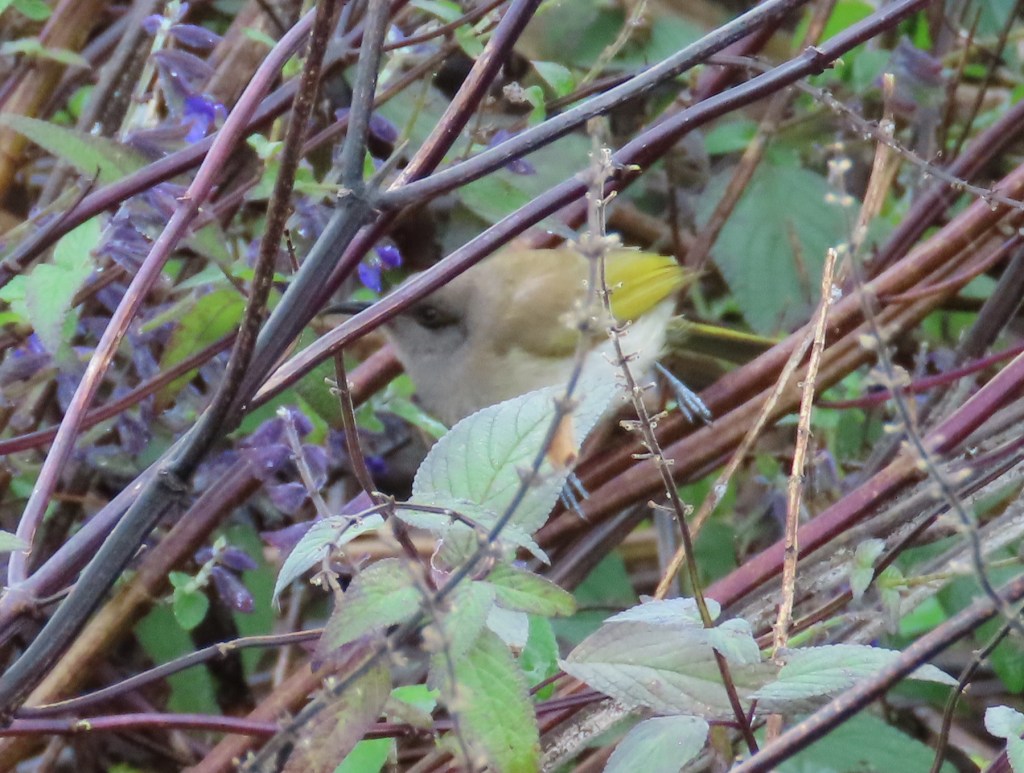
There’s also a hint of yellow at the edge of the eye, as well as that lovely dark eye mask:
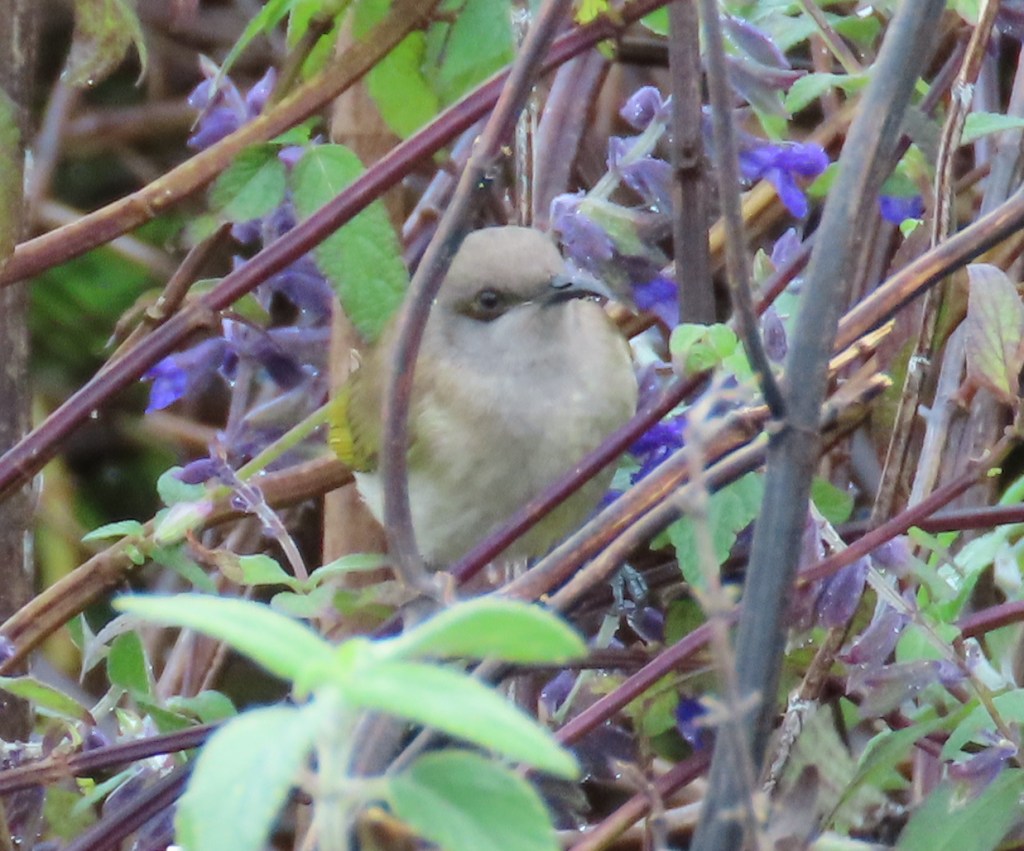
Common name: Brown Honeyeater
Scientific name: Lichmera indistincta
Length: 12-16 cm
Date spotted: 6 July 2024 (winter)
Location: Maleny Botanic Gardens, Queensland: 26°46’54.7″S 152°50’04.0″E


