
New Holland Honeyeater drinking from Mountain Devil flower
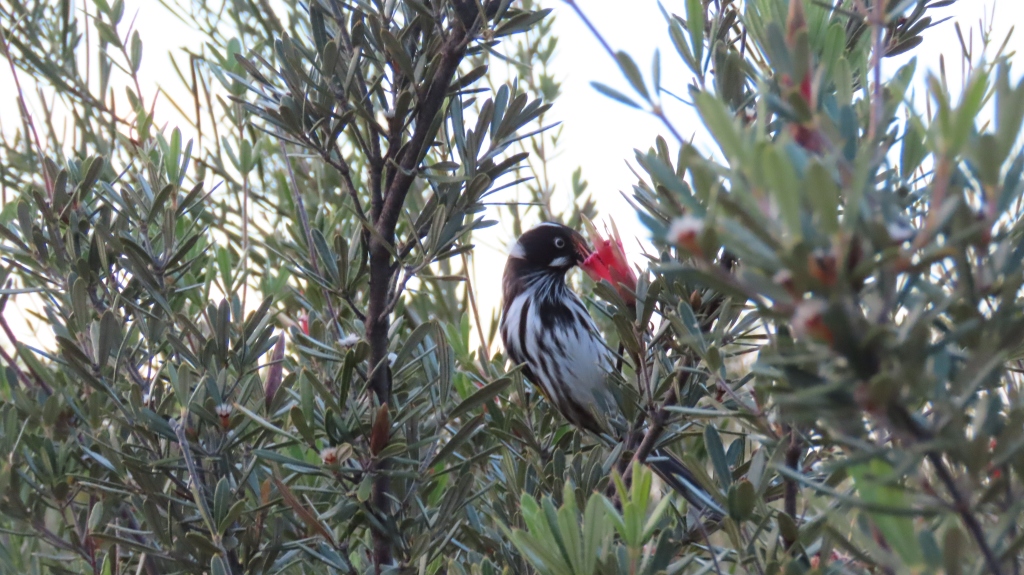
New Holland Honeyeaters are small birds that feed on nectar from flowers, as well as small insects. This video shows one of them drinking from the red, cup-shaped flower of a Mountain Devil bush (Lambertia formosa).
New Holland Honeyeaters are just one of the many types of birds labelled honeyeaters in Australia. It’s a varied and raucous group!
I did take a still photo of the bird, but it’s a bit fuzzy due to the early morning dimness:
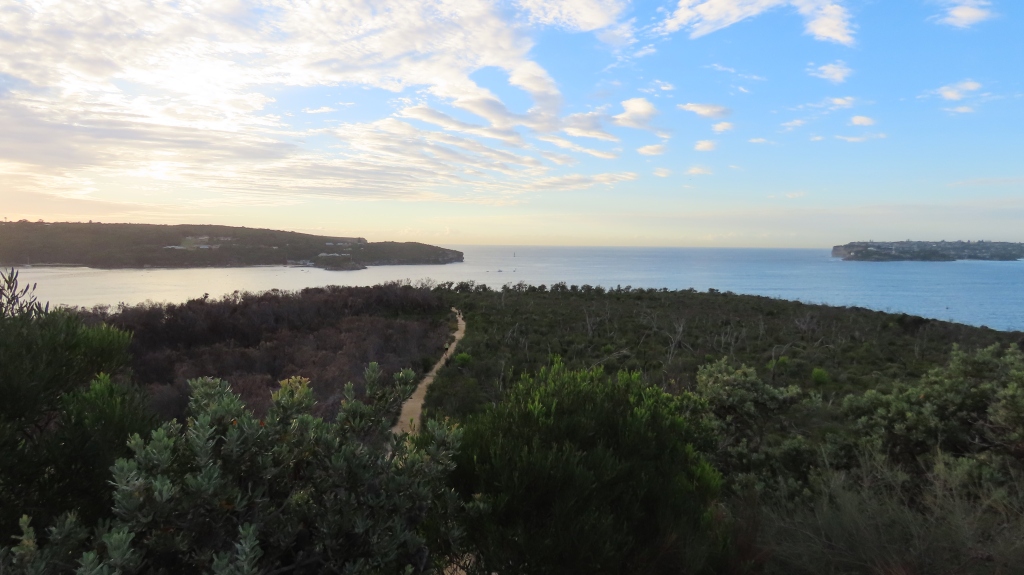
After watching the bird a while, I walked further along the path and took a photo looking back the way I’d come. The bird was at the very end of the path in this picture, near the water. In the distance are the two headlands that form the mouth of Sydney Harbour:
Common name: New Holland Honeyeater
Scientific name: Phylidonyris novaehollandiae
Approximate length: 17-19 cm
Date spotted: 23 March 2024 (summer)
Location: Dobroyd Head, New South Wales, Australia: 33°48’38.0″S 151°16’24.3″E

My first Superb Fairy-wrens
I was out in the Putty Valley area this weekend, and spotted my first Superb Fairy-wrens. We often see Variegated Fairy-wrens closer to home, but I’m delighted to see a Superb at last. The familiar squeaky trills drew my attention, and I snapped a couple of shots, but it wasn’t until I downloaded the photos that I saw these were not the usual catch!
First the female:
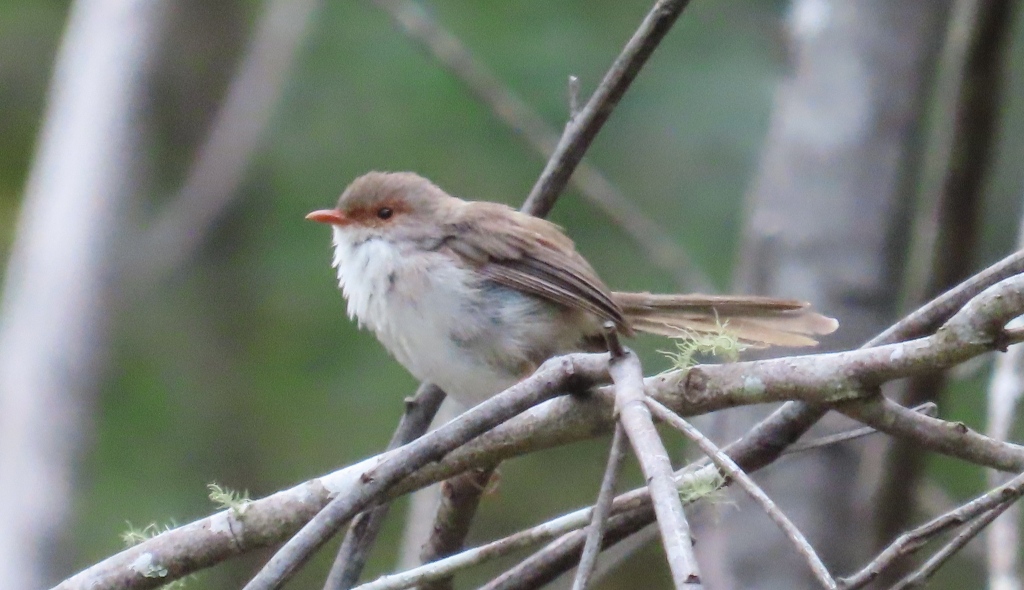
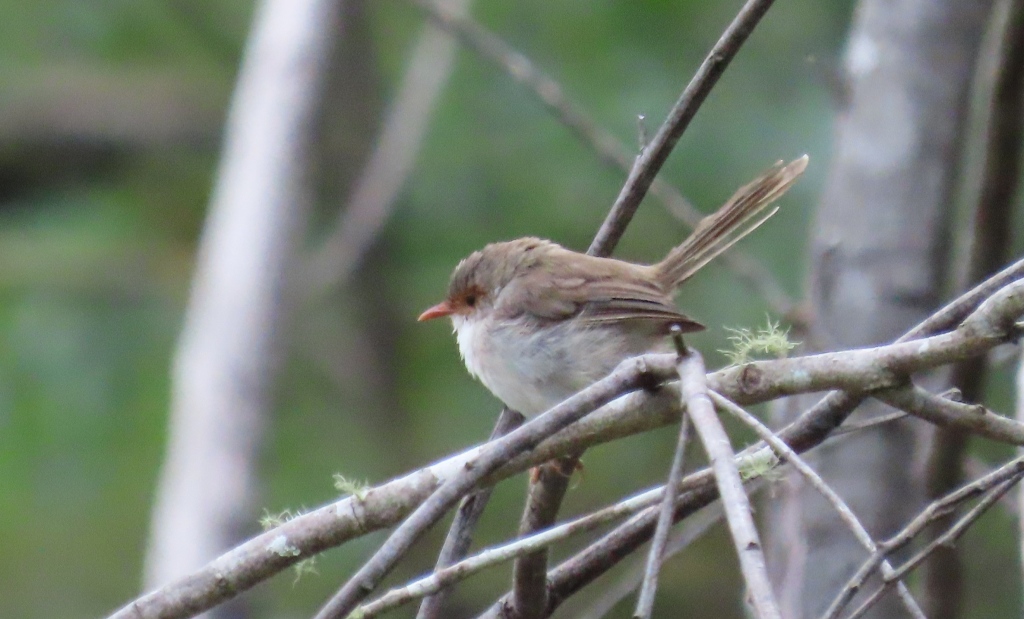
Overall, her colouring is similar to the Variegated Fairy-wrens. The differences are that the brownish patch around the eye is more cinnamon than chestnut, and her tail lacks the blue of her Variegated cousin. Here’s another shot of the same bird:
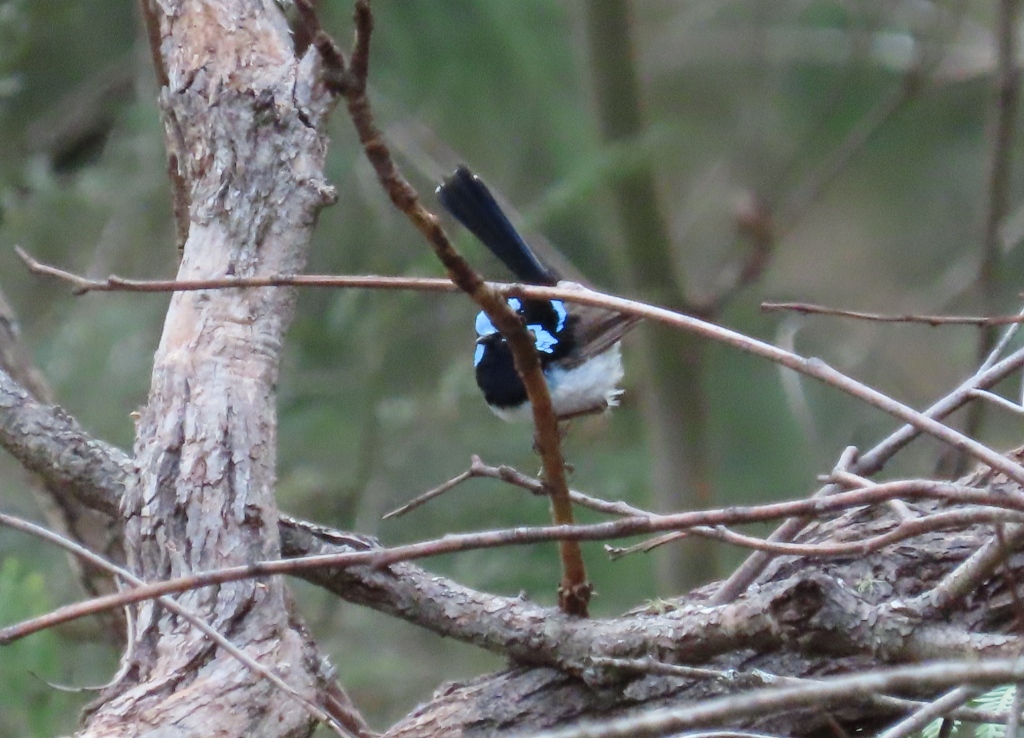
The male was, as usual, hard to photograph. He’s partially obscured by a twig, but you can still make out the bright and darker blues. He lacks the chestnut shoulders of the Variegated Fairy-wren:
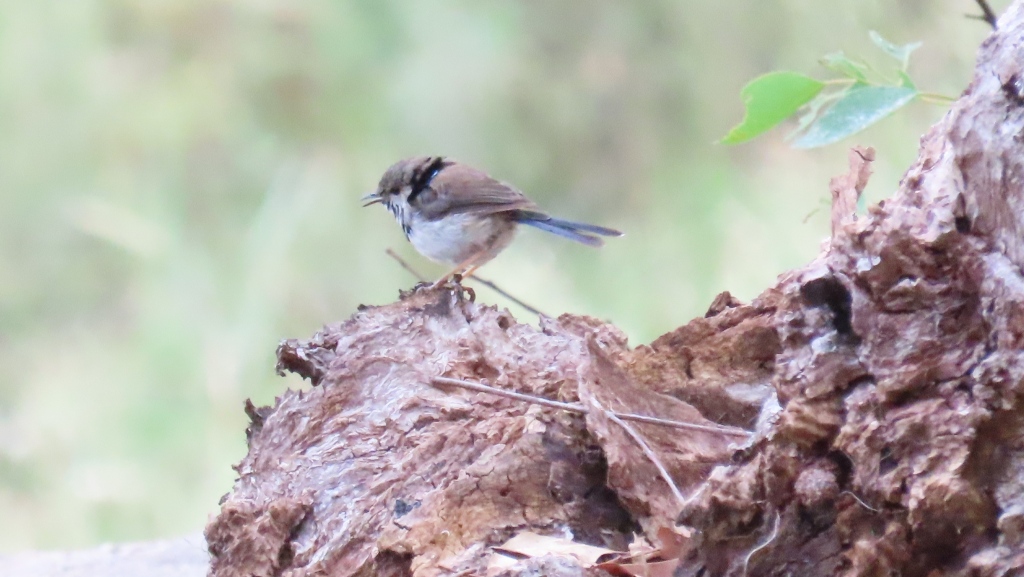
The next one is, I think, a juvenile male. The blue colouring is just starting to appear:
Common name: Superb Fairy-wren
Scientific name: Malurus cyaneus
Approximate length: 13-14 cm
Date spotted: 15 March 2024 (summer)
Location: Putty Valley, New South Wales, Australia: 32°54’00.8″S 150°38’16.9″E

Eastern Whipbird’s dance
Two Eastern Whipbirds were chirruping at each other. One of them did a little dance, puffing up its white cheeks and flaring its wings and tail. Alas, the only photos that I got of the dance are very blurry, but I’ve included them at the end of this post anyway.
This is a good shot of the bird that was dancing:

Eastern Whipbirds are quite reclusive, staying low and using the undergrowth as cover most of the time. It was a pleasure to see one out in the open. They’re pretty in an unobtrusive way, with a black crest on their heads, a grey-black body, white cheek patches, and olive wings and tail.
The other bird was more coy, staying in the bushes and watching its friend:

There’s no difference in plumage between male and female birds. My guess is that the first one is the male, since he was doing the display dance.
The two birds were flitting from place to place, with one of them repeating his little dance at each new location. The dance was so fast that it was hard to see with the naked eye. The photos that I got were alas blurry, but they give some idea of what was happening.
This blurry photo shows a side view of the dancer puffing up its cheeks:

And this one shows a frontal view, with the puffed cheeks and flared wings:

Whipbirds get their name from the long, drawn-out whistle that they make, ending with an abrupt squawk. The call reminds people of a cracking whip, hence the name. You can hear the call in an earlier post.
Common name: Eastern Whipbird
Scientific name: Psophodes olivaceus
Approximate length: 30 cm
Date spotted: 8 March 2024 (summer)
Location: Manly Dam Park near Sydney, NSW, Australia: 33°46’38.7″S 151°14’56.0″E

Blue-faced Honeyeater: my first sighting
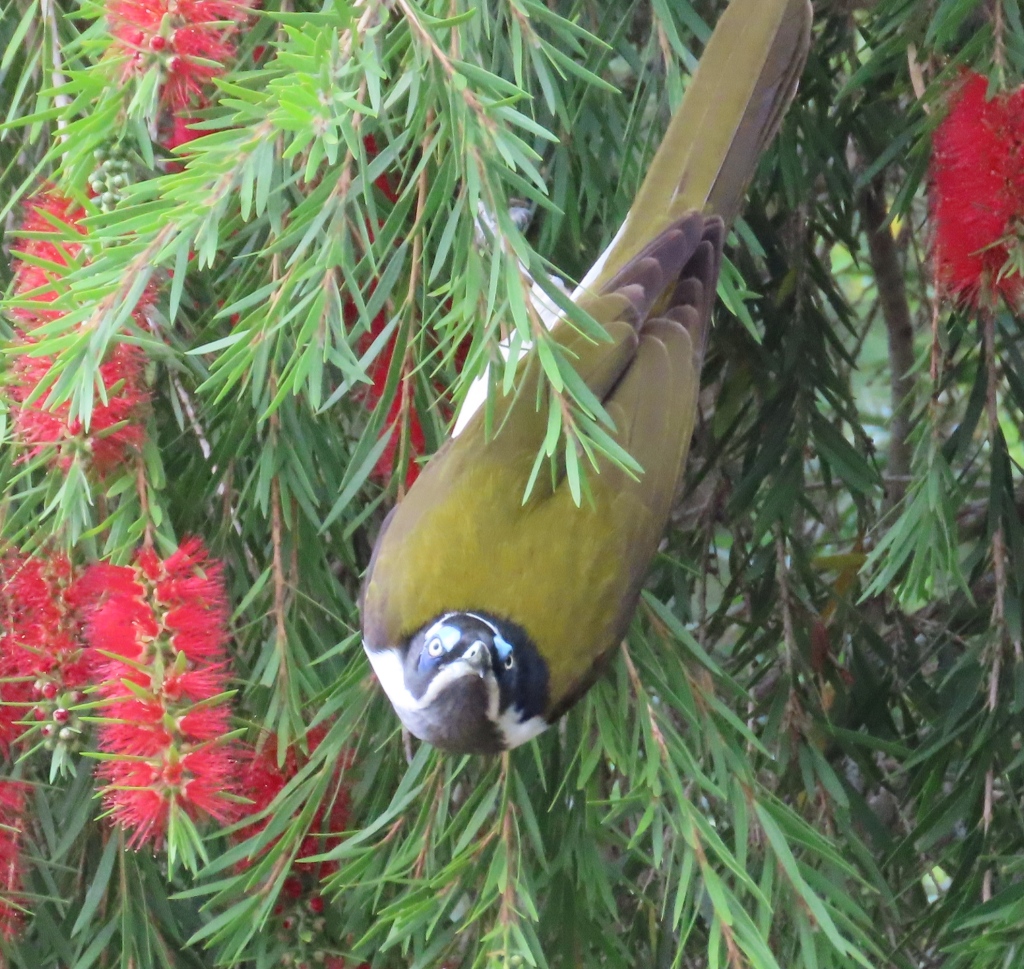
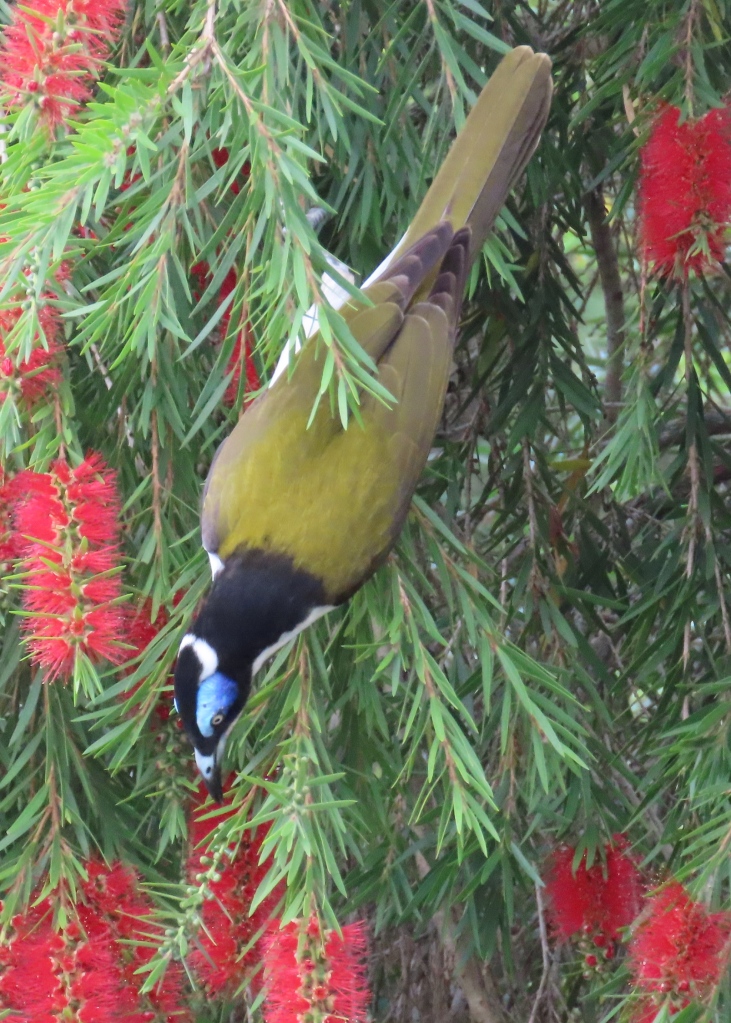
It’s always exciting to see a bird species for the first time. Yesterday I saw my first Blue-faced Honeyeater. There were two of them in a Red Bottlebrush (Callistemon) bush, one an adult and the other a juvenile.
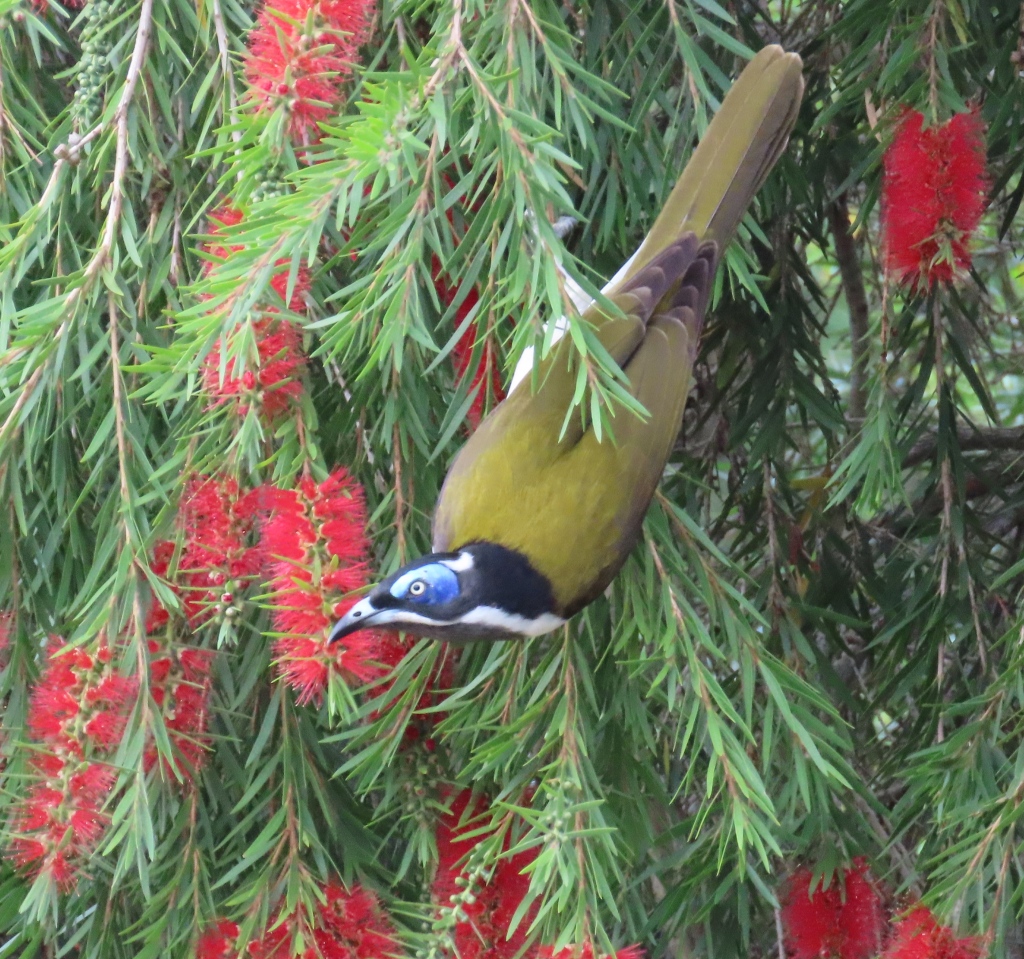
This bird is an adult — you can tell by the fact that the patch of skin around its eye is entirely blue (rather than green):
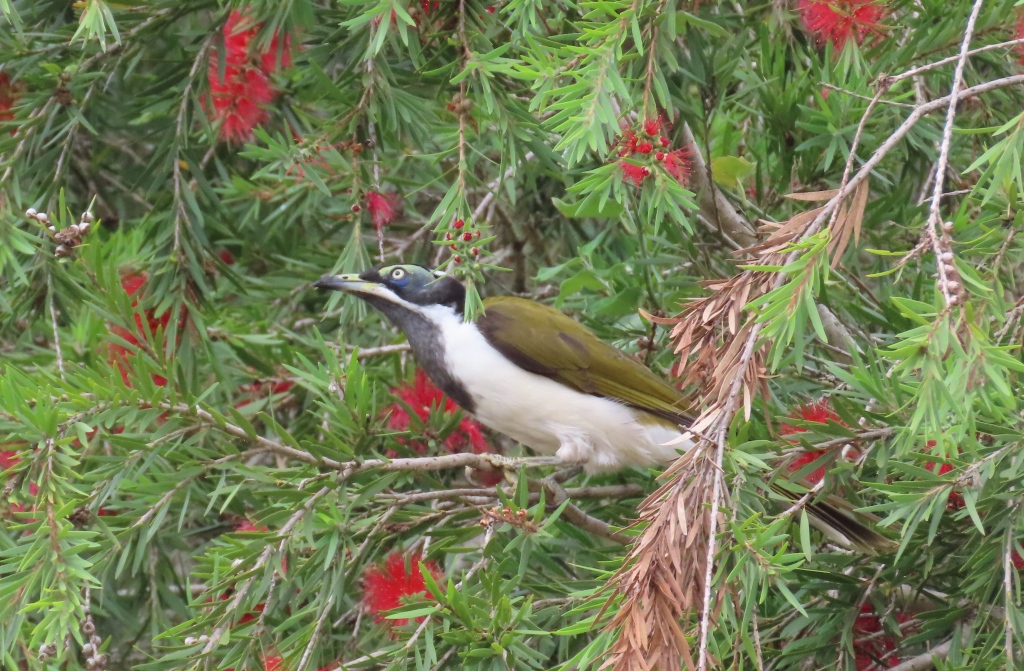
This is the youngster — the skin around the eye is mostly green, but already changing to blue:
Blue-faced Honeyeaters are larger than most other honeyeaters that I’ve seen. Like most honeyeaters, they make quite a noise! It was their enthusiastic cackles and comments that drew me to the bush where they were feeding on nectar.
Here’s another view of the youngster, showing the two white bands that extend from the eye patches and almost meet at the back of the head:
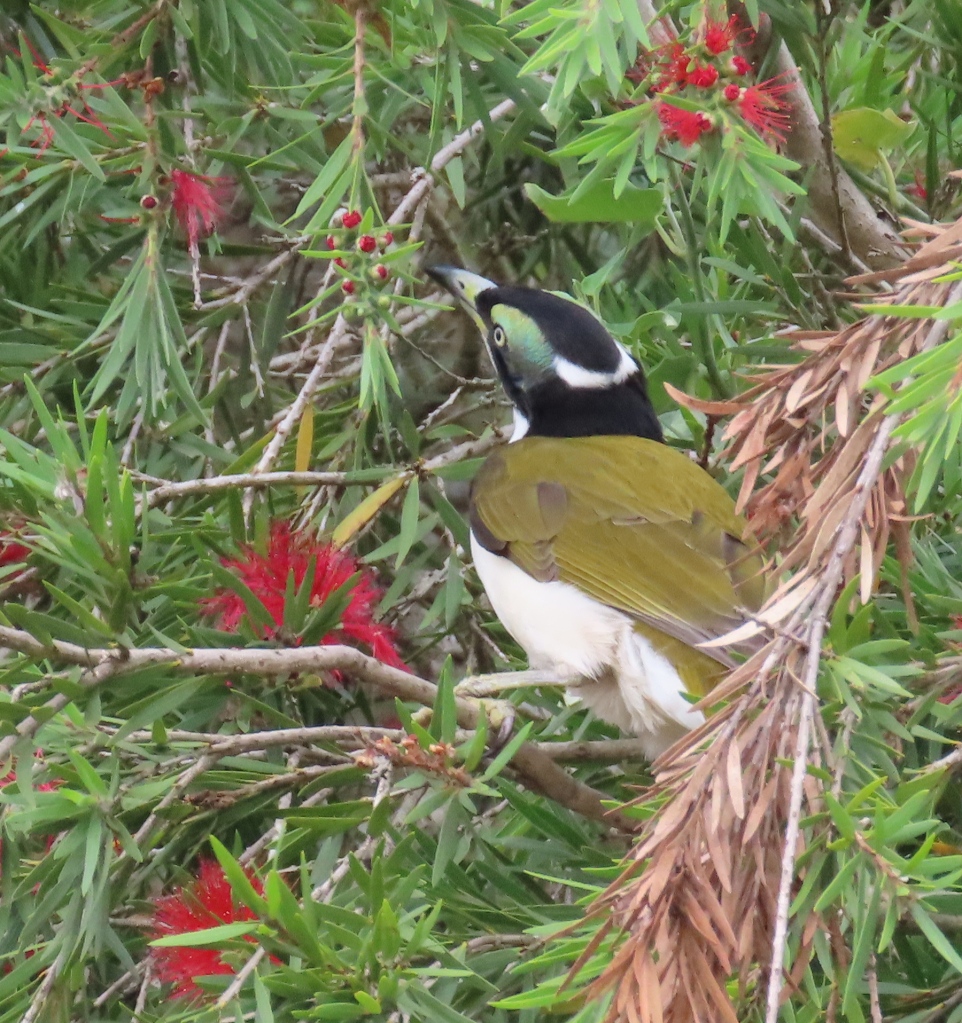
Both birds have a lovely olive-green back and a white front with an extended black bib.
Here’s the adult again:
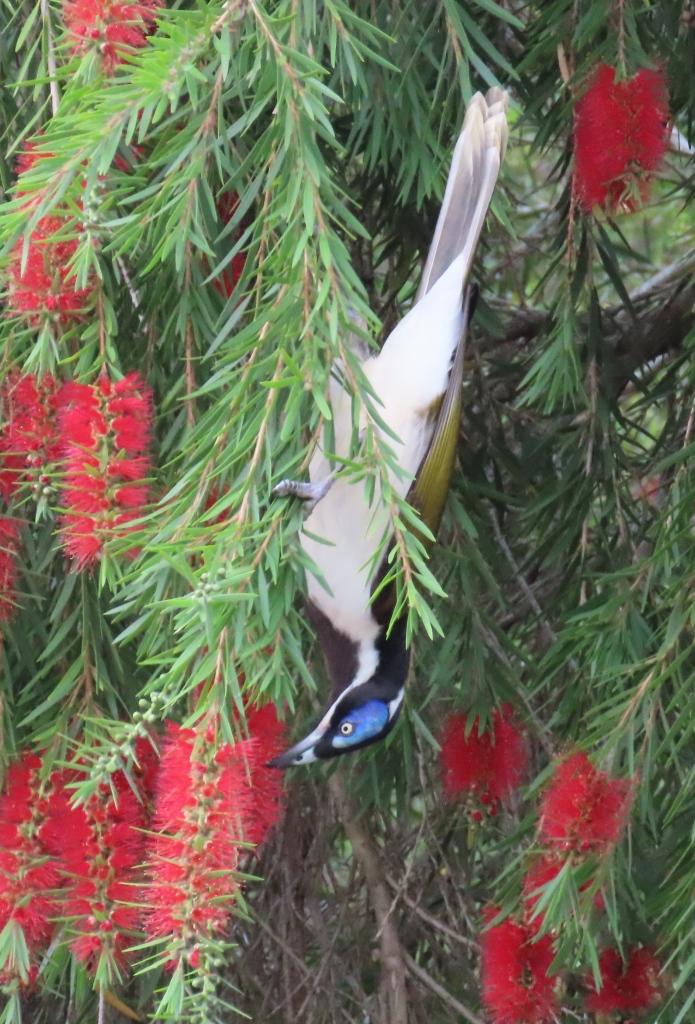
In the next photo, the bird has twisted its neck up to take a look at me. Well, hello there:
The last picture shows that white band on the head again:
Common name: Blue-faced Honeyeater
Scientific name: Entomyzon cyanotis
Approximate length: 25-31 cm.
Date spotted: 3 March 2024 (summer)
Location: Laguna, New South Wales, Australia: 32°59’25.4″S 151°07’52.8″E

Little Pied Cormorant on honeycomb rock
Little Pied Cormorants are quite common in the waters around Sydney. Most often, you see them from afar, and they just look like another black and white bird. But when you see them through the camera zoom, they’re rather cute. They have big floppy black feet, a Tintin-like hairstyle, and a goofy smile:

Their tail is short and stubby, and seems to be useful in preventing them from teetering over backwards. That tuft of black hair extends down the back of their necks, adding a touch of sophistication:
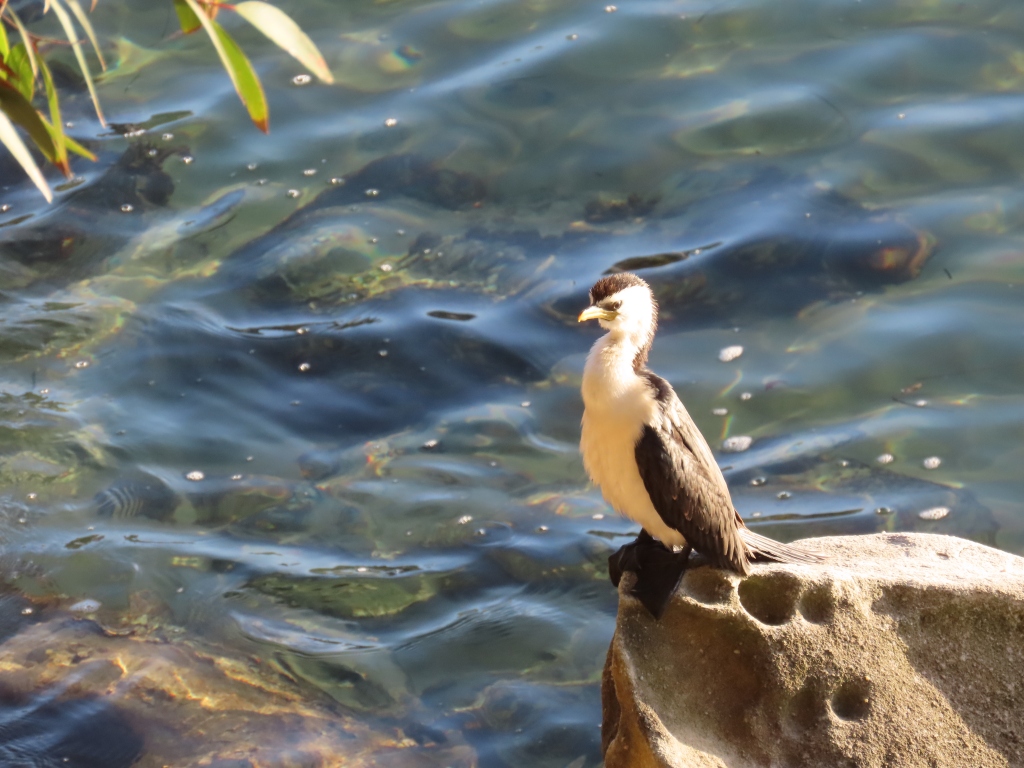
The rock that this cormorant is sitting on has attractive honeycomb weathering patterns:

In this video, the cormorant is stretching its neck and gulping to help its latest meal go down.
Common name: Little Pied Cormorant
Scientific name: Phalacrocorax melanoleucos
Approximate length: 60 cm
Date spotted: 25 February 2024 (summer)
Location: North Harbour Walk, Sydney Harbour, New South Wales, Australia: 33°48’05.9″S 151°16’10.1″E

So lucky! King Parrots and Eastern Rosellas come to visit
Two days ago, a couple of Eastern Rosellas dropped by. The next day, I was getting ready to write this blog post when two King Parrots came visiting. We’re so lucky, to have such beautiful birds in the area.
Eastern Rosellas
It’s quite odd: we have visits from two of these little parrots at around this time every year. The pattern is always the same: I hear them twittering, and lean out of the window. A male perches on our telephone line, or on a branch near by, and gives a little show for his lady friend. The show consists of some twittering, and bit of feather fluffing and scratching, and some wing shuffling. Then, after a few minutes they fly away.
Eastern Rosellas are medium-sized parrots, measuring about 30cm from head to tail. This is the male:

Here he’s in the middle of a wing shuffle:

The female looks on:

Common name: Eastern Rosella
Scientific name: Platycercus eximius
Approximate length: 30 cm
Date spotted: 19 February 2024 (summer)
Location: Allambie Heights, NSW, Australia
King Parrots
Sitting in the lounge the next afternoon, I heard a soft thunk and then an inquisitive chirp from the veranda. A female King Parrot perched on the window sill, looking in to see what was happening:

The male sat on a branch close by, keeping watch:

At 44cm from head to tail, King Parrots are quite a bit larger than the Eastern Rosellas (30cm). The birds stayed for around 15 minutes. Of course, I talked to them, as you do. The female let me get within a couple of metres.
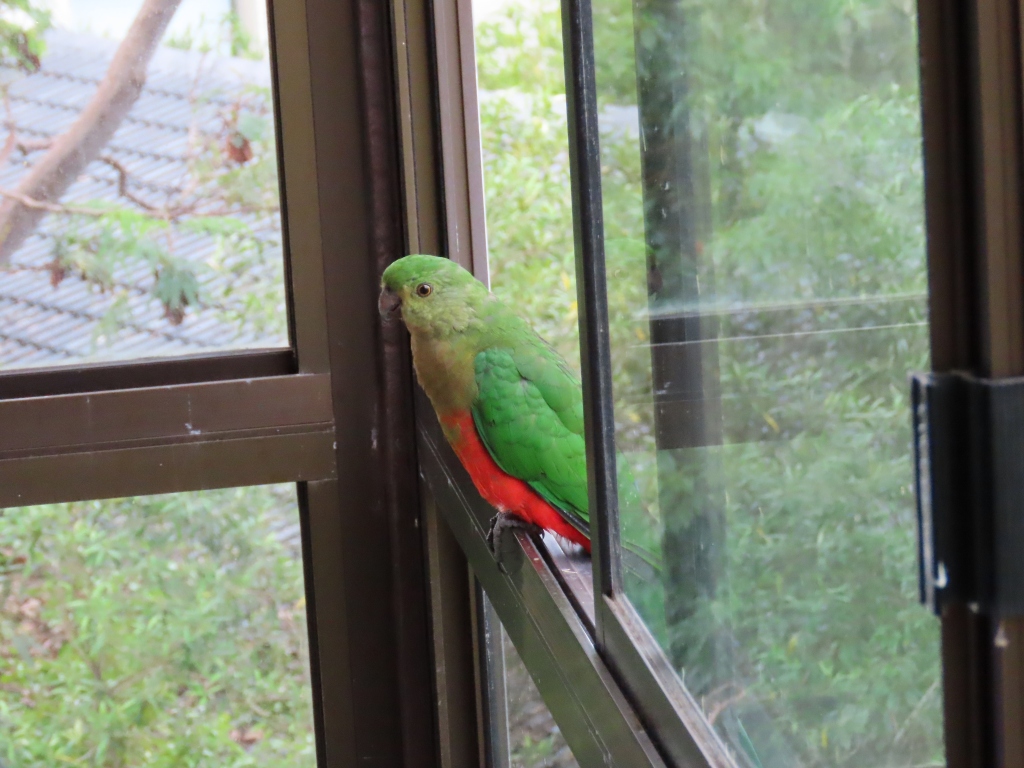
She was quite happy to turn her back on me and check out the goings on outside:

At the start of this video, the female perches on the window sill, peering in. I then find the male outside the window. The view judders a bit, as I need to kneel down to get the male in view. A cockatoo squawks as it flies past:
In the next video, the female is perched on the window sill looking outwards. If you turn up the volume, you’ll hear her soft chirps at around 6 to 12 seconds into the video. Then I manoeuvred carefully around some obstacles on the veranda, and moved the camera to outside the window. Now you can see the female’s head peering out at the bottom of the view, and the male perched on a branch higher up (and also reflected in the window pane). An Australian Raven wails. The camera pans out to show the view.
It felt like a huge privilege to be able to chat to these quiet, majestic birds.
Eventually, the female flew out onto a branch:
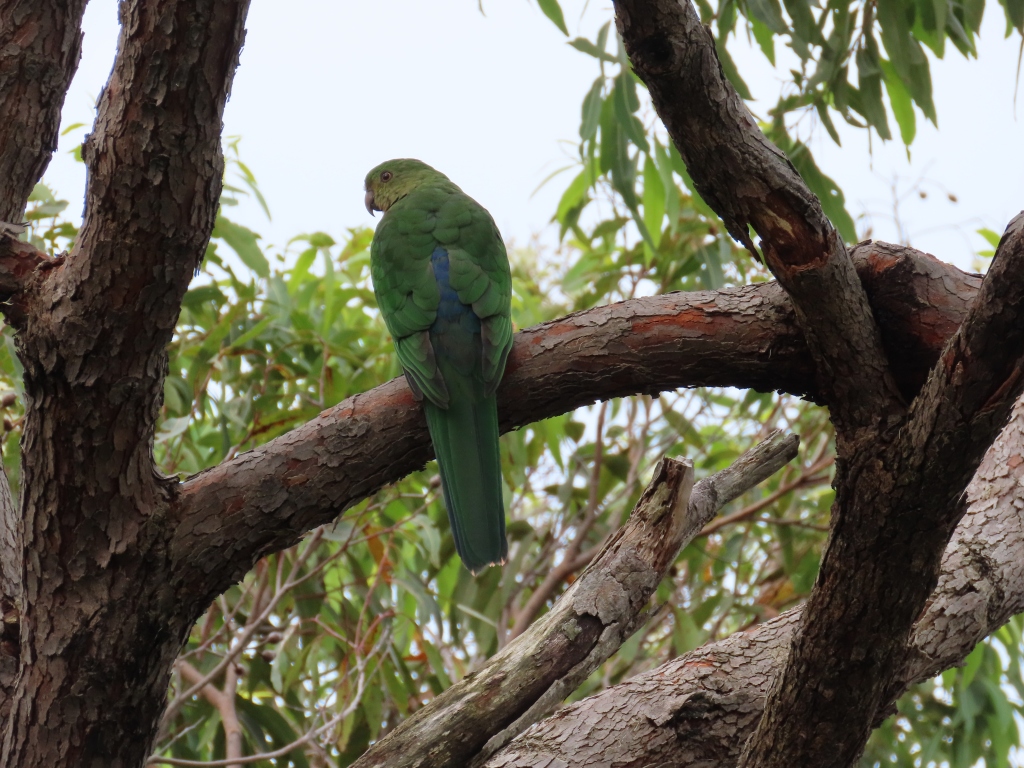
Both birds stuck around for a while. Maybe they were enjoying the view! Then they swooped away to grace another house or tree.
Common name: Australian King Parrot
Scientific name: Alisterus scapularis
Approximate length: 44 cm
Date spotted: 20 February 2024 (summer)
Location: Allambie Heights, New South Wales, Australia

Little Wattlebird on Old Man Banksia
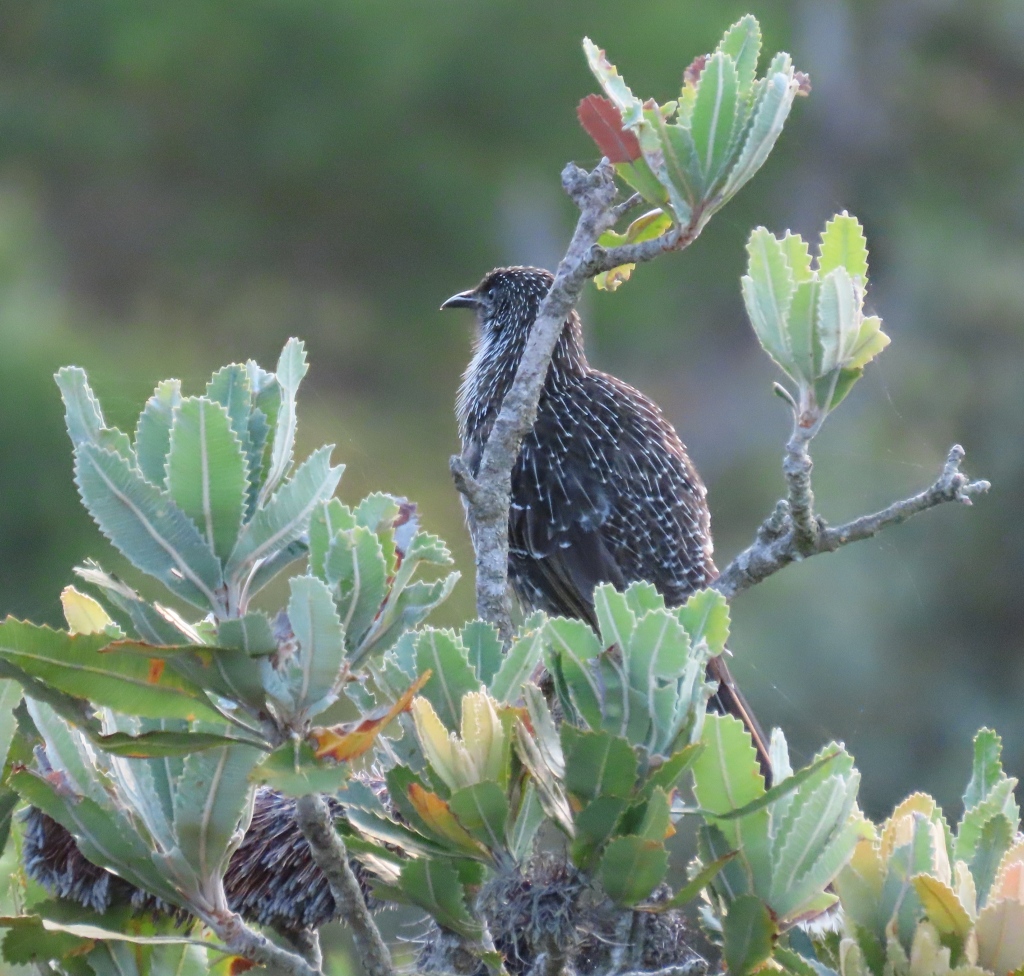
In the early morning light, this Little Wattlebird sits among the sunlit leaves of an Old Man Banksia tree.
Common name: Little Wattlebird
Scientific name: Anthochaera chrysoptera
Approximate length: 30 cm
Date spotted: 17 February 2024 (summer)
Location: Dobroyd Head Track, Balgowlah, New South Wales, Australia: 33°48’33.2″S 151°16’14.1″E

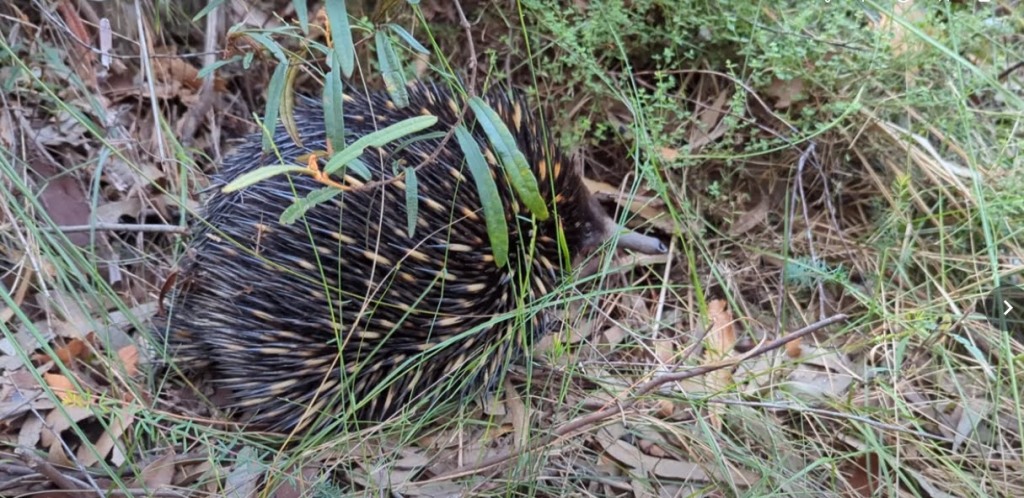
Echidna convinced I’m gone after just a couple of seconds
Walking early one morning at Manly Dam near Sydney, Australia, I came across this Echidna. They are cute, adorable animals that don’t seem to have a care in the world. Whenever I come across one, it quickly buries its nose in a bush (hiding!) But if I wait just a few seconds, the animal is convinced that I’m gone. It comes out of hiding and continues its casual amble.
Echidnas are mammals, about the size of a fat cat. They look like a cross between an anteater, a porcupine, and a small bear. Echidnas and platypuses are the only mammals that lay eggs.
This is a short-beaked echidna (Tachyglossus aculeatus), which is the only living type of echidna found in Australia. There are three other types, which live in New Guinea.
They have long, very tough noses that they stick into the ground in search of ants and termites. If you look carefully at the start of the video, you can see the animal’s eye and the rather strange-looking nose.
Here’s a still picture, taken from the video:

Black Swan grooming
Early in the morning, a Black Swan was grooming.
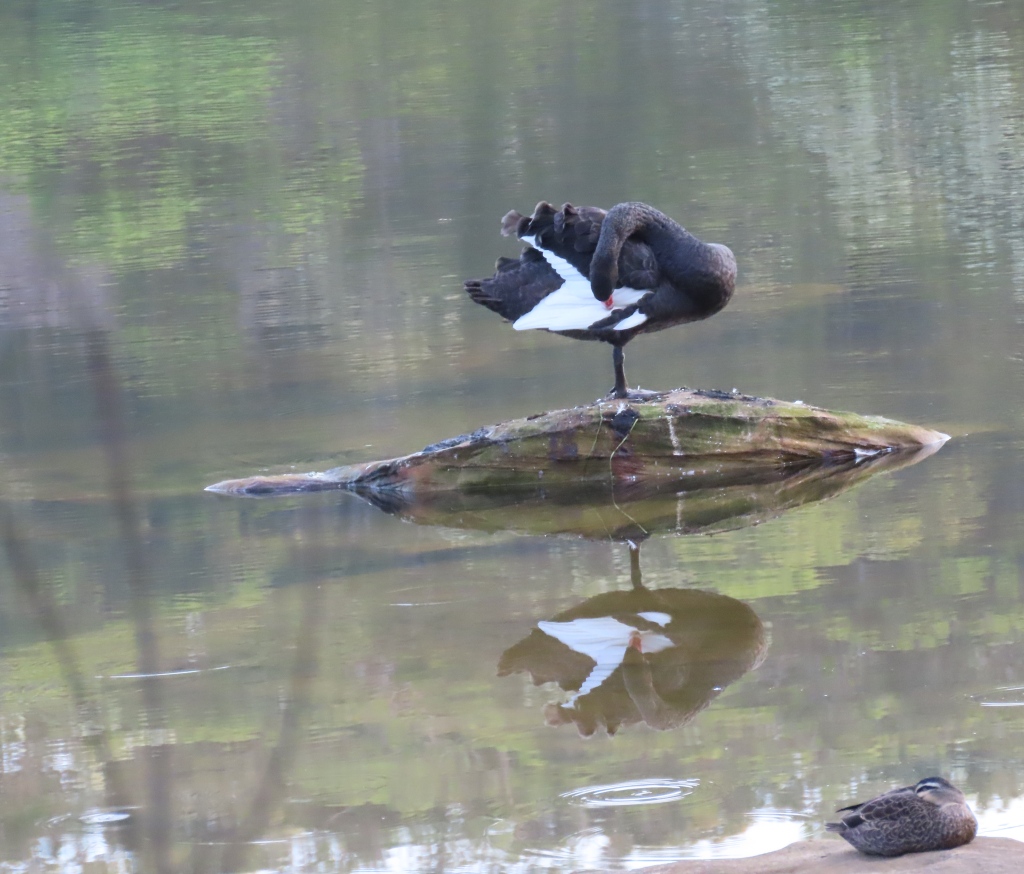
In the foreground, a Pacific Black Duck still sleeps.

Common name: Black Swan
Scientific name: Cygnus atratus
Approximate length: 120 cm
Date spotted: 4 February 2024 (summer)
Location: Manly Dam Park, New South Wales, Australia: 33°46’35.4″S 151°14’49.8″E

Pretty but ew: Snail Parasitic Blowfly
I came across a large, pretty fly yesterday afternoon:
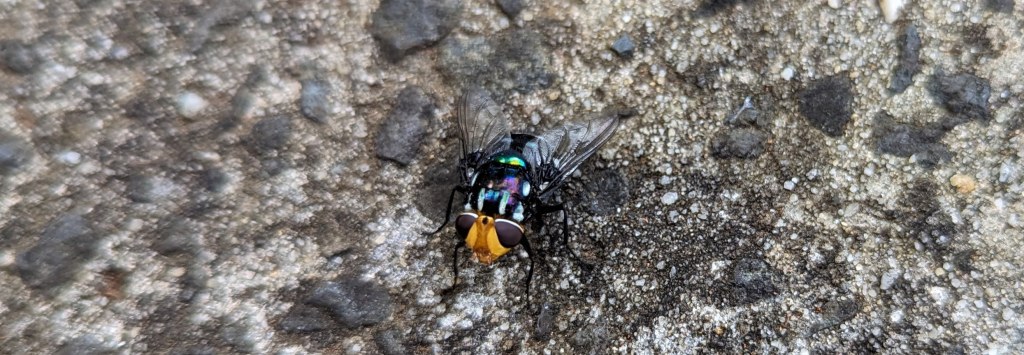
It’s a Snail Parasitic Blowfly (Amenia), found on the east coast of Australia. It has an orange head with large brown eyes outlined in white — almost as if it’s wearing sunglasses. Its body is mostly black, with turquoise, green, and purple patches and white spots. The wings are transparent.
Unlike other blowflies, this one doesn’t lay eggs or maggots in dead flesh. Instead, it lays its live larvae onto the shells of snails. The larvae then feed off the snail. The adult flies feed on nectar, helping to pollinate flowers.

There are many different types of blowfly, not all of them as pretty as this one. Evidently the name “blowfly” comes from Shakespearean times: when flies laid eggs on meat and maggots emerged, the meat was called “fly blown”.


 Sydney Birder