Blog Archives

Superb Fairy-wren and Yellow Thornbill in a puddle
A couple of weeks ago, I was at Marrambidya Wetland near Wagga Wagga, NSW. A couple of Superb Fairy-wrens were sharing a puddle with some Yellow Thornbills. I managed to photograph one of each bird, but not all together.
First a Superb Fairy-wren:
The croaking noise in the background is a Darter. (You can see and hear one in this post.)
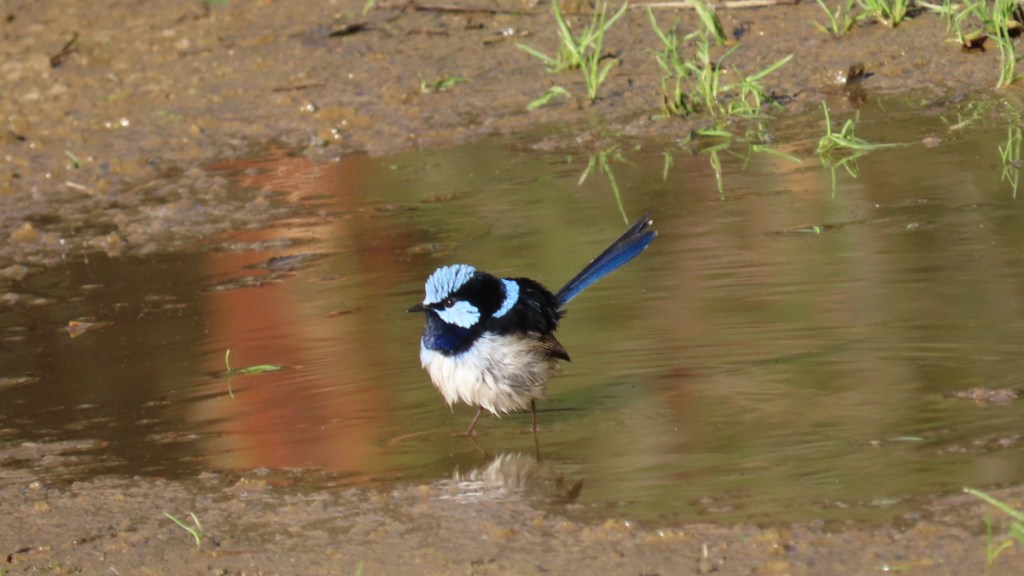
These birds are quick and bright, with their clearly-delineated blocks of blue, black, and white. Here’s a still shot:
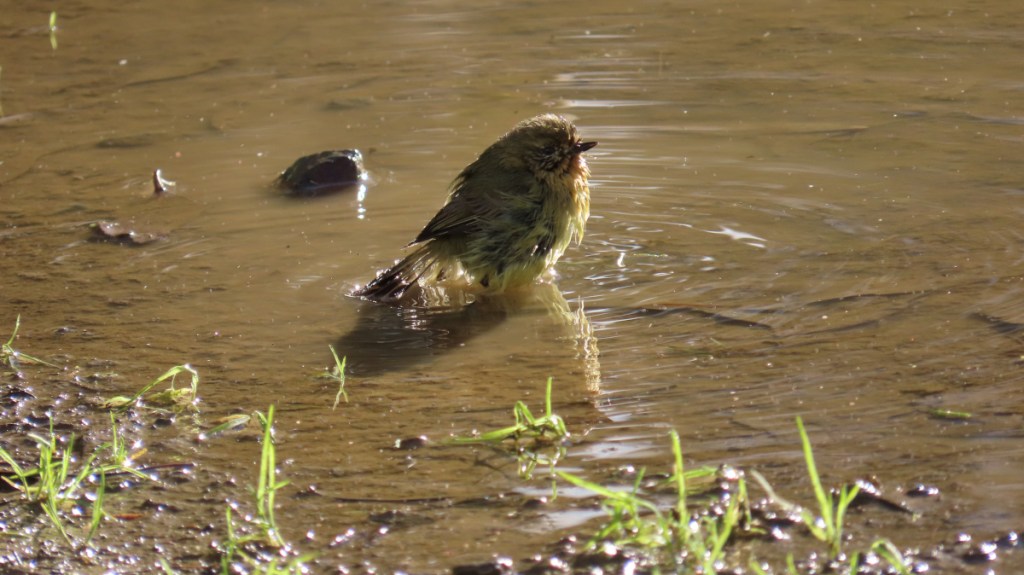
Yellow Thornbills aren’t nearly as showy! Here’s one taking his or her turn in the puddle:
They’re tiny birds, with olive backs, a buff-coloured chest, and striations around the eyes. This bird is wet, which makes its colouring hard to see:
Common name: Superb Fairy-wren and Yellow Thornbill
Scientific name: Malurus cyaneus and Acanthiza nana
Approximate length: 13-14 cm and 9-10 cm
Date spotted: 14 July 2026 (winter)
Location: Marrambidya Wetland near Wagga Wagga, NSW, Australia: 35°05’25.5″S 147°21’27.8″E

Call of the Superb Fairy-wren
Next to the Big Koala in Gundagai, this feisty little Superb Fairy-wren scampered along the ground then flew up into a tree and sang for a few seconds. At the speed at which these birds live, that’s a lengthy recital!
Tip: For best results, set the video quality to HD in the YouTube settings.
The bird’s song is rusty, squeaky trill. Perhaps if we could slow it down and lower it by several octaves, we might hear a melodic symphony.
The colours of this bird are dramatic, with the various shades of blue from bright turquoise darkening to black, the light brown wings, and the white belly. Here’s a still picture of the little fellow:

And another showing the bird’s back:

Common name: Superb Fairy-wren
Scientific name: Malurus cyaneus
Approximate length: 13-14 cm
Date spotted: 17 February 2025 (summer)
Location: Gundagai, New South Wales, Australia: 35°00’08.1″S 148°06’38.2″E

Video of a Superb Fairy-wren
At last, a Fairy-wren stayed visible for long enough to star in a short video! This one is a male Superb Fairy-wren chirping, wagging its tail, and hopping across open ground. Spotted at Dixons Long Point in NSW, on the banks of the Macquarie River.
A female was nearby too, but true to form it didn’t stay still long enough for a good photo. Here’s what I have:

Here’s a still photo of the male:

Common name: Superb Fairy-wren
Scientific name: Malurus cyaneus
Approximate length: 13-14 cm
Date spotted: 20 September 2024 (spring)
Location: Dixons Long Point, New South Wales, Australia: 33°01’13.5″S 149°16’53.6″E

My first Superb Fairy-wrens
I was out in the Putty Valley area this weekend, and spotted my first Superb Fairy-wrens. We often see Variegated Fairy-wrens closer to home, but I’m delighted to see a Superb at last. The familiar squeaky trills drew my attention, and I snapped a couple of shots, but it wasn’t until I downloaded the photos that I saw these were not the usual catch!
First the female:
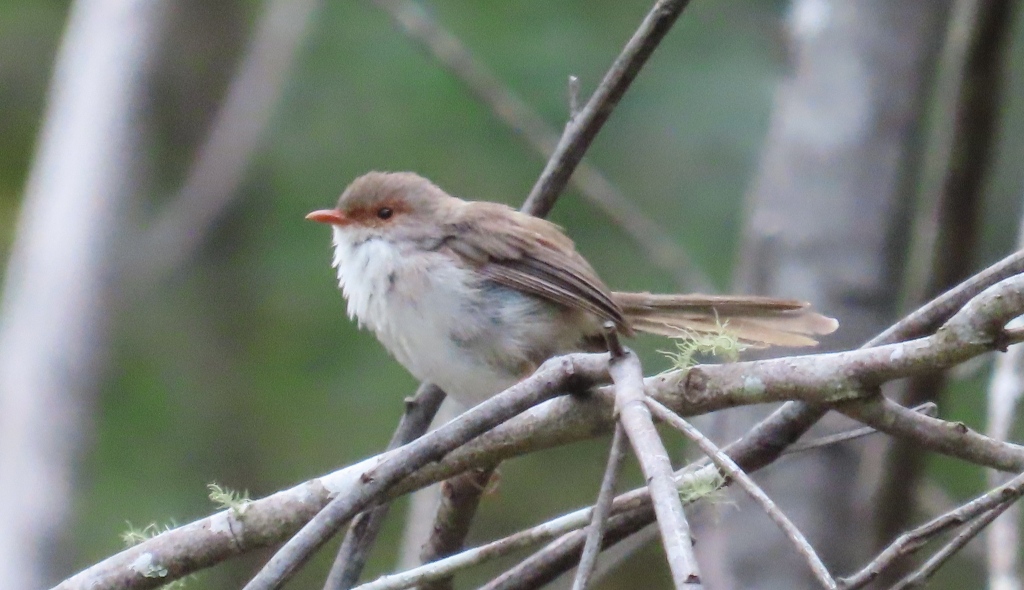
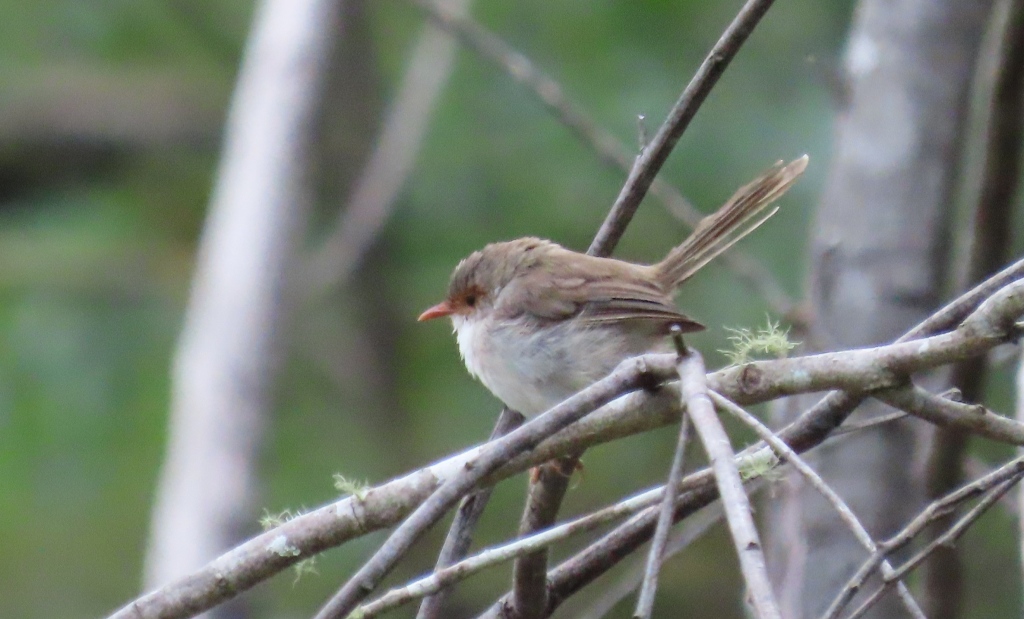
Overall, her colouring is similar to the Variegated Fairy-wrens. The differences are that the brownish patch around the eye is more cinnamon than chestnut, and her tail lacks the blue of her Variegated cousin. Here’s another shot of the same bird:
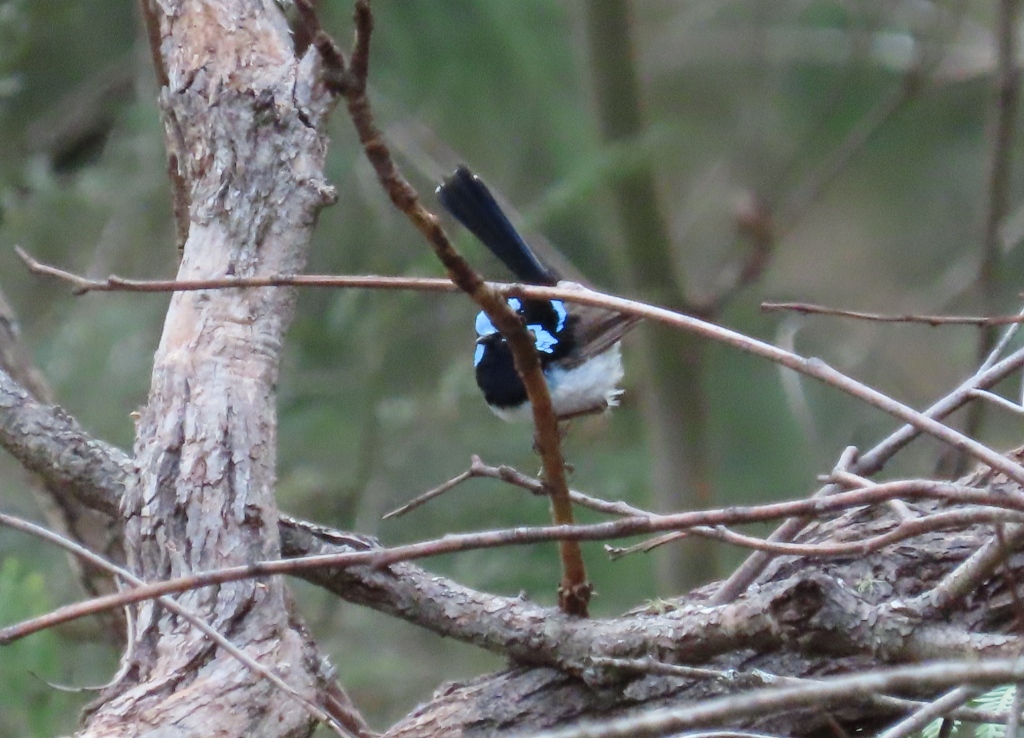
The male was, as usual, hard to photograph. He’s partially obscured by a twig, but you can still make out the bright and darker blues. He lacks the chestnut shoulders of the Variegated Fairy-wren:
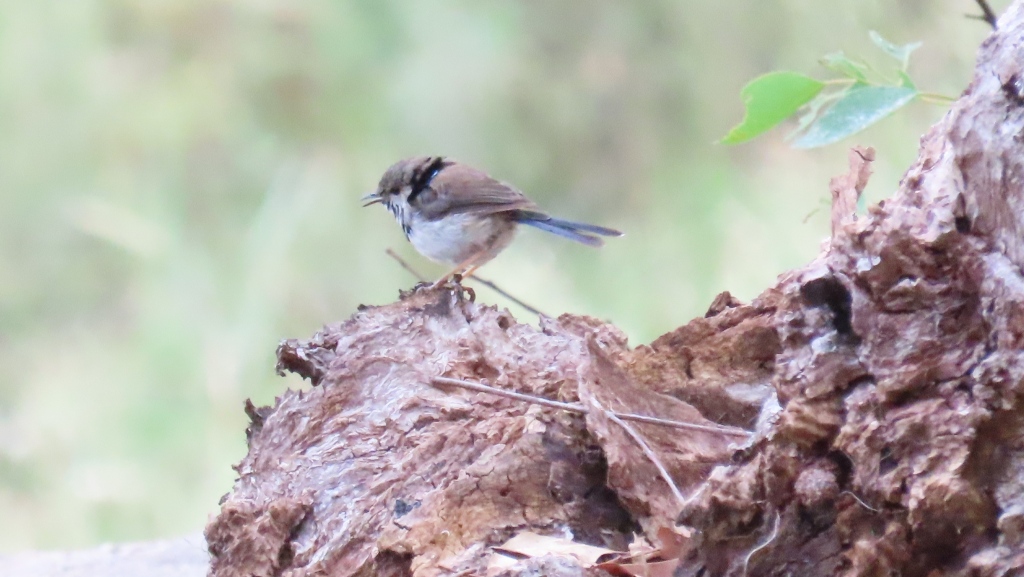
The next one is, I think, a juvenile male. The blue colouring is just starting to appear:
Common name: Superb Fairy-wren
Scientific name: Malurus cyaneus
Approximate length: 13-14 cm
Date spotted: 15 March 2024 (summer)
Location: Putty Valley, New South Wales, Australia: 32°54’00.8″S 150°38’16.9″E


