Yellow-tufted Honeyeater at Bobbin Head
A pair of Yellow-tufted Honeyeaters darted through the mangroves around the boardwalk at Bobbin Head. I managed to catch a snap of one of them before they both disappeared.
The photo shows the yellow tuft of feathers behind the black mask around the eye. The tuft is what gives the bird its name:

This bird is related to the Helmeted Honeyeater, a subspecies of Yellow-tufted Honeyeaters that is critically endangered and is found only in three small areas of Victoria.
Common name: Yellow-tufted Honeyeater
Scientific name: Lichenostomus cratitius
Approximate length: 16-19 cm
Date spotted: 28 August 2019 (late winter)
Location: Bobbin Head, Ku-ring-gai Chase National Park, New South Wales, Australia: 33°39’50.8″S 151°09’18.3″E
Azure Kingfisher in Ku-ring-gai Chase Park near Sydney
Today I visited Bobbin Head in Ku-ring-gai Chase National Park. I started at the Mangrove Boardwalk, then followed the Gibberagong track along Cockle Creek. It’s a lovely walk. Quiet and cool.
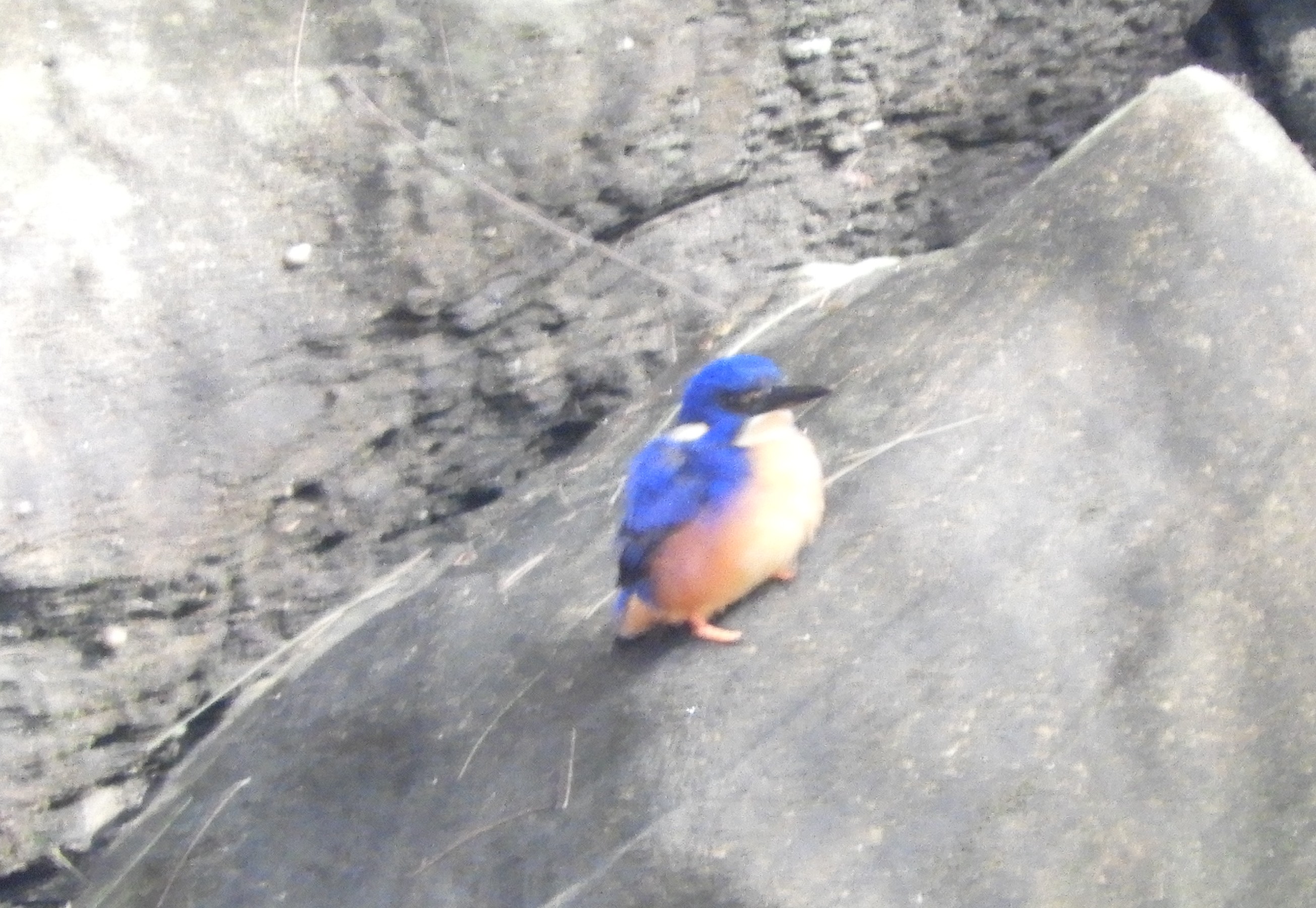
At one point I started hearing something plopping into the water at regular intervals. A flash of colour swooped up into a tree. I stopped to watch. It was a tiny bird, shining blue and orange. Only the long zoom of my camera revealed what I was seeing.
An Azure Kingfisher, sitting on a rock, waiting for prey to pass by in the river below:
Azure Kingfishers are common further north in Australia, but are uncommon this far south due to loss of habitat. They like banks of creeks with lots of vegetation and mangroves. This area of Ku-ring-gai Chase National Park certainly fits the bill.
The next video shows the bird diving into the water. It’s far away, so all you get is an impression, but it’s pretty to watch:
Here’s a still shot of the bird – fuzzy because of the max zoom on my camera:

Kingfishers are related to kookaburras. (See my previous post about a wet kookaburra.) At only 17-19 centimetres long, this kingfisher is a tiny cousin of the Laughing Kookaburra, which comes in at a whopping 40-47 centimetres.
The next photo gives a good idea of the very short length of the tail, which is an identifying mark of this bird:
Common name: Azure Kingfisher
Scientific name: Alcedo azurea
Approximate length: 18 cm
Date spotted: 28 August 2019 (late winter)
Location: Bobbin Head, Ku-ring-gai Chase National Park, New South Wales, Australia: 33°40’10.5″S 151°08’54.9″E
Cormorant poses on Manly Oceanides statue
The Oceanides, or The Sea Nymphs, is a graceful sculpture on the edge of the sea pool at Cabbage Tree Bay in Manly. Today a Little Pied Cormorant added its grace to the work of art:

(Click on the picture to zoom in.)
Common name: Little Pied Cormorant
Scientific name: Phalacrocorax melanoleucos
Approximate length: 60 cm
Date spotted: 27 August 2019 (Late winter)
Location: Cabbage Tree Bay, Manly, New South Wales, Australia: 33°48’02.5″S 151°17’40.0″E
Wet Kookaburra
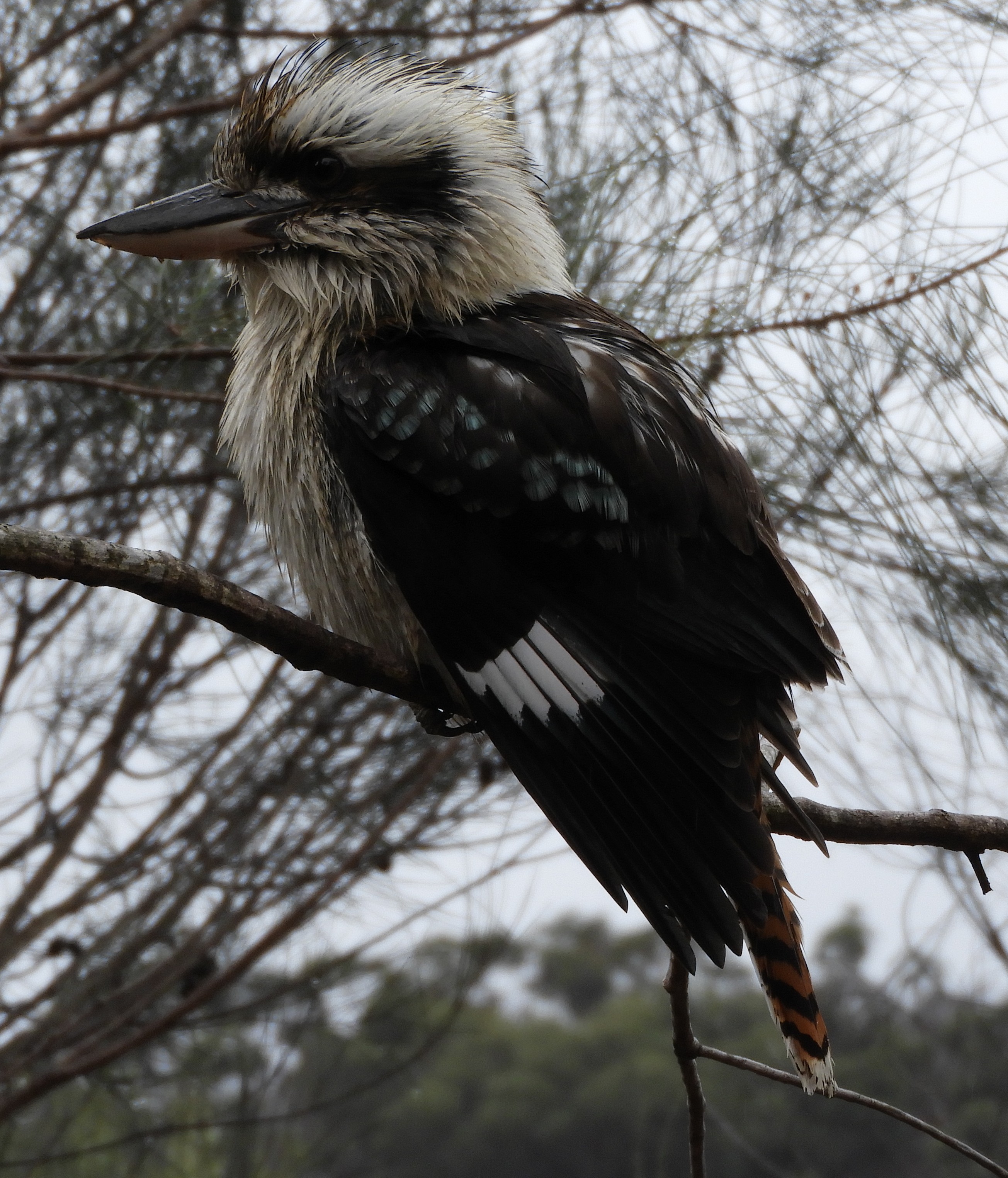
It’s been raining quite a bit recently, which is a good thing for the environment and our water supply. Sometimes, though, I do feel sorry for the wildlife caught out in the deluge.
Crikey, that was a downpour, mate!

A view of the bird’s head from behind isn’t any prettier:
Turn me upside down, and I’d do a good job of mopping your floor.
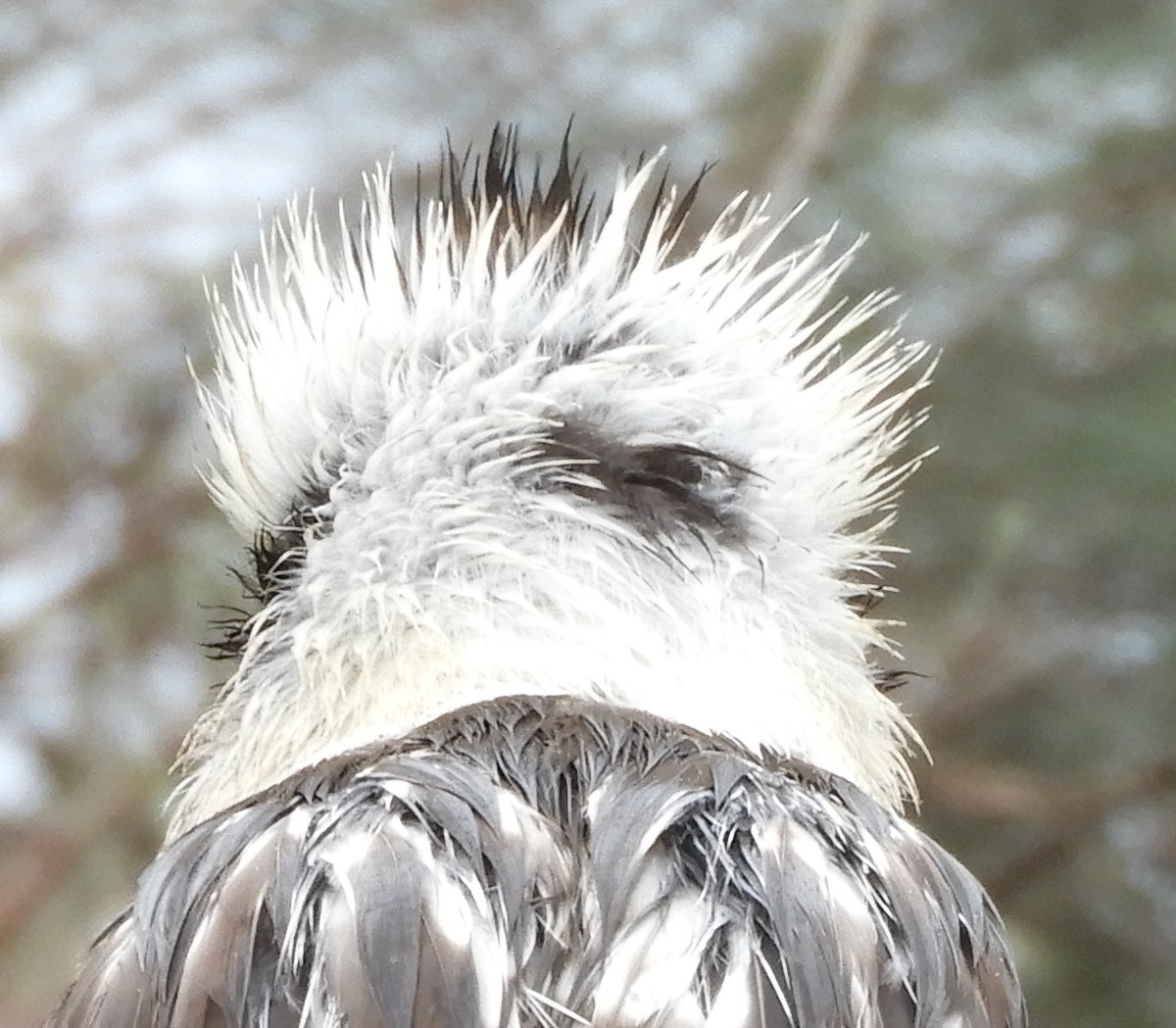
You know that feeling, when your feathers just feel like old, wet fur…
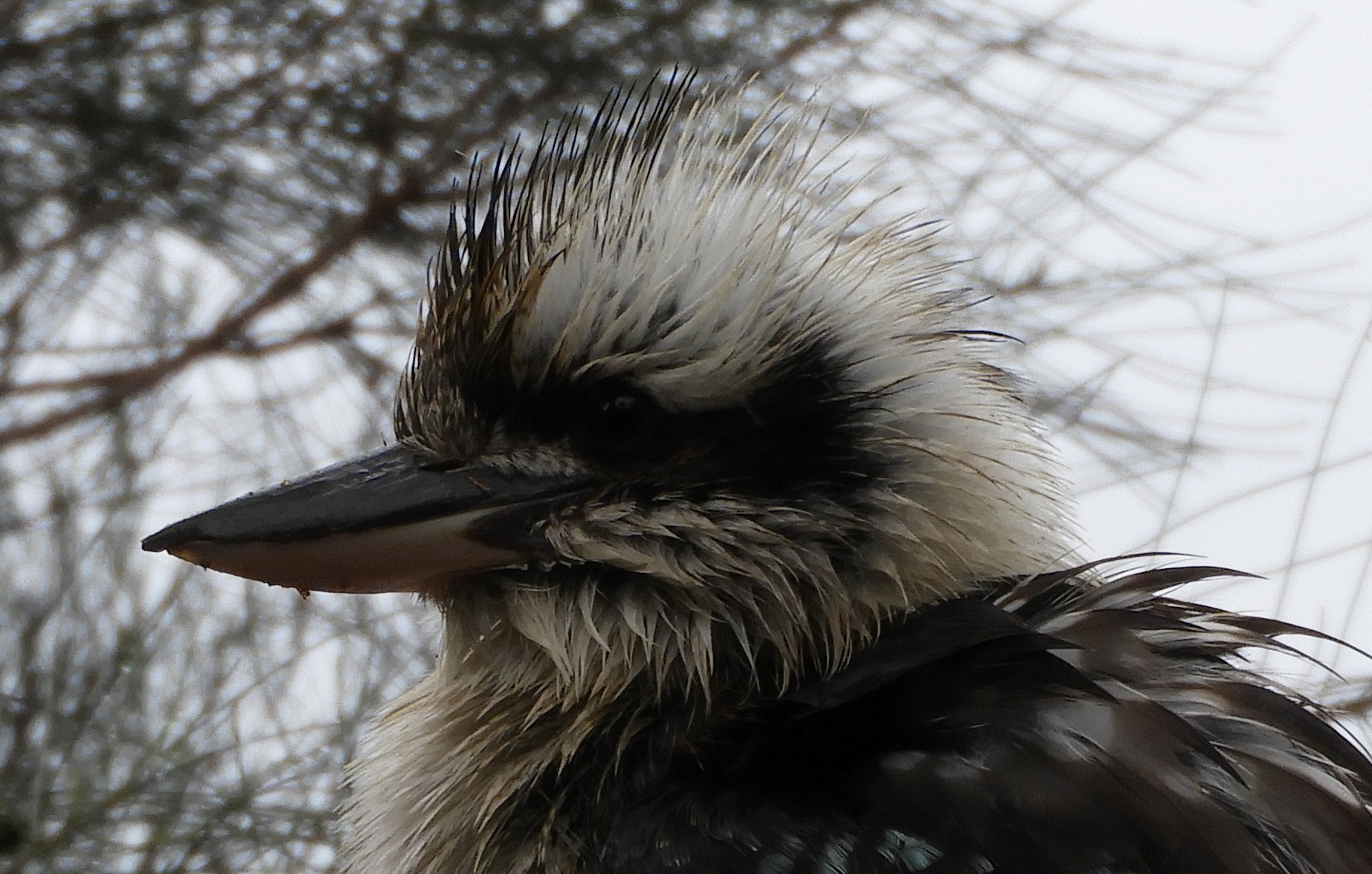
I feel like I’ve been hung out to dry:
Common name: Laughing Kookaburra
Scientific name: Dacelo novaeguineae
Approximate length: 47 cm
Date spotted: 27 August 2019 (Late winter)
Location: Manly Dam National Park, New South Wales, Australia: 33°46’54.6″S 151°15’09.4″E
Song of the Golden Whistler
It was exciting to see this pretty little bird and hear its call. This is the first time I’ve seen a Golden Whistler, though my bird book says they’re common. This one is a male, brightly coloured with clearly-delineated yellow, black, and white patches. Its song ripples through the forest.
In this video, the Golden Whistler makes a brief appearance and utters its call. Off stage, a Sulphur-crested Cockatoo squawks, and the Golden Whistler dives for cover:
Here’s a still shot of the bird. My apologies for the fuzziness – the bird was high up and far away, and my camera lens is on maximum zoom. The moon-shaped white patch is the white throat of the bird:
Here’s another brief video of the bird calling before he darts off again:
In the next video, the Golden Whistler enters from the right and has his say. The shot is taken with a lower zoom, so there’s more chance to stay with the bird:
The last video doesn’t show the bird, but you can hear its call and enjoy a general view of the forest, including some fungus growing on a dead tree trunk. The Golden Whistler’s call is slightly different from the earlier videos:
Common name: Golden Whistler
Scientific name: Pachycephala pectoralis
Approximate length: 16-18 cm
Date spotted: 24 August 2019 (late winter)
Location: Manly Dam Reserve, New South Wales, Australia: 33°46’48.6″S 151°14’52.3″E
Australian Ravens building a nest and crooning
Nesting is a tricky business. If you’re an Australian Raven, there’s a lot of moaning involved. I heard the fuss while walking along a bush path, and peered up high into the trees to see what all the commotion was about. This video starts with the two ravens weaving twigs into their nest. The nest looks more like an untidy platform of sticks at this stage. The birds croon to each other throughout the process. One of the birds flies off. It lands close to me, grabs a stick, and makes a bit of a fuss about getting just the right grip before taking off for the nest:
Australian Ravens are large birds, with ice blue eyes, black plumage that shimmers blue in the sun, and a thick ruff of feathers under their beaks. When they’re flying, they make a long drawn-out cawing that can sound like a wailing cat.
The next video shows more of the nest building and crooning. At first one raven is alone in the nest, and takes time out to have a bit of a stretch. Then its partner arrives, and the serious business of nest building starts again. It’s funny how the birds’ voices wobble when they bob their heads up and down, trying to get those pesky sticks into the right position:
Common name: Australian Raven
Scientific name: Corvus coronoides
Approximate length: 50 cm
Date spotted: 24 August 2019 ( Late winter)
Location: Manly Dam Reserve, New South Wales, Australia: 33°46’59.7″S 151°15’14.8″E
Glossy Black-Cockatoos near Sydney
Update on 9 October 2019: The birds are Glossy Black-Cockatoos, not Red-tailed Black-Cockatoos. Thank you to Carol Probets for pointing this out in a comment on the post.
Today I heard an unusual bird call – a kind of heavy, high-pitched whirring noise. I followed it down the path and saw two large black cockatoos. They flew off when I arrived, and landed again a few trees further on, chattering to each other.
I’ve seen Glossy Black-Cockatoos in the same area once or twice (see my posts). Today’s birds were larger, I thought, and seemed to have larger crests than the others I’d seen. At first, this led me to think they were Red-tailed Black-Cockatoos, but it turns out they were Glossies.
Here’s the only picture I managed to get. (The birds were much more timid than the Yellow-tailed Black-Cockatoos that are more common in our area.) This is the female of the pair, so her tail has yellow/orange panels rather than red:
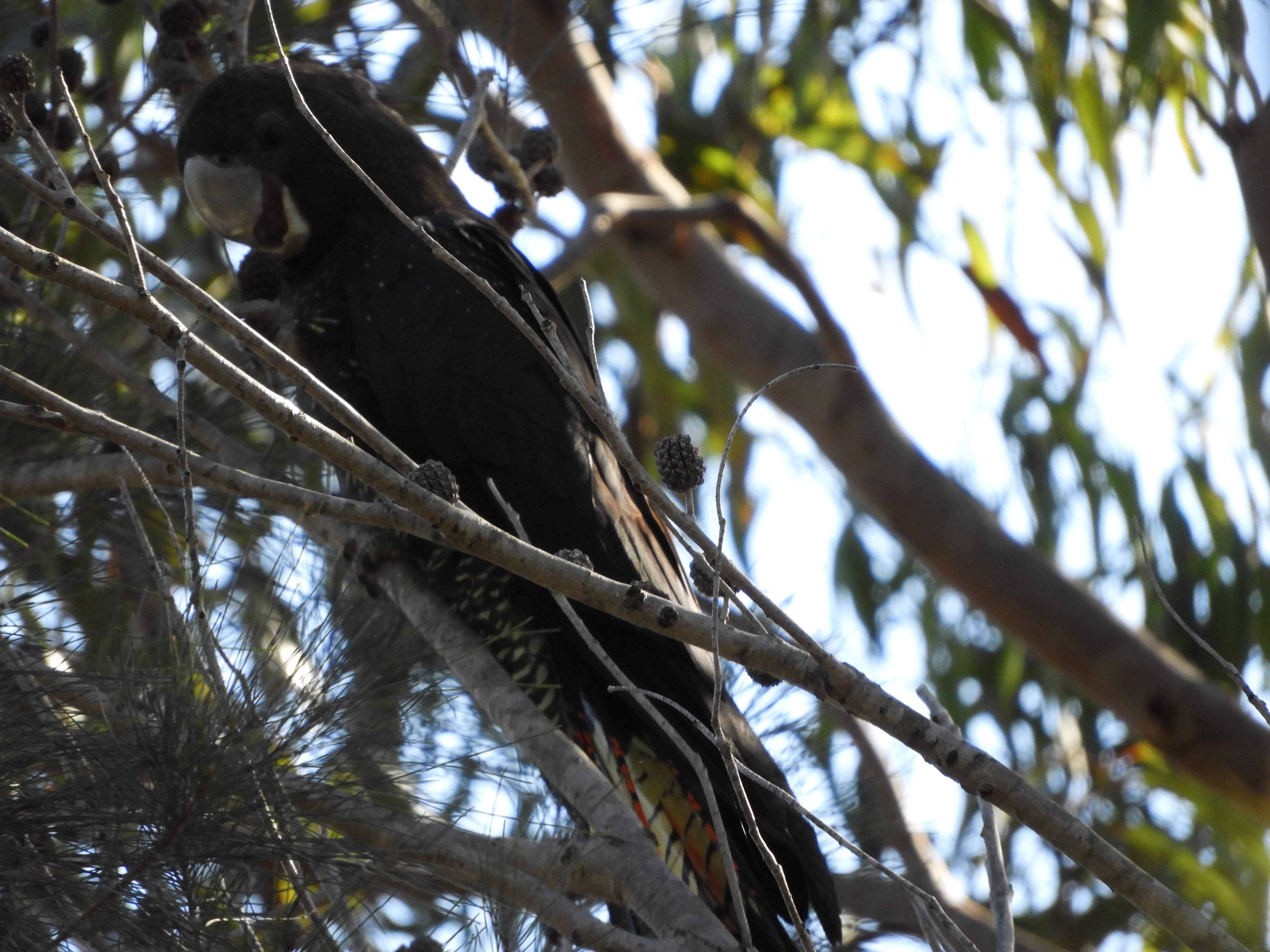
Common name: Glossy Black-Cockatoo
Scientific name: Calyptorhynchus lathami
Approximate length: 50cm
Date spotted: 18 August 2019 (late winter)
Location: Manly Dam National Reserve, near Sydney: 33°46’47.3″S 151°15’03.3″E
Hanging out with an Australian Magpie
It’s early August, and spring is in the air. The weather is chilly but bright and clear. Birds have started collecting twigs and putting their best feather forward. And I’ve been having some interesting encounters with a magpie.

Spring in Australia is the season for magpie attacks, so I was a little wary when an Australian Magpie zoomed past my ear a couple of days ago. I was going down the steps outside the house. The bird decided it needed to be on the narrow patch of earth between the steps and a hibiscus bush, which was more or less where I happened to be too.
The magpie missed me by a very narrow margin, landed on the ground, and eyed me. Then it started trying to pull up one of the long, thin roots of the fishbone ferns that dominate that part of our garden.
Tug, tug, tuuuuug…
Let go in a hurry to avoid falling over when the root refuses to yield.
Try again. Tug, tug, tuuug,…
Almost fall over backwards. Embarrassing.
Try again…
So, being me, I started chatting to the magpie. “That’s not gonna work, mate,” and that kind of thing. It stopped tugging, looked at me, then went back to tugging. So I went closer. No worries, bird kept on tugging. Closer. Still no worries. Eventually I sat down on a step two feet away from the bird. I leaned over and tugged out a root (easy when you’re big and have hands) then held the root out towards the bird. To my surprise, the magpie took it from my hand and flew off with it!
The same bird came back a few hours later and we did the same thing all over again. And again the next day. During our third encounter, the bird accepted two thin roots from me. When I tried to offer a thicker root, the bird rejected it with disdain. Twice. Picky.
I took this video during that third encounter. I was using my phone to make the video, so bear with me when the picture moves away from the bird while I lean in to grab a root!
Yesterday I was hanging up the washing when the magpie appeared. I went down the steps and sat down for our usual chat. The magpie hopped up onto the step I was sitting on, then hopped up all the other steps one by one, just taking in the time of day, giving me the opportunity to follow it. Which of course I did. We hung out while I hung up the washing. Getting the hang of each other. 😀
(What’s that song? Sing a song of sixpence… The maid was in the garden, hanging out the clothes, when down came a blackbird, and pecked off her nose!)
Flying with a forked twig is tricky, thinks this Australian Raven
Flying with a forked twig must be tricky. Especially if you’re flying through a forest of gum trees.
It’s early spring, and some birds have started building nests. I watched this Australian Raven and its partner pick up twigs and carry them away to their nest high in the trees. Then one of the birds found two perfect twigs. The only problem was that the twigs were attached together.
Hmm, let’s see. I could snip off one half with this great big beak of mine. Nup, that didn’t work.
Maybe if I hold it this way… Nup, tree-entanglement potential too high.
If I stand on one half, the other half should break off. Nup, too green.
OK, this is just taking too long. Plus, it’s annoying.
Grab it in the middle. I’m off.
Common name: Australian Raven
Scientific name: Corvus coronoides
Approximate length: 50 cm
Date spotted: 3 August 2019
Season: Winter
Location: Manly Dam Reserve, New South Wales, Australia: 33°46’15.6″S 151°14’48.9″E
Kookaburra in a mess after hollowing out termite nest
“Don’t look at me! I’m a mess.
Been hard at work hollowing out a termite nest.”
That’s what this kookaburra seems to be saying:

“What, you don’t think termite gunge is the right look for me?”

“OK then. Here’s what I’ve been doing for the last half hour:”
“That’s a big termite nest, high up in a tall tree.
And soon it’ll be a home for my family and me:”

Common name: Laughing Kookaburra
Scientific name: Dacelo novaeguineae
Approximate length: 47 cm
Date spotted: 28 July 2019 (Winter)
Location: Manly Dam National Park, New South Wales, Australia: 33°46’48.1″S 151°14’52.5″E


 Sydney Birder