Territory! Ravens vs Lorikeets
The National Parks and Wildlife Service recently did a hazard reduction burn in the area where I often go for a walk. This morning, a group of Rainbow Lorikeets occupied some bare branches with a strategic view of the newly cleared area. Right next door, a collection of ravens had the same idea. They viewed each other for a while, then all hell broke loose.
Turn up the volume to get the full effect! Listen to the bawling ravens and the scolding parrots. When things really get hectic, hear the whop-whop-whop of wings swooping overhead.
Here’s a closeup of some of the ravens, in their best villain pose:
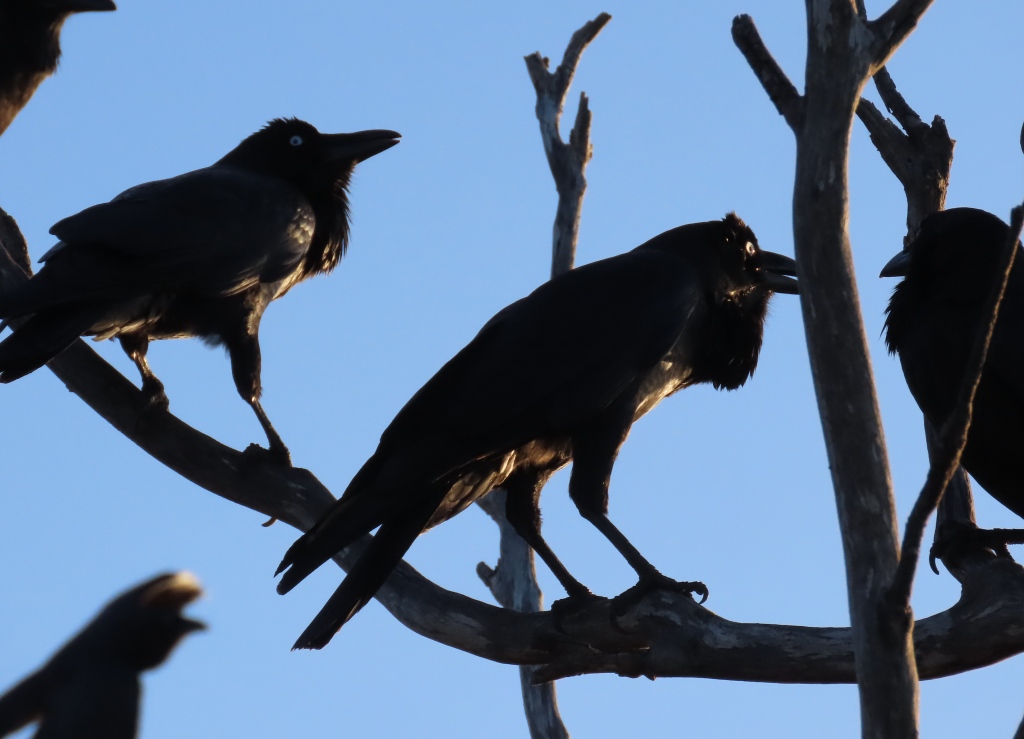
Common name: Australian Raven
Scientific name: Corvus coronoides
Approximate length: 50 cm
Date spotted: 10 June 2023 (winter)
Location: Dobroyd Head, New South Wales, Australia: 33°48’36.6″S 151°16’23.9″E
And the I’m-so-pretty, butter-wouldn’t-melt-in-my-mouth pose of the lorikeets:
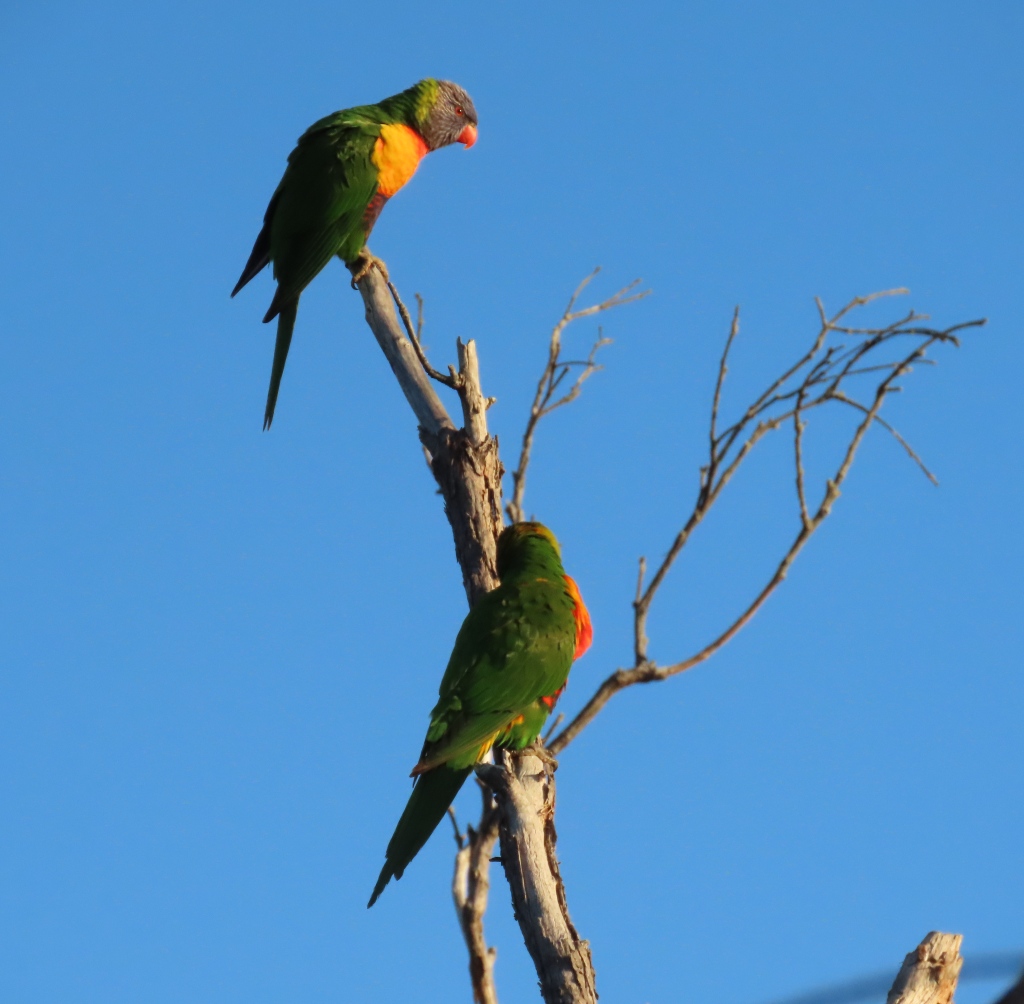
Common name: Rainbow Lorikeet
Scientific name: Trichoglossus haematodus
Approximate length: 30 cm
Date spotted: 10 June 2023 (winter)
Location: Dobroyd Head, New South Wales, Australia: 33°48’36.6″S 151°16’23.9″E

Darter with cream-coloured neck
This lovely light-coloured Darter took me by surprise!
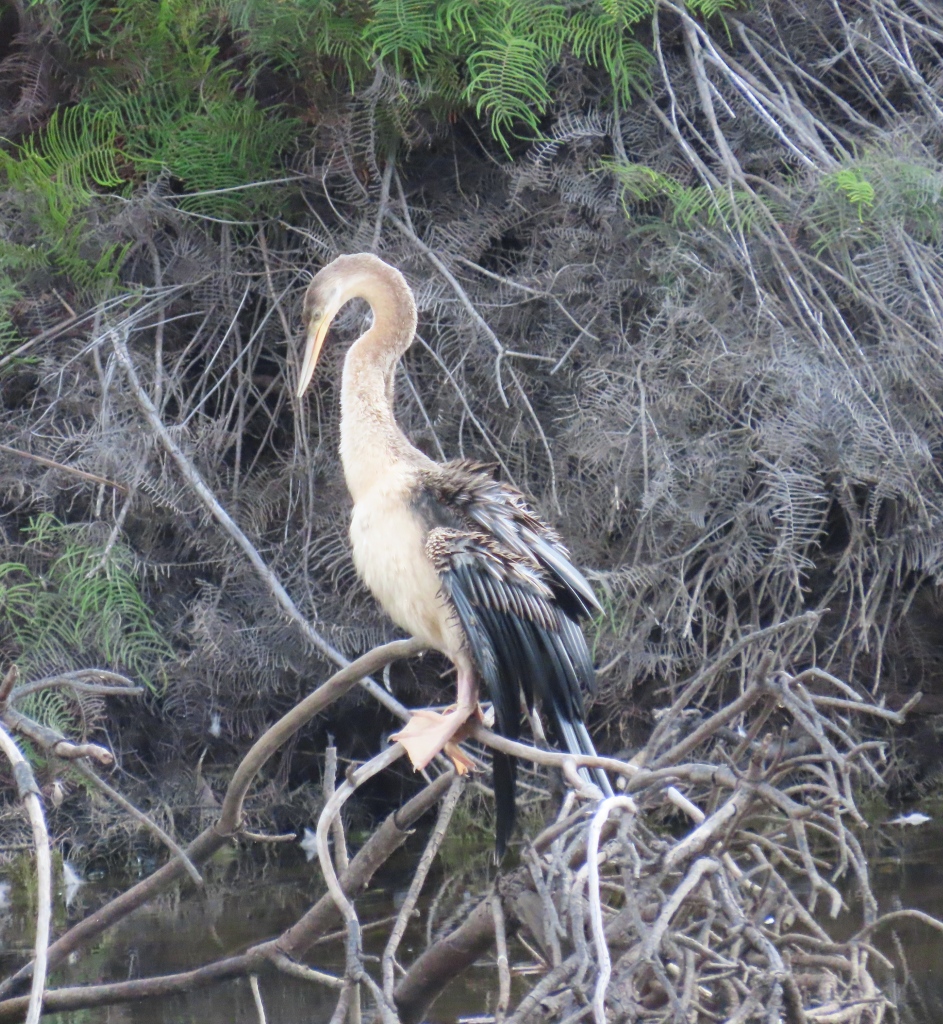
The only Darters I’ve seen up to now have been very dark in colour, with black necks and bodies. You can see them in my posts about the sinuous neck of a Darter and a Darter drying its wings then taking off.
Evidently it’s the males that are dark in colour, whereas the females and juveniles are lighter. Judging by the overall state of dishevelment of this bird’s feathers, I’d say it’s a juvenile.
This video shows the impressive length of the bird’s neck when the bird lifts its head to listen to an unusual sound:
The next video shows another neck stretch, with the bird looking in the direction of the camera:
Common name: Darter
Scientific name: Anhinga melanogaster
Approximate length: 90 cm; wing span: 1.2 m
Date spotted: 2 June 2023 (winter)
Location: Manly Dam Reserve, New South Wales, Australia: 33°46’34.7″S 151°14’48.9″E

White-bellied Sea-Eagle at Manly Dam
For the third time ever, I’ve seen a White-bellied Sea-Eagle at Manly Dam. These are very large birds, and it’s quite awe-inspiring to see them in the skies above the dam. As usual, the eagle was very far away. I managed to get this picture of it:
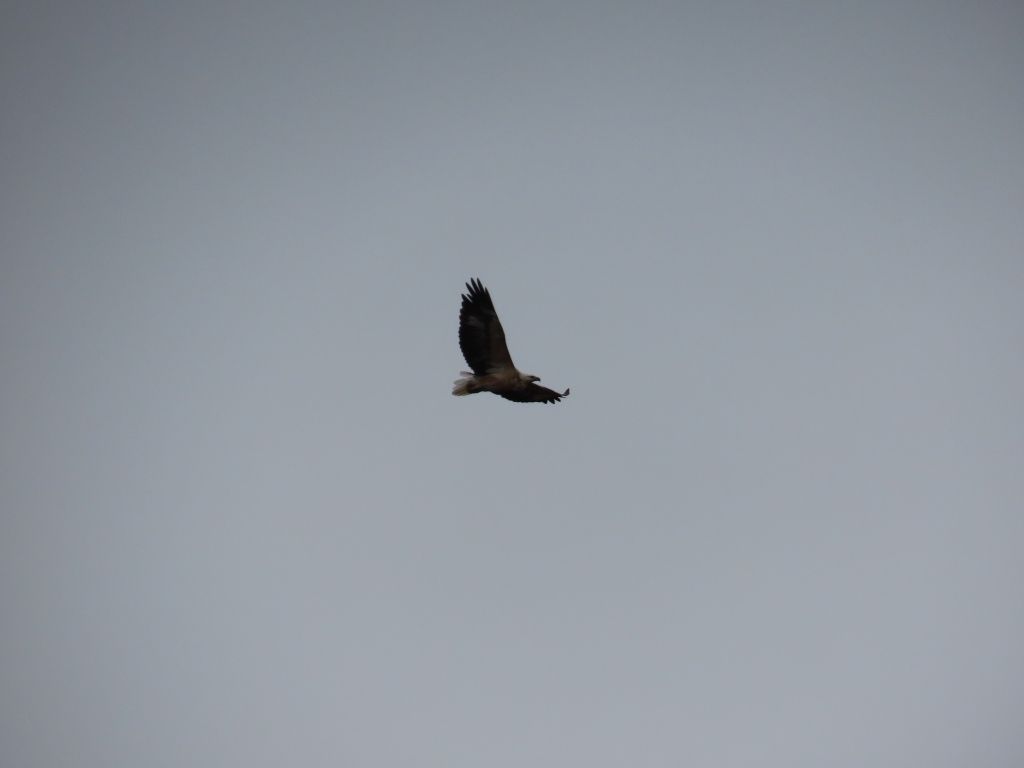
The eagle flew rapidly along the northern shore of the dam. I was far away on the opposite shore. The bird flew east to west, then disappeared into the trees on the north western shore — in the area that’s approximately in the middle of this photo:
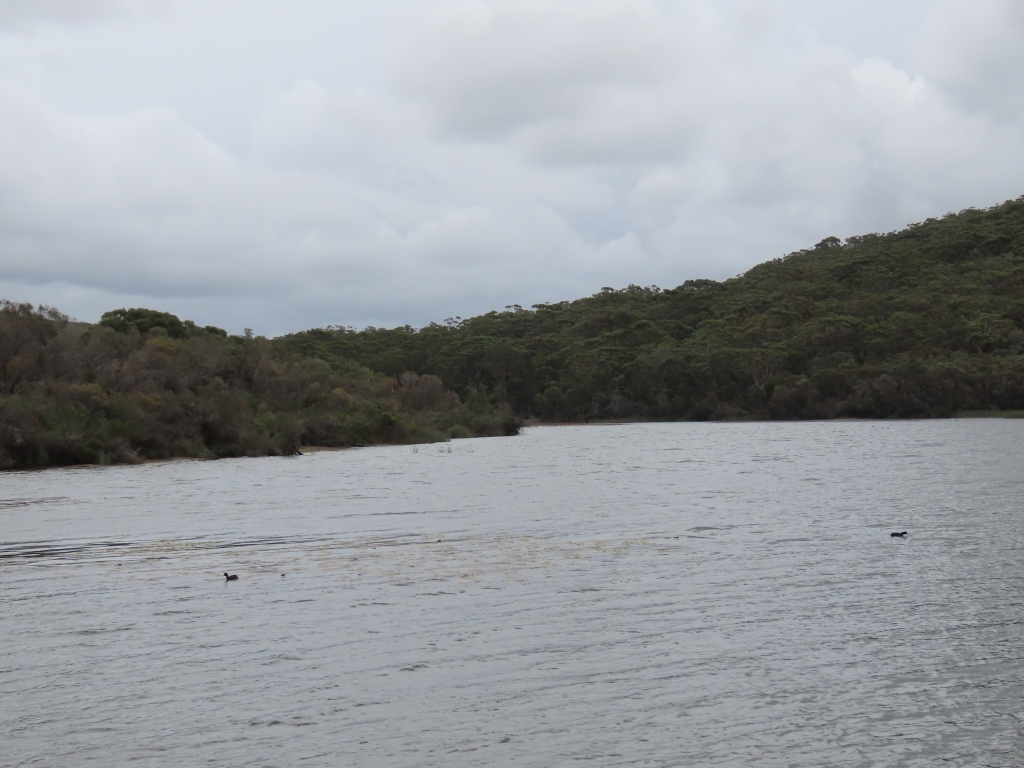
Common name: White-bellied Sea-Eagle
Scientific name: Haliaeetus leucogaster
Approximate length: 85 cm. Wing span: 2.2 m
Date spotted: 26 May 2023 (autumn)
Location: Manly Dam Reserve, New South Wales, Australia: 33°46’30.0″S 151°14’54.7″E

Two more Yellow-faced Honeyeaters!
A few weeks back, I saw my first ever Yellow-faced Honeyeater (recorded in this blog post). At that time, I was near the little town of Capertee, out west of Sydney. Since then, to my surprise, I’ve spotted two of them at my frequent haunt: Manly Dam on Sydney’s Northern Beaches.
The first occasion was when I was filming an Eastern Spinebill that was dipping itself into a quiet pool in the creek that feeds Manly Dam. Towards the end of the video, another bird flutters into view. It’s a Yellow-faced Honeyeater:
A couple of weeks later, I saw another Yellow-faced Honeyeater, this time in the forest on the southern shore of the dam (33°46’50.5″S 151°14’54.1″E):
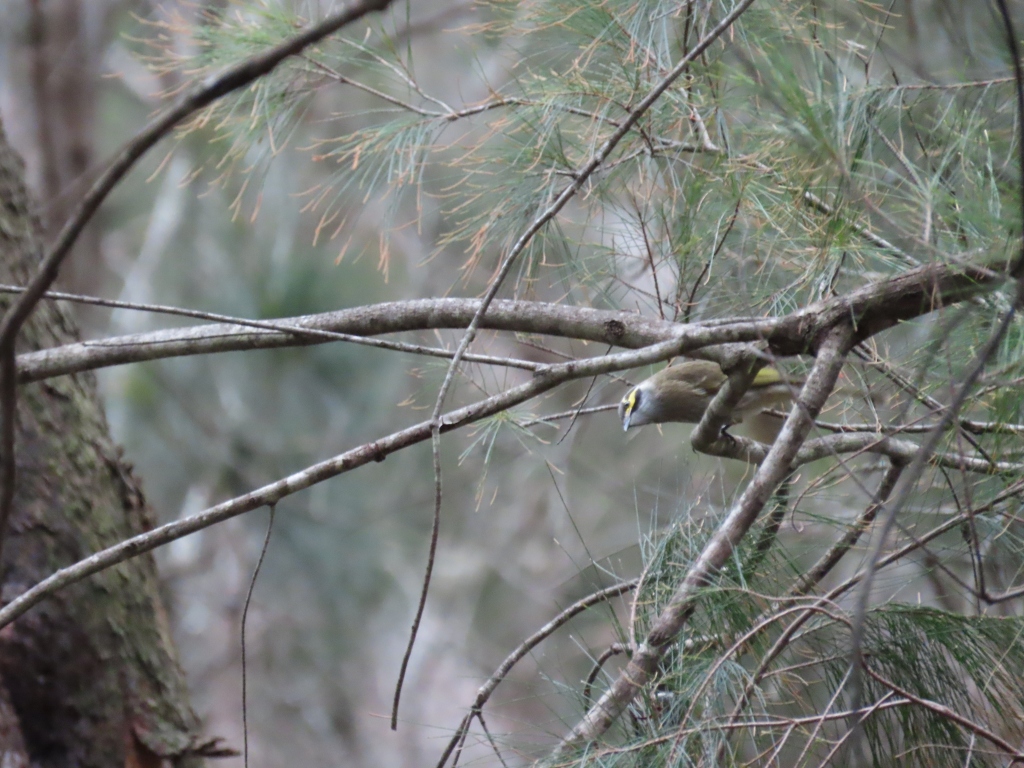
Common name: Yellow-faced Honeyeater
Scientific name: Lichenostomus chrisops
Approximate length: 16-18 cm
Date spotted: 14th and 26th May 2023 (autumn)
Location: Manly Dam, New South Wales, Australia: 33°46’50.5″S 151°14’54.1″E

Dinner? Red dragonfly looms over fly
“Come into my parlour,” said the dragonfly to the fly:
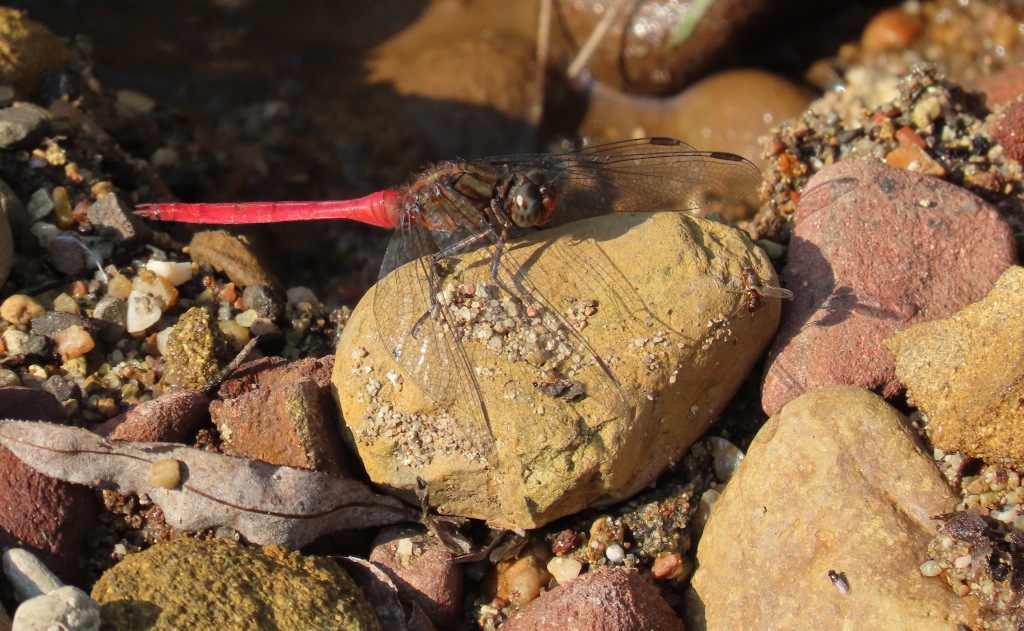
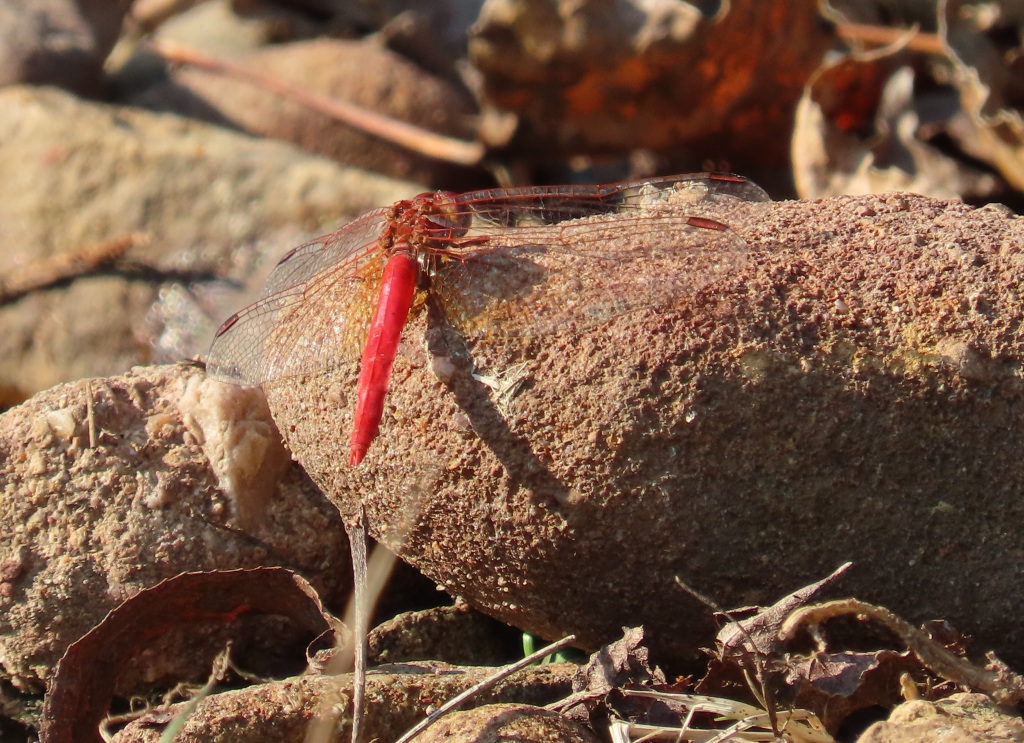
In the beautiful area of Cedar Creek yesterday, near Pokolbin State Forest, a red dragonfly sat on a rock. I took a couple of photos. When I zoomed in, I saw the fly almost under the dragonfly’s wings. The fly’s shadow gives it away. Another, smaller, fly, sits seemingly unaware on a nearby rock.
Here’s the dragonfly in a different pose:
Rainbow Lorikeet practising its dance
A Rainbow Lorikeet swooped down onto the branch of a Casuarina tree and treated me to a little dance. I think it was practising, because there were no other lorikeets around, and the bird’s movements weren’t as fluid as others I’ve seen. A little practice was needed before trying out the dance on a potential breeding partner!
Common name: Rainbow Lorikeet
Scientific name: Trichoglossus haematodus
Approximate length: 30 cm
Date spotted: 28 April 2023 (autumn)
Location: Manly Dam, New South Wales, Australia: 33°46’38.6″S 151°14’55.6″E

Royal Spoonbill at Manly Dam
This is only the second time I’ve ever seen a spoonbill, and the first time I’ve seen one at Manly Dam. This picture shows the wide, flattened end of the beak that gives the bird its name:

Royal Spoonbills are large birds, about 80 cm tall. In the breeding season, they have long white feathers trailing from their heads and can look quite magnificent. This bird, though, doesn’t have its breeding plumage. It was quite sleepy, dozing in the autumn sun, and I was lucky to catch it moving around.
Here’s another picture showing the head and beak in profile:
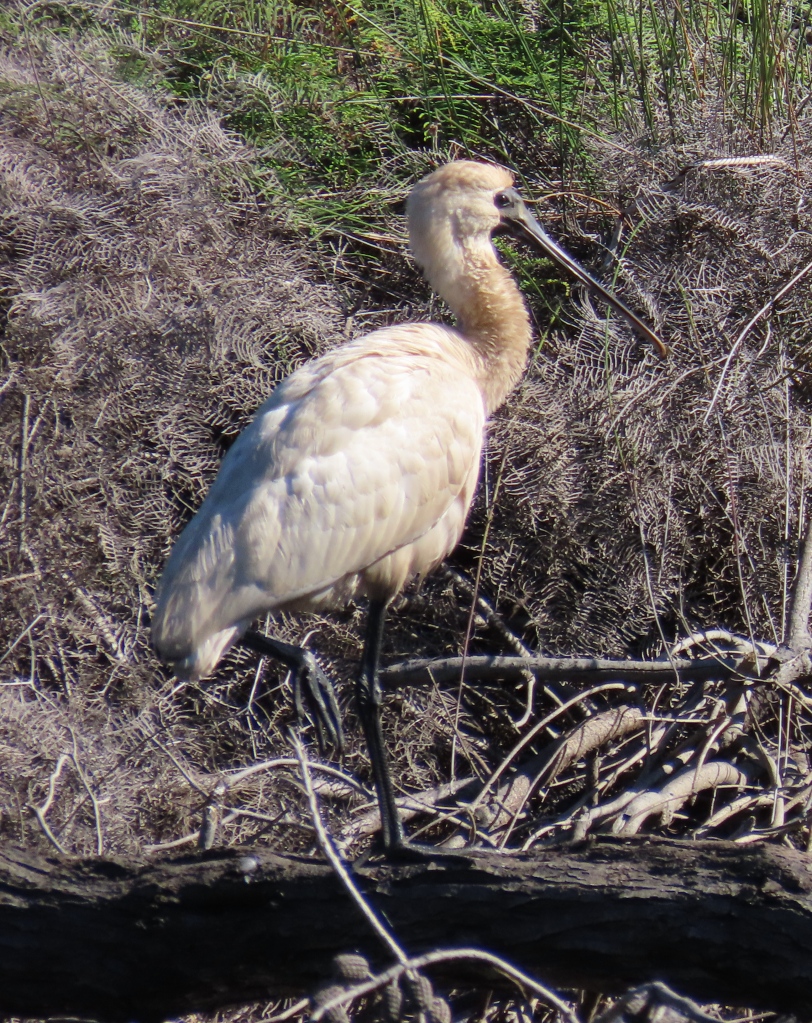
A while ago, I saw my first spoonbill at Manly Beach. That one did have its breeding plumage, and its feathers were a brighter white than today’s bird. Take a look at my post from October 2020. Today’s bird also lacks the white spot above the eye that adults have. It could be a juvenile, still to come into full plumage.
Common name: Royal Spoonbill
Scientific name: Platalea regia
Approximate length: 75-80 cm
Date spotted: 28 April 2023 (autumn)
Location: Manly Dam, New South Wales, Australia: 33°46’34.8″S 151°14’48.1″E

Yellow-faced Honeyeater near Capertee
Yet another first sighting for me: a Yellow-faced Honeyeater that I spotted during last week’s trip out west of Sydney. I was taking an early-morning walk in the countryside near the little town of Capertee. It’s gorgeous out there. Rolling hills, vistas of the Blue Mountains, Eucalypt forests, and green grassy clearings.
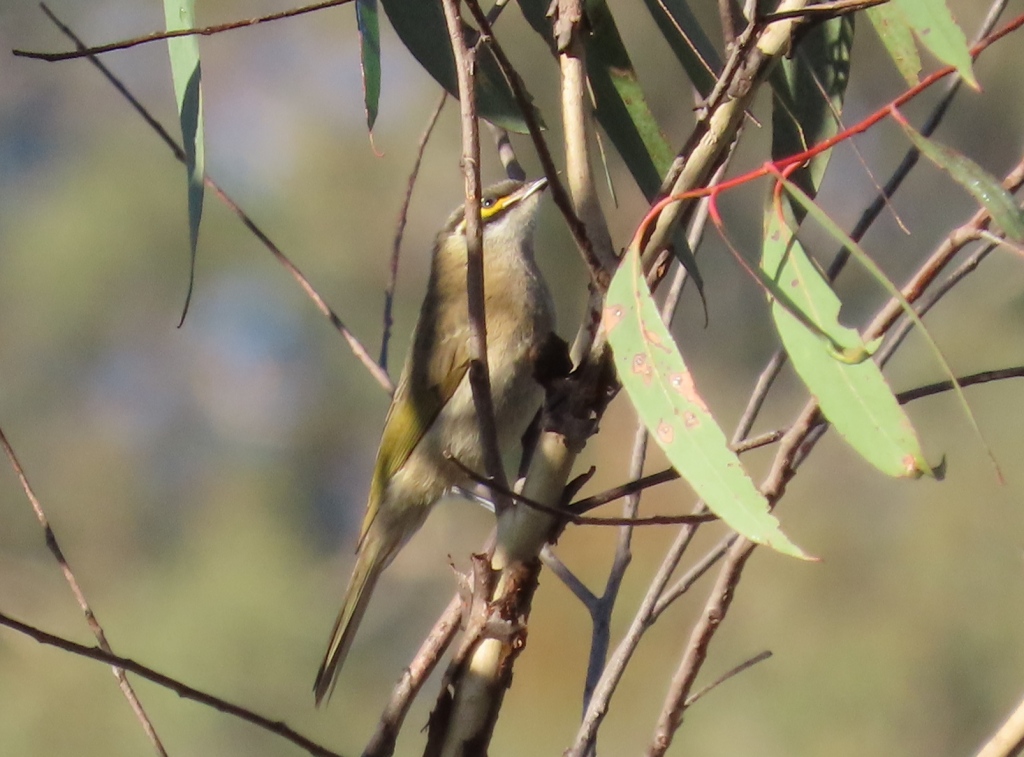
Yellow-faced Honeyeaters feed on manna, nectar, and small insects. They get their name from the yellow streak that runs across the face below the eye. The streak is bordered in black. Other colours on the bird range from off-white to grey-brown, with olive-yellow edges on the wings.
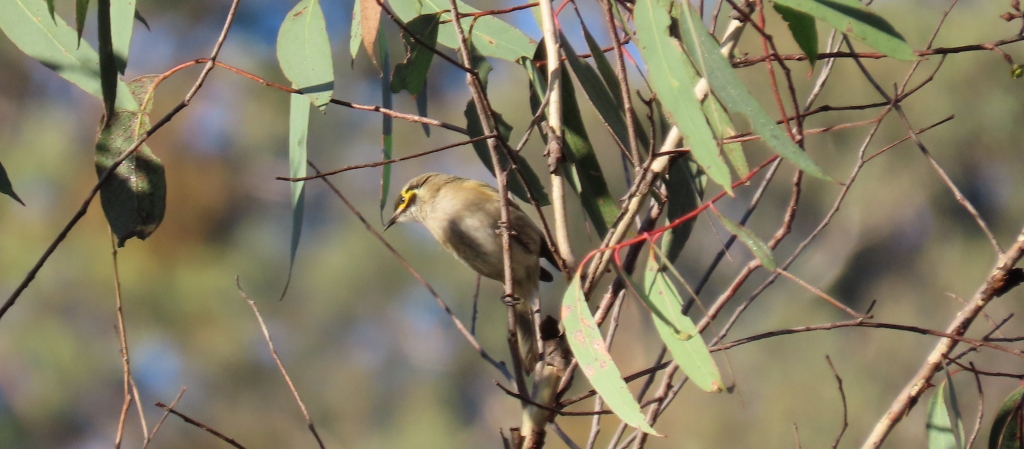
Common name: Yellow-faced Honeyeater
Scientific name: Lichenostomus chrisops
Approximate length: 16-18 cm
Date spotted: 23 April 2023 (autumn)
Location: Long Ridge, Capertee, New South Wales, Australia: 33°09’53.9″S 150°00’06.2″E

Wallabies and kangaroos near Capertee
Last week I was in a beautiful part of New South Wales, near a little town called Capertee to the west of the Blue Mountains. I’ve published a few blog posts about some birds in the area. Another group of creatures that caught my eye were the wallabies and kangaroos.
The wallabies in Capertee look quite different from those in my area near Sydney. I’m used to seeing Swamp Wallabies, also called Black Wallabies (here’s a recent post about them). They’re quite dark in colour, whereas the wallabies that I saw further west are a lighter grey-brown overall, with pretty black markings on their faces. They’re called Black-Striped Wallabies:
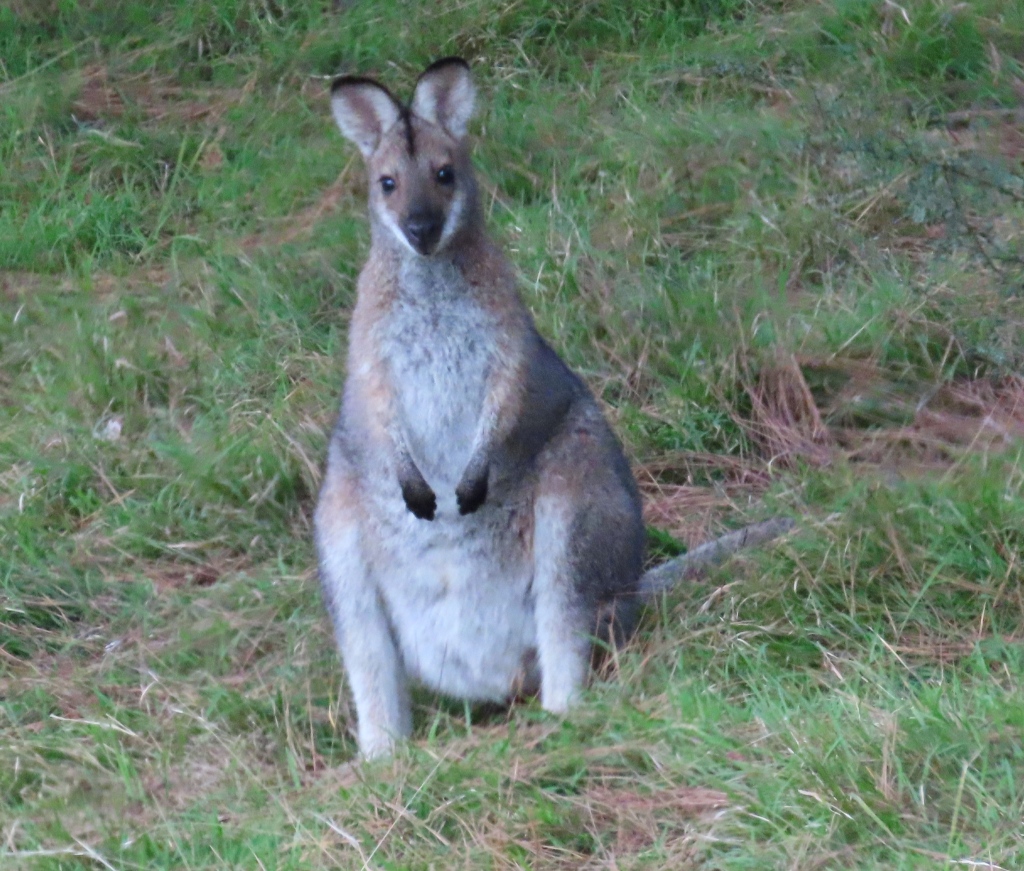
The Black-striped Wallabies are listed as endangered in New South Wales. Here’s another one:
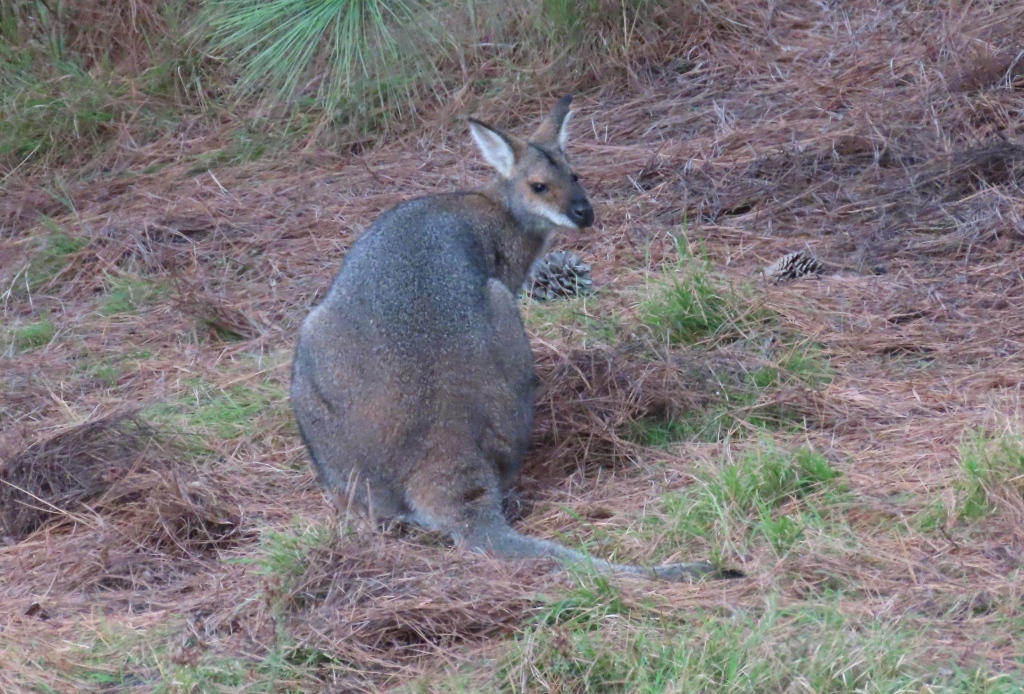
These wallabies are about 80 centimetres tall (31 inches), whereas Eastern Grey Kangaroos are much larger — up to two metres in height. Here’s one of the kangaroos that I saw on an early morning walk near Capertee:
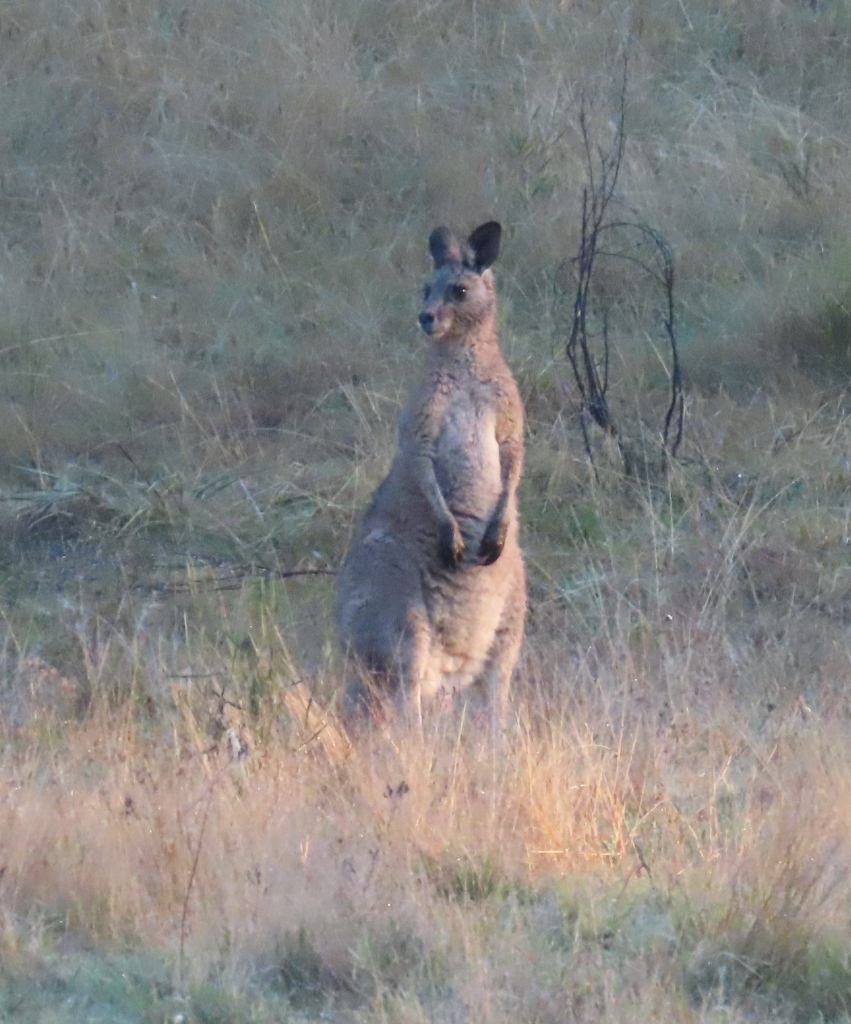
Capertee and surrounds are absolutely gorgeous. I’d highly recommend a visit!
White-throated Treecreeper near Capertee
This sighting is another first for me! I’ve always wanted to see a treecreeper — they have such a romantic name. This little one is a female White-throated Treecreeper:
It was racing up and down a tree trunk, as treecreepers do. The bright white throat flashed in the dim early morning light, catching my eye. The bird has a small red spot at the upper edge of the white patch (see the time stamp 0.04 and 0.11 in the video), which marks it as a female.
Common name: White-throated Treecreeper
Scientific name: Cormobates leucophaeus
Approximate length: 13-15 cm
Date spotted: 23 April 2023 (autumn)
Location: Long Ridge, Capertee, New South Wales, Australia: 33°09’53.9″S 150°00’06.2″E


 Sydney Birder