
Grey Goshawk in quiet contemplation
On a walk through the Australian forests near Sydney, I stopped on a rocky ledge to take in the view. Then I noticed a Grey Goshawk on a branch close by, also gazing out across the valley.
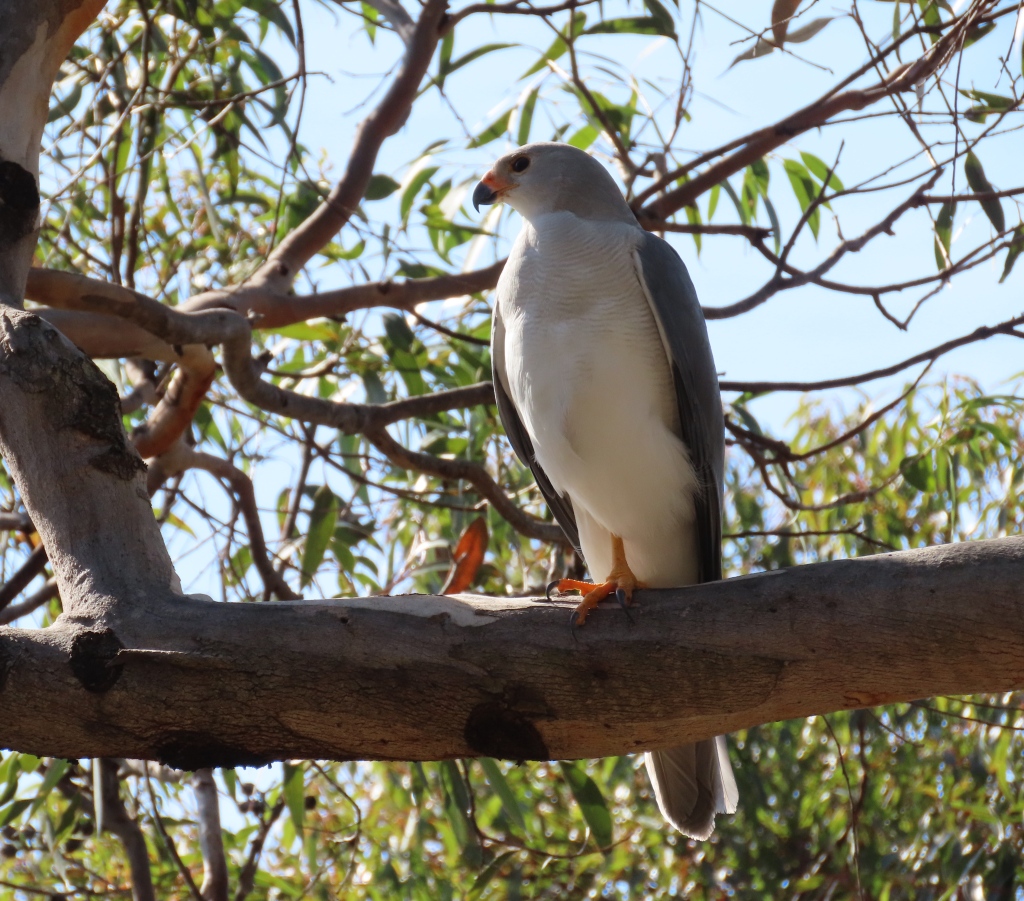
These beautiful birds of prey are quite sturdy, about 55 cm in length from head to tail, and have a wingspan of about one metre. Their chest and belly feathers are white with light grey horizontal bars. The head is grey, with large dark eyes outlined in yellow, and a yellow beak tipped in dark grey. Add the dark grey wings and tail feathers, and you have a very striking bird.
The goshawk was standing on one leg, with the other foot tucked under its belly feathers. The bird turned its head to see whether I posed it any danger, then went back to quiet contemplation of the view.

After five minutes or so, it hopped off the branch and glided away.
This is only the second time I’ve managed to snap some photos of a goshawk, though I’ve seen them a couple more times.
Common name: Grey Goshawk
Scientific name: Accipiter novaehollandiae
Approximate length: 40-55 cm. Wing span: 70-110 cm.
Date spotted: 4 August 2023 (winter)
Location: Manly Dam Reserve, New South Wales, Australia: 33°46’54.8″S 151°15’03.5″E

Pardalotes nesting on a Sydney beach
Pardalotes are unusual in that they build their nests underground, usually at around ankle height. This morning I spotted a couple of the birds flitting around a grassy bank on a beach in Sydney Harbour. With a bit of patience and the benefit of my camera’s super zoom, I was able to see the birds going in and out of their nesting tunnel.
The next video shows the male bird waiting on a tree branch until the coast is clear, then flitting off towards the nest:
Here’s the female, also checking for danger near the nest:
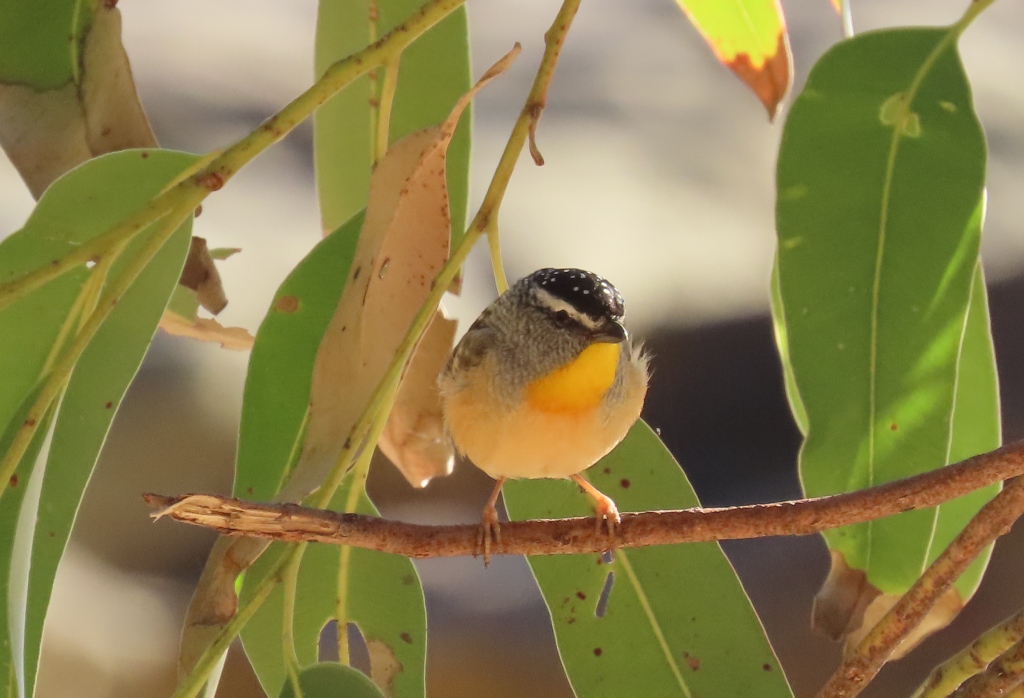
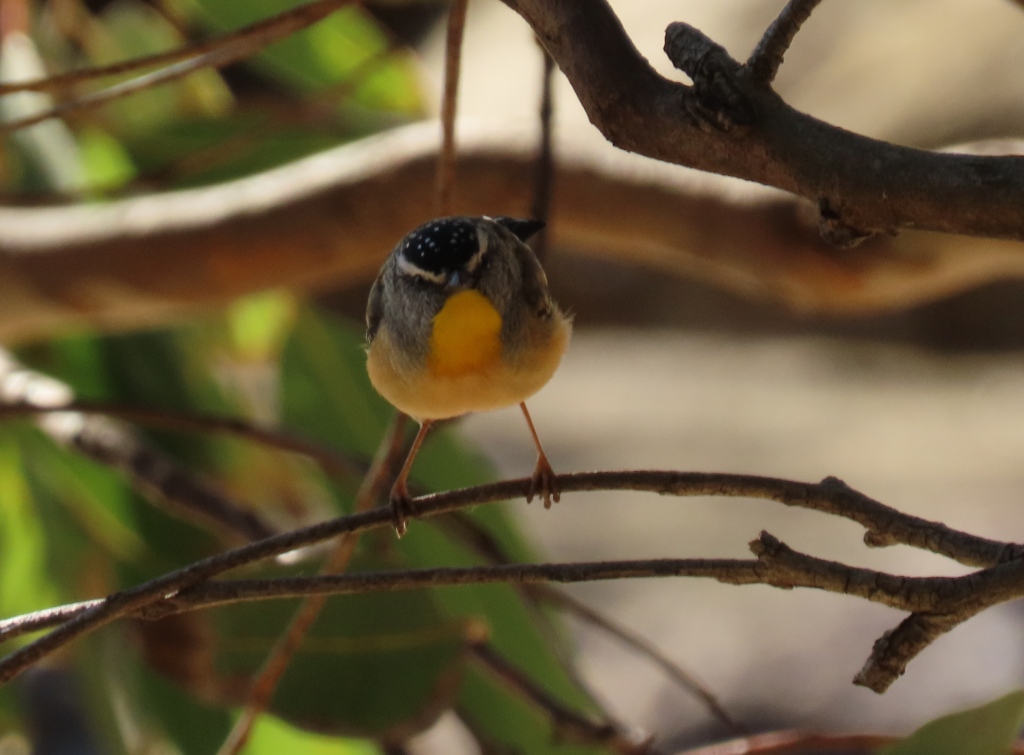
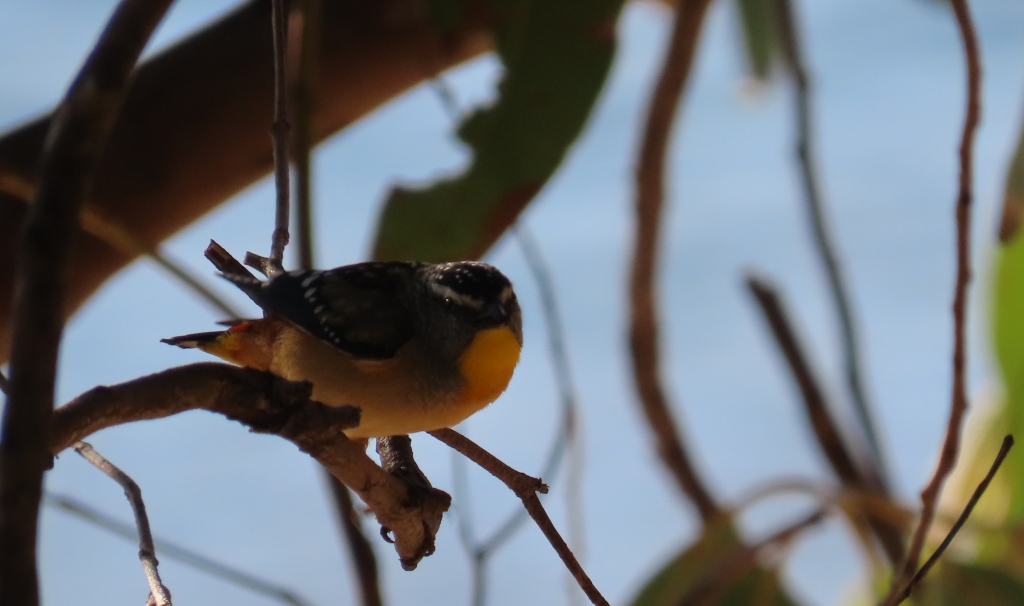
These are Spotted Pardalotes, also called Diamondbirds. They’re one of the smallest of Australian birds, at approximately 10 cm from head to tail. I’m often surprised at how unbothered they seem by my presence.
The female has a pale, faun-coloured chest. Her head and back are prettily dotted with spots, and her tail is aflame with red and yellow.

The male has an orange-yellow chest. The white stripes across its eyes are more pronounced than those of the femail, and there’s more black on the head and back, making the white spots stand out.
Common name: Spotted Pardalote or Diamondbird
Scientific name: Pardalotus punctatus
Approximate length: 10 cm
Date spotted: 29 July 2023 (winter)
Location: Reef Beach in Sydney Harbour

Spitfire grubs and Kookaburras
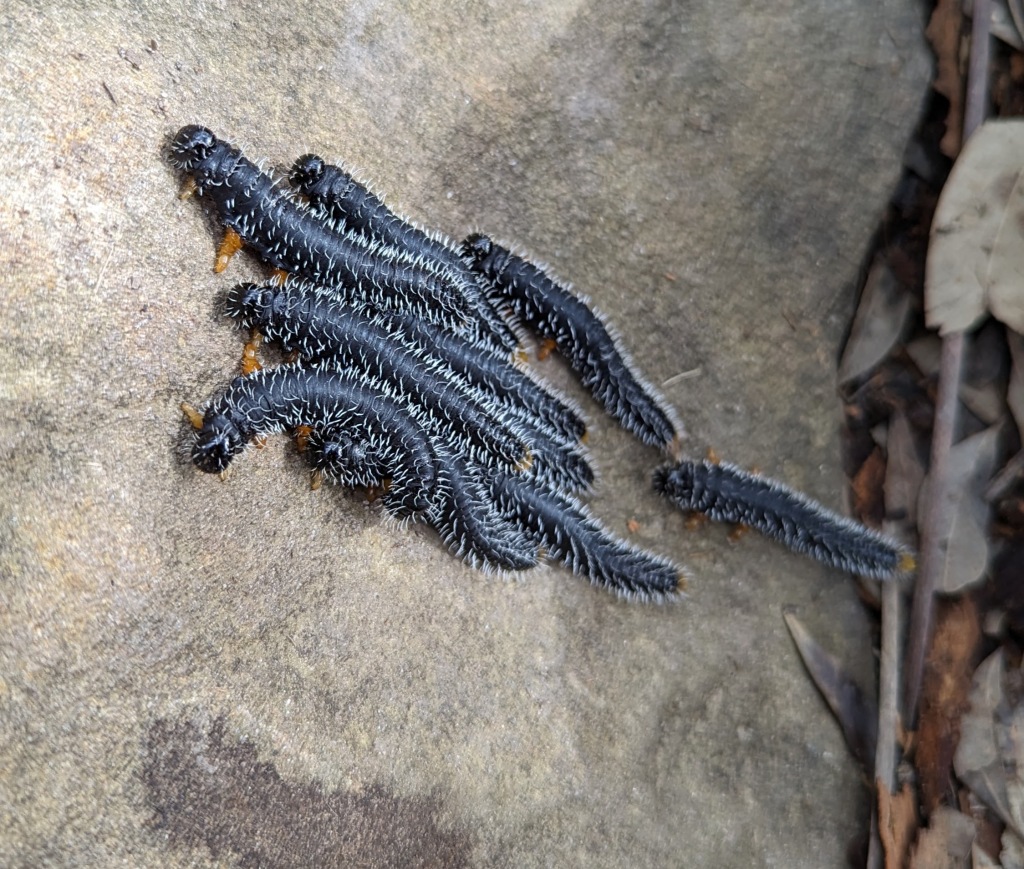
While wandering along a bush path, I came across a curious collection of grubs:
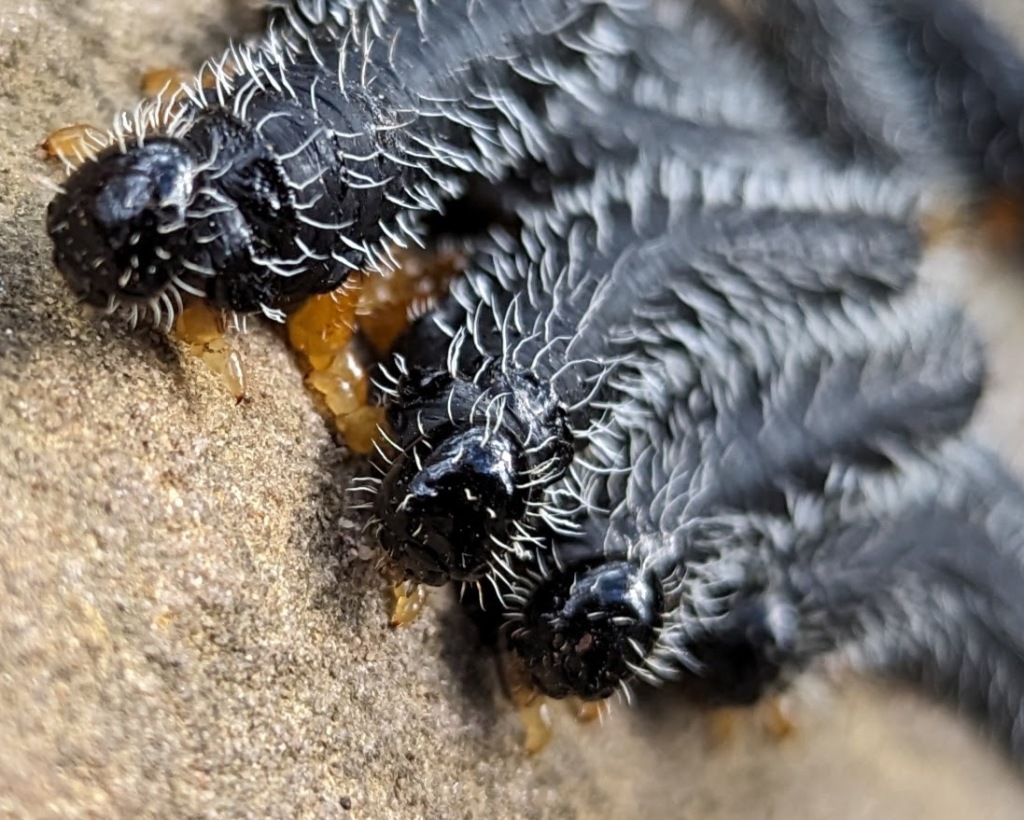
They’re spitfire grubs, which are the larvae of a type of wasp called a sawfly. The grubs look quite a lot like caterpillars with a don’t-mess-with-me attitude. They’re black and shiny, with white bristles, yellow feet, and a yellow tail. They’re quite long and fat: about the size of my little finger.
Despite the name “spitfire”, the grubs don’t actually spit anything, but if you touch them you can get a burning sting from the spikes. The grubs also spew out a thick yellow liquid from their mouths when threatened, but the liquid isn’t harmful to people. It’s made from eucalyptus oil, since the grubs feed on eucalyptus leaves.
In the video, you can see them tapping their tails on the rock. They do that to communicate their whereabouts with each other.
Here’s a close-up of some of their heads:
There were ten grubs in the clump:
Next on the scene was a riot of Kookaburras! The birds gathered above me while I was bent over the clutch of spitfire grubs. I was worried that the Kookaburras might swoop down and grab a grub as a snack!
The Kookaburras left the grubs alone. I guess they don’t taste great!
Common name: Laughing Kookaburra
Scientific name: Dacelo novaeguineae
Approximate length: 47 cm
Date spotted: 18 July 2023 (winter)
Location: Manly Dam park, New South Wales, Australia: 33°46’56.0″S 151°15’05.4″E

Spiffy little Red-browed Finches and a Pardalote
In the muted tones of a wintry day in the bush after rain, the green and red colouring of the Red-browed Finches stands out cheerily:
Red-browed finches are small (about 12 centimetres from beak to tail) and fast-moving. The red on their brow and tail can be quite vivid, as in this little one.

Common name: Red-browed Finch
Scientific name: Neochmia temporalis
Approximate length: 12 cm
Date spotted: 17 July 2023 (winter)
Location: Manly Dam park, near Sydney: 33°46’48.7″S 151°15’03.9″E
There were a couple of Pardalotes hopping around too:
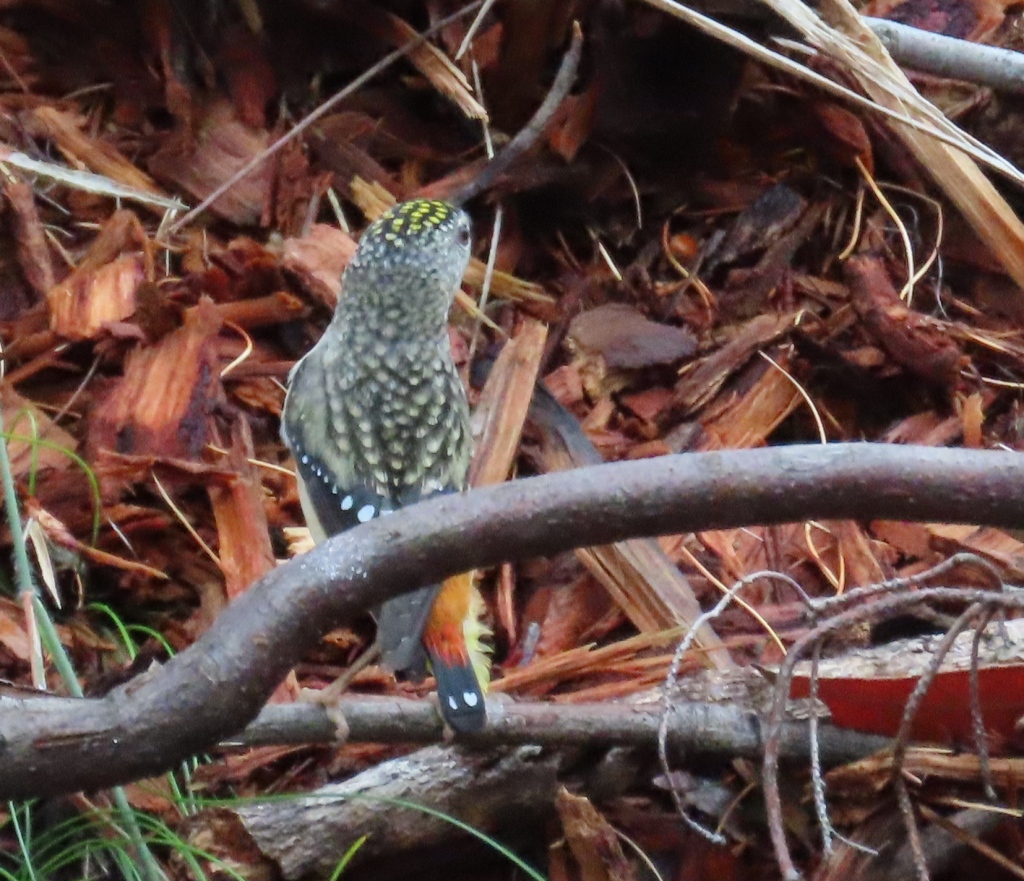
I’ve shown better pics of Pardalotes in earlier posts.
Common name: Spotted Pardalote
Scientific name: Pardalotus punctatus
Approximate length: 10 cm
Date spotted: 17 July 2023 (winter)
Location: Manly Dam park, near Sydney: 33°46’48.7″S 151°15’03.9″E

Yellow-faced Honeyeater at entrance to Manly Dam
As I was walking through the gates at Manly Dam park, I heard this little Yellow-faced Honeyeater in the bushes at the roadside:
These birds move very fast, as you can tell from the video. It was only a few months ago that I saw my very first one. Now that I know what they are, I’ve seen a few of them. They have a distinctive yellow stripe running under the eye.
Here’s a still photo of the bird:

Common name: Yellow-faced Honeyeater
Scientific name: Lichenostomus chrisops
Approximate length: 16-18 cm
Date spotted: 10 July 2023 (winter)
Location: Manly Dam, New South Wales, Australia: 33°46’58.0″S 151°15’21.0″E

Another gorgeous Red-bellied Black Snake
This was my third encounter with a Red-bellied Black Snake in three months! And that after never seeing one before.
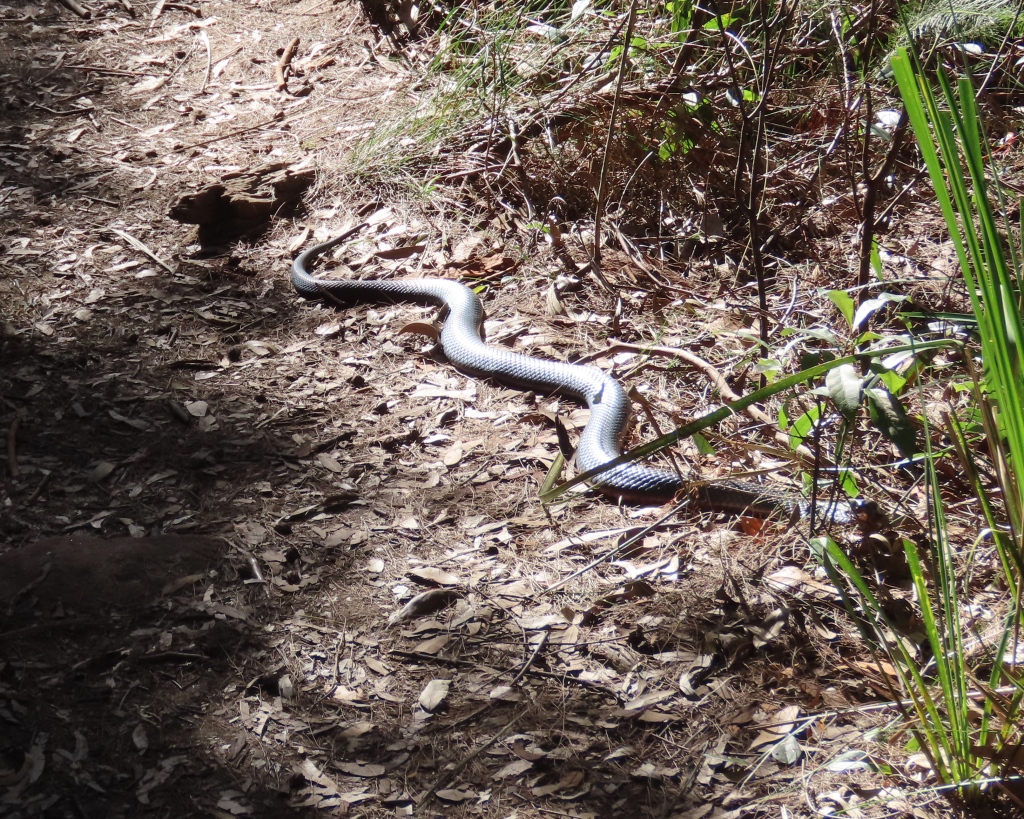
The snake was lying in the sun on the side of the walking track. I stopped to wait for it to move away. It was a big snake!
Red-bellied Black Snakes (Pseudechis porphyriacus) are quite large in comparison with other snakes I’ve seen. They’re a dark, shiny black on top, with a glowing red tinge underneath. You can see a bit of the red under-belly in this close-up of the snake’s head:
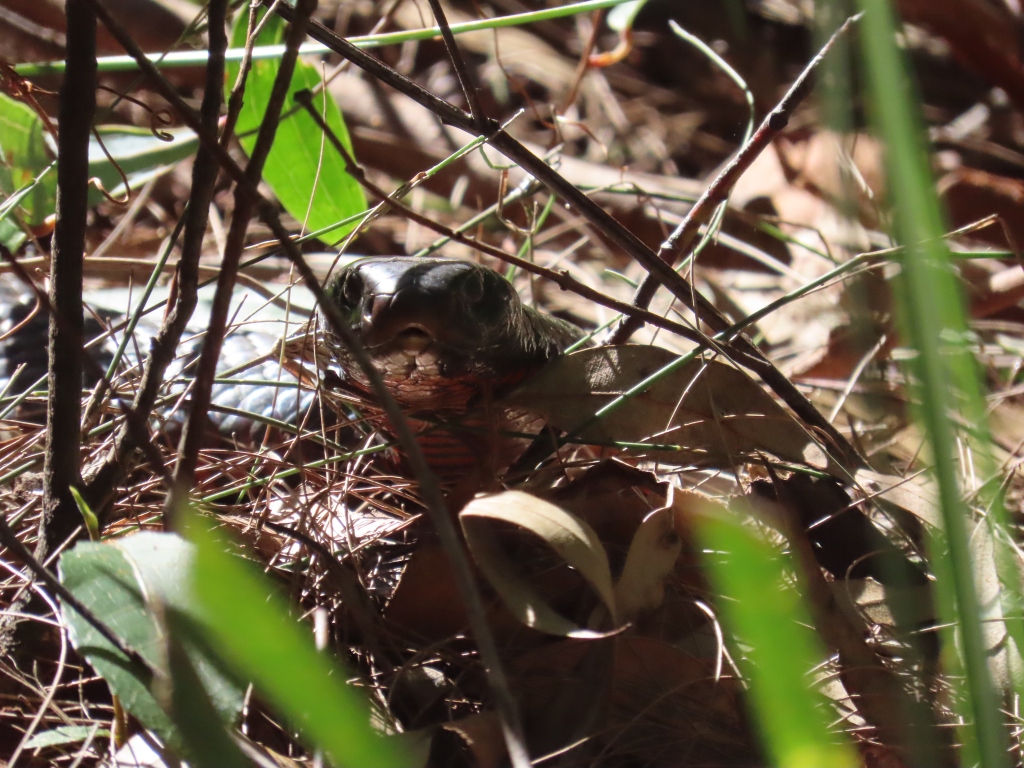
This snake was at Manly Dam (location on the map) where I often walk. My first encounter with a red belly happened near the Turon River, quite a way from my usual haunts. I posted a photo and video of that snake in another blog post. My second encounter was just a couple of weeks ago, a few hundred metres away from today’s snake at Manly Dam. It might have been the same snake.
Evidently the venom of Red-bellied Black Snakes isn’t as harmful to humans as some of the other snakes in these parts, but it can still make you quite ill. So it’s a good thing to give the snake its space. This one just watched me carefully. When I moved back, it slowly crossed the path in front of me and took shelter in the undergrowth. As I passed, I could see its head and flickering tongue as it watched me go.

My first Lewin’s Honeyeater
Australia hosts several types of honeyeater, and I’ve spotted a few of them over the lifetime of this blog. Recently I saw my very first Lewin’s Honeyeater:
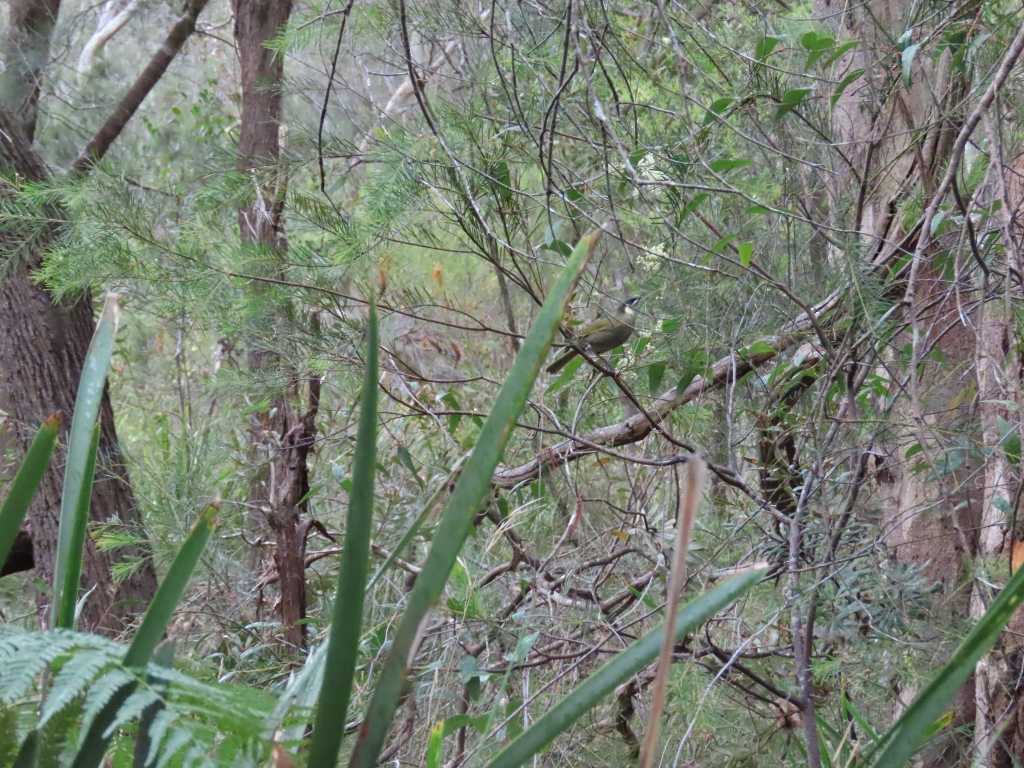
Lewin’s Honeyeater is a medium-sized bird. As is the case with other honeyeaters, nectar forms a major part of their diet. They also eat fruits and insects. They have a distinctive, crescent-shaped yellow ear patch as well as a light yellow stripe under each eye.
According to my bird book, they’re “abundant”, especially in the wetter areas of eucalypt forests. I’ll keep a look out now that I know they’re around.
Common name: Lewin’s Honeyeater
Scientific name: Meliphaga lewinii
Approximate length: 19-22 cm
Date spotted: 5 June, 2023 (winter)
Location: Manly Dam Reserve, New South Wales, Australia: 33°46’47.6″S 151°14’53.2″E

Female Golden Whistler?
It’s taken me ages to identify this bird. At first I thought it was a robin of some sort, but the colouring isn’t quite right. My best bet is a female Golden Whistler:
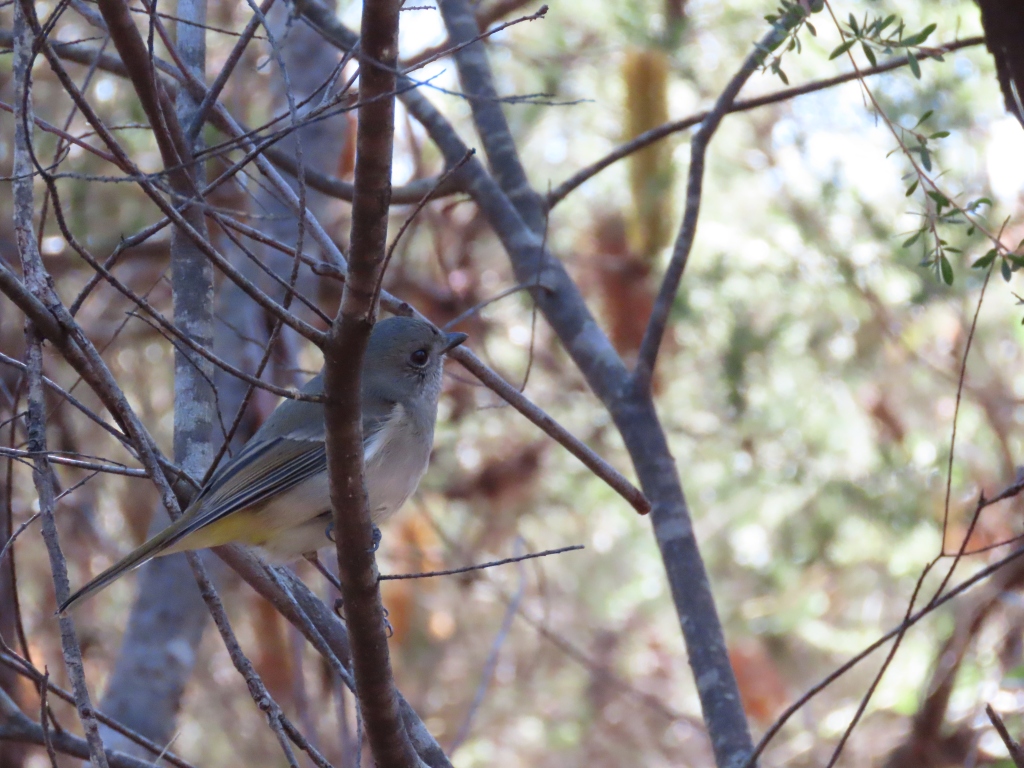
The bird is small and neat, with large dark eyes. It’s mostly grey in colour, with a striking yellow patch under the tail and olive hints on the wings. The bird was quite inquisitive, and perched not far off to examine me, with a green twig in its beak.

I’ve filmed male Golden Whistlers before: pictures and videos of the Golden Whistler’s song.
Common name: Golden Whistler
Scientific name: Pachycephala pectoralis
Approximate length: 16-18 cm
Date spotted: 16 June, 2023 (winter)
Location: Manly Dam Reserve, New South Wales, Australia: 33°46’52.4″S 151°15’07.2″E

Grey Fantail waving its tail
Grey Fantails are fairly common around my neck of the woods. The problem is that they move so fast, it’s hard to get them in a camera frame. A couple of days ago, one of the little birds kept going back to the same tree to show off its skills. So, with a bit of patience, I was able to get some video footage:
In the video, you can see the bird’s typical behaviour pattern: it makes its way up a tree trunk, waving its tail, then it drops suddenly down to ground level, before starting again. In the background, the orange Banksia flower heads glow in the sunlight.
Here’s a still picture of that fanned tail catching the light:
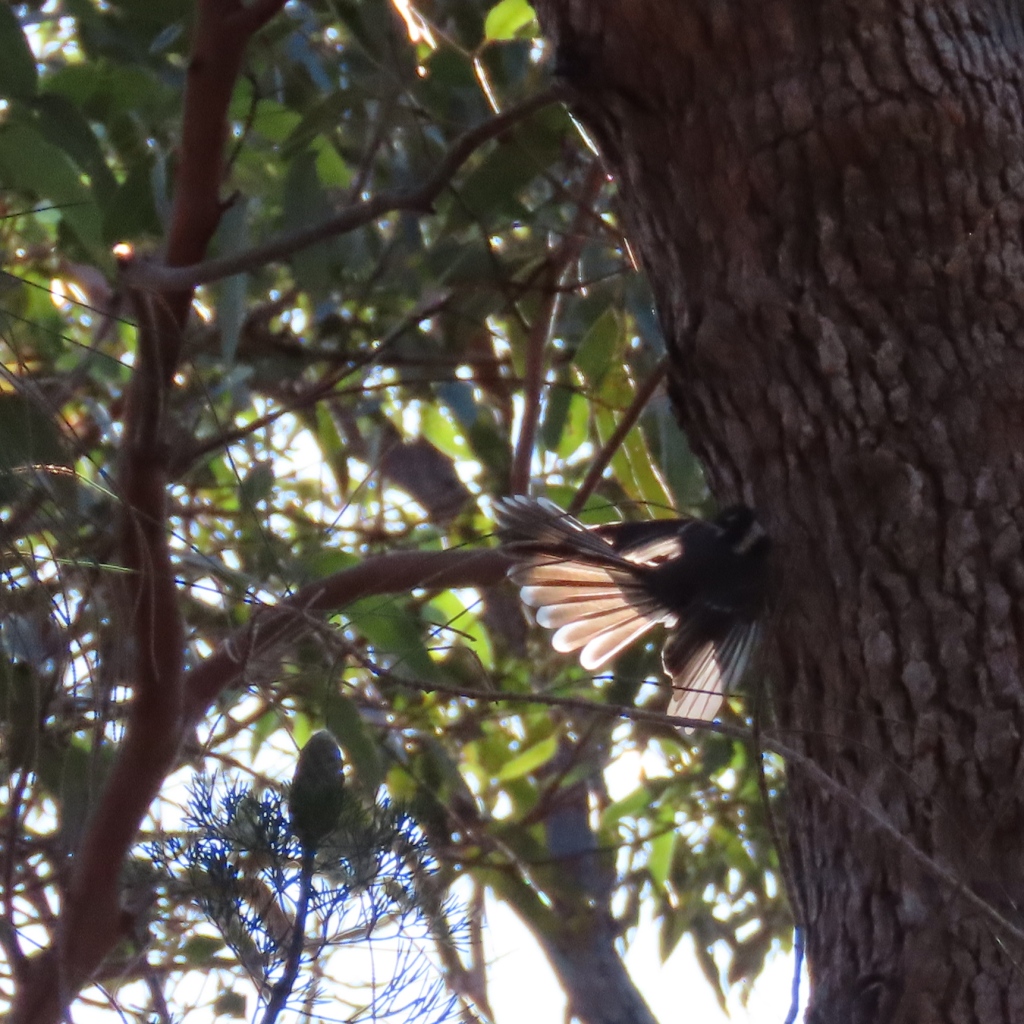
A couple of slightly-fuzzy images give you a better idea of what the bird looks like:
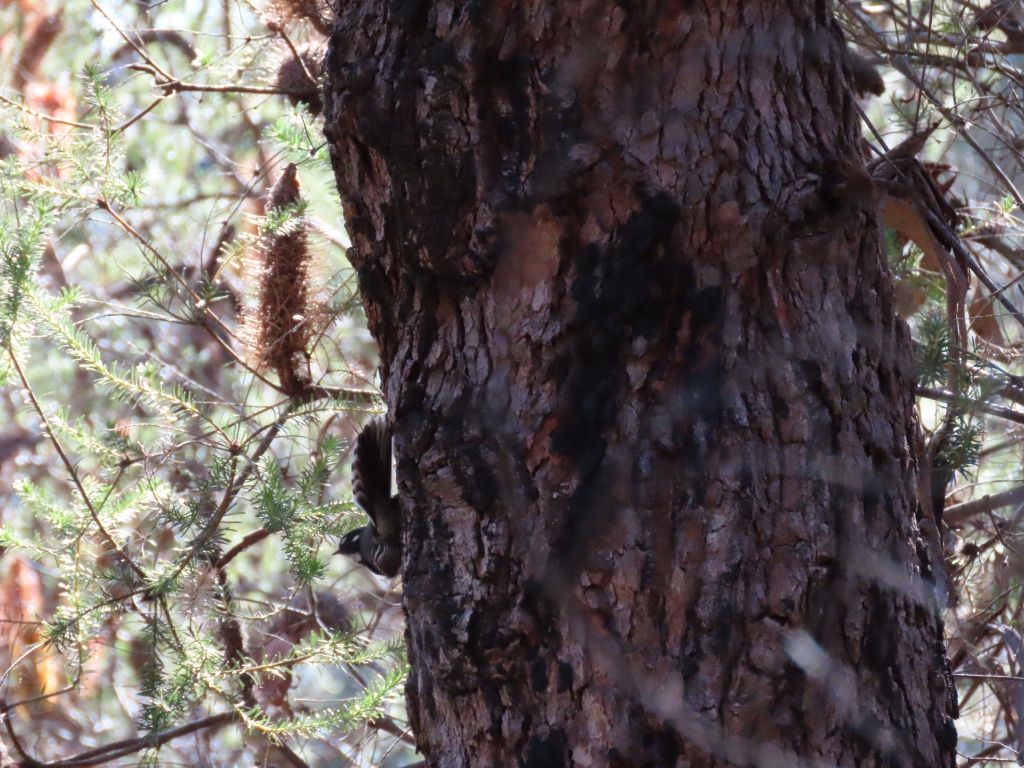
It’s a small bird (about 15 cm from head to tail). This one is quite dark in colour, with its black head and collar markings below the white throat.
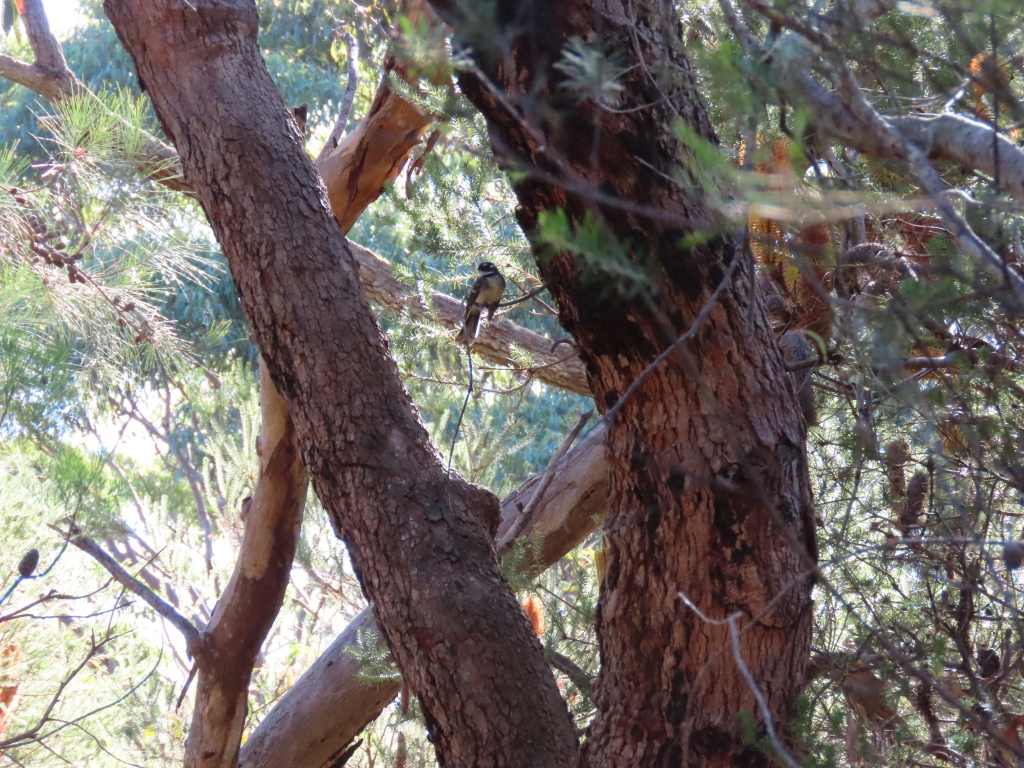
A few weeks ago, I saw another Grey Fantail in a location close to this one. Both birds were on the shores of Manly Dam, about 700 meters apart. This one is quite a lot lighter in colour:


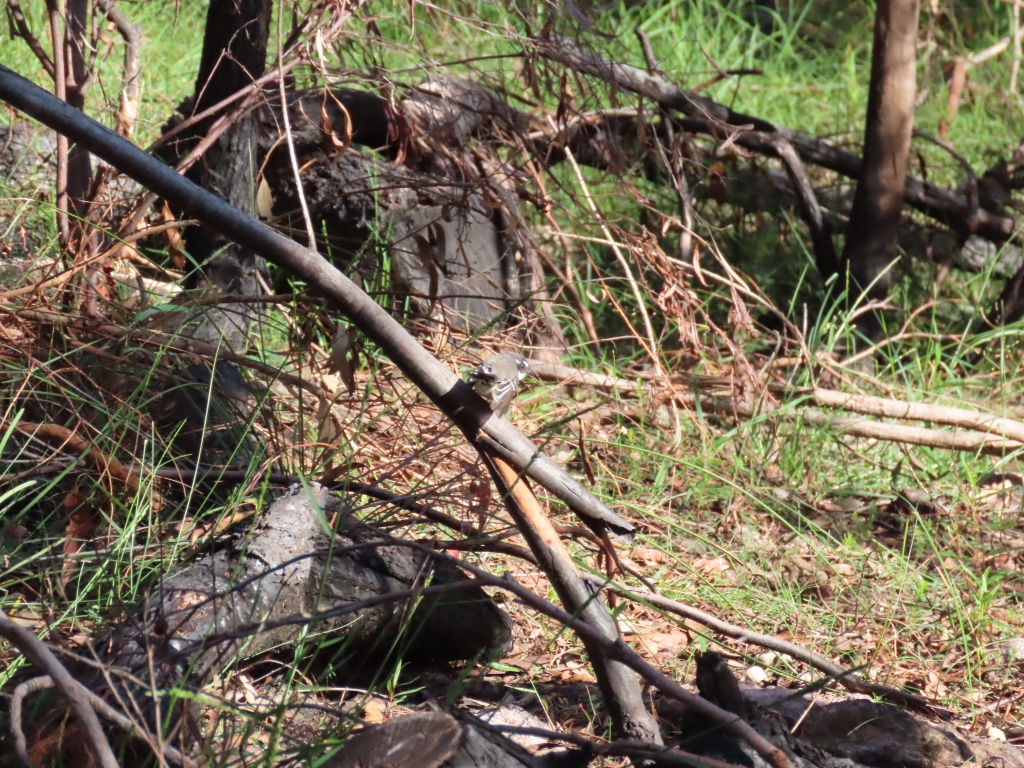
If you’d like to hear what Grey Fantails sound like (squeaky) or see other videos and photos of these birds, check out the list of my fantail blog posts.
Common name: Grey Fantail
Scientific name: Rhipidura fuliginosa
Approximate length: 14-17 cm
Date spotted: 16 June and 10 June, 2023 (winter)
Location: Manly Dam Reserve, New South Wales, Australia: 33°46’52.4″S 151°15’07.2″E and 33°46’37.9″S 151°14’48.5″E

Post-fire scenes from the Australian bush
The National Parks and Wildlife Service recently conducted a hazard reduction burn in one of my favourite bush-walking areas. The NPWS lights these controlled fires to burn away excess vegetation, which reduces the chance of a more severe fire raging out of control during fire season.
Many of the plants in the Australian bush are adapted to cope with fires. For example, these Hakea seedpods popped open after the fire, allowing the seeds to escape:
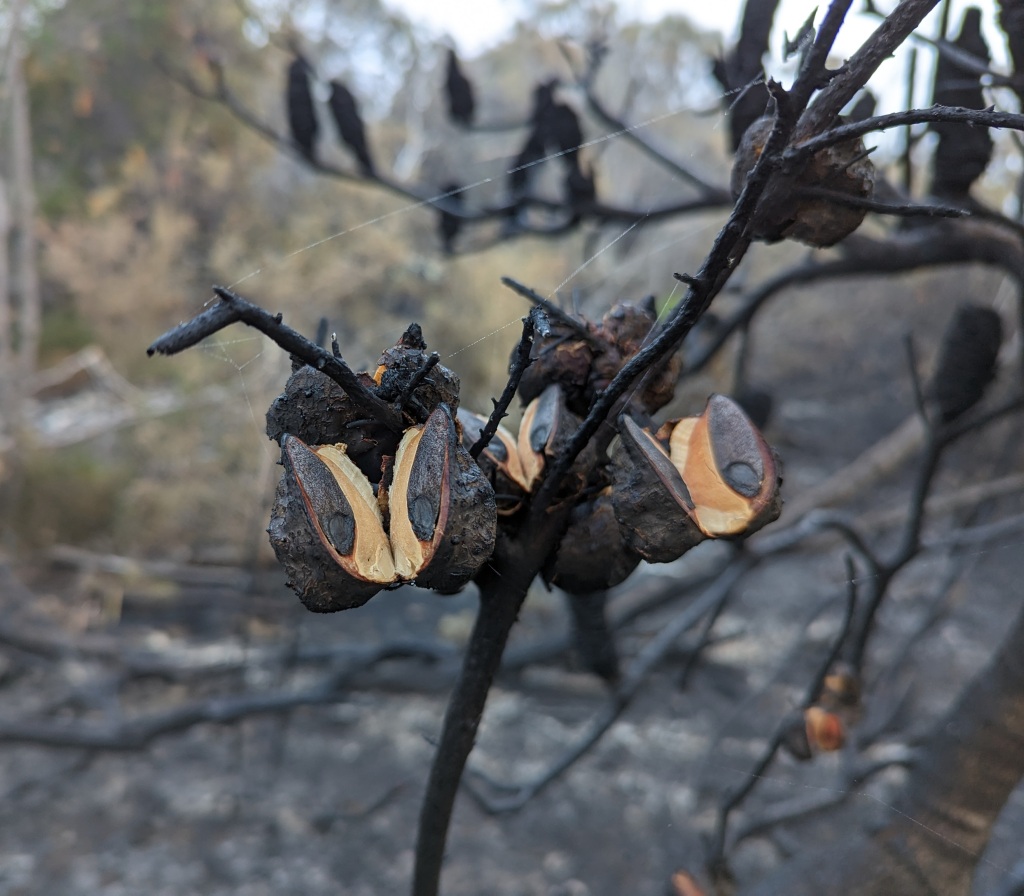
The above seed pods have both seeds still in place — the seeds are black and oval-shaped. Each seed is attached to a thin membrane, which acts as a wing: when the seed is released, it spirals gently to the ground. If there’s any wind around, the seed can travel a short distance from its parent bush.
In the next photo, only one of the seeds remains in the pod:

The next photo shows the seed head of a Banksia bush, also popped open to release the seeds. The open pods look like smiling mouths:

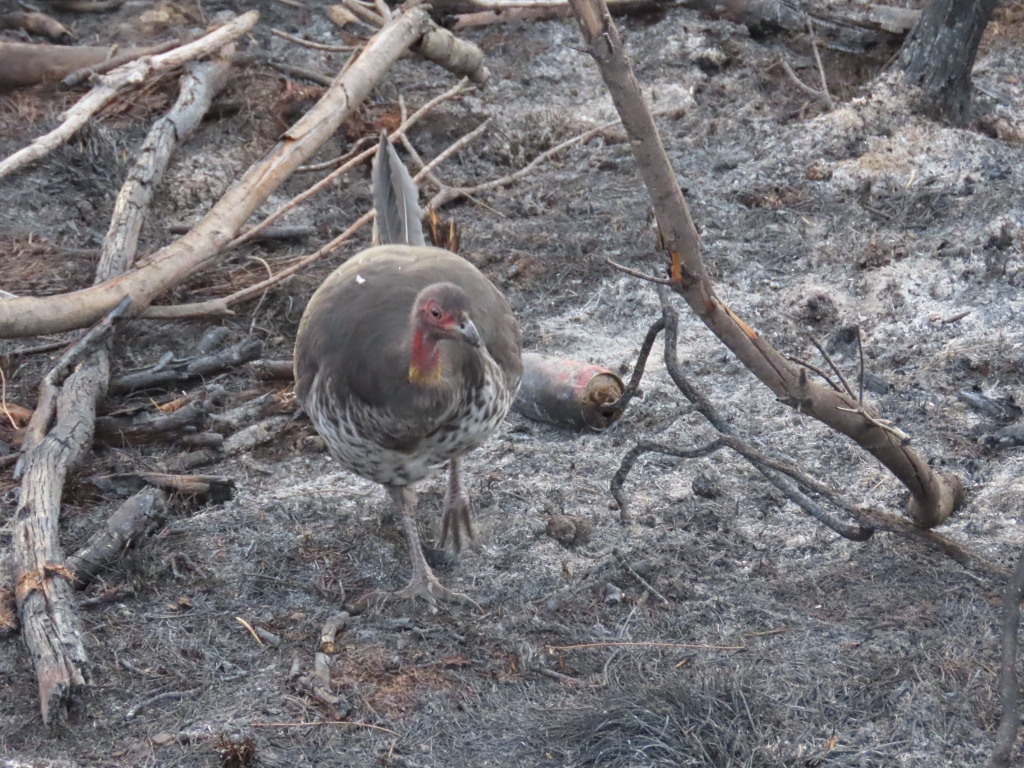
An Australian Brush-turkey wanders over the ashes, looking for pickings. A discarded can echoes the bird’s colouring:
Nearby, Australian Ravens look for insects and other goodies:

A Currawong keeps a watchful eye over the proceedings:

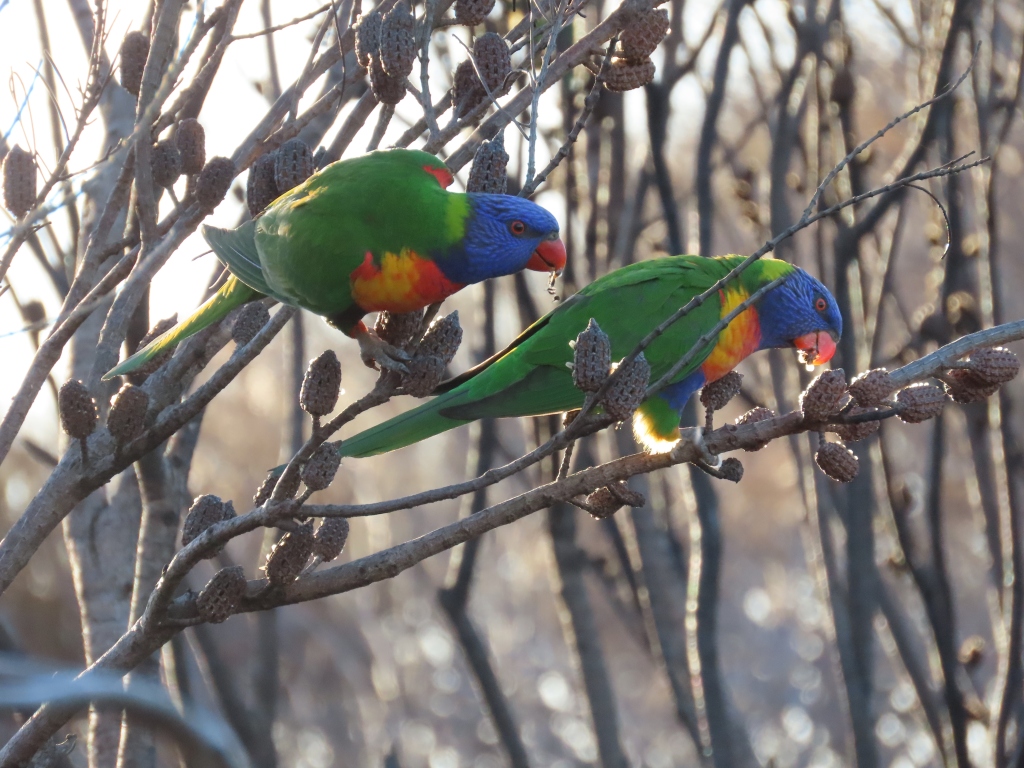
A Rainbow Lorikeet adds a splash of colour, hoping to snag a Casuarina seed or two:
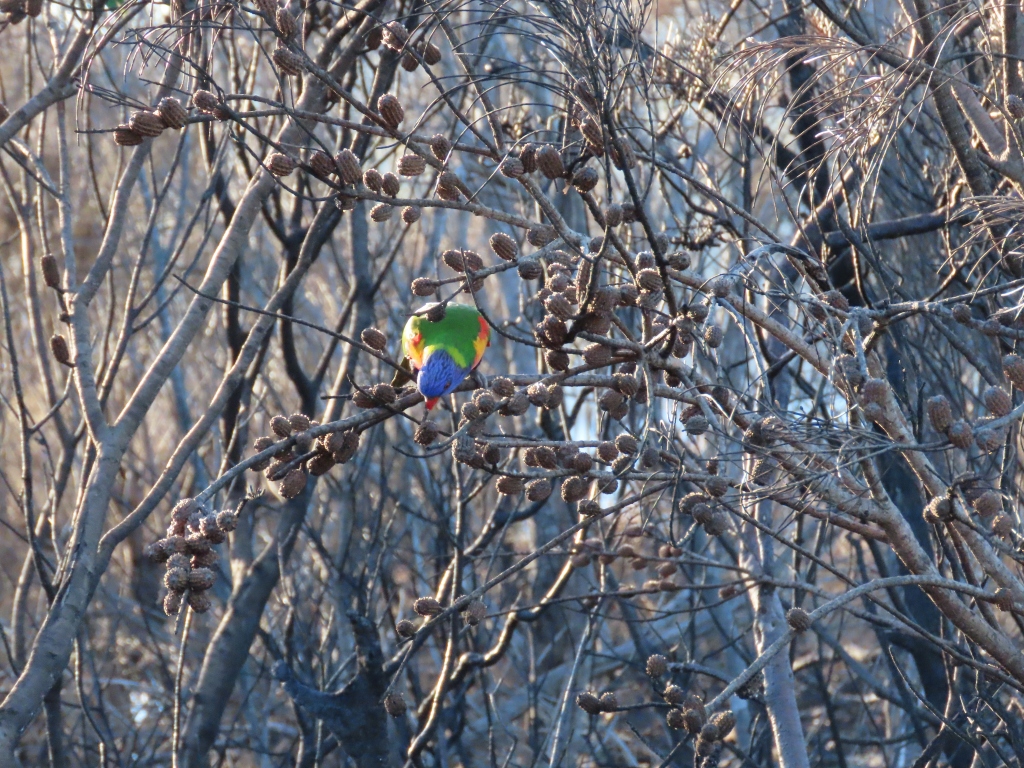
It’s much easier to grab a seed now that the fire has dried out the seedpods!
A week later, a Swamp Wallaby shared the browns and greys of the burned area too:
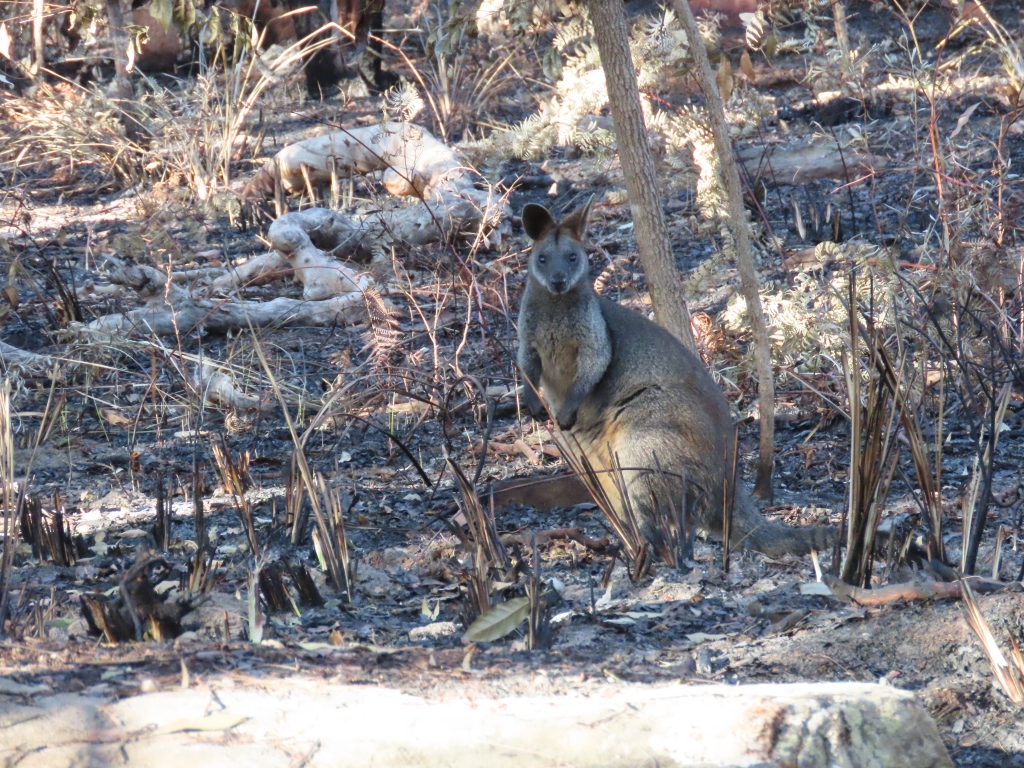
Here’s a video of the wallaby. At one stage, a plane flies overhead and a group of birds squawk loudly. The wallaby looks at me, checking whether I’m the cause of the disturbance, then goes calmly about its business:
To close, here’s a restful scene of the post-fire forest in the early morning light:

Date spotted: Early June, 2023
Location: Dobroyd Head, Sydney Harbour, NSW, Australia; between this point and this point on the map.


 Sydney Birder