
Speckled Warbler in Capertee
This is a first sighting for me. I spent last weekend beyond the Blue Mountains, about three hours’ drive west of Sydney. During my early morning walk in the countryside near Capertee, this attractive little bird alighted long enough for a photo:

I’m pretty sure it’s a Speckled Warbler. It’s small and round, clad in tones of yellow and brown. The top of its head is chestnut brown with lighter stripes, and its breast and belly are a light yellow with brown stripes. The eyes are quite large, relatively speaking. It looks to have a reddish-brown line above its brow, which means it’s a female.
Here’s a slightly different angle:
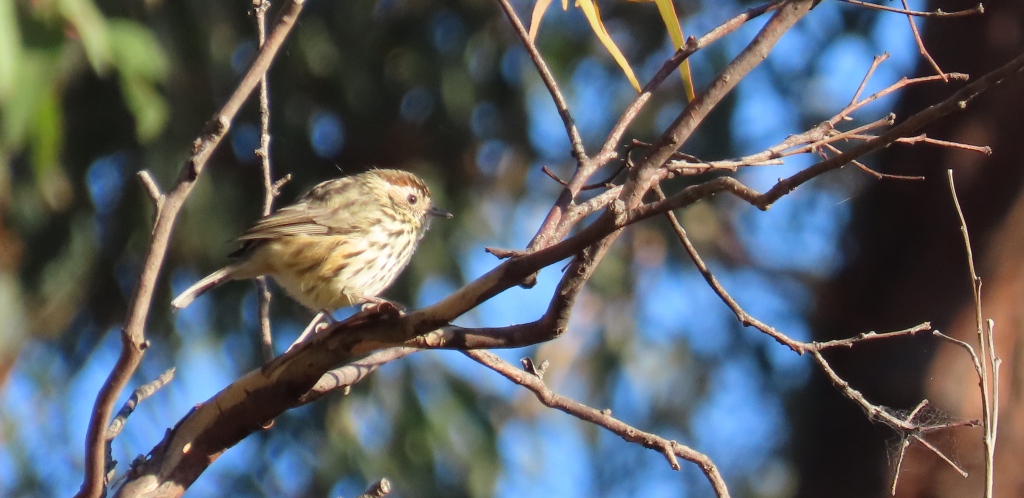
According to my bird book, these birds are scarce to moderately common, depending on geographical area. They’ve been spotted mostly west of the ranges, which is exactly where I saw this bird.
Common name: Speckled Warbler
Scientific name: Chthonicola sagittata
Approximate length: 12-13 cm
Date spotted: 23 April 2023 (autumn)
Location: Long Ridge, Capertee, New South Wales, Australia: 33°09’53.9″S 150°00’06.2″E

Bell Miners heard, and spotted at last!
Bell Miners, often called bellbirds, are well known in parts of Eastern Australia. We don’t have them in the area where I live, but I’ve heard them often when visiting nearby places. The odd thing is, though, that I’ve never before managed to actually see a Bell Miner. Until this weekend.
I was visiting the area of Capertee, about three hours’ drive west of Sydney. Bell Miners were chiming away in the trees:
For a while, as usual, I couldn’t spot a bird. There aren’t any clearly visible in the video either. Then, a flash of olive green, and a bird alighted for a brief moment:

The image is fuzzy, because I didn’t have time to focus on the bird. But at least I now know what they look like!
Here’s another Bell Miner in the same tree. This time it’s a juvenile bird, darker in colour than the adult:

Common name: Bell Miner, often called bellbird
Scientific name: Manorina melanophrys
Approximate length: 18-20 cm
Date spotted: 22 April 2023 (autumn)
Location: Long Ridge, Capertee, New South Wales, Australia: 33°09’53.9″S 150°00’06.2″E

Water dragon chillin’ in a tree
This Australian Water Dragon has draped itself over a tree branch, catching some sun on a cool wintry morning:
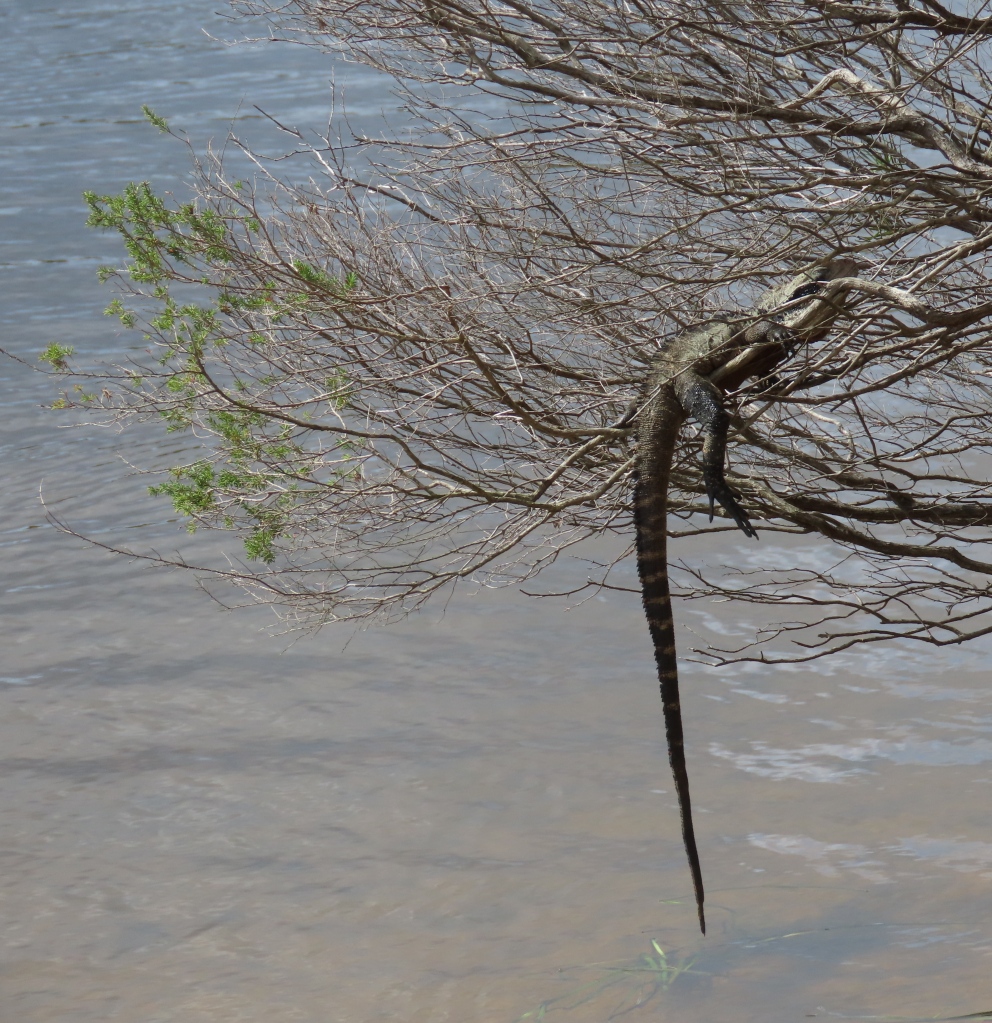
Here’s a close-up of that lovely head, eye closed in a lazy doze:
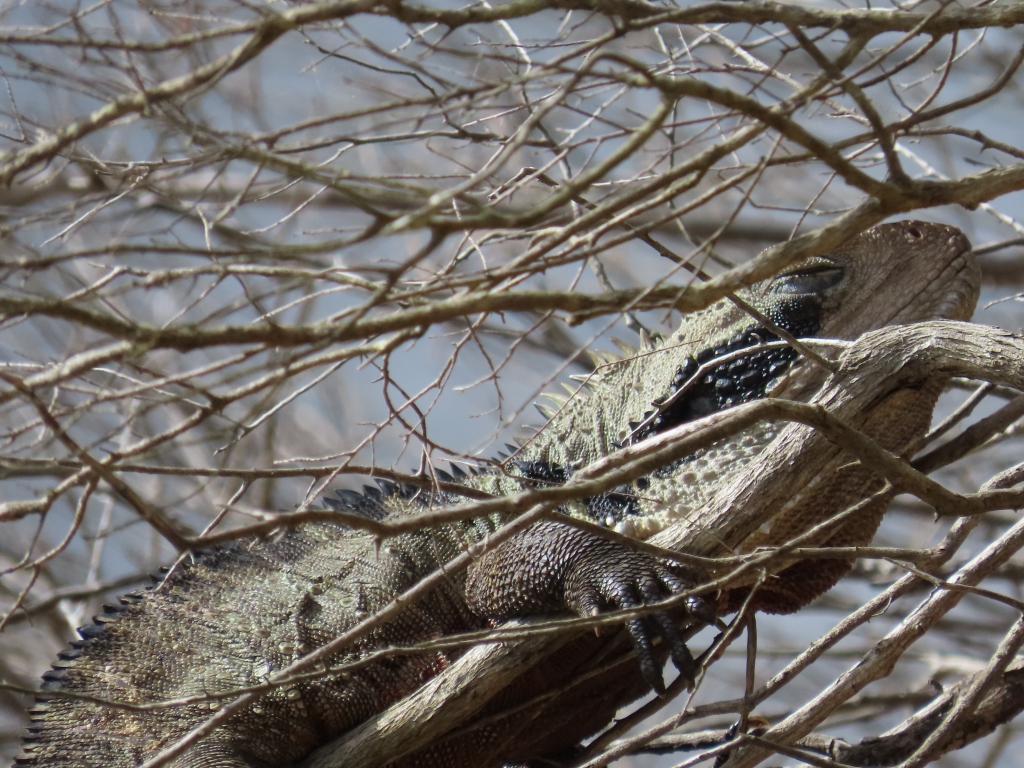
Australian Water Dragons (Intellagama lesueurii) are large dragon lizards, reaching a length of more than two metres. During the cold winter months, they burrow a hole for themselves, then slow down their metabolism and go into a state of brumation. We’re in the middle of autumn now — it must be about time for this one to head underground! They eat insects, flowers, and fruits such as figs and Lilly Pilly berries.
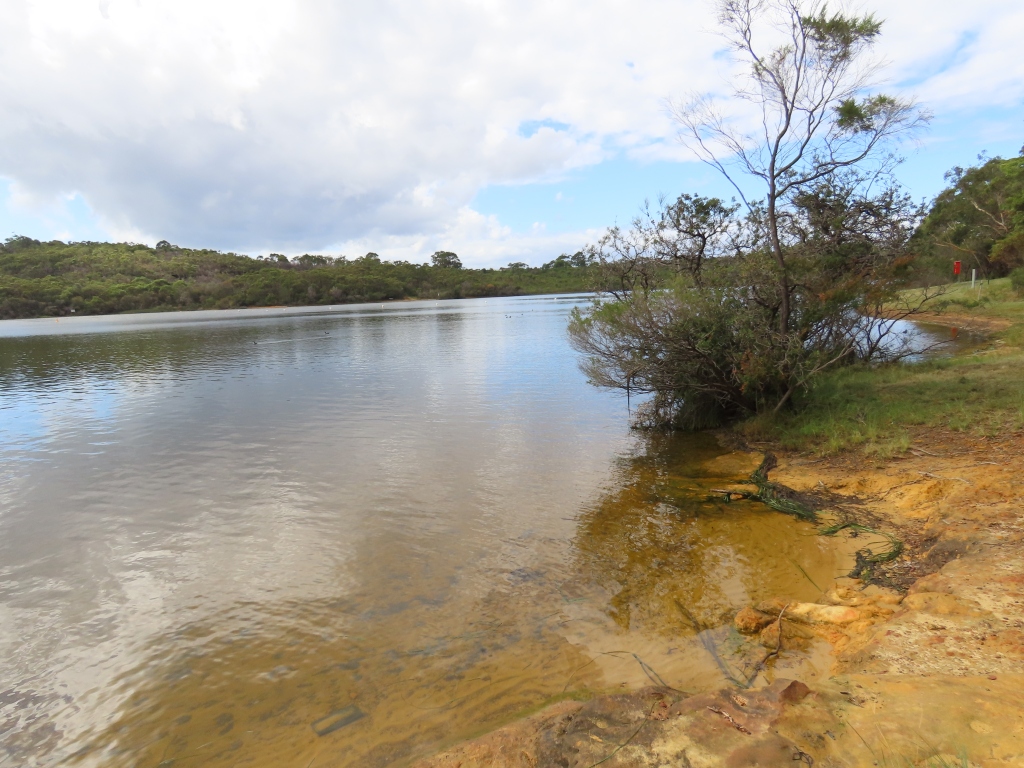
I spotted the Water Dragon at Manly Dam, north of Sydney, Australia. Here’s a zoomed-out view of the scene. You can see the lizard’s tail hanging down from the bush on the right-hand side of the dam:

Juvenile Crimson Rosella in Hazelgrove, NSW
A group of four young Crimson Rosellas gathered around a cabin that I was staying in this weekend, in the region of Hazelgrove. That’s west of the Blue Mountains, about three hours’ drive from Sydney.
At first, it was difficult to identify the birds. Other Crimson Rosellas that I’ve seen are red and blue, like the one in my earlier post. After some research, I discovered that the juvenile birds are mostly green instead of red, though they do have the characteristic red and blue markings on their heads.
Here are two of the birds that I saw this weekend:
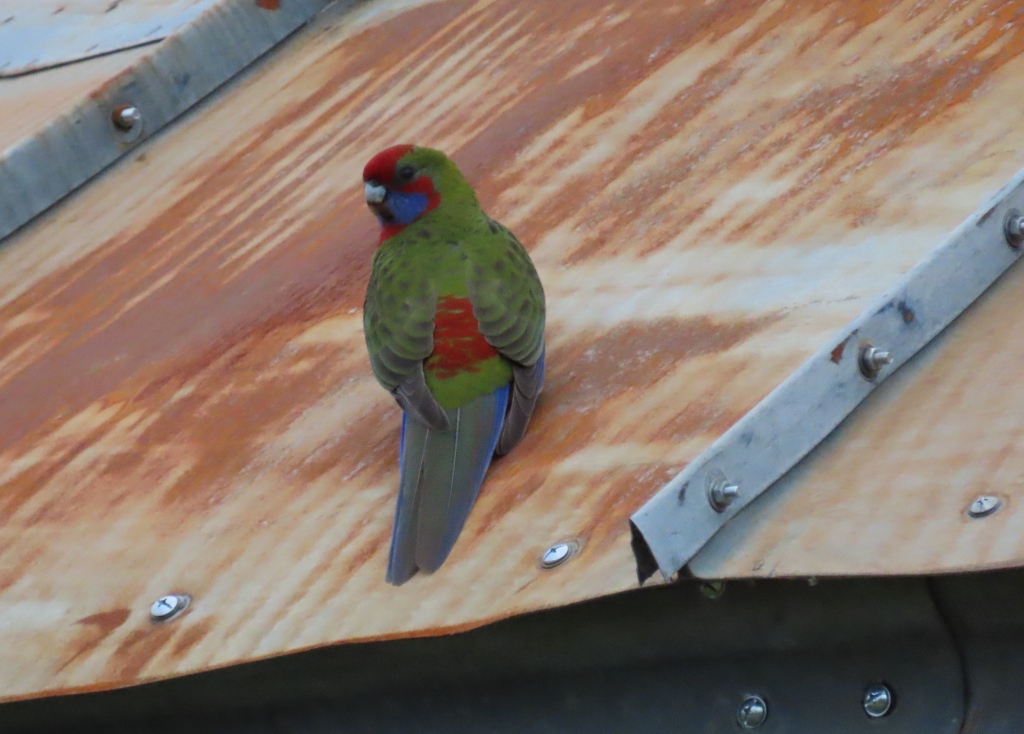
They were posing nicely on a rusty shed roof, for maximum warmth of colour!
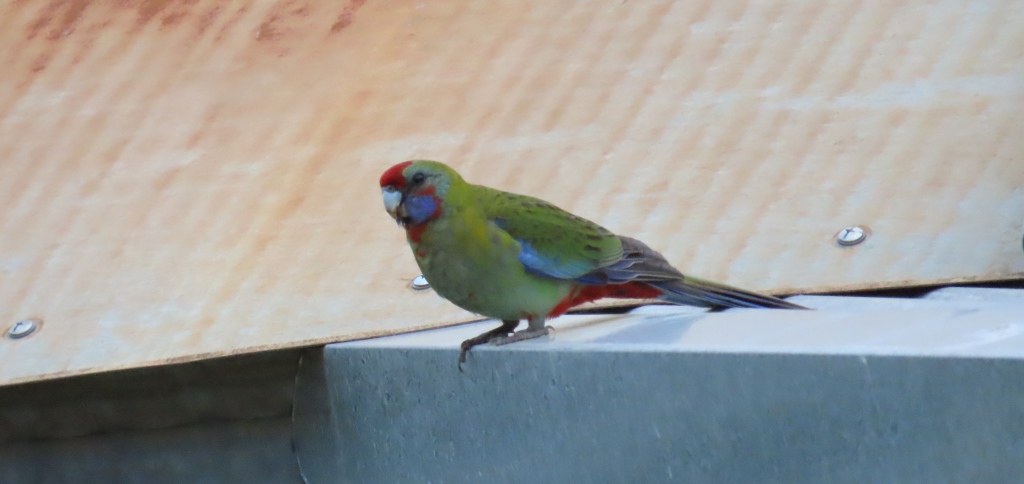
Common name: Crimson Rosella
Scientific name: Platycercus elegans elegans
Approximate length: 35 cm
Date spotted: 15 April 2023 (autumn)
Approximate location: Hazelgrove, New South Wales, Australia (map)

Red-bellied Black Snake at Turon River
This post is not about a bird. Instead, it’s about a large and beautiful snake that I encountered near the banks of the Turon River in New South Wales. We were travelling along Upper Turon Road, on the way from Capertee to Sofala. I brought the car to a quick halt when I noticed the snake in the middle of the road:
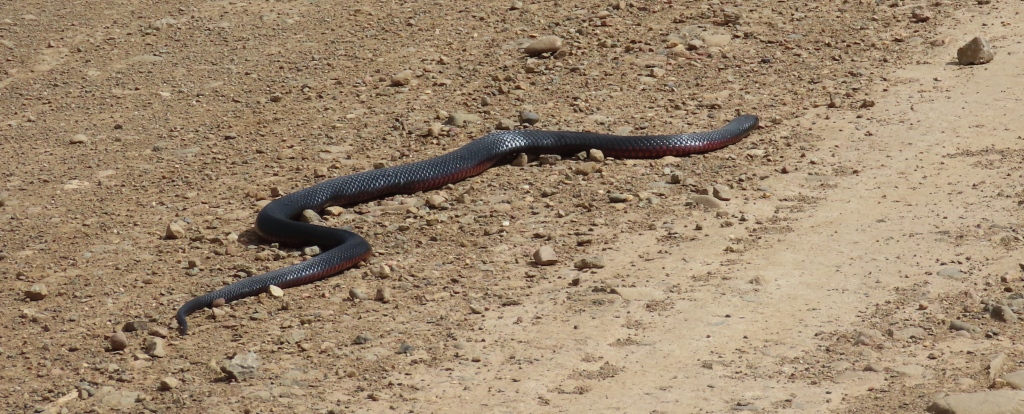
It was close on two metres long, and very lively indeed. We jumped out to take some pictures. The snake moved off the road onto the grass and came over to have a look at us:
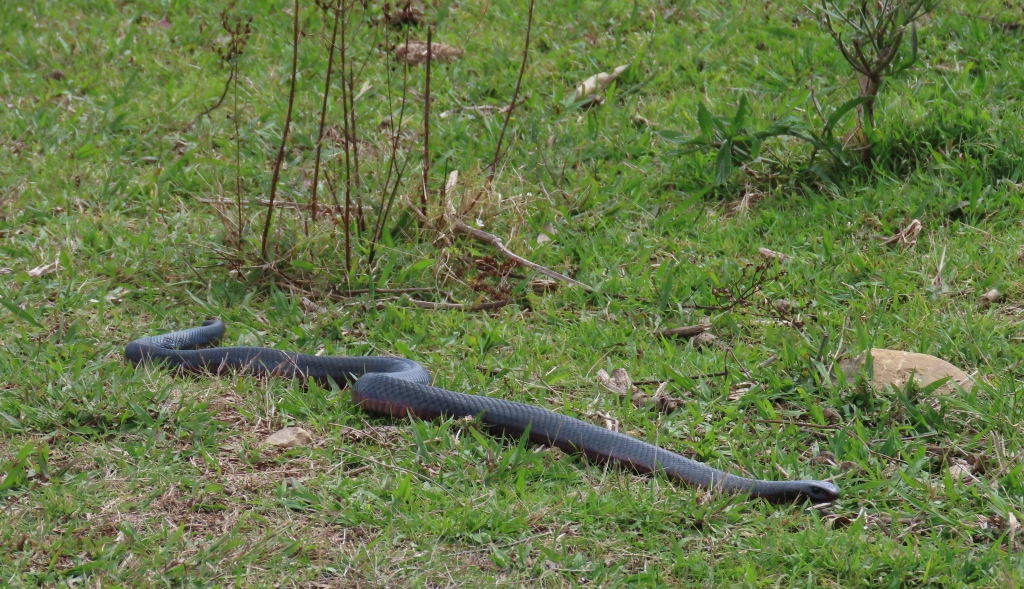
It’s a Red-bellied Black Snake (Pseudechis porphyriacus). Evidently their bites are rarely fatal, although the venom can cause quite severe illness. Usually, these snakes move away from humans. This one was an exception. It appeared to be very interested in us, and we kept well clear of it while admiring its beauty.
This video shows the snake making its way off the road onto the grass:
It felt like a great privilege to encounter this creature as it went about its daily life.

Musk Lorikeet drops by
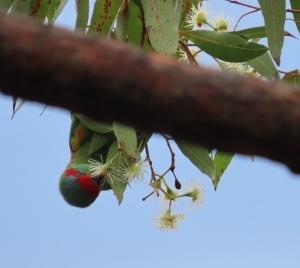
Very occasionally, we’re lucky enough to see Musk Lorikeets in the gum trees around our house. Today was such a day:

They’re pretty little parrots, with a clearly-defined red mask around their eyes. Their predominant colour is green, with tinges of red, blue, and yellow.
The more boldly-coloured Rainbow Lorikeets are frequent visitors. It’s a treat when I hear the slightly different trilling call of the Musk Lorikeets, grab my camera, and am rewarded with a view like the ones in this post.
The lorikeets come to drink the nectar from the gum tree flowers. Here’s another view of the same Musk Lorikeet:
Common name: Musk Lorikeet
Scientific name: Glossopsitta concinna
Approximate length: 23 cm
Date spotted: 3 April 2023 (autumn)
Location: Allambie Heights, New South Wales, Australia
White-faced Heron in Sydney Harbour
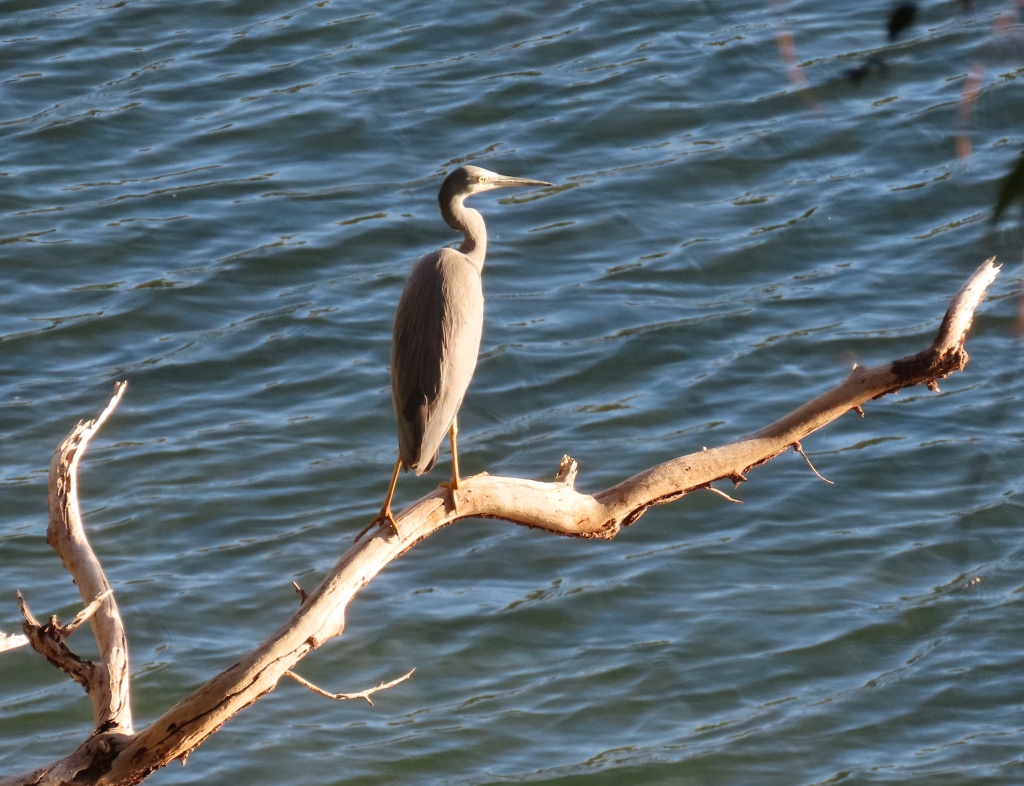
This White-faced Heron sat on a branch overlooking a Sydney Harbour inlet. I think the bird is a juvenile, judging by its soft colouring:
Common name: White-faced Heron
Scientific name: Ardea novaehollandiae
Approximate length: 66-69 cm
Date spotted: 1 April 2023 (autumn)
Location: North Harbour Walk, Sydney Harbour, New South Wales, Australia: 33°47’59.9″S 151°16’04.0″E

Soft colours of a young Little Wattlebird
This bird was busy gathering food on an Old Man Banksia tree (Banksia serrata). It has a small insect in its beak:

I think the bird is a Little Wattlebird, though others that I’ve seen have been darker and greyer in colour. Perhaps it’s a juvenile. I considered an oriole, but the stripes on this bird’s chest are more like those of a wattlebird than an oriole, and the shapes of the beak and head are closer to those of a wattlebird too.

Little Wattlebirds don’t have the red wattles that give this genus its name. These birds are classified as honeyeaters, but like most honeyeaters they’ll grab a passing insect too. This bird was at Dobroyd Head, one of the pieces of land that jut into Sydney Harbour.
Here’s a view that shows more of the wings and back:

Common name: Little Wattlebird
Scientific name: Anthochaera chrysoptera
Approximate length: 30 cm
Date spotted: 11 March 2023 (autumn)
Location: Dobroyd Head Track, Balgowlah, New South Wales, Australia: 33°48’33.2″S 151°16’14.1″E
Six kookies a-cackling
This morning I was treated to the sight of six kookaburras in a row, perched on the horizontal bar of an outlet pipe, all cackling away to each other. Australians fondly call these birds “kookies”. So, here you go, six kookies a-cackling:
Towards the end of the video, you’ll hear a jogger running up to me in excitement, exclaiming that she wished she had a camera. She obviously didn’t realize I was videoing!
After the birds flew off, I spotted two perched on a nearby TV antenna. It’s probably two of the six in the video, but not necessarily — there were quite a few kookaburras around:

Common name: Laughing Kookaburra
Scientific name: Dacelo novaeguineae
Approximate length: 47 cm
Date spotted: 28 January 2023 (summer)
Location: Balgowlah, New South Wales, Australia: 33°48’01.4″S 151°15’53.0″E

The quiet of the duck
It’s early morning on New Year’s Day in the park. The air is still, the crowds haven’t yet arrived. The ducks putter around as only ducks can do.
I’m at Manly Dam park near Sydney. On a quiet morning, the dam water reflects the hills and forest all round. The oranges, browns, and reds in this scene aren’t seasonal, though they do bring autumn to mind. They show the path of a recent fire — a hazard reduction burn conducted to reduce the risk of more damaging fires as summer draws on.
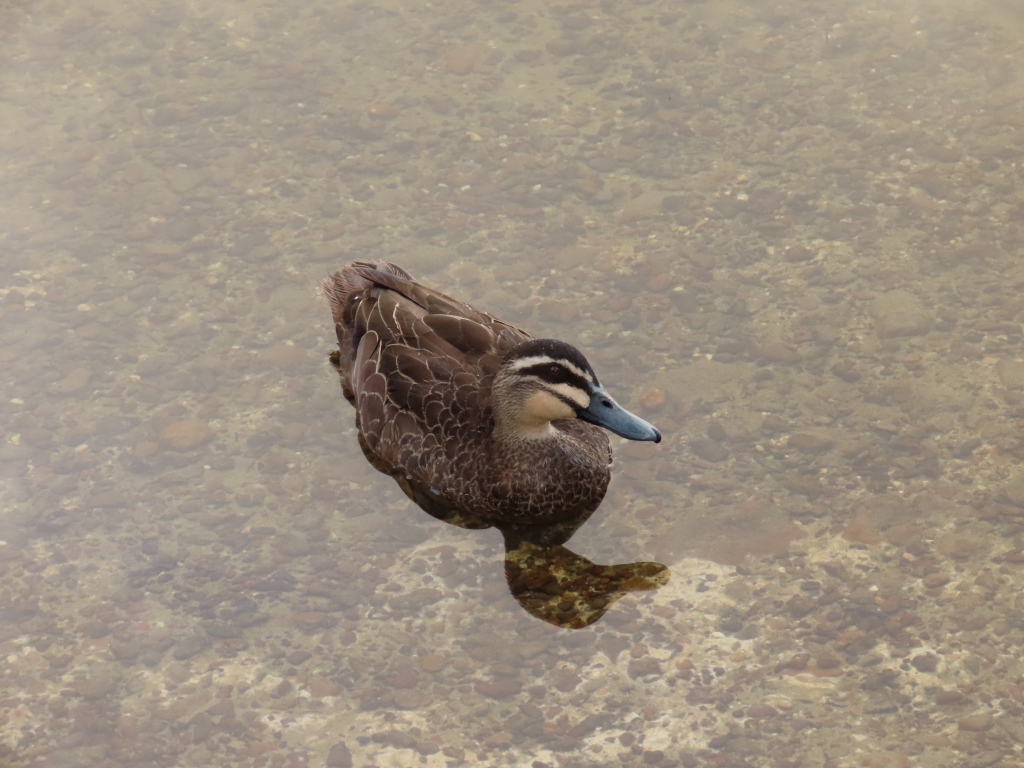
Among the ducks were this Pacific Black Duck:
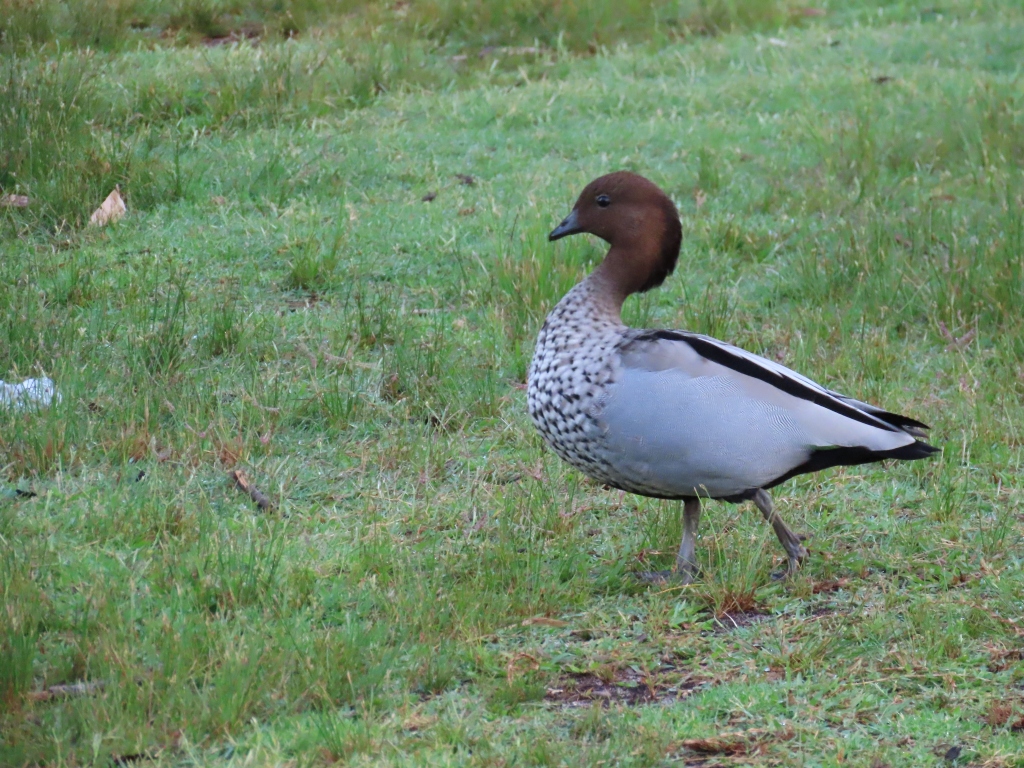
A male Australian Wood Duck:
A female Australian Wood Duck:
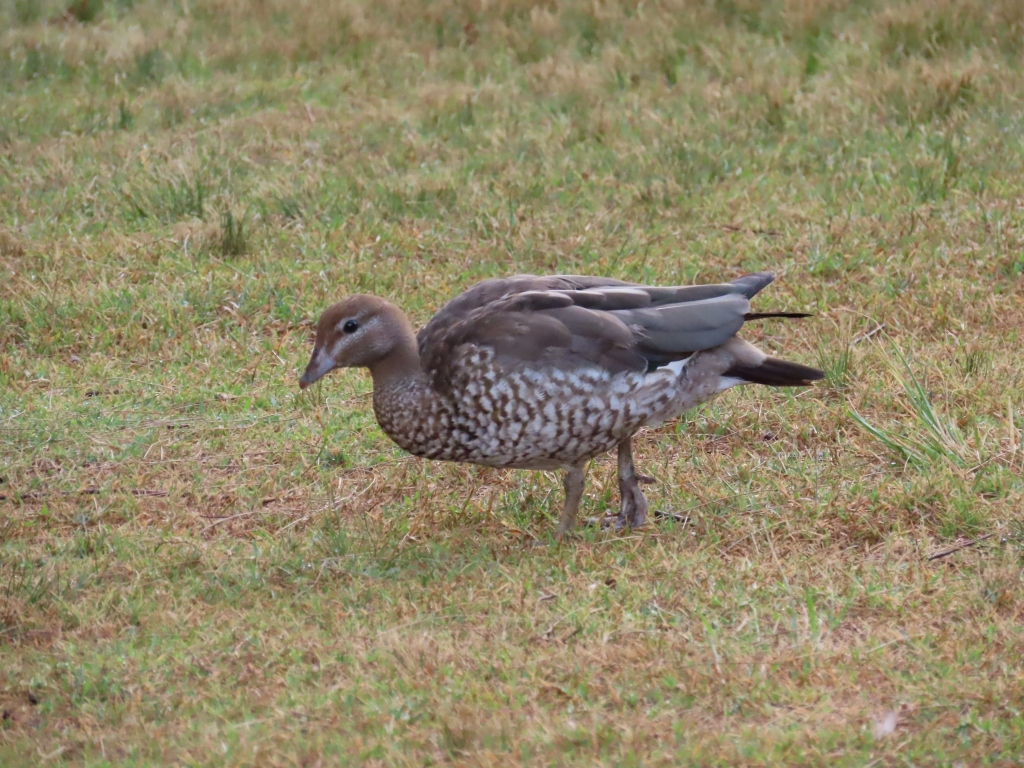
And a female Mallard with a gorgeous yellow-green beak:

For me as watcher, the meanderings of the ducks enhanced the quiet of the early morning scene.
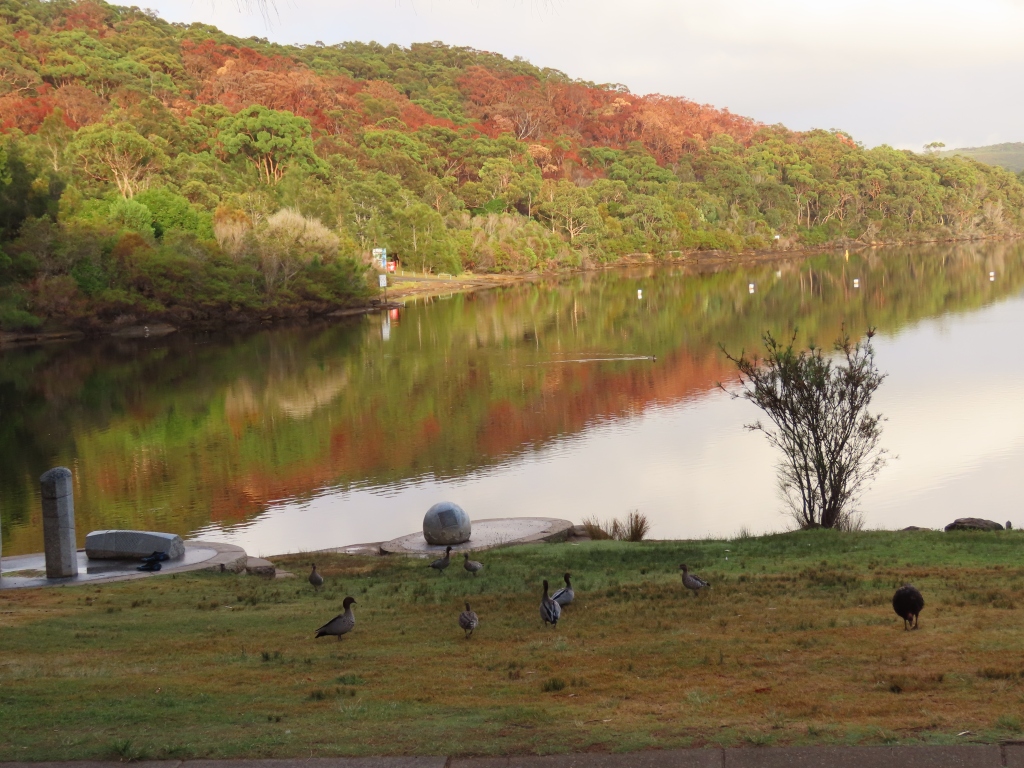
Oh yes, and there’s a Brush Turkey on the right too!


 Sydney Birder