Blog Archives

Story of two nesting Black Swans: Part 1
This is part 1 of a story about a pair of nesting Black Swans. At this point, I’m concerned about the state of the swans’ eggs. I don’t know what part 2 will hold, but I do hope for a happy ending.
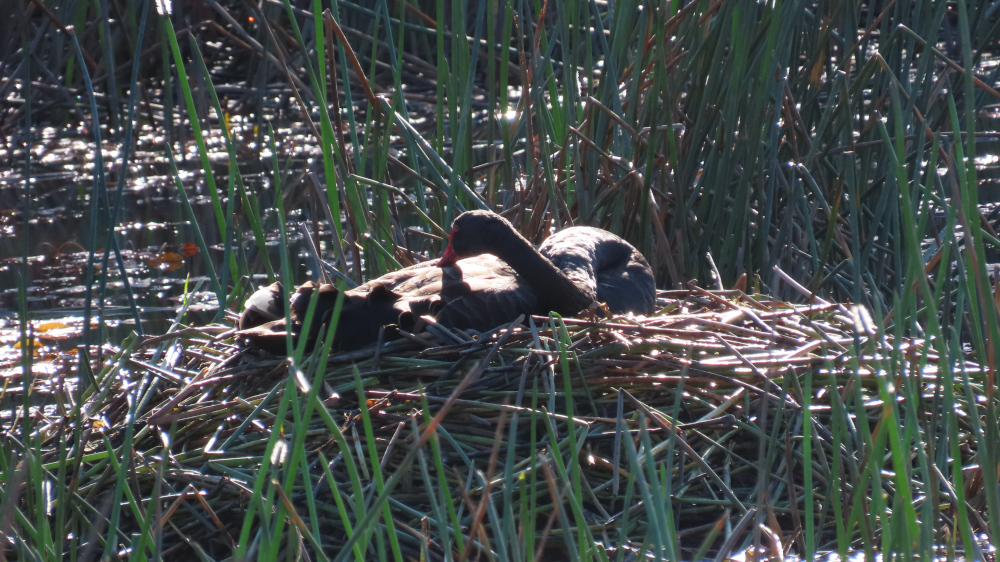
These two swans have been sitting on their nest since late August. I first saw them sitting on 23 August, and a park ranger told me that they’d been sitting for at least a few days by then. It’s now 9 December. That’s more than 15 weeks — more than 105 days.
The eggs of Black Swans usually hatch after 39-45 days.
This photo is from the first time that I saw the nest, on 23 August:
(Photo taken on 23 August 2024)
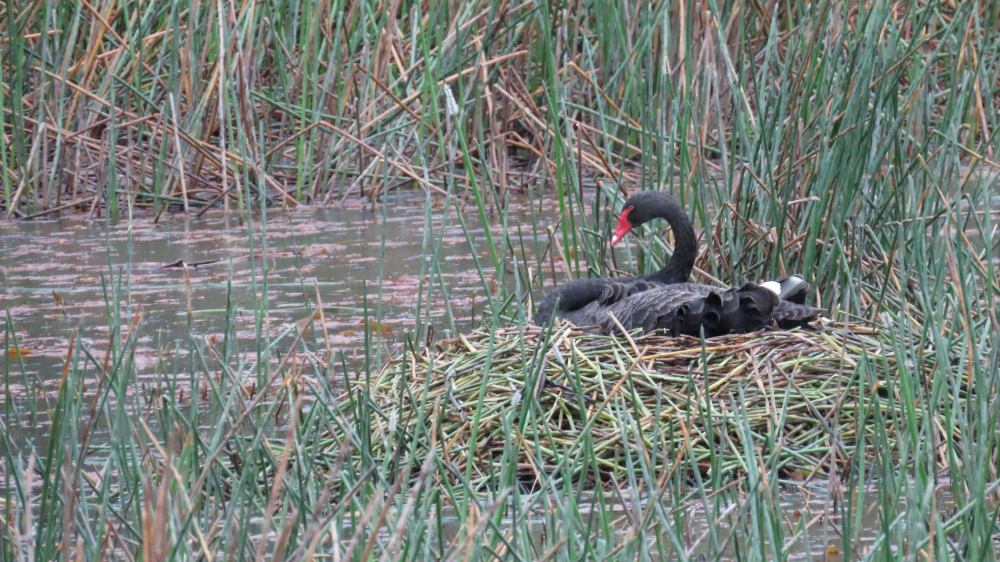
The swan’s nest is a large pile of reeds, positioned in shallow water in the middle of a large reed bed. It’s quite a distance from the shore on both sides, and well screened from entrance on the water too. From the shore, it’s not possible to see into the nest. I’m assuming there are eggs, because the swans are very diligent about sitting on the nest and occasionally it looks as if they gently prod the eggs with their beaks.
Here’s another photo from the early days:
(Photo taken on 24 August 2024)
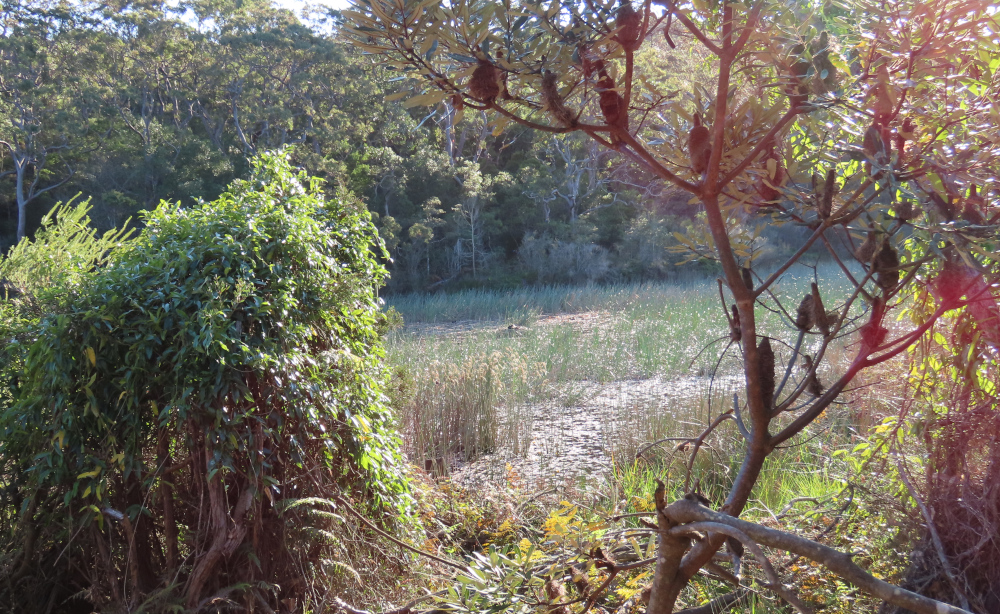
The setting is tranquil and pretty:
(Photo taken on 2 September 2024)
The nest is near a popular bush walking path, and I’ve walked past it every few days. When the first period of 45 days went by with no cygnets appearing, I thought maybe the parents had decided that their first batch of eggs was infertile and had started again.
But now the second period of 45 days is well and truly passed, and I’m worried.
Both the male and the female swan are still actively looking after the nest. I’ve seen each of them sitting on the nest alone, and occasionally both of them tending the nest together. The nest is never without one of the swans sitting or standing over it.

(Photo taken on 3 October 2024)
The male and female take turns to sit on the nest. The next video shows the changing of the guard. One bird has been sitting all night, the other has arrived for the morning shift. One of the birds grooms itself, and they both do a bit of nest maintenance. If you listen carefully, you can hear the swans’ soft hoots as they chat to each other:
(Video taken on 1 October 2024)
Every now and then, the swans spend quite some time and energy clearing the reeds around the nest and building up the nest:

(Photo taken on 3 October 2024)
Despite the nest’s seclusion, plenty of ducks, coots, and moorhens swim around the nest, keeping the swans company. Every now and then other visitors appear, like this kookaburra:

(Photo taken on 4 October 2024)
And this Eastern Water Dragon:

(Photo taken on 17 November 2024)
On 1 October, a beautiful light-coloured Grey Goshawk made an appearance near the nest, and was chased away by currawongs and cockatoos:

(Photo taken on 1 October 2024. I wrote another post about the goshawk.)
Here’s a nice video of one of the swans seating itself carefully on the nest:
(Video taken on 28 October 2024)
In more recent days, the site of the nest has become less tranquil. Cicadas have crept up from the earth to celebrate the summer full blast, as only cicadas can do. Sulphur-crested Cockatoos collect in the tree tops, high above the nest. The cockatoos squawk and yell, outdoing even the cicadas. It’s a very noisy environment for a nest, but at least it gives the parent swans some company. At this stage, they’d been sitting on the nest for more than 100 days:
(Video taken on 29 November 2024)
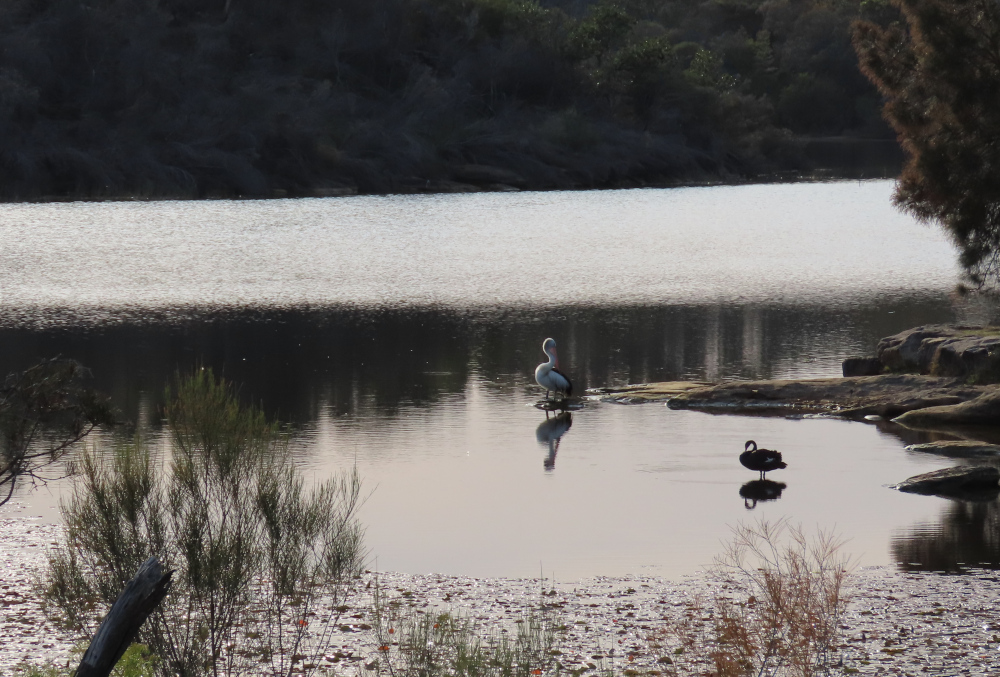
When it’s their turn for a break from sitting on the nest, one of the adults heads off to another part of the dam to stretch and feed. Here, a pelican keeps the off-duty swan company:
(Photo taken on 9 September 2024)
It’s good to stretch and preen:
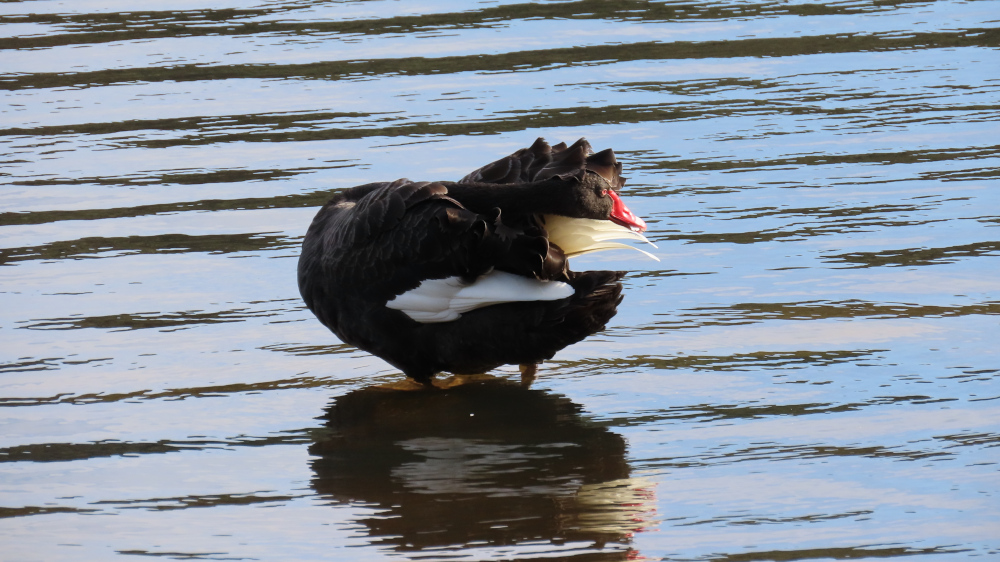
(Photo taken on 9 September 2024)
In the next video, one of the swans comes in close to shore for a good stretch. Eastern Koel cuckoos and cicadas dominate the sound waves. On a rock nearby, an Eastern Water Dragon looks on:
(Video taken on 21 November 2024)
In the next video, a Great Cormorant watches on as the swan preens and fluffs its wings. Cockatoos, Eastern Koels, and Channel-billed cuckoos call in the distance:
(Video taken on 29 November 2024)
As I write this post, December has arrived and the bush has a surfeit of insects. It’s very noisy at the swans’ nest. Two kookaburras dropped by and chatted a bit. Moths flap past, cicadas shriek, and a dead heat beats down on the nest:
(Video taken on 6 December 2024)
The last time I visited the nest was yesterday, 8 December. The swans were still sitting. Two kookaburras dropped by again and the cicadas were still very noisy.
I’ll keep a look out to see what’s happening at the nest next time I pass. I do hope to see the two swans relieved of their nesting duties. It would be wonderful to see some little ones to reward their amazing dedication. Even if there are no cygnets, though, it’d be good to see the adults roaming free again, ready for another go at raising a family next year.

(Photo taken on 8 December 2024)
Good luck, patient swans!
Update on 10 April 2025: Black Swans abandon nest after 8 months (part 2 of story).
Common name: Black Swan
Scientific name: Cygnus atratus
Approximate length: 120 cm
Date spotted: 23 August through to 8 December, 2024 (late winter, through spring, going into early summer)
Approximate location: Manly Dam Park, New South Wales, Australia

Angry duck
This male Hardhead (on the right of the picture) looks like he has something to say. To his left, a Pacific Black Duck seems mildly surprised, or perhaps just living up to his scientific name, Anas superciliosa.

And perhaps the Hardhead thinks that his mate is paying too much attention to his supercilious rival!
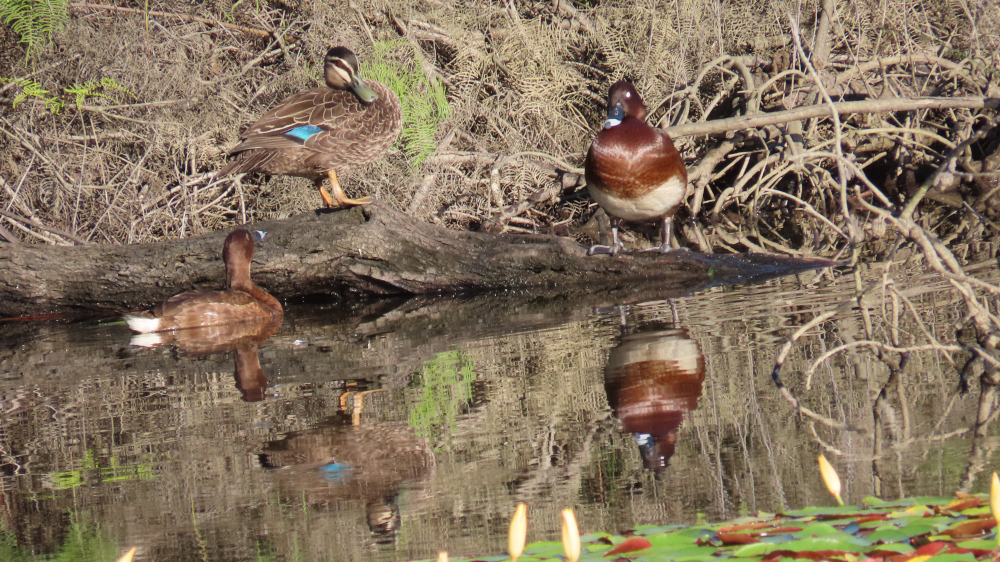
This is the first time I’ve photographed a Hardhead. Evidently they’re the only Australian duck that can claim the name of true diving ducks, as they dive deep into the water to feed. The males have white eyes while the females have brown eyes.
Common names: Hardhead and Pacific Black Duck
Scientific names: Aythya australis and Anas superciliosa
Approximate length: 45-60 cm and 48-60 cm
Date spotted: 2 December 2024 (summer)
Location: Manly Dam National Reserve, near Sydney, Australia: 33°46’34.8″S 151°14’49.6″E

Shufflewings earning their name
Black-faced Cuckoo-shrikes are a type of bird with the nickname “Shufflewings” because they like to move their wings up and down while perching on a branch. They do it when they land and, I’ve just seen, also when they want to attract each other’s attention. The wing shuffle is almost like a little dance. This video shows two of the birds shuffling at each other:
Don’t let the official name, Black-faced Cuckoo-shrikes, deceive you. These birds aren’t shrikes or cuckoos. Evidently the reason they were given this name is that their beaks have the same hooked end as a shrike’s and their feathers have similar patterns to some cuckoos.
Check out the other Black-faced Cuckoo-shrikes that I’ve spotted over time.
Common name: Black-faced Cuckoo-shrike, also called a Shufflewing
Scientific name: Coracina novaehollandiae
Approximate length: 35 cm
Date spotted: 27 November 2024 (spring)
Location: Manly Dam Park, New South Wales, Australia: 33°46’32.9″S 151°14’47.7″E

King Parrots amongst Grevillea flowers
On a recent walk in the bush, I came across a pair of King Parrots. In this video, the female bird feeds amongst the white flowers of a Grevillea bush:
In the background of the video, you can hear two types of cuckoos that have arrived in the area for the summer. First an Eastern Koel, then the raucous hoots of a Channel-billed Cuckoo. Just before the parrot flies off, a Peewee (Mud-lark) shrieks in the distance too.
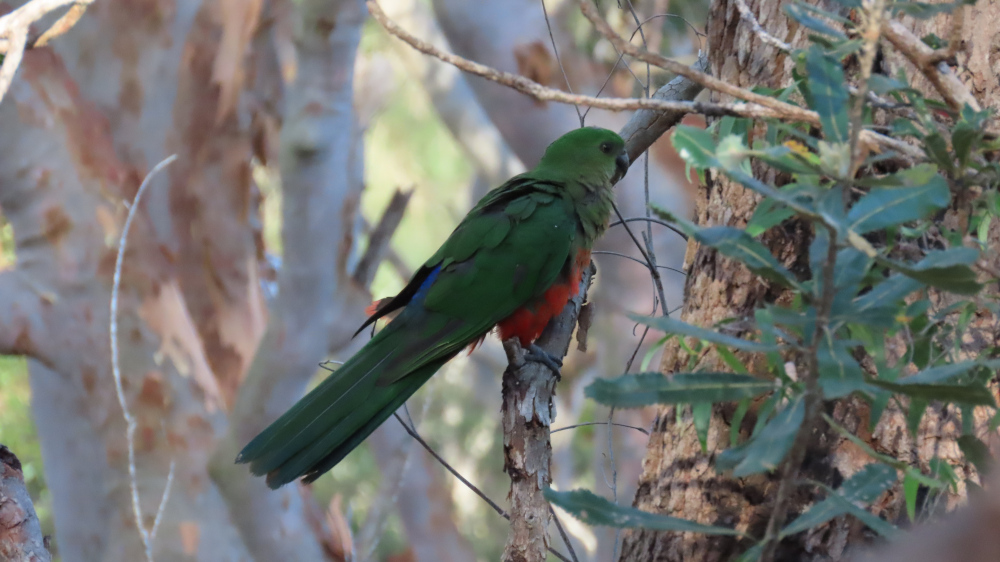
King Parrots are fairly large parrots, most often seen in pairs. The female has a green chest and neck:
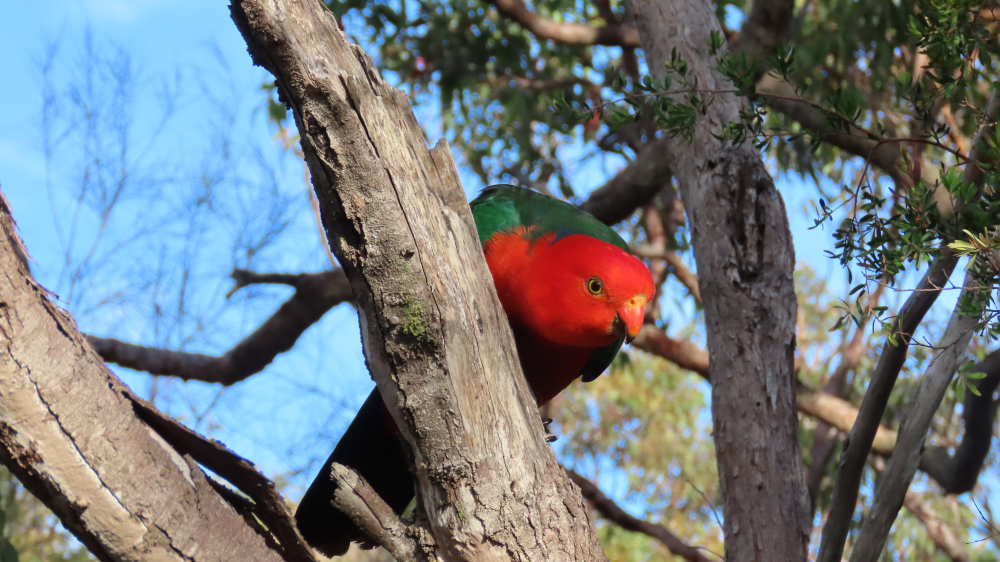
The male’s body and head are bright red. In fact, the male and female look so different that for a while, people thought they belonged to different species:

Here’s the male again, peering cheekily at the camera:
Common name: Australian King Parrot
Scientific name: Alisterus scapularis
Approximate length: 44 cm
Date spotted: 21 November 2024 (spring)
Location: Manly Dam reserve, New South Wales, Australia: 33°46’40.6″S 151°14’50.1″E
Cockatoos on a shed roof
A gang of Sulphur-crested Cockatoos dropped by to examine our shed roof and munch some grass seeds. One of the birds rather liked the noise the roof made when he jumped on it. Another bird is rather mucky, with brownish feathers. Perhaps he’s been dumpster diving? It’s interesting watching the interaction between the birds as they share a spray of grass flowers.

Coot cuddles
Coots always look so calm and cute. Here are two of them having a Coot cuddle.

And a Coot conversation:

Common name: Eurasian Coot
Scientific name: Fulica atra
Approximate length: 35 cm
Date spotted: 7 November 2024 (spring)
Location: Manly Dam Reserve, New South Wales, Australia: 33°46’35.4″S 151°14’49.5″E

Powerful Owl dozing in the treetops
It’s a while since I’ve spotted a Powerful Owl. A few days ago, I saw the tell tale dark blob high in the branches of the forest. Using my camera’s zoom, I could identify the bird. The only view I had is from behind, with the bird’s head turned slightly towards me and one eye partly open:
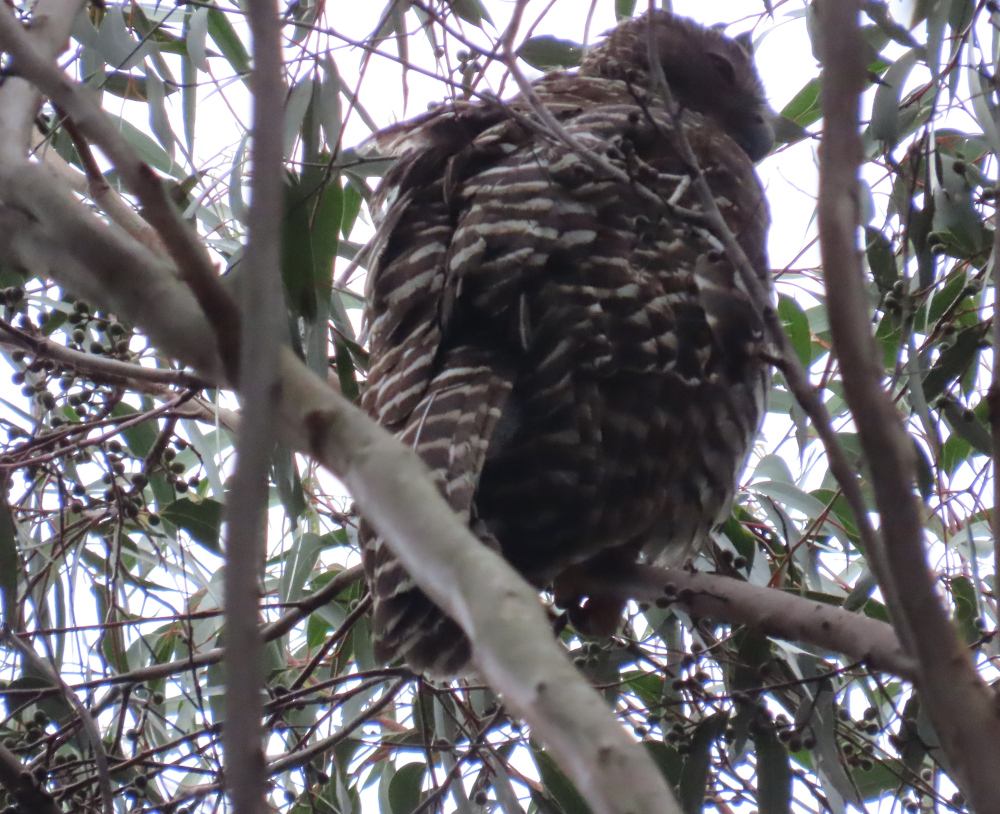
It’s always a privilege to see these impressive birds. Powerful Owls can weigh well over 2 kilograms, and reach up to 65 centimetres in height. They hunt at night and roost quietly during the day. Their prey consists of small creatures such as possums.
Common name: Powerful Owl
Scientific name: Ninox strenua
Approximate length: 65 cm
Date spotted: 7 November 2024 (spring)
Location: Manly Dam Park, New South Wales, Australia. Approximate map reference: 33°46’55.8″S 151°15’12.1″E

Bird on a wire – Eastern Rosella
Eastern Rosellas are medium-sized parrots, found on the east coast of Australia. We’re lucky enough to be visited regularly by a pair of them. I don’t know if it’s the same two birds each time, or if our phone line is somehow part of the flight lines for a family of birds.
In this video, the male Eastern Rosella struts along a phone line, spiffy in his breeding colours. Alas, the background sound is noisy, but you can just hear the bird chirping as he does his little hello dance:
The next picture is somewhat whimsical. It’s what my camera made up when the bird flew off. I love the colours and motion in this picture, even if the bird’s head is off camera:

The female glowed in the sunlight:

The male’s colours are brighter, with the divisions between the coloured sections more clearly defined. Deep blue and black scallops outline the wings, while the rest of the bird is yellow and black, and red and white:
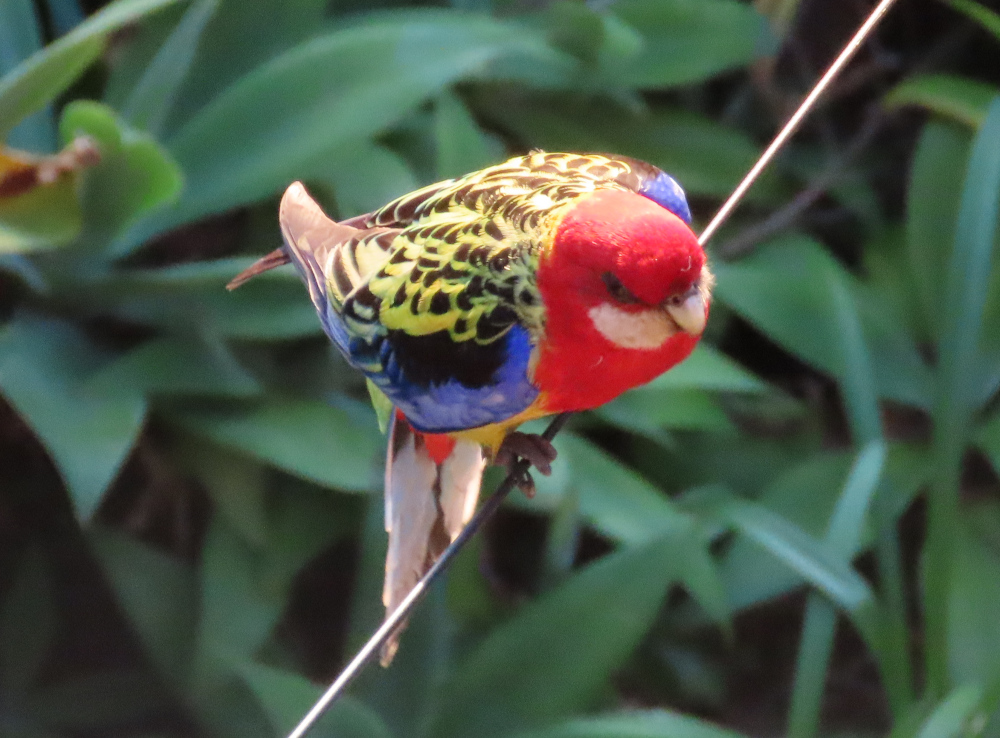
He knows he’s gorgeous!
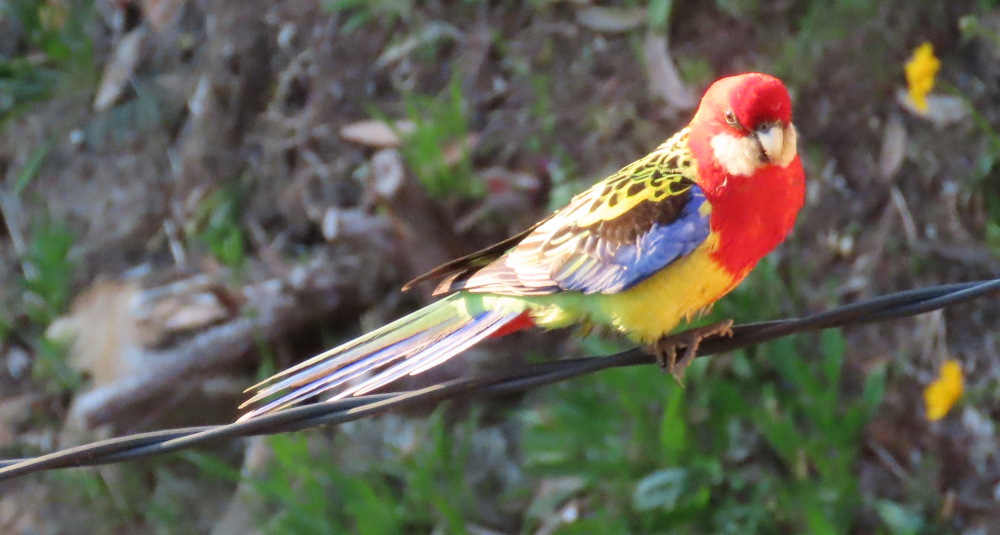
Common name: Eastern Rosella
Scientific name: Platycercus eximius
Approximate length: 30 cm
Date spotted: 28 October 2024 (spring)
Location: Allambie Heights, NSW, Australia

My first Buff-banded Rail
This bird is very very shy. I’ve seen it twice, and this is the best photo I have. It’s my first sighting of a Buff-banded Rail, or any kind of rail.
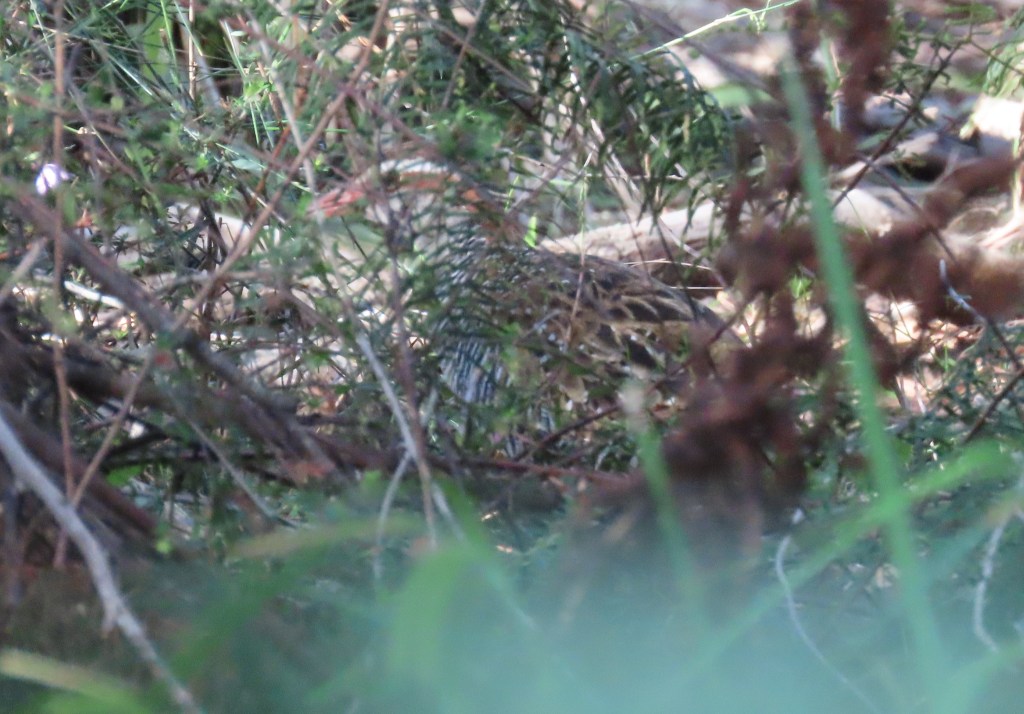
The bird has a distinctive wide white eyebrow, with a chestnut stripe through the eye. The top of the head is a darker brown, and the beak is orange and quite long. (At first I thought the bird was some sort of quail, but I couldn’t find any quails with orange beaks.) The body has black and white barring on the sides, whereas the plumage on the back is mottled brown and cream.
The bird hides in the low growth at the edge of Manly Dam, on Sydney’s northern beaches. I’ll keep a look out, to try and get a better photo.
Common name: Buff-banded Rail
Scientific name: Gallirallus philippensis
Length: 28-32 cm
Date spotted: 26 October 2024 (spring)
Location: Manly Dam Reserve, New South Wales, Australia: 33°46’40.0″S 151°14’50.2″E

Glossy Black-Cockatoo
Five Glossy-Black Cockatoos are frequent visitors to the Casuarina trees on the edge of Manly dam at the moment. Here’s one of the birds:
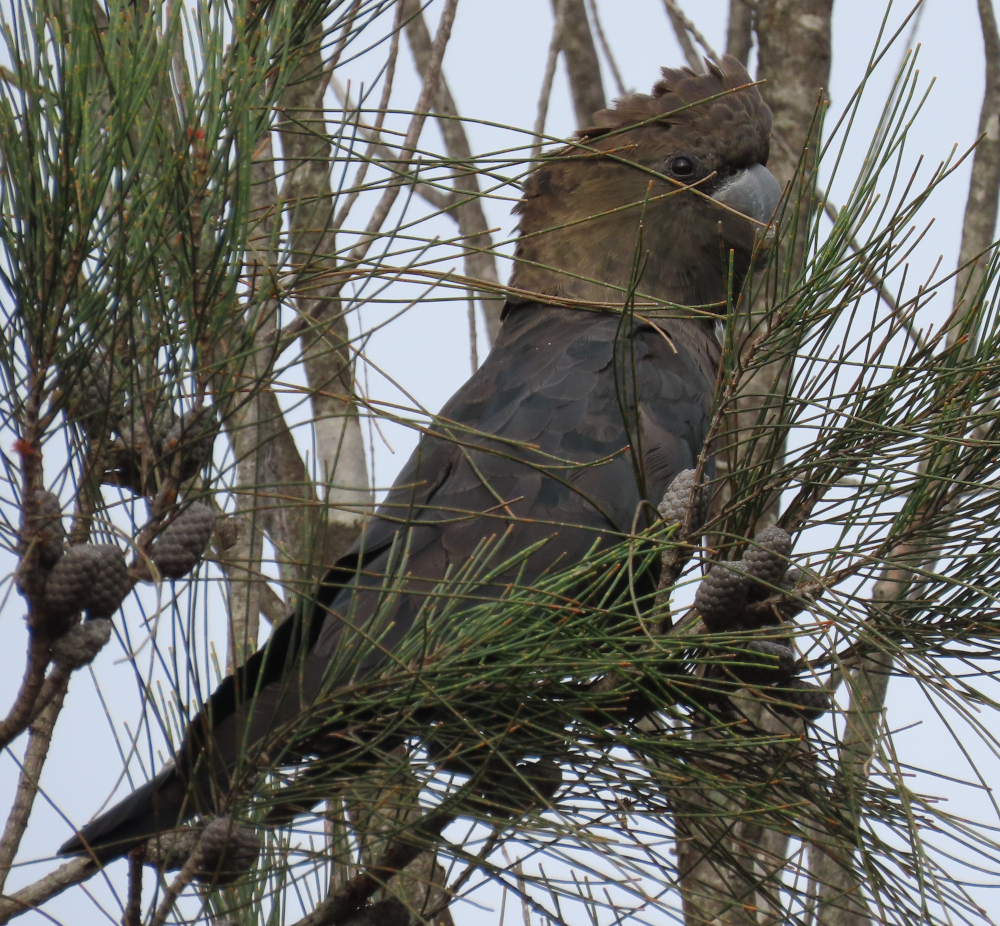
Common name: Glossy Black-Cockatoo
Scientific name: Calyptorhynchus lathami
Approximate length: 50cm
Date spotted: 27 October 2024 (spring)
Location: Manly Dam Park, near Sydney: 33°46’16.4″S 151°14’30.9″E


 Sydney Birder