Blog Archives

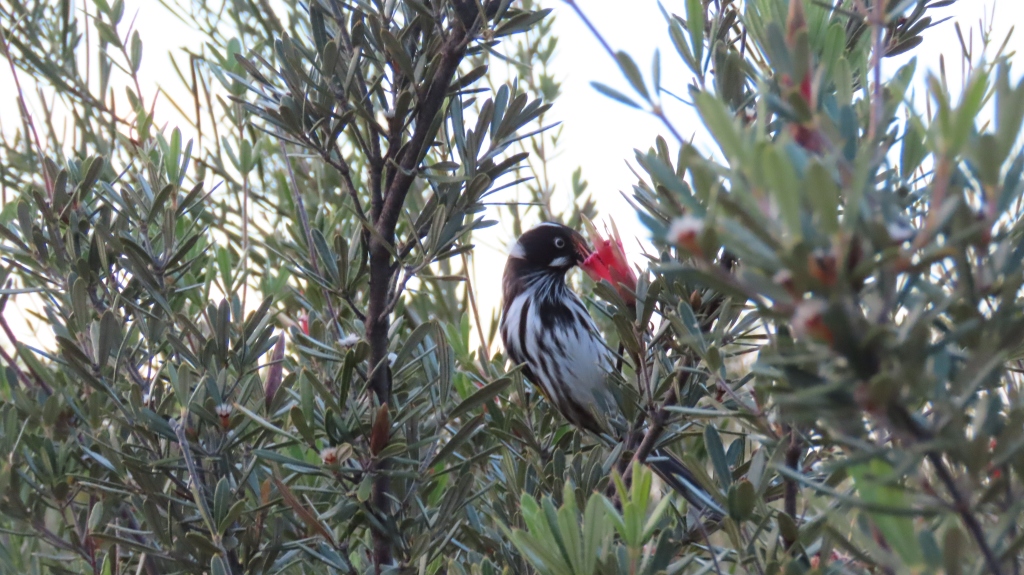
New Holland Honeyeater drinking from Mountain Devil flower
New Holland Honeyeaters are small birds that feed on nectar from flowers, as well as small insects. This video shows one of them drinking from the red, cup-shaped flower of a Mountain Devil bush (Lambertia formosa).
New Holland Honeyeaters are just one of the many types of birds labelled honeyeaters in Australia. It’s a varied and raucous group!
I did take a still photo of the bird, but it’s a bit fuzzy due to the early morning dimness:
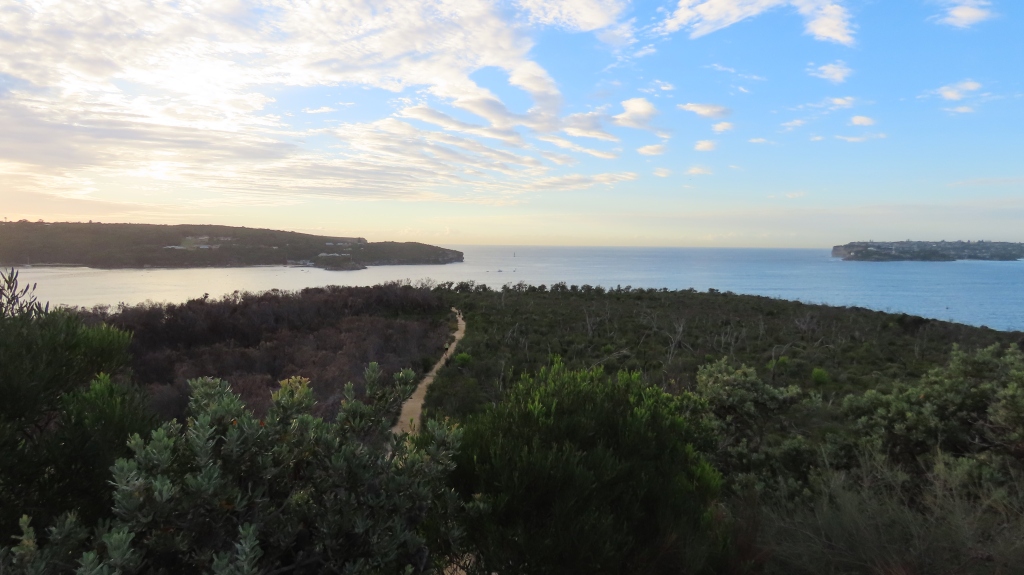
After watching the bird a while, I walked further along the path and took a photo looking back the way I’d come. The bird was at the very end of the path in this picture, near the water. In the distance are the two headlands that form the mouth of Sydney Harbour:
Common name: New Holland Honeyeater
Scientific name: Phylidonyris novaehollandiae
Approximate length: 17-19 cm
Date spotted: 23 March 2024 (summer)
Location: Dobroyd Head, New South Wales, Australia: 33°48’38.0″S 151°16’24.3″E

My first Superb Fairy-wrens
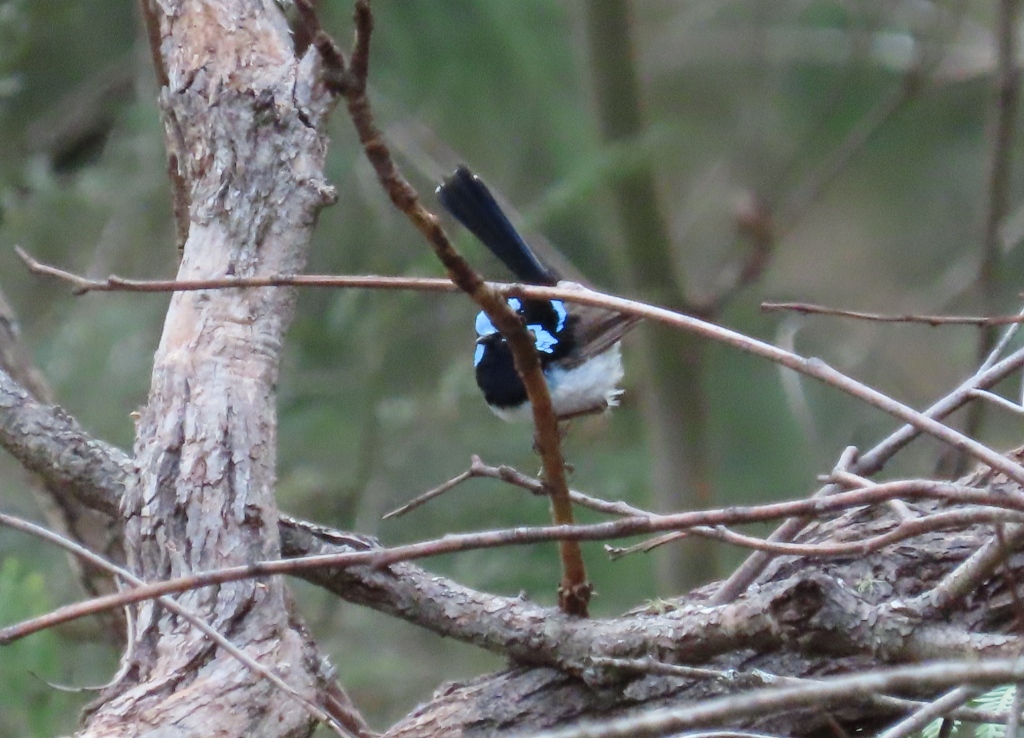
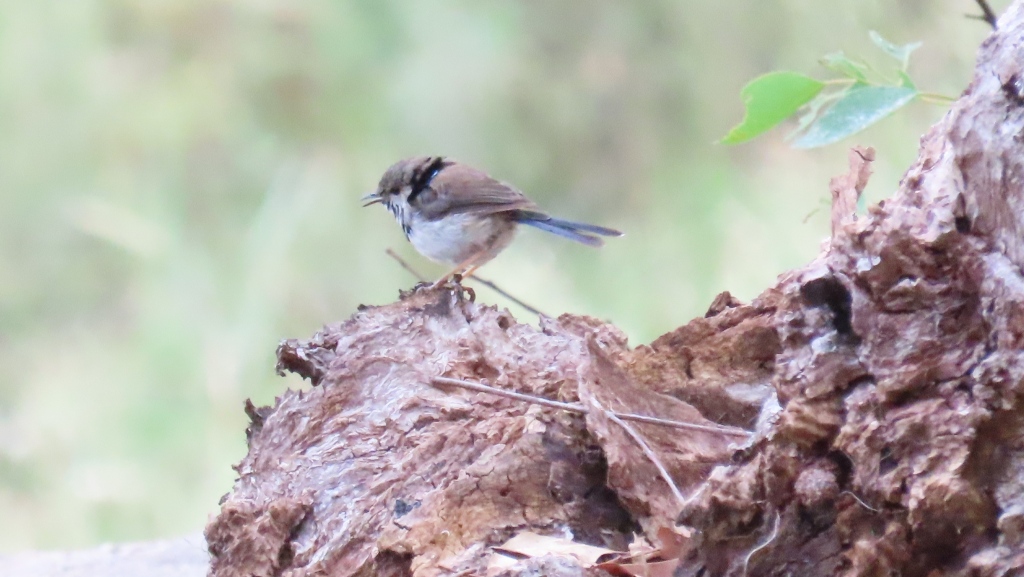
I was out in the Putty Valley area this weekend, and spotted my first Superb Fairy-wrens. We often see Variegated Fairy-wrens closer to home, but I’m delighted to see a Superb at last. The familiar squeaky trills drew my attention, and I snapped a couple of shots, but it wasn’t until I downloaded the photos that I saw these were not the usual catch!
First the female:
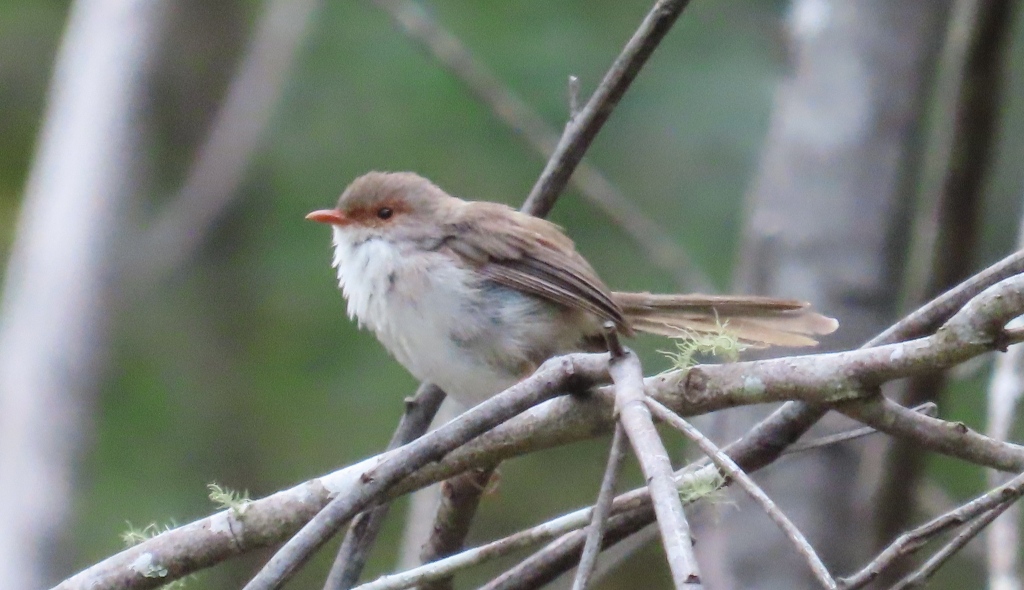
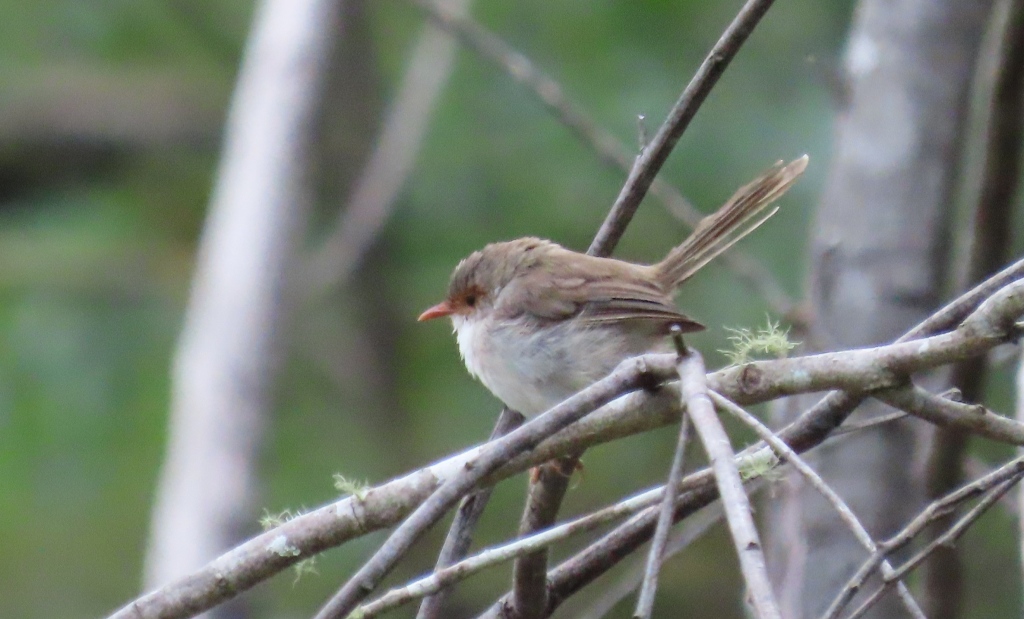
Overall, her colouring is similar to the Variegated Fairy-wrens. The differences are that the brownish patch around the eye is more cinnamon than chestnut, and her tail lacks the blue of her Variegated cousin. Here’s another shot of the same bird:
The male was, as usual, hard to photograph. He’s partially obscured by a twig, but you can still make out the bright and darker blues. He lacks the chestnut shoulders of the Variegated Fairy-wren:
The next one is, I think, a juvenile male. The blue colouring is just starting to appear:
Common name: Superb Fairy-wren
Scientific name: Malurus cyaneus
Approximate length: 13-14 cm
Date spotted: 15 March 2024 (summer)
Location: Putty Valley, New South Wales, Australia: 32°54’00.8″S 150°38’16.9″E

Eastern Whipbird’s dance
Two Eastern Whipbirds were chirruping at each other. One of them did a little dance, puffing up its white cheeks and flaring its wings and tail. Alas, the only photos that I got of the dance are very blurry, but I’ve included them at the end of this post anyway.
This is a good shot of the bird that was dancing:

Eastern Whipbirds are quite reclusive, staying low and using the undergrowth as cover most of the time. It was a pleasure to see one out in the open. They’re pretty in an unobtrusive way, with a black crest on their heads, a grey-black body, white cheek patches, and olive wings and tail.
The other bird was more coy, staying in the bushes and watching its friend:

There’s no difference in plumage between male and female birds. My guess is that the first one is the male, since he was doing the display dance.
The two birds were flitting from place to place, with one of them repeating his little dance at each new location. The dance was so fast that it was hard to see with the naked eye. The photos that I got were alas blurry, but they give some idea of what was happening.
This blurry photo shows a side view of the dancer puffing up its cheeks:

And this one shows a frontal view, with the puffed cheeks and flared wings:

Whipbirds get their name from the long, drawn-out whistle that they make, ending with an abrupt squawk. The call reminds people of a cracking whip, hence the name. You can hear the call in an earlier post.
Common name: Eastern Whipbird
Scientific name: Psophodes olivaceus
Approximate length: 30 cm
Date spotted: 8 March 2024 (summer)
Location: Manly Dam Park near Sydney, NSW, Australia: 33°46’38.7″S 151°14’56.0″E

Blue-faced Honeyeater: my first sighting
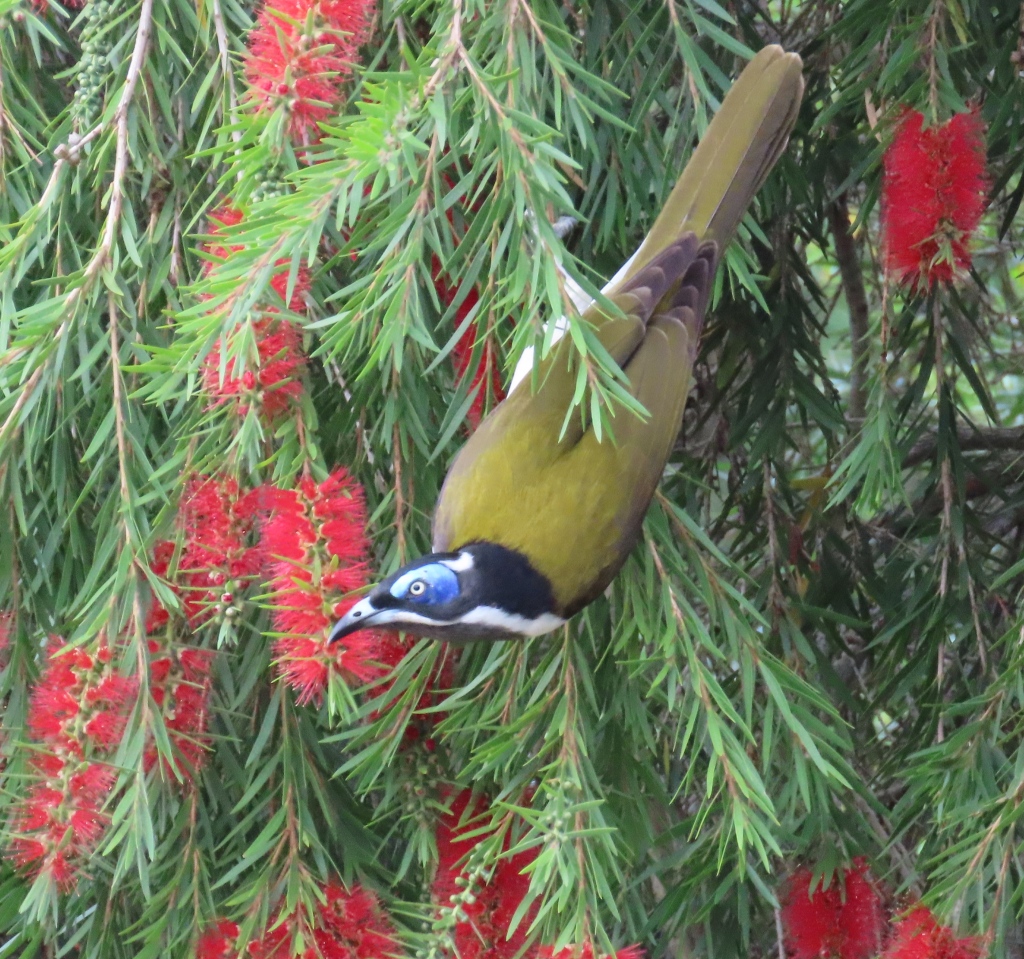
It’s always exciting to see a bird species for the first time. Yesterday I saw my first Blue-faced Honeyeater. There were two of them in a Red Bottlebrush (Callistemon) bush, one an adult and the other a juvenile.
This bird is an adult — you can tell by the fact that the patch of skin around its eye is entirely blue (rather than green):
This is the youngster — the skin around the eye is mostly green, but already changing to blue:
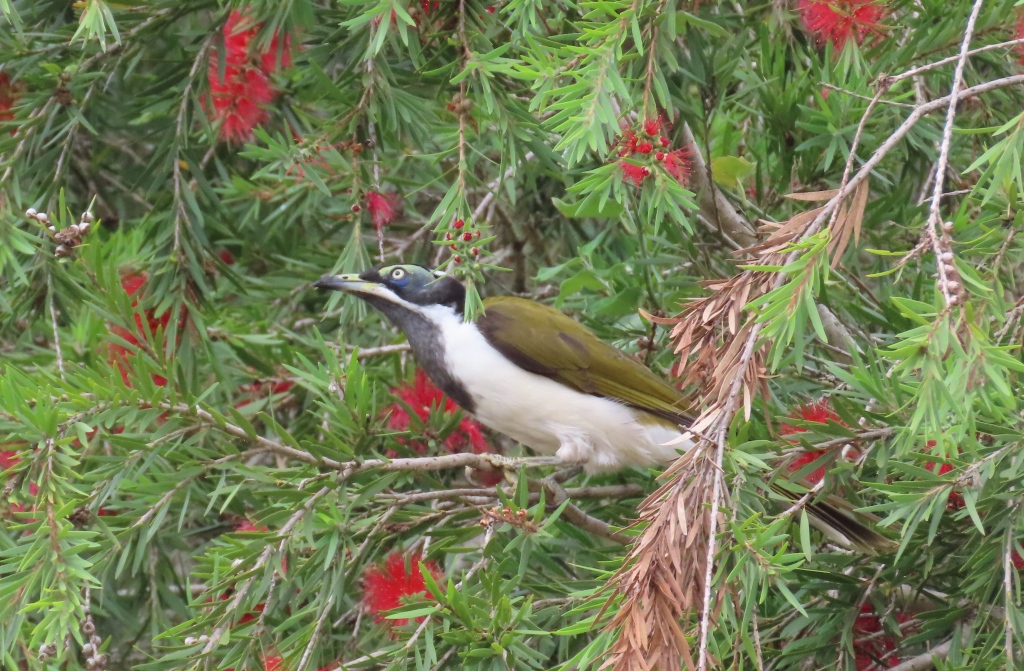
Blue-faced Honeyeaters are larger than most other honeyeaters that I’ve seen. Like most honeyeaters, they make quite a noise! It was their enthusiastic cackles and comments that drew me to the bush where they were feeding on nectar.
Here’s another view of the youngster, showing the two white bands that extend from the eye patches and almost meet at the back of the head:
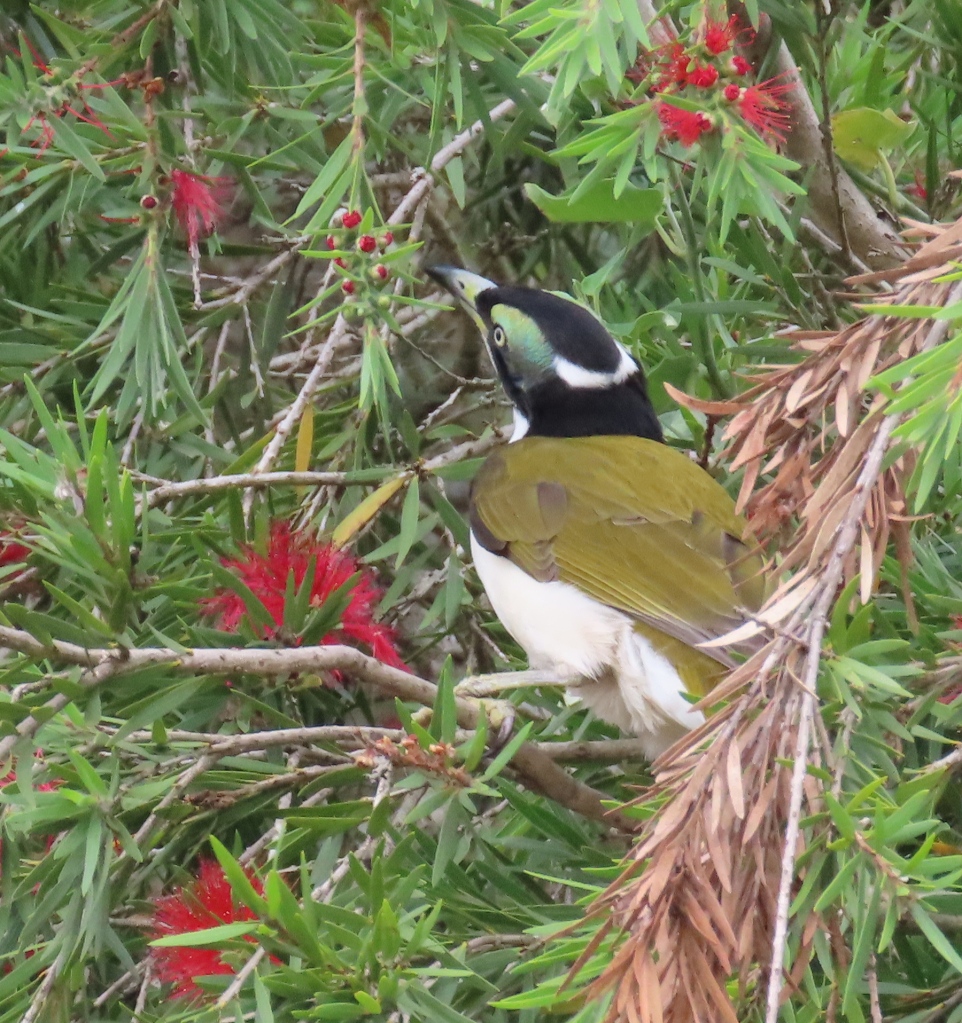
Both birds have a lovely olive-green back and a white front with an extended black bib.
Here’s the adult again:
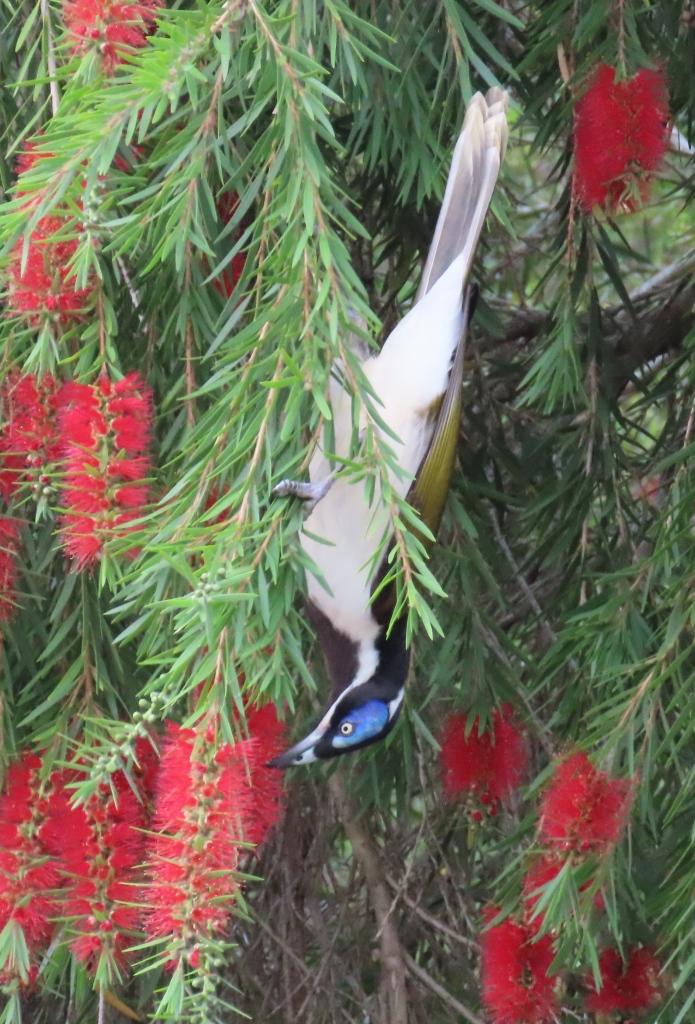
In the next photo, the bird has twisted its neck up to take a look at me. Well, hello there:
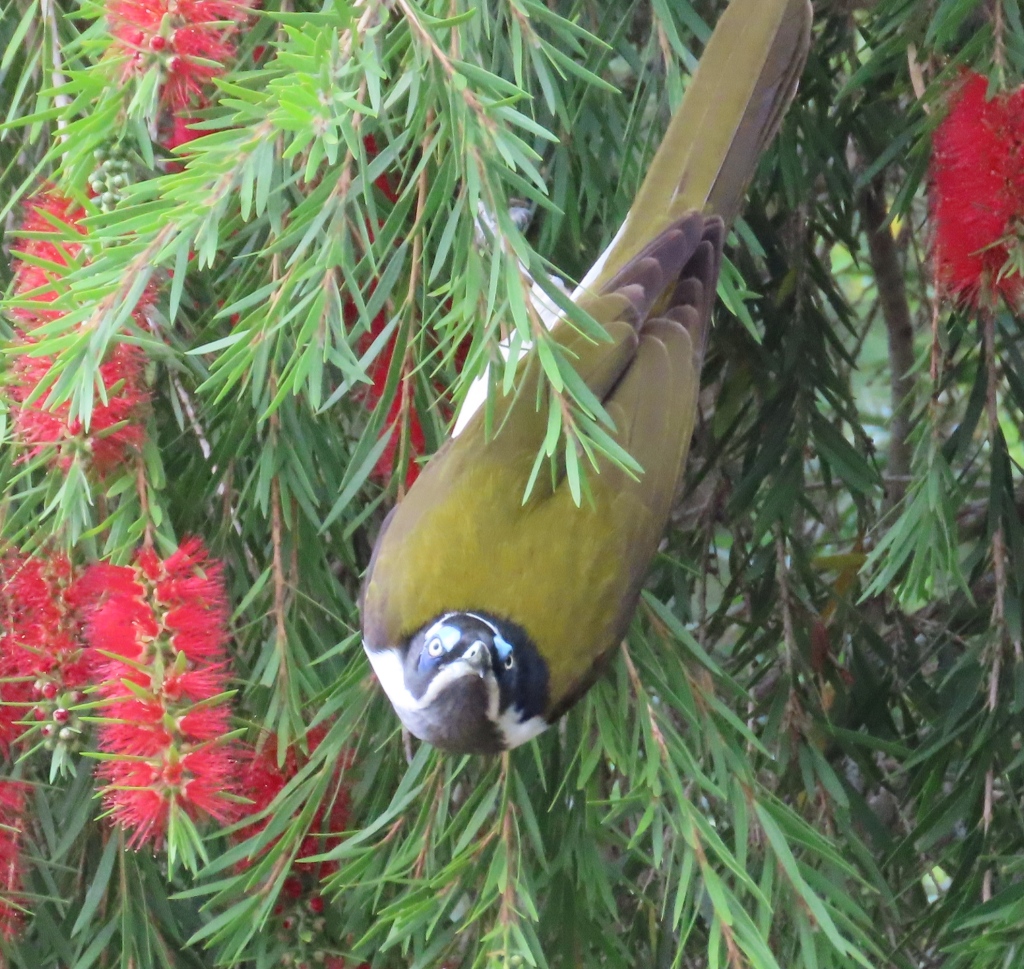
The last picture shows that white band on the head again:
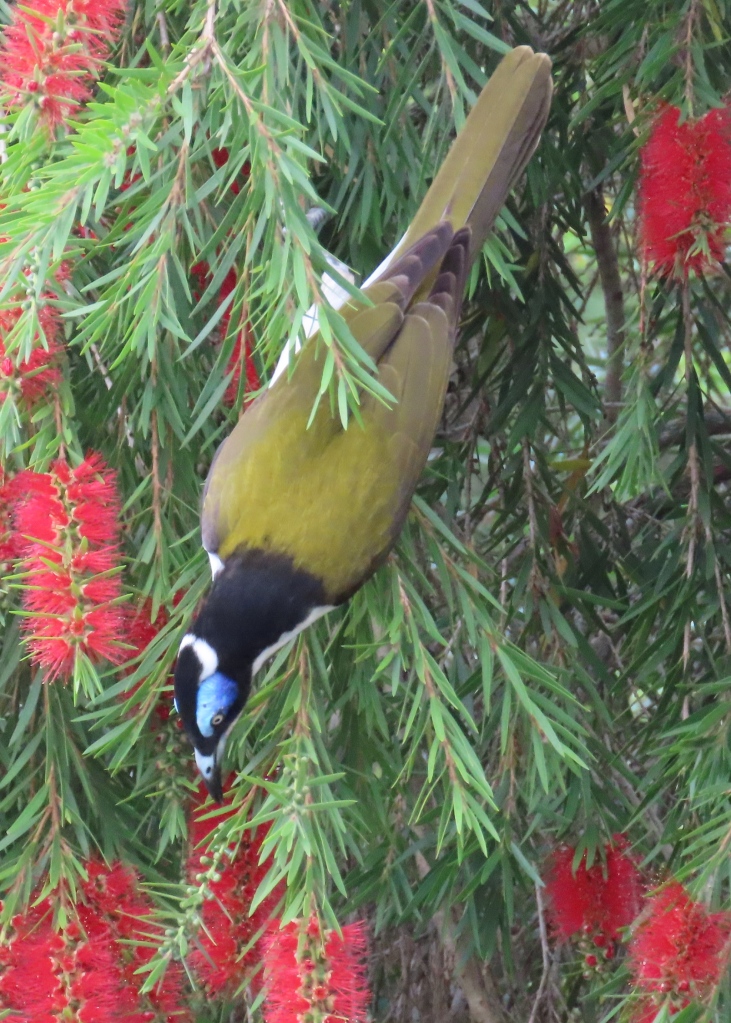
Common name: Blue-faced Honeyeater
Scientific name: Entomyzon cyanotis
Approximate length: 25-31 cm.
Date spotted: 3 March 2024 (summer)
Location: Laguna, New South Wales, Australia: 32°59’25.4″S 151°07’52.8″E

Little Pied Cormorant on honeycomb rock
Little Pied Cormorants are quite common in the waters around Sydney. Most often, you see them from afar, and they just look like another black and white bird. But when you see them through the camera zoom, they’re rather cute. They have big floppy black feet, a Tintin-like hairstyle, and a goofy smile:

Their tail is short and stubby, and seems to be useful in preventing them from teetering over backwards. That tuft of black hair extends down the back of their necks, adding a touch of sophistication:
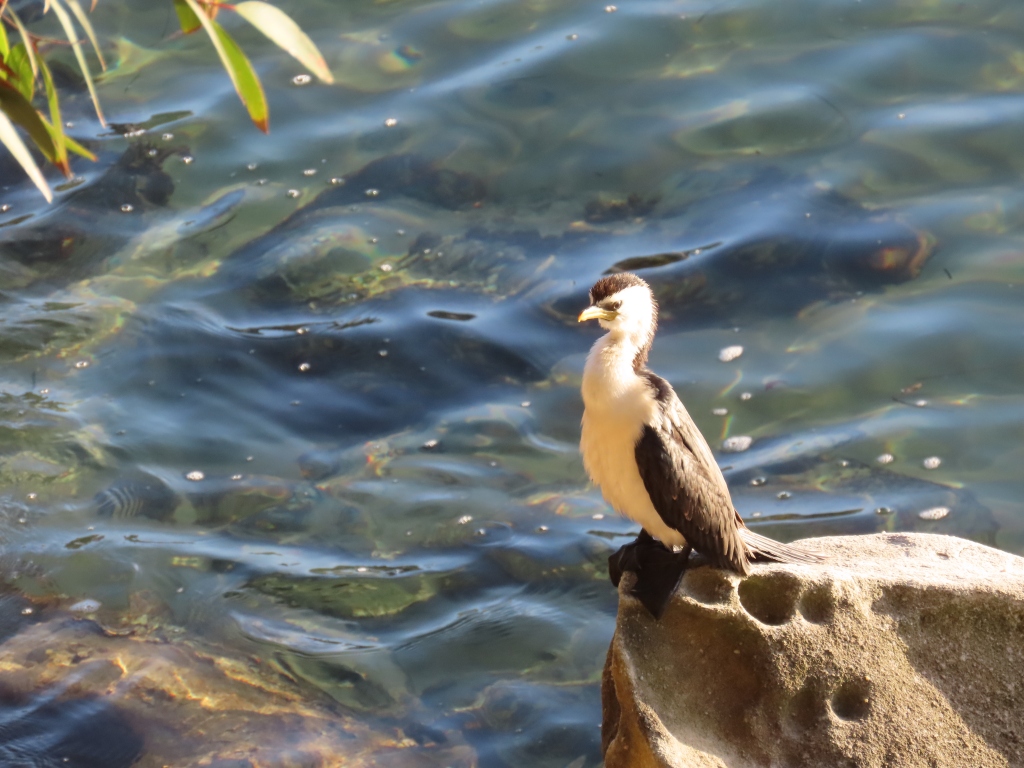
The rock that this cormorant is sitting on has attractive honeycomb weathering patterns:

In this video, the cormorant is stretching its neck and gulping to help its latest meal go down.
Common name: Little Pied Cormorant
Scientific name: Phalacrocorax melanoleucos
Approximate length: 60 cm
Date spotted: 25 February 2024 (summer)
Location: North Harbour Walk, Sydney Harbour, New South Wales, Australia: 33°48’05.9″S 151°16’10.1″E

So lucky! King Parrots and Eastern Rosellas come to visit
Two days ago, a couple of Eastern Rosellas dropped by. The next day, I was getting ready to write this blog post when two King Parrots came visiting. We’re so lucky, to have such beautiful birds in the area.
Eastern Rosellas
It’s quite odd: we have visits from two of these little parrots at around this time every year. The pattern is always the same: I hear them twittering, and lean out of the window. A male perches on our telephone line, or on a branch near by, and gives a little show for his lady friend. The show consists of some twittering, and bit of feather fluffing and scratching, and some wing shuffling. Then, after a few minutes they fly away.
Eastern Rosellas are medium-sized parrots, measuring about 30cm from head to tail. This is the male:

Here he’s in the middle of a wing shuffle:

The female looks on:

Common name: Eastern Rosella
Scientific name: Platycercus eximius
Approximate length: 30 cm
Date spotted: 19 February 2024 (summer)
Location: Allambie Heights, NSW, Australia
King Parrots
Sitting in the lounge the next afternoon, I heard a soft thunk and then an inquisitive chirp from the veranda. A female King Parrot perched on the window sill, looking in to see what was happening:

The male sat on a branch close by, keeping watch:

At 44cm from head to tail, King Parrots are quite a bit larger than the Eastern Rosellas (30cm). The birds stayed for around 15 minutes. Of course, I talked to them, as you do. The female let me get within a couple of metres.
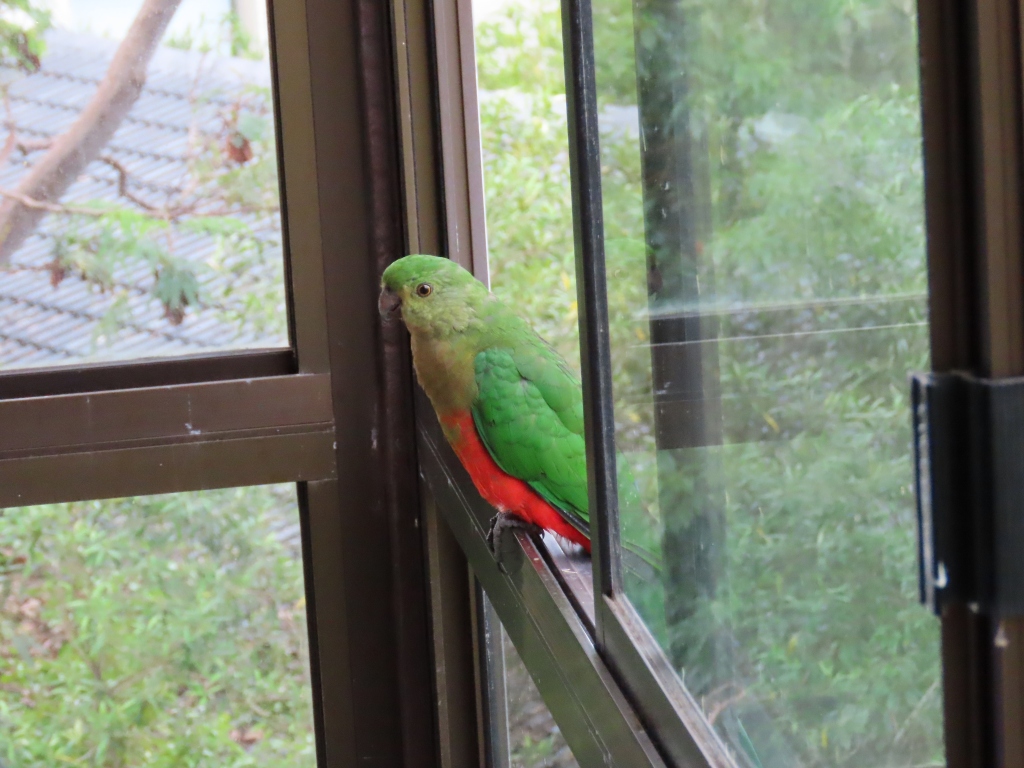
She was quite happy to turn her back on me and check out the goings on outside:

At the start of this video, the female perches on the window sill, peering in. I then find the male outside the window. The view judders a bit, as I need to kneel down to get the male in view. A cockatoo squawks as it flies past:
In the next video, the female is perched on the window sill looking outwards. If you turn up the volume, you’ll hear her soft chirps at around 6 to 12 seconds into the video. Then I manoeuvred carefully around some obstacles on the veranda, and moved the camera to outside the window. Now you can see the female’s head peering out at the bottom of the view, and the male perched on a branch higher up (and also reflected in the window pane). An Australian Raven wails. The camera pans out to show the view.
It felt like a huge privilege to be able to chat to these quiet, majestic birds.
Eventually, the female flew out onto a branch:
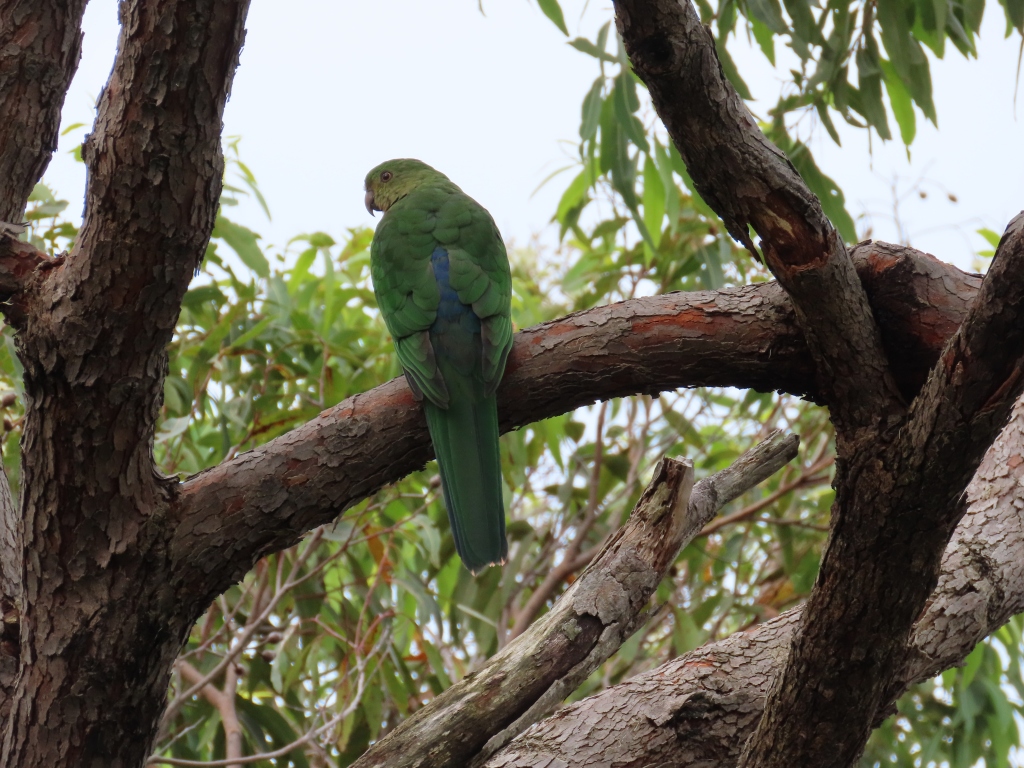
Both birds stuck around for a while. Maybe they were enjoying the view! Then they swooped away to grace another house or tree.
Common name: Australian King Parrot
Scientific name: Alisterus scapularis
Approximate length: 44 cm
Date spotted: 20 February 2024 (summer)
Location: Allambie Heights, New South Wales, Australia

Little Wattlebird on Old Man Banksia
In the early morning light, this Little Wattlebird sits among the sunlit leaves of an Old Man Banksia tree.
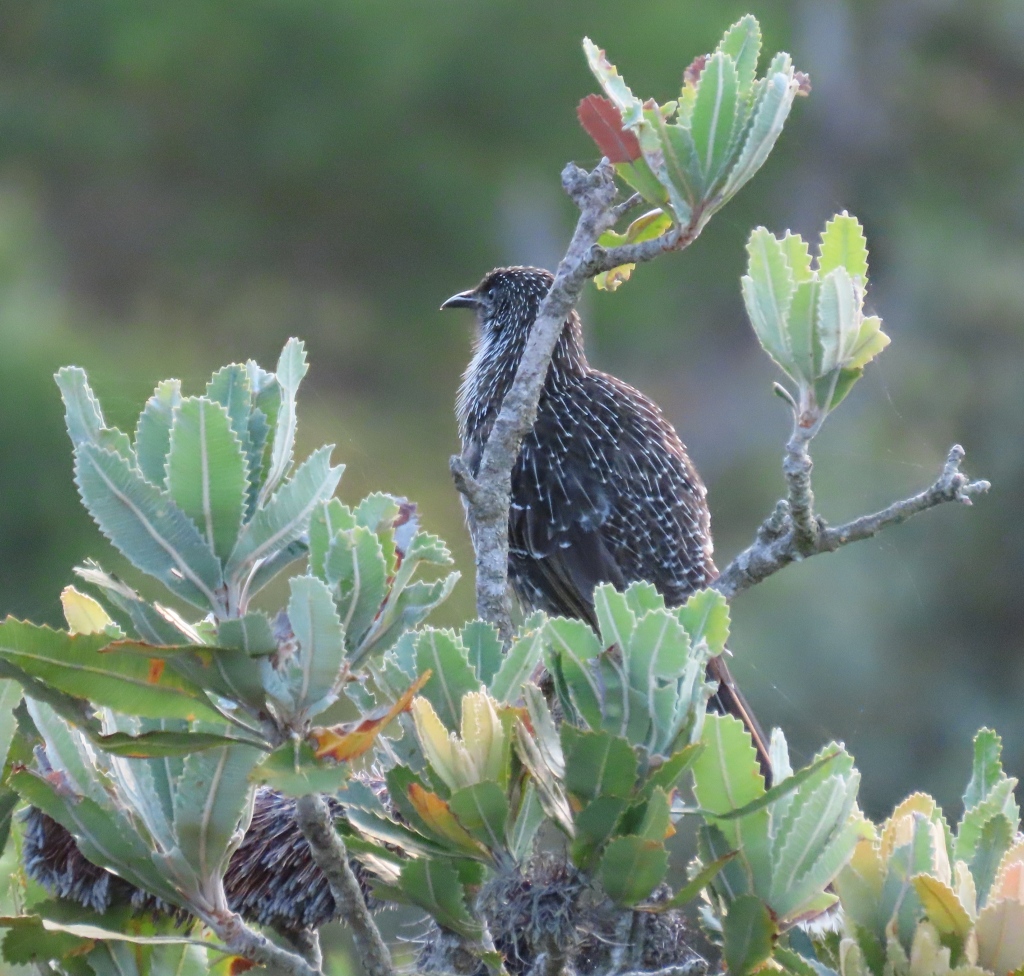
Common name: Little Wattlebird
Scientific name: Anthochaera chrysoptera
Approximate length: 30 cm
Date spotted: 17 February 2024 (summer)
Location: Dobroyd Head Track, Balgowlah, New South Wales, Australia: 33°48’33.2″S 151°16’14.1″E

Black Swan grooming
Early in the morning, a Black Swan was grooming.
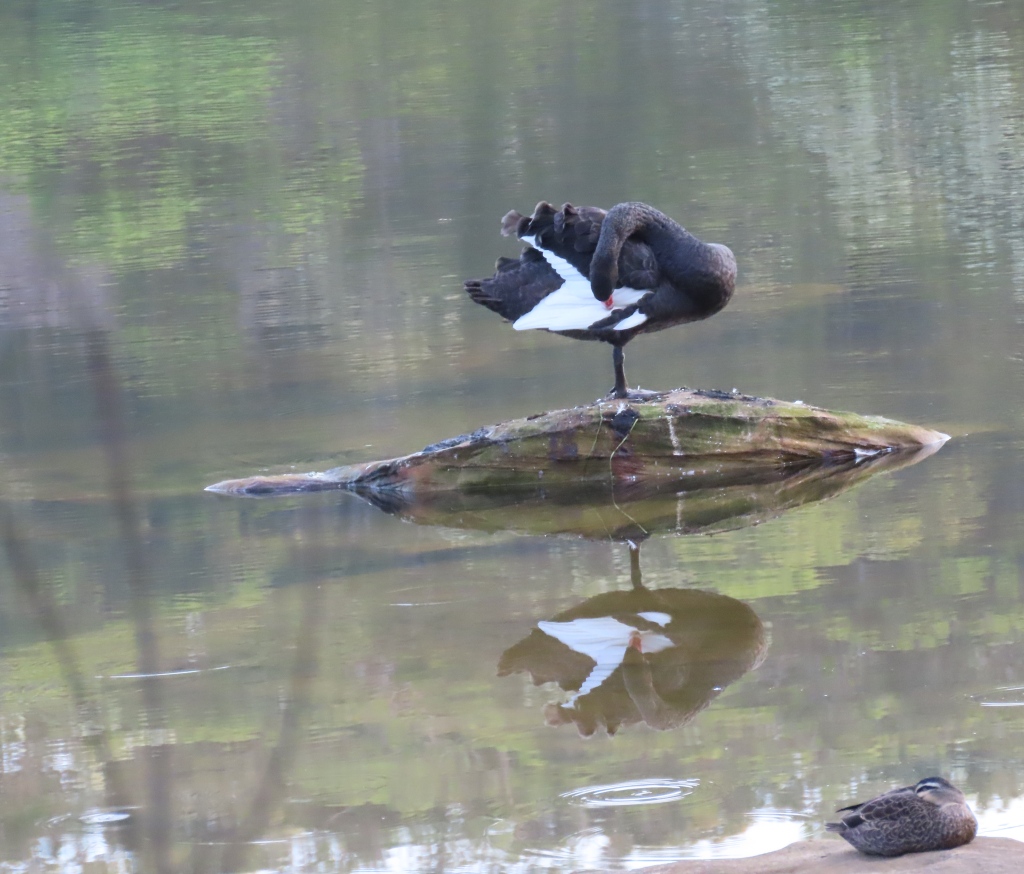
In the foreground, a Pacific Black Duck still sleeps.

Common name: Black Swan
Scientific name: Cygnus atratus
Approximate length: 120 cm
Date spotted: 4 February 2024 (summer)
Location: Manly Dam Park, New South Wales, Australia: 33°46’35.4″S 151°14’49.8″E

Currawong youngsters with Avian Pox (plus a bonus cicada story)
A couple of young Pied Currawongs have been making quite a racket in our neighbourhood recently. I was puzzled and concerned when I noticed that one of them had red swellings around its eyes and an unhealthy-looking bump on top of its beak.

Aside from being unsightly, though, the swellings don’t seem to bother the youngster much. For wont of a better name, let’s call this one Youngster 1. The bird is quite lively and curious, and feeding well.
Here’s Youngster 1 hiding in the shade, awaiting its next feed:
The other young Currawong, Youngster 2, now also has similar swellings, though to a lesser extent:
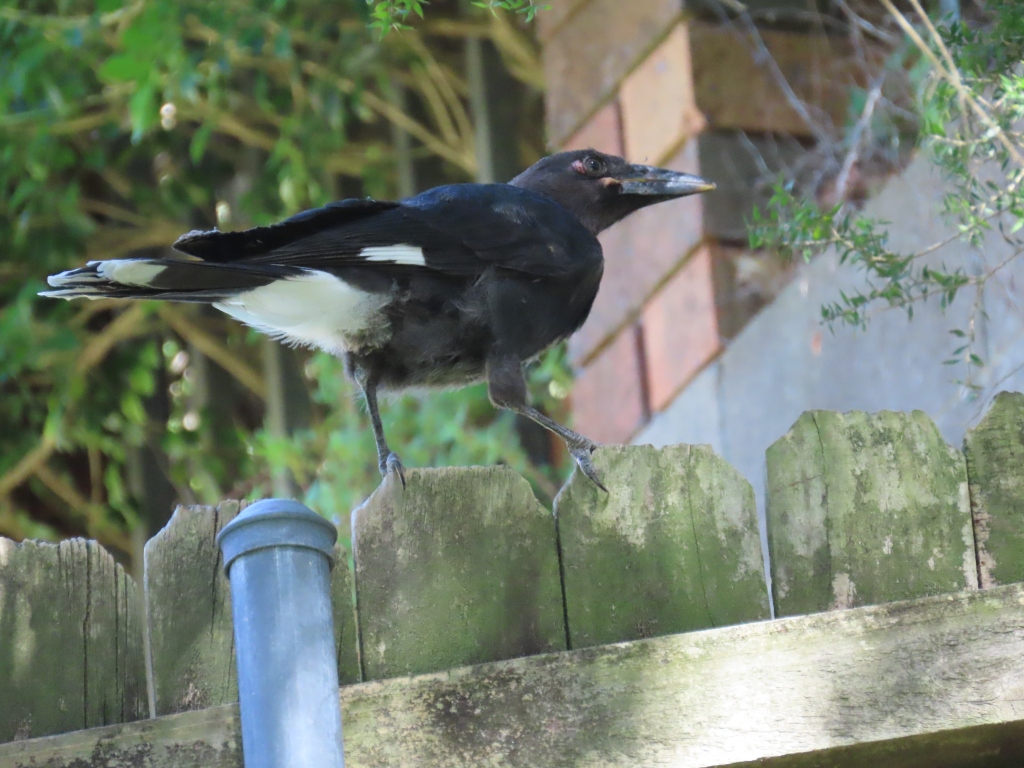
Here’s Youngster 2 sitting on the same fence as its sibling:
After some research and image comparison, I’ve discovered that these two little ones are most likely suffering from Avian Pox. This condition is caused by a virus that infects many bird species around the world, including currawongs and other Australian birds. It’s usually not too serious, and the birds recover within three to four weeks.
That’s good to know!
Here’s a glimpse of one of the hard-working adult currawongs, taking a breather between feeding runs:

Common name: Pied Currawong
Scientific name: Strepera graculina
Approximate length: 45 cm
Date spotted: 19 January 2024 (summer)
Location: Allambie Heights, north of Sydney, New South Wales, Australia
A bonus cicada story
A couple of weeks ago, I was filming one of the baby currawongs being fed:
As I was filming a bit of drama occurred. Alas, I didn’t capture any of it on film, as the action took up the whole sky and went down very fast.
Picture this:
A cicada flies past. Two little Noisy Miners give chase. One of them grabs the cicada and lands on our roof, the other Noisy Miner in close pursuit. A currawong parent thinks, “Ah, perfect for the little one.” It swoops on the Noisy Miners, who both fly away, abandoning the cicada to buzz around on the roof. The currawong grabs the cicada.
Not taking this lightly, the Noisy Miners swoop on the baby currawong, which is minding its own business deep in the foliage. There’s a sudden flurry of activity as the adult currawongs and Noisy Miners swoop noisily around the tree. The baby takes deeper cover under a thick leafy branch. The fuss dies down and everyone goes about their business.
I don’t know what happened to the cicada.

Koel cuckoo wearing the midnight
The Koel cuckoos are back! They migrate to our region of eastern Australia in spring, and go back up north in autumn. You know they’re there because of their loud call: coo-eee, coo-ee. It’s less often that you manage to see one, as they tend to stay high up in the trees and make use of the foliage to hide from other birds.
This male Koel spent a few minutes in a relatively exposed position on the street where I live:
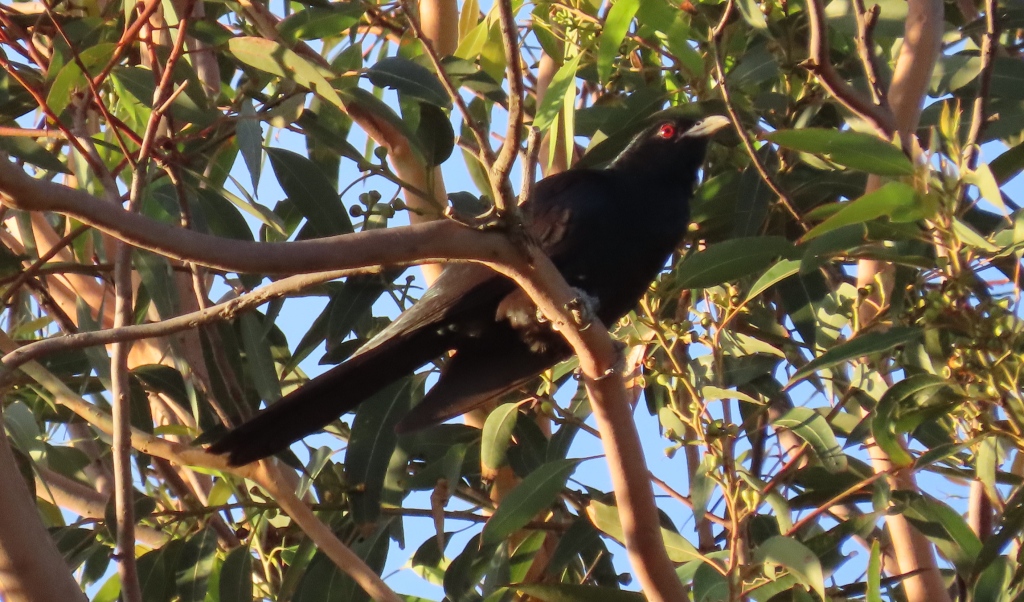
The males are entirely black, with bright red eyes and a pale beak. Like other cuckoos, the females lay their eggs in the nests of other birds (mostly wattle birds and friar birds). The cuckoo then abandons the egg and leaves it up to the foster parents to bring up the chick.
My earlier posts name this bird as a Common Koel (Eudynamys scolopacea). I’ve discovered recently that Koel cuckoos were recently reclassified as Pacific Koels (Eudynamys orientalis).
Common name: Pacific Koel or Eastern Koel
Scientific name: Eudynamys orientalis (was scolopacea)
Approximate length: 45 cm
Date spotted: 19 January 2024 (summer)
Location: Allambie Heights (north of Sydney) New South Wales, Australia


 Sydney Birder