Blog Archives
Eastern Rosellas brighten a work day
Today I’m working from home. I heard a gentle twittering outside the window, and looked out just in time to see a male Eastern Rosella serenading his lady love.

I’ve seen and heard these birds a few times before, but this is the first time I’ve managed to see the female before they both fly away. Here she is, looking rather coy:

In my previous post you can see and hear the dance and calls that the male birds make. Interestingly, that post was almost exactly a year ago.
Common name: Eastern Rosella
Scientific name: Platycercus eximius
Approximate length: 30 cm
Date spotted: 10 March 2020 (late summer)
Location: Allambie Heights, NSW, Australia
Yellow-tailed Black Cockatoo calling while keeping a lookout
Yesterday I saw a group of four Yellow-tailed Black Cockatoos. I love coming across these large birds, as they impart a feeling of calm and grace. I took a video of the bird that seemed to be the designated lookout, sitting on a branch while the others foraged on the ground. You can hear the eerie call that the bird makes. It sounds rather like a door opening on rusty hinges!
Common name: Yellow-tailed Black Cockatoo
Scientific name: Calyptorhynchus funereus
Approximate length: 65 cm
Date spotted: 9 November 2019 (spring)
Location: Manly Dam Reserve, New South Wales, Australia: 33°46’40.0″S 151°14’50.2″E
Sulphur-crested Cockatoos at Bobbin Head
A group of Sulphur-crested Cockatoos gathered on the mud amidst the mangrove stalks at Bobbin Head:

It’s the first time I’ve been to Bobbin Head. I started with the Mangrove Boardwalk and also walked part of the Gibberagong Track, which follows on from the boardwalk. This is the sign at the start of the Mangrove Boardwalk:

The cockatoos had gathered next to this bridge at the start of the Mangrove Boardwalk:

From time to time the birds flew up into the surrounding trees to have a peaceful snack:


And a bit of mutual grooming:

Common name: Sulphur-crested Cockatoo
Scientific name: Cacatua galerita
Approximate length: 50 cm
Date spotted: 28 August 2019 (late winter)
Location: Bobbin Head, Ku-ring-gai Chase National Park, New South Wales, Australia: 33°39’48.5″S 151°09’21.3″E
Glossy Black-Cockatoos near Sydney
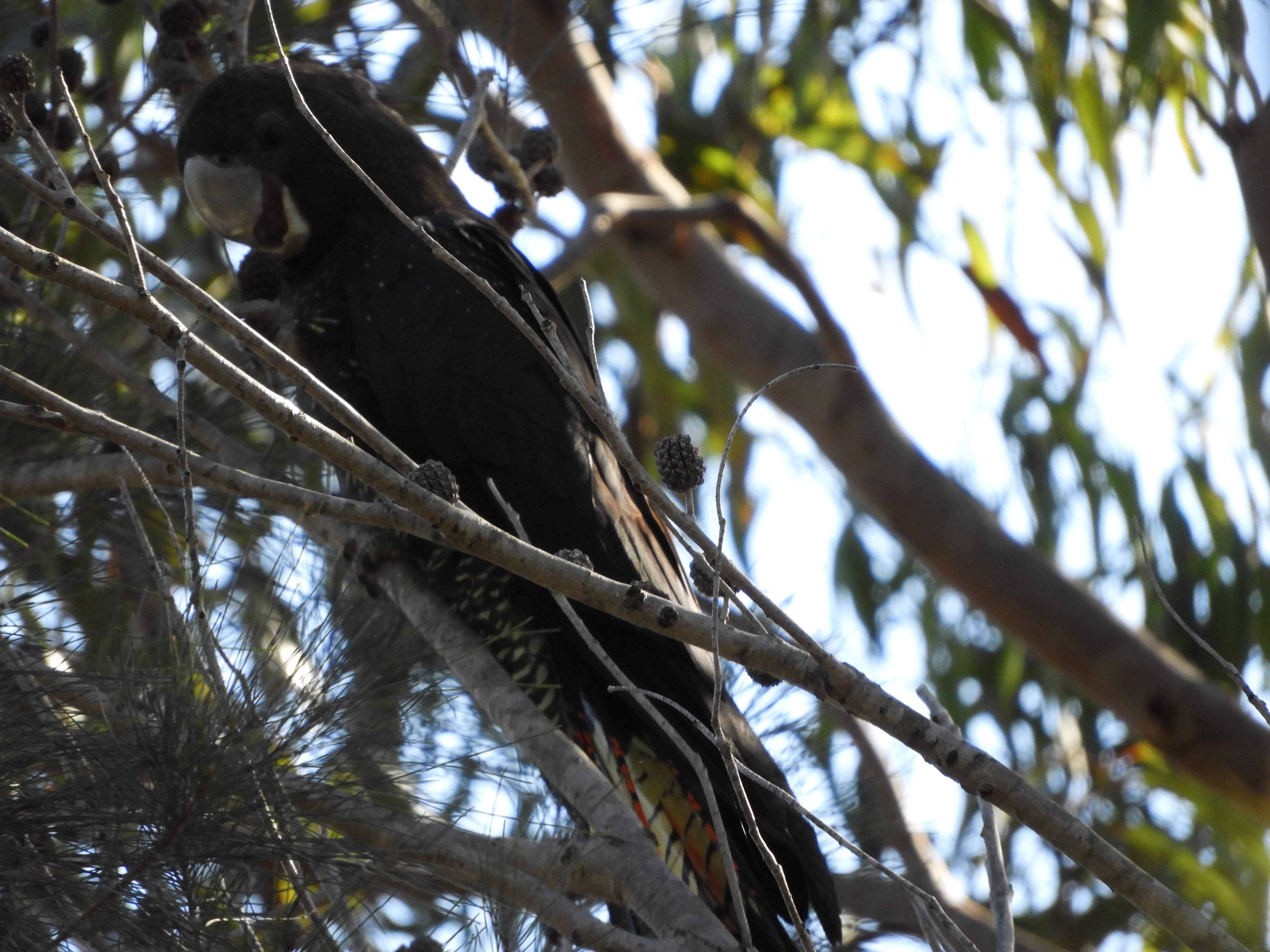
Update on 9 October 2019: The birds are Glossy Black-Cockatoos, not Red-tailed Black-Cockatoos. Thank you to Carol Probets for pointing this out in a comment on the post.
Today I heard an unusual bird call – a kind of heavy, high-pitched whirring noise. I followed it down the path and saw two large black cockatoos. They flew off when I arrived, and landed again a few trees further on, chattering to each other.
I’ve seen Glossy Black-Cockatoos in the same area once or twice (see my posts). Today’s birds were larger, I thought, and seemed to have larger crests than the others I’d seen. At first, this led me to think they were Red-tailed Black-Cockatoos, but it turns out they were Glossies.
Here’s the only picture I managed to get. (The birds were much more timid than the Yellow-tailed Black-Cockatoos that are more common in our area.) This is the female of the pair, so her tail has yellow/orange panels rather than red:
Common name: Glossy Black-Cockatoo
Scientific name: Calyptorhynchus lathami
Approximate length: 50cm
Date spotted: 18 August 2019 (late winter)
Location: Manly Dam National Reserve, near Sydney: 33°46’47.3″S 151°15’03.3″E
Little Corella sipping water from roof guttering
From a distance, Little Corellas look very similar to Sulphur-crested Cockatoos. It’s only when you get up close that you notice the differences. Corellas do have a crest on their heads, but it’s smaller than that of their sulphur-crested cousins and doesn’t have a yellow flare.
Up until a few months ago, it was unusual to see these birds in our neighbourhood on the east coast of Australia, but I’ve seen them three or four times recently. I filmed this one sipping water from the gutter on the roof of a house:
Little Corellas have big, rubbery-looking blue patches around and under their eyes. The first time I saw one of these birds, for a couple of seconds I thought it was a very sick Sulphur-crested Cockatoo!
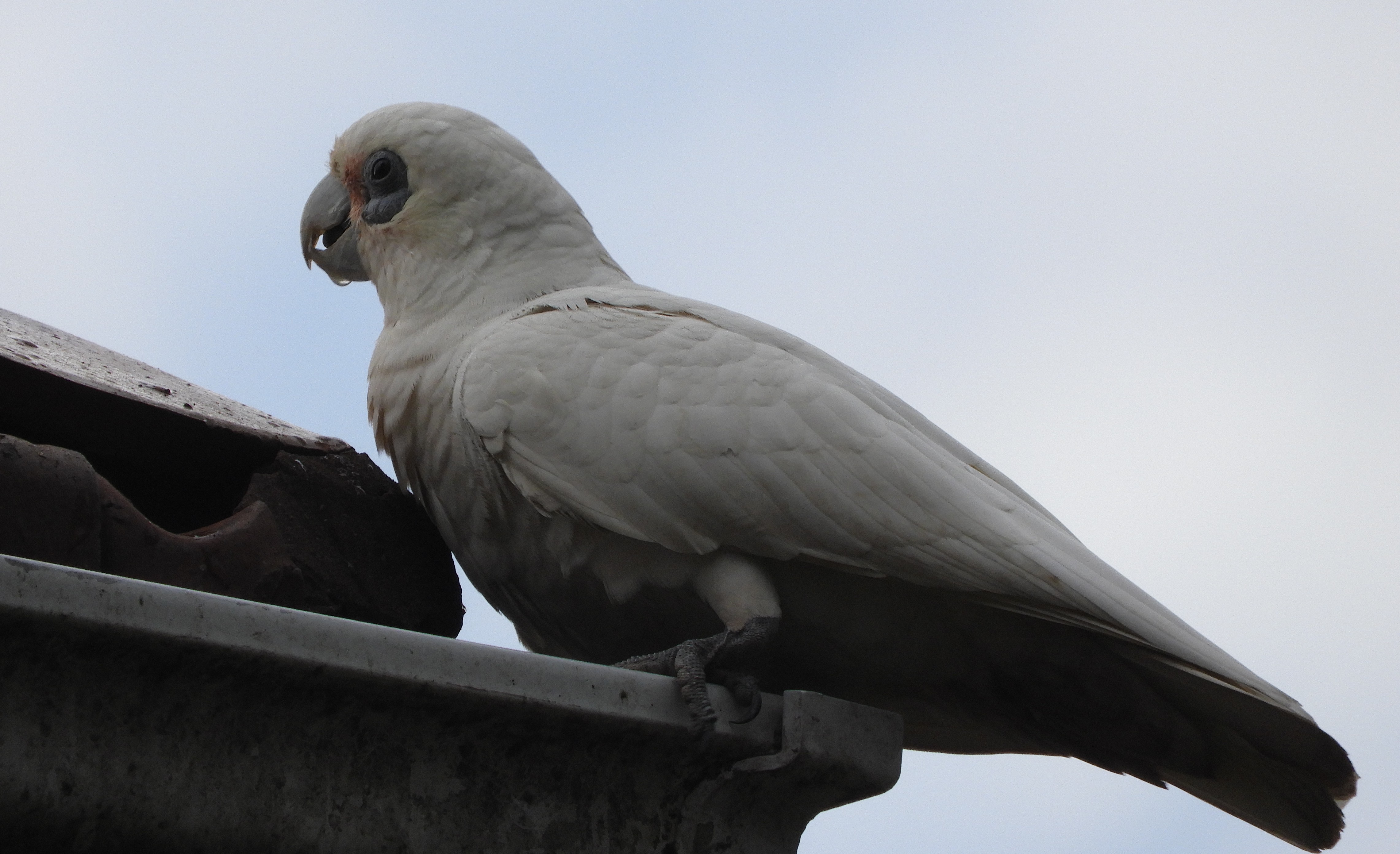
Often the crests on their heads are laid flat, as in the above photo. Here’s one with a raised crest, giving it that typically cheeky cockatoo look:

I’m delighted to add this bird to my posts about the various types of cockatoo that I’ve seen in our neighbourhood.
Common name: Little Corella
Scientific name: Cacatua sanguinea
Approximate length: 36-39 cm
Date spotted: 26 May 2019 (Autumn)
Location: Allambie Heights near Sydney, Australia
Cockatoos cleaning out a tree hollow
Two Sulphur-crested Cockatoos were very busy cleaning out a hollow in a tree trunk when I walked past them today. The tree is in Manly Dam National Park. I often see cockatoos strutting up and down this tree trunk, raising their crests and squawking, and flying from tree to tree. The area is where they hang out. It’s a cockatoo playground.
In this video, one of the cockatoos gets into the cleaning in a big way, disappearing into the hollow and kicking out chunks of debris. The other cockatoo watches from above, then goes down to join the fun:
It seems an odd time of year to be preparing to build a nest. I’ve seen a few swarms of bees in this particular hollow from time to time over the years. I wonder if the cockatoos are looking for left over honeycomb?

Common name: Sulphur-crested Cockatoo
Scientific name: Cacatua galerita
Approximate length: 50 cm
Date spotted: 10 March 2019 (late summer)
Location: Manly Dam National Reserve, near Sydney: 33°46’50.5″S 151°14’51.1″E
Eastern Rosella calling and dancing
This has turned out to be parrot weekend in our garden. Yesterday four black cockatoos dropped by. Today it was two Eastern Rosellas. This is the first time I’ve managed to get a photo of one of these lovely birds. Its characteristic call drew me to the window. There it was on our Scribbly Gum tree right outside the window, dancing and chattering to its mate:
Knowing that these birds usually go about in pairs, I looked for the other one but didn’t see it until they both flew away, several minutes later. (The mate was higher up in the tree, hidden by the foliage.)
At 30 cm in length, Eastern Rosellas are slightly smaller than the Crimson Rosellas that we see more often in our area. This still shot shows the bird in all its beauty:

Common name: Eastern Rosella
Scientific name: Platycercus eximius
Approximate length: 30 cm
Date spotted: 21 October 2018 (Spring)
Location: Allambie Heights, NSW, Australia
Four Yellow-tailed Black Cockatoos come to visit
Today I arrived home from a long overseas trip. An hour or so after getting home, I was delighted to hear the haunting calls of a group of Yellow-tailed Black Cockatoos. They came to visit our Old Man Banksia tree, which is currently covered in dried seed pods. A tasty snack for a cockatoo!
I love the comfortable nibbling noises the birds make. Every now and then they chatter to each other too, as you can hear towards the end of this next video:
Yellow-tailed Black Cockatoos are large birds, quite a lot bigger than the more common white cockatoo. They have a dignified, graceful presence. It feels like a privilege to have them drop by. We planted the Old Man Banksia (Banksia serrata)a few years ago, with the goal of feeding the local bird life. It looks like our plan is working.
Two of the birds flew up into a Sydney Red Gum that towers over our house, for a quiet grooming session. It’s cute how attentive the groomer is, even returning to her job when she notices that her companion still has an intractable itch. When she stops for the second time, he reprimands her and she returns to the task yet again.
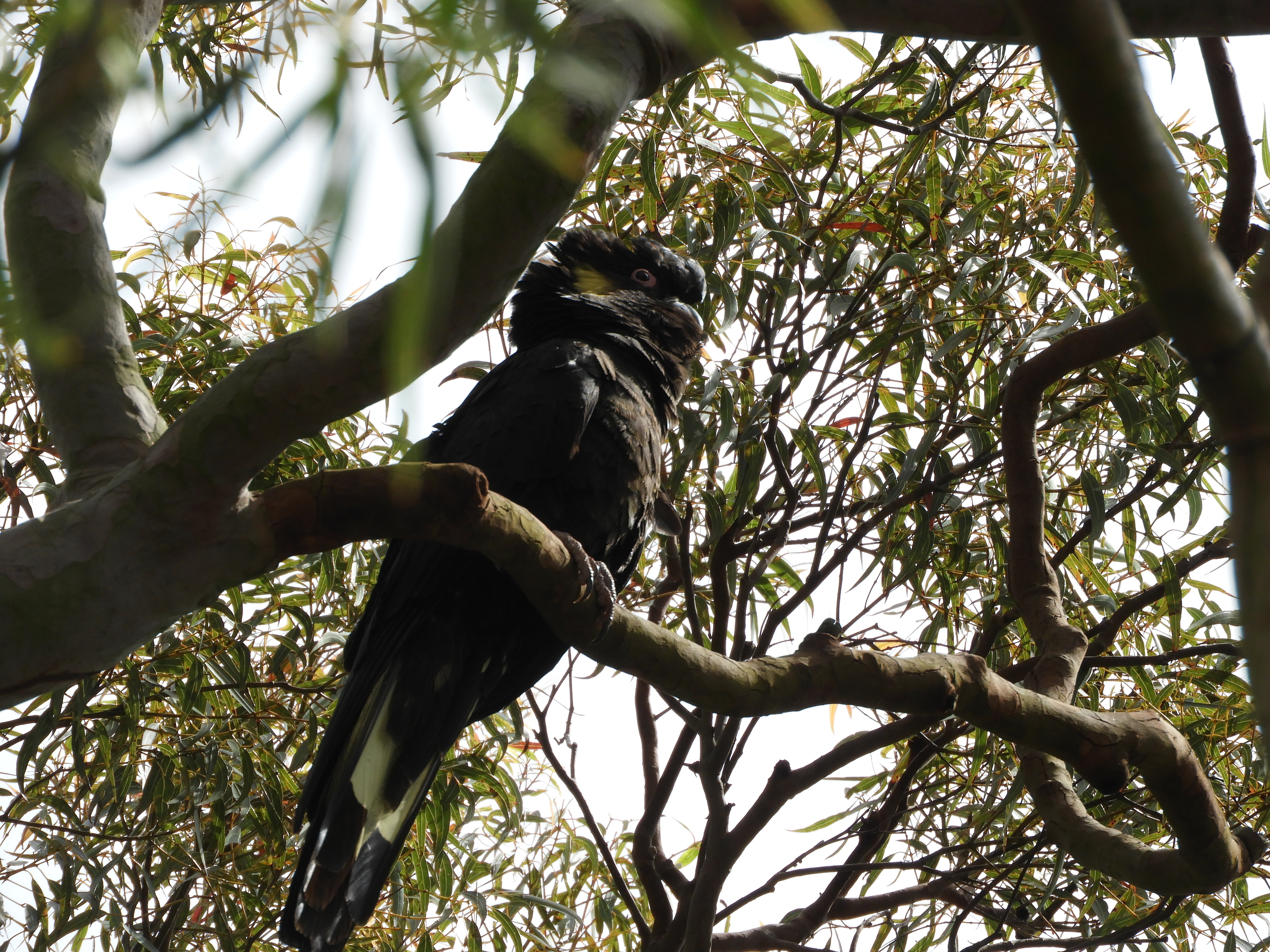
The bird with the pinkish-red ring around his eye is the male. The females have grey eye rings and a lighter-coloured bill. Here’s a still shot of the male, looking content after a good grooming from his mate:
Common name: Yellow-tailed Black Cockatoo
Scientific name: Calyptorhynchus funereus
Approximate length: 65 cm
Date spotted: 20 October 2018 (Spring)
Location: Allambie Heights, NSW, Australia
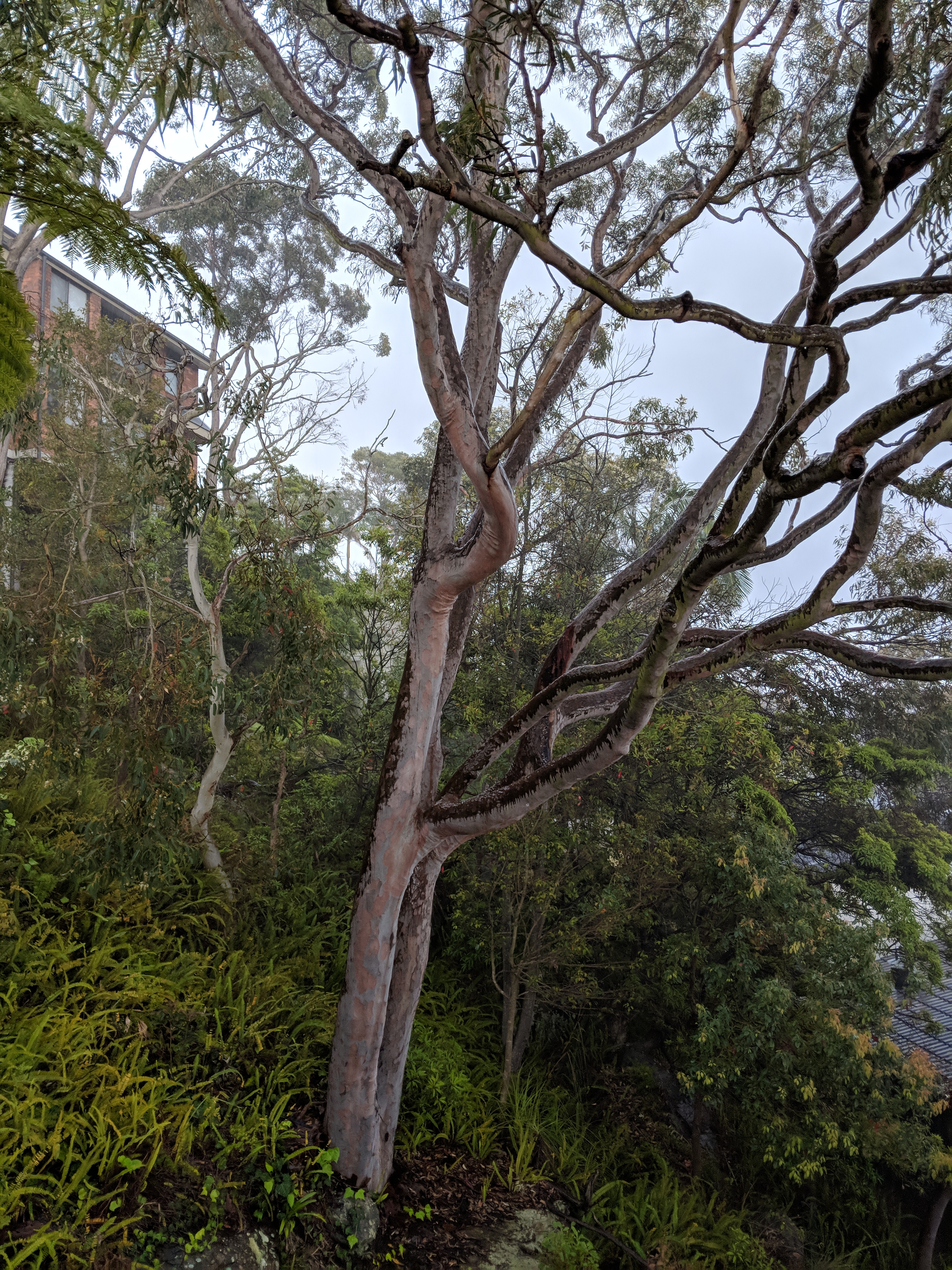
The Sydney Red Gum (Angophora costata) is a beautiful tree. I took this shot of it a couple of weeks ago, when the rain was making interesting patterns on the bark:
King Parrot on neighbour’s tree
A high-pitched whistle drew me to the window early on Friday morning. A King Parrot perched on a nearby tree to take stock of the neighbourhood.
Here’s a zoomed-in view of the same photo:
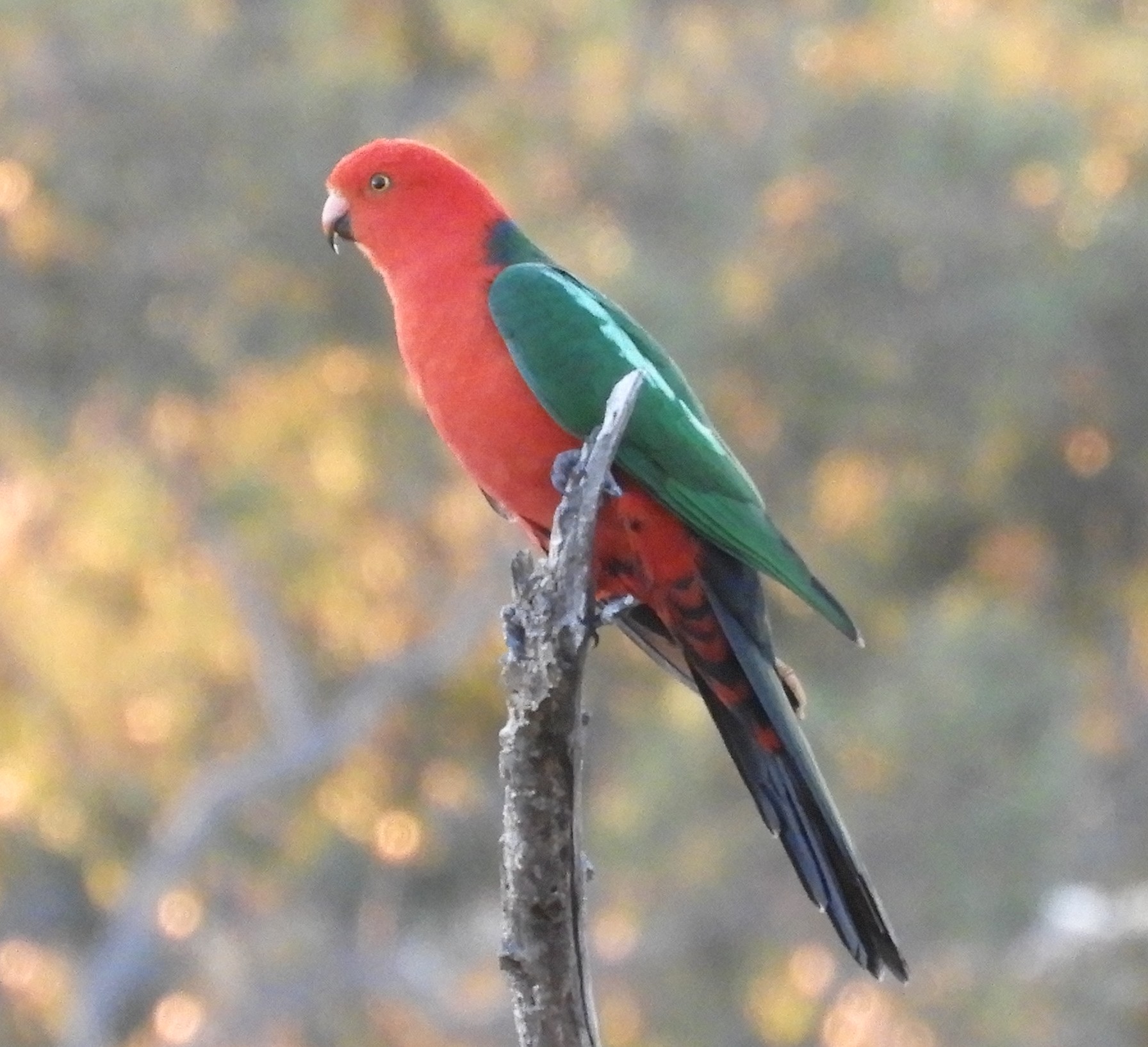
Common name: Australian King Parrot
Scientific name: Alisterus scapularis
Approximate length: 44 cm
Date spotted: 6 July 2018 (Winter)
Location: Allambie Heights, New South Wales, Australia
Sharing a treetop shower with King Parrots
This was one of those magical moments that happen when you walk in the Aussie bush. I was strolling along under the canopy of tall gum trees…
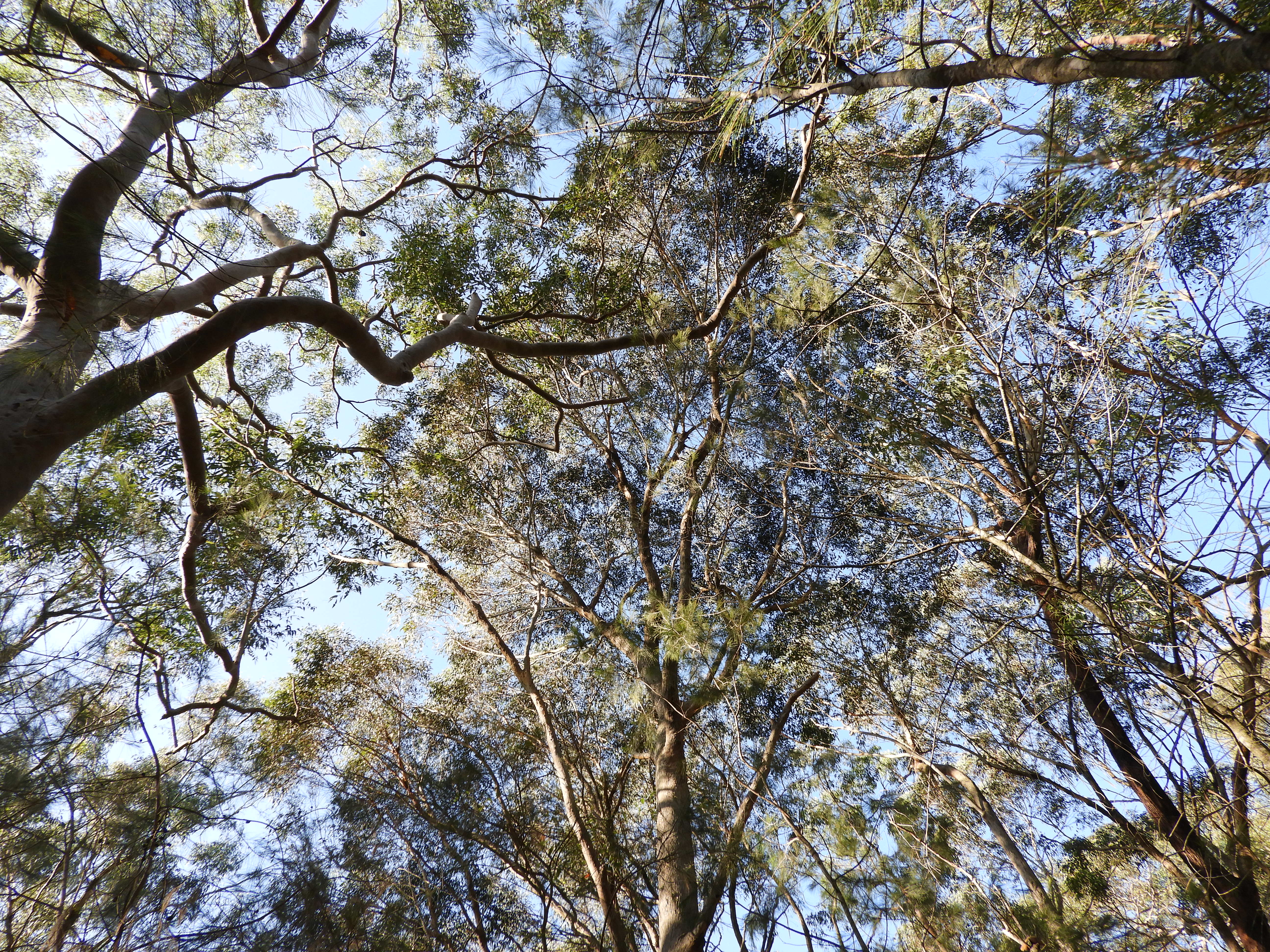
… when I heard a swooshing and clattering of wings. I looked up, just in time to receive a spattering of large droplets on my face.
Oops, I thought, some bird had a little accident.
But then it happened again. And I saw this face looking down from high in a leafy cluster:

Looking around, I saw four or five other birds – all Australian King Parrots.
(The birds were very high up indeed. My camera’s zoom has done a good job, though some of the images are a little fuzzy.)

They were swooping through the wet clusters of leaves at the top of the trees, then coming to rest for a good grooming session.

And I was lucky enough to share the resulting shower of droplets!
Here’s a female King Parrot. It’s interesting how short her tail is in comparison with the male birds. It’s perhaps a trick of perspective:
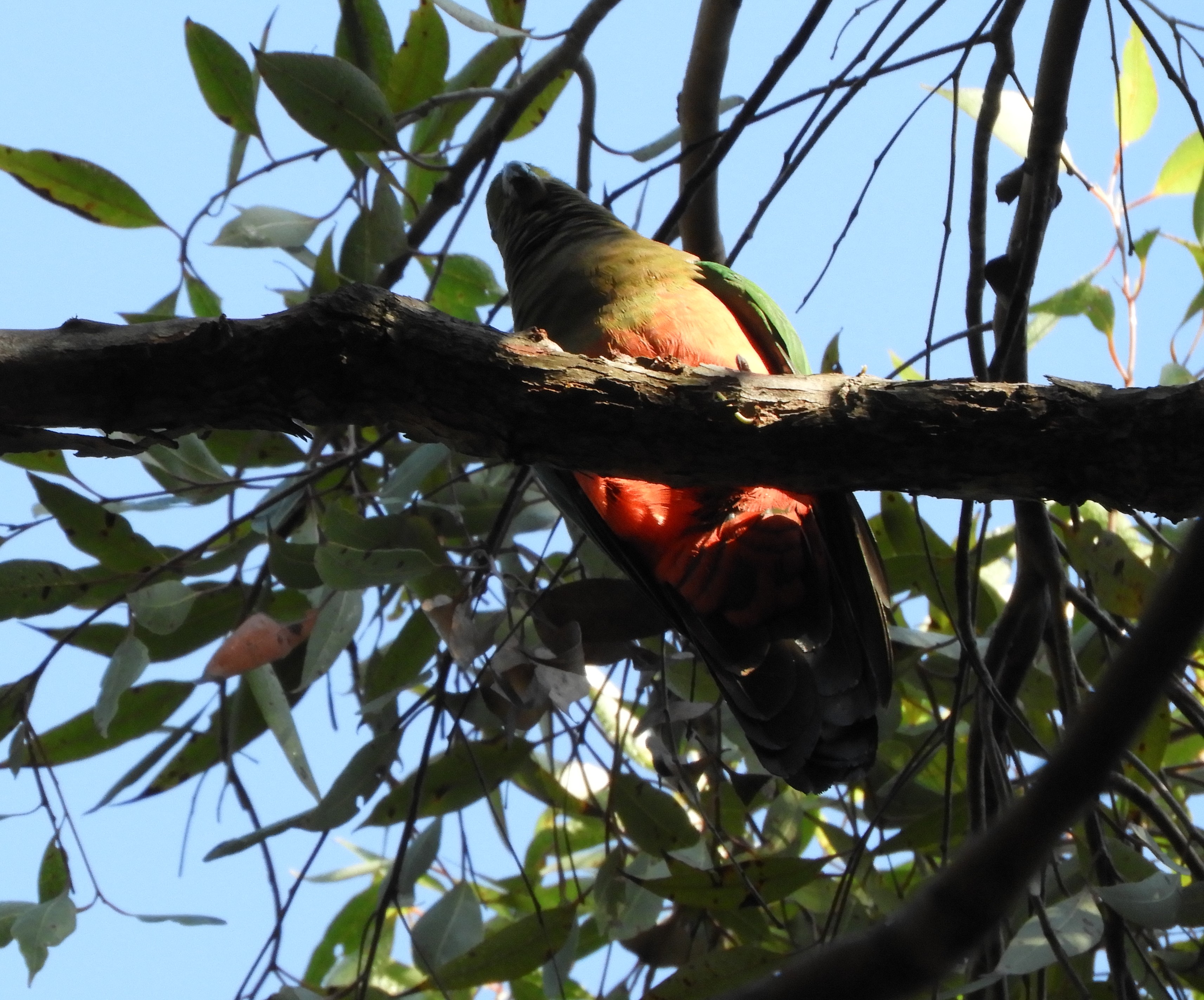
Common name: Australian King Parrot
Scientific name: Alisterus scapularis
Approximate length: 44 cm
Date spotted: 1 April 2018 (Autumn)
Location: Manly Dam National Park, New South Wales, Australia: 33°46’51.3″S 151°14’52.3″E


