Blog Archives

Rainbow Lorikeets enjoying our Banksia flowers
One of our Banksia trees has covered itself in blooms. The local Rainbow Lorikeets are delighted. A delighted lorikeet is a noisy lorikeet! In fact, anyone who lives near these birds will tell you that a lorikeet in any type of mood is a noisy creature.
One day was quite breezy. I like this video because of the way the bird hangs on to the Banksia flower as it sways in the wind, and because you get a chance to see the bird’s colourful underside as well as its topside.
Here are a couple of the birds lurking on a nearby tree before making the hop down to the Banksia:
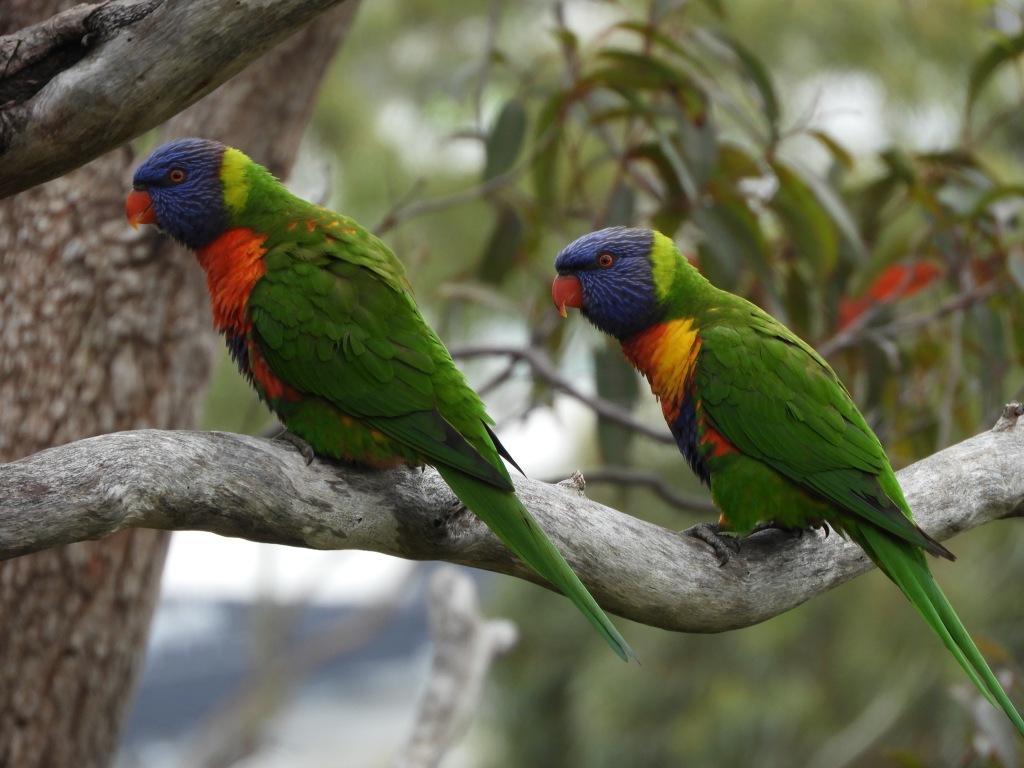
I’m so lucky to have these pretty, chatty little birds dropping in regularly to see what’s what.
Common name: Rainbow Lorikeet
Scientific name: Trichoglossus haematodus
Approximate length: 30 cm
Date spotted: November 2021 (spring)
Location: Australian east coast, about 20km north of Sydney

Majestic Glossy Black-Cockatoo pair
Two Glossy Black-Cockatoos have taken to hanging out at Manly Dam. The Casuarina trees are currently full of seed pods, which are this bird’s favourite food. In fact, Glossies feed almost exclusively on Casuarina seeds.
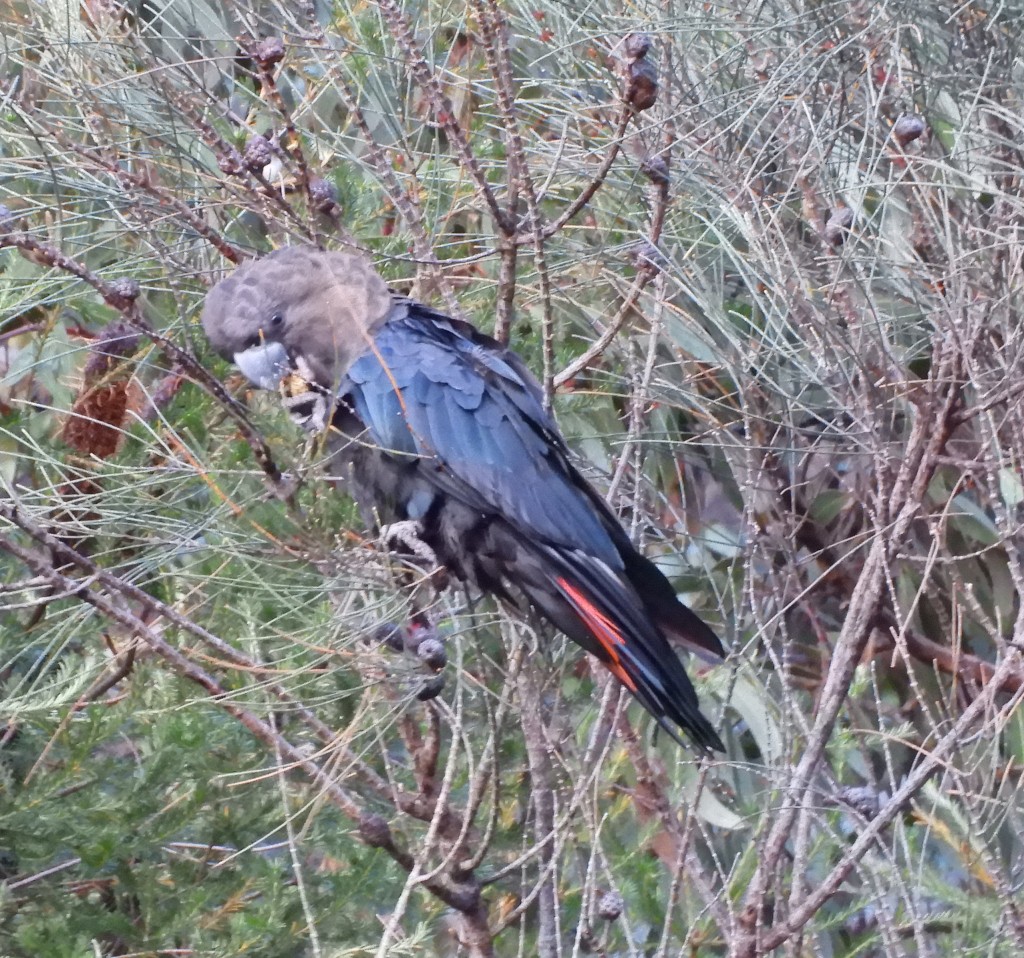
This video shows the male bird first, its feathers gleaming a soft blue in the early morning light, and the red tail flares standing out nicely. Then the view moves to the female feeding on a nearby tree.
Glossy Black-Cockatoos are large parrots at around 15 cm in length. We’re lucky to see four different types of cockatoos in this area. Glossies are heavier than the white Sulphur-crested Cockatoos and Corellas, and shorter in length than the Yellow-tailed Black Cockatoos. Of the four types, Glossies are by far the least common.
This is the male bird, with that blueish gleam lent by the early morning light, and those red tail flares:
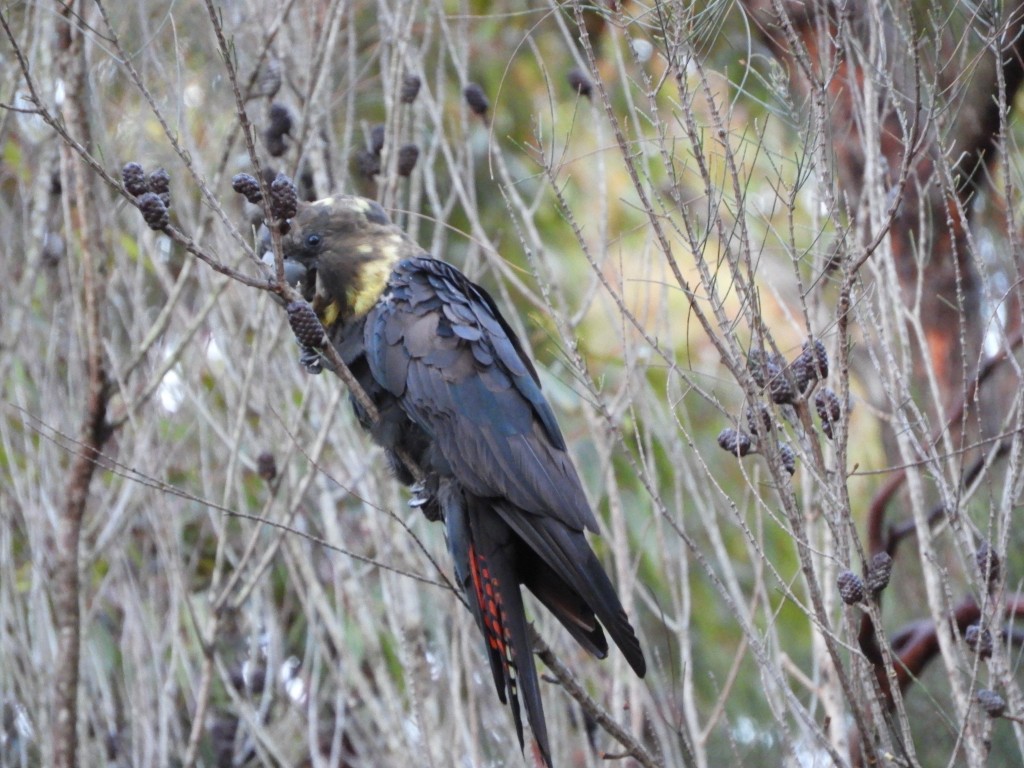
The female has yellow markings around her neck, and her tail flares are yellow and a softer shade of orange-red than the male’s:
With their large heads and that mane of feathers, Glossies sometimes remind me of a bear. Here’s a close up of the male bird, taken a few days before the above shots:

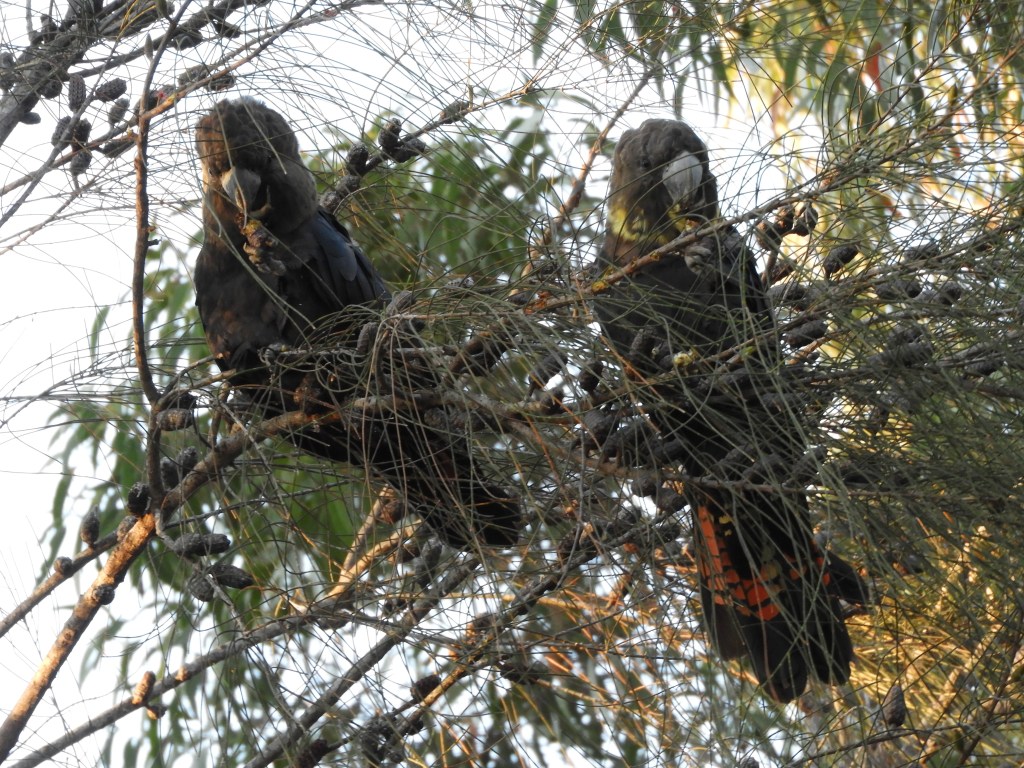
Here are both birds, sharing a tree this time:
Common name: Glossy Black-Cockatoo
Scientific name: Calyptorhynchus lathami
Approximate length: 50cm
Date spotted: 5 October and 15 October 2021 (spring)
Location: Manly Dam Park, near Sydney: 33°46’56.5″S 151°15’10.3″E

Eastern Rosella a frequent visitor
How lucky am I? This gorgeous bird has taken to dropping by frequently, and hanging out on our telephone line. It’s a male Eastern Rosella. Often the female comes along too, but she’s more shy and flies off when I appear.

Eastern Rosellas are medium-sized parrots, at about 30cm from head to tail. This one usually makes his presence known with a distinctive twittering call. The phone line is below the level of my lounge window, so he has to look up to spot me.

Common name: Eastern Rosella
Scientific name: Platycercus eximius
Approximate length: 30 cm
Date spotted: 10 April 2021 (autumn)
Location: Allambie Heights, NSW, Australia
3 Glossy Black-Cockatoos and a tale of a Brush-turkey and a Raven
Two days ago, I encountered a group of three Glossy Black-Cockatoos on a Casuarina tree. These large cockatoos are not a very common sight. When I noticed them, I stopped walking and said “ooh” out loud. Luckily there was no-one around to hear, and the birds ignored me!
While I was watching the cockatoos, a couple of other characters appeared and contributed to the encounter. Read the story below!
First, the glossies
This picture shows two of the Glossy Black-Cockatoos. They’re quite different in appearance from the more common Yellow-tailed Black-Cockatoos. The feather arrangement around the glossies’ necks and the general setting of their heads make me think of a lion:

I think the bird on the left is a female, as she has a lot of yellow around her head. The one on the right is, I think, a male.
In the video below, the birds are munching happily on Casuarina seed pods. About half way through the video (at around 50-53 seconds on the timeline) the birds mutter to each other in low-pitched raspy calls. This munching and muttering is typical of the birds’ behaviour.
Below is a solo shot of the first of the three birds. This one has a lot of yellow around its head, which means it’s probably a female:
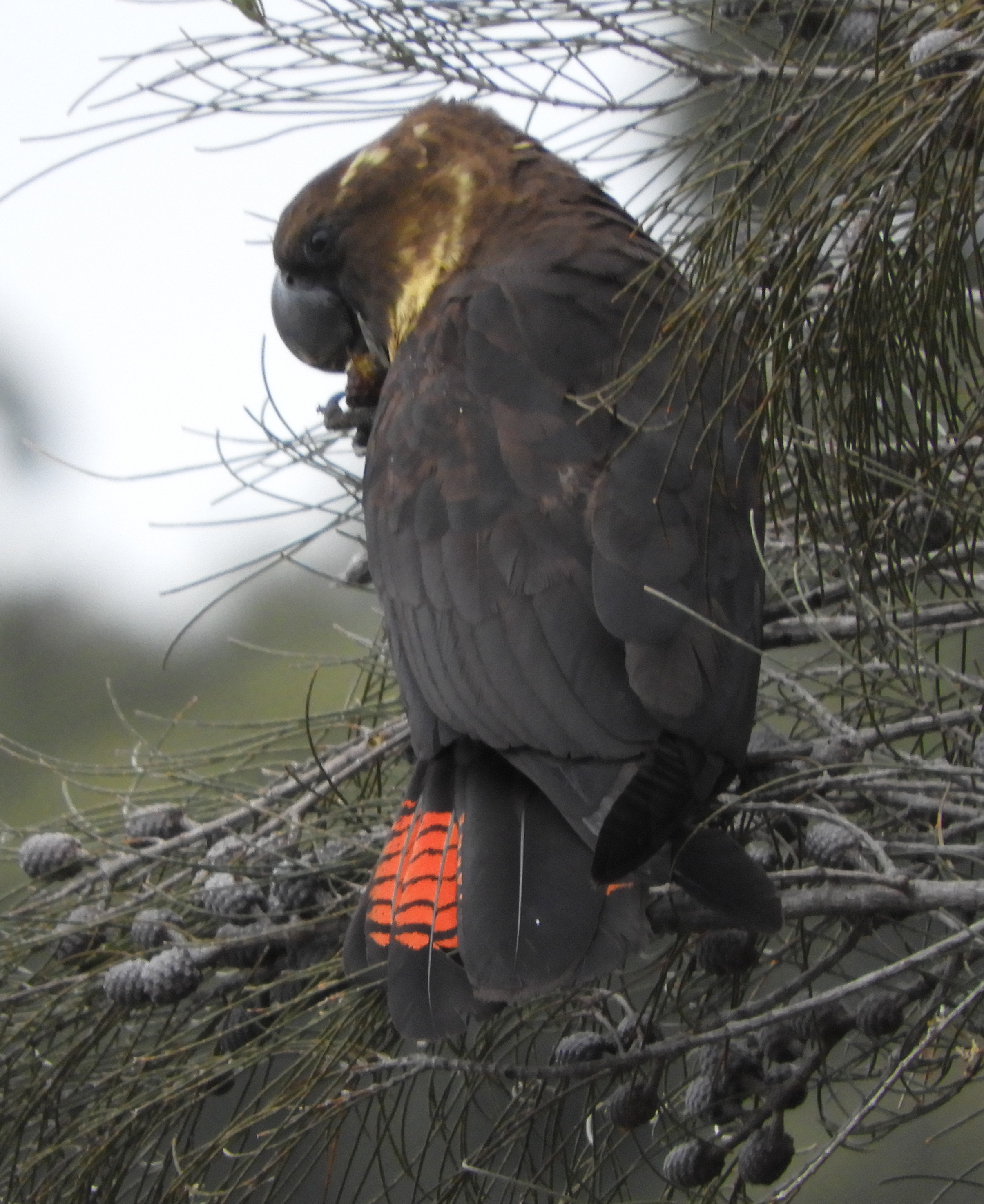
Glossy Black-Cockatoos depend on Casuarina seeds for their food. This choosiness puts the birds at risk when the tree coverage is depleted by land clearance or bush fires. Casuarinas, also called sheoaks or she-oaks, are a group of trees and shrubs native to Australia and other Asian countries. Evidently the name Casuarina is derived from cassowary (a big bird) because the branches look like cassowary feathers.
Next comes a solo shot of the second of the three birds. I think this one is a male. The feathers around its head and neck are quite brown in comparison to the darker black feathers on the rest of its body. The bird is holding a Casuarina seed pod. You can also see a few of the tree’s tiny red flowers:
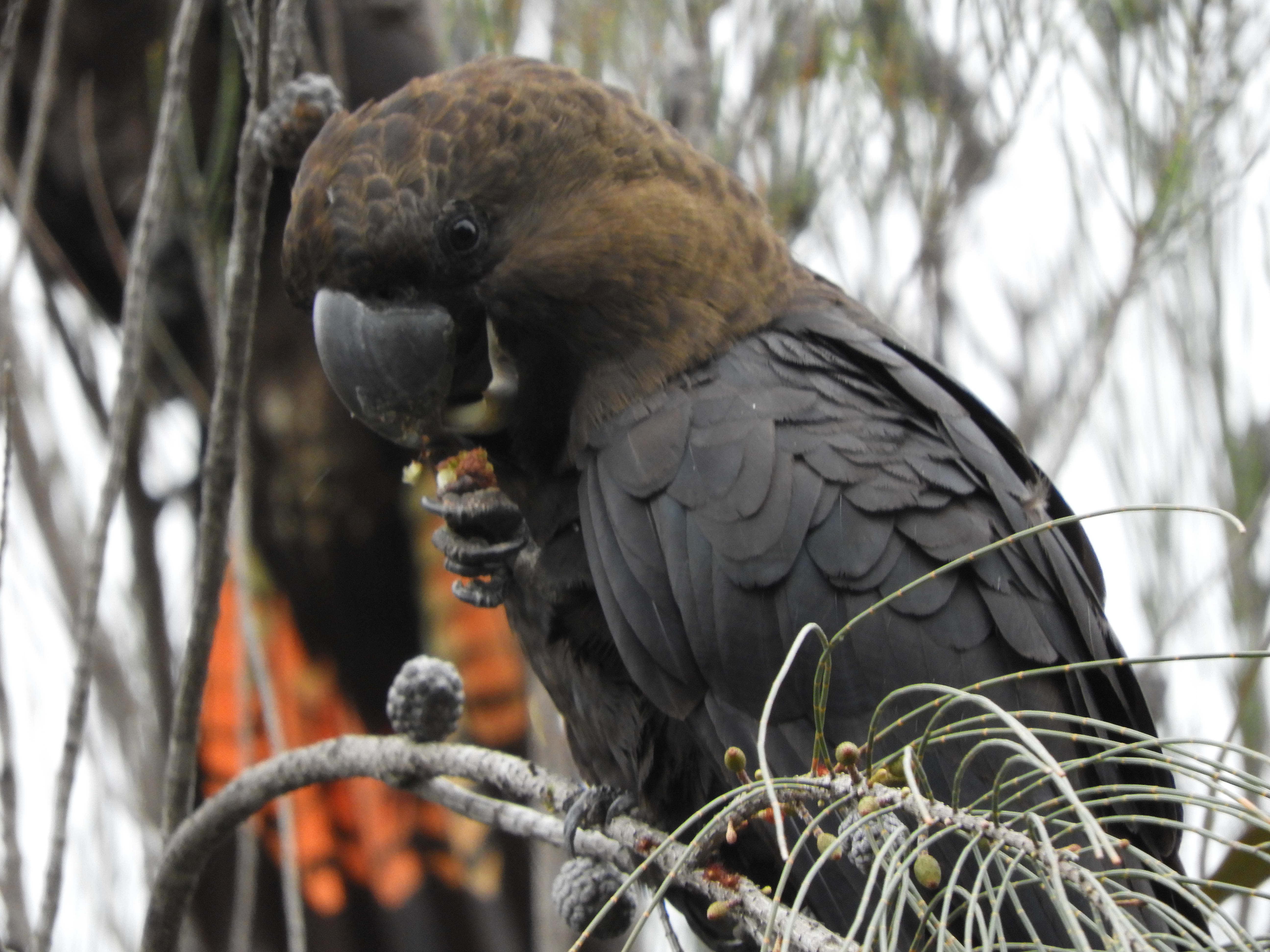
It’s a treat to see these unusual, gorgeous birds. Definitely a moment for oohing and aahing.
Unwell Glossy Black-Cockatoo – beak and feather disease?
One of the three cockatoos has an illness which has affected its beak. It may be Psittacine beak and feather disease, or some sort of cancer, or maybe the result of a fight or accident?

I didn’t notice the hole above the bird’s beak until I got the pictures home and put them on a big screen. The birds were quite a distance away, and I was using my camera’s super zoom to photograph them. But even from the long distance, I did think that the bird looked duller and more skeletal than the other two.
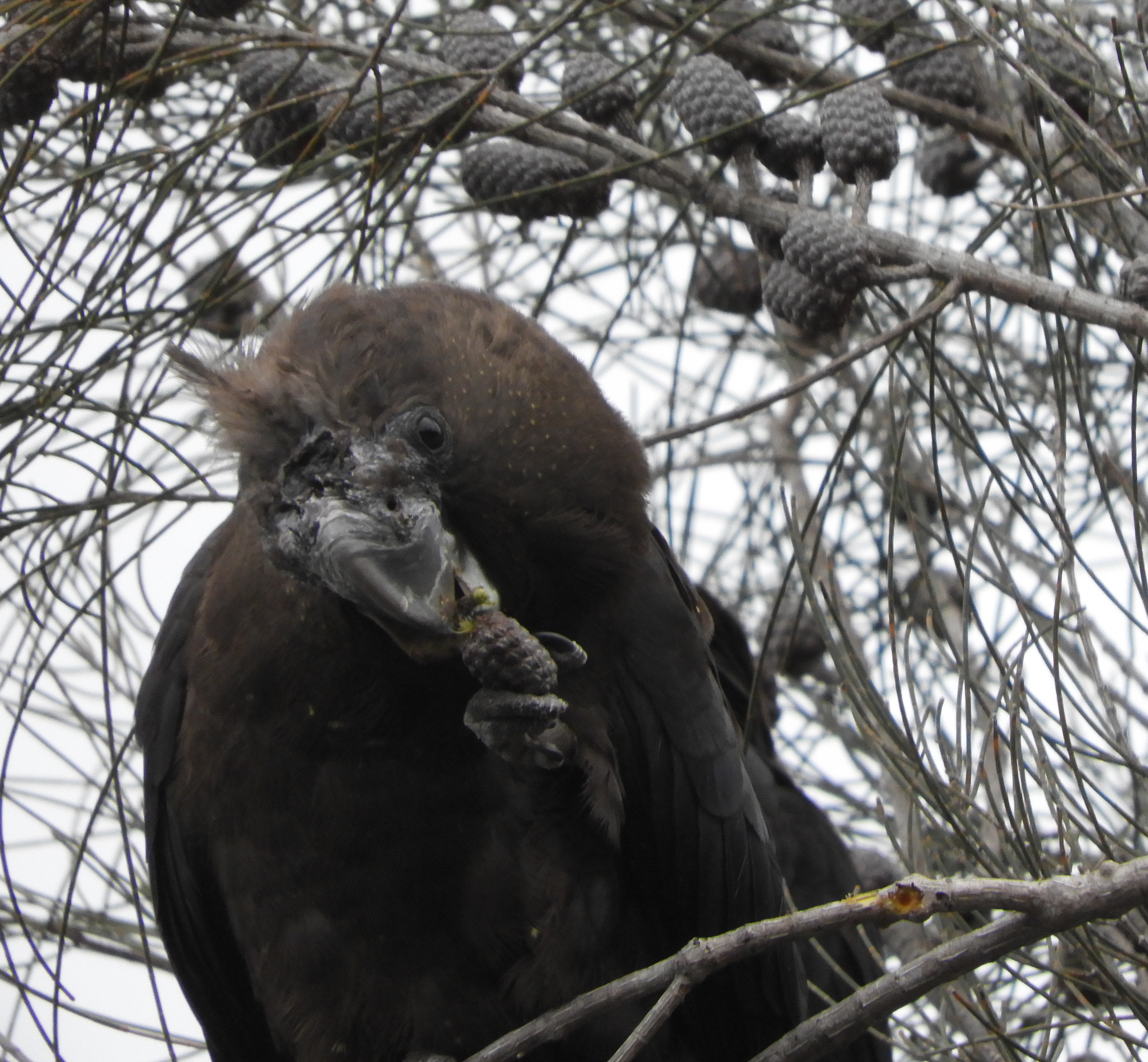
Poor bird, I hope the condition isn’t causing it too much discomfort.
Video featuring the female Glossy Black-Cockatoo
Here’s another video of two of the birds, this time featuring the female. Hint: At the start of the video you can hear a bit of thrashing around in the undergrowth. That background noise leads into the story below!
Common name: Glossy Black-Cockatoo
Scientific name: Calyptorhynchus lathami
Approximate length: 50cm
Date spotted: 18 September 2020 (spring)
Location: Manly Dam Park, near Sydney: 33°46’55.0″S 151°15’10.1″E
A tale of a Brush-turkey and an Australian Raven
If you listen carefully in the first half of the above video, you’ll hear a bit of a kerfuffle in the background. I heard it too, and turned to look when I stopped filming. I saw an Australian Brush-turkey flapping around among the trees a few metres away from me. “Ah, just a brush-turkey,” I thought, and turned back to the cockatoos. Brush-turkeys seem to specialize in making a fuss about nothing.
The kerfuffle turned into a whoosh of large wings, followed by a downdraft of air and the sound of claws on metal. I turned around again, to discover that the brush-turkey had landed on a gate less than two metres away from me. (The gate was one of those that the authorities use to close the park when the danger of bush fires is critical.)
“Hallo, mate,” said I. “What are you up to?” I do talk to birds when they approach me, partly to make us both feel comfortable.
The brush-turkey look at me, then teetered slightly and looked down at the ground with some apprehension. They do that, when they’re off the ground. They’re no doubt thinking, “I got myself up here, but now that ground is a long way down. How do I get down there?”
Two seconds later, a large, fierce Australian Raven arrived. Eyes ice blue. Beak long, strong, and pointy. Being the focus of that glare is rather daunting, even if you’re a large human.
The raven glared at me. I stood my ground. One point five metres of empty space between me and that beak.
The raven decided I wasn’t a threat, and turned its attention back to the brush-turkey. Obviously, the raven wanted to continue the altercation that had been the cause of all that kerfuffle in the trees.
The brush-turkey looked at the raven, looked at me, and hopped off the gate. A few hurried steps, and it was at my feet. It got as close to my knees as it could, then started walking round my legs. When it comes to a choice between a raven and me, it seems I’m a safe haven.
The raven looked thoroughly peeved. It leapt into the air and spotted the Glossy Black-Cockatoos, who were still peacefully munching and muttering in the Casuarinas. With a caw and a swoop, the raven dislodged the glossies. They floated into the air with easy grace, and came to land again a few trees away. “Ah, ravens,” the glossies were no doubt thinking. “They seem to specialize in making a fuss about nothing.”
The brush-turkey was still jittering around my legs. I wanted to continue filming the cockatoos, so I waited for a gap in the brush-turkey’s circle, and strode out along the path towards the cockatoos’ new roosting area.
Within a second, I heard the tick-tick-tick of brush-turkey claws on the path. The turkey had decided to stay with its safe haven for a while, in case that nasty bird with the ice-blue eyes and big strong beak came back.
So there we were, the cockatoos munching and muttering, I oohing and aahing, and the brush-turkey click-clacking companionably at my heels.
I wish I’d got all of that on camera! Anyway, I hope you enjoyed the story. 🙂
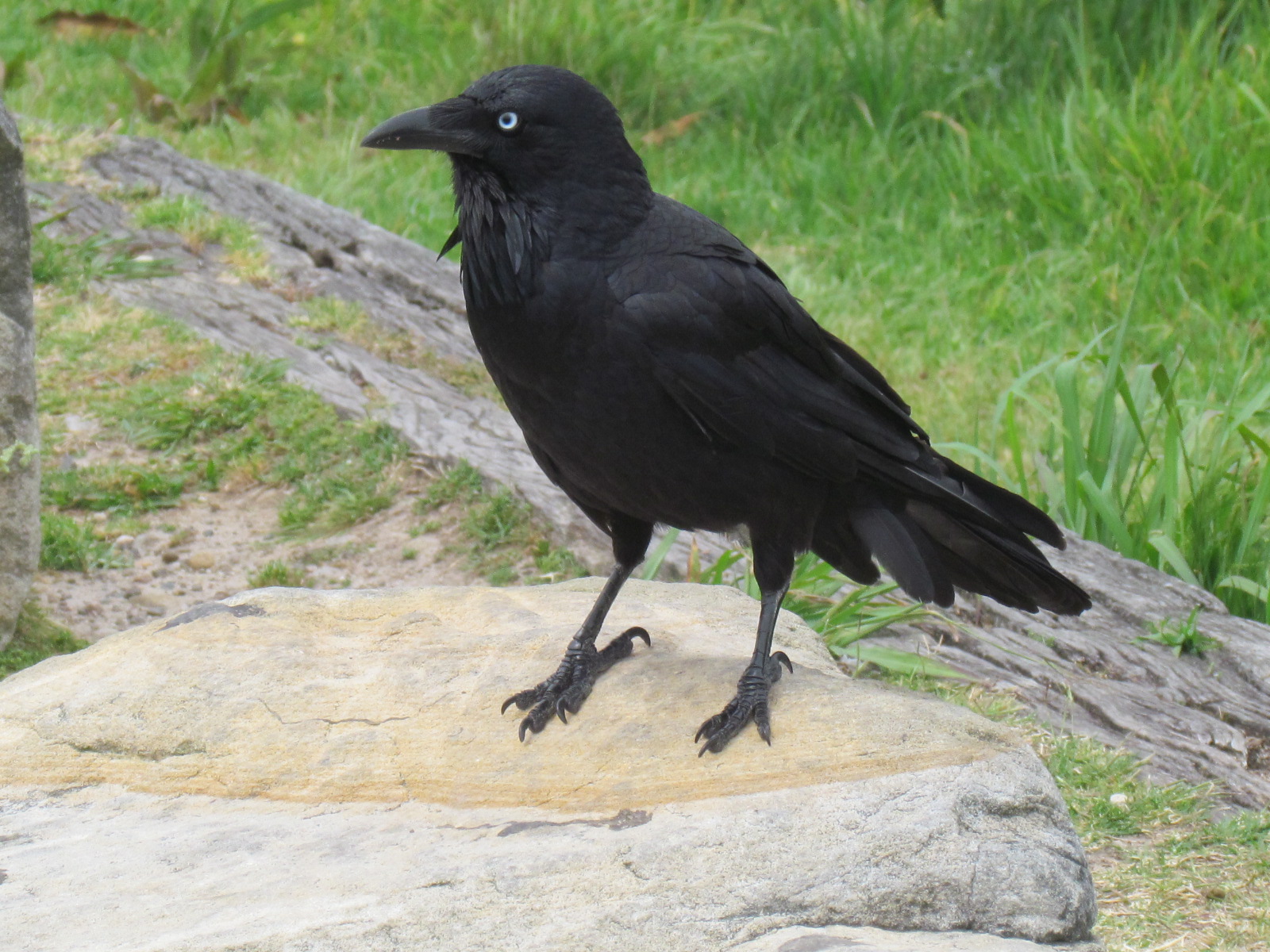
Here are a couple of pics of a brush-turkey and a raven, though these are not the same birds that appear in this story.

Rainbow Lorikeet feeding on Banksia flower
Rainbow Lorikeets have a brush-shaped tongue, which they use to lick nectar off flowers. This little lorikeet is feeding on a Heath Banksia flower:
Common name: Rainbow Lorikeet
Scientific name: Trichoglossus haematodus
Approximate length: 30 cm
Date spotted: 6 June 2020 (winter)
Location: Allambie Heights Heath Walk, New South Wales, Australia: 33°46’08.3″S 151°14’45.7″E
Little Corella and Sulphur-crested Cockatoo
Yesterday I came across a large group of Little Corellas on the sidewalk. In the midst of them was a Sulphur-crested Cockatoo. It was interesting to see the two birds up close, because from afar they look very similar. This video shows an interaction between the cockatoo and one of the corellas. You can also hear the corellas chatting to each other constantly.
These two corellas were cuddling up:
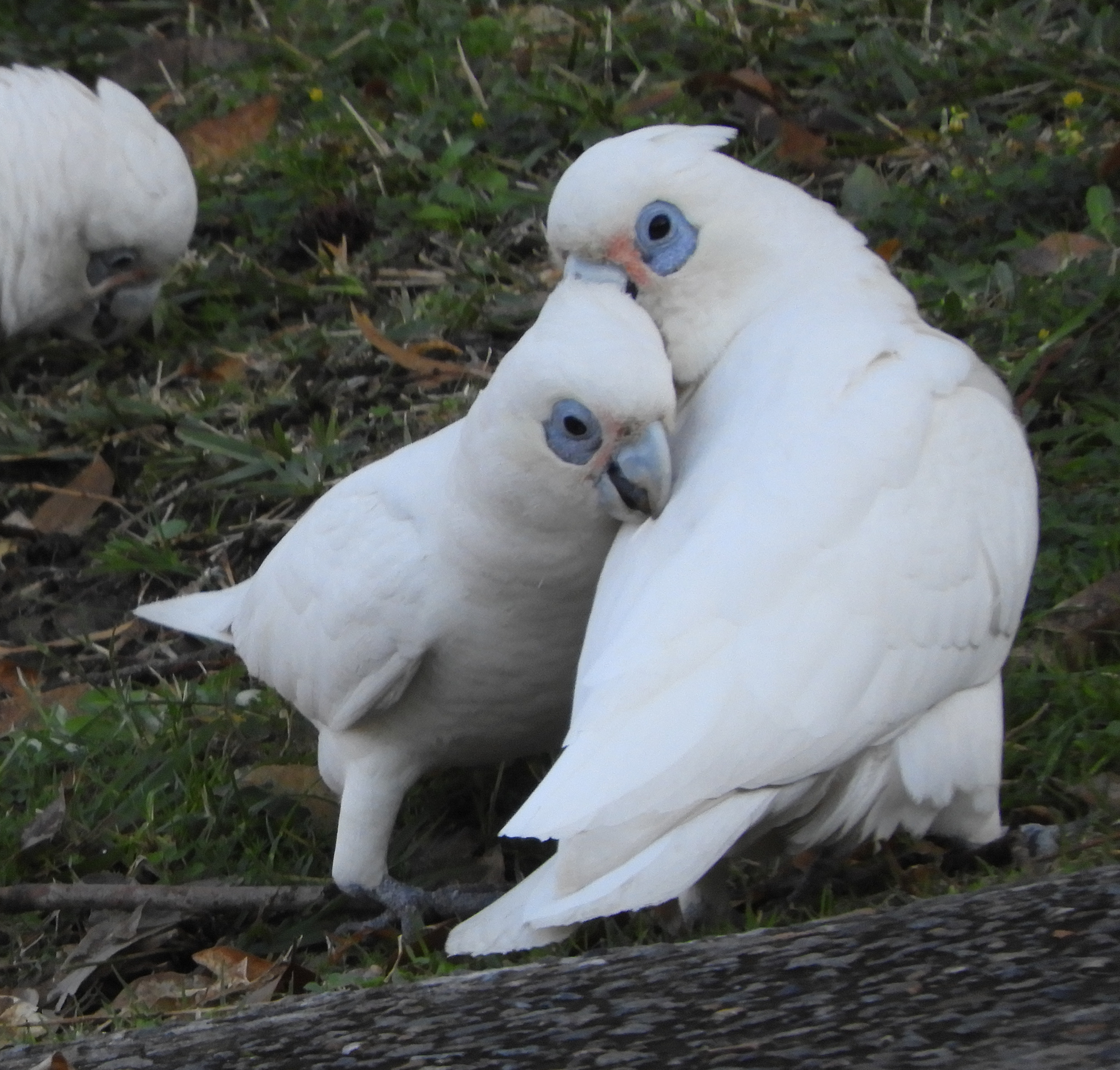
The crest of a Little Corella is white, and smaller than that of a Sulphur-crested Cockatoo:

Little Corellas have blue-grey feet, a blue patch of skin around the eye, and a pinkish patch of feathers between the eye and beak. The birds’ overall colouring makes them look rather cadaverous!
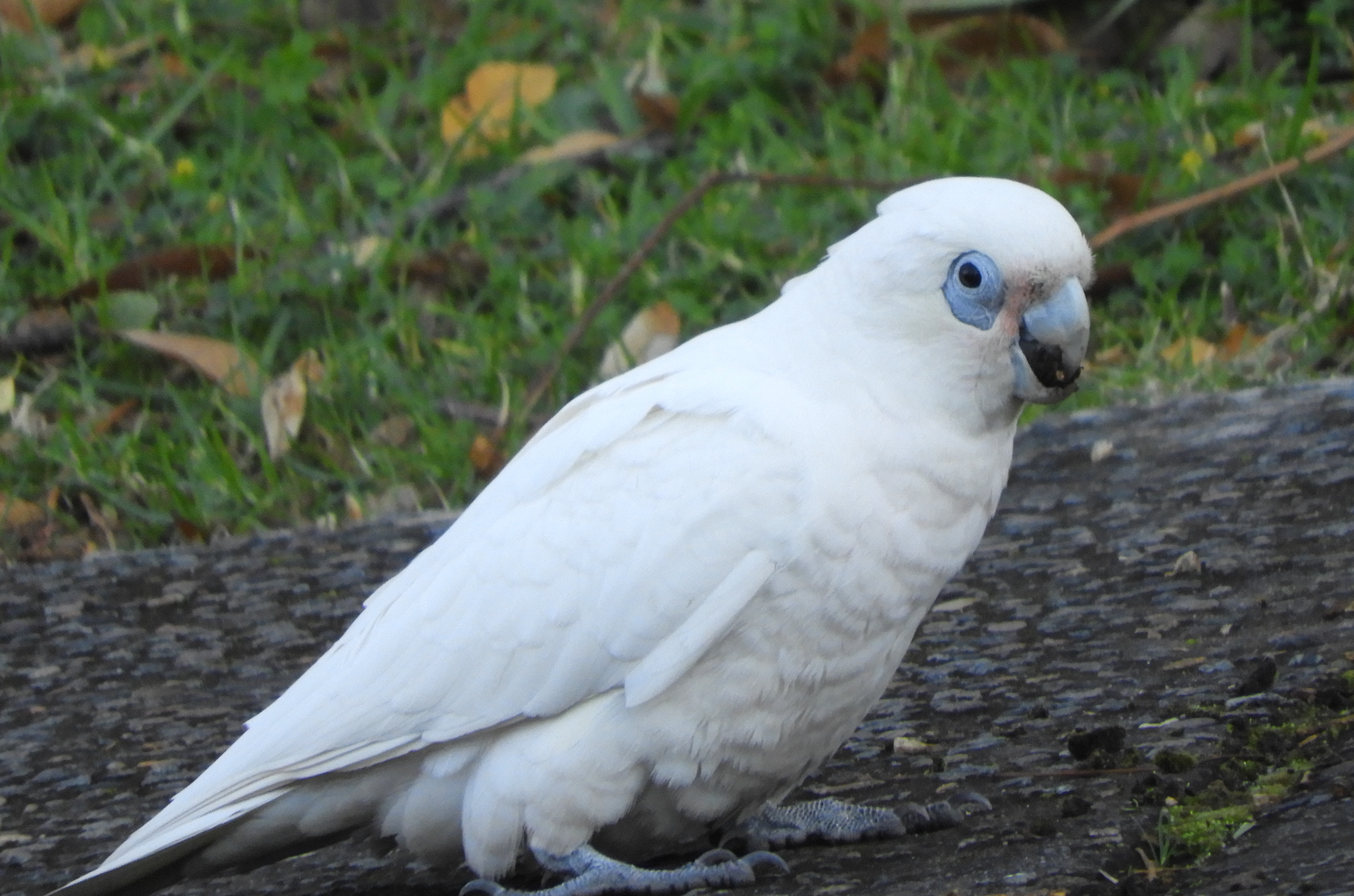
Common name: Little Corella
Scientific name: Cacatua sanguinea
Approximate length: 36-39 cm
Date spotted: 23 May 2020 (autumn)
Location: Allambie Heights near Sydney, Australia
Yellow-tailed Black Cockatoos in the garden
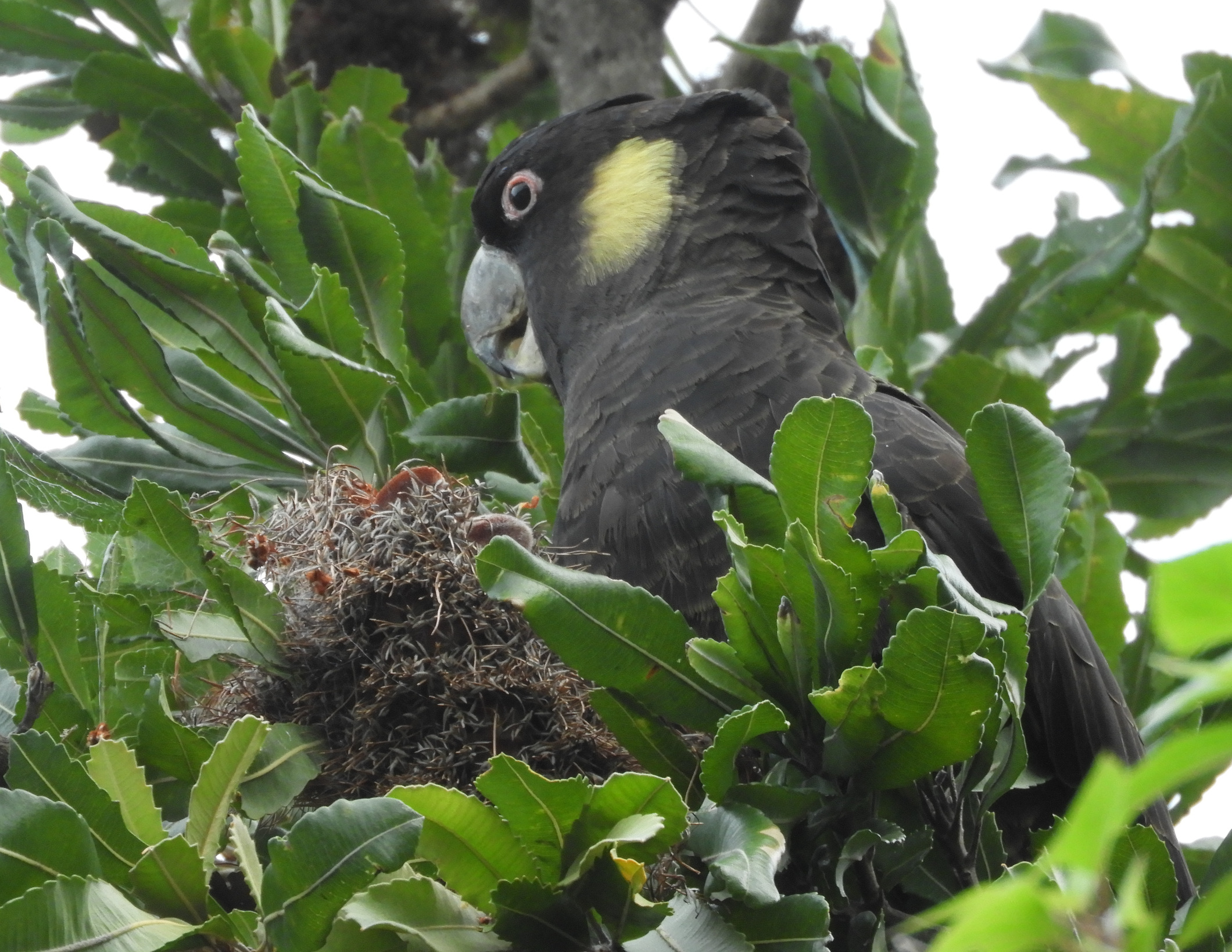
Three Yellow-tailed Black Cockatoos dropped in this afternoon. They chatted to each other with their weird squealing call, while demolishing parts of our Old Man Banksia bush.
Here’s one of the birds. The pink ring around the eye identifies it as a male:
In this short video, you can hear them chatting to each other:
It’s lovely to have these big, gracious birds paying us a call.
Common name: Yellow-tailed Black Cockatoo
Scientific name: Calyptorhynchus funereus
Approximate length: 65 cm
Date spotted: 20 May 2020 (autumn)
Location: Allambie Heights, NSW, Australia
Musk Lorikeet feeding off gum tree flowers
Musk Lorikeets are small, colourful parrots found in south-eastern Australia. A few of them have been visiting the gum tree outside our window over the past few weeks, to eat the nectar from the flowers.

These birds have rough, brush-tipped tongues to collect nectar and pollen from flowers. Musk Lorikeets are a little smaller than the more common Rainbow Lorikeets, which have been visiting the same flowers. Things can get quite noisy when the birds scold each other! Musk Lorikeets are nomadic, in that they move up and down the east coast of Australia in search of the flowering eucalypt trees that constitute their main source of food.

Common name: Musk Lorikeet
Scientific name: Glossopsitta concinna
Approximate length: 23 cm
Date spotted: 26 March 2020 (late summer)
Location: Allambie Heights, New South Wales, Australia
Birding at home
Like many people, I’m currently working from home to stave off the Coronavirus. There’s a great hashtag on Twitter at the moment: #BirdingAtHome. As a contribution to that hashtag, here are some of the birds I’ve seen at home over the last few days.
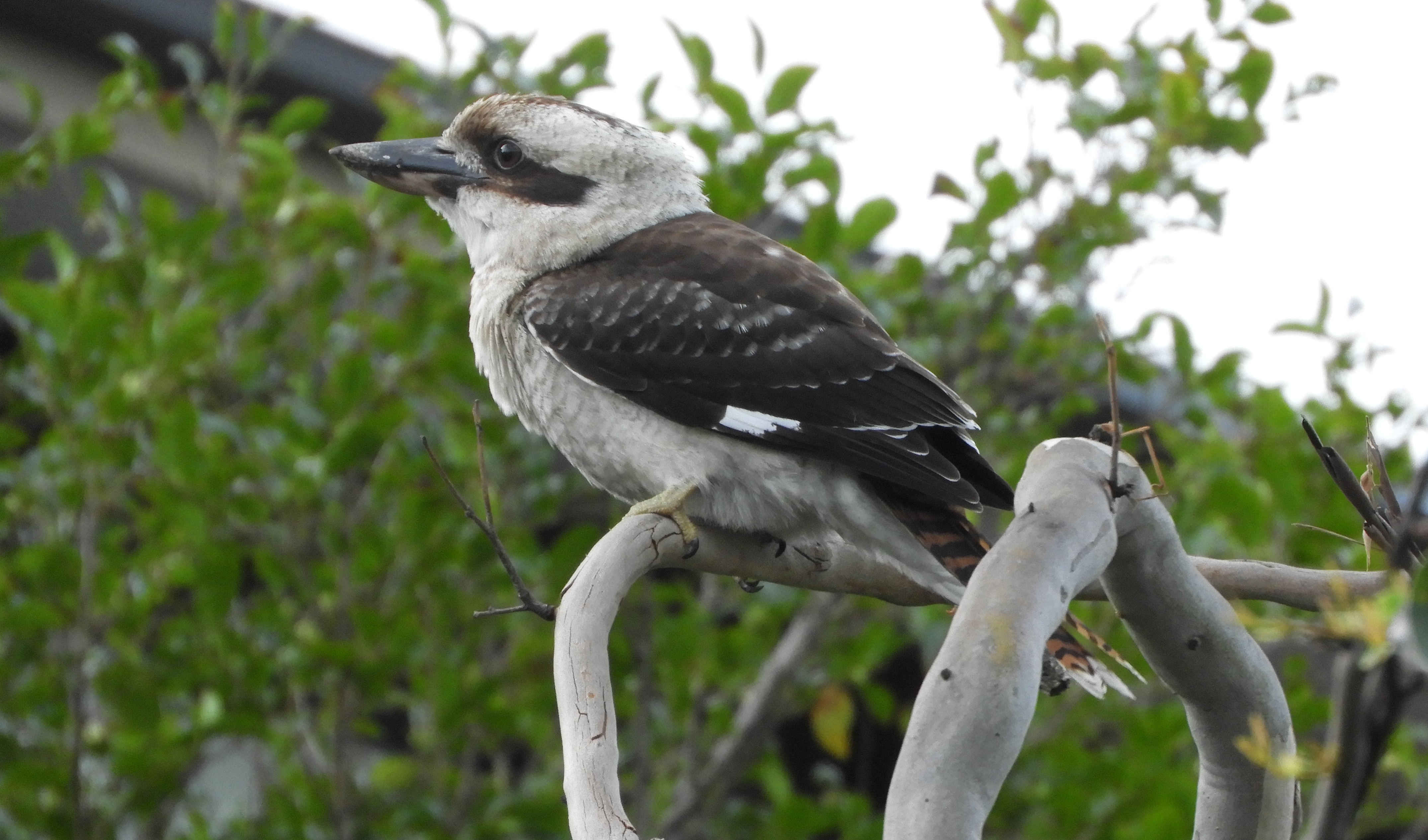
Laughing Kookaburra
Scientific name: Dacelo novaeguineae | Approximate length: 47 cm | Date: 17 March 2020
Grey Butcherbird
Scientific name: Cracticus torquatus | Approximate length: 30 cm | Date: 17 March 2020
I think this may be a juvenile, as the lines between the black and white sections of plumage are not well defined. The bird is on a Sydney Red Gum, one of my favourite trees, and currently the biggest tree in our garden:

Australian Magpie
Scientific name: Gymnorhina tibicen | Approximate length: 40 cm | Date: 17 March 2020
This inquisitive Australian Magpie landed on the roof of our porch and peered down at us. It was in a perfect spot to achieve a weird doubling effect with its reflection in the window. The real bird is on the left:
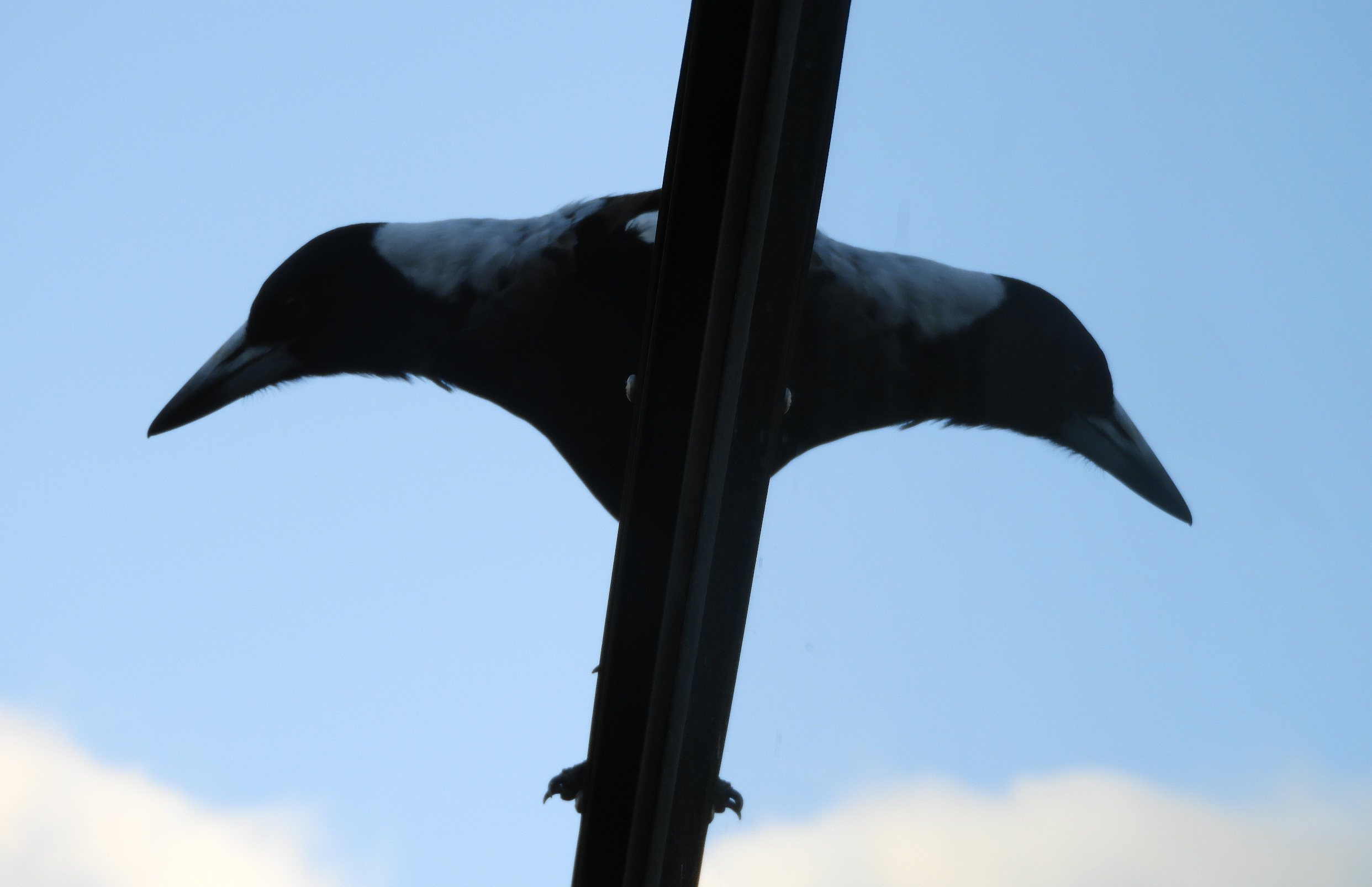
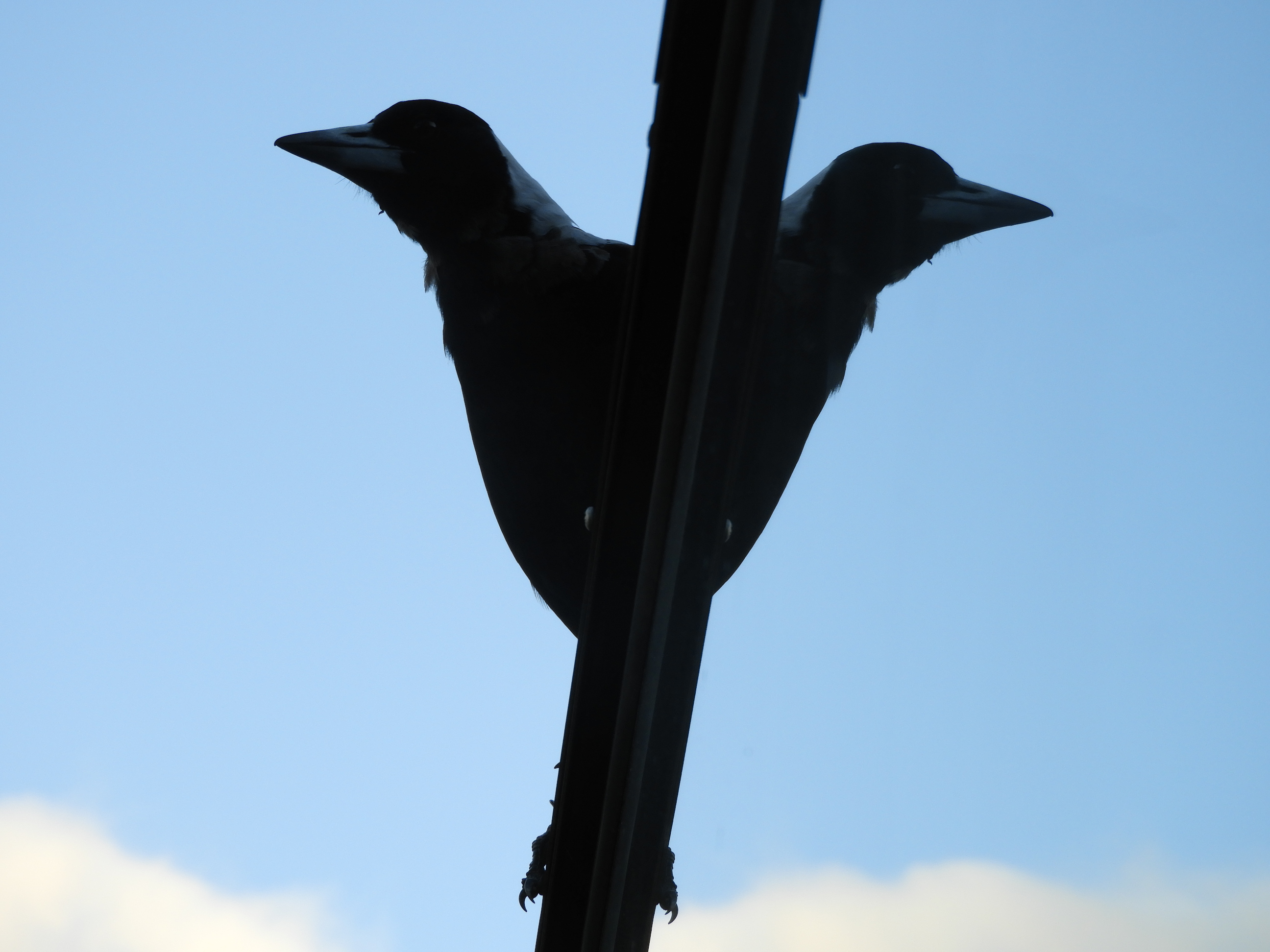
You can see the bird’s head and shoulders at the top and its feet at the bottom. Here’s another pose by the same bird in the same spot on the roof:
The magpie then hopped in through the window and examined the place:

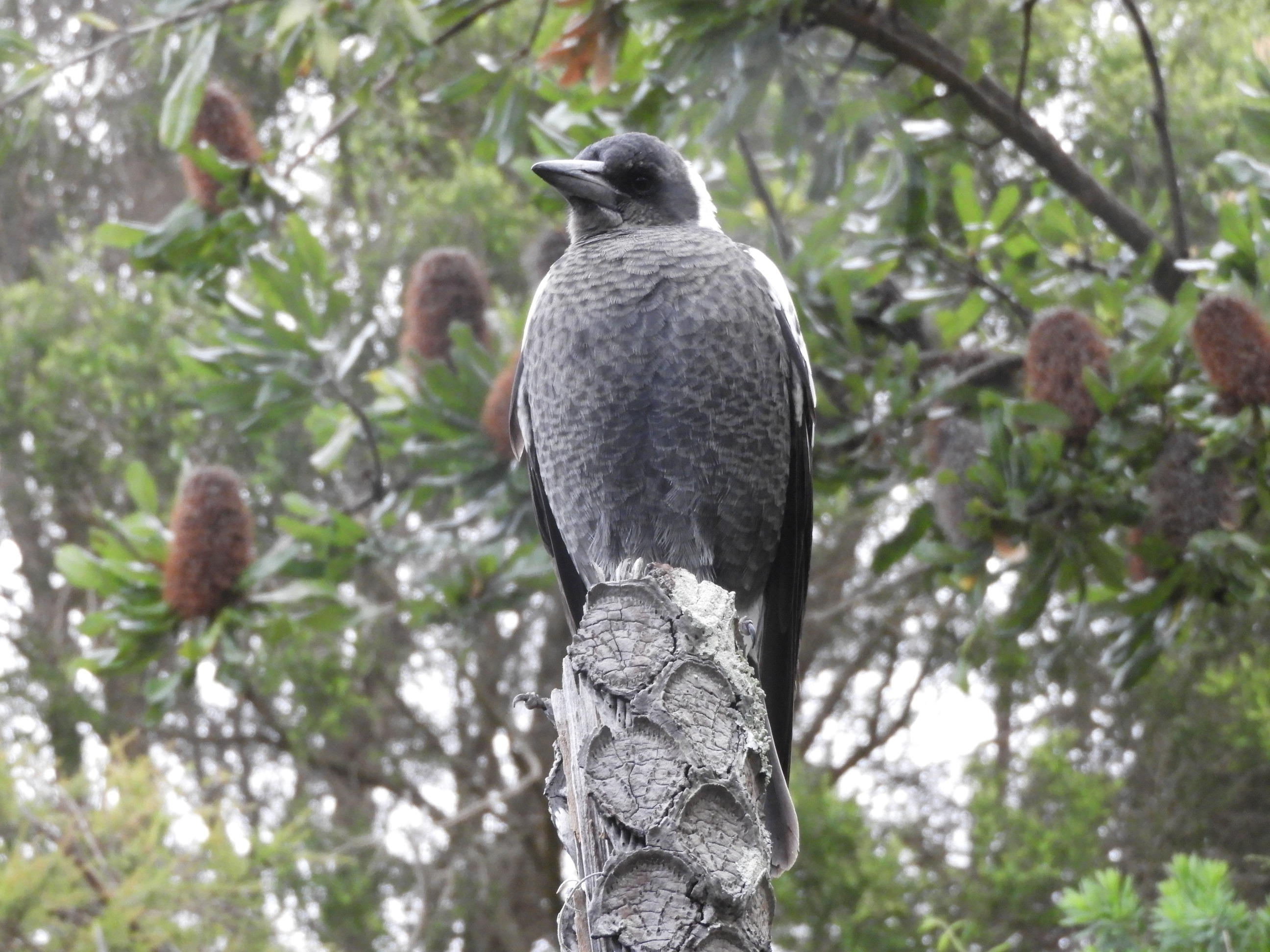
A couple of days earlier, a juvenile magpie (note the soft grey colouring) posed like a statue on a pedestal. The pedestal is the trunk of a tree fern that died off a while ago:
A side view of the same bird on the same perch:

Pied Currawong
Scientific name: Strepera graculina | Approximate length: 45 cm | Date: 11 March 2020
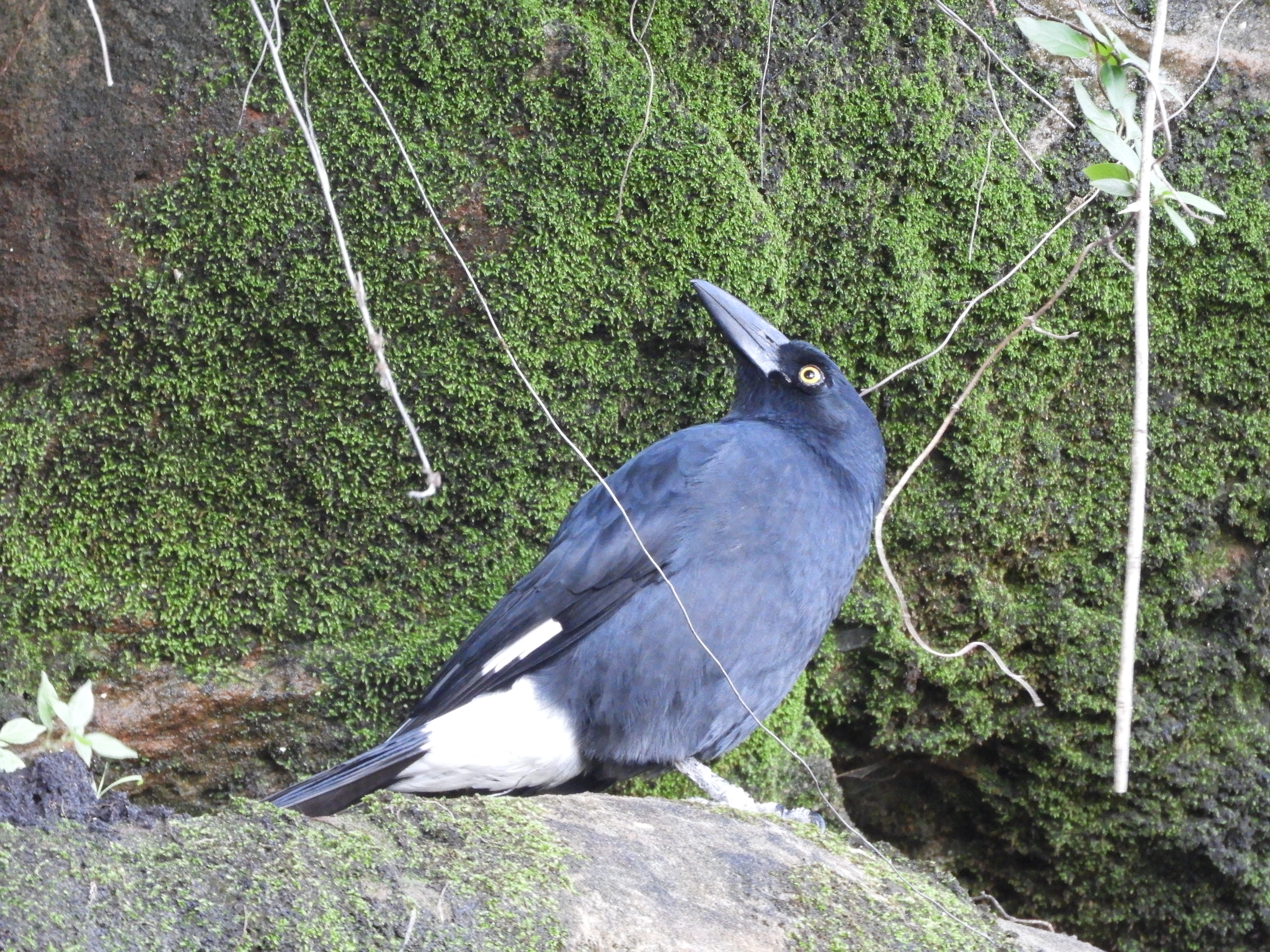
Currawongs are not quite as bold as magpies. They tend to view human activity from afar and swoop past when something interesting is going on. This one chose a mossy perch that showed off its dark plumage and yellow eyes:
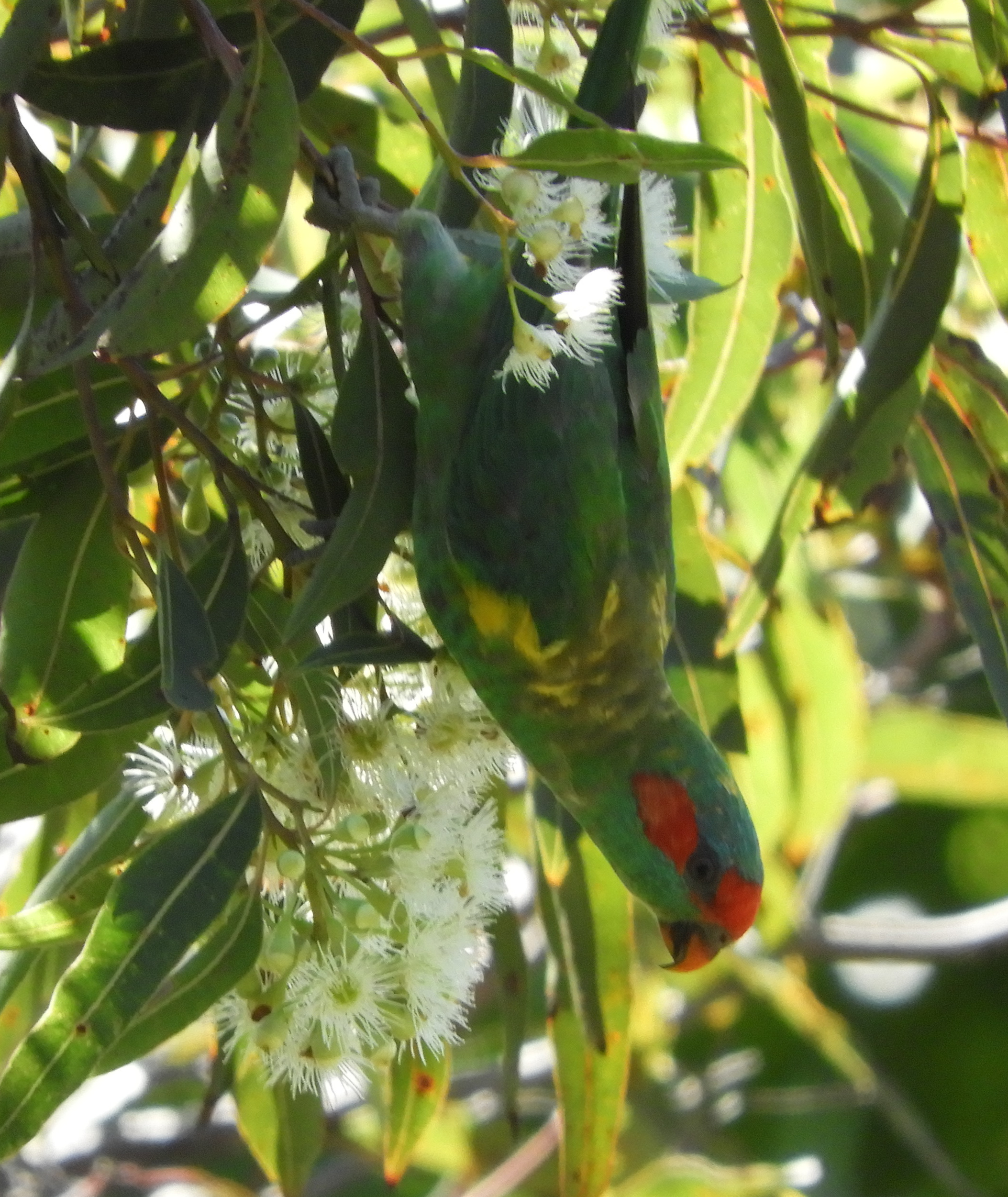
Musk Lorikeet
Scientific name: Glossopsitta concinna | Approximate length: 23 cm | Date: 18 March 2020
I don’t often see Musk Lorikeets. At the moment, a number of the gum trees are in flower and are attracting a variety of birds. It’s hard to get a good picture of a Musk Lorikeet. They seem to be more shy than other birds and take care to hide within the foliage as much as possible.
Rainbow Lorikeet
Scientific name: Trichoglossus haematodus | Approximate length: 30 cm | Date: 17 March 2020
We see many of these colourful, quarrelsome birds, and these last few days have been no exception. They were competing with the Musk Lorikeets for the same flowers:

Australian King Parrot
Scientific name: Alisterus scapularis | Approximate length: 44 cm | Date: 15 March 2020
A couple of days ago, I blogged about the two King Parrots that spent some time above our patio. Here’s the male again:

Grey-headed Flying Fox
Scientific name: Pteropus poliocephalus | Approximate length: 30 cm | Date: 18 March 2020
To finish off with, below is a very dark pic of a Flying Fox, which is a bat not a bird. In fact, it’s a megabat (yes, that’s a thing) and is one of the largest bats in the world. These bats eat fruit and flowers, and they visit the flowering trees at night. They make quite a noise, but it’s a privilege to have them around!
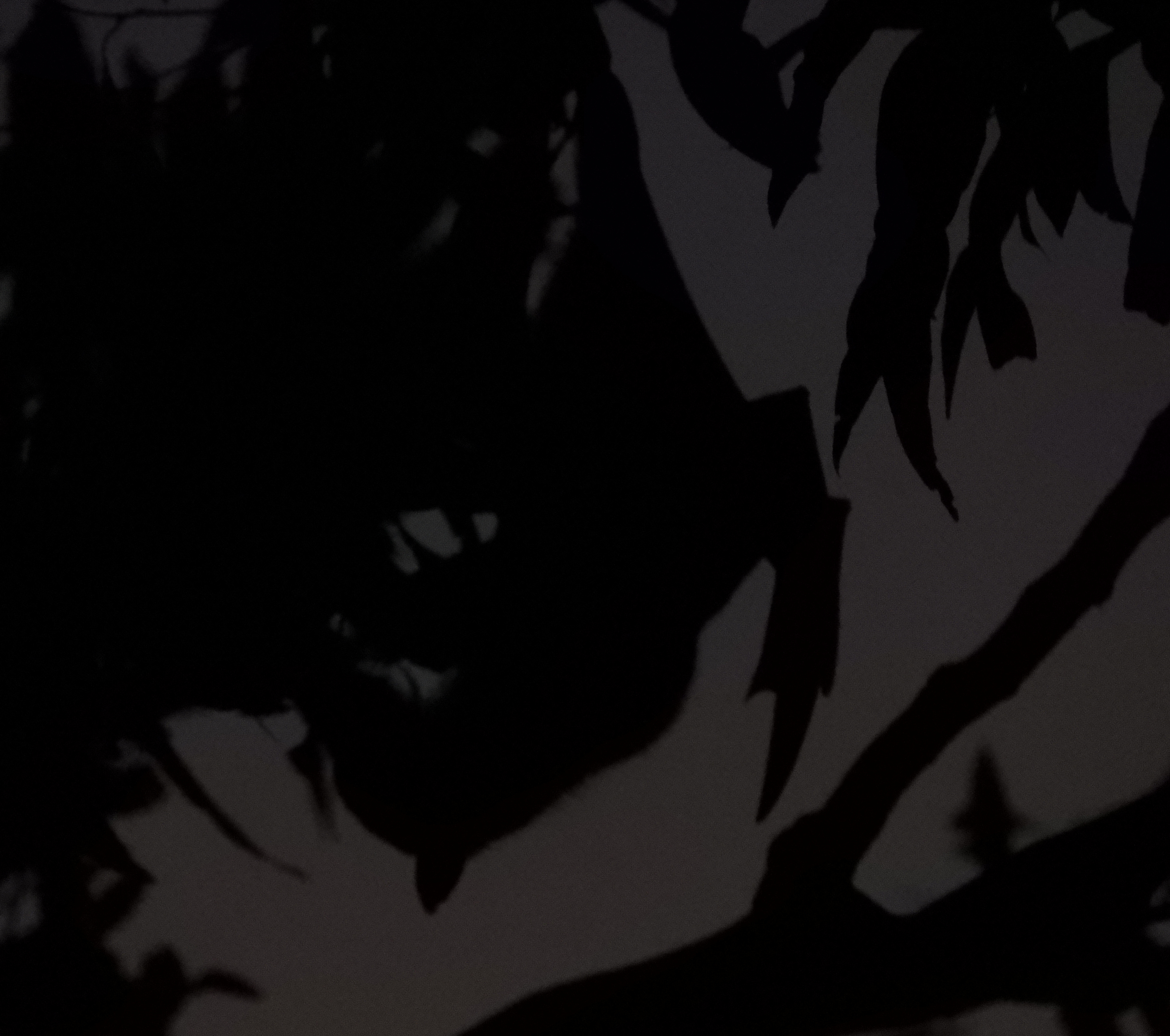
The bat is, as usual, upside down. You can see an ear near the bottom of the picture, slightly to left of centre. The nose is higher up on the left. The spiky bit to the right is a folded wing. The feet are attached to a branch at top centre. A Grey Headed Flying Fox is about 30 cm long and has a wing span of one metre.
Happy #BirdingAtHome everyone!
King Parrots add a splash of colour to my garden
Two King Parrots have been flying around the neighbourhood for the last few days. I often hear their piercing whistle. On Sunday, they spent about fifteen minutes on a tree above our terrace. No need to go looking for them. They came to us!
This is the male:
And here’s the female:
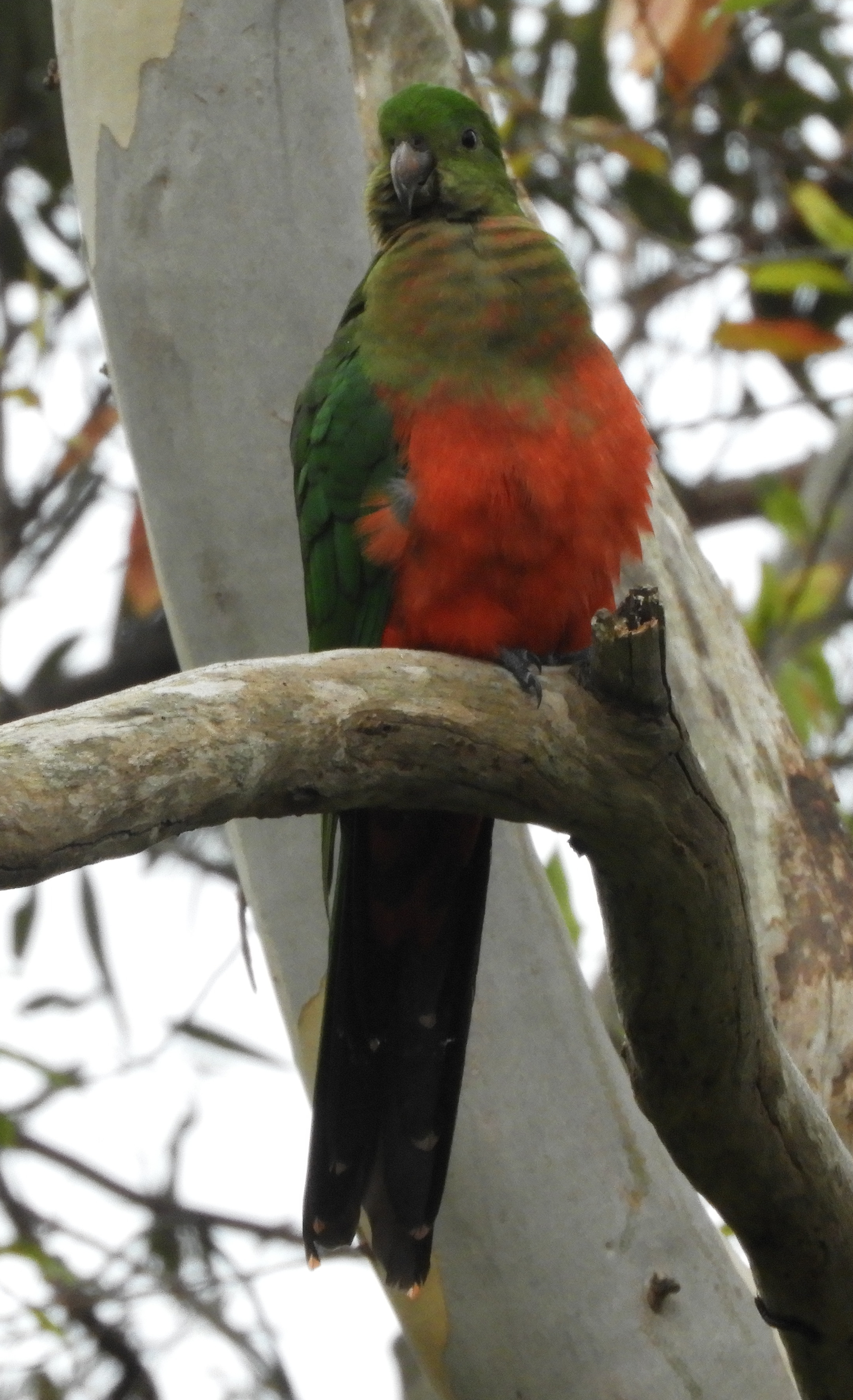
They’re on a Scribbly Gum. This wider shot gives you more of an idea of the environment:
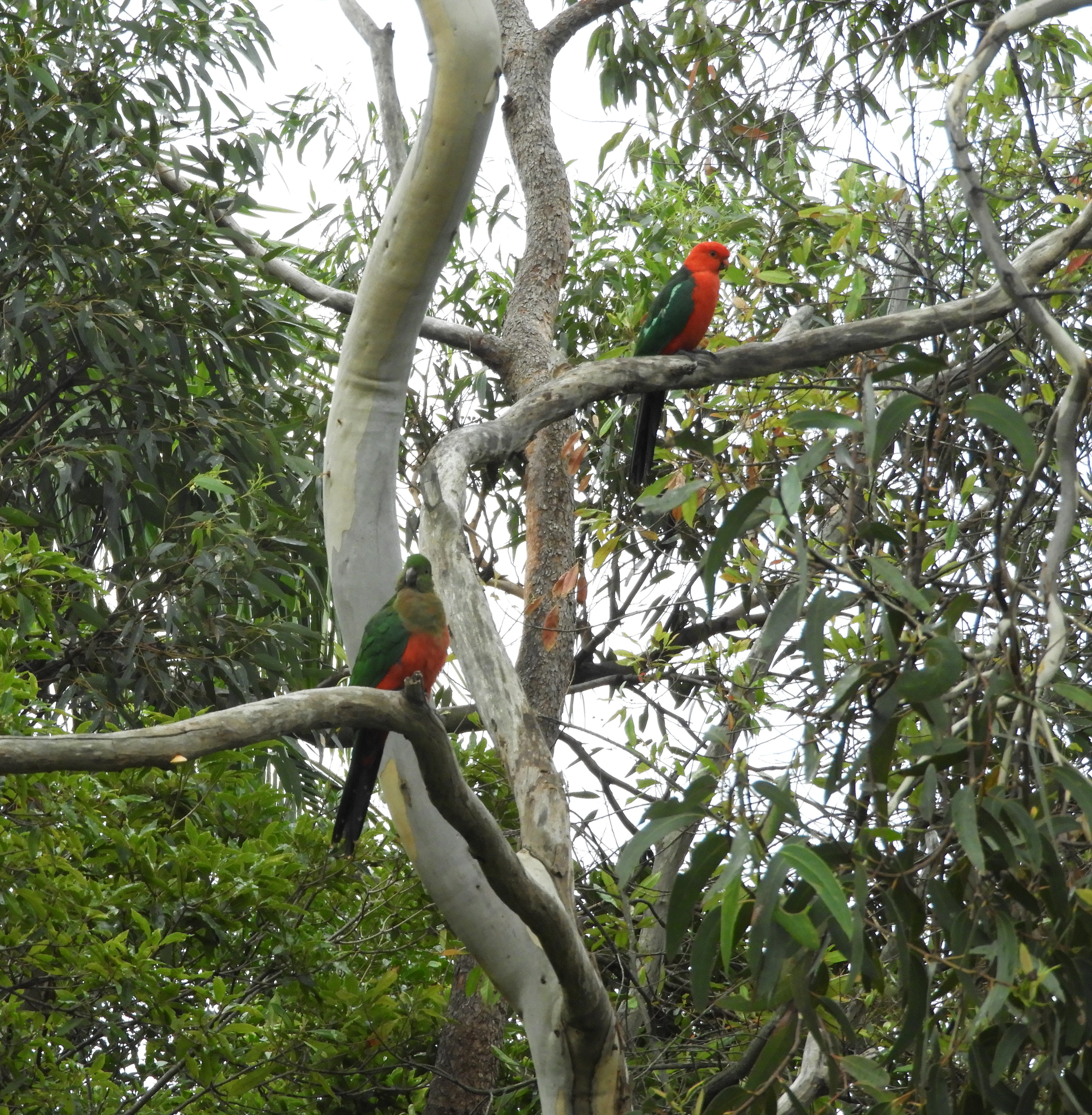
We encourage indigenous vegetation in our garden, which means that many birds come visiting! Our garden forms a way point on their route from one nature park to another.
Common name: Australian King Parrot
Scientific name: Alisterus scapularis
Approximate length: 44 cm
Date spotted: 15 March 2020 (late summer)
Location: Allambie Heights, New South Wales, Australia


