Blog Archives
Eastern Spinebill near Sydney, Australia
This pretty little bird is fast-moving and hard to photograph. The trickling noise in the background is the waterfall at Manly Dam Reserve. Towards the end of the clip, you’ll hear first a Whipbird and then some tweeting that may be the Spinebill itself.
Here it is, an Eastern Spinebill dancing around as it catches insects. At least, I think that’s what it’s doing.
Common name: Eastern Spinebill
Scientific name: Acanthorhynchus tenuirostris
Approximate length: 15 cm
Date spotted: 6 March 2016
Season: Late summer
Location: Waterfall at Manly Dam Reserve, New South Wales, Australia
Latitude/longitude: 33°46’08.5″S 151°14’29.1″E
Cuckoos are back in town
They’re noisy creatures, but I love it when the cuckoos arrive in Sydney. They herald the start of spring. They also send the local birds into a tizzy. Territorial disputes abound. The kookaburras have a rival for their 5am wake-up duties. And the noisy miners have another large bird to terrorise.
The cuckoos are migratory, spending the warmer half the year in Australia and the cooler half in Indonesia, Papua New Guinea and other northern climes. Two types of cuckoos make themselves known in our neighbourhood by their loud calls: the Channel-billed Cuckoos and the Koel Cuckoos.
Channel-billed Cuckoo
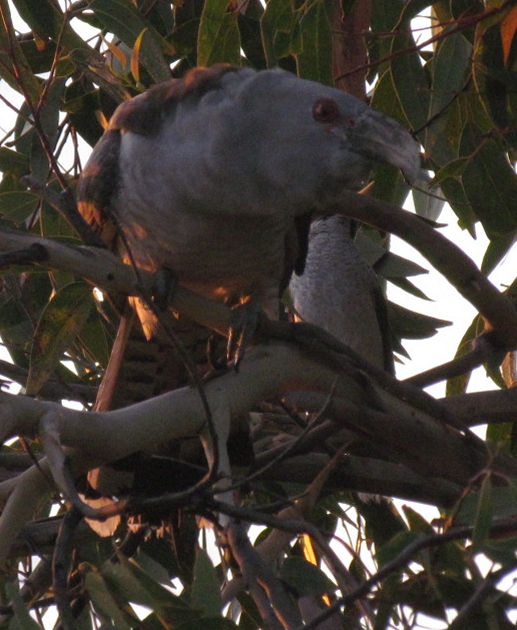
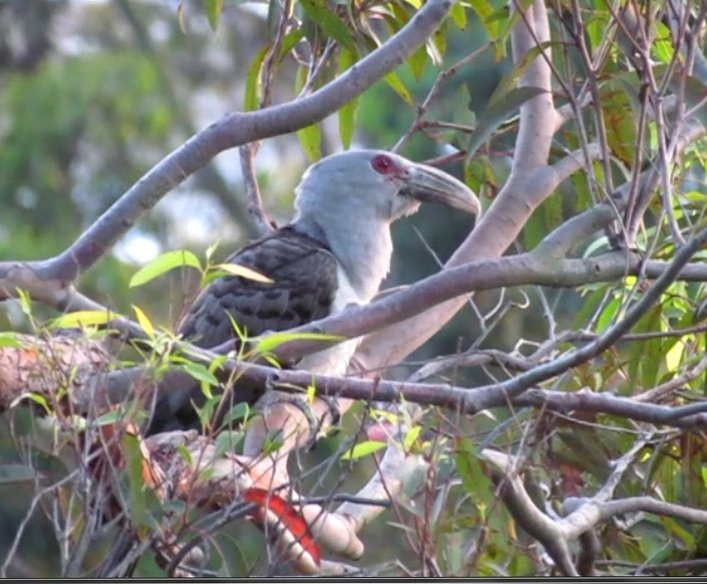
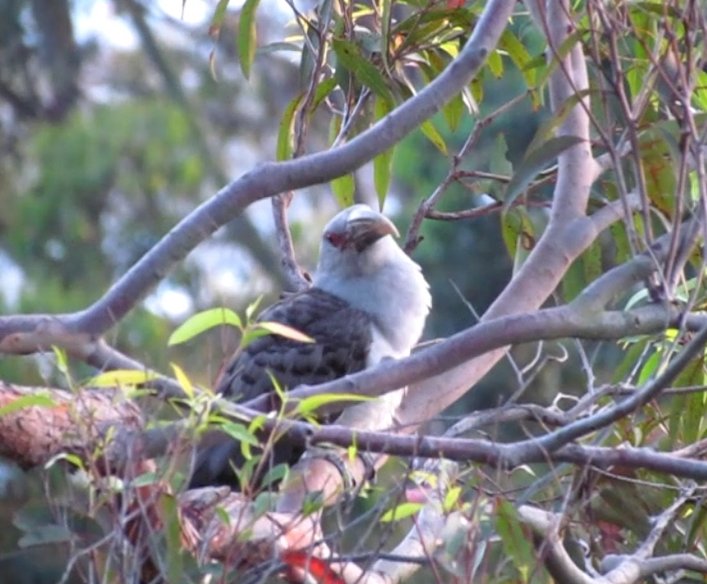
The Channel-billed Cuckoos are the largest cuckoos in the world. With their red eyes and large beaks, they’re an impressive sight. Today I was lucky to see one reasonably close by, and I was amazed by the way it moves. This one was being bothered by a noisy miner. The cuckoo was constantly bending and wriggling its neck to try and spot its tormentor. At the end of the video, you’ll see it looking up in alarm then disappearing with a flash of its tail, as the much smaller miner dive-bombs it.
Here’s a still photo of the same cuckoo peering out from underneath a canopy of leaves:
In this one, the cuckoo is looking reasonable relaxed but on the alert for attack:
And here it’s definitely wary:
Common name: Channel-billed Cuckoo
Scientific name: Scythrops novaehollandiae
Approximate length: 58-65 cm
Date spotted: 1 November 2015
Season: Summer
Location: Allambie Heights, New South Wales, Australia
Latitude/longitude: 33°46’13.9″S 151°15’39.2″E
Koel Cuckoo
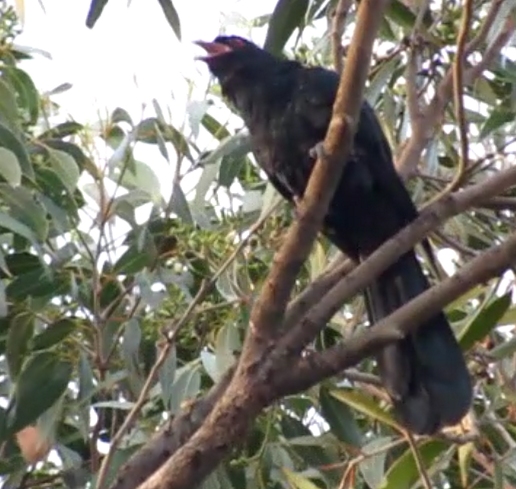
Then there are the Koel Cuckoos, like this one who came calling recently:
Here’s a photo of the Koel Cuckoo in full throat:
Common name: Common Koel or Eastern Koel
Scientific name: Eudynamys scolopacea
Approximate length: 45 cm
Date spotted: 11 October 2015
Season: Summer
Location: Allambie Heights, New South Wales, Australia
Latitude/longitude: 33°46’13.9″S 151°15’39.2″E
Galahs galore
I’ve posted a few pictures of galahs on this blog. They’re gorgeous birds, a type of parrot with a distinctive call and an endearing habit of walking around on the ground in large groups, bobbing their white-capped heads at each other. If you do something silly, an Australian might fondly say, “You silly galah” – an affectionate nod to the slightly bumbling behaviour of the birds.
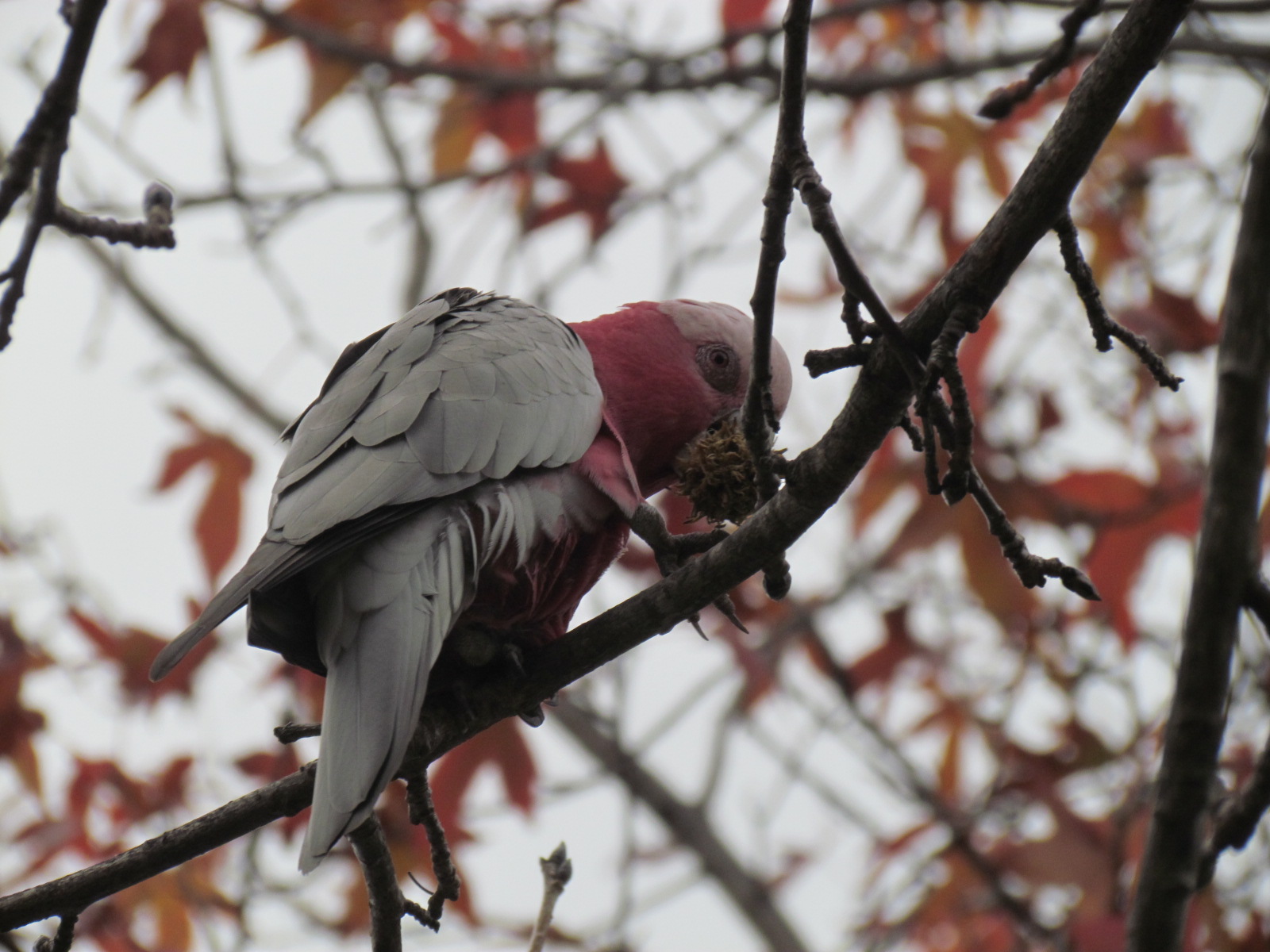
Yesterday I came across a group of them, all agog because a tree was dropping its seed balls. This bird peeks down at me while holding a seed ball in its beak:
In this video, you can hear the galahs chatting noisily to each other. Towards the end, something startles them and they take off, flying towards the camera with seed balls in their beaks:
Common name: Galah
Scientific name: Cacatua roseicapilla
Approximate length: 38 cm
Date spotted: 23 May 2015
Season: Winter
Location: Manly Vale, New South Wales, Australia
Latitude/longitude: 33°46’48.6″S 151°15’52.2″E
To find more about these pretty birds, see the galah category in this blog.
Song of the Currawong
Currawongs gather in a tree during a rain shower at dusk, chatting to each other. Their calls vary from bell-like chimes to whistles and peeps. For most of this video, the birds are just silhouettes flitting from branch to branch. I zoomed in on one bird at around the two-minute mark, and you can see it uttering its calls.
Here’s a still image of one of the Currawongs:

Common name: Pied Currawong
Scientific name: Strepera graculina
Approximate length: 45 cm
Date spotted: 10 January 2015
Season: Summer
Location: Allambie Heights, New South Wales, Australia
Approximate latitude/longitude: 33°46’19.2″S 151°15’25.2″E
Black Swans calling
Black swans are native to New South Wales, Australia. This morning I saw four of them swimming amongst the other water birds.

Two of them were calling to each other and raising their necks up and down in a stately dance. They make a slightly funny, bugling call, a bit like a child’s party tooter, as you can hear in this video:
Common name: Black Swan
Scientific name: Cygnus atratus
Approximate length: 120 cm
Date spotted: 27 December 2014
Season: Summer
Location: Manly Dam Reserve, New South Wales, Australia
Latitude/longitude: 33°46’58.4″S 151°15’18.6″E
Dollarbird in Sydney
Update on 25 December 2014: It’s a Dollarbird, also called a Broad-billed Roller. Thanks to Hamish Robertson for identifying this bird! They’re migratory, arriving in Australia in September/October every year and leaving again in March. They spend the winter in New Guinea and other northern islands.
Does anyone know what bird this is? I heard it making an insistent chattering noise the other day. It was high up on an electric cable, so I couldn’t see it very well. It’s dark in colour, with a red beak. I’d guess its size to be roughly that of a magpie. Here’s the best shot I got of it:

Here’s a video, useful mainly for the sound. I had the camera on high zoom without a tripod, so it’s quite shaky, but you can hear the sound very well.
Common name: Dollarbird (Thanks to Hamish Robertson for identifying this bird!)
Scientific name: Eurystomus orientalis
Approximate length: 30 cm
Date spotted: 21 December 2014
Season: Summer
Location: Manly Dam Reserve, New South Wales, Australia
Latitude/longitude: 33°46’36.4″S 151°15’16.1″E
Little Wattlebird croaking
This Little Wattlebird appears quite drab when seen from afar, but from close up has a sleek coat of streaks with chestnut touches on its wings. Wattlebirds are one of the many types of honeyeaters found in Australia. As well as nectar, they eat berries and insects. And they’re noisy and argumentative.
In the video, the bird is uttering its characteristic scratchy croak.
From behind:

In full song:

Common name: Little Wattlebird
Scientific name: Anthochaera chrysoptera
Approximate length: 30 cm
Date spotted: Saturday 22 November 2014
Season: Spring
Location: Manly Dam National Park, Sydney, Australia
Latitude/longitude: 33°46’40.3″S 151°14’58.5″E
Black Cockatoos social grooming
A flight of Black Cockatoos swooped in over my head and landed in a big old gum tree, screeching their wild call. Two of them immediately started a careful and fond session of mutual grooming. As far as I can tell, both birds are female as they both have pale bills and grey (not red) rings around their eyes. You can hear their soft squawks as well as their characteristic wild shrieks on the video.
Here’s a still photo of the two social groomers:

This is one of the other birds in the group:

Common name: Yellow-tailed Black Cockatoo
Scientific name: Calyptorhynchus funereus
Approximate length: 65 cm
Date spotted: 6 October 2014
Season: Spring
Location: Manly Dam Reserve, New South Wales, Australia
Latitude/longitude: 33°46’05.2″S 151°14’26.5″E
A King Parrot comes to call
This Australian King Parrot dropped in for a visit this afternoon. He hung around for a while, exploring the trees around our house and making his piercing whistle, “Eeeeeep”. King Parrots are fairly large birds, bigger and more dramatic in appearance than the Rainbow Lorikeets we see more often.
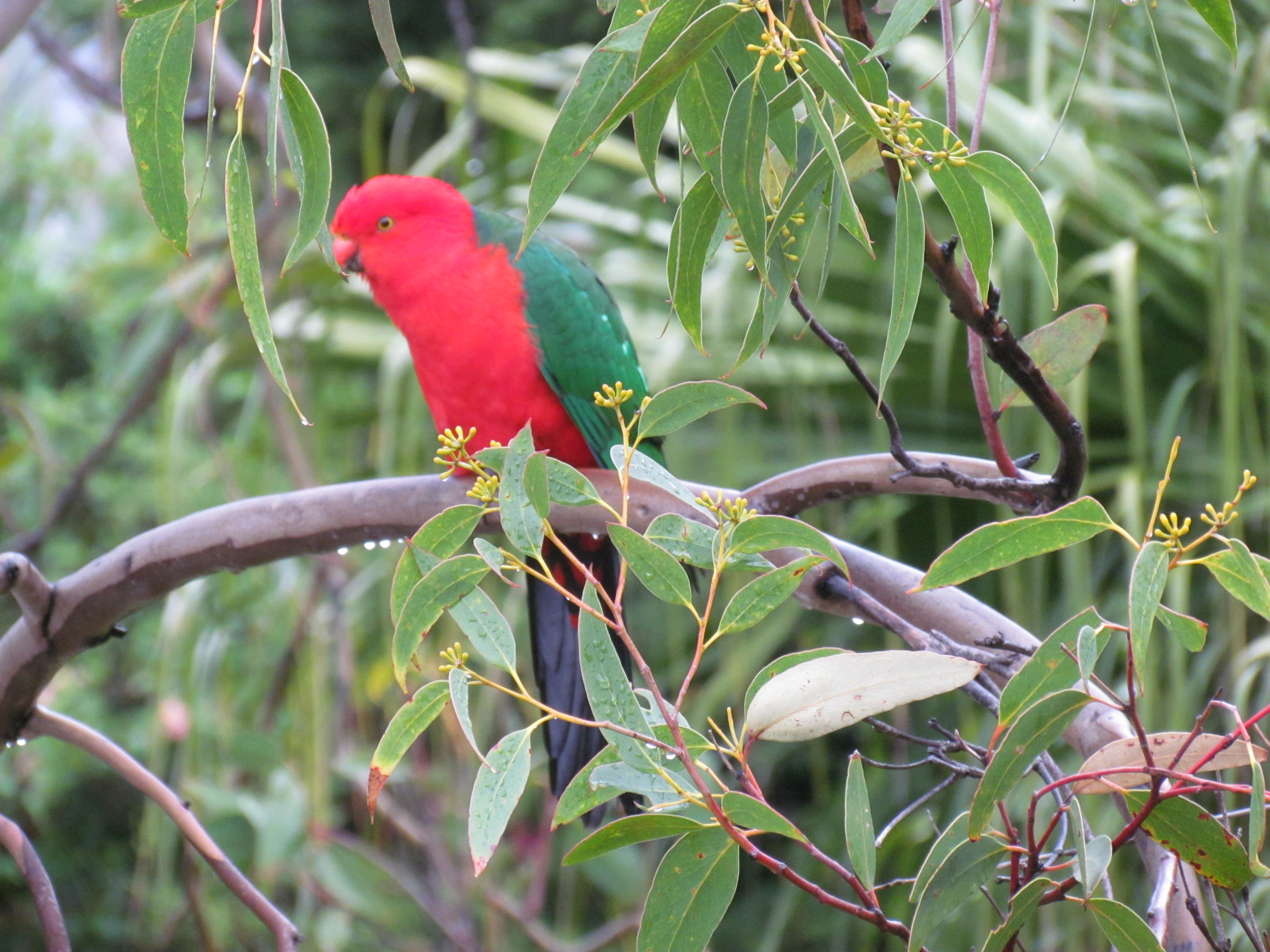
This was my first view of the bird, before I zoomed in with the camera:
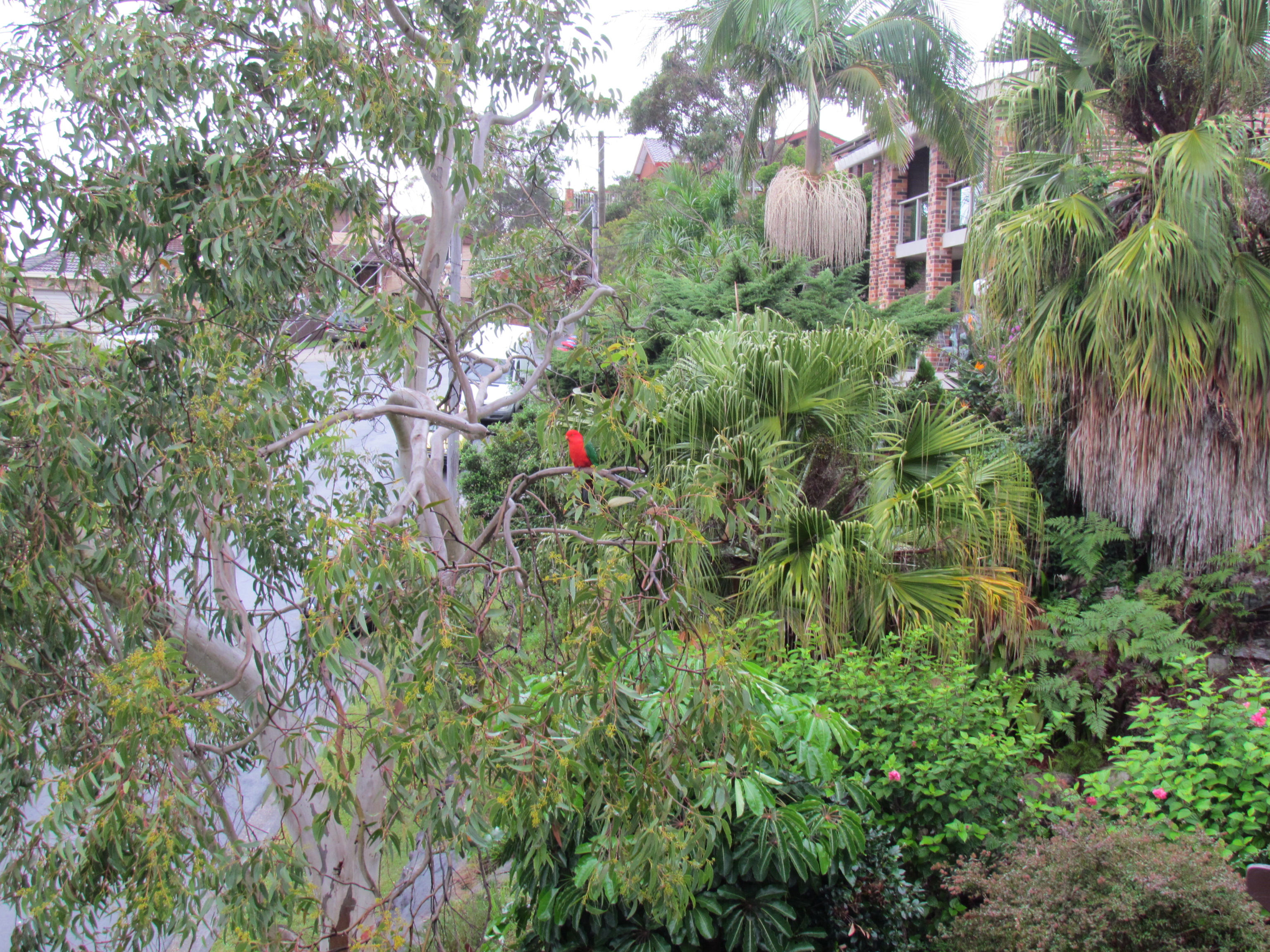
He moved to another tree:

Where I got a shot of his back too:

Common name: Australian King Parrot
Scientific name: Alisterus scapularis
Approximate length: 44 cm
Date spotted: 30 April 2014
Season: Autumn
Location: Allambie Heights, New South Wales, Australia
Approximate latitude/longitude: 33°44’15.2″S, 151°18’44.1″E
You silly galah
“You silly galah!” That’s what Australians say, usually affectionately, when someone makes a gaffe or does something daft. A galah is actually a beautiful bird, grey with a deep pink chest, and a funny little crest on its head. I spotted a tree full of them this morning, chirping away at each other in that funny voice of theirs.
Common name: Galah
Scientific name: Cacatua roseicapilla
Approximate length: 38 cm
Date spotted: 27 January 2014
Season: Summer
Location: Manly Vale, New South Wales, Australia
Latitude/longitude: -33° 46.791′, 151° 15.744′
Here’s a still photo of them:


 Sydney Birder