Blog Archives
Two chirpy Variegated Fairy-wrens
Followers of this blog will know that I’m building up a collection of pictures of fairy wrens, bit by hard-won bit! They’re tiny little birds that like to flit around the undergrowth, granting observers tantalising glimpses but not much more.
These two female Variegated Fairy-wrens were out in the open for a few seconds, which has to be some kind of record. They’re chirping sociably to each other as they hop along next to a bush path.
Common name: Variegated Fairy-wren
Scientific name: Malurus lamberti
Approximate length: 13 cm
Date spotted: 12 February 2017
Season: Summer
Location: Manly Dam Reserve, New South Wales, Australia: 33°46’47.9″S 151°15’02.7″E
Magpie serenade
Two magpies hopped onto a branch and serenaded each other as I walked past. They had to battle a fairly fierce wind, as you can see from the ruffled state of their feathers.
Common name: Australian Magpie
Scientific name: Gymnorhina tibicen
Approximate length: 40 cm
Date spotted: 26 January 2017
Season: Summer
Location: Long Reef near Dee Why, New South Wales, Australia: 33°44’21.1″S 151°18’30.8″E
Kookaburra baby cackling and feeding
The kookaburras around our neighbourhood are very noisy at the moment. A couple of juveniles drop by regularly to practise their cackling skills. They’re cute and funny.
In this video, you can see one youngster crooning to himself, and another behind the branches. In the background, other birds chime in to show him how it’s done. A parent comes by a couple of times too, to feed the ever-demanding little one.
Common name: Laughing Kookaburra
Scientific name: Dacelo novaeguineae
Approximate length: 47 cm
Date spotted: 31 December 2016
Season: Summer
Location: Allambie Heights, New South Wales, Australia
Kookaburras cranking up for a cackle
You’ve probably heard kookaburras in full voice, cackling and hooting raucously. I think the sound they make when they’re preparing for a full-voice yodel is funny and cute. It happens in particular when there’s a group of birds. They chunter at each other, perhaps in warning or perhaps companionably. They sound a bit like rusty saws in a dusty attic.
These two were in a tree high above my lounge window:
I encountered this disreputable, slightly dangerous looking character deep in the bush:
Common name: Laughing Kookaburra
Scientific name: Dacelo novaeguineae
Approximate length: 47 cm
Date spotted (second video): 26 December 2016
Season: Summer
Location (second video): Manly Dam Nature Reserve, New South Wales, Australia: 33°46’50.4″S 151°14’59.6″E
Currawong in song
Currawongs are medium-sized birds that look similar to magpies and butcher birds. An easy way to tell them apart is that currawongs don’t have white markings on their heads, where magpies and butcher birds do have white collars or caps. Currawongs have yellow eyes, where magpies’ eyes are red.
The song of the currawong is varied, with clear bell-like sounds, whistles, and yodels. This video shows a currawong listening to the song of others around him, and responding every now and then.
Common name: Pied Currawong
Scientific name: Strepera graculina
Approximate length: 45 cm
Date spotted: 16 October 2016
Season: Summer
Location: Manly Dam National Park, New South Wales, Australia
Approximate latitude/longitude: 33°46’42.1″S 151°14’59.3″E
Cockatoos teasing
Cockatoos are playful, sociable creatures. Yesterday I watched a pair of Sulphur-crested Cockatoos high in a gum tree. One of them was grooming. The other was teasing its companion, prodding it and seeming very satisfied with the startled response.
A couple of minutes later both of them flare their wings and crests, squawking gleefully.
Common name: Sulphur-crested Cockatoo
Scientific name: Cacatua galerita
Approximate length: 50 cm
Date spotted: 8 October 2016
Season: Spring
Location: Manly Dam Park, New South Wales, Australia
Latitude/longitude: 33°46’51.5″S 151°14’51.7″E
Noisy Miners feeding chicks in nest
Noisy Miners live up to their name. If they lived in California, Hitchcock would surely have used them as inspiration for The Birds. They cheep and squeak at everything in sight, and frequently attack everything in sight too. They’re also known as Australian Miners.
This nest has three chicks, cheeping continuously. The adult birds drop in to feed them every now and then. At one stage in the video, one of the chicks stretches up and flaps its wings. Getting ready for that first flight.
Interestingly, the adult birds feeding the chicks aren’t necessarily the parents. Other birds in a Miner colony often help to feed the babies. Noisy Miners are honeyeaters. They eat nectar, fruit and insects.
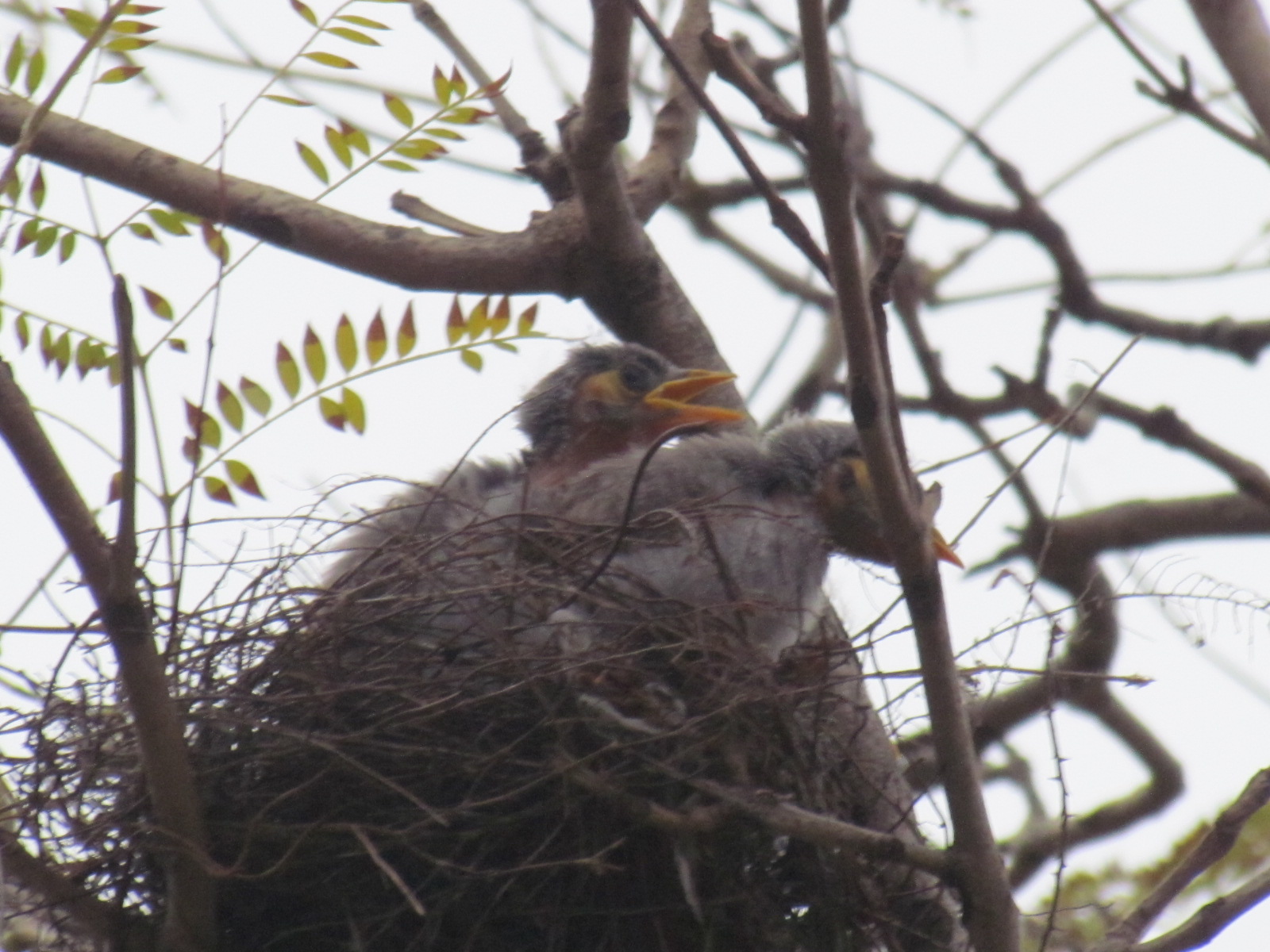
Common name: Noisy Miner, also called Australian Miner
Scientific name: Manorina melanocephala
Approximate length of adult bird: 26 cm
Date spotted: 13 September 2016
Season: Spring
Location: Allambie Heights, New South Wales, Australia
Latitude/longitude: 33°46’13.7″S 151°15’39.8″E
Wild call of the black cockatoo
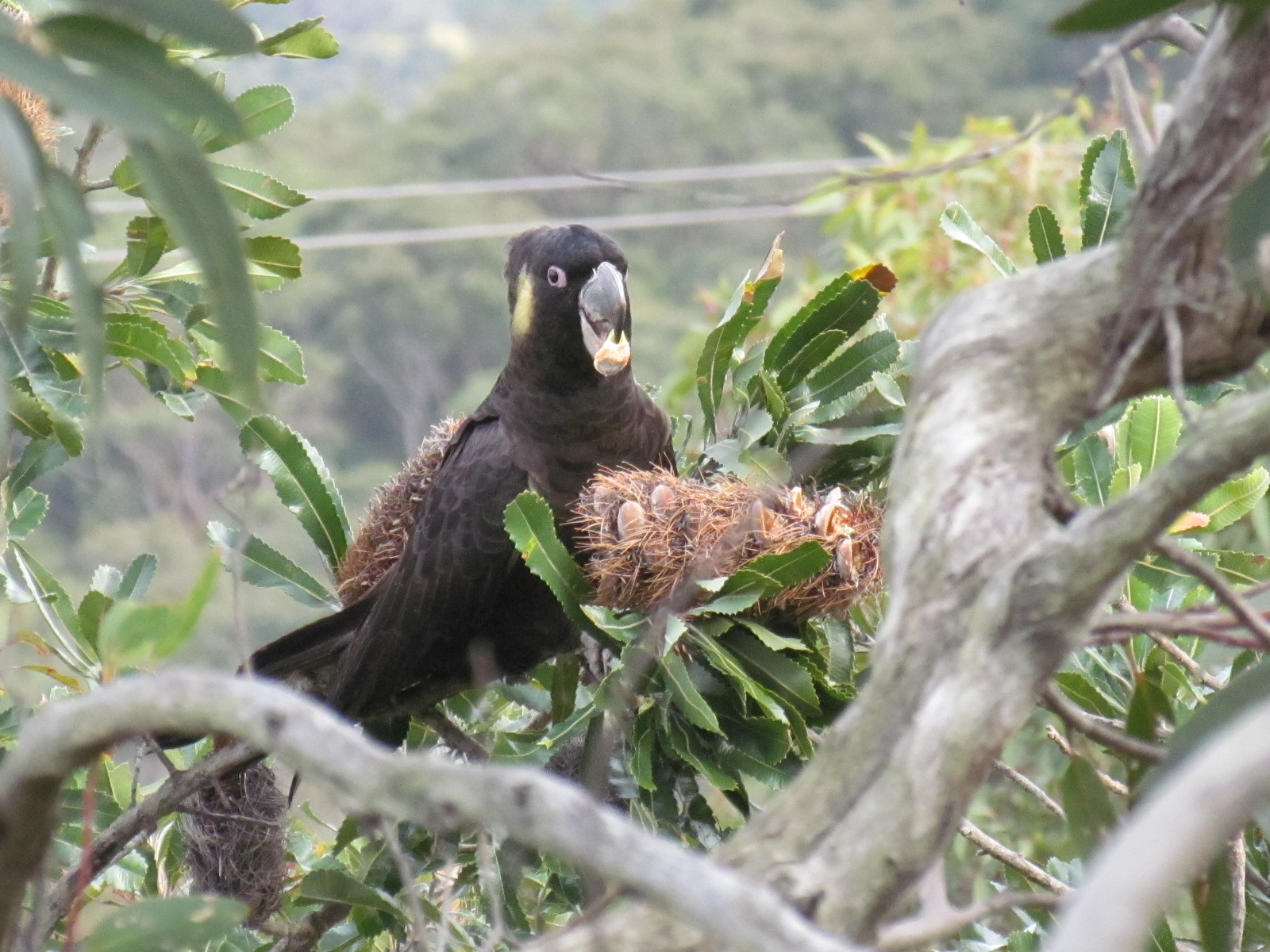
The banksias are in seed, and the black cockatoos are in town! Out strolling in the bush today, I came across a large group of these majestic birds. Their raucous squawks are typical cockatoo, but they add a wild, shrieking call that sounds more like a fish eagle, and a chitter chatter that’s all their own.
The first video shows a dead tree with plenty of interesting cavities and perches for a curious cockatoo. You can hear the wild calls as the birds take off and land.
In the next video, the birds chatter and call to each other as they clamber around the same dead tree. I hadn’t heard this type of chatter from black cockatoos before today.
What does a gum tree full of black cockatoos sound like? This is the same flock, high up in a gum tree.
Details of this sighting
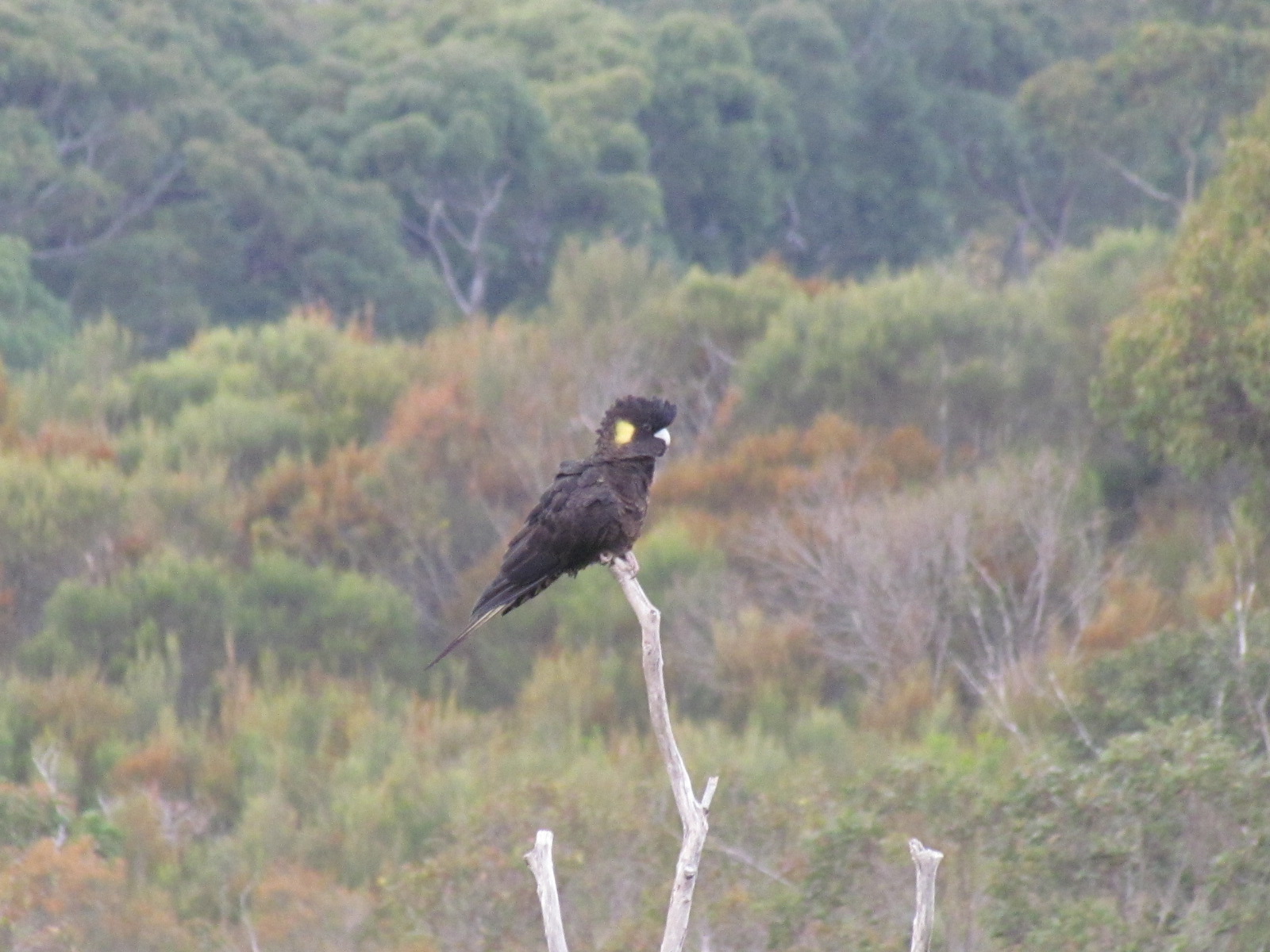
Common name: Yellow-tailed Black Cockatoo
Scientific name: Calyptorhynchus funereus
Approximate length: 65 cm
Date spotted: 27 August 2016
Season: Late winter
Location: Manly Dam Reserve, New South Wales, Australia
Latitude/longitude: 33°46’50.7″S 151°14’53.7″E
A few days earlier
The following video and photos show an encounter with a group of the birds a few days earlier (22 August) in a different area of the reserve (33°46’35.1″S 151°15’16.7″E).
Perched high above the bush:
A final cheeky look:
Juvenile Australian Magpie calling and investigating his surrounds
It took me a while to identify this youngster. My choice was a magpie (but magpies’ eyes are red), a butcher bird (but this little fellow’s white cap is too big), or a currawong (but there’s too much white on this youngster). Then I read that a juvenile magpie has dark eyes. That clinched it.
So, here’s a juvenile Australia Magpie, playfully investigating a hole in a tree and a stray bit of fluff. Every now and then, the bird ducks and eyes the skies fearfully, as if expecting a sudden attack from above. As anyone knows who’s ever watched Australian birds in action, that fear is completely justified.
At one stage in the video, the warbling call of adult magpies makes the little one perk up and fluff his feathers in expectation of a feed.
Common name: Australian Magpie
Scientific name: Gymnorhina tibicen
Approximate length: 37 cm
Date spotted: 6 August 2016
Season: Winter
Location: Manly Dam Reserve, New South Wales, Australia
Latitude/longitude: 33°46’58.6″S 151°15’18.9″E
Black cockatoo eating banksia seedpod
Out for an early morning walk the other day, I suddenly found myself amongst a group of black cockatoos snacking on seedpods and chatting. These birds are large and wild, and fairly rare, so it’s a real treat when you bump into them.
The cockatoos were in a cluster of banksia trees. In the video, you’ll hear the black cockatoo’s weird squealing call just once, as well as the more raucous squawk of some sulphur-crested cockatoos (not visible in the video) and other bird calls.
Common name: Yellow-tailed Black Cockatoo
Scientific name: Calyptorhynchus funereus
Approximate length: 65 cm
Date spotted: 1 August 2016
Season: Winter
Location: Manly Dam Reserve, New South Wales, Australia
Latitude/longitude: 33°46’46.4″S 151°15’22.3″E


