Blog Archives
Eastern Whipbird nesting, calling, and showing its colours
Eastern Whipbirds make the oddest noise. As their name implies, their call sounds a little like a whip cracking: p-p-peeeuuw pheuw-pheuw. Actually, to me, it sounds more like a laser gun in a child’s science fiction game.
I have two videos to show you. The first is cool because right at the beginning, the bird is in the sun, and you can see all the olive colour in its feathers. Usually, the birds are more like dark blobs because they stick to the shady parts of the bush. In the video you can also see the bird make its characteristic call.
At the beginning of the second video, the bird is tending a nest. I didn’t see that until I got the video home and looked on the wider screen. There’s more of the calling too, which takes a lot of energy. The little bird almost leaps off the branch with the effort.
Common name: Eastern Whipbird
Scientific name: Psophodes olivaceus
Approximate length: 30 cm
Date spotted: 13 August 2017 (Early spring)
Location: Manly Dam National Reserve, New South Wales, Australia: 33°46’36.9″S 151°15’16.7″E
Grey Fantail fluttering and waving its tail
Every now and then, while walking in the bush near Sydney, I see a bird fluttering up and down a tree and waving its tail in a merry dance. These birds move fast and don’t stay in one place for long. It’s hard to take a photo, especially as they’re usually deep in the undergrowth.
Today I managed to video one of these showoffs. As you’ll see, I had to follow the bird in its random jaunts to various branches of the tree. Now that I had a video, I could identify the bird. It’s a Grey Fantail, according to my bird book. Specifically, I think it’s one the alisteri race, which is the most common in the Sydney region.
Common name: Grey Fantail
Scientific name: Rhipidura fuliginosa
Approximate length: 15 cm
Date spotted: 13 August 2017 (Early spring)
Location: Manly Dam National Reserve, New South Wales, Australia: 33°46’16.1″S 151°14’47.5″E
King Parrots on the pavement
A pair of King Parrots surprised me today. They were quietly feeding on a grassy pavement as I walked by. At first they took a careful look at me, then they decided I was harmless and went back to their browsing. The photos aren’t great quality, because I had only the camera on my mobile phone with me.
The male of the pair has a red head and chest, and dark green on his back. The female bird has a green head and softer red colouring on her chest. The video shows them feeding quietly then flying off with a characteristic chirp.
It wasn’t me that scared them away, but rather a big bird flying overhead. The big scary bird turned out to be just a currawong, so the parrots came back quite quickly. Here they are together:

Here’s the male, showing the pretty colouring and markings on his back:
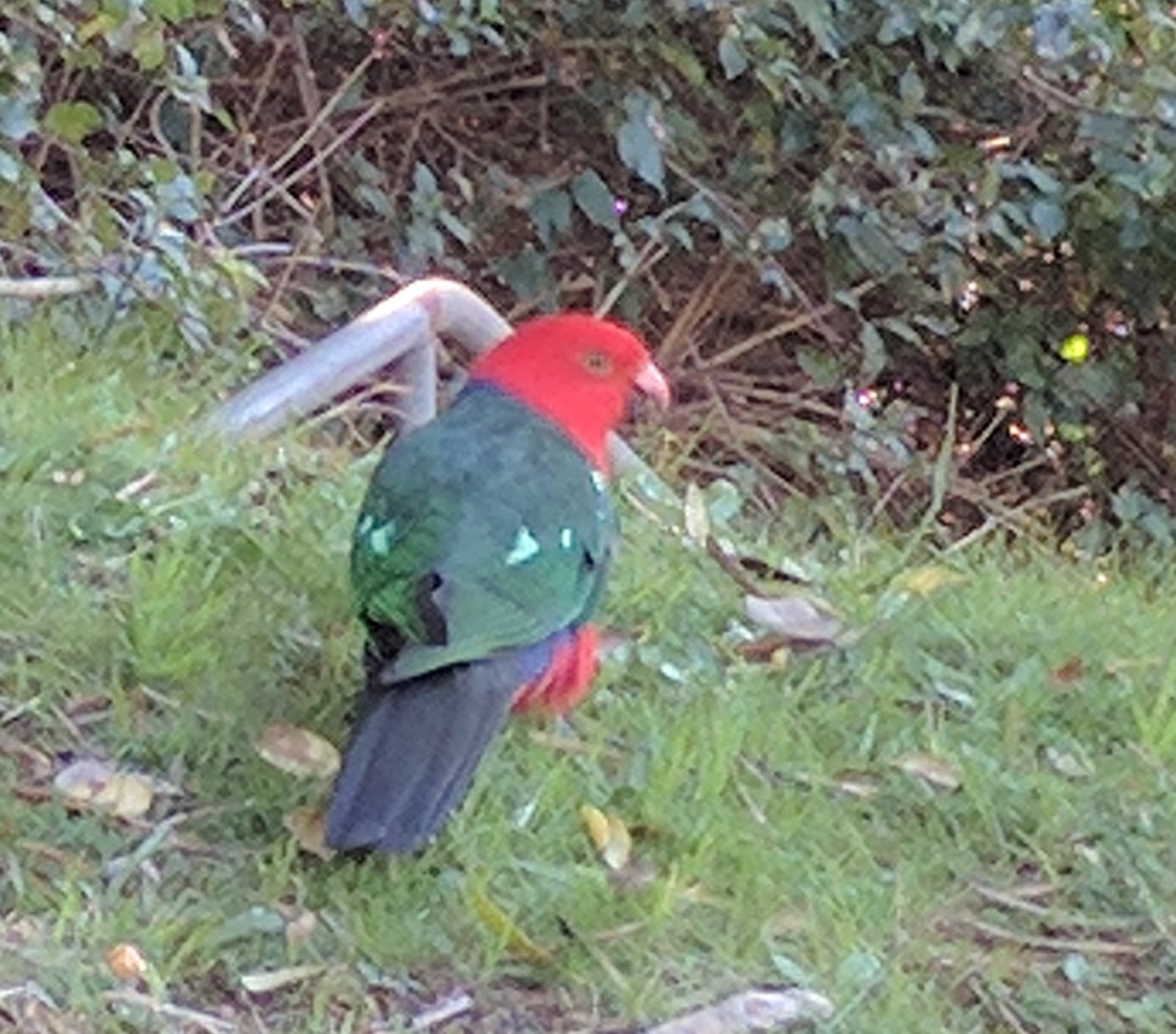
Common name: Australian King Parrot
Scientific name: Alisterus scapularis
Approximate length: 44 cm
Date spotted: 7 July 2017 (Winter)
Location: Allambie Heights, New South Wales, Australia: 33°46’13.2″S 151°15’41.1″E
Rainbow Lorikeets and a flowering grass tree
A grass tree (Xanthorrhoea) perches precariously on the edge of a cliff in our garden. Every couple of years, the grass tree throws up a flower spike—much to the delight of the Rainbow Lorikeets in the area. Here’s a closeup of a couple of the birds on the flower spike:
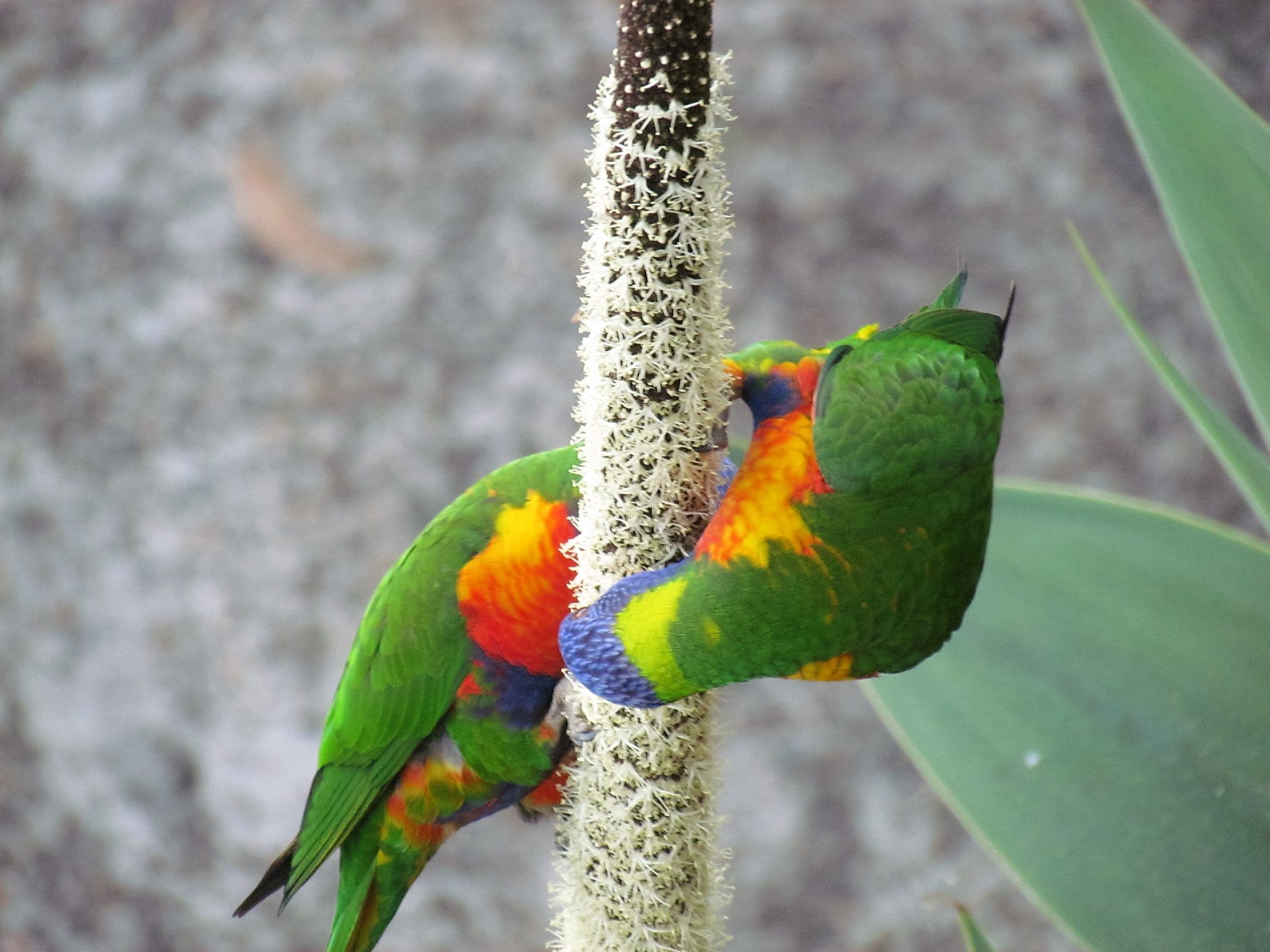
Here’s the grass tree on the cliff, with the flower spike shooting up. The grass tree is the one with long, thin, spiky leaves at the base of the flowering spike, not the fleshy big-leafed succulents that surround it:

You can only fit so many lorikeets on a flower spike at once. So, the trick is to line up on the nearest power line and take turns. This video shows the interaction between the birds as they wait in line:
Evidently the nectar from the flowers on the spike is deliciously sweet. Australian Aboriginal people use it to make a sweet drink. Europeans used to burn it as incense in churches. The birds feel it’s worth waiting in line:
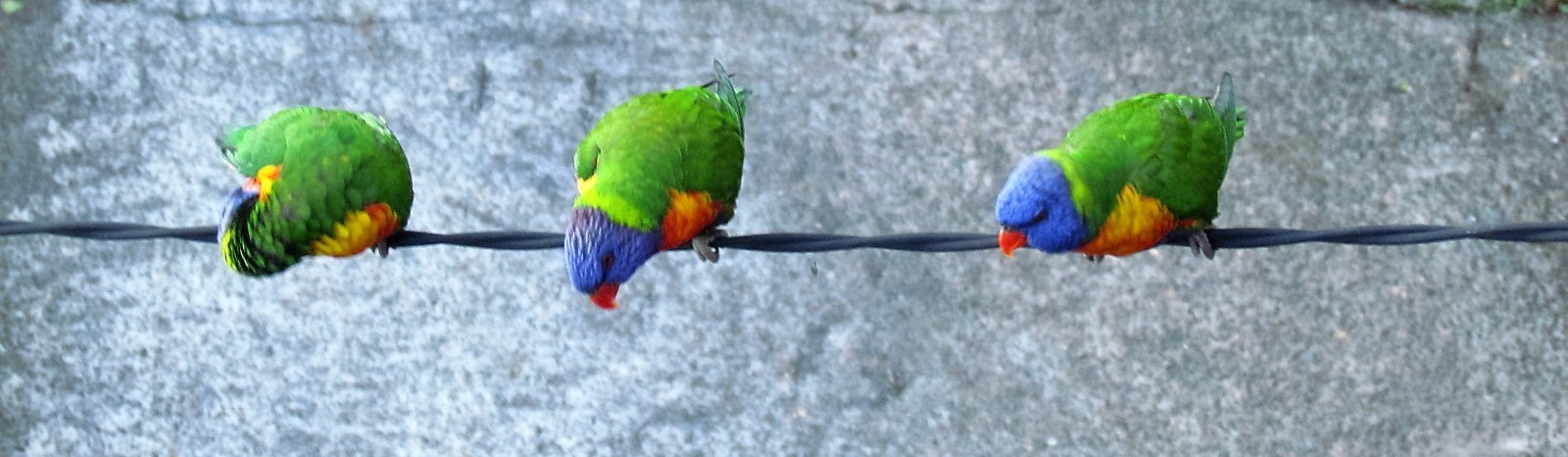
It turns out you can fit quite a few lorikeets on a flower spike:

Common name: Rainbow Lorikeet
Scientific name: Trichoglossus haematodus
Approximate length: 30 cm
Date spotted: 7 July 2017 (Winter)
Location: Allambie Heights, New South Wales, Australia
Australian Wood Duck
Australian Wood Ducks are a fairly common sight. They stand out, with their neat round head and short beaks. Up close, I noticed the soft frilly feathers on the sides of this bird’s body under the wings. This one is a male, as its head is dark brown and lacks the females’ white markings around the eyes.

Common name: Australian Wood Duck
Scientific name: Chenonetta jubata
Approximate length: 60cm
Date spotted: 3 June 2017 (Winter)
Location: Manly Dam Reserve, New South Wales, Australia: 33°46’58.1″S 151°15’14.7″E
Eastern Spinebill preening
This 7-second video shows an Eastern Spinebill tidying its feathers. Eastern Spinebills are small, fast-moving birds that whiz through the midlevel vegetation. They’re part of the honeyeater family. It’s often hard to identify these spinebills, as they don’t stay in one spot for very long. This one gave me an excellent view of its long, curved beak.
Common name: Eastern Spinebill
Scientific name: Acanthorhynchus tenuirostris
Approximate length: 16cm
Date spotted: 3 June 2017 (Winter)
Location: Manly Dam Reserve, New South Wales, Australia: 33°46’49.6″S 151°14’51.3″E
A coot and a metaphor
At first there’s nothing but the universe. The water and the sky. Then suddenly, there you are, in the middle of it all.
Common name: Eurasian Coot
Scientific name: Fulica atra
Approximate length: 35 cm
Date spotted: 23 April 2017 (Autumn)
Location: Manly Dam Reserve, New South Wales, Australia: 33°46’27.7″S 151°15’05.9″E
White-bellied Sea-Eagle at Manly Dam near Sydney
Yesterday I spotted a White-bellied Sea-Eagle flying along the shore of Manly Dam. It flew up and down the shore a few times, and across the water, then landed at the edge of the water in a baylet, with its legs in the water.
I was on the opposite side of the dam, so I couldn’t get a close look at the bird. I did take some photos and videos, but they’re fuzzy and unsatisfactory, although they’re good enough to satisfy me about the identification of the bird. So I decided to record the sighting here, and hope I get to see this beautiful bird again soon.
Common name: White-bellied Sea-Eagle
Scientific name: Haliaeetus leucogaster
Approximate length: 85 cm. Wing span: 2.2 m
Date spotted: 22 April 2017 (Autumn)
Location: Manly Dam Reserve, New South Wales, Australia: 33°46’35.2″S 151°15’08.0″E
Square-tailed Kite at Manly Dam near Sydney
This magnificent bird was sitting quietly in a tree, occasionally squinting down at the path, when I passed by. It’s a Square-tailed Kite – a large bird, at approximately 55 centimetres from head to tail (half a metre) with a wing span of 1.4 metres.

Square-tailed Kites are classified as rare in my bird book. Also, they’re not often seen around Sydney. I identified this one by the white markings around the face, and the characteristically long wing tips. When folded, they’re significantly longer than the tail, as you can see in the photo below:
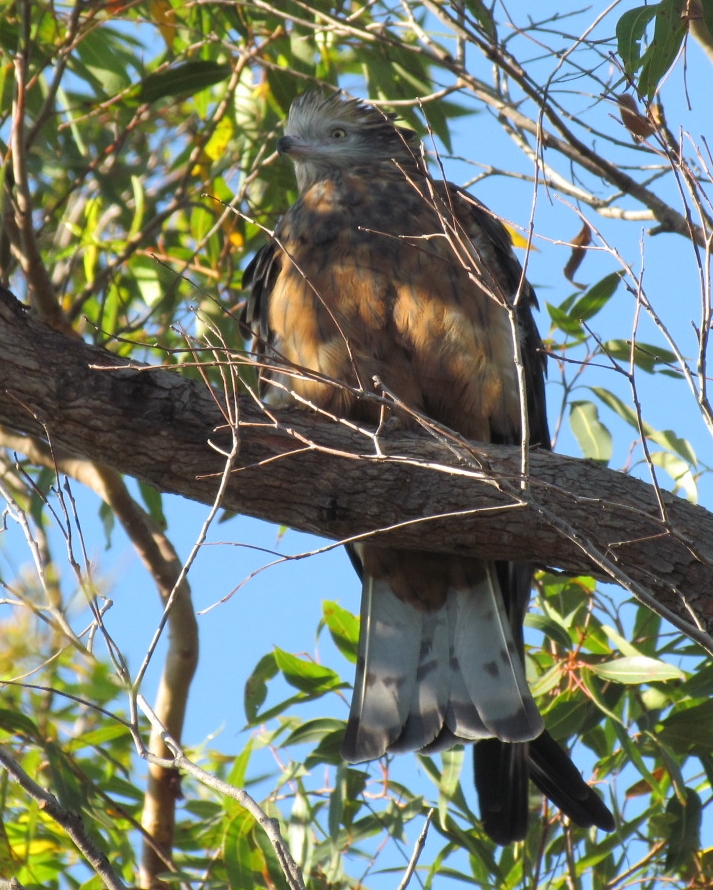
This video shows the bird having a good grooming session, feathers flying:
In the next video, the bird moves its head back and forward in a slightly eery way, perhaps scanning for prey:
Common name: Square-Tailed Kite
Scientific name: Lophoictinia isura
Approximate length: 55 cm. Wing span: 1.4 m
Date spotted: 15 April 2017 (Autumn)
Location: Manly Dam Reserve, New South Wales, Australia: 33°46’35.3″S 151°15’13.3″E
Darter drying wings then taking off
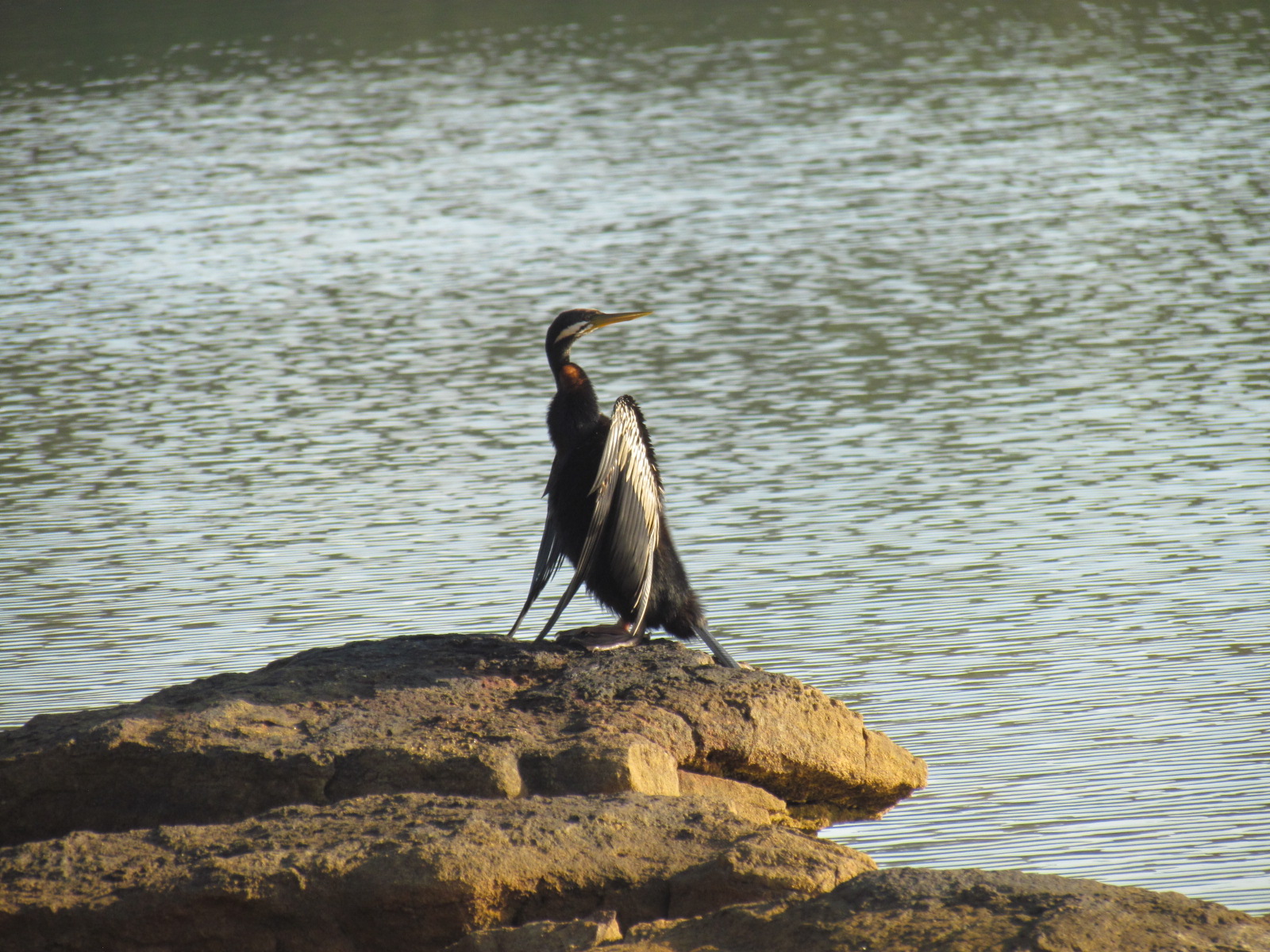
At first sight I thought this bird was a cormorant, but it’s actually a darter, also known as a snake bird because of its long, snake-like neck. Darters are related to cormorants, and also to boobies and gannets. They swim fast under water, hunting and impaling fish with their formidable long, thin beak.
Like cormorants, they sit on shore with their wings spread to dry. After I’d been watching this one for a few minutes, it decided to take off and fly over the water. It’s interesting to see how low it flies, with the wing tips actually tapping the water as it goes.
This pose reminded me of the ballet, the Dying Swan:

Here you can see the characteristic chestnut colouring at the base of the darter’s neck:
Common name: Darter
Scientific name: Anhinga melanogaster
Approximate length: 90 cm; wing span: 1.2 m
Date spotted: 12 February 2017 (Summer)
Location: Manly Dam Reserve, New South Wales, Australia: 33°46’49.6″S 151°15’05.7″E


 Sydney Birder