Blog Archives

Eat your greens! Baby swans growing up
Early in October I spotted a family of swans at Manly Dam. These are Australian Black Swans. When I first saw them, there were five baby swans (cygnets), closely watched over by two adults. This was one of the little ones, just a few days old then, I think:

Since then, I’ve been watching the cygnets grow. Alas, two of them disappeared over the weeks. But there are still three of the cygnets, still with their parents in late December, and much bigger and stronger.
The video below shows a cygnet and a parent feeding on water weeds. This was towards the end of November, when the cygnets were around six weeks old. Near the beginning of the video, the adult swan grabs a clump of weed and dumps it near the baby.
Eat your greens!
Later the video zooms out to show the entire family of three babies and two adults:
Here’s one of the cygnets swimming with an adult, also at around six weeks old:

On 23 December, at ten to eleven weeks old, the cygnets are much bulkier and their faces look more swan-like:

Even at this age, their wings are still small and stumpy, nowhere near ready for flight:
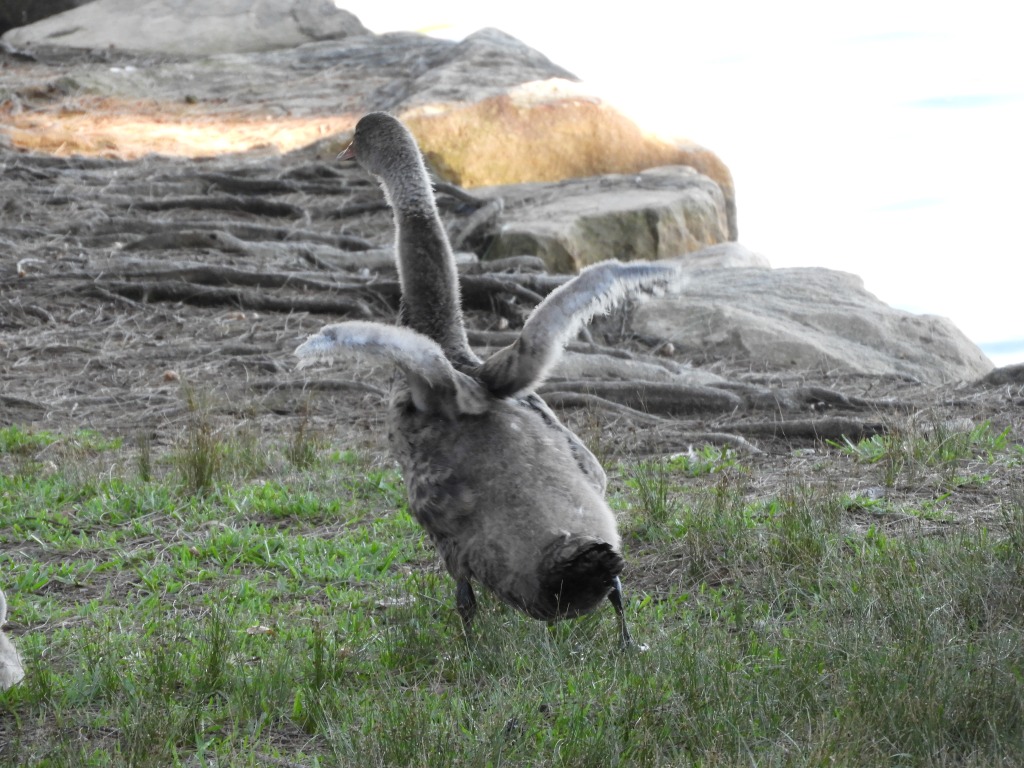
Common name: Black Swan
Scientific name: Cygnus atratus
Approximate length of adult: 120 cm
Date spotted: 9 October 2020 (spring) through to 23 December 2020 (summer)
Location: Manly Dam Park, New South Wales, Australia: 33°46’58.5″S 151°15’18.6″E
Royal Spoonbill at Manly Beach
Today I saw a Royal Spoonbill for the first time. The bird was strutting along the bank of Manly Creek, right where the lagoon opens into the Queenscliff end of Manly Beach. The spoonbill was accompanied by a White-faced Heron.
A Royal Spoonbill is a large white bird with a black face, a spoon-shaped beak, and black legs. Spoonbills feed by dragging their beaks through the water. In the video below, the bird hops into the water and trawls for food. During mating season (which is now), Royal Spoonbills have an impressive crest of long white feathers on the back of their heads. Thanks to the wind today, you can see this bird’s fine crest blowing around its head.
Common name: Royal Spoonbill
Scientific name: Platalea regia
Approximate length: 75-80 cm
Date spotted: 25 October 2020 (spring)
Location: Manly Beach, New South Wales, Australia: 33°47’06.8″S 151°17’16.3″E

Baby black swans and ducklings
Baby swans are called cygnets. Pictures of cygnets from white swans are quite common, but what do baby black swans look like? Very similar to the white-swan babies, it turns out. They’re grey and fluffy, with black eyes, feet, and beak. I was delighted to spot a family of black swans while out walking a couple of days ago.

The parent swans were watchful, taking care to keep their little ones in a group. A male swan is called a cob, and a female is a pen. Five babies! That’s a lot of curiosity and cuteness to look after.

Did I say five babies? Yes. One of the cygnets was fossicking around in the undergrowth at the water’s edge. You can see the fifth little one in this video:
Common name: Black Swan
Scientific name: Cygnus atratus
Approximate length of adult: 120 cm
Date spotted: 9 October 2020 (spring)
Location: Manly Dam Park, New South Wales, Australia: 33°46’58.5″S 151°15’18.6″E
Nearby was a family of Australian Wood Ducks. The ducklings are almost as cute as the cygnets. But not quite!
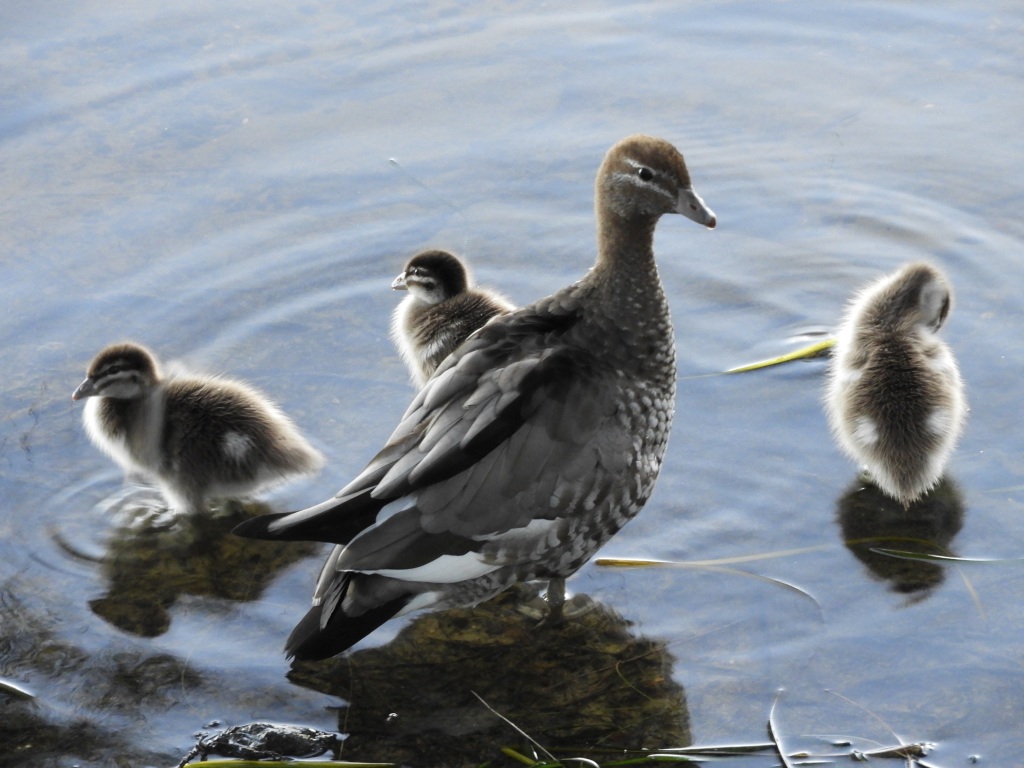
Common name: Australian Wood Duck
Scientific name: Chenonetta jubata
Approximate length of adult: 50 cm
Date spotted: 9 October 2020 (spring)
Location: Manly Dam Park, New South Wales, Australia: 33°46’58.5″S 151°15’18.6″E
The sinuous neck of a Darter
Darters are sometimes called snakebirds, because of their long, sinuous necks. I came across this small darter sheltering on a branch close to the footpath at Manly Dam.

The bird didn’t seem to be worried by my presence. I stood and watched it for a while, enjoying the supply movements of its wings and neck:
At one stage a couple of ravens started cawing. The darter showed some concern, looking skywards to see if there was any threat:
Darters use that long neck to hunt underwater, straightening it suddenly to dash out and catch their prey.
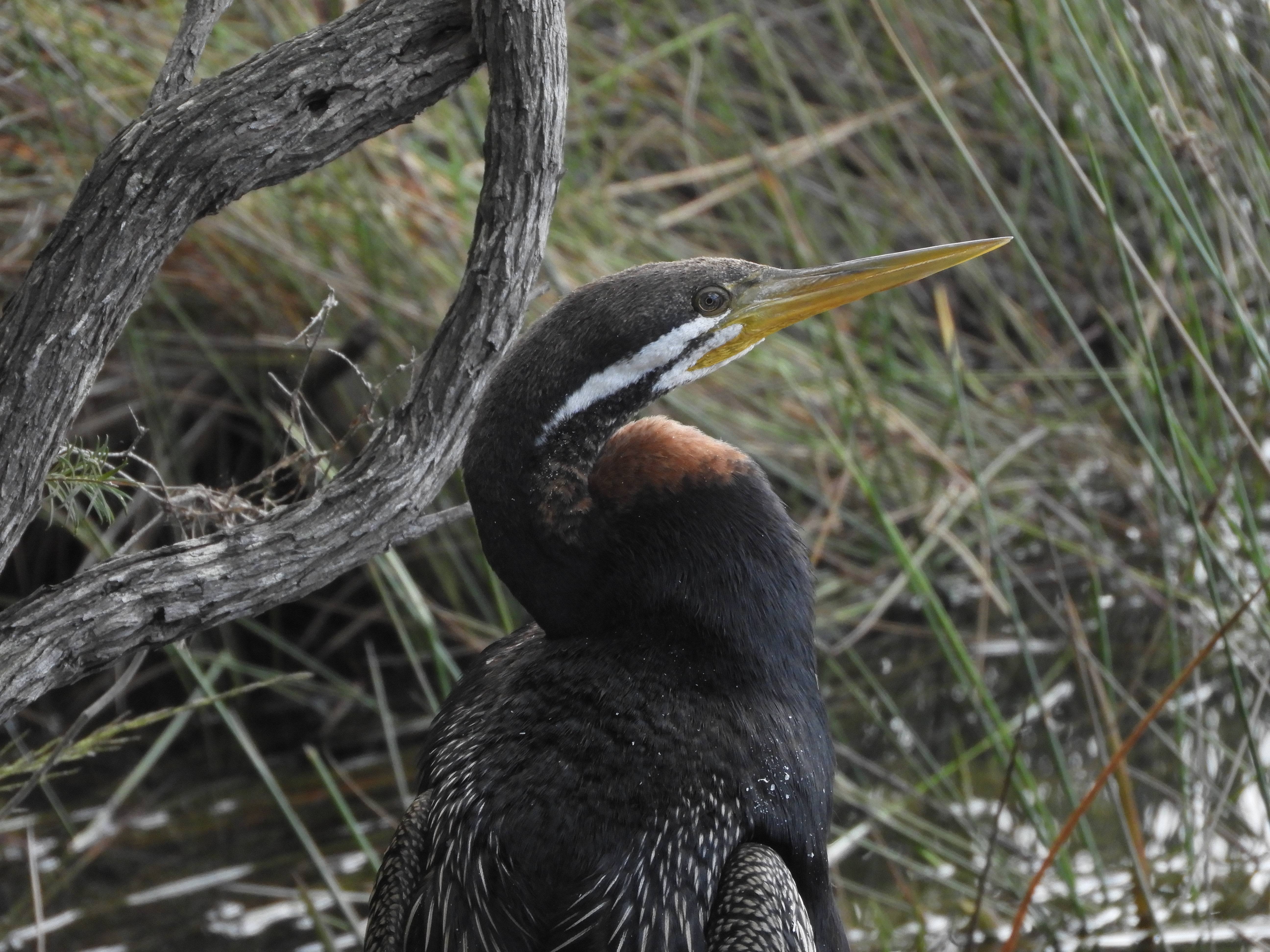
Here’s a close-up shot of the bird’s head, neck, and shoulders, with the neck coiled up in the resting pose:
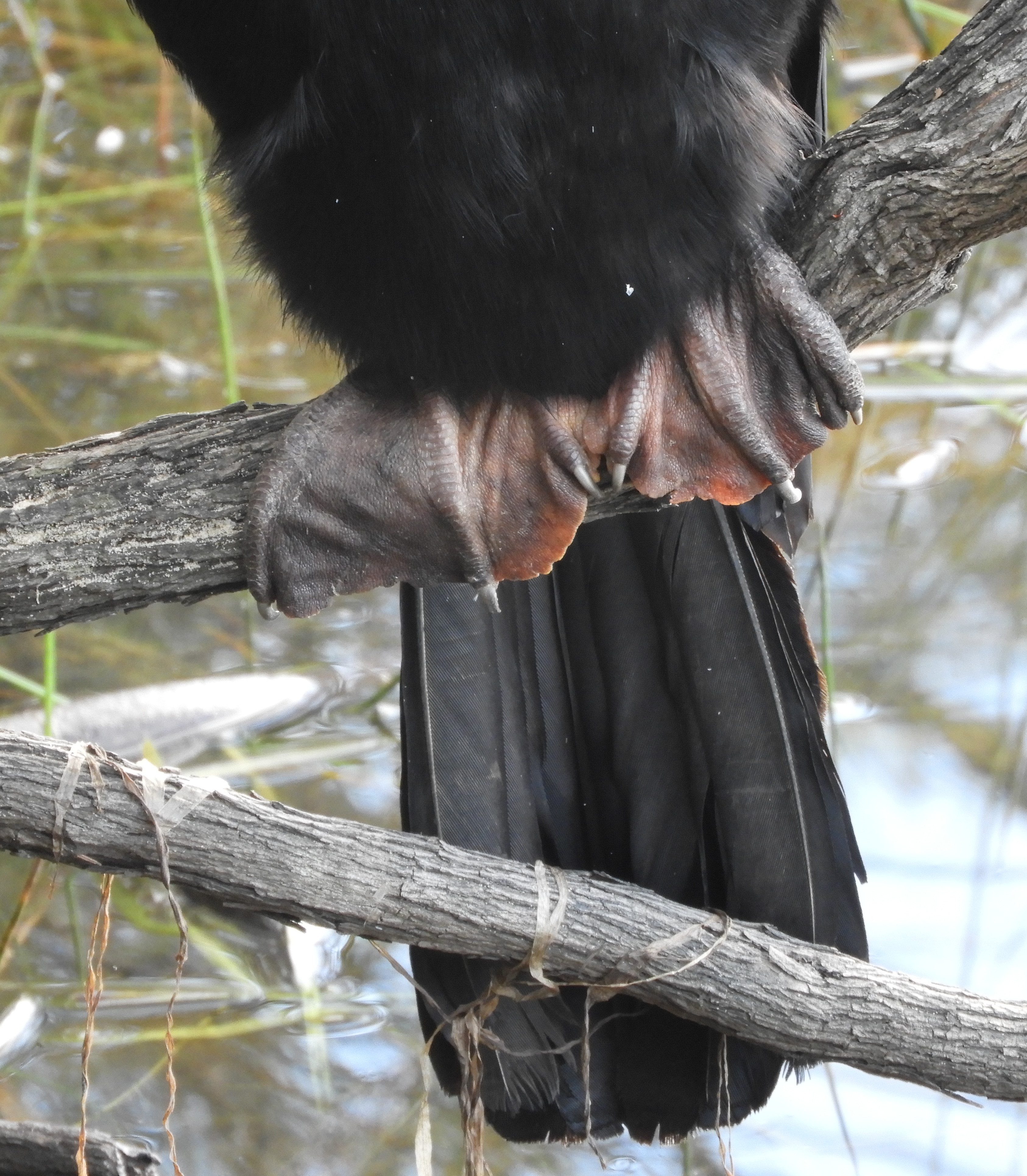
The bird’s feet are webbed, good for swimming and for clasping a branch:
Spreading its feathers prior to a stretch:

Like cormorants, darters need to hold out their wings to dry:
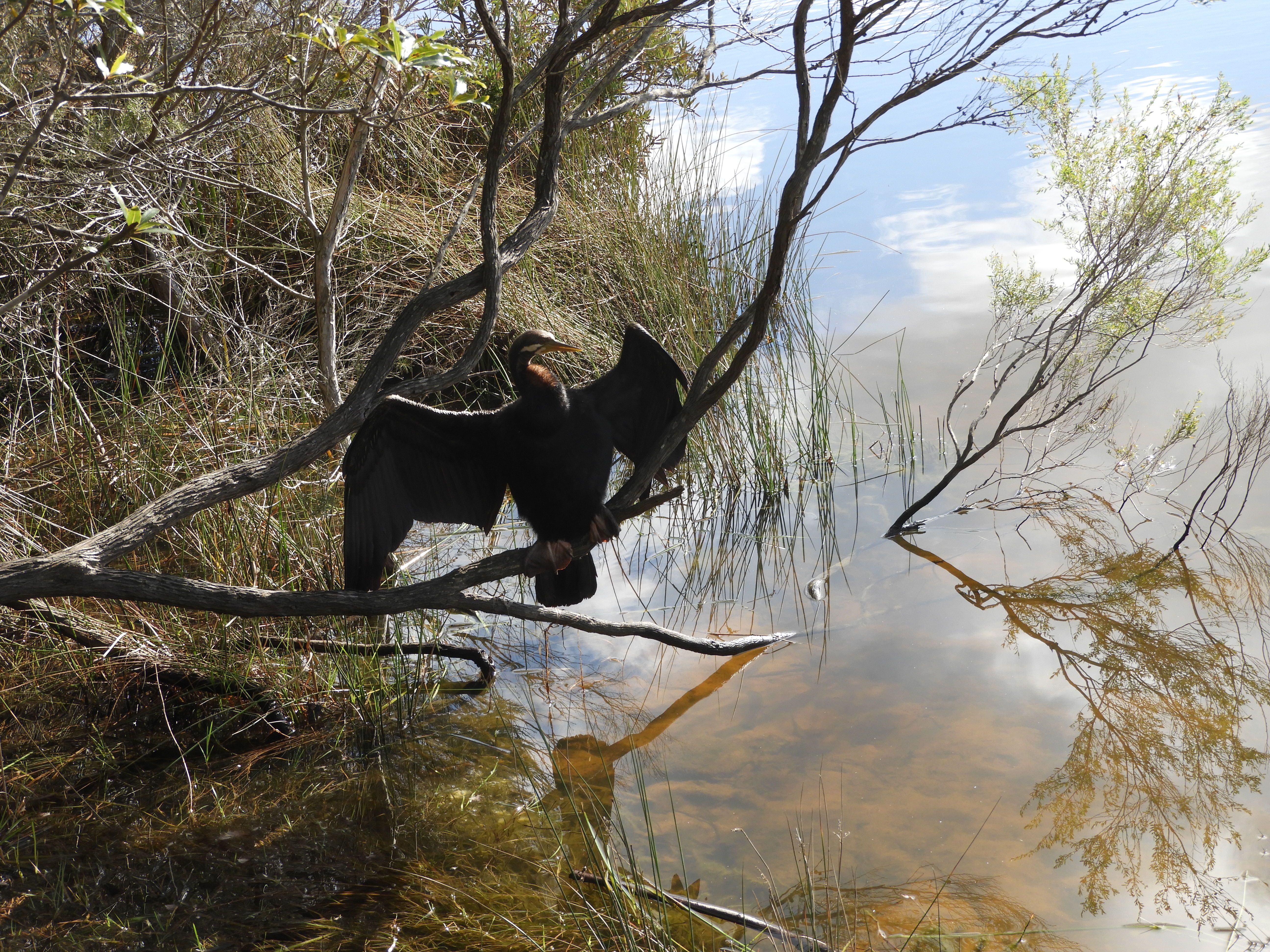
Common name: Darter
Scientific name: Anhinga melanogaster
Approximate length: 90 cm; wing span: 1.2 m
Date spotted: 30 June 2020 (winter)
Location: Manly Dam Reserve, New South Wales, Australia: 33°46’38.5″S 151°14’57.0″E
Fluffy Australasian Grebe, not a duckling
Update on 19 April: The bird is actually an Australasian Grebe, not a duckling as I originally thought. Thanks to Pamela and Carol for helping to identify the bird (see comments on this post).
This tiny ball of fluff was zooming around an inlet of Manly Dam. I thought it was a Mallard duckling, because it seemed to spend most time close to an adult Mallard. Despite its size, the little thing was independent of spirit and a fast paddler.

Common name: Australasian Grebe
Scientific name: Tachybaptus novaehollandiae
Approximate length: 23-25 cm
Date spotted: 6 April 2020 (autumn)
Location: Manly Dam National Reserve, near Sydney: 33°46’34.8″S 151°14’49.6″E
This is the Mallard that the little one seemed to home in on:

Mallards are an introduced species in Australia. Their original home is the northern hemisphere, but they’re quite common in south eastern Australia now too.
Common name: Mallard
Scientific name: Anas Platyrhynchos
Approximate length: 50-70 cm
Date spotted: 6 April 2020 (autumn)
Location: Manly Dam National Reserve, near Sydney: 33°46’34.8″S 151°14’49.6″E
Cormorant poses on Manly Oceanides statue
The Oceanides, or The Sea Nymphs, is a graceful sculpture on the edge of the sea pool at Cabbage Tree Bay in Manly. Today a Little Pied Cormorant added its grace to the work of art:

(Click on the picture to zoom in.)
Common name: Little Pied Cormorant
Scientific name: Phalacrocorax melanoleucos
Approximate length: 60 cm
Date spotted: 27 August 2019 (Late winter)
Location: Cabbage Tree Bay, Manly, New South Wales, Australia: 33°48’02.5″S 151°17’40.0″E
Crested Tern chilling out in Curl Curl
Amongst the wheeling Silver Gulls, joggers, and fishermen, a Crested Tern stood gazing over the rocks and sea.

I was walking along the cliff path when I passed the bird. Fifteen minutes later I was on my way back. The bird was still there. This picture shows the crest from which the bird’s name comes:
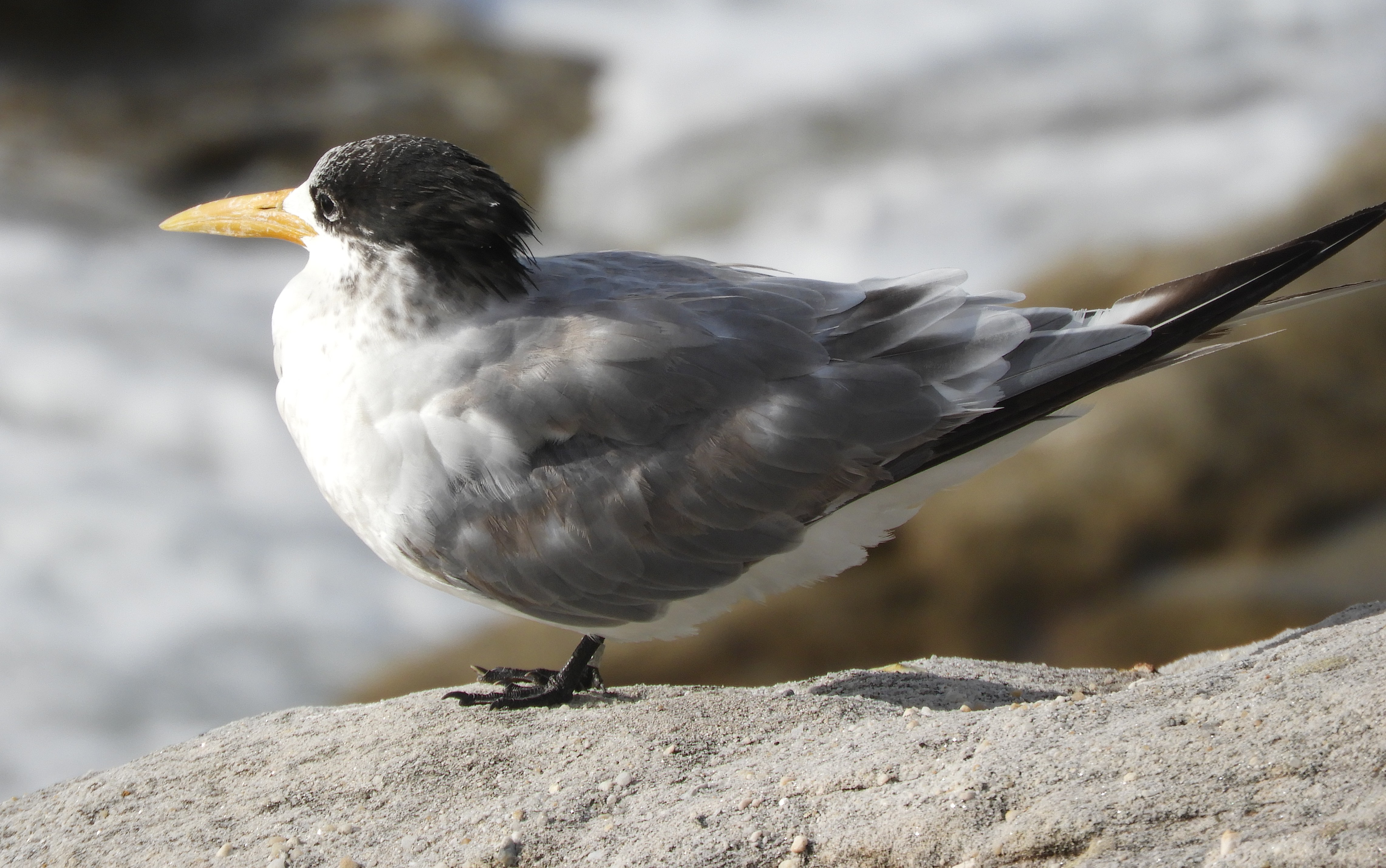
Crested Terns are a common sight around the shores of Australia. You may see them sitting on the sand with the gulls, or darting over the waves and diving to catch a fish. These are the seas and cliffs of Curl Curl where the bird and I were chilling out:

Common name: Crested Tern
Scientific name: Sterna bergii
Approximate length: 45 cm
Date spotted: 22 April 2019 (Autumn)
Location: Curl Curl, New South Wales, Australia: 33°46’36.9″S 151°17’36.8″E
Little Black Cormorant catching the sun
I went for a late afternoon walk near Spit Bridge today, and saw this Little Black Cormorant catching the last of the sun:
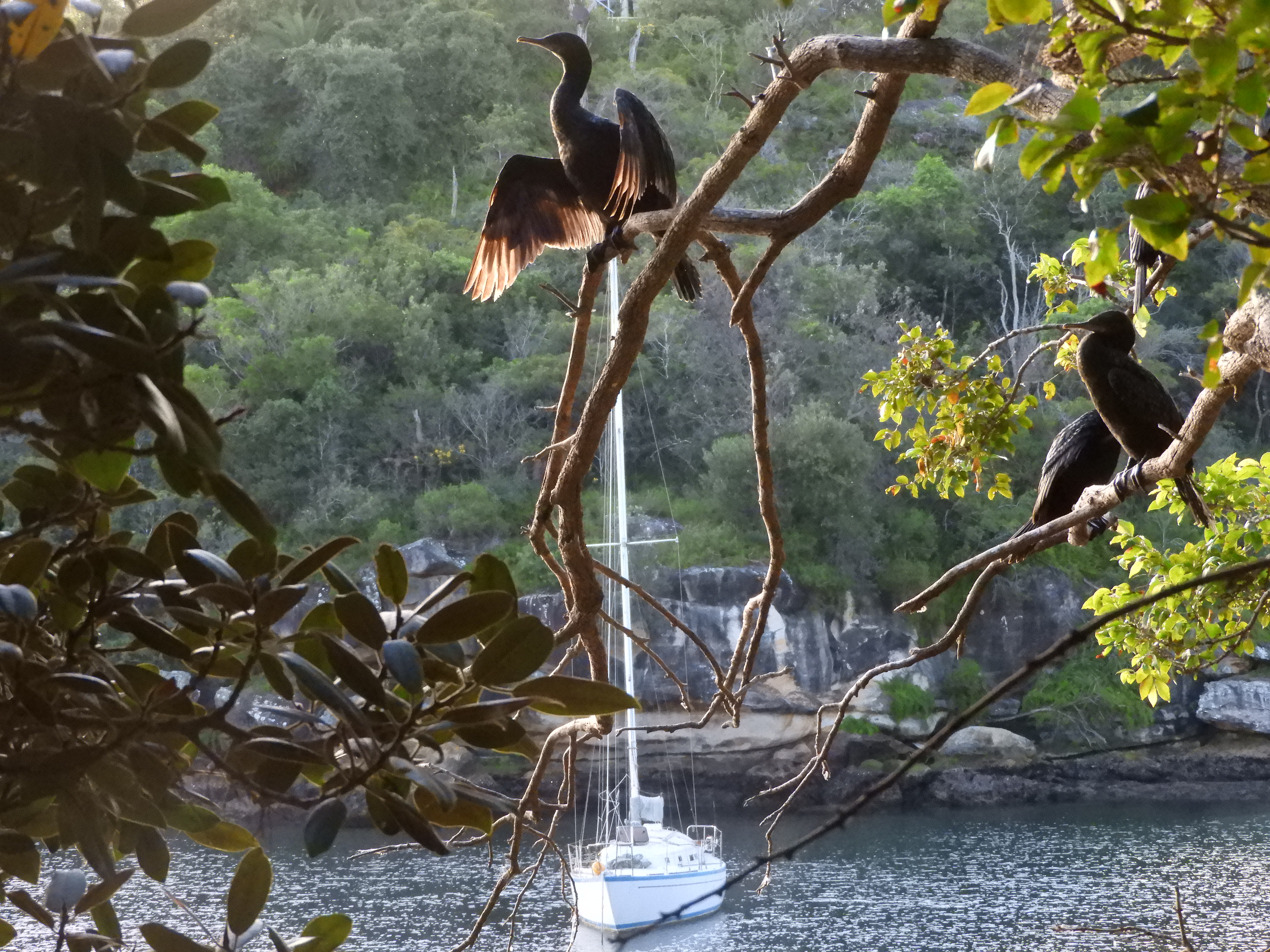
In the next photo you can see the bird’s webbed feet nicely. Cormorants are very fast and agile under water, where they catch their prey. Their feathers are not waterproof, which is why they spend so much time with their wings spread out to dry.
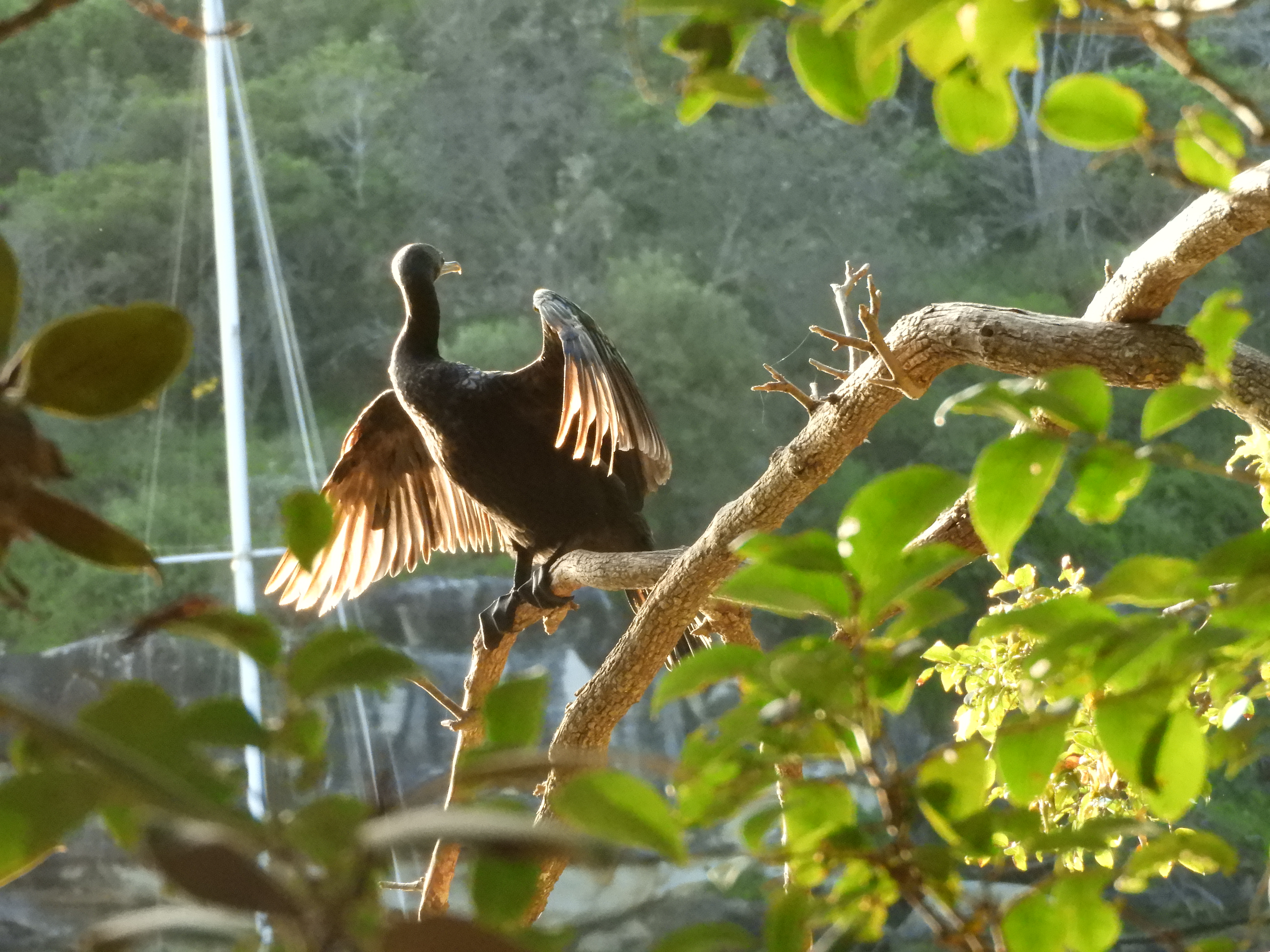
Common name: Little Black Cormorant (see other cormorants)
Scientific name: Phalacrocorax sulcirostris
Approximate length: 65 cm
Date spotted: 20 April 2019 (Autumn)
Location: Near Middle Harbour, Clontarf, New South Wales, Australia: 33°48’07.8″S 151°15’00.2″E
Cormorants at Long Reef Headland, Dee Why
This morning I took a walk along Dee Why Headland and followed the path down onto Long Reef. Far in the distance, perched on the rocks at the sea’s edge, was an assortment of cormorants.
Pretty cool: when I dropped the pin on Google Maps to mark the spot, the label came up as “Near South Pacific Ocean”!
Great Cormorants
First there were these four birds, which I think are Great Cormorants. The air was full of spray and the early morning sun was low in the sky, so it’s hard to be sure. One is holding its wings up in typical cormorant style. The birds seem to be just about entirely black, with yellow or white around the beak. At the end of the video, I zoom back out so that you can see just how far away the birds were. On cue, a yacht hoves into view too.
Common name: Great Cormorant
Scientific name: Phalacrocorax carbo
Approximate length: 85 cm; wing span 1.5 m
Date spotted: 29 December 2018 (Summer)
Location: Long Reef Headland, Dee Why, New South Wales, Australia: 33°44’30.6″S 151°19’04.2″E
Little Pied Cormorant
Next I saw this Little Pied Cormorant, looking a bit ruffled:
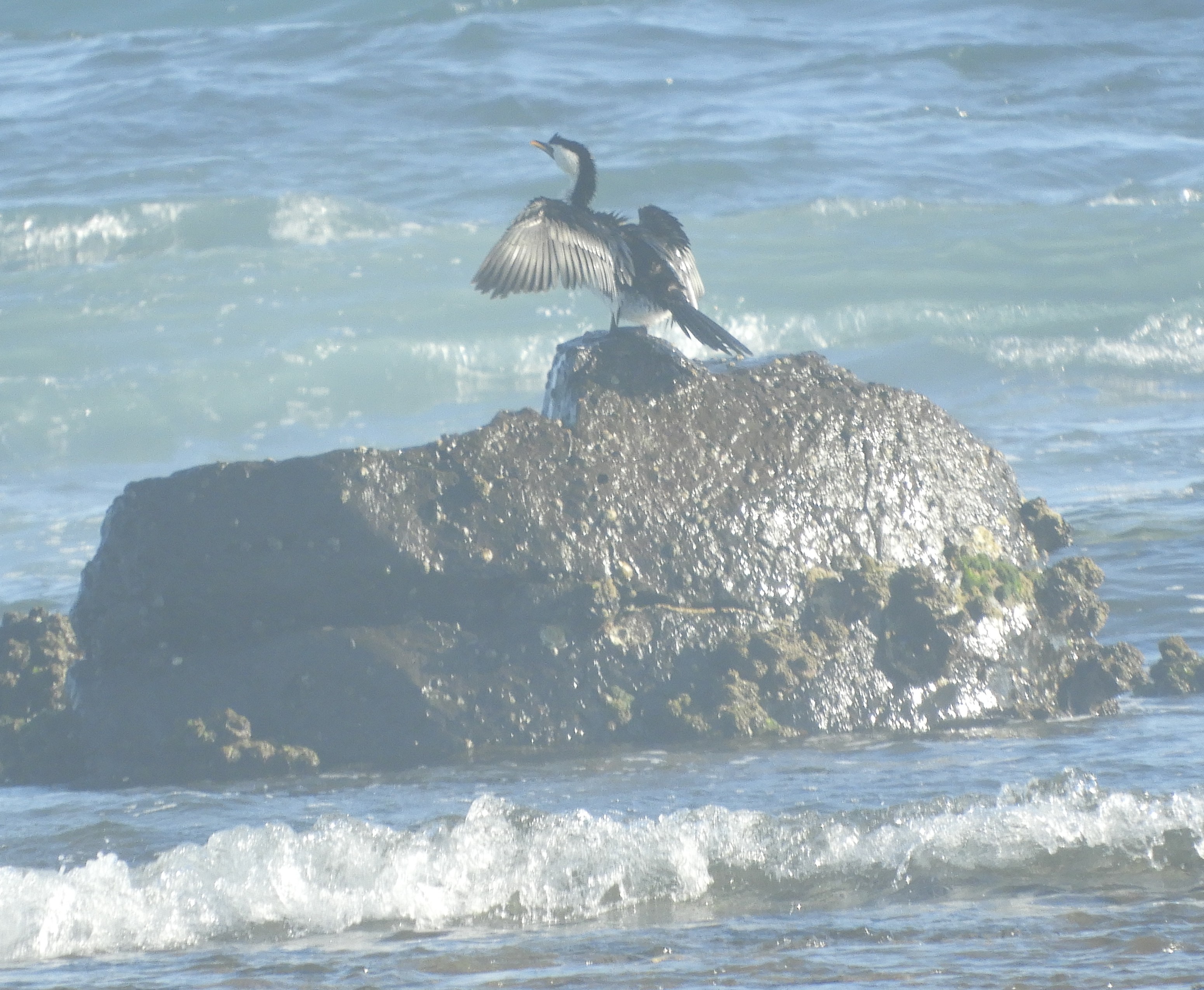
Here’s a video of the Little Pied Cormorant enjoying the waves and the sticky breeze:
Common name: Little Pied Cormorant
Scientific name: Phalacrocorax melanoleucos
Approximate length: 60 cm
Date spotted: 29 December 2018 (Summer)
Location: Long Reef Headland, Dee Why, New South Wales, Australia: 33°44’30.6″S 151°19’04.2″E
Misty coot
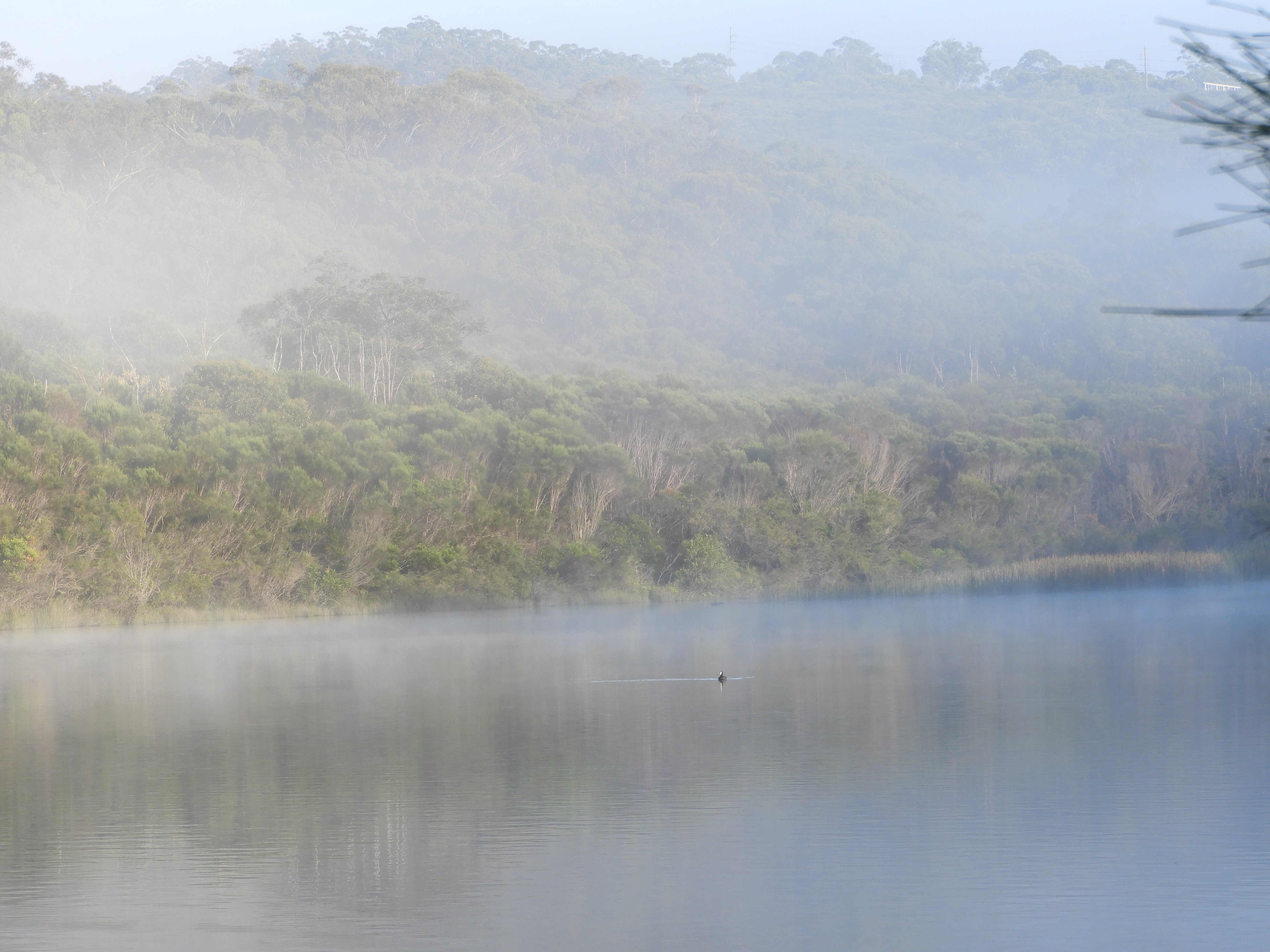
Mist over Manly Dam. You can’t really see the coot. But then, you don’t really need to see it. It’s just there, as coots are.
Common name: Eurasian Coot
Scientific name: Fulica atra
Approximate length: 35 cm
Date spotted: 26 December 2018 (Summer)
Location: Manly Dam Reserve, New South Wales, Australia: 33°46’27.7″S 151°15’05.9″E


 Sydney Birder