Blog Archives

Corellas chewing yacht ropes
A group of Little Corellas has lately taken a shine to the Forty Baskets Beach area in Balgowlah, NSW. They spend their time in the nearby trees and on the rocks.

The corellas seem to enjoy the sea water trapped in crevices on the rocks. Or perhaps it’s rain water.
The corellas are beautiful, and fun to watch, but I’m rather glad that I don’t have a yacht moored there.

The birds really get into the ropes, watched by their friends:
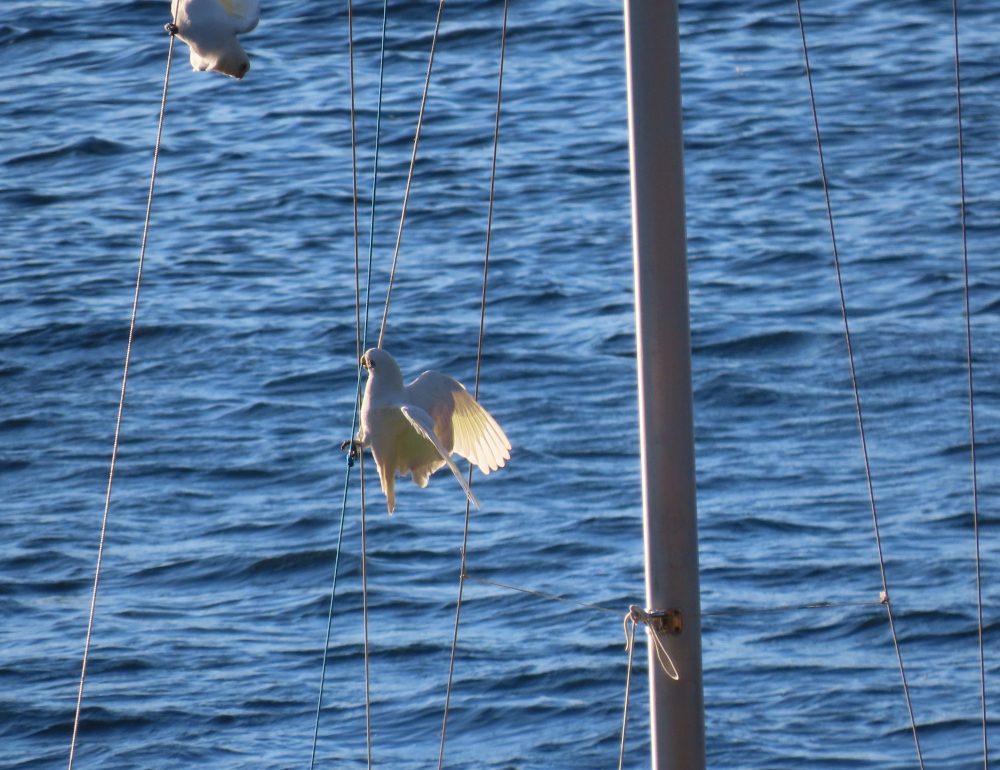

It’s a good time for all.

When fun at the beach palls, it’s time to find a nook for a bit of canoodling:

This grooming session ended in a squabble:
Common name: Little Corella
Scientific name: Cacatua sanguinea
Approximate length: 36-39 cm
Date spotted: 28 July 2024 (winter)
Location: Forty Baskets Beach, Sydney Harbour, New South Wales, Australia: 33°48’15.8″S 151°16’13.9″E

Great Egret at Manly Dam
This is the first time I’ve seen a Great Egret in this part of the world. My only other sightings were on a trip to Queensland a while ago.

They’re quiet and imposing birds. This one had a fluffy beak. I guess it had been doing some preening before I came along.

Common name: Great Egret
Scientific names: Ardea alba
Approximate length: 85 cm to 1.05 m
Date spotted: 26 July 2024 (winter)
Location: Manly Dam Park, near Sydney, Australia: 33°46’34.8″S 151°14’49.6″E

Red-browed Finch
I love these birds. They’re the only native finch that I see commonly around Sydney.
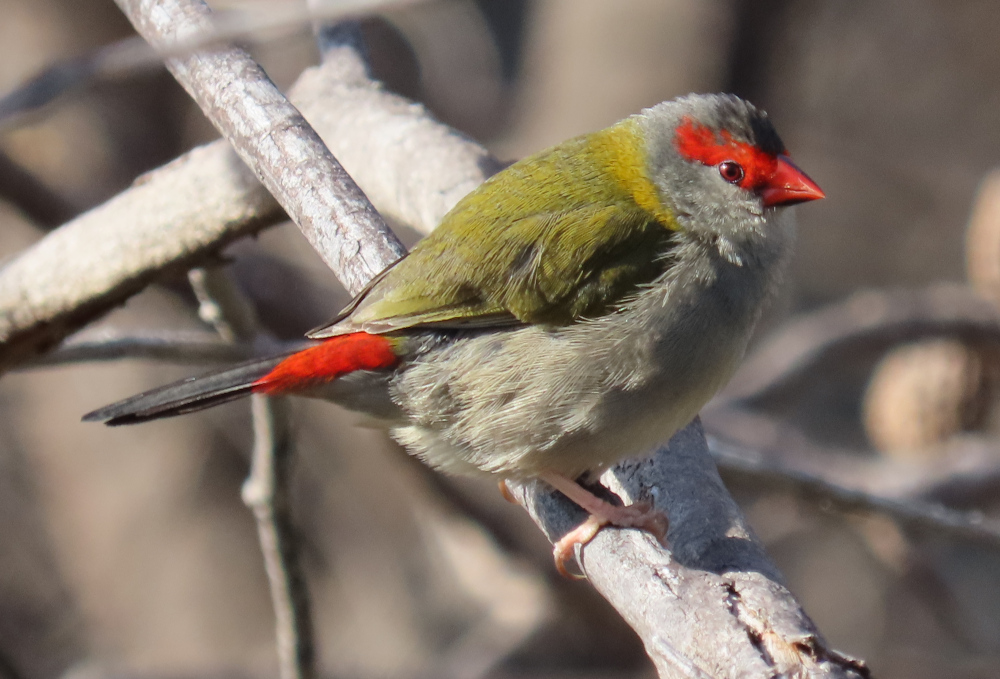
They usually look spiffing, all buffed and polished. This one looks a little less well turned out. Perhaps it’s a youngster. Standing straight and tall (well, tall for a finch anyway):

Common name: Red-browed Finch
Scientific name: Neochmia temporalis
Approximate length: 12 cm
Date spotted: 24 July 2024 (winter)
Location: Allambie Heights, NSW, Australia: 33°46’18.7″S 151°14’56.1″E

Lyrebird imitating a shooting game and several birds
It was a rare treat to find this Lyrebird in Sydney’s Northern Beaches. The bird was dancing, displaying his tail, and calling. He had an impressive repertoire, including the pieuw-pieuw sounds of an electronic shooting game and the calls of various birds.
Hint: For the best experience, increase the default quality of the video. (Use YouTube’s cog icon to update the settings.)
At the start of the video, the Lyrebird is searching through the leaves and twigs on the ground. The rushing noise in the background is a small waterfall nearby. The bird starts gently crooning and chirping to himself. (Turn up the volume to hear the mutterings.) Then the urge to sing overcomes him, and he starts his performance. The full display starts at about 50 seconds into the video, with the rattling and pieuw-pieuwing of an electronic shooting game accompanied by side-to-side and frontwards steps. He mingles some bird chirps into the shooting sounds for dramatic effect. Next come the bird sounds. I heard the start of a kookaburra call, though he didn’t get fully into it. (He did the full call in another performance, which I haven’t posted here.) He adds the calls of magpies, wattlebirds, lorikeets, and whipbirds. I think I hear a Yellow-tailed Black-cockatoo and a magpie in there too, and other birds that I haven’t identified.
Between performances, the little fellow spent some time resting and picking through the leaves before starting up again.
The bird kept to the shadiest spots, making it hard to get a good photo. This is the best that I managed:

Common name: Superb Lyrebird
Scientific name: Menura Novaehollandiae
Length: 80-95 cm
Date spotted: 18 July 2024 (winter)
Location: Sydney’s Northern Beaches, New South Wales, Australia
Two pretty little Silvereyes
Two Silvereyes perched on a twig, lending a touch of colour to the winter chill. Here’s one of them, showing the buff colouring on its front, under the wings. And, of course, that characteristic white-ringed eye:
Another view shows the olive green on the birds’ backs and wings:

Common name: Silvereye
Scientific name: Zosterops cornwalli
Length: 11-13 cm
Date spotted: 13 July 2024 (winter)
Location: Dobroyd Head, New South Wales, Australia: 33°48’36.1″S 151°16’24.1″E

My first Tattler
A few weeks ago, I took some photos of a bird that I thought was a juvenile Oystercatcher. When I posted the pictures and location on eBird, a reviewer let me know that this is a Tattler, probably a Grey-tailed Tattler.
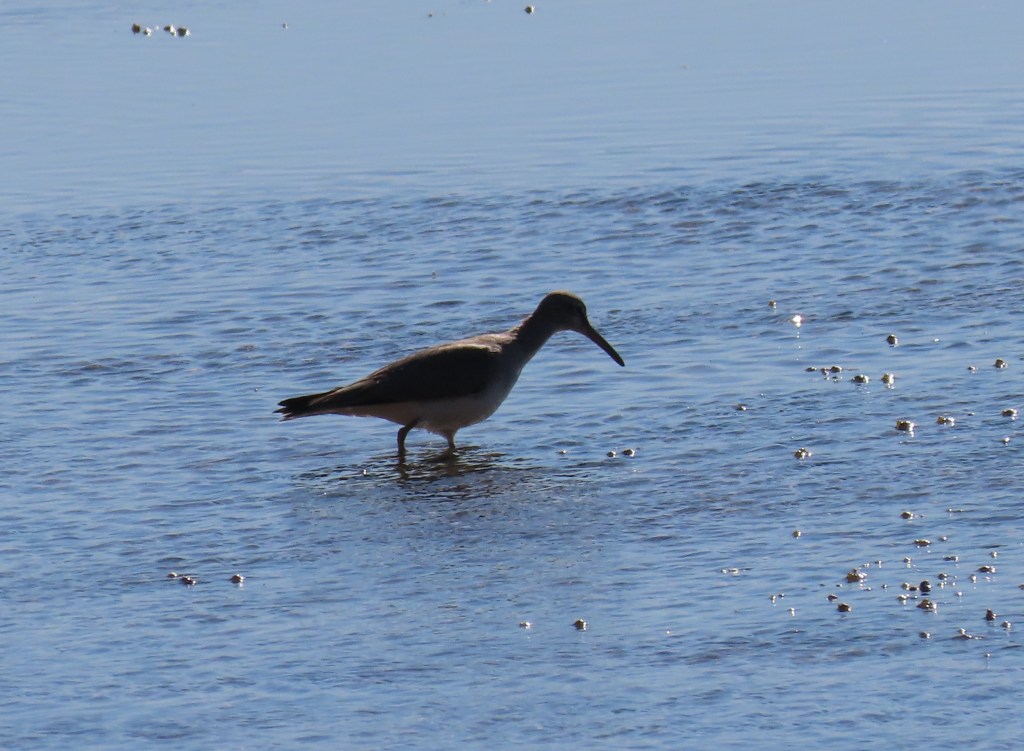
I was delighted to be corrected, and particularly so because this is the first time I’ve spotted a Tattler. These birds are uncommon in the south of Australia, particularly in winter.
The bird was wading in the shallows of the rocky plate that leads out into the ocean from Long Reef Headland. Every now and then, it probed the rocks below the water for food.
The lighting was harsh and the bird was far away, which made it difficult to get a good photo.

Common name: Tattler, probably a Grey-tailed Tattler
Scientific name: sp. Heteroscelus, probably Heteroscelus brevipes
Approximate length: 24-28 cm
Date spotted: 19 June 2024 (winter)
Location: Long Reef Aquatic Reserve, Collaroy, New South Wales, Australia: 33°44’19.7″S 151°18’42.0″E

The foot of the Coot
Coots are underrated. Their feet even more so.

Drama in monochrome and a touch of red:

How to own a reflection:

Common name: Eurasian Coot
Scientific name: Fulica atra
Approximate length: 35 cm
Date spotted: April and June 2024
Location: Manly Dam Reserve, New South Wales, Australia

Pardalotes nest-building in winter
It’s mid-winter here in Sydney: cold, wet, and grey. Yet I’ve noticed some of the birds are already preparing for breeding season. On Friday, I saw a group of Australian Ibises in breeding plumage. And a few days ago, I watched a Spotted Pardalote gathering material for its nest:

Pardalotes are tiny little birds (10 cm from head to tail). They nest in burrows in the ground, usually at around ankle level. This one was unusual, in that its nest was in the side of a low cliff, overlooking the water of Sydney Harbour. Here’s the view that the bird would see:

Some distance away on the same walk, another Spotted Pardalote stopped on a branch for a few seconds:

Even when stopped on a branch, these birds don’t stand still for any time at all! I was lucky to get some usable shots from the many that I took. Another view of the same bird:

Common name: Spotted Pardalote or Diamondbird
Scientific name: Pardalotus punctatus
Approximate length: 10 cm
Date spotted: 26 June 2024 (winter)
Location: Forty Baskets (33°48’05.7″S 151°16’09.3″E) and Dobroyd Head (33°48’35.0″S 151°16’18.8″E) in Sydney Harbour

Young Scarlet Honeyeater
It took me a while to identify this bird. The long, thin, curved beak made me think of a honeyeater or a spinebill. I’d seen Scarlet Honeyeaters in the area before, and this bird was the right sort of size and shape to be one of those. But it has no red around its head or throat, and its legs are orange instead of grey.
It’s a young Scarlet Honeyeater:

I’ve posted some pictures of previously-spotted Scarlet Honeyeaters, where you can see the lovely reds of the adult birds.
There’s a small hint of red on the back, just above the tail:

This is the view the bird was enjoying:

Common name: Scarlet Honeyeater
Scientific name: Myzomela sanguinolenta
Approximate length: 10 cm
Date spotted: 26 June 2024 (winter)
Location: Dobroyd Head, New South Wales, Australia: 33°48’34.0″S 151°16’14.8″E

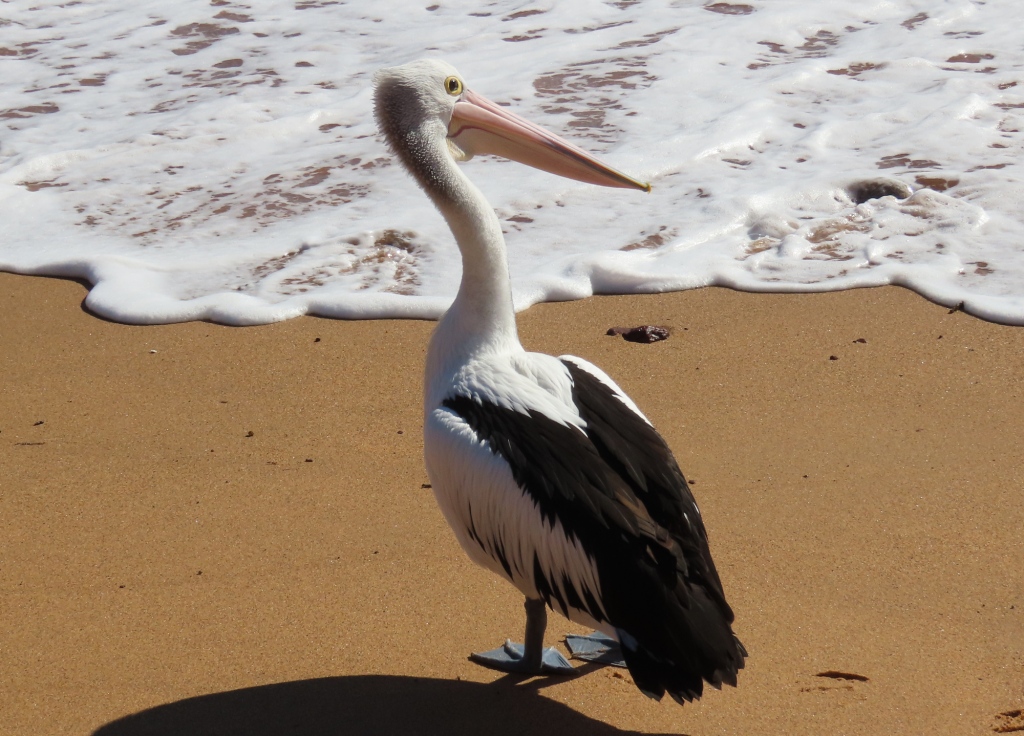
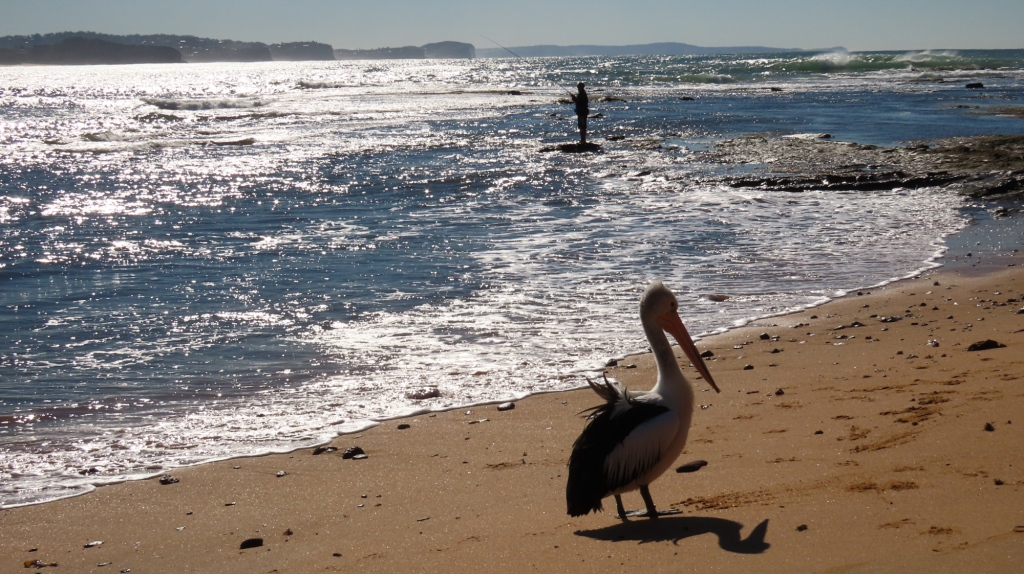
Pelicans prowling around fisherman
At Long Reef in Collaroy, a fisherman was washing out his bucket. Three pelicans followed in his footsteps, hoping for some tasty morsels to fall.
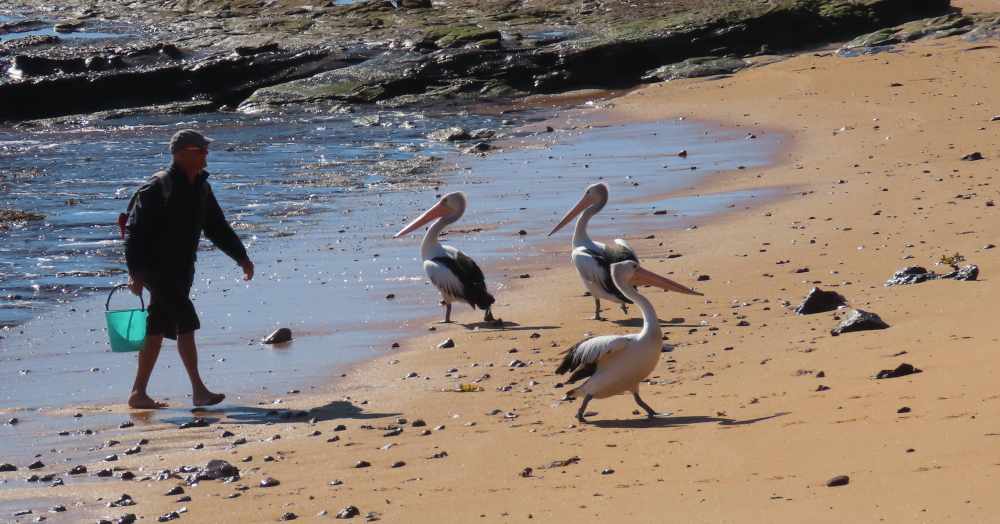
The birds weren’t too worried when I approached to take some photos.
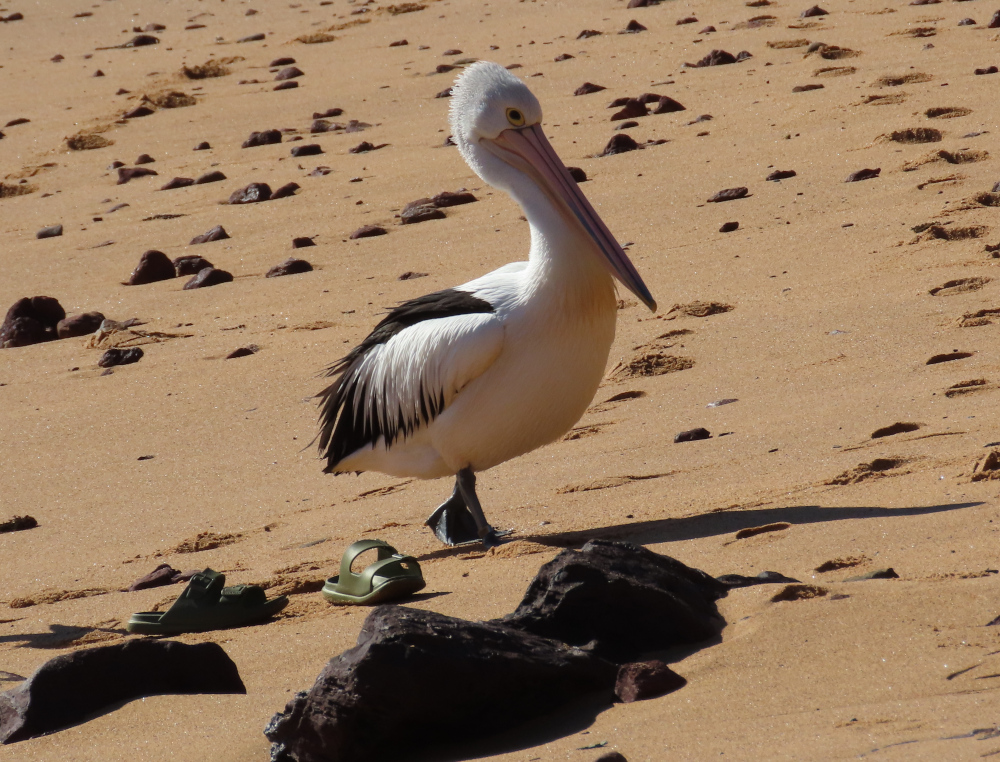
Cosying up to a pair of sandals that someone left on the beach:
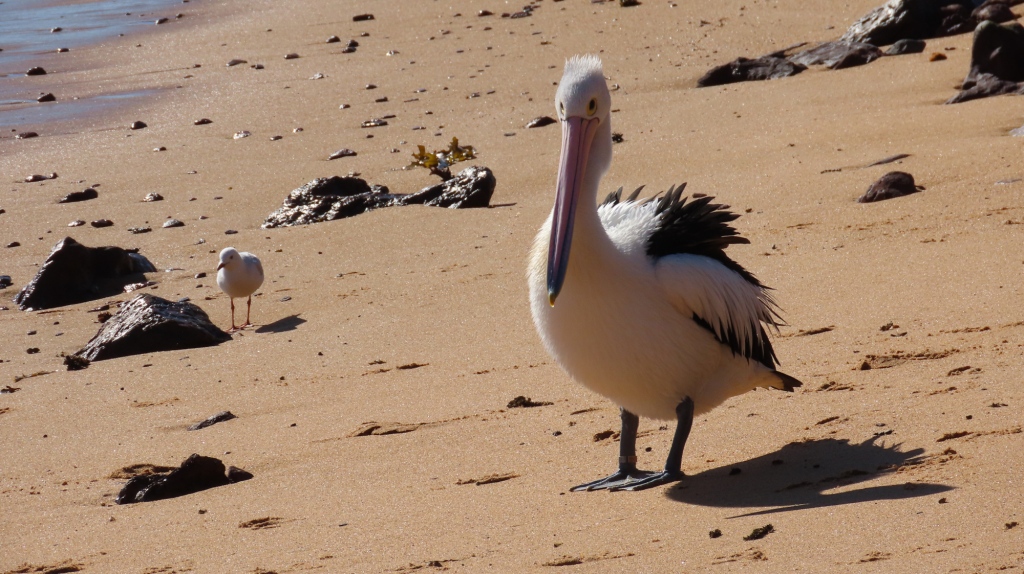
With a Silver Gull, giving some idea of scale:
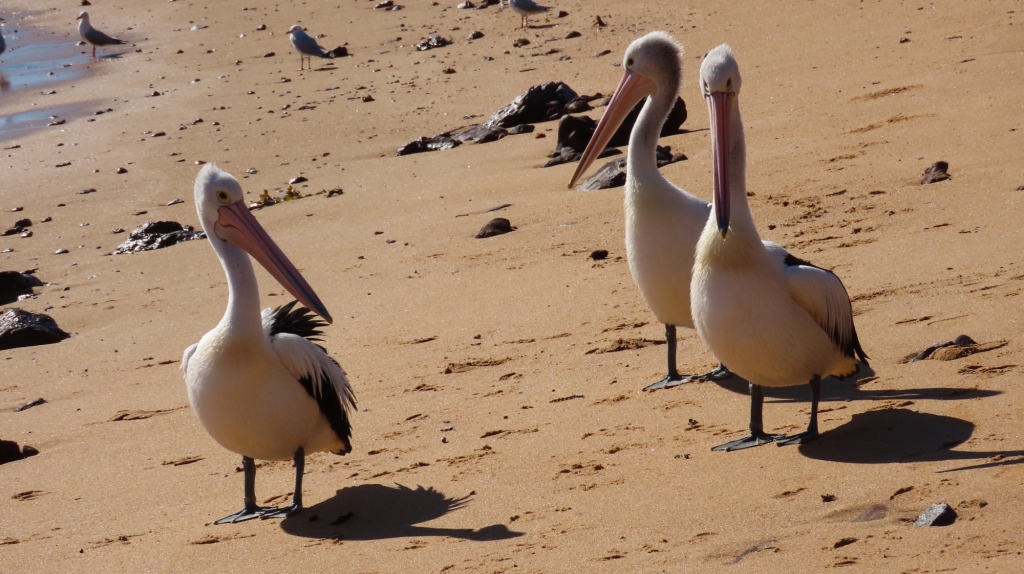
Three pelicans, three poses:
Surf as a backdrop:
A moody shot of fisherman and bird:
Common name: Australian Pelican
Scientific name: Pelecanus conspicillatus
Approximate length: 170 cm
Approximate wingspan: 2.5m
Date spotted: 19 June 2024 (winter)
Location: Long Reef Aquatic Reserve, Collaroy, New South Wales, Australia: 33°44’19.7″S 151°18’42.0″E


 Sydney Birder