Blog Archives

Mmm, Mountain Devil flowers make a nice change from those tough Banksia pods!
A Yellow-tailed Black-cockatoo contemplates life while demolishing the flower of a Mountain Devil bush.
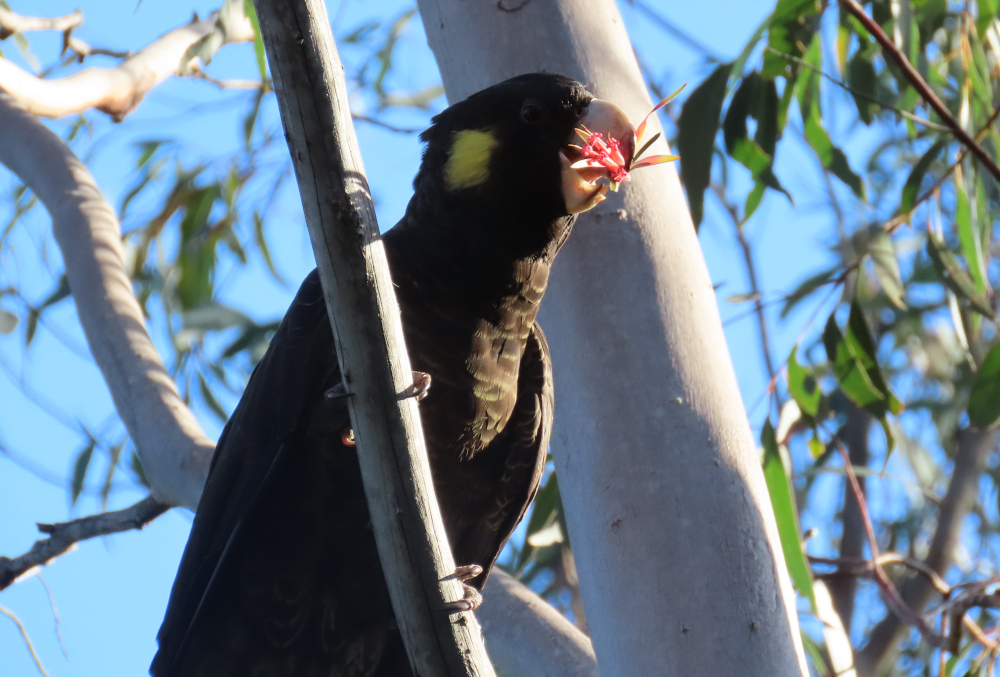
Common name: Yellow-tailed Black Cockatoo
Scientific name: Calyptorhynchus funereus or Zanda funereus
Length: 58-65 cm
Date spotted: 26 October 2024 (spring)
Location: Manly Dam Reserve, New South Wales, Australia: 33°46’40.0″S 151°14’50.2″E

Fairy-wren an early Christmas decoration
A Variegated Fairy-wren paused for a second on a tree draped with lichen. It brought to mind a Christmas scene, with the bird a bauble that adds its bright colours to the grey of the tree and the rather surreal green tinsel formed by the lichen.

Common name: Variegated Fairy-wren
Scientific name: Malurus lamberti
Approximate length: 13 cm
Date spotted: 17 October 2024 (spring)
Location: Manly Dam park, near Sydney: 33°46’23.1″S 151°14’35.9″E

What does a Darter sound like? Plus random turtles.
Darters are large water birds, a bit like cormorants. They make a weird cackling sound, a bit like a sardonic duck. And they only do it every now and then, for a short time, so you have to just be there with your camera ready if you want to record the call.
I was lucky to be looking at a kingfisher through the camera lens when a darter started cackling nearby. Here’s what I got on camera — the darter call is right at the start of the video. Also, when watching the video I noticed there are a couple of turtles on a log at bottom left of the shot, visible just as the camera starts zooming out.
Here’s the darter with its beak open. I’m not sure if it was thinking of cackling again or if something was tickling its throat. It is, after all, rather a long throat:
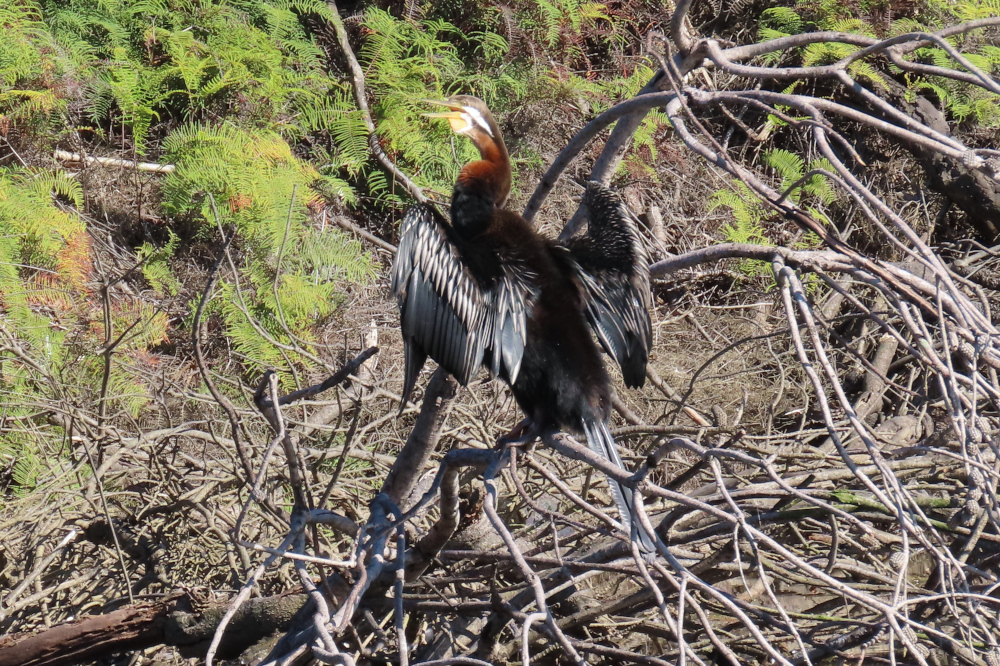
Here’s a pic showing the turtles on the log at bottom left. I didn’t know they were there until I saw the photos on a big screen. There are at least two turtles, one behind the other, and possibly a third below them:

This bird is a male, with its black neck and red throat.
Common name: Darter
Scientific name: Anhinga melanogaster
Approximate length: 90 cm; wing span: 1.2 m
Date spotted: 10 October 2024 (spring)
Location: Manly Dam Reserve, New South Wales, Australia: 33°46’34.7″S 151°14’48.9″E

Very light-coloured Grey Goshawk
This is a Grey Goshawk, but it’s a lot lighter in colour than others I’ve seen, and it doesn’t seem to have the barring on its front (though I didn’t get to see it fully front on). It was at Manly Dam in Sydney’s Northern Beaches area.
There are two colour variations in the Grey Goshawk: the white morph and the grey morph. The white morph is found in north-western Australia, Tasmania, and the Victorian coast. It isn’t known to be found near Sydney. Besides which, this bird has light grey plumage as well as white, whereas the white morph is entirely white.

Whatever the answer to the question about its colour, this is a gorgeous bird.
Common name: Grey Goshawk
Scientific name: Accipiter novaehollandiae
Approximate length: 40-55 cm. Wing span: 70-110 cm.
Date spotted: 1 October 2024 (spring)
Location: Manly Dam Reserve, New South Wales, Australia: 33°46’22.5″S 151°14’35.7″E

The tranquil parrot: Glossy-black Cockatoos
Of all the various types of cockatoos that we get in our area of Australia, the Glossy-blacks are by far the most restful to be with. When they chatter to each other, their call is a restful croon. They seem to take life easy, with few sudden moves. Watch this one going with the flow while the wind tosses her perch back and forth:
Casuarina seeds are just about the only food that Glossy-black Cockatoos eat. I usually find the birds by the comfortable munching noises that they make, rather than the noisy fuss that other types of cockatoos are fond of making!

This family of three birds has been visiting the Casuarina trees beside one of my current favourite bush walks.

I took these pictures over the period of a week.
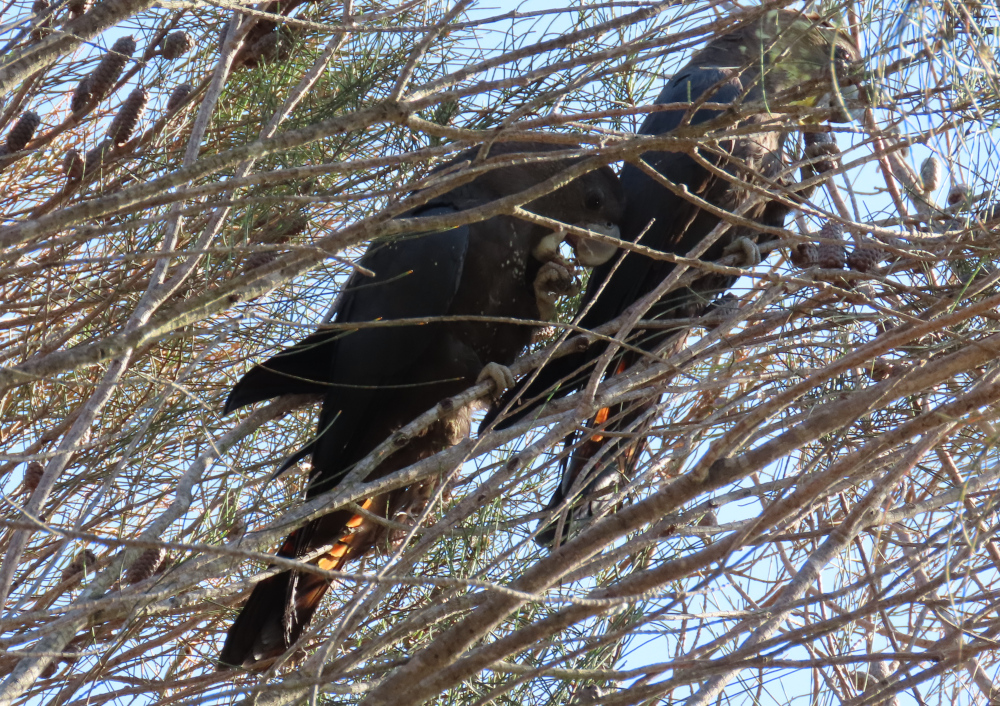
It’s interesting that I almost always see these birds in groups of three, most likely an adult male and female, and a juvenile. The bird with yellow around her head is the female of the group. I think this one is the adult male:
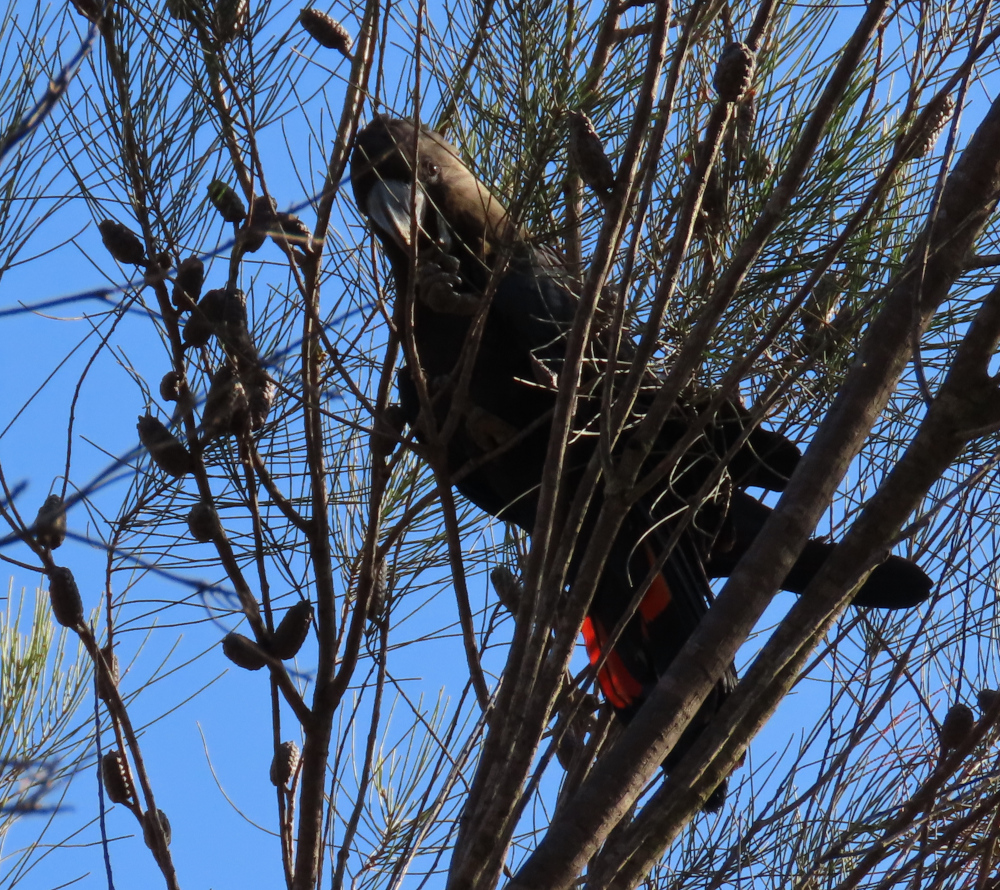
Check out some previous sightings of these gorgeous birds.
Common name: Glossy Black-Cockatoo
Scientific name: Calyptorhynchus lathami
Approximate length: 50cm
Date spotted: 23-27 September 2024 (spring)
Location: Manly Dam Park, near Sydney: 33°46’16.4″S 151°14’30.9″E

Did the big scary lizard make the Mudlarks abandon their nest?
For a few weeks now, I’ve been watching a pair of Mudlarks building their nest. In fact, they’ve built two nests. The first one looked good and solid from my vantage point, far away and down at ground level. But a couple of days after they’d finished it, they abandoned it and started a new one higher up in the same tree.
Mudlarks, also called Magpie-larks or Peewees, build neat round nests that are basically bowls made of mud. This video shows a male Mudlark collecting mud and reeds at the water’s edge. When he has a good collection, he flies off towards the nest that he and his mate are constructing. As the bird flies, a couple of Kookaburras start cackling, and one of the Mudlarks gives its distinctive call: “pee-wee pee-wee pee-wee”.
Here’s the male Mudlark on mud collection duty:

The next video shows the first nest under construction. The bird prods and pushes mud into the walls of the nest, then sits flat and wiggles its tail end to shape the nest.
As well as building walls, nest construction also involves sitting on the nest and wiggling back and forth to get the shape right:

The nest was looking good, I thought. But several days later, a decision is made. The birds abandon their first attempt and start a new nest, higher up in the same tree:
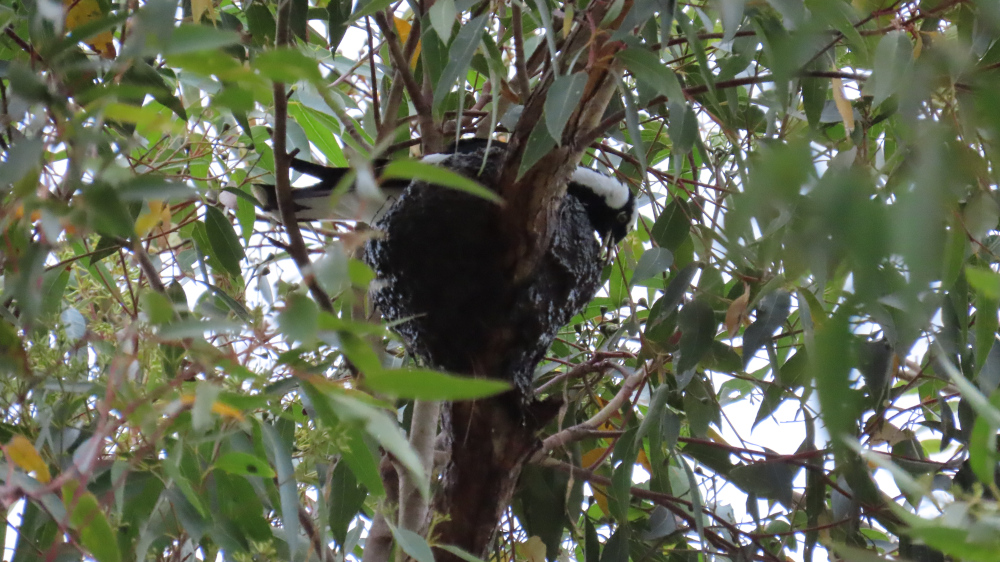
They’ve chosen a lovely spot, at the edge of Manly Dam. The next video shows one of the birds building the second nest. The second bird arrives with a beak-ful of mud, and takes over construction. The video then zooms out and in again to show the first nest on a lower branch, then zooms out further to show the dam and some of the neighbours (a Little Black Cormorant and a Great Egret).
Aside from the occasional noisy cockatoo, the neighbours are quiet for the most part — like this Great Egret:

And a few water dragons:

But the park does get quite busy over the weekend. Families hold picnics nearby, and children paddle in canoes. Perhaps the birds moved higher to avoid the weekend disturbance.
Perhaps the first nest didn’t meet quality assurance checks. Or perhaps the two parents-to-be spotted the large, scary intruder in the neighbourhood: a Lace Monitor lizard. I took this video of the lizard prowling around the tree where both nests are. Lace Monitors eat eggs and baby birds, and are very good at climbing trees. The Mudlarks’ second nest is higher in the tree and on thinner branches, which would make it much more difficult for the lizard to reach.
Lace Monitors are the second-largest lizards in Australia. They measure 1.5 to 2 metres long — longer than I am tall, and their hands are as big as mine! Here’s a close-up of the Lace Monitor on the move:
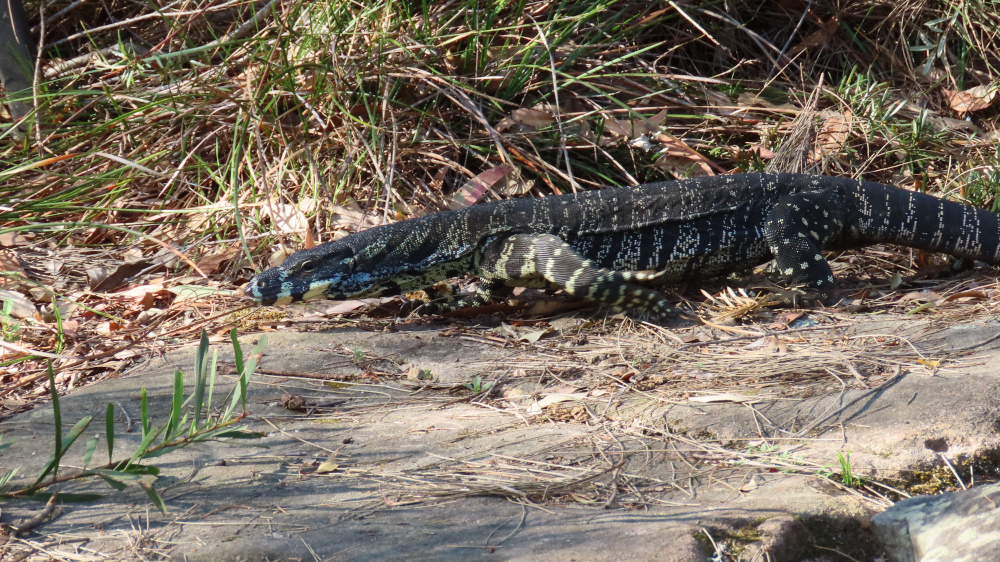
When I got too close with my camera, the lizard crouched down and went into stealth mode:

The Mudlarks are still sitting happily on their new nest. Here’s the male:

And here’s the female:
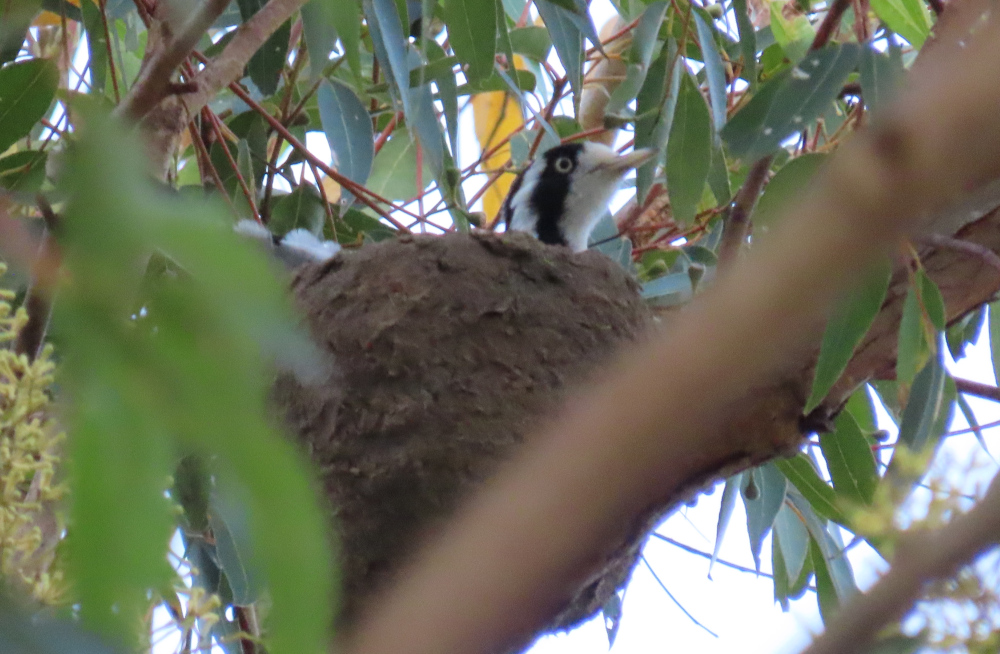
Good luck to them and their new family!
Common name: Magpie-lark, also called a Peewee or a Mudlark
Scientific name: Grallina cyanoleuca
Approximate length: 30 cm
Date spotted: August to September 2024 (summer)
Location: Manly Dam National Park, New South Wales, Australia

Those dinosaur birds are back for the summer: Channel-billed Cuckoos
Channel-billed Cuckoos are large, strange-looking birds with red eyes, a large canoe-shaped beak, and a strangely apologetic way of moving around. These cuckoos migrate to Australia’s south-eastern coast in the warmer months, and they’ve just arrived for this year’s summer.

When provoked, Channel-billed Cuckoo’s make a reptilian hissing noise. With their red eyes and fierce beaks, and the prehistoric way that they move, they remind me that their ancestors were dinosaurs.

Like many other cuckoos, these birds lay their eggs in the nests of other birds, such as Currawongs, and leave the raising of their chicks to the adoptive parents.
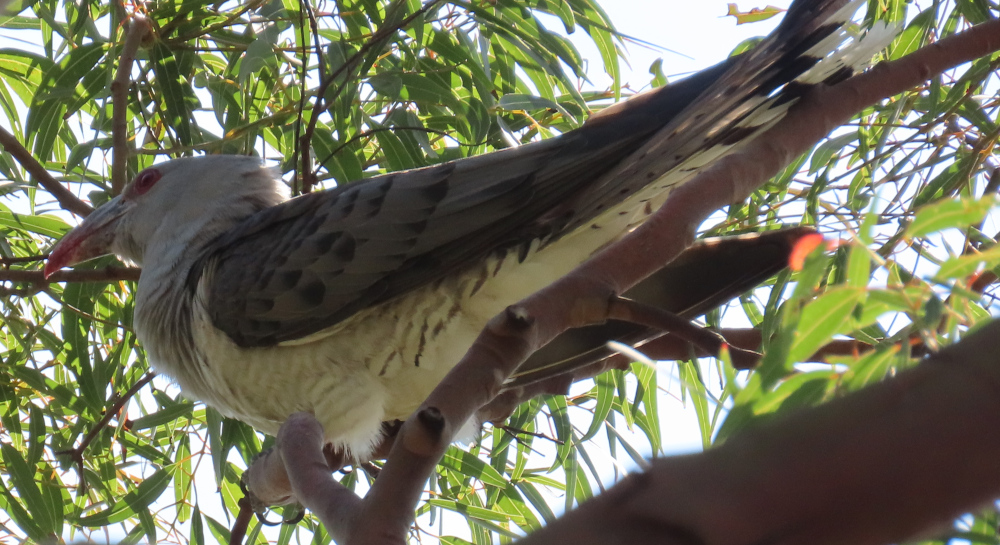
A Channel-billed Cuckoo’s life is not a peaceful one. Several other species do their best to chase the cuckoos out of the neighbourhood, to prevent them from hi-jacking nests. In this video, the cuckoo ducks the persistent swooping of Noisy Miners (hint: set the video quality to high definition for best viewing):
You can find out more about these birds in my other posts about cuckoos.
Common name: Channel-billed Cuckoo
Scientific name: Scythrops novaehollandiae
Approximate length: 58-65 cm
Date spotted: 22 September 2024 (spring)
Location: Allambie Heights, New South Wales, Australia

My first Black-fronted Dotterels
Wandering the paths of Manly Dam reserve a couple of days ago, I met a fellow birdwatcher. He showed me some pictures of a bird that he’d seen, and asked me if I knew what it was. I didn’t, which of course was gratifying to both of us. Something new! I wandered along to the rocks where he’d seen the bird. Sure enough, two pretty little waterbirds dashed back and forth along the water’s edge, poking their beaks into the green sludge on the rocks. I managed to photograph one of them (though I’m not sure it’s always the same bird in these photos).

I wondered if it was some type of stilt, but the beak and legs weren’t long enough. My fellow birdwatcher had suggested it was a juvenile plover.

The bird had a distinctive V-shaped black marking on its chest.
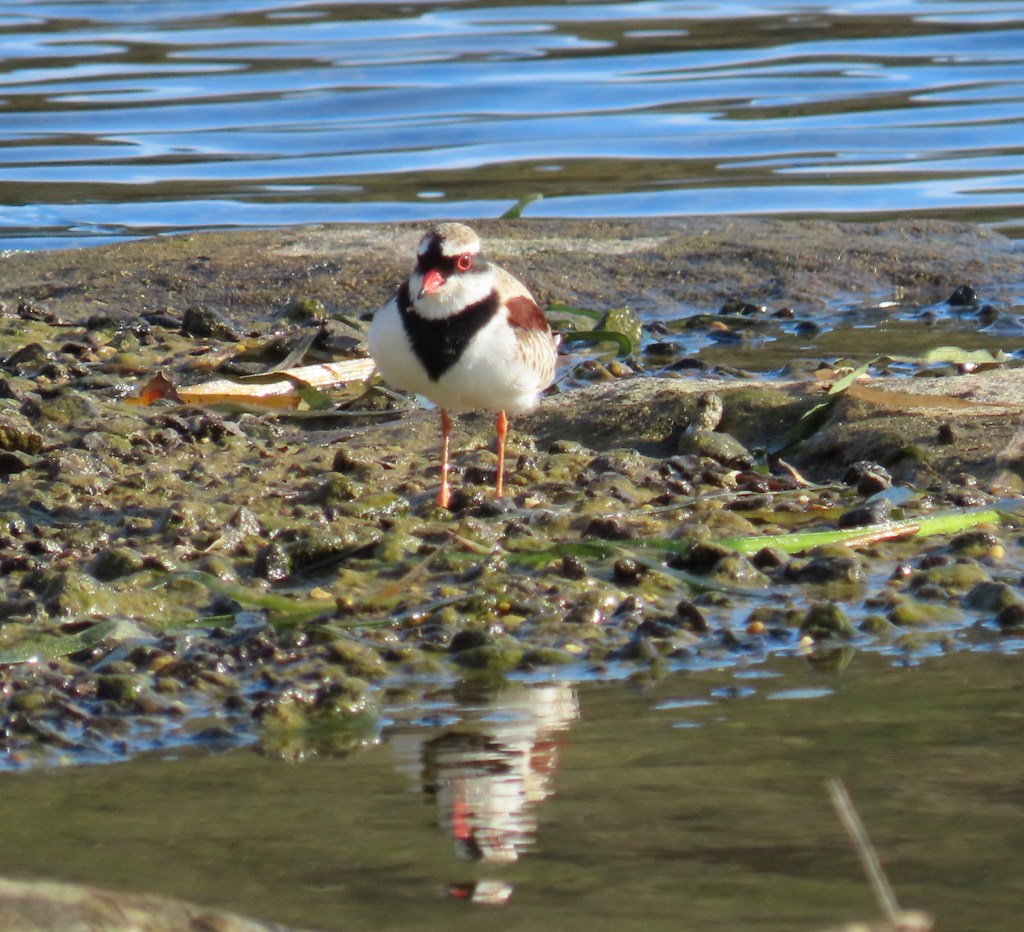
Consultation of my bird book revealed that these are Black-fronted Dotterels. They’re a type of plover. I heard them make their call, a series of short pips. Evidently they’re common and widespread, though I’ve not seen them in my area before.
Common name: Black-fronted Dotterel
Scientific name: Charadrius (Elseyornis) melanops
Approximate length: 16-18 cm
Date spotted: 22 September 2024 (spring)
Location: Manly Dam Park, New South Wales, Australia: 33°46’31.1″S 151°14’47.9″E

Pretty yellow robin
An Eastern Yellow Robin paused for a few seconds on a nearby branch. I grabbed the chance to take a snap:

Common name: Eastern Yellow Robin
Scientific name: Eopsaltria australis
Approximate length: 15 cm
Date spotted: 17 September 2024 (spring)
Location: Manly Dam National Park, New South Wales, Australia: 33°46’23.8″S 151°14’39.8″E

Masleep! Or, sleepy Pelican contortions
Early this morning, a pelican dozed on the banks of Manly Dam:

I’ve never seen a pelican asleep before. It looked a bit weird and back-to-front.

At one stage, the pelican decided a yawn was in order:
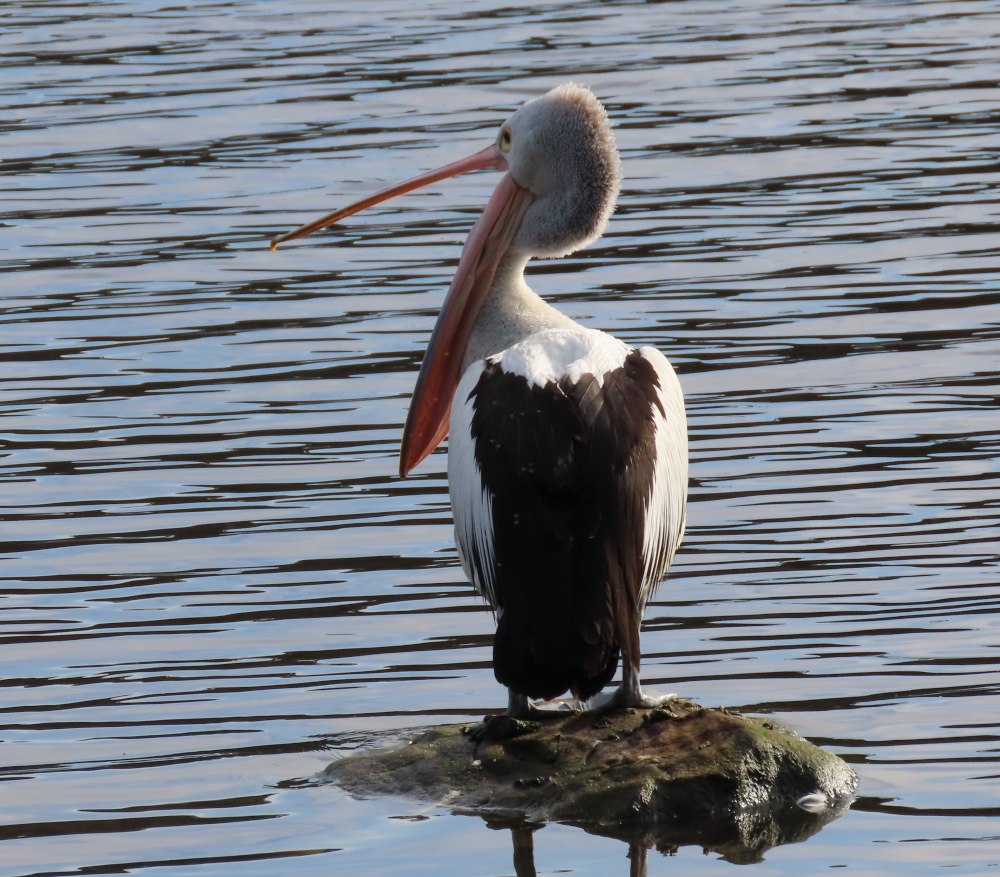
That pesky pouch beneath its beak got a bit tangled and inside-out:

Once that mess was sorted, the pelican manoeuvred its beak sideways onto its back:

With the beak nicely pointed straight down its back, the bird folded its wings over the beak. A bit like a bat, but the right way up!

Optimal sleeping position achieved:

Here’s the same bird, awake and looking as well put together as a pelican can:

It’s not often that you see a pelican at Manly Dam. I’m pretty sure this is a first for me, though I’ve seen them often on the beaches around Sydney.
Common name: Australian Pelican
Scientific name: Pelecanus conspicillatus
Approximate length: 170 cm
Approximate wingspan: 2.5m
Date spotted: 9 September 2024 (spring)
Location: Manly Dam Park, New South Wales, Australia: 33°46’31.2″S 151°14’46.6″E


 Sydney Birder