Blog Archives
Glossy Black-Cockatoos near Sydney
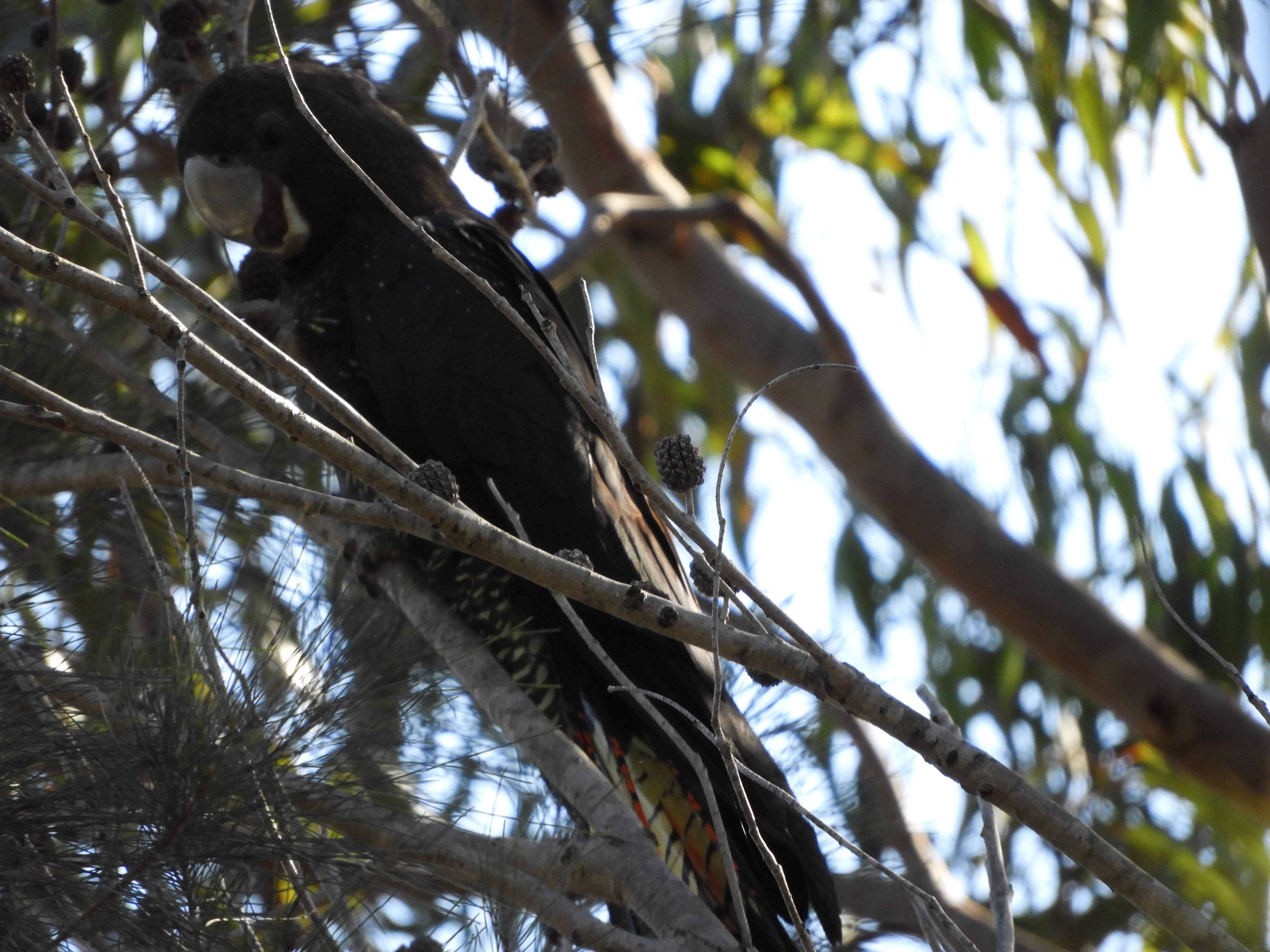
Update on 9 October 2019: The birds are Glossy Black-Cockatoos, not Red-tailed Black-Cockatoos. Thank you to Carol Probets for pointing this out in a comment on the post.
Today I heard an unusual bird call – a kind of heavy, high-pitched whirring noise. I followed it down the path and saw two large black cockatoos. They flew off when I arrived, and landed again a few trees further on, chattering to each other.
I’ve seen Glossy Black-Cockatoos in the same area once or twice (see my posts). Today’s birds were larger, I thought, and seemed to have larger crests than the others I’d seen. At first, this led me to think they were Red-tailed Black-Cockatoos, but it turns out they were Glossies.
Here’s the only picture I managed to get. (The birds were much more timid than the Yellow-tailed Black-Cockatoos that are more common in our area.) This is the female of the pair, so her tail has yellow/orange panels rather than red:
Common name: Glossy Black-Cockatoo
Scientific name: Calyptorhynchus lathami
Approximate length: 50cm
Date spotted: 18 August 2019 (late winter)
Location: Manly Dam National Reserve, near Sydney: 33°46’47.3″S 151°15’03.3″E
Hanging out with an Australian Magpie
It’s early August, and spring is in the air. The weather is chilly but bright and clear. Birds have started collecting twigs and putting their best feather forward. And I’ve been having some interesting encounters with a magpie.

Spring in Australia is the season for magpie attacks, so I was a little wary when an Australian Magpie zoomed past my ear a couple of days ago. I was going down the steps outside the house. The bird decided it needed to be on the narrow patch of earth between the steps and a hibiscus bush, which was more or less where I happened to be too.
The magpie missed me by a very narrow margin, landed on the ground, and eyed me. Then it started trying to pull up one of the long, thin roots of the fishbone ferns that dominate that part of our garden.
Tug, tug, tuuuuug…
Let go in a hurry to avoid falling over when the root refuses to yield.
Try again. Tug, tug, tuuug,…
Almost fall over backwards. Embarrassing.
Try again…
So, being me, I started chatting to the magpie. “That’s not gonna work, mate,” and that kind of thing. It stopped tugging, looked at me, then went back to tugging. So I went closer. No worries, bird kept on tugging. Closer. Still no worries. Eventually I sat down on a step two feet away from the bird. I leaned over and tugged out a root (easy when you’re big and have hands) then held the root out towards the bird. To my surprise, the magpie took it from my hand and flew off with it!
The same bird came back a few hours later and we did the same thing all over again. And again the next day. During our third encounter, the bird accepted two thin roots from me. When I tried to offer a thicker root, the bird rejected it with disdain. Twice. Picky.
I took this video during that third encounter. I was using my phone to make the video, so bear with me when the picture moves away from the bird while I lean in to grab a root!
Yesterday I was hanging up the washing when the magpie appeared. I went down the steps and sat down for our usual chat. The magpie hopped up onto the step I was sitting on, then hopped up all the other steps one by one, just taking in the time of day, giving me the opportunity to follow it. Which of course I did. We hung out while I hung up the washing. Getting the hang of each other. 😀
(What’s that song? Sing a song of sixpence… The maid was in the garden, hanging out the clothes, when down came a blackbird, and pecked off her nose!)
Flying with a forked twig is tricky, thinks this Australian Raven
Flying with a forked twig must be tricky. Especially if you’re flying through a forest of gum trees.
It’s early spring, and some birds have started building nests. I watched this Australian Raven and its partner pick up twigs and carry them away to their nest high in the trees. Then one of the birds found two perfect twigs. The only problem was that the twigs were attached together.
Hmm, let’s see. I could snip off one half with this great big beak of mine. Nup, that didn’t work.
Maybe if I hold it this way… Nup, tree-entanglement potential too high.
If I stand on one half, the other half should break off. Nup, too green.
OK, this is just taking too long. Plus, it’s annoying.
Grab it in the middle. I’m off.
Common name: Australian Raven
Scientific name: Corvus coronoides
Approximate length: 50 cm
Date spotted: 3 August 2019
Season: Winter
Location: Manly Dam Reserve, New South Wales, Australia: 33°46’15.6″S 151°14’48.9″E
Kookaburra in a mess after hollowing out termite nest
“Don’t look at me! I’m a mess.
Been hard at work hollowing out a termite nest.”
That’s what this kookaburra seems to be saying:

“What, you don’t think termite gunge is the right look for me?”

“OK then. Here’s what I’ve been doing for the last half hour:”
“That’s a big termite nest, high up in a tall tree.
And soon it’ll be a home for my family and me:”

Common name: Laughing Kookaburra
Scientific name: Dacelo novaeguineae
Approximate length: 47 cm
Date spotted: 28 July 2019 (Winter)
Location: Manly Dam National Park, New South Wales, Australia: 33°46’48.1″S 151°14’52.5″E
Not all robins have red breasts
The Eastern Yellow Robin is a reasonably common sight in the bush around Sydney, Australia. This one was perched on a twig in a marshy area around a creek:

Common name: Eastern Yellow Robin
Scientific name: Eopsaltria australis
Approximate length: 15 cm
Date spotted: 22 July 2019 (Winter)
Location: Manly Dam National Park, New South Wales, Australia: 33°46’24.2″S 151°15’05.8″E
Who said a Pardalote isn’t a dinosaur?
Well, I guess maybe nobody has ever said “a Pardalote isn’t a dinosaur”. I mean, why would you? Still, this little Pardalote’s plucky pose made me think of a dinosaur in a Spielberg movie. At the very least, it was considering auditioning for the role:

Although they’re only 10 centimetres tall, Spotted Pardalotes don’t seem to be daunted by huge creatures like me standing close by. This one was on a twig a few metres away, singing its heart out with a pause to grab a bite to eat:
It seemed to find me as interesting as I found it:
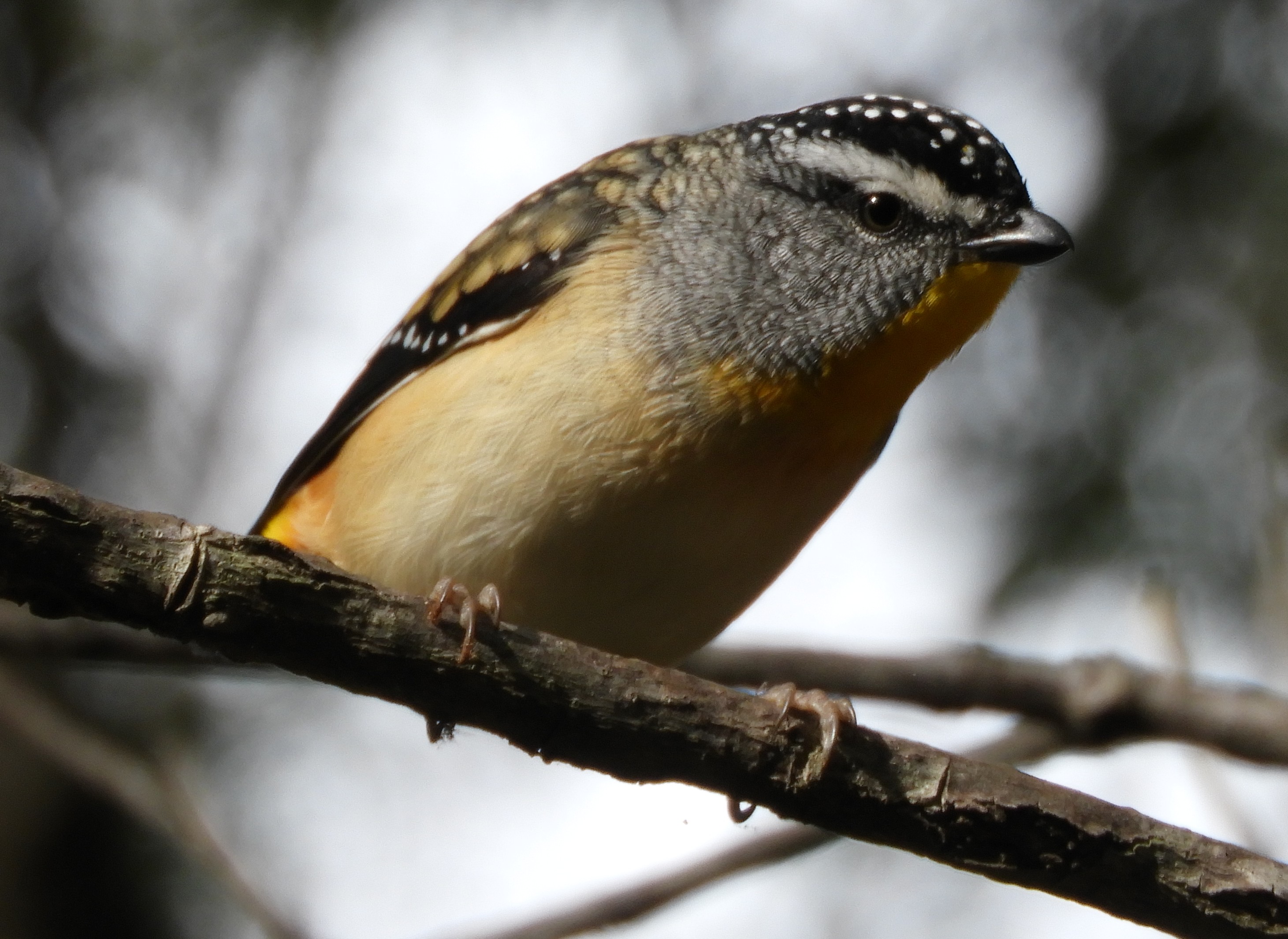
Did any dinosaur ever catch the sun as prettily as this?

Common name: Spotted Pardalote
Scientific name: Pardalotus punctatus
Approximate length: 10 cm
Date spotted: 22 July 2019 (Winter)
Location: Manly Dam National Park, New South Wales, Australia: 33°46’24.4″S 151°15’03.6″E
Hybrid Spotted Turtle-Dove with Crested Pigeon?
Today I spotted a couple of interlopers in an area that’s the regular hangout for a group of Crested Pigeons. One of the interlopers looks like a regular Spotted Turtle-Dove. Here’s a Crested Pigeon on the left and the interloper on the right:

But nearby, on the same wire, is this rather interesting individual:

The bird looks like a Spotted Turtle-Dove but has a bit of feathery decoration on its head. Could it be a cross-breeding of a Spotted Turtle-Dove with a Crested Pigeon? Or is it just a Spotted Turtle-Dove having a bad hair day?
Here’s another pic of the same Crested Pigeon as in the first photo:

Crested Pigeons are native to Australia. When they take off, you hear the distinctive whistling noise from their wings that is characteristic of many pigeon types. When I first saw these birds, I thought how typical it is that even the common pigeons in Australia are different from those I’ve seen in other part of the world.
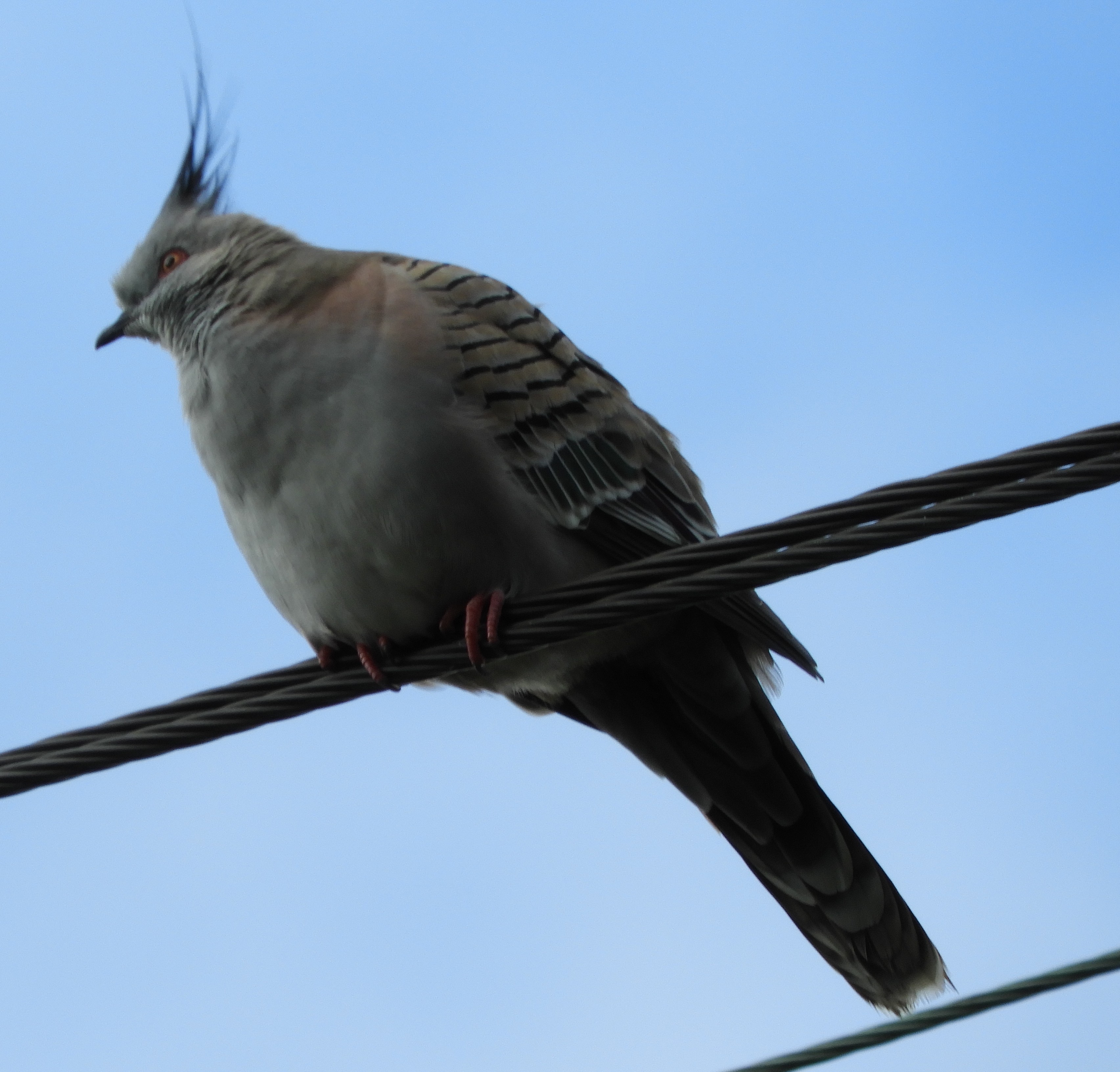
The group of birds later moved down to forage on the ground. Here’s one of the Crested Pigeons:

There was only one bird that looked like a Spotted Turtle-Dove with a vestigial crest. Here’s another pic of the same bird:
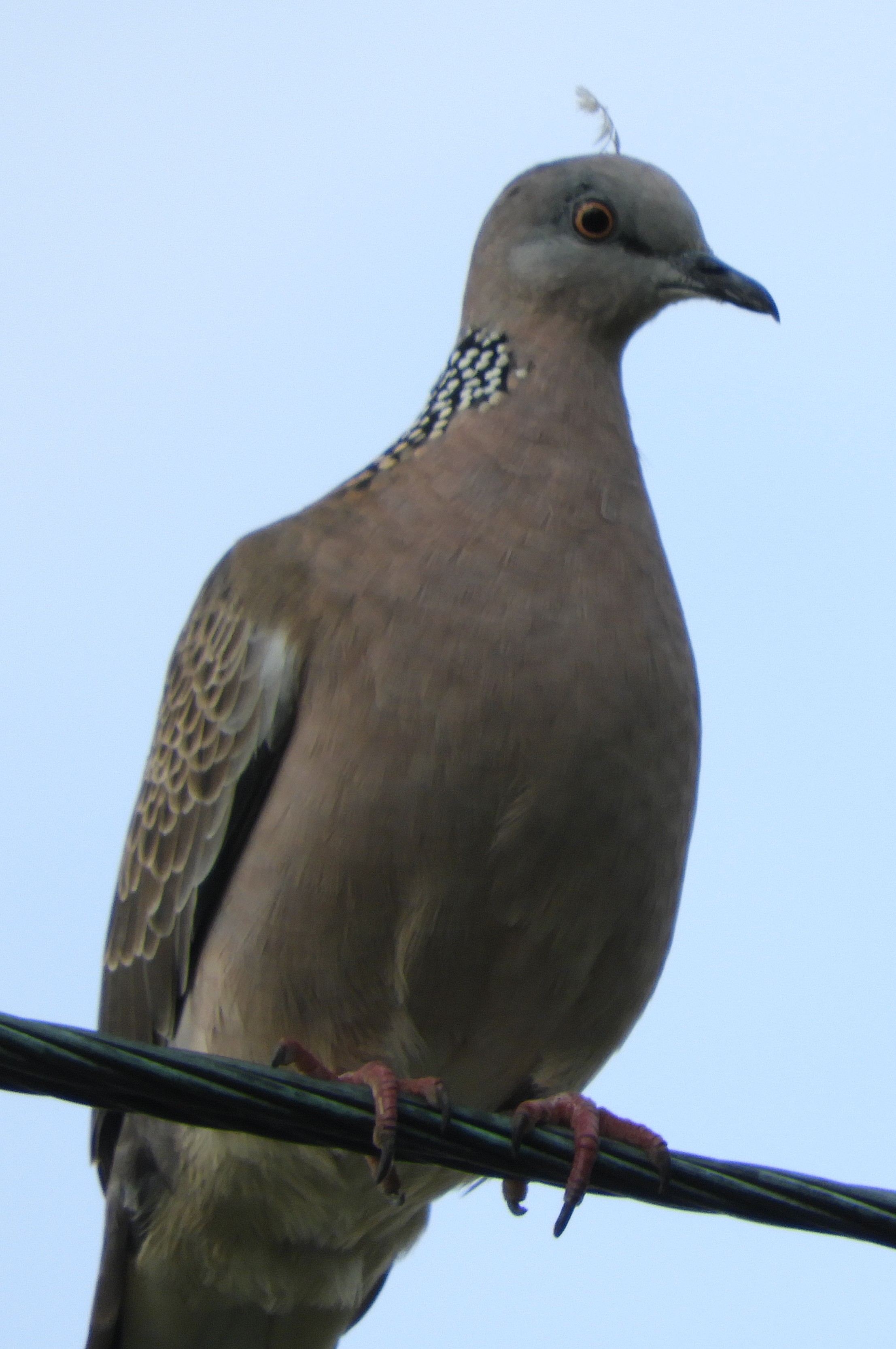
Spotted Turtle-Doves are not native to Australia. They were introduced in the late 1800s, and are seen as a pest in some regions of the country.
Pigeon or dove? The names “Crested Pigeon” and “Spotted Turtle-Dove” led me to wondering, not for the first time, what the difference is between a pigeon and a dove. I’ve asked various people over the years. Some say doves are white whereas pigeons are not. Other say that doves are smaller than pigeons. According to much of the internet, the two terms are interchangeable.
Here’s another view of the same bird with the miniscule crest (or perhaps it’s just a feather expressing its individual identity):

A wink, almost as if the bird knows that it’s presented me with a puzzle:

Spotted Turtle-Dove | Scientific name: Streptopelia chinensis | Approximate length: 30-32 cm
Crested Pigeon | Scientific name: Ocyphaps lophotes | Approximate length: 31-35 cm
Date spotted: 5 July 2019 (Winter)
Location: Allambie Heights, New South Wales, Australia
Little Corella sipping water from roof guttering
From a distance, Little Corellas look very similar to Sulphur-crested Cockatoos. It’s only when you get up close that you notice the differences. Corellas do have a crest on their heads, but it’s smaller than that of their sulphur-crested cousins and doesn’t have a yellow flare.
Up until a few months ago, it was unusual to see these birds in our neighbourhood on the east coast of Australia, but I’ve seen them three or four times recently. I filmed this one sipping water from the gutter on the roof of a house:
Little Corellas have big, rubbery-looking blue patches around and under their eyes. The first time I saw one of these birds, for a couple of seconds I thought it was a very sick Sulphur-crested Cockatoo!
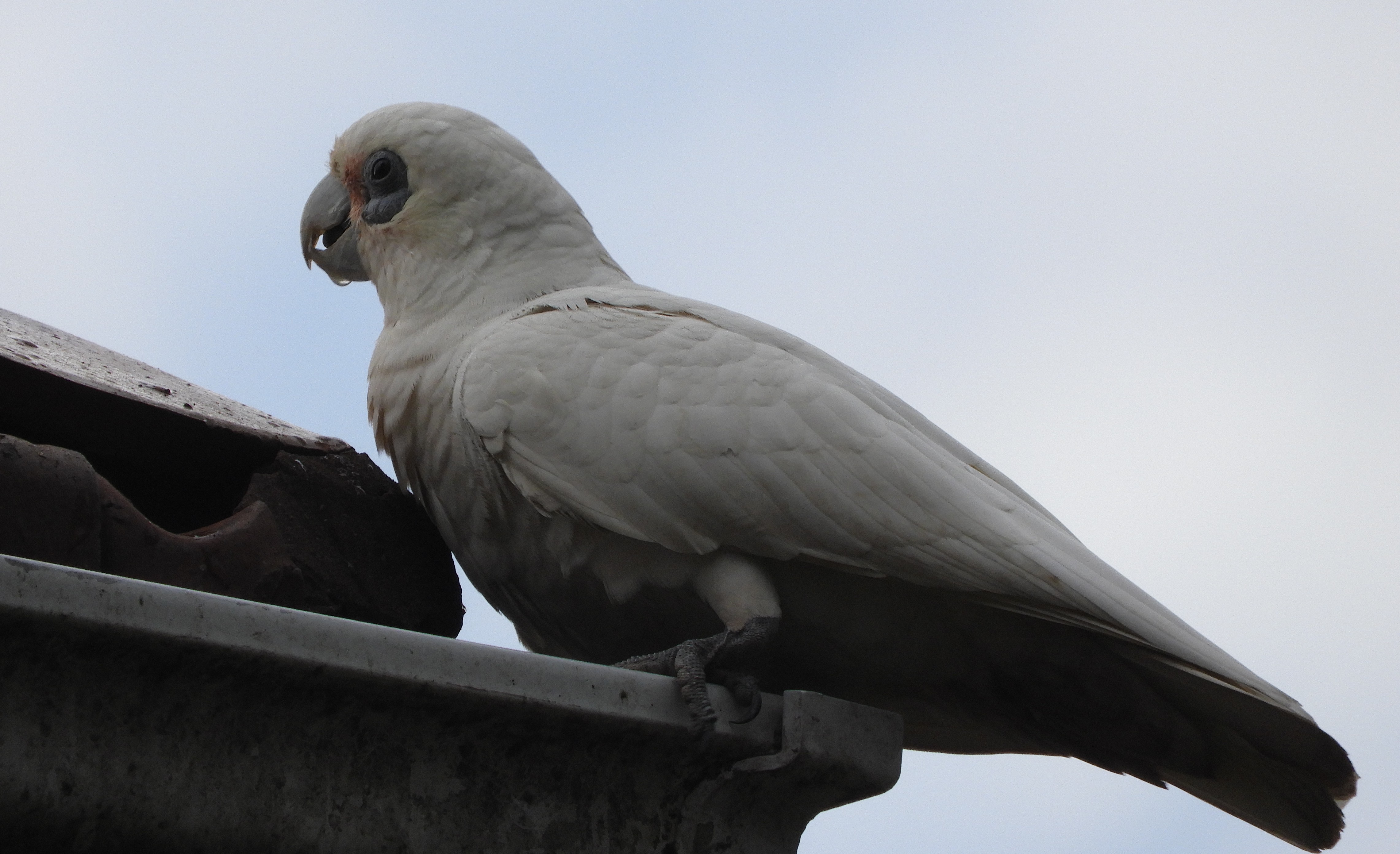
Often the crests on their heads are laid flat, as in the above photo. Here’s one with a raised crest, giving it that typically cheeky cockatoo look:

I’m delighted to add this bird to my posts about the various types of cockatoo that I’ve seen in our neighbourhood.
Common name: Little Corella
Scientific name: Cacatua sanguinea
Approximate length: 36-39 cm
Date spotted: 26 May 2019 (Autumn)
Location: Allambie Heights near Sydney, Australia
Crested Tern chilling out in Curl Curl
Amongst the wheeling Silver Gulls, joggers, and fishermen, a Crested Tern stood gazing over the rocks and sea.

I was walking along the cliff path when I passed the bird. Fifteen minutes later I was on my way back. The bird was still there. This picture shows the crest from which the bird’s name comes:
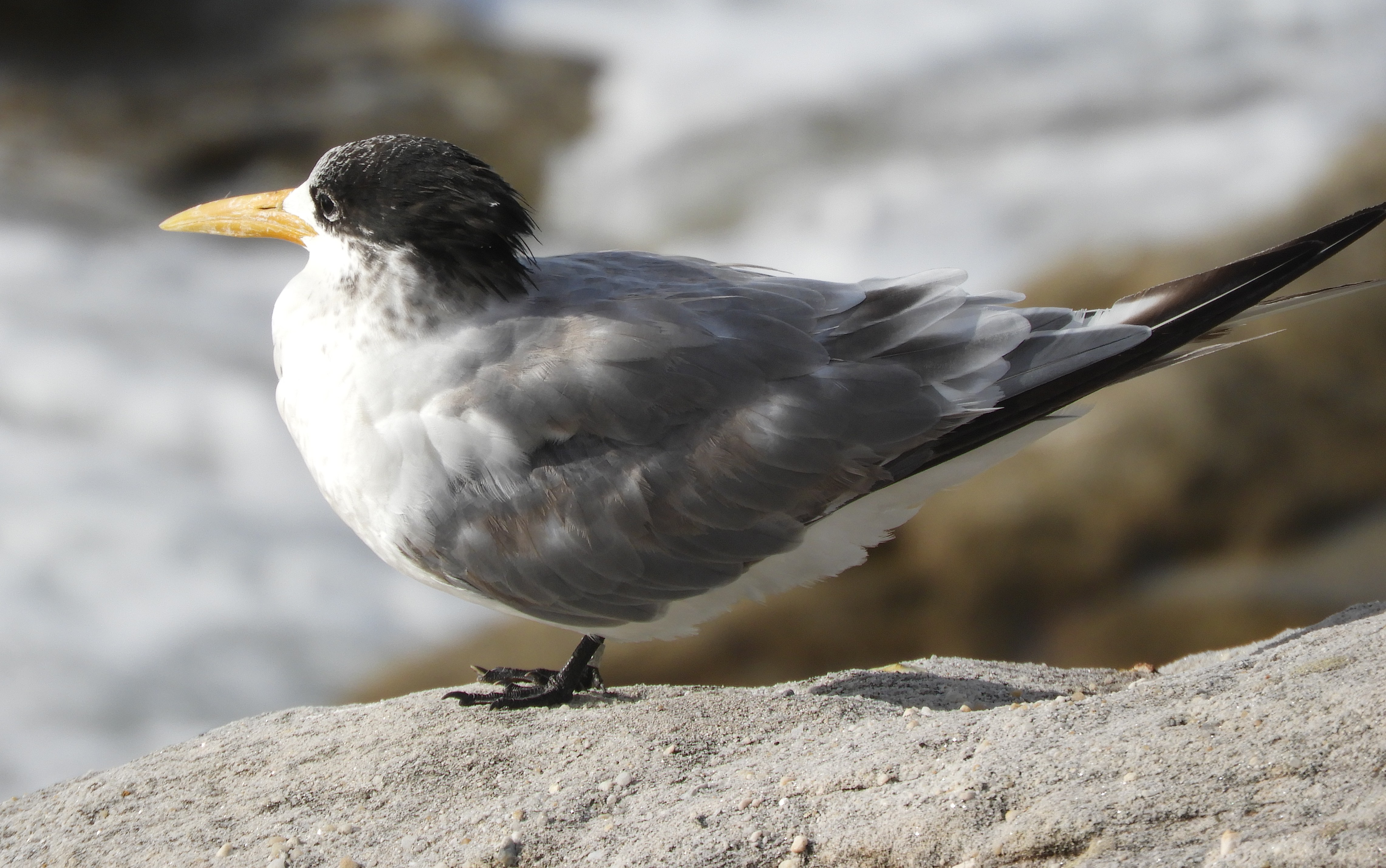
Crested Terns are a common sight around the shores of Australia. You may see them sitting on the sand with the gulls, or darting over the waves and diving to catch a fish. These are the seas and cliffs of Curl Curl where the bird and I were chilling out:

Common name: Crested Tern
Scientific name: Sterna bergii
Approximate length: 45 cm
Date spotted: 22 April 2019 (Autumn)
Location: Curl Curl, New South Wales, Australia: 33°46’36.9″S 151°17’36.8″E
Little Black Cormorant catching the sun
I went for a late afternoon walk near Spit Bridge today, and saw this Little Black Cormorant catching the last of the sun:
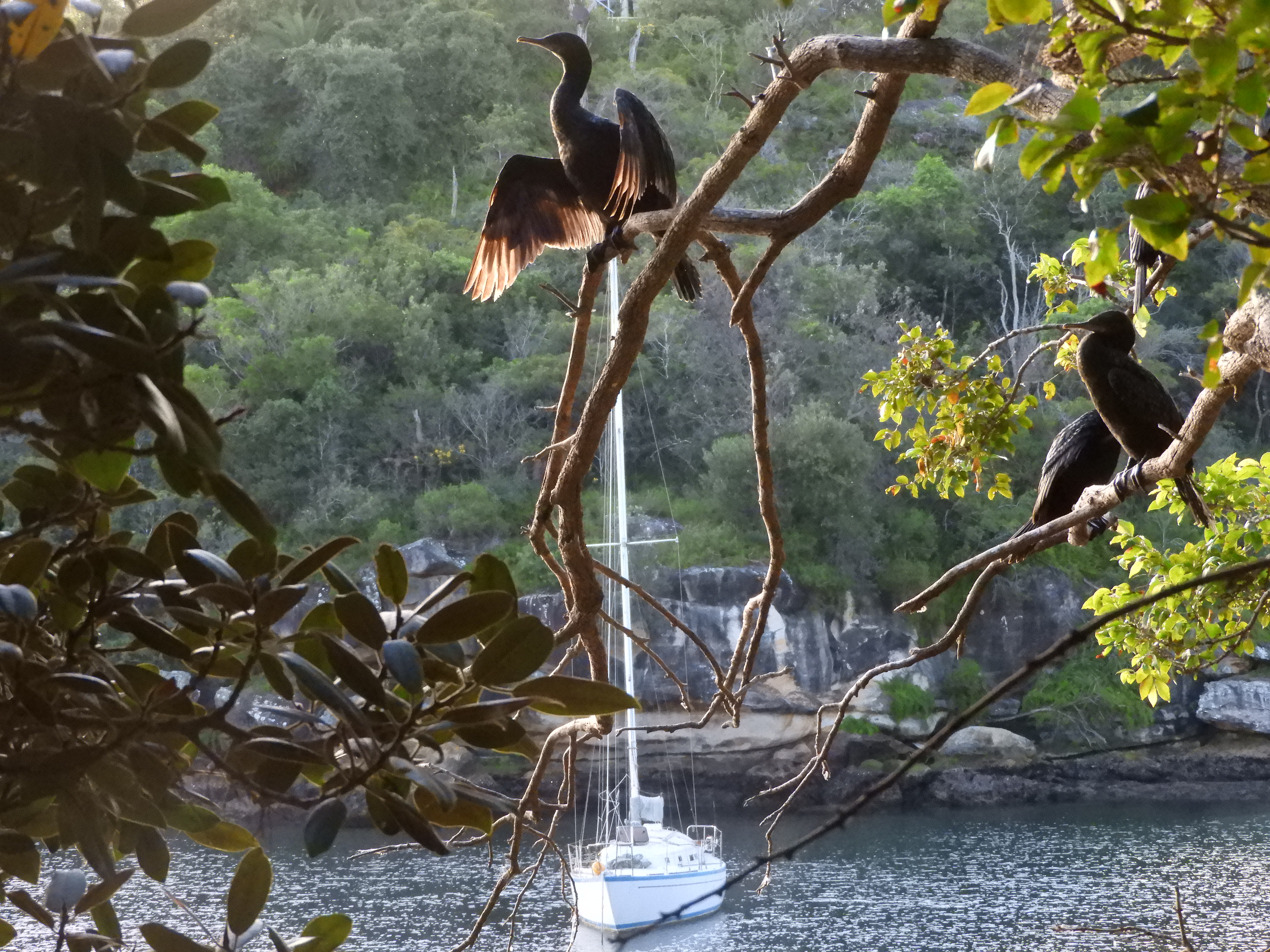
In the next photo you can see the bird’s webbed feet nicely. Cormorants are very fast and agile under water, where they catch their prey. Their feathers are not waterproof, which is why they spend so much time with their wings spread out to dry.
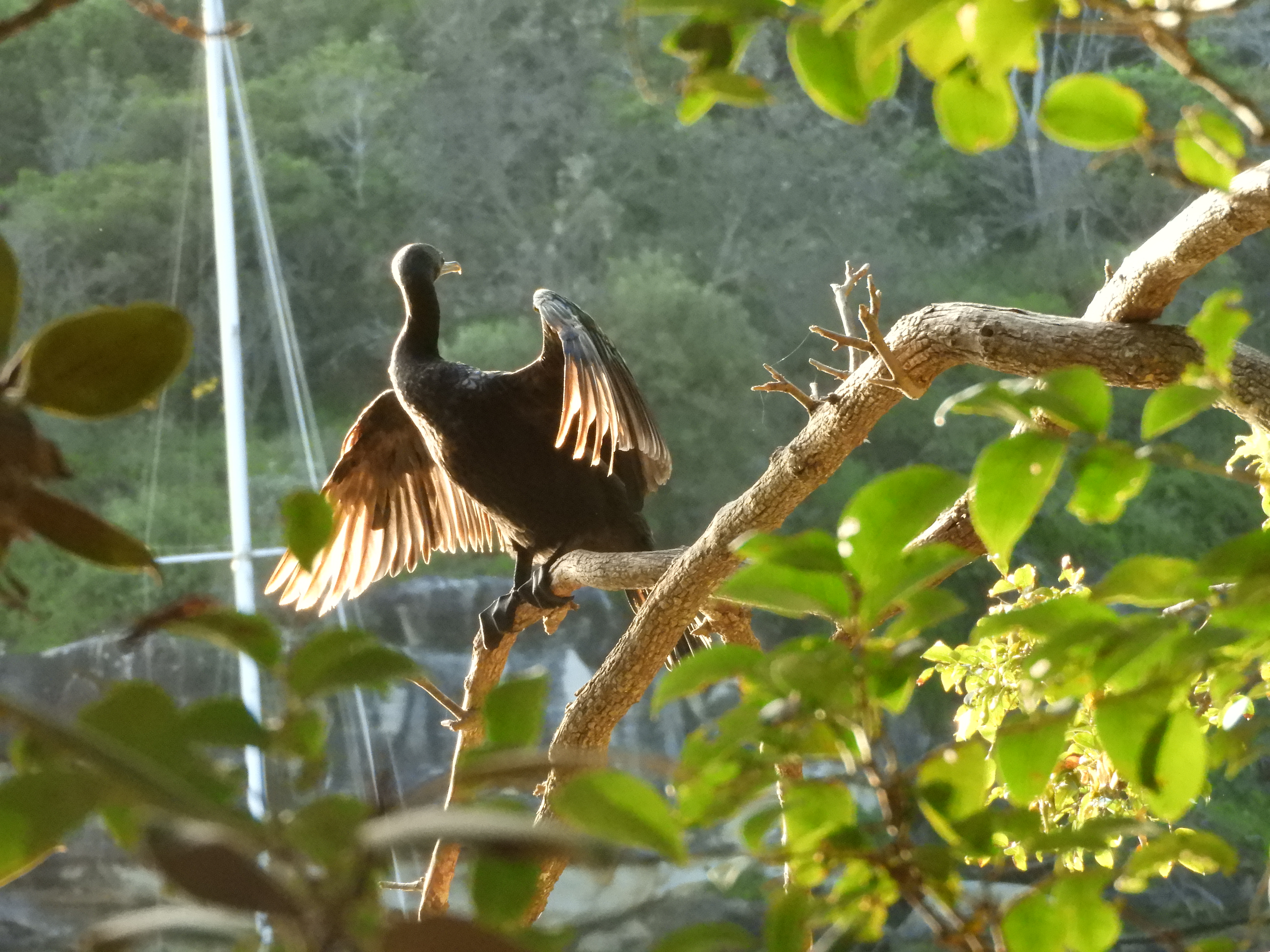
Common name: Little Black Cormorant (see other cormorants)
Scientific name: Phalacrocorax sulcirostris
Approximate length: 65 cm
Date spotted: 20 April 2019 (Autumn)
Location: Near Middle Harbour, Clontarf, New South Wales, Australia: 33°48’07.8″S 151°15’00.2″E


