Blog Archives
Laughing Kookaburras with a drop-in Australian Raven
As I was crossing the dam wall at Manly Dam, a couple of Laughing Kookaburras landed on the railing a few metres away and started cackling. I managed to get my camera out in time to recorded some of their song. (That’s unusual, because most kookaburras stop and look at you when you stop and look at them!)
A few seconds into their song, an Australian Raven appeared as if from nowhere and landed on one side of the kookaburras. They seemed annoyed. Then the raven hopped into the air above the kookaburras. It’s funny to see the kookies stretch their necks upwards to keep the raven in view. The raven, ever annoying, then landed on the opposite side of the kookies. At that stage, the kookies decided enough was enough, and flew away.
Laughing Kookaburra (Dacelo novaeguineae) — approximate length: 47 cm
Australian Raven (Corvus coronoides) — approximate length: 50 cm
Date spotted: 13 August 2022 (winter)
Location: Manly Dam Park, New South Wales, Australia: 33°46’53.9″S 151°15’20.2″E
Pretty Silvereye
Silvereyes are tiny birds (about 11cm from beak to tail) that flit around the scrub, chirping and twittering merrily. Their colouring is muted but lovely, with a soft olive head and wings, a white front, and a chestnut blush on each side. And of course, the silver ring around the eyes that gives them their name.
Unfortunately, a twig got in the way of my photo. Still, you can get a good idea of this pretty little bird:
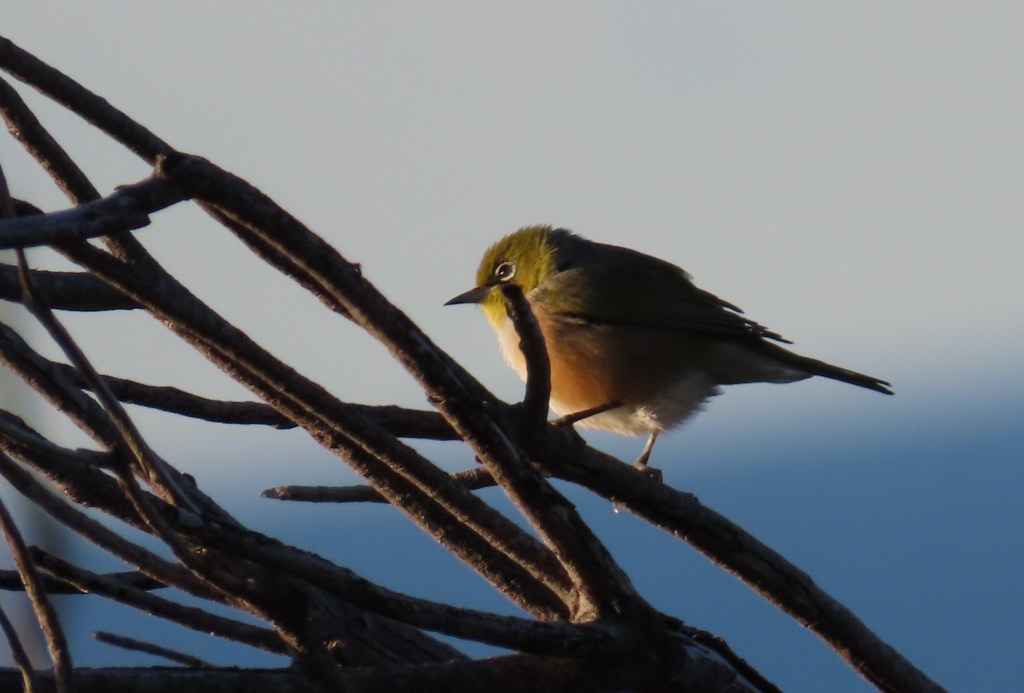
Common name: Silvereye
Scientific name: Zosterops cornwalli
Approximate length: 11 cm
Date spotted: 6 August 2022 (winter)
Location: Dobroyd Head, New South Wales, Australia: 33°48’35.4″S 151°16’19.3″E

Scarlet Honeyeater at Dobroyd Head
A little Scarlet Honeyeater adds a dash of colour to a wintry day:
It’s interesting that the bird was focusing on the Red Spider Flowers (Grevillea). Perhaps it’s not a crazy idea to be bright red in colour if you spend your time among red flowers! I’ve read that these birds also frequent Bottlebrush shrubs (Callistemon) which are also red.
This is only my second sighting of a Scarlet Honeyeater. They’re small and move fast, which makes it hard to get a good shot. Here’s still photo of the same bird, a male:
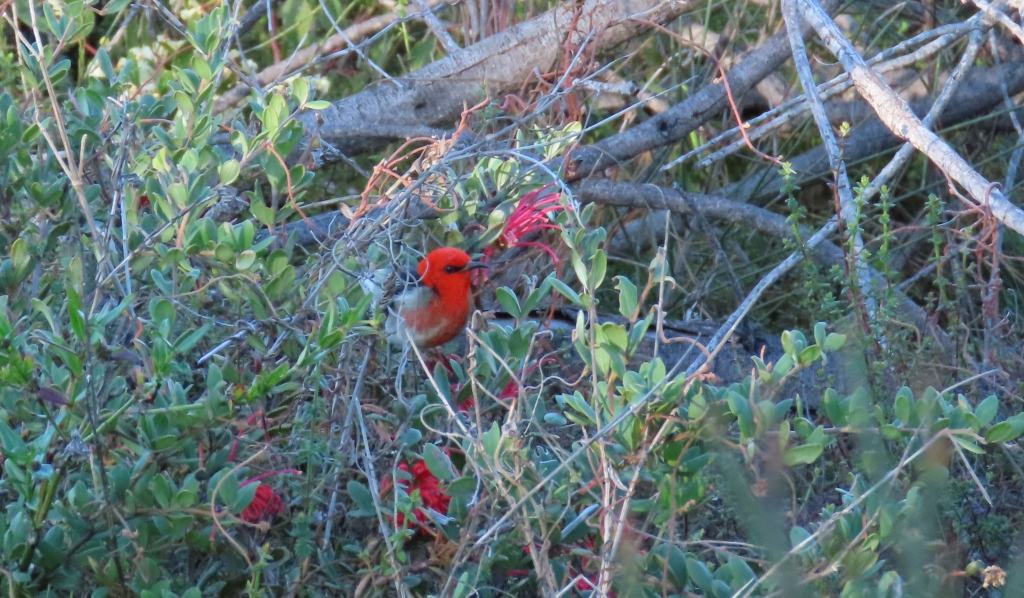
Scarlet Honeyeaters feed mainly on the nectar from flowers, hence their name. Sometimes they catch insects.
A female was close by. This photo shows the bird’s curved beak, a good tool for probing blossoms in search of nectar:
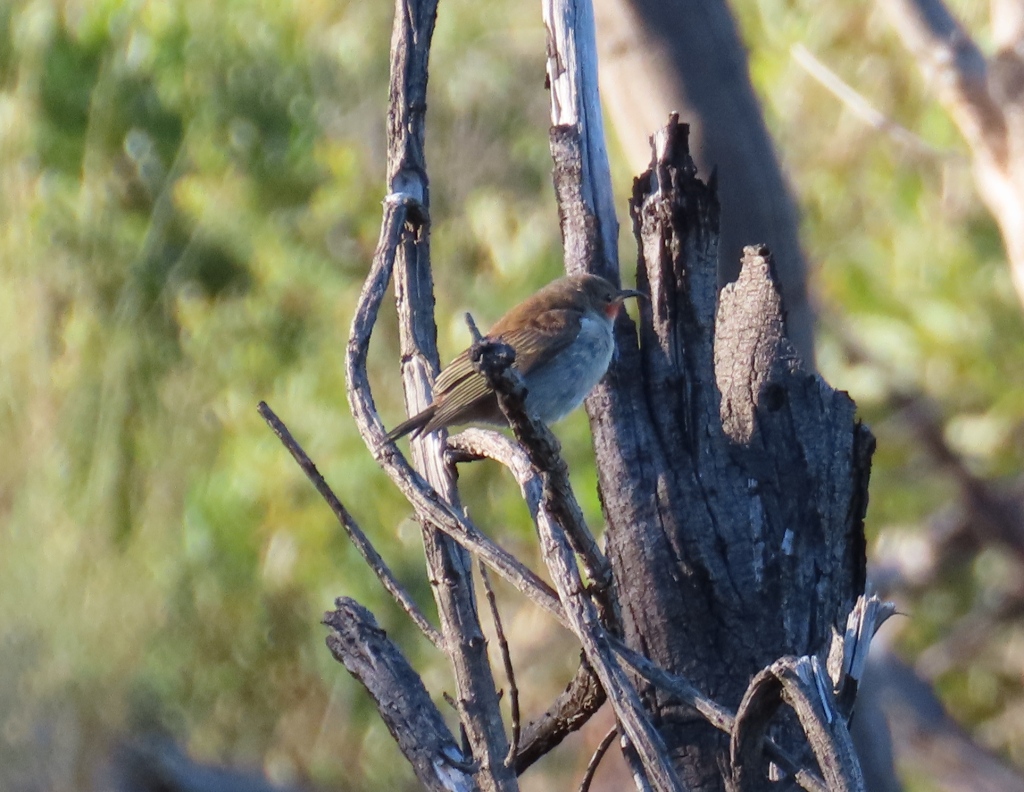
Common name: Scarlet Honeyeater
Scientific name: Myzomela sanguinolenta
Approximate length: 10 cm
Date spotted: 17 July 2022 (winter)
Location: Dobroyd Head, New South Wales, Australia: 33°48’36.4″S 151°16’19.0″E

Red-whiskered Bulbul
Red-whiskered Bulbuls are evidently quite common around Sydney, but this is the first time I’ve seen one! It’s a pretty little bird, with striking black, red, and white markings and a tall crest on its head like a woodpecker.
In this video, the bird is very far away and I had to do some radical zooming with my camera. You can hear the bulbul’s pretty call:
These birds are native to south Asia, and introduced into Sydney in the late 1800s. They tend to stay in areas close to human habitation.
Here’s a still picture of the bird:

Common name: Red-whiskered Bulbul
Scientific name: Pycnonotus jocosus
Approximate length: 20 cm
Date spotted: 5 June 2022 (winter)
Location: Dobroyd Head, Sydney Harbour, Australia: 33°48’38.6″S 151°16’05.4″E

Those magnificent black cockatoos are back!
For the past couple of years, a group of Yellow-tailed Black Cockatoos has visited our garden to snack on our Banksia tree when the seeds are ripe. This happens around May-June and again in October. It’s a real privilege to have such magnificent birds in the garden. At approximately 65 cm (more than 2 feet) from head to tail, they’re much larger than the more common white Sulphur-crested Cockatoos (50 cm).
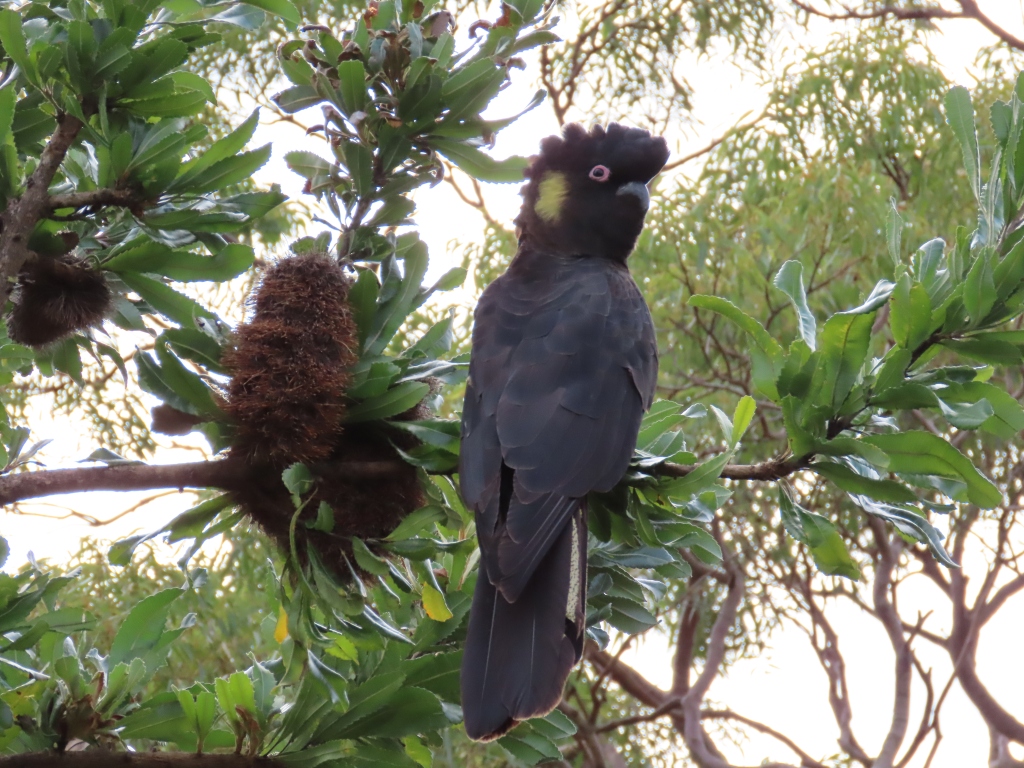
The bird on the left is a female. Toward the end of the video, you see the male higher up in the tree (he’ll be near the top right), keeping watch. You can tell the male by the pinkish colour of the ring surrounding his eye.
The bird on the right at the start of the video (in the middle when all three birds are in view) is making a constant low crooning sound. I think the noisy one must be a juvenile, because I’ve noticed that the juvenile birds of many species keep up a constant noise, perhaps to reassure their parents that they’re still around. Early on in the video, the female on the left calls out in that lovely, wild squeal that’s characteristic of these birds. They also chitter companionably to each other throughout.
Here’s a still picture of the male:
The next video shows one of the birds (probably the female, though it might be the juvenile) tucking into a Banksia seed pod:
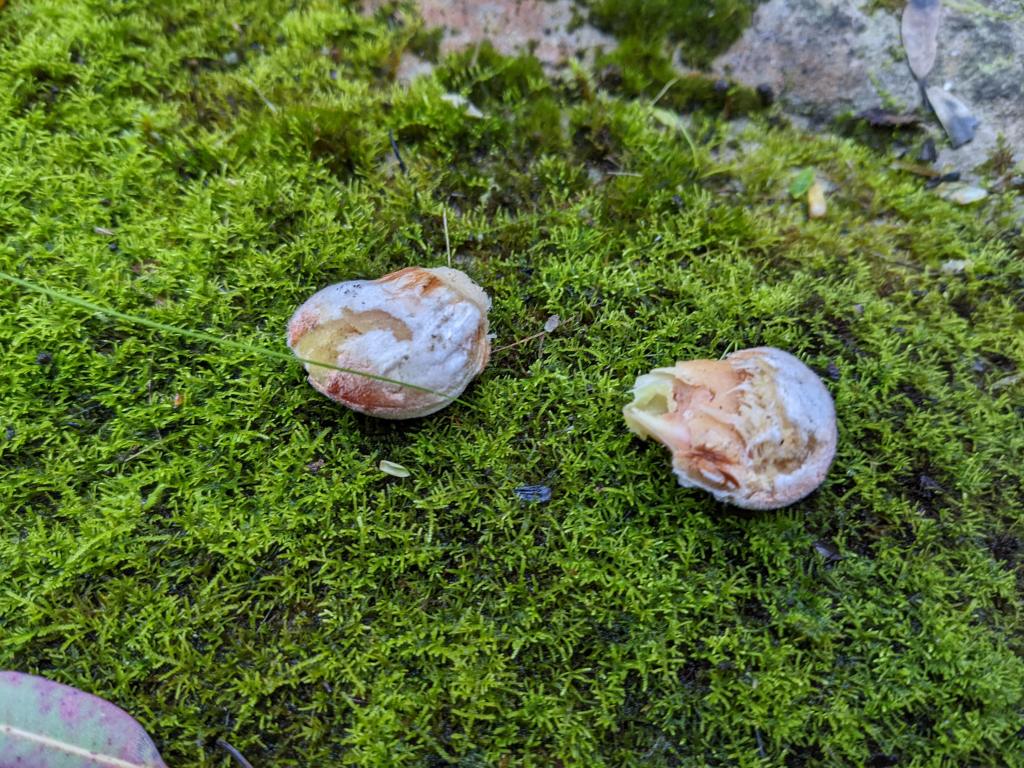
It’s funny to see how ruthless the bird is. She basically tears the dead flower apart, chucking bits onto the floor seemingly at random, until she finds a tasty morsel. Our neighbour was giggling from his verandah, from where he had a birds’ eye view of the feasting! Our garden quickly became littered with half-eaten seeds:
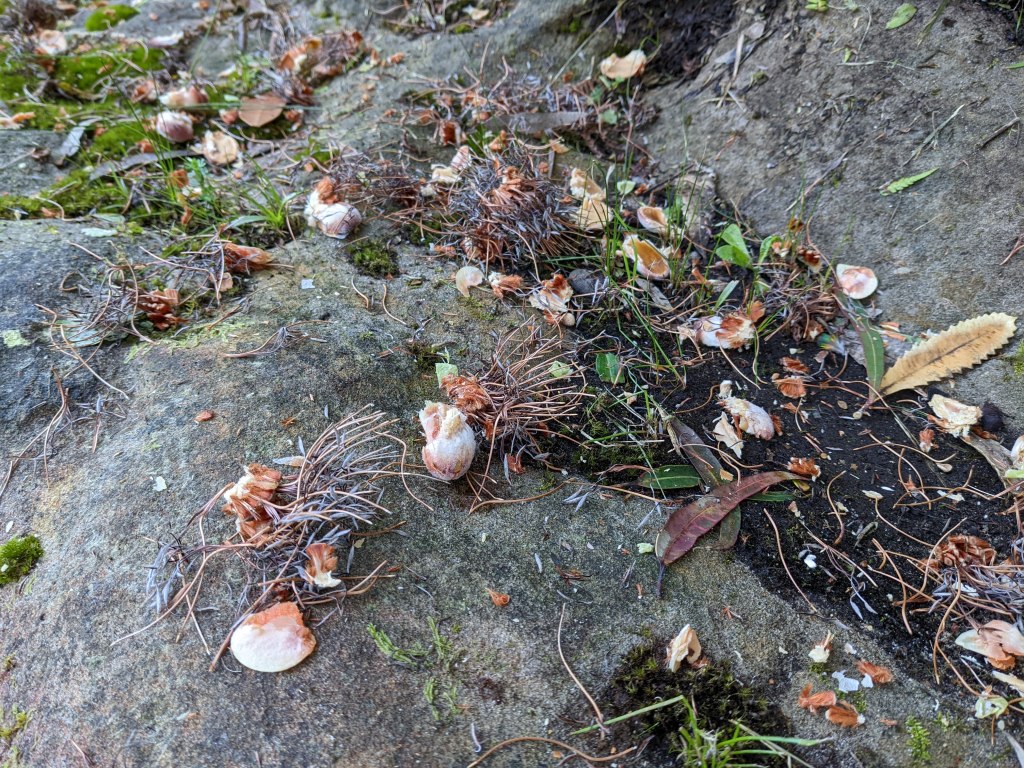
The tree is a Banksia serrata, also known as Old Man Banksia. See the marks of that huge beak on these seeds!
Here’s a closeup of a cockatoo on a seed pod:
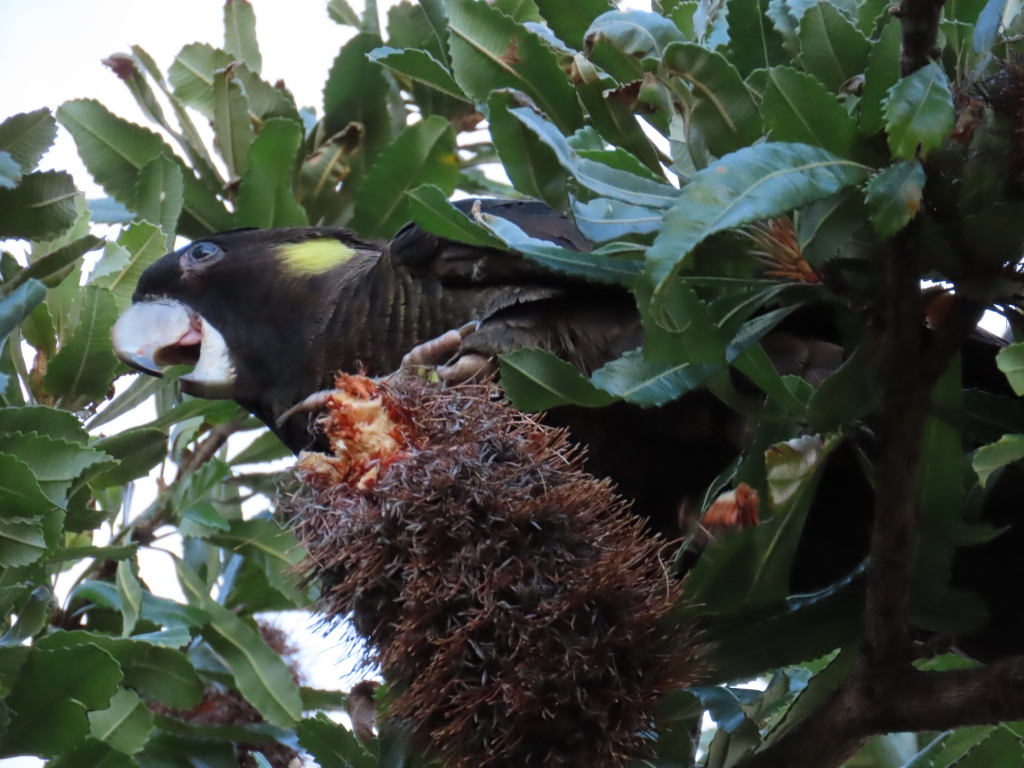
The scientific name of these birds is Calyptorhynchus funereus. Evidently the funereus part of the name stems from the dark, somewhat gloomy colouring of the birds. George Shaw, the naturalist who first named the birds, thought that the colouring was suited to a funeral! The bird was even called the “funereal cockatoo” for a while.
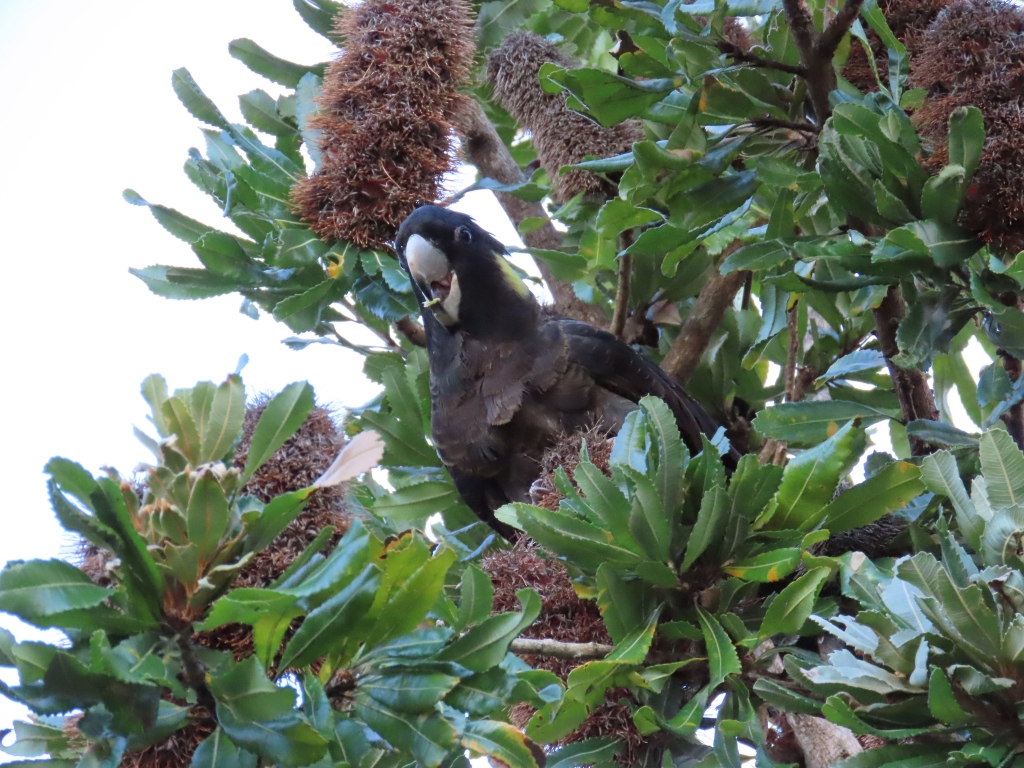
There’s also some dispute in the birding community about whether these birds are actually part of the genus Calyptorhynchus. Some people group them into a different genus, Zanda, based on genetic diversity.
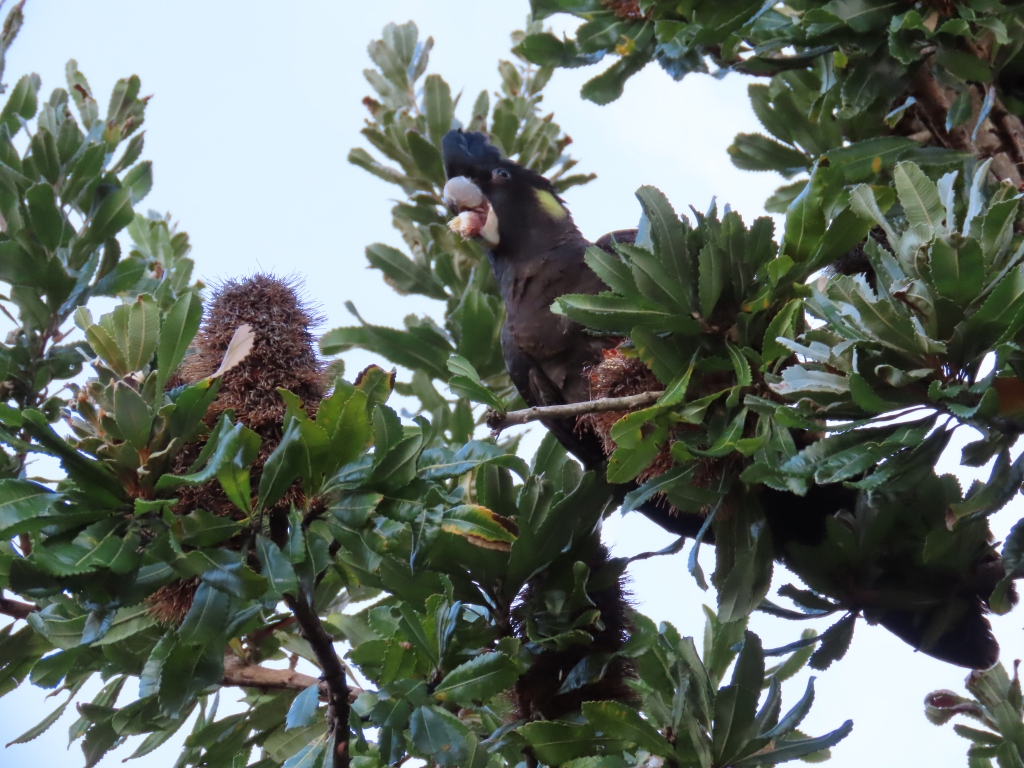
The next photo shows the bird that I think is a juvenile. With its beak feathers fluffed up, it seems to be sleepy or wanting attention!

A shot from the back gives a nice view of the crest on the bird’s head:
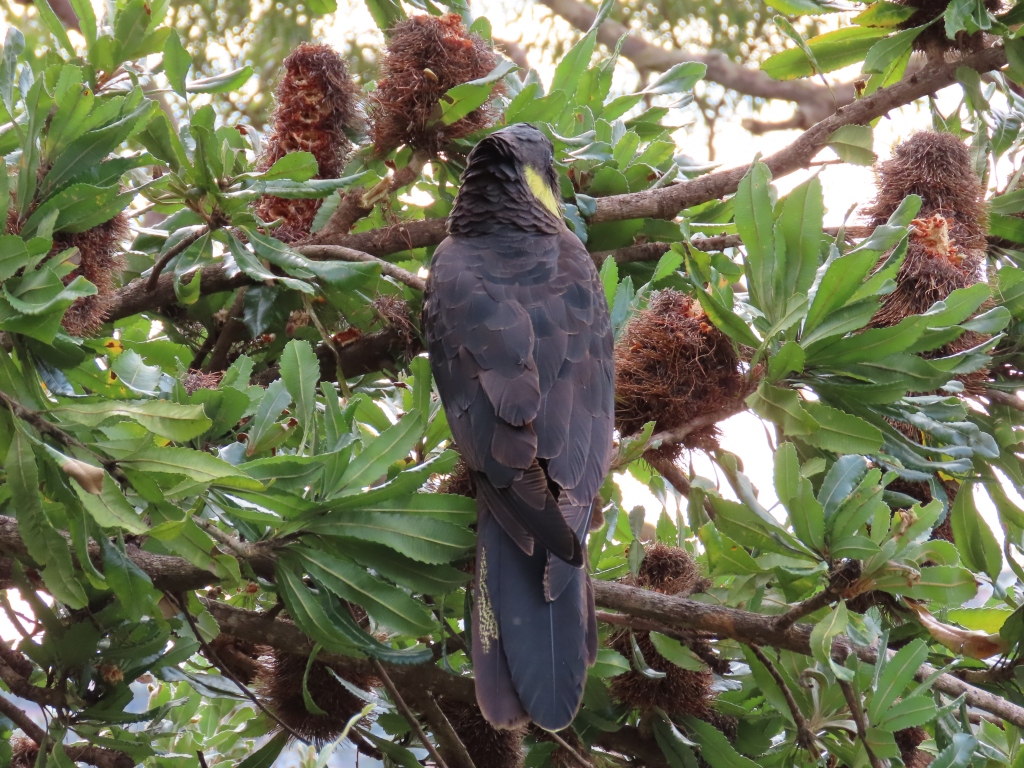
Common name: Yellow-tailed Black Cockatoo
Scientific name: Calyptorhynchus funereus or Zanda funereus
Length: 58-65 cm
Date spotted: 2nd and 3rd June 2022 (winter)
Location: Allambie Heights, NSW, Australia

Cockatoo sculpted by sunlight
It can be difficult to get a good photo of a white cockatoo, because they’re so uniformly white. My camera tends to treat them as an uninteresting blob of uniform colour, unless I can get really close to the bird. I was quite pleased with this shot. Even though the bird was high in a tree, the early morning sun glows nicely through the cockatoo’s yellow crest and adds contour to the bird’s body:

The video of the same cockie is also rather nice. The bird is screeching and waving its head around, as they often do. It’s having fun with a small pool of water in a tree hollow, dipping its beak in and throwing water droplets around:
Common name: Sulphur-crested Cockatoo
Scientific name: Cacatua galerita
Approximate length: 50 cm
Date spotted: 3 April 2022 (autumn)
Location: Angophra Track, Balgowlah Heights, New South Wales, Australia: 33°48’20.9″S 151°16’17.8″E
Young Kookaburra learning call from adult
The bush is alive with the sound of young Kookaburras practising their call. They sound like rusty saws, or motor engines that can’t quite start. After crooning away to itself for a while, this little one approached an adult for a lesson!
Common name: Laughing Kookaburra
Scientific name: Dacelo novaeguineae
Approximate length: 47 cm
Date spotted: 3 March 2022 (summer)
Location: Manly Dam Park, New South Wales, Australia: 33°46’56.3″S 151°15’10.4″E

Large net-casting spider
While doing some gardening a couple of weeks ago, I came across this large, unique-looking spider. It was on my green bin, where I was about to deposit a load of garden trimmings. I didn’t want to hurt the spider, so I carefully moved it onto the nearby vegetation, after taking a couple of photos.
Here’s the spider, with my finger for scale:

It has its legs neatly clumped together in four groups of two. The body is long and thin, with two little humps on the sides about half way down the length. It’s head, seen from above, forms a neat triangle with two bulbs at the front.
Today I spent some time figuring out what type of spider it is. It turns out to be a net-casting spider. I wish I’d know that at the time! Evidently the spider has two huge eyes (under those bulbs seen here from above) and its face looks a little scary. As well as earning the name net-casting spiders, they’re also called ogre-faced spiders! I wish I’d got down onto the ground and looked at the spider from below, so that I could see its eyes and ogre face.
Here’s another picture, without the finger this time:

Why the name net-casting spider? These creatures spin a small square of web each night, which they hold in their front legs and cast over their prey. That’s why they have big eyes: to be able to see their prey in the dark.
Fascinating. It’s a jungle out there.

Baby Channel-billed Cuckoos fed by Currawongs
Walking along a shady path this morning, I heard a loud caterwauling from above. Two baby Channel-billed Cuckoos sat in the trees, yowling and shaking their wings. A Currawong arrived and fed a piece of meat to one of the cuckoos. Then another Currawong brought food to the second screeching youngster.
Like most cuckoos, Channel-billed Cuckoos lay their eggs in the nests of other birds and leave it to those other birds to hatch the egg and look after the growing chick. These particular cuckoos are very large (around 65 cm from head to tail) and so they need to pick the adoptive parents carefully. Currawongs are the usual choice.
This video shows one of the babies yowling and begging for food from its Currawong adoptive parent:
See how large the baby is in relation to the Currawong who’s looking after it! In the next video, one of the babies attempts to eat a largish morsel of meat that a Currawong has just fed to it:
I’ve never seen two babies together before. I wonder if they both came from the same nest, or if they found each other after leaving their nests?
Here’s a still picture of one of the baby cuckoos:
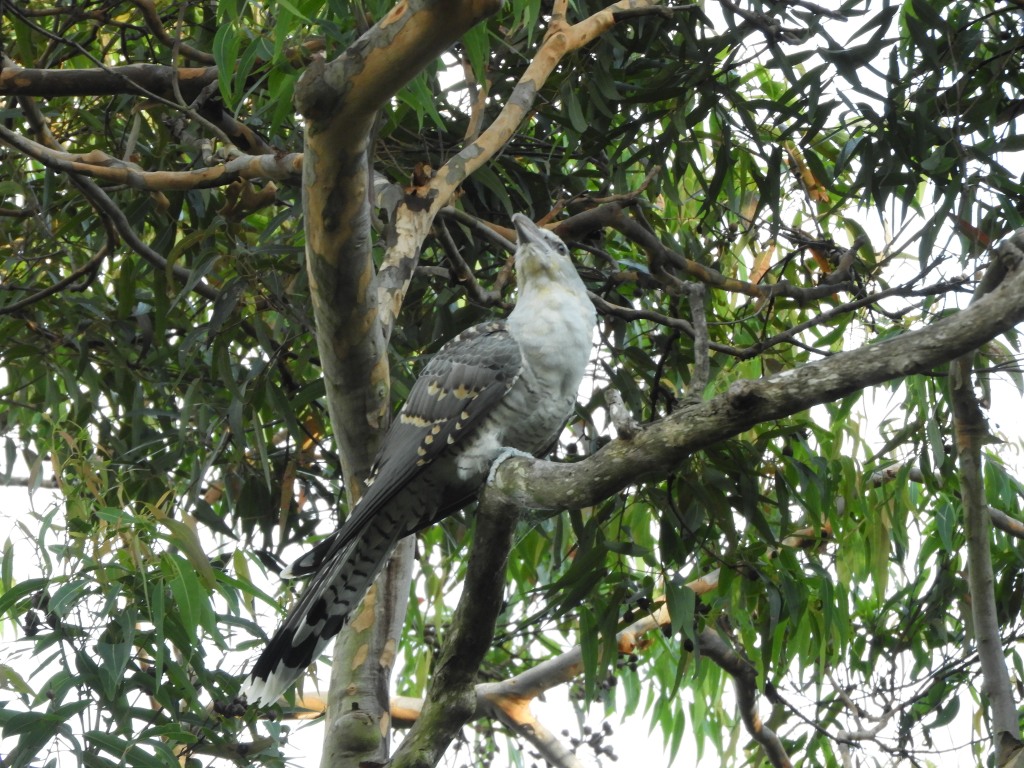
Being a youngster, its eyes are still light brown. The adult birds have fierce red eyes. They’re magnificently ugly birds.
In the next picture, one of the babies is pointing its beak at the sky, perhaps wondering where its next feed is coming from:
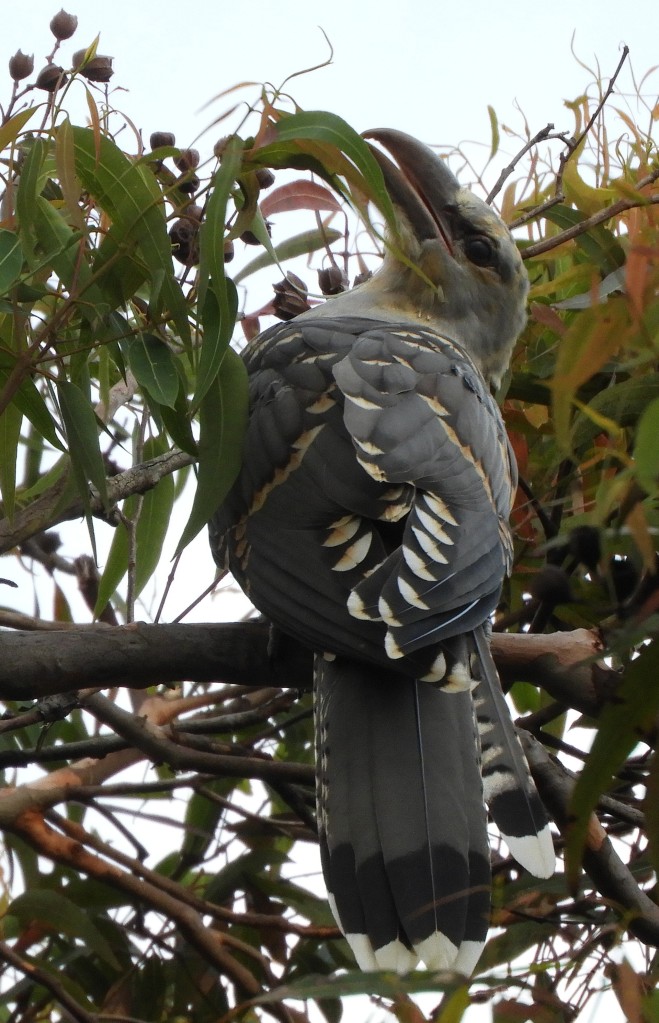
That picture gives a good view of the bird’s large beak and the markings on its back and tail.
One of the things you notice about Channel-billed Cuckoos is the supple way they move their neck and head. Here’s one of the babies leaning forward, in a pose that’s typical of these birds:
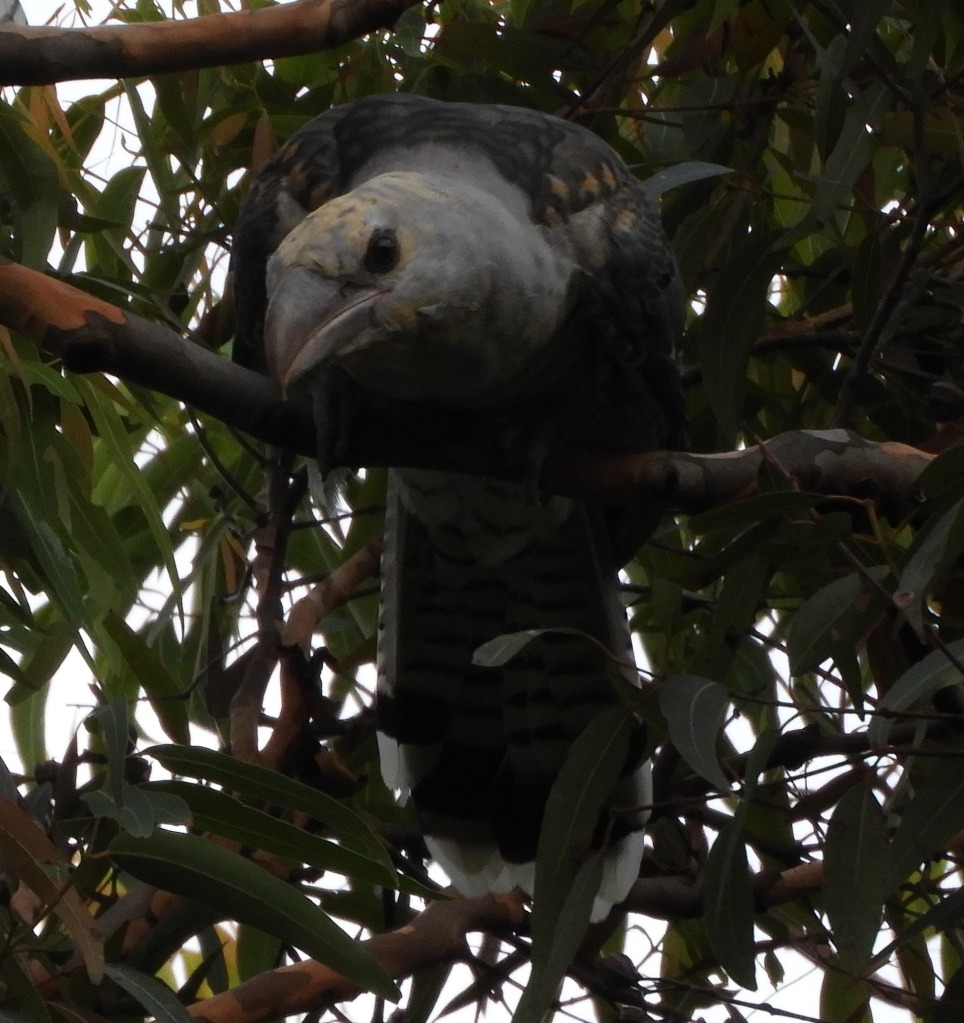
Oo-er, you probably wouldn’t want to bump into that bird one dark night. Here’s a picture of both baby cuckoos, looking at each other:

To finish off with, here’s a close up of one of the babies, head and neck only:

You can find out more about these birds in my other posts about cuckoos.
Common name: Channel-billed Cuckoo
Scientific name: Scythrops novaehollandiae
Approximate length: 58-65 cm
Date spotted: 18 December 2021 (summer)
Location: Manly-to-Spit Walk, Balgowlah, New South Wales, Australia: 33°48’00.9″S 151°15’54.9″E

Dollarbirds courting
It’s that time of year for birds on the south east coast of Australia: breeding season! I heard a cosy chattering sound high in the treetops. My superzoom camera revealed two Dollarbirds getting friendly:
Dollarbirds are migratory. They travel down to the south east coast of Australia for the summer months (roughly September to March) then fly up north to warmer climes for the winter.
They get their name from the white circular markings on the undersides of their wings. The white circles reminded people of the old silver Australian one-dollar coins. You can see the flash of white nicely when the male flies off at the end of the video.
This still photo shows the blue-green colouring of the birds. They have soft brown heads and pretty purple shading under the beak:
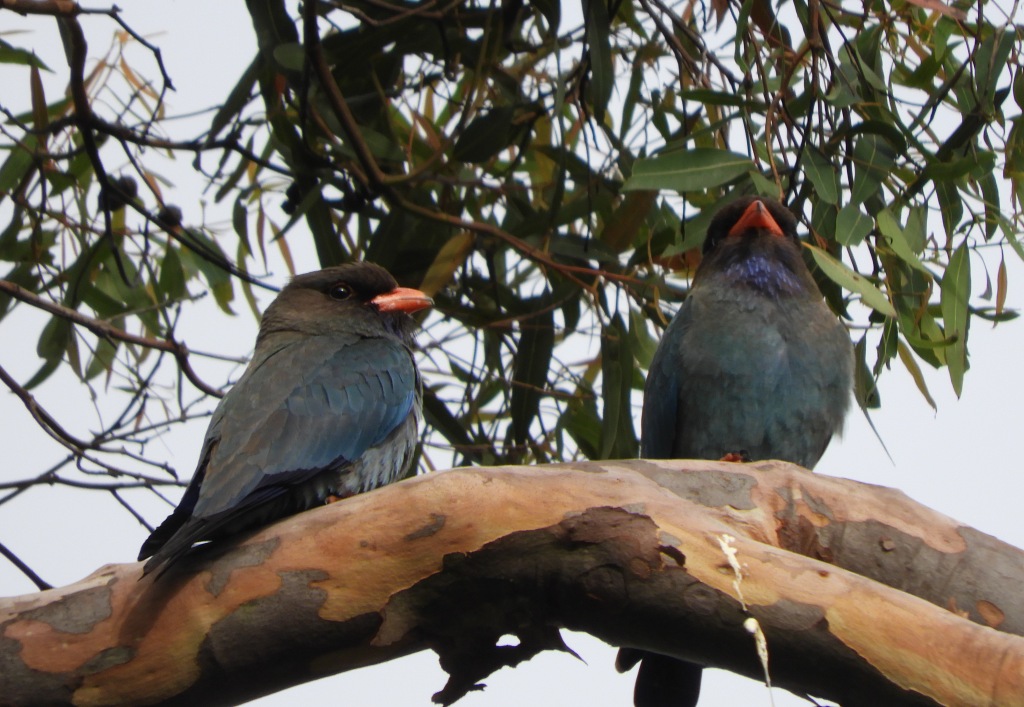
Common name: Dollarbird
Scientific name: Eurystomus orientalis
Approximate length: 30 cm
Date spotted: 29 November 2021 (late spring)
Location: North Harbour Reserve, Balgowlah, NSW: 33°47’59.4″S 151°15’57.8″E


