Blog Archives
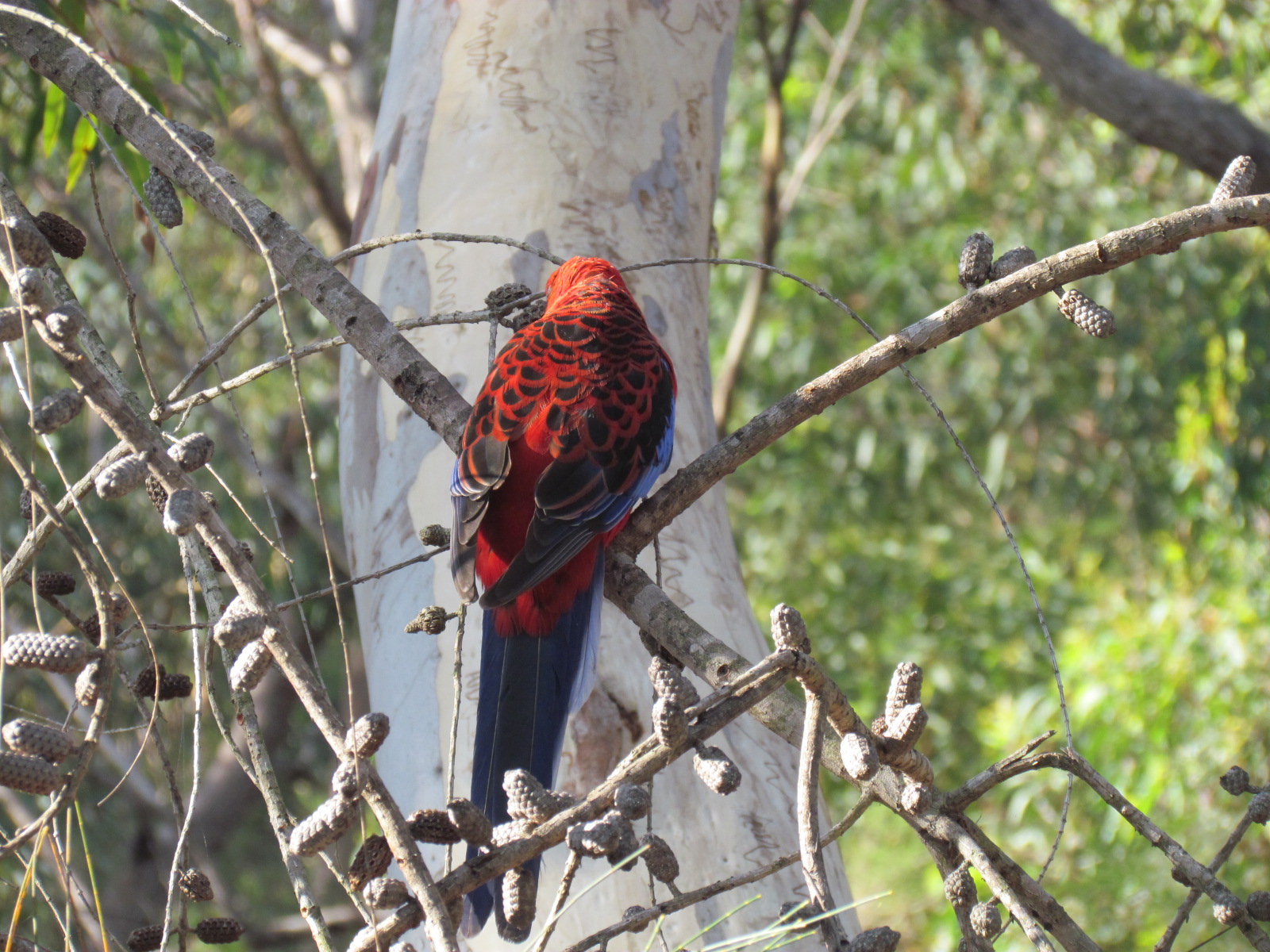
Crimson Rosella feeding on bottlebrush seeds
Usually when you spot a Crimson Rosella, there’s another one close by. This time, though, I could only see one. It was contentedly nibbling at the seeds on a bush – a bottlebrush, I think. [Update on 24 April: It’s not a bottlebrush, but Scrub She-oak, Allocasuarina distyla. Thanks to Carol Probets for the comment!]
The male and female Crimson Rosella look very similar, with the male being larger. I don’t know whether this one was male or female.

These birds are so pretty, even though this one was moulting, so a little shabby in places.

From the rear, the feathers are quite intricate in pattern:
Common name: Crimson Rosella
Scientific name: Platycercus elegans elegans
Approximate length: 35 cm
Date spotted: 12 February 2017 (Summer)
Location: Manly Dam Reserve, New South Wales, Australia: 33°46’58.4″S 151°15’11.8″E
Cockatoos teasing
Cockatoos are playful, sociable creatures. Yesterday I watched a pair of Sulphur-crested Cockatoos high in a gum tree. One of them was grooming. The other was teasing its companion, prodding it and seeming very satisfied with the startled response.
A couple of minutes later both of them flare their wings and crests, squawking gleefully.
Common name: Sulphur-crested Cockatoo
Scientific name: Cacatua galerita
Approximate length: 50 cm
Date spotted: 8 October 2016
Season: Spring
Location: Manly Dam Park, New South Wales, Australia
Latitude/longitude: 33°46’51.5″S 151°14’51.7″E
King Parrots on my commute
Not many people in the world are lucky enough to be able to say this: I bumped into a couple of King Parrots on my way home from work the other day.
We see a few different varieties of parrots around the neighbourhood. King Parrots aren’t a very common sight – I see them maybe two or three times a year. One of their charming characteristics is that they’re always in pairs. See one, and the other isn’t far away.
These two were investigating some seeds on the ground. They let me get quite close, and flew off when I was about a metre away.
Common name: Australian King Parrot
Scientific name: Alisterus scapularis
Approximate length: 44 cm
Date spotted: 5 October 2016
Season: Spring
Location: Allambie Heights, New South Wales, Australia
Approximate latitude/longitude: 33°46’13.2″S 151°15’41.1″E
Why we plant native bushes and trees
One of the reasons we plant native bushes and trees in our garden is to provide food and shelter for the birds and animals. So that they’ll drop in and share this tiny patch of Australia with us. We see possums, lizards, bats, and birds of many kinds. Last week a wallaby passed through on its way from somewhere to somewhere else – but that’s most unusual, as ours really is a very small patch.
Rainbow lorikeets are frequent visitors, snacking on the nectar from the flowers. They’re noisy and quarrelsome, and very pretty.
The bush is a grevillia that we planted a couple of years ago, specifically to attract birds. It works!

Common name: Rainbow Lorikeet
Scientific name: Trichoglossus haematodus
Approximate length: 30 cm
Date spotted: 3 September 2016
Season: Spring
Bird swathed in Christmas colours
This little Rainbow Lorikeet shows off its bright cloak of red, green, blue and yellow, perched on the greeny-white flower of an Old Man Banksia. Christmas colours indeed

Common name: Rainbow Lorikeet
Scientific name: Trichoglossus haematodus
Approximate length: 30 cm
Date spotted: 24 December 2015
Season: Summer
Location: Allambie Heights, New South Wales, Australia
Approximate latitude/longitude: 33°46’19.2″S 151°15’39.6″E
Crimson Rosella in the wet
A Crimson Rosella hangs out on a wire in a Sydney rain storm.

(Click the image to zoom in.)
The Rosella looks a little miffed. The rain’s been going on a while, and I guess the bird’s had enough of it.

Common name: Crimson Rosella
Scientific name: Platycercus elegans elegans
Approximate length: 35 cm
Date spotted: 26 September 2015
Season: Spring
Location: Allambie Heights, New South Wales, Australia
Latitude/longitude: 33°46’13.9″S 151°15’39.2″E
Galahs galore
I’ve posted a few pictures of galahs on this blog. They’re gorgeous birds, a type of parrot with a distinctive call and an endearing habit of walking around on the ground in large groups, bobbing their white-capped heads at each other. If you do something silly, an Australian might fondly say, “You silly galah” – an affectionate nod to the slightly bumbling behaviour of the birds.
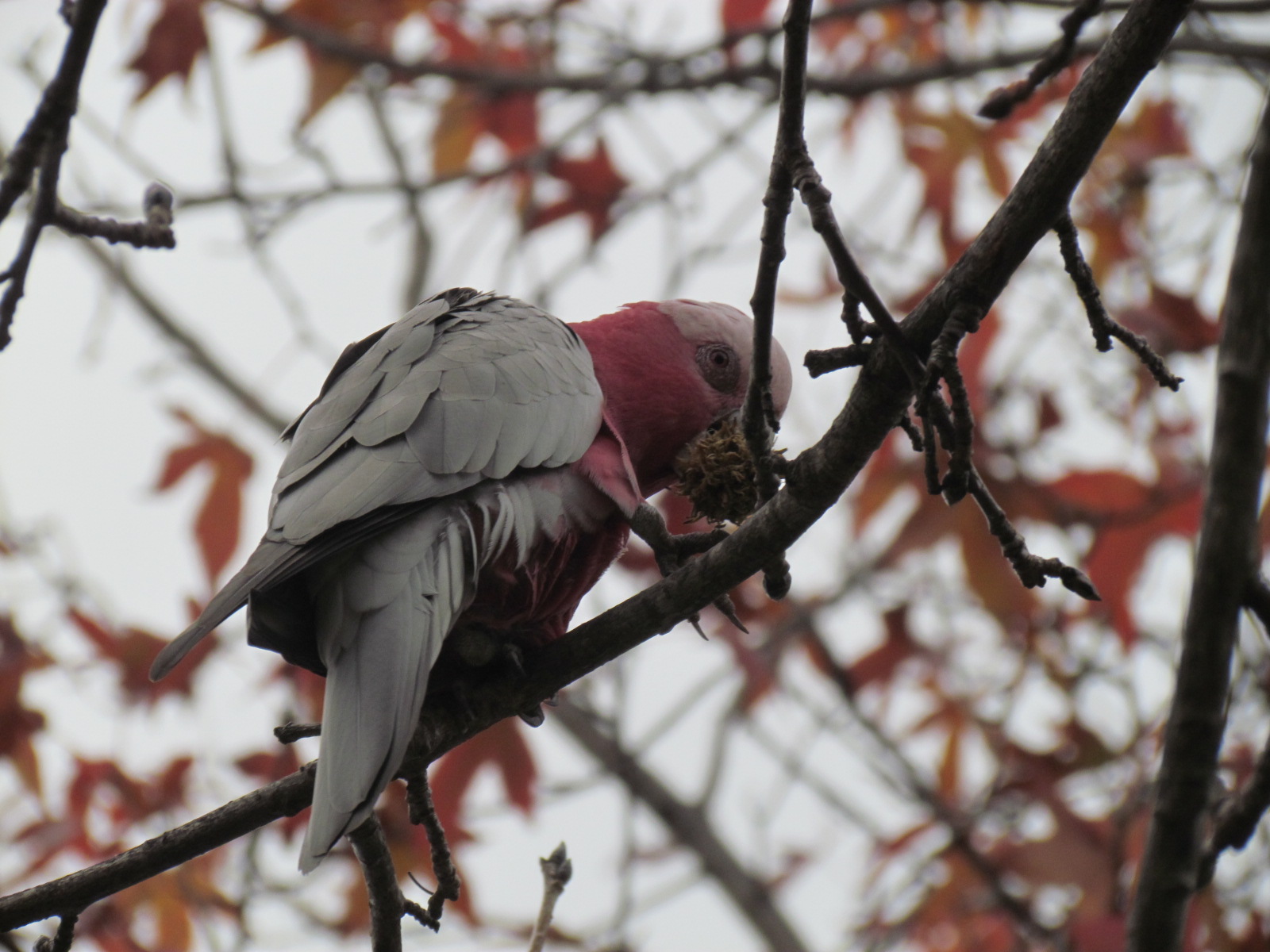
Yesterday I came across a group of them, all agog because a tree was dropping its seed balls. This bird peeks down at me while holding a seed ball in its beak:
In this video, you can hear the galahs chatting noisily to each other. Towards the end, something startles them and they take off, flying towards the camera with seed balls in their beaks:
Common name: Galah
Scientific name: Cacatua roseicapilla
Approximate length: 38 cm
Date spotted: 23 May 2015
Season: Winter
Location: Manly Vale, New South Wales, Australia
Latitude/longitude: 33°46’48.6″S 151°15’52.2″E
To find more about these pretty birds, see the galah category in this blog.
Sulphur-crested Cockatoo
Sulphur-crested Cockatoos are sociable creatures, often travelling in large groups. This one was with four others, but sat apart looking a bit grumpy.

It can be difficult to get a good photo of a cockatoo, because they’re so white that the sun gleams off them and the resulting glare removes all detail. So I was pretty please with these shots. Here’s a rear view:

Common name: Sulphur-crested Cockatoo
Scientific name: Cacatua galerita
Approximate length: 50 cm
Date spotted: 20 December 2014
Season: Summer
Location: Manly Dam Reserve, New South Wales, Australia
Latitude/longitude: 33°46’45.6″S 151°14’59.2″E
A pair of Crimson Rosellas
Parrots galore! Two weeks ago I encountered a King Parrot on my walk in the bush. This week it’s a couple of Crimson Rosellas. They’re slightly smaller than a King Parrot, with different colouring.
Common name: Crimson Rosella
Scientific name: Platycercus elegans elegans
Approximate length: 35 cm
Date spotted: 27 September 2014
Season: Spring
Location: Manly Dam Reserve, New South Wales, Australia
Latitude/longitude: 33°46’36.6″S 151°15’16.2″E
Here’s a still shot of one of the birds, high up in a tree:

And another, snapped in a pool of sunlight:

King Parrot in spring splendour
This splendid King Parrot is perched high in a tree. Only the power of my Canon zoom brought it into clear sight.

Another shot, after the bird moved to shadier spot:

Common name: Australian King Parrot
Scientific name: Alisterus scapularis
Approximate length: 44 cm
Date spotted: 14 September 2014
Season: Spring
Location: Manly Dam National Park, New South Wales, Australia
Approximate latitude/longitude: 33°46’50.2″S, 151°14’54.5″E


 Sydney Birder