Blog Archives

Blue Bonnet: a new parrot for me
I love parrots, and it’s always exciting to see a new type. This is my first sighting of a Blue Bonnet. It was at Mungo Lodge, during our recent Outback trip.

Of course, as so often happens with birds, it was difficult to get a good shot. For the above photo, the bird turned its back. The next one is totally out of focus, but gives a good idea of the colouring around the bird’s face:

Common name: Blue Bonnet
Scientific name: Northiella haematogaster
Approximate length: 27-34 cm
Date spotted: 20 May 2024 (autumn)
Location: Mungo Lodge, Mungo National Park, New South Wales, Australia: 33°44’31.4″S 143°00’06.1″E

Australian Ringneck parrot at Cobar
First sightings are rolling in for me, thanks to my recent trip into the Australian Outback. We stopped for lunch at a town called Cobar in central New South Wales. A couple of Australian Ringneck parrots hid in the shade near our picnic place.
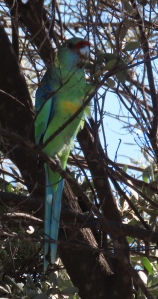
The shots are a little fuzzy, due to the lighting. Still, it’s worth sharing these shots as I’m unlikely to see these birds again for a while.
This particular variety of Australian Ringneck is called a Mallee Ringneck. The name “ringneck” comes from the narrow collar that this parrot shares with other varieties in the same species.

Common name: Australian Ringneck, subspecies Mallee Ringneck
Scientific name: Barnardius zonarius barnardi
Approximate length: 34-38 cm
Date spotted: 18 May 2024 (autumn)
Location: Cobar, New South Wales, Australia: 31°29’53.6″S 145°50’21.7″E

So lucky! King Parrots and Eastern Rosellas come to visit
Two days ago, a couple of Eastern Rosellas dropped by. The next day, I was getting ready to write this blog post when two King Parrots came visiting. We’re so lucky, to have such beautiful birds in the area.
Eastern Rosellas
It’s quite odd: we have visits from two of these little parrots at around this time every year. The pattern is always the same: I hear them twittering, and lean out of the window. A male perches on our telephone line, or on a branch near by, and gives a little show for his lady friend. The show consists of some twittering, and bit of feather fluffing and scratching, and some wing shuffling. Then, after a few minutes they fly away.
Eastern Rosellas are medium-sized parrots, measuring about 30cm from head to tail. This is the male:

Here he’s in the middle of a wing shuffle:

The female looks on:

Common name: Eastern Rosella
Scientific name: Platycercus eximius
Approximate length: 30 cm
Date spotted: 19 February 2024 (summer)
Location: Allambie Heights, NSW, Australia
King Parrots
Sitting in the lounge the next afternoon, I heard a soft thunk and then an inquisitive chirp from the veranda. A female King Parrot perched on the window sill, looking in to see what was happening:

The male sat on a branch close by, keeping watch:

At 44cm from head to tail, King Parrots are quite a bit larger than the Eastern Rosellas (30cm). The birds stayed for around 15 minutes. Of course, I talked to them, as you do. The female let me get within a couple of metres.
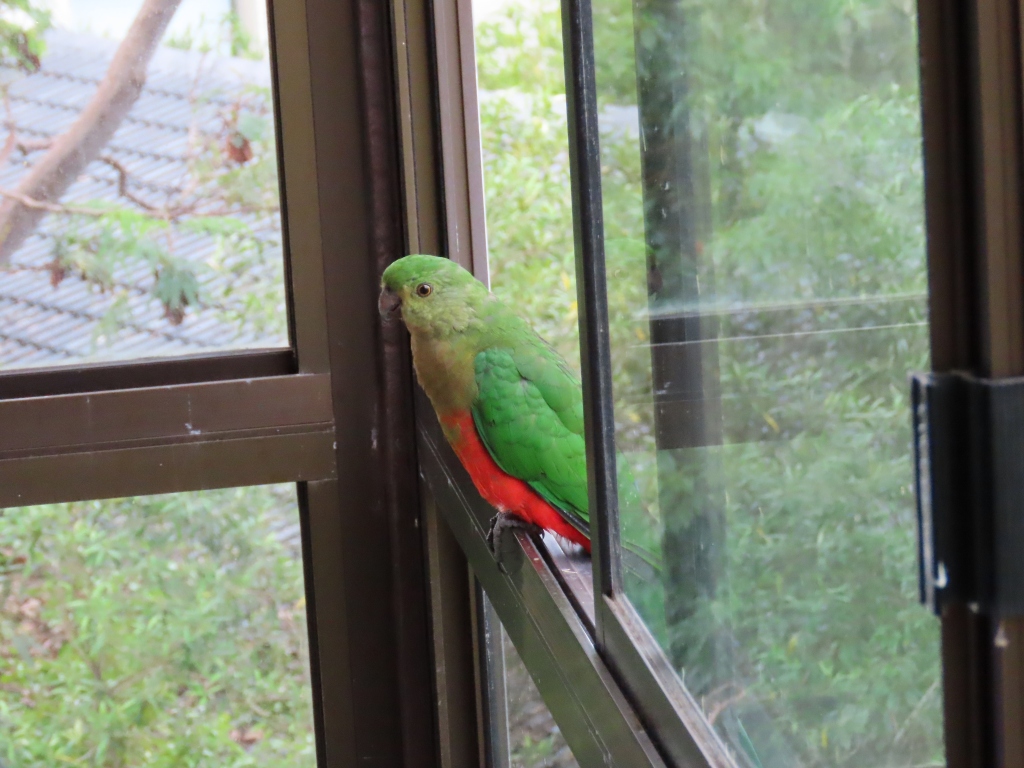
She was quite happy to turn her back on me and check out the goings on outside:

At the start of this video, the female perches on the window sill, peering in. I then find the male outside the window. The view judders a bit, as I need to kneel down to get the male in view. A cockatoo squawks as it flies past:
In the next video, the female is perched on the window sill looking outwards. If you turn up the volume, you’ll hear her soft chirps at around 6 to 12 seconds into the video. Then I manoeuvred carefully around some obstacles on the veranda, and moved the camera to outside the window. Now you can see the female’s head peering out at the bottom of the view, and the male perched on a branch higher up (and also reflected in the window pane). An Australian Raven wails. The camera pans out to show the view.
It felt like a huge privilege to be able to chat to these quiet, majestic birds.
Eventually, the female flew out onto a branch:
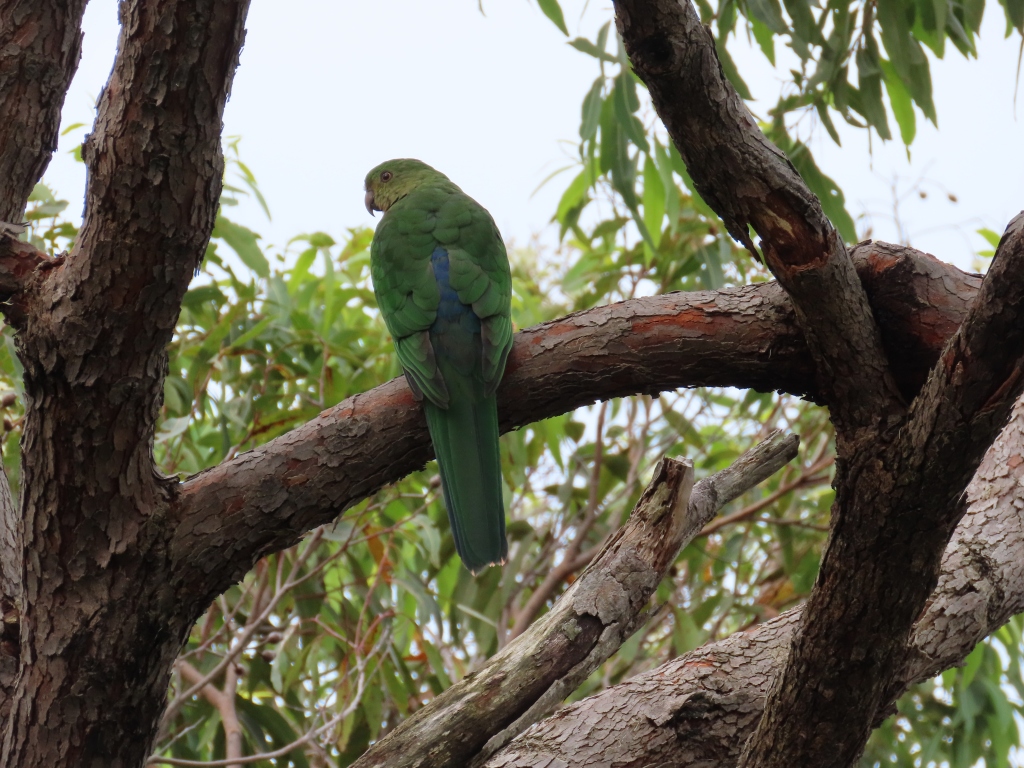
Both birds stuck around for a while. Maybe they were enjoying the view! Then they swooped away to grace another house or tree.
Common name: Australian King Parrot
Scientific name: Alisterus scapularis
Approximate length: 44 cm
Date spotted: 20 February 2024 (summer)
Location: Allambie Heights, New South Wales, Australia

Rainbow Lorikeet
A brightly coloured Rainbow Lorikeet posed in the early morning light:

Common name: Rainbow Lorikeet
Scientific name: Trichoglossus haematodus
Approximate length: 30 cm
Date spotted: 1 January 2024 (summer)
Location: Dobroyd Head, Sydney Harbour, Australia: 33°48’38.6″S 151°16’05.4″E

Post-fire scenes from the Australian bush
The National Parks and Wildlife Service recently conducted a hazard reduction burn in one of my favourite bush-walking areas. The NPWS lights these controlled fires to burn away excess vegetation, which reduces the chance of a more severe fire raging out of control during fire season.
Many of the plants in the Australian bush are adapted to cope with fires. For example, these Hakea seedpods popped open after the fire, allowing the seeds to escape:
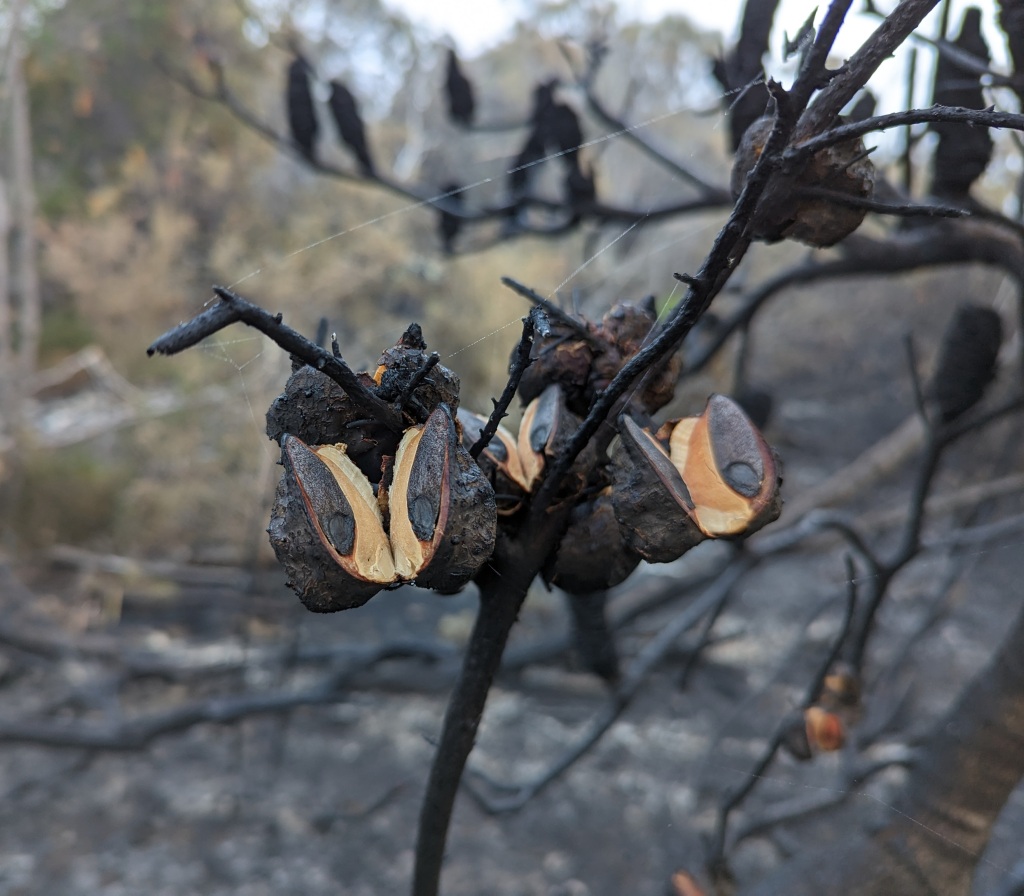
The above seed pods have both seeds still in place — the seeds are black and oval-shaped. Each seed is attached to a thin membrane, which acts as a wing: when the seed is released, it spirals gently to the ground. If there’s any wind around, the seed can travel a short distance from its parent bush.
In the next photo, only one of the seeds remains in the pod:

The next photo shows the seed head of a Banksia bush, also popped open to release the seeds. The open pods look like smiling mouths:

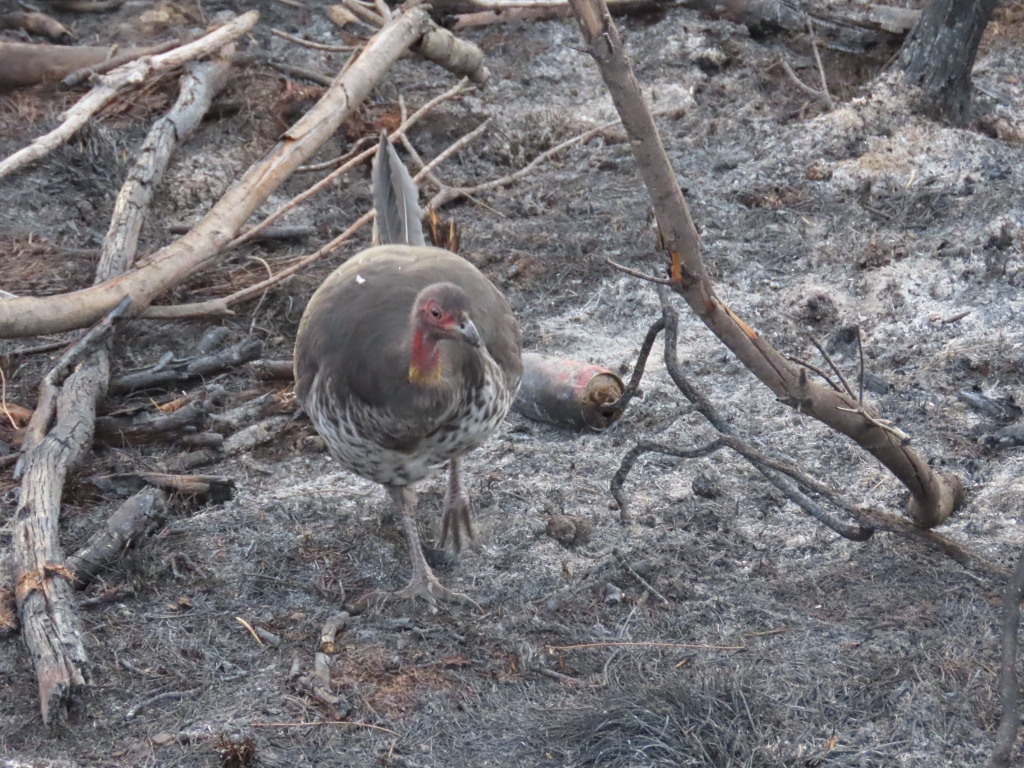
An Australian Brush-turkey wanders over the ashes, looking for pickings. A discarded can echoes the bird’s colouring:
Nearby, Australian Ravens look for insects and other goodies:

A Currawong keeps a watchful eye over the proceedings:

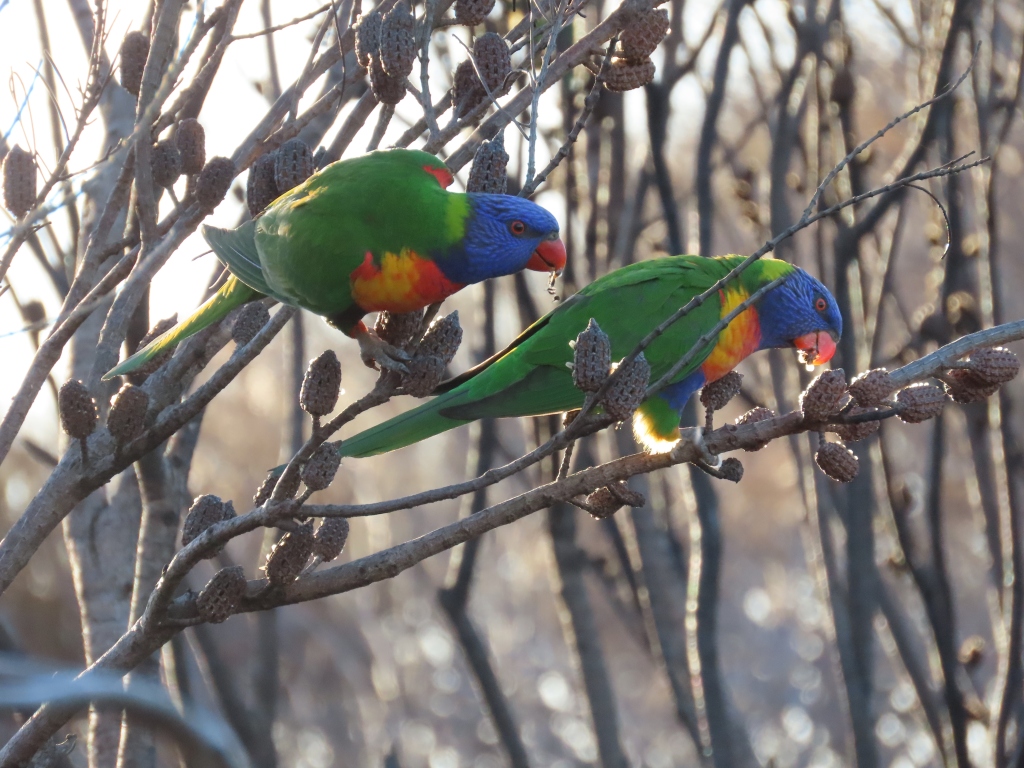
A Rainbow Lorikeet adds a splash of colour, hoping to snag a Casuarina seed or two:
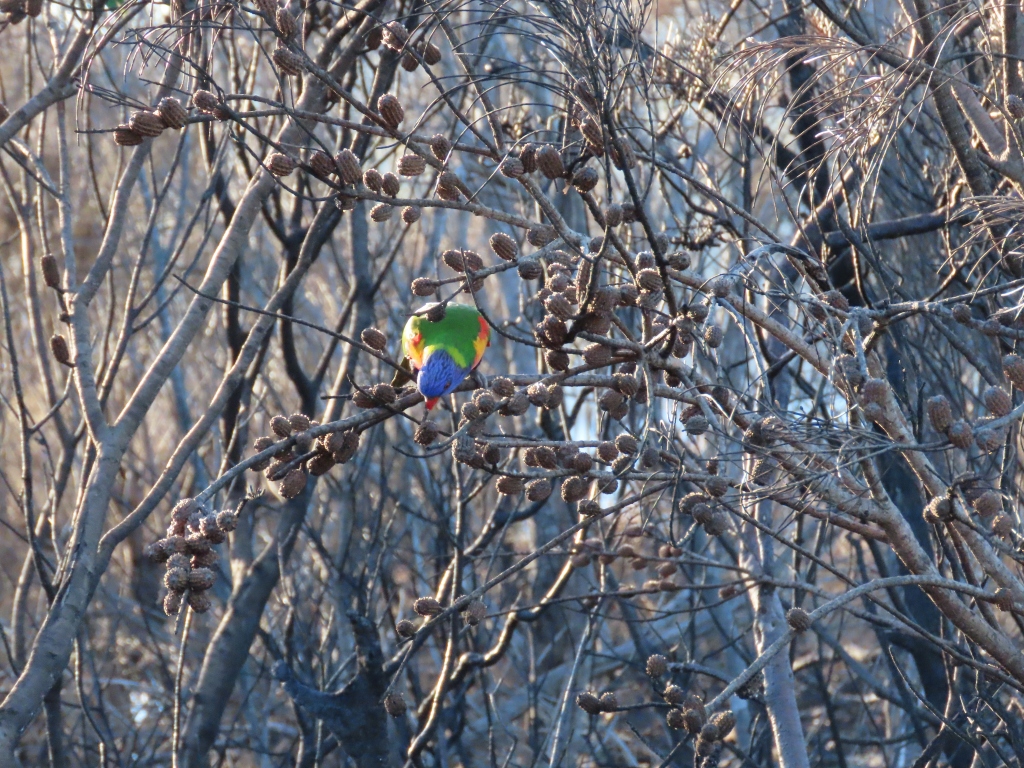
It’s much easier to grab a seed now that the fire has dried out the seedpods!
A week later, a Swamp Wallaby shared the browns and greys of the burned area too:
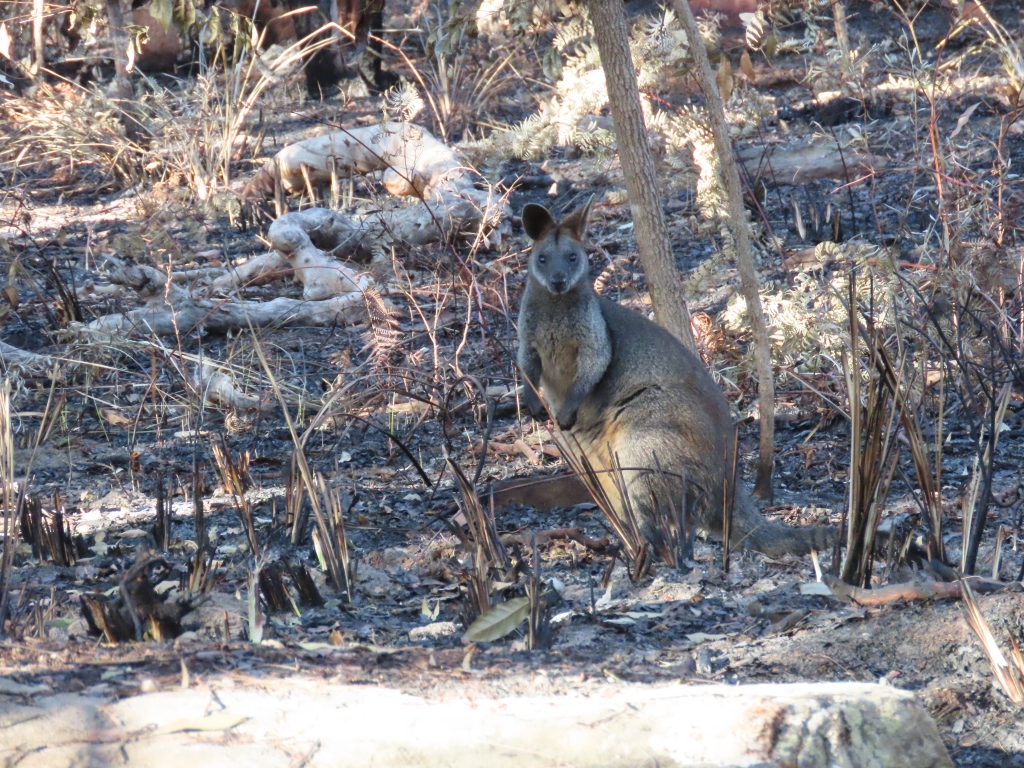
Here’s a video of the wallaby. At one stage, a plane flies overhead and a group of birds squawk loudly. The wallaby looks at me, checking whether I’m the cause of the disturbance, then goes calmly about its business:
To close, here’s a restful scene of the post-fire forest in the early morning light:

Date spotted: Early June, 2023
Location: Dobroyd Head, Sydney Harbour, NSW, Australia; between this point and this point on the map.
Territory! Ravens vs Lorikeets
The National Parks and Wildlife Service recently did a hazard reduction burn in the area where I often go for a walk. This morning, a group of Rainbow Lorikeets occupied some bare branches with a strategic view of the newly cleared area. Right next door, a collection of ravens had the same idea. They viewed each other for a while, then all hell broke loose.
Turn up the volume to get the full effect! Listen to the bawling ravens and the scolding parrots. When things really get hectic, hear the whop-whop-whop of wings swooping overhead.
Here’s a closeup of some of the ravens, in their best villain pose:
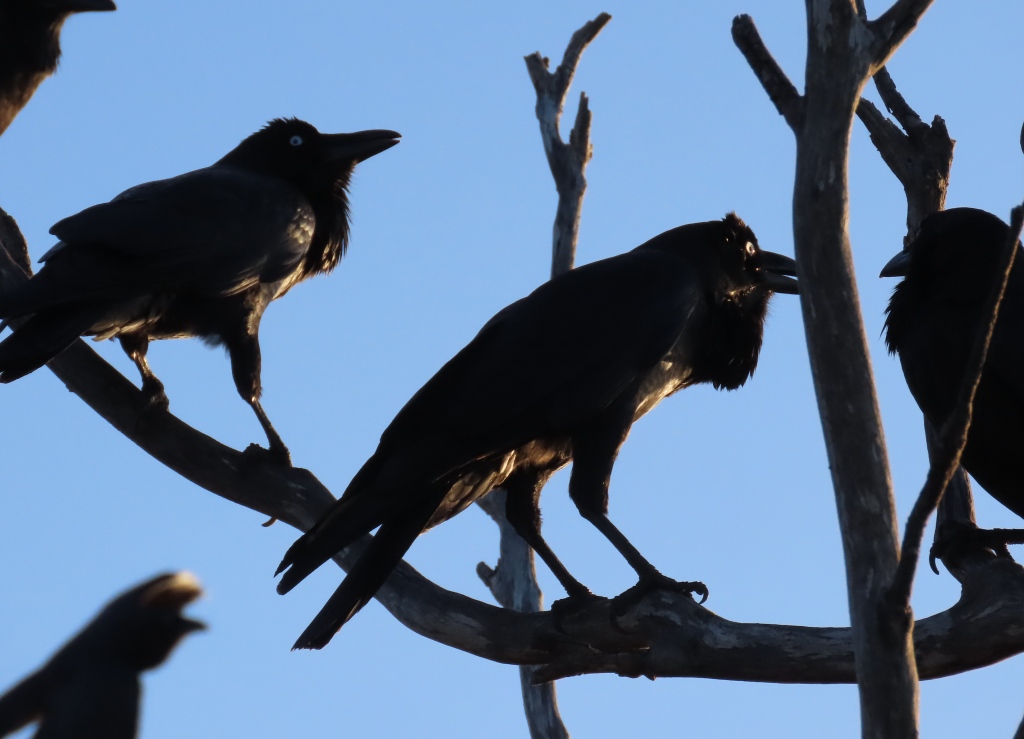
Common name: Australian Raven
Scientific name: Corvus coronoides
Approximate length: 50 cm
Date spotted: 10 June 2023 (winter)
Location: Dobroyd Head, New South Wales, Australia: 33°48’36.6″S 151°16’23.9″E
And the I’m-so-pretty, butter-wouldn’t-melt-in-my-mouth pose of the lorikeets:
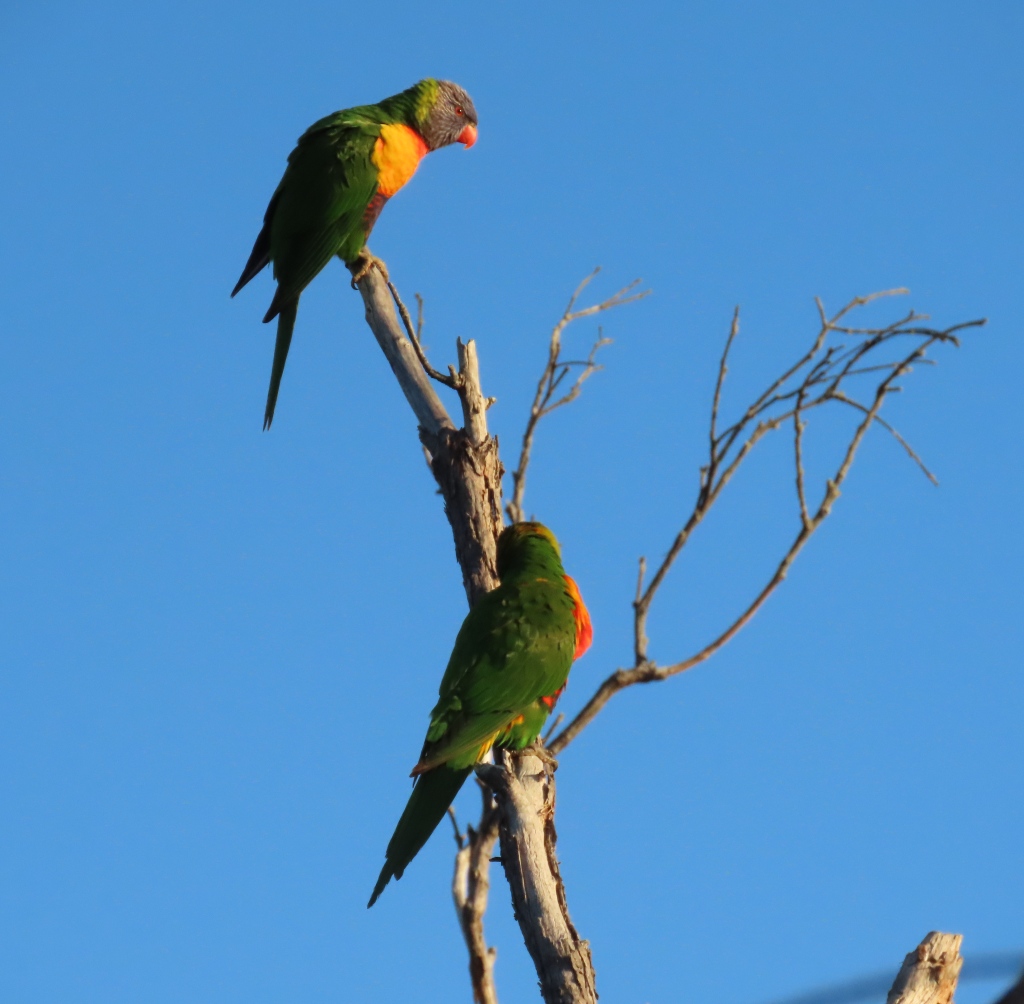
Common name: Rainbow Lorikeet
Scientific name: Trichoglossus haematodus
Approximate length: 30 cm
Date spotted: 10 June 2023 (winter)
Location: Dobroyd Head, New South Wales, Australia: 33°48’36.6″S 151°16’23.9″E
Rainbow Lorikeet practising its dance
A Rainbow Lorikeet swooped down onto the branch of a Casuarina tree and treated me to a little dance. I think it was practising, because there were no other lorikeets around, and the bird’s movements weren’t as fluid as others I’ve seen. A little practice was needed before trying out the dance on a potential breeding partner!
Common name: Rainbow Lorikeet
Scientific name: Trichoglossus haematodus
Approximate length: 30 cm
Date spotted: 28 April 2023 (autumn)
Location: Manly Dam, New South Wales, Australia: 33°46’38.6″S 151°14’55.6″E

Juvenile Crimson Rosella in Hazelgrove, NSW
A group of four young Crimson Rosellas gathered around a cabin that I was staying in this weekend, in the region of Hazelgrove. That’s west of the Blue Mountains, about three hours’ drive from Sydney.
At first, it was difficult to identify the birds. Other Crimson Rosellas that I’ve seen are red and blue, like the one in my earlier post. After some research, I discovered that the juvenile birds are mostly green instead of red, though they do have the characteristic red and blue markings on their heads.
Here are two of the birds that I saw this weekend:
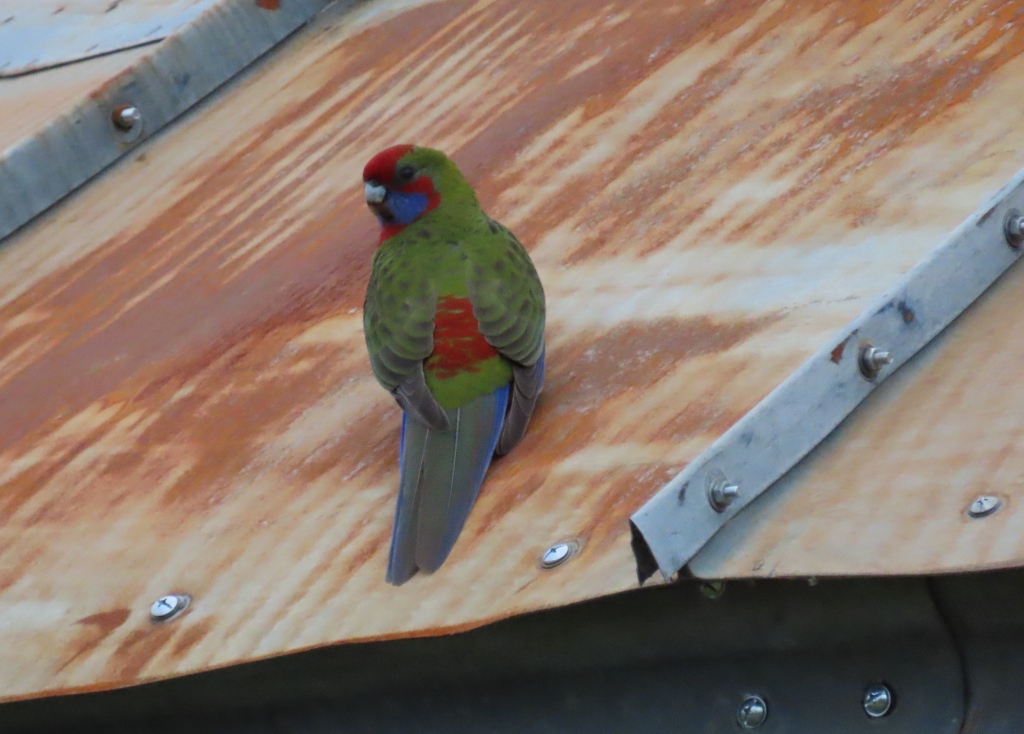
They were posing nicely on a rusty shed roof, for maximum warmth of colour!
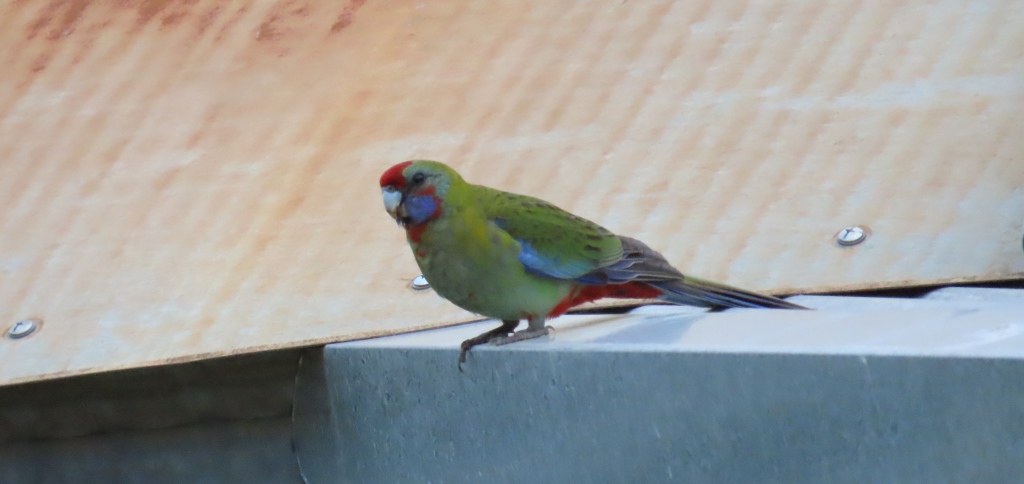
Common name: Crimson Rosella
Scientific name: Platycercus elegans elegans
Approximate length: 35 cm
Date spotted: 15 April 2023 (autumn)
Approximate location: Hazelgrove, New South Wales, Australia (map)

Musk Lorikeet drops by
Very occasionally, we’re lucky enough to see Musk Lorikeets in the gum trees around our house. Today was such a day:

They’re pretty little parrots, with a clearly-defined red mask around their eyes. Their predominant colour is green, with tinges of red, blue, and yellow.
The more boldly-coloured Rainbow Lorikeets are frequent visitors. It’s a treat when I hear the slightly different trilling call of the Musk Lorikeets, grab my camera, and am rewarded with a view like the ones in this post.
The lorikeets come to drink the nectar from the gum tree flowers. Here’s another view of the same Musk Lorikeet:
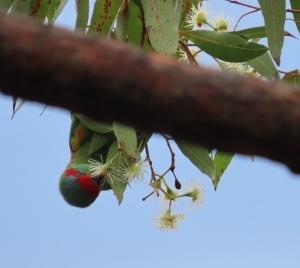
Common name: Musk Lorikeet
Scientific name: Glossopsitta concinna
Approximate length: 23 cm
Date spotted: 3 April 2023 (autumn)
Location: Allambie Heights, New South Wales, Australia

3 parrots on one walk
A few days ago I went for a walk and saw three different types of parrots all within a few paces of each other. How amazing is that!
First up, a trio of King Parrots. Two were males, the other a female. This is one of the males:

King Parrots are quite large, at 44 cm from head to tail. The females have a lot more green in their colouring. I think they’re prettier than the males, with their softer shading:
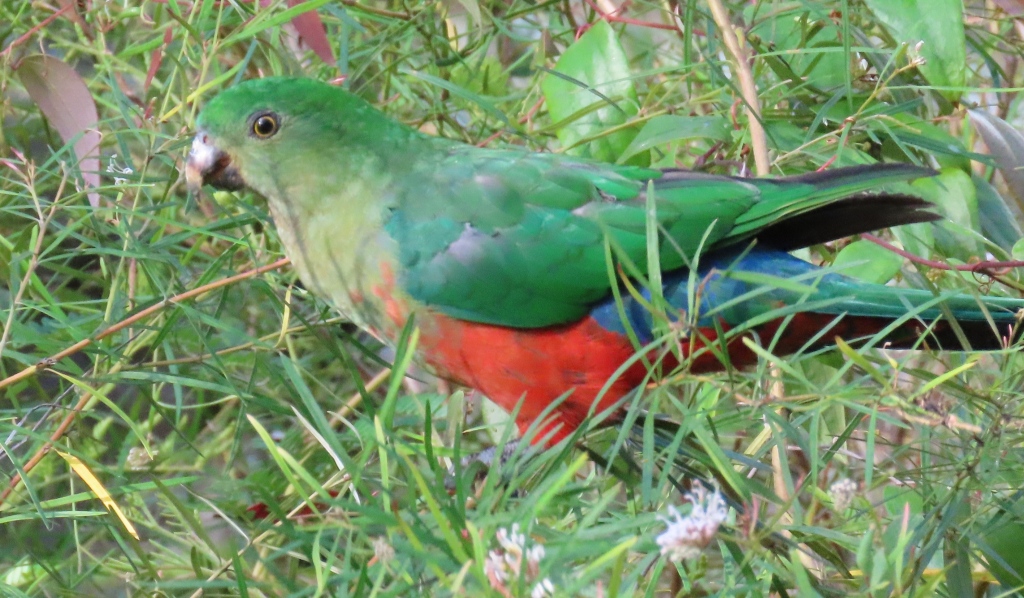
This video shows all three of the birds enjoying the flowers of a Grevillea bush. First you see the two males together. Then one of them flies over to join the female on the other side of the bush:
In the trees around the parrots, the smaller Rainbow Lorikeets chattered and scolded. Here’s one in a more contemplative mood than most:

One of them stood still for a while to examine me, before launching itself in my direction then swerving at the last moment as they are wont to do:
At the next tree, a group of Sulphur-crested Cockatoos examined a tree hollow. Perhaps a good place to raise a family? But competition is fierce!
Here’s one of the cockatoos making a point about ownership, or perhaps just being its usual excited self:

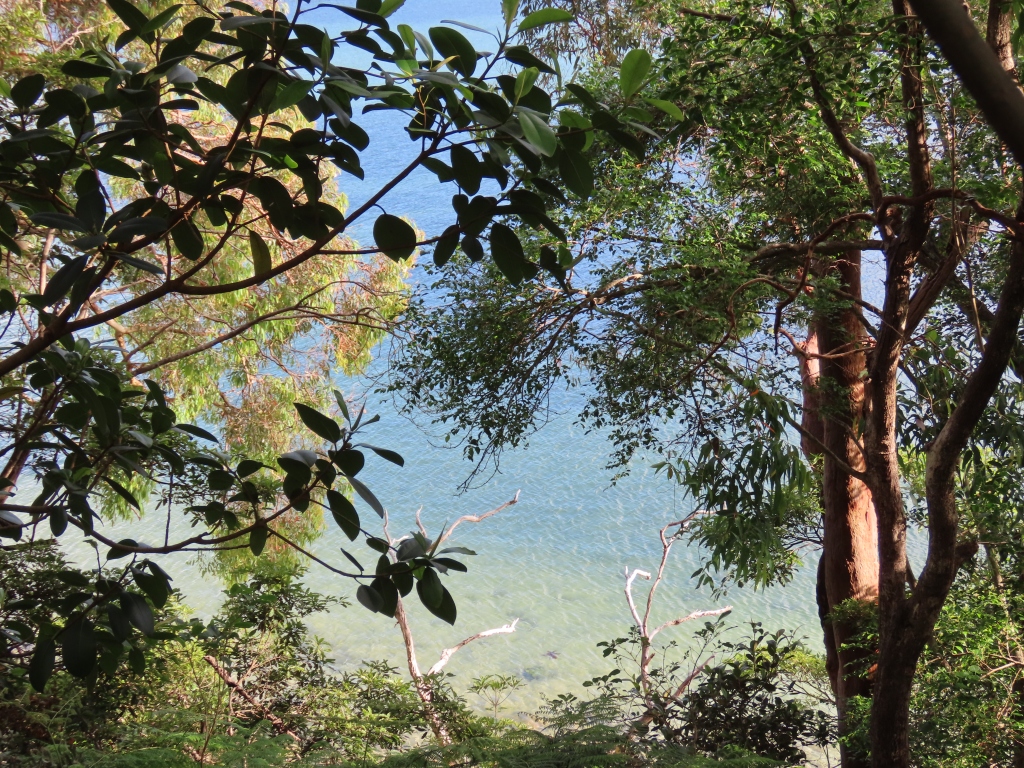
The walk itself is lovely, starting in Balgowlah and winding along the coast of Sydney Harbour, with bushland and forest on one side:

And pretty views of the waters of Sydney Harbour on the other side:
The birds:
Common name: Australian King Parrot
Scientific name: Alisterus scapularis
Approximate length: 44 cm
Common name: Rainbow Lorikeet
Scientific name: Trichoglossus haematodus
Approximate length: 30 cm
Common name: Sulphur-crested Cockatoo
Scientific name: Cacatua galerita
Approximate length: 50 cm
Date spotted: 26 November 2022 (spring)
Location: Near Forty Baskets beach, Sydney Harbour, New South Wales, Australia: 33°48’03.2″S 151°16’07.2″E


 Sydney Birder