Blog Archives

My first Black-fronted Dotterels
Wandering the paths of Manly Dam reserve a couple of days ago, I met a fellow birdwatcher. He showed me some pictures of a bird that he’d seen, and asked me if I knew what it was. I didn’t, which of course was gratifying to both of us. Something new! I wandered along to the rocks where he’d seen the bird. Sure enough, two pretty little waterbirds dashed back and forth along the water’s edge, poking their beaks into the green sludge on the rocks. I managed to photograph one of them (though I’m not sure it’s always the same bird in these photos).

I wondered if it was some type of stilt, but the beak and legs weren’t long enough. My fellow birdwatcher had suggested it was a juvenile plover.

The bird had a distinctive V-shaped black marking on its chest.
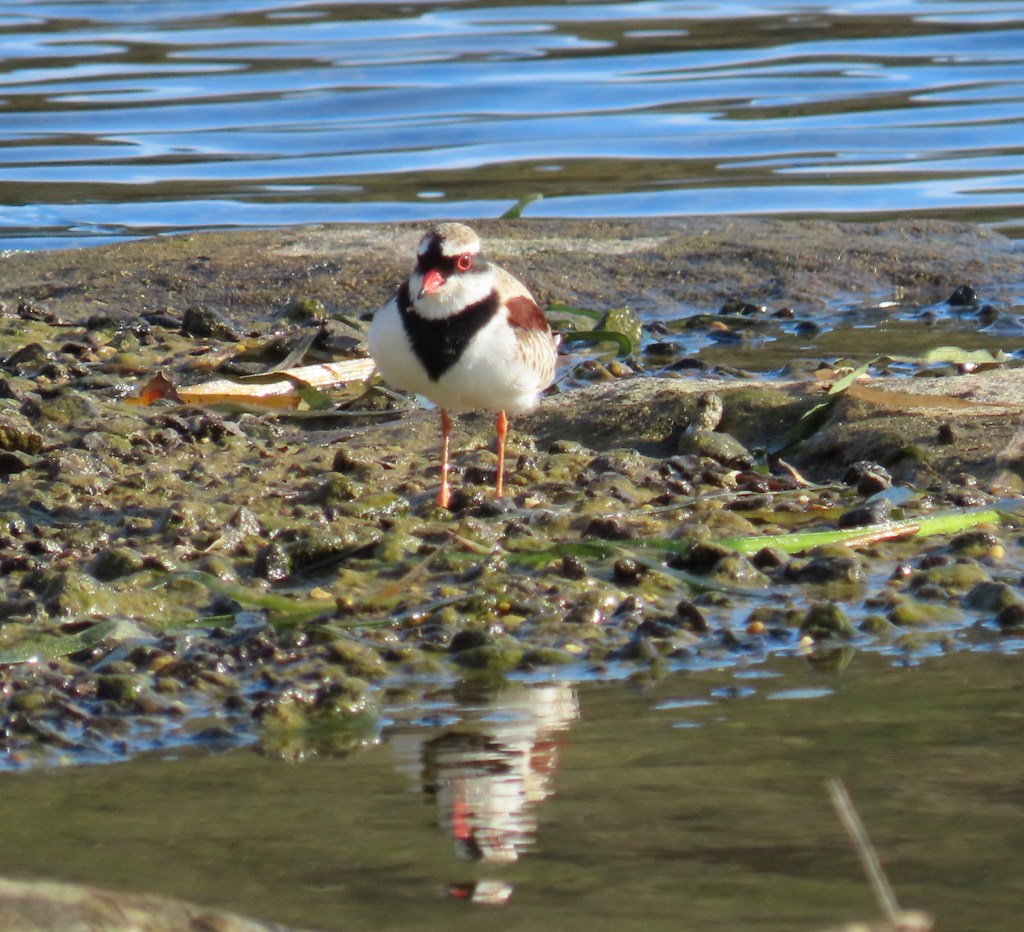
Consultation of my bird book revealed that these are Black-fronted Dotterels. They’re a type of plover. I heard them make their call, a series of short pips. Evidently they’re common and widespread, though I’ve not seen them in my area before.
Common name: Black-fronted Dotterel
Scientific name: Charadrius (Elseyornis) melanops
Approximate length: 16-18 cm
Date spotted: 22 September 2024 (spring)
Location: Manly Dam Park, New South Wales, Australia: 33°46’31.1″S 151°14’47.9″E

Video of a Superb Fairy-wren
At last, a Fairy-wren stayed visible for long enough to star in a short video! This one is a male Superb Fairy-wren chirping, wagging its tail, and hopping across open ground. Spotted at Dixons Long Point in NSW, on the banks of the Macquarie River.
A female was nearby too, but true to form it didn’t stay still long enough for a good photo. Here’s what I have:

Here’s a still photo of the male:

Common name: Superb Fairy-wren
Scientific name: Malurus cyaneus
Approximate length: 13-14 cm
Date spotted: 20 September 2024 (spring)
Location: Dixons Long Point, New South Wales, Australia: 33°01’13.5″S 149°16’53.6″E

Pretty yellow robin
An Eastern Yellow Robin paused for a few seconds on a nearby branch. I grabbed the chance to take a snap:

Common name: Eastern Yellow Robin
Scientific name: Eopsaltria australis
Approximate length: 15 cm
Date spotted: 17 September 2024 (spring)
Location: Manly Dam National Park, New South Wales, Australia: 33°46’23.8″S 151°14’39.8″E

Masleep! Or, sleepy Pelican contortions
Early this morning, a pelican dozed on the banks of Manly Dam:

I’ve never seen a pelican asleep before. It looked a bit weird and back-to-front.

At one stage, the pelican decided a yawn was in order:
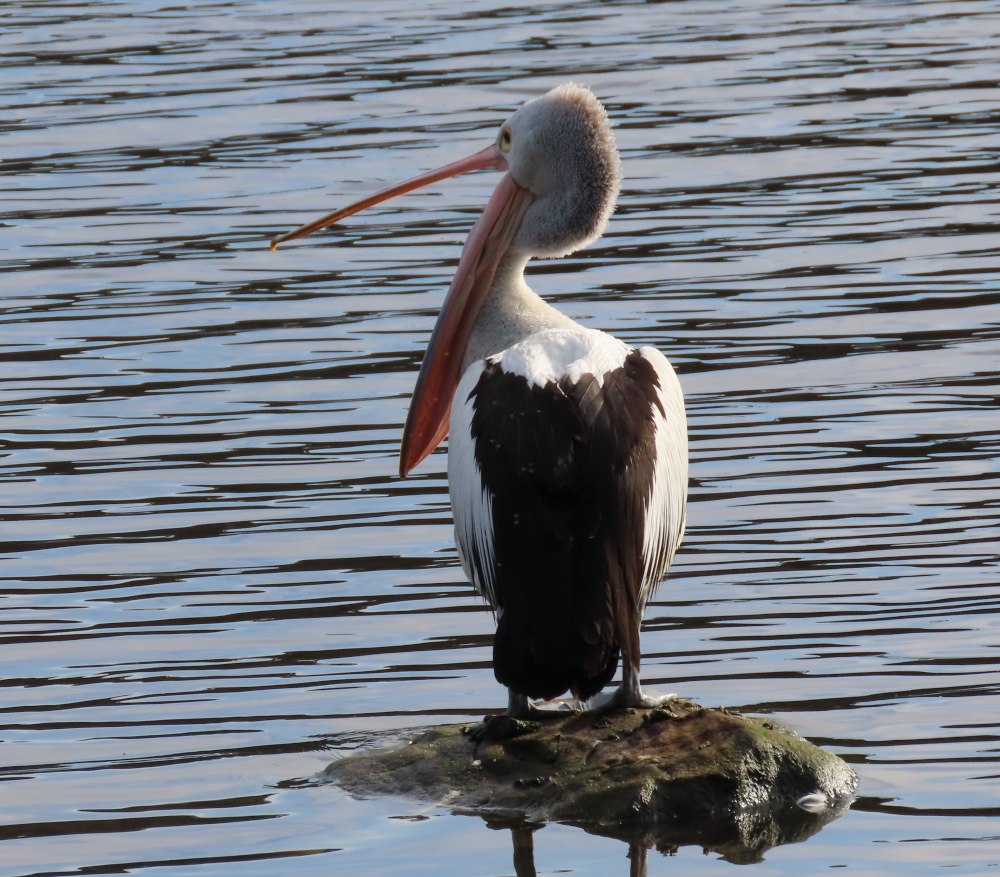
That pesky pouch beneath its beak got a bit tangled and inside-out:

Once that mess was sorted, the pelican manoeuvred its beak sideways onto its back:

With the beak nicely pointed straight down its back, the bird folded its wings over the beak. A bit like a bat, but the right way up!

Optimal sleeping position achieved:

Here’s the same bird, awake and looking as well put together as a pelican can:

It’s not often that you see a pelican at Manly Dam. I’m pretty sure this is a first for me, though I’ve seen them often on the beaches around Sydney.
Common name: Australian Pelican
Scientific name: Pelecanus conspicillatus
Approximate length: 170 cm
Approximate wingspan: 2.5m
Date spotted: 9 September 2024 (spring)
Location: Manly Dam Park, New South Wales, Australia: 33°46’31.2″S 151°14’46.6″E

Call of the Sacred Kingfisher
Ever wondered what a kingfisher sounds like? Well, you’ll know after watching this video, for a Sacred Kingfisher anyway. The call is a series of chirps, all on more or less the same note. Not very exciting really, for such a pretty bird! You hear them mostly around breeding time, when the calls can be quite insistent.
At the start of the video, you see and hear the kingfisher calling. The camera then zooms out to show the surroundings, including a Great Egret, a Darter, and a Coot. The scene is set at Manly Dam in Sydney’s Northern Beaches.
Set the video settings to HD for best results:
Despite their name, these kingfishers don’t often eat fish! Instead, they prey on small reptiles and large insects, and occasional crustaceans from the water’s edge.
Common name: Sacred Kingfisher
Scientific name: Todiramphus sanctus
Length: 20-23 cm
Date spotted: 8 September 2024 (spring)
Location: Manly Dam Park, New South Wales, Australia: 3°46’31.2″S 151°14’46.6″E

Looking great!
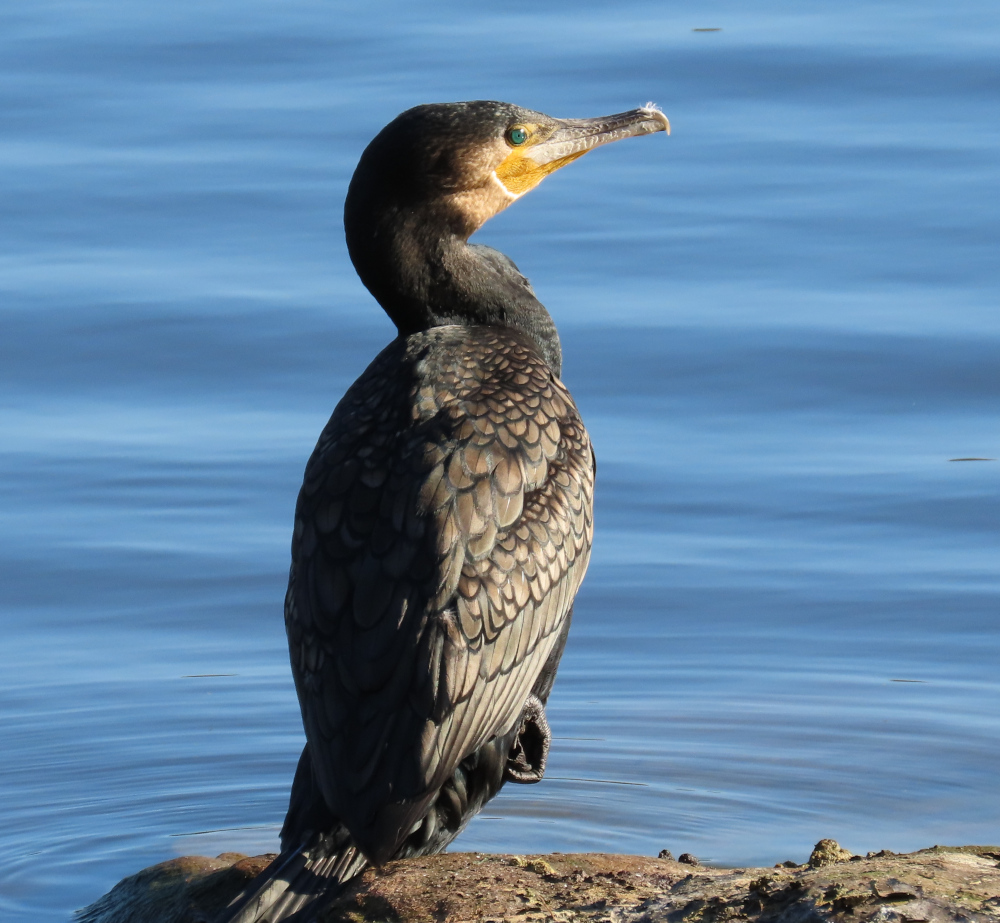
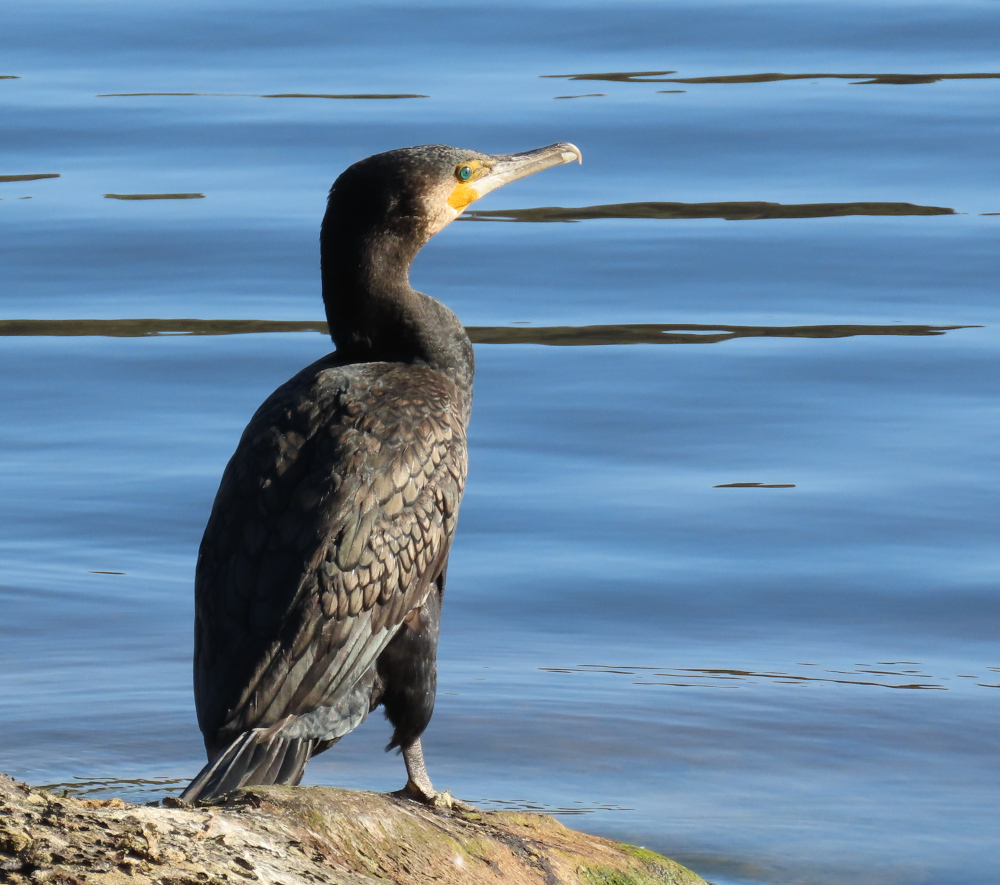
These two Great Cormorants were chilling at Manly Dam, in Sydney’s Northern Beaches. I didn’t realise how pretty their wing feathers are until I saw them through the camera zoom.
The first bird’s image is slightly spoiled by the bit of fluff on its nose, but check out those clear turquoise eyes and white-and-yellow face markings:
The second bird has no fluff problems, and stands proud:
Common name: Great Cormorant
Scientific name: Phalacrocorax carbo
Approximate length: 85 cm; wing span 1.5 m
Date spotted: 6 September 2024 (spring)
Location: Manly Dam, New South Wales, Australia: 33°46’34.5″S 151°14’50.5″E

White-necked Herons in Sydney’s Northern Beaches
Yesterday, walking at the north western end of Manly Dam, I saw four large water birds flying high above the trees. Here are two of them:

Intrigued, I followed them around the corner where, luckily, they landed high in a tree. I managed to photograph two of them, before they took off again:
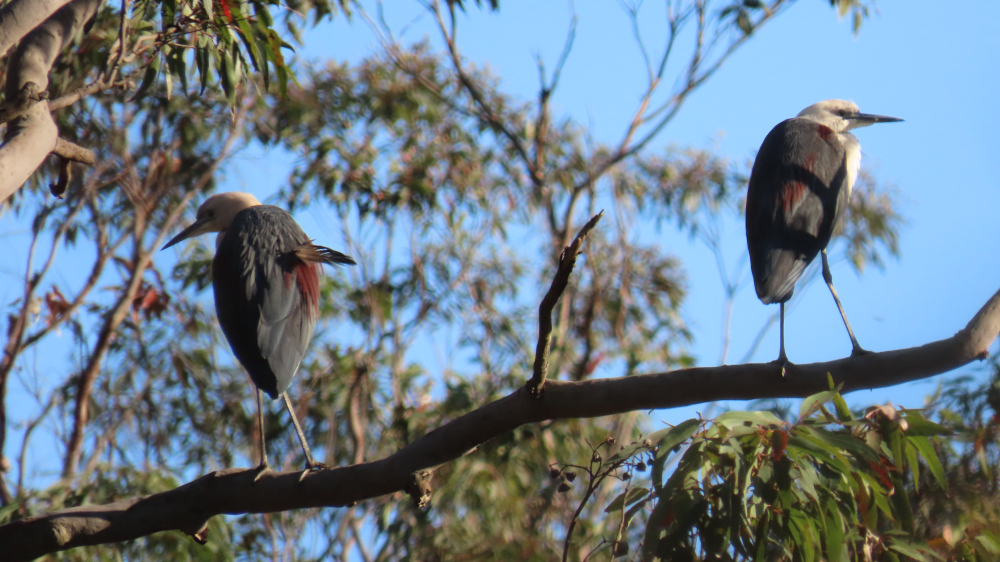
They’re White-necked Herons! This is my first sighting of these birds. They’re large and impressive, with those long legs and undertaker stance. The bird on the left has a misplaced feather that, combined with the reddish colouring on its wing tips, looks a little painful.
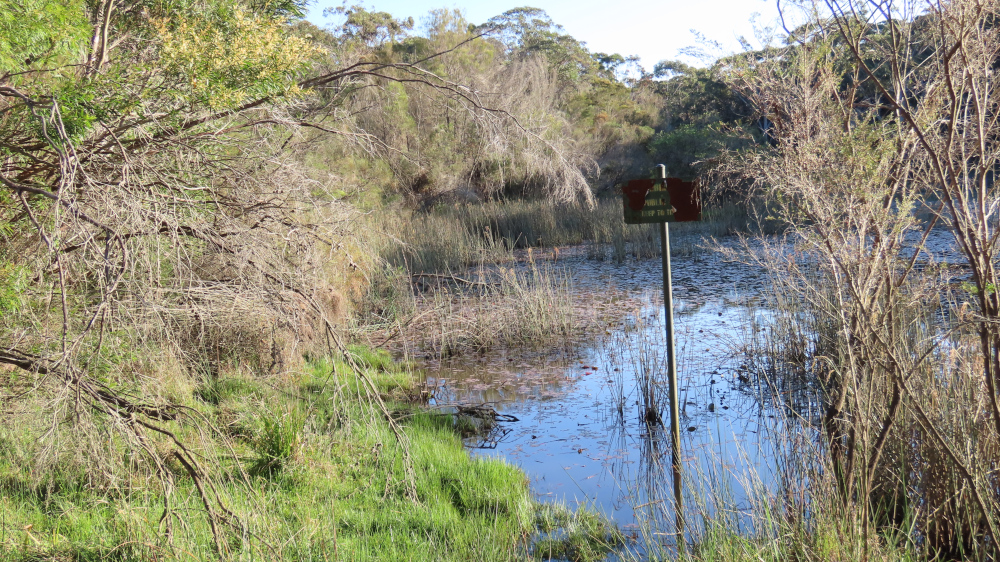
The birds were very high up, in the furthermost tree in this picture (though they had gone by the time I took the photo):
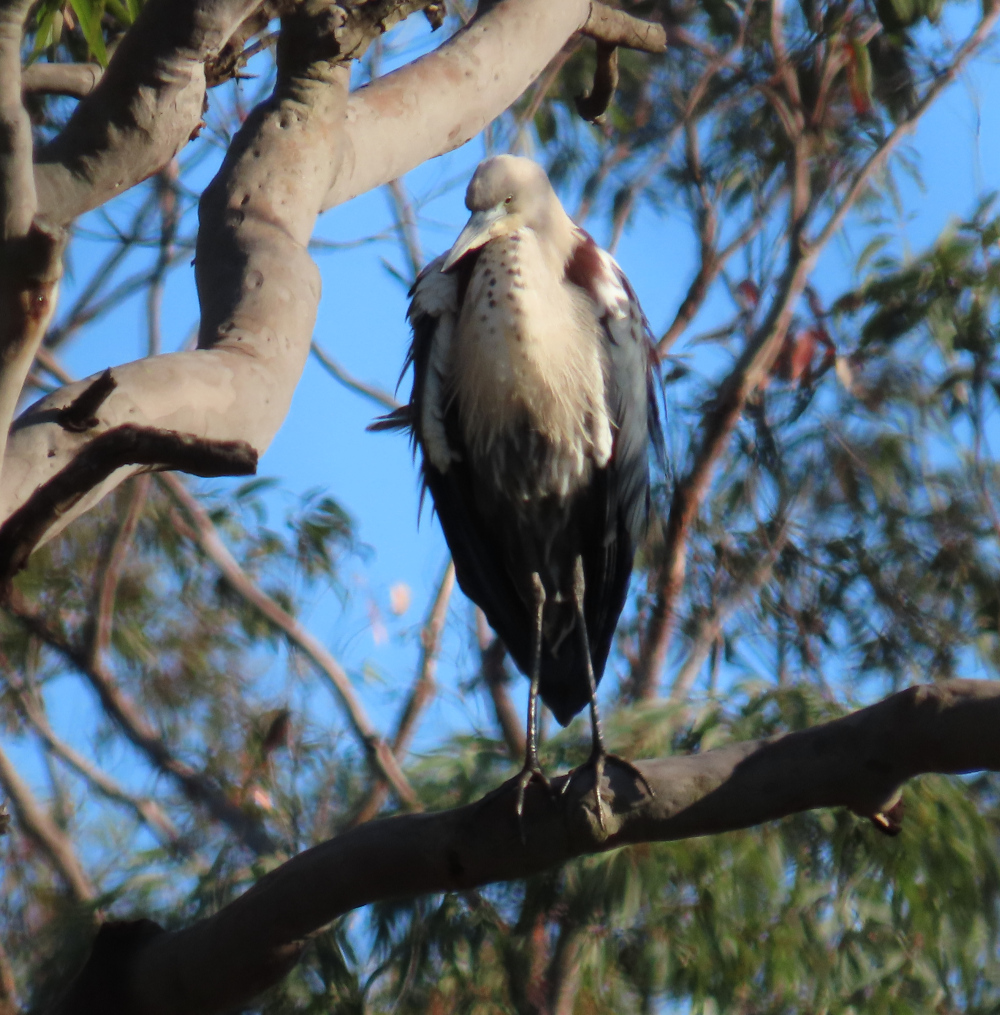
The left-most bird turned around at one stage, giving us a nice view of the spots running down its chest and the reddish marking at the top of its wings:
Another pose of the same bird:

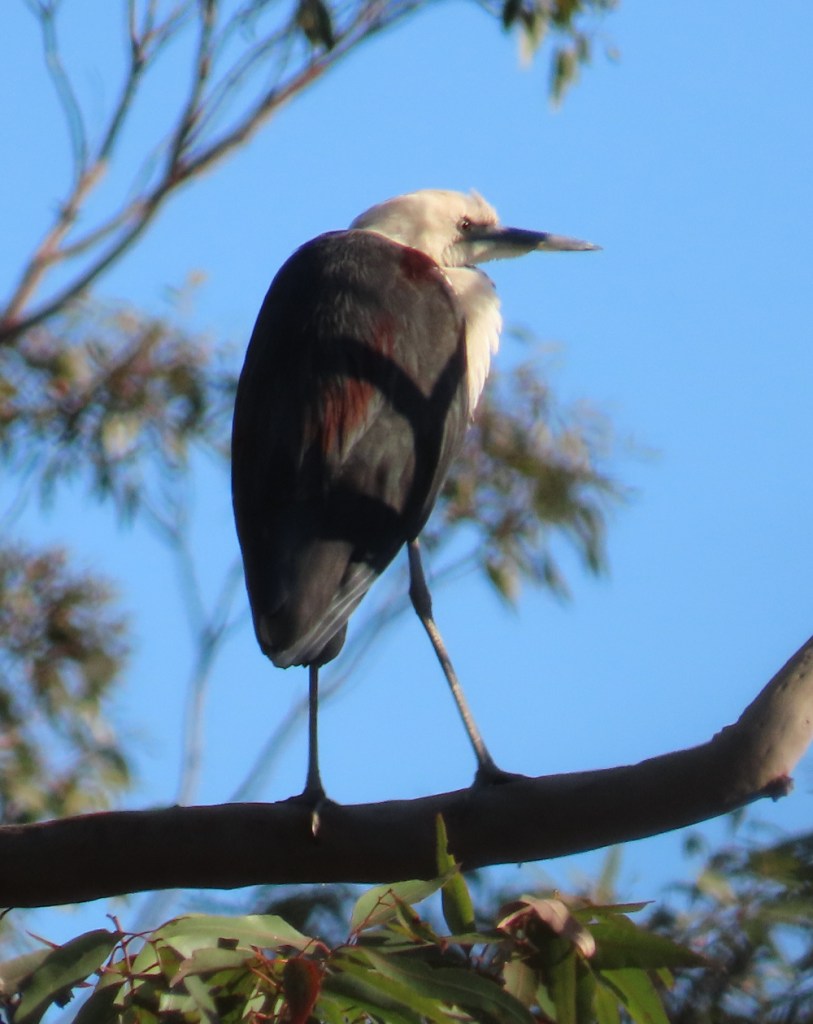
This is the right-hand bird, looking altogether sleeker and fiercer:
It’s exciting to see such large, impressive visitors at Manly Dam!
Common name: White-necked Heron
Scientific name: Ardea pacifica
Approximate length: 75-105 cm
Date spotted: 2 September 2024 (spring)
Location: Manly Creek in Manly Dam Reserve, New South Wales, Australia: 33°46’20.0″S 151°14’30.6″E

Currawong crazy hour
An excited group of currawongs made our backyard the centre of their activity yesterday afternoon. The commotion lasted at least half an hour. Birds dashed back and forth, calling and flying noisily past each other. Parents of young children will sympathise with the term “crazy hour”, sometimes called the “witching hour”, in late afternoon — it seems to apply to currawongs too!
Common name: Pied Currawong
Scientific name: Strepera graculina
Approximate length: 45 cm
Date spotted: 31 August 2024 (end of winter)
Location: Allambie Heights, north of Sydney, New South Wales, Australia

Golden Whistlers calling
It’s a lovely experience walking through an Australian forest, with Golden Whistlers calling around you. In this video, the bird appears only as a shape flashing through the branches. There’s also a Grey Fantail echoing the whistler’s call:
That video is from my Soothing Musings channel. I’ve included it here because it’s such a tranquil scene.
The next video shows one of the birds calling to his mates:
At the start of the video, some Sulphur-crested Cockatoos are screeching, but they quieten down eventually. You can also hear a Grey Fantail at about 26 seconds into the video and again at the end. There’s an Olive-backed Oriole calling in the distance too.
Golden Whistlers are small birds, about the size of a wren. They have a black head, a white bib, and the golden chest, underbelly, and collar that gives them their name.

Common name: Golden Whistler
Scientific name: Pachycephala pectoralis
Approximate length: 16-18 cm
Date spotted: 30 August 2024 (end of winter)
Location: Manly Dam Reserve, New South Wales, Australia: 33°46’50.3″S 151°14’51.7″E

Three whipbirds calling
The noise that whipbirds make is strange: “eeeuuw-phwit”. It reminds people of a whip whistling and cracking, and that’s what gives the bird its name.
In this video, at least three Eastern Whipbirds are calling to each other. Twice in the video, you can hear two of them doing the long drawn-out whistle at the same time: the whistle vibrates and little. When you hear two (or three) chirps after the whistle and crack, like “eeeuuw-phwit-pheeuw-pheeuw”, the last two (or three) chirps are actually made by a second bird. The final chirps come so close after the first call that it sounds like one bird.
As you can see in the video, whipbirds are very good at hiding in the bushes. It’s hard to get a good picture. They’re quite pretty, in a subdued, forest-loving way.
Here’s one of the birds:

Its head and neck are black and white, with a nice little crest. The back and tail are a soft forest green. Here’s the same bird from a different angle:

Common name: Eastern Whipbird
Scientific name: Psophodes olivaceus
Approximate length: 30 cm
Date spotted: 22 August 2024 (winter)
Location: Dobroyd Head in Sydney Harbour, NSW, Australia: 33°48’35.6″S 151°16’04.6″E


 Sydney Birder