Blog Archives

Peregrine Falcon at Dobroyd Head near Sydney
On an early morning walk at Dobroyd Head in Sydney Harbour, I spotted this beautiful falcon:

The bird sat quietly on a bare branch, observing the world from on high. I think it’s a Peregrine Falcon. My other choice would be an Australian Hobby, but the lighter-coloured collar doesn’t curve upwards as much as I’d expect in an Australian Hobby:

On the other hand, adult Peregrine Falcons in this area of Australia have a white collar. This bird’s collar is buff-coloured. It could be a juvenile bird, or it could be one of the buff-fronted form of Peregrine Falcon strayed all the way from Western Australia.
Both Peregrine Falcons and Australian Hobbies are uncommon, though widely distributed. The Peregrine Falcons are more rare than the Australian Hobbies.
Here’s another view of the falcon. Let me know if you think it’s an Australian Hobby rather than a Peregrine Falcon:

The bird was far away from me. Here’s a picture using less of my camera’s zoom. The falcon is perched on the bare tree to the right. To the left is another bird, most likely a Noisy Miner:

Birds of prey in Australia are often accompanied by a minder — another bird, usually a Noisy Miner, ready to sound the alarm if the hunter looks likely to hunt. This falcon was so peaceful that even the Noisy Miners were quiet!
Common name: Peregrine Falcon
Scientific name: Falco peregrinus
Approximate length: 35-50 cm; wing span 85-100 cm
Date spotted: 27 November 2022 (spring)
Location: Dobroyd Head, Sydney Harbour, New South Wales, Australia: 33°48’35.5″S 151°16’27.5″E
Great Cormorant reflections at Manly Dam
In the early morning, a Great Cormorant holds its wings up to dry:

The cormorant waves its wings gently in the still air. Every now and then, it turns to check the noisy Australian Ravens in the background. As I approach along the path, the cormorant decides to take off and head for a safer spot further up the dam:
Common name: Great Cormorant
Scientific name: Phalacrocorax carbo
Approximate length: 85 cm; wing span 1.5 m
Date spotted: 19 November 2022 (spring)
Location: Manly Dam, New South Wales, Australia: 33°46’34.5″S 151°14’50.5″E

Orange-breasted Sunbird sticks out its tongue
A couple of weeks ago, I was on top of Table Mountain in South Africa. One of the birds I saw was an Orange-breasted Sunbird:
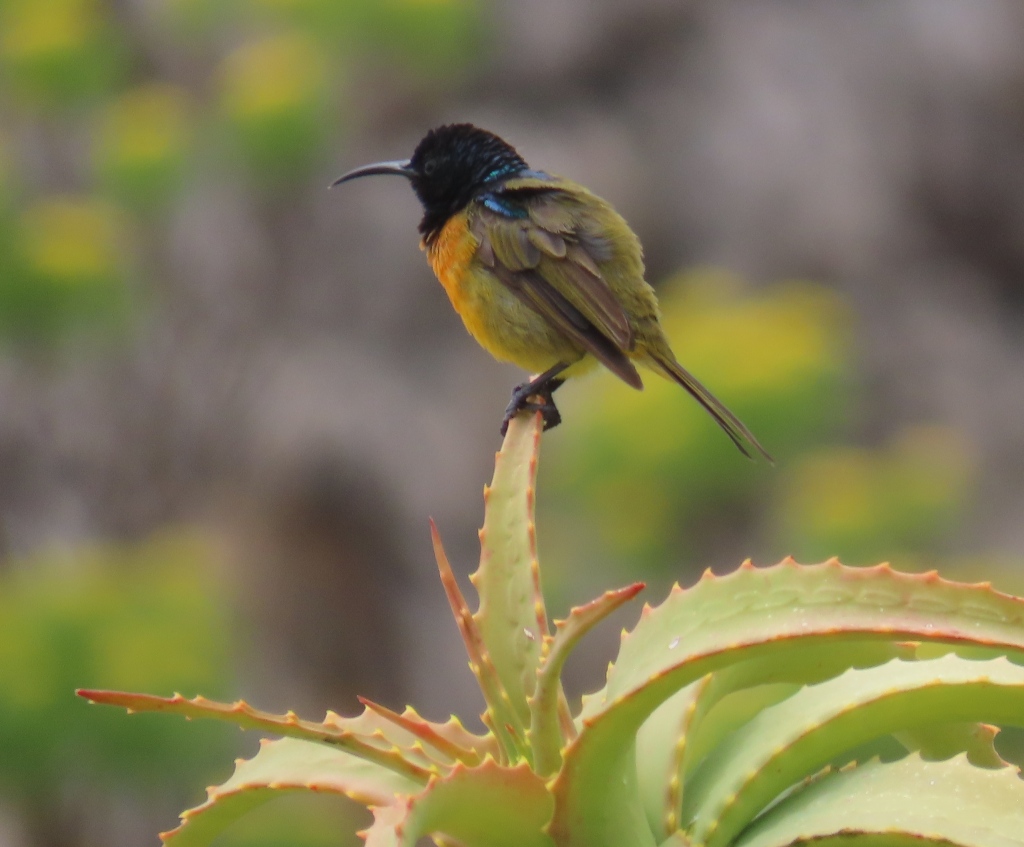
It’s a small bird with a black head, orange chest fading to yellow lower on the front, and iridescent blue markings above olive and brown wings. Super pretty!
Sunbirds have long, tubular tongues that they use to suck nectar from flowers. This next picture shows the bird’s tongue protruding from its beak:
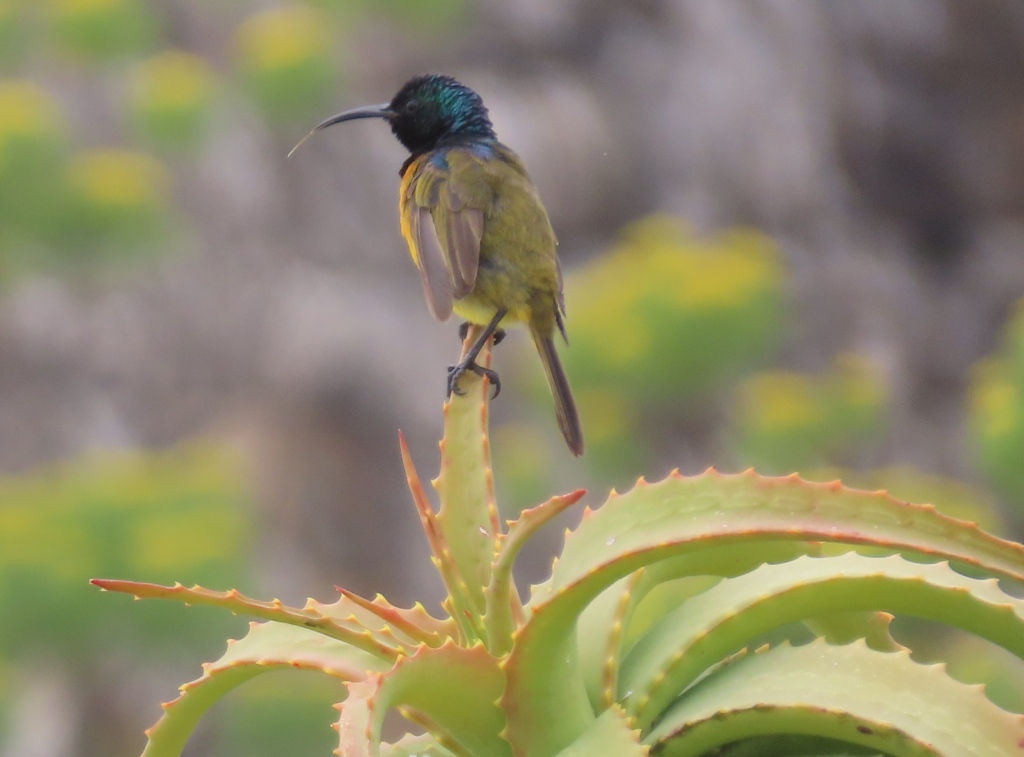
Being up on Table Mountain is one of my favourite experiences. If you’d like to see more about being there, take a look at my bookmark’s blog: Atop Table Mountain in the clouds.

White-capped Red-winged Starling on Table Mountain
A couple of weeks ago, while on a short visit to South Africa, I saw this bird on Table Mountain:

I didn’t know what type of bird it was, but it looked to have a messy white cap.
Then the bird started poking its beak into the nearby flowers:

See how the flower touches the top of the bird’s head? The flower is dumping pollen grains — a handy way to get its genes transferred to the next plant visited by the bird!

The bird is a Red-winged Starling. The male is black with red flares on its wings. It typically doesn’t have a white patch on top of its head! The female’s colouring is softer, with a grey head and blue hues in the rest of the plumage. She also has orange-red wing flares:
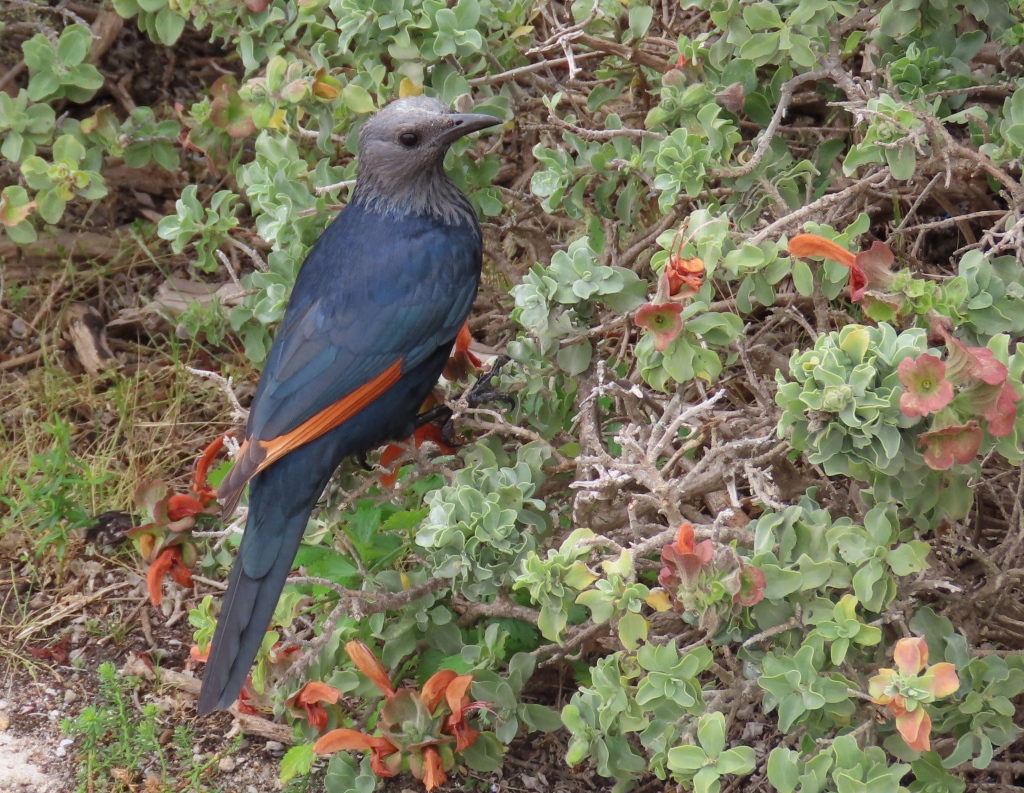
The two birds spent some time playing together on the edge of the mountain. In the next photo, the male shows the red wing flares nicely as it comes in to land:

Being on top of Table Mountain is a magical experience. It really is flat up there, like a table top. The morning that we were up there was misty and quiet:
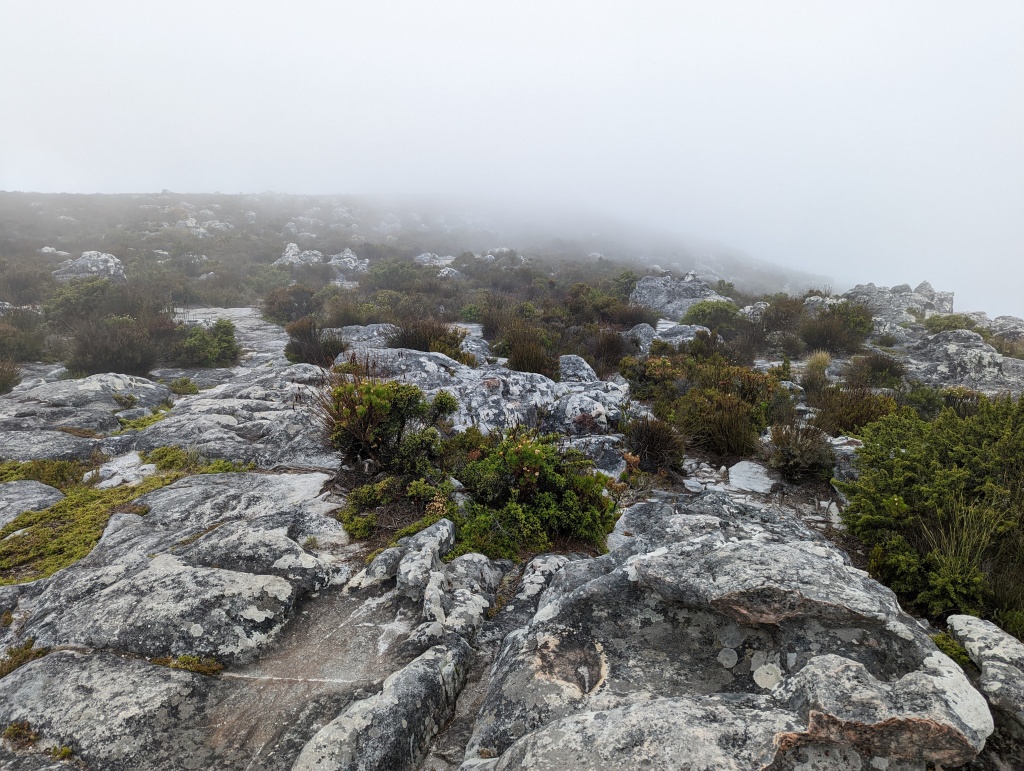
If you’d like to see more about being there, take a look at my bookmark’s blog: Atop Table Mountain in the clouds.

Australian Brush-turkeys, a wallaby, and me
Back in Sydney after a short visit to South Africa, I’m delighted to walk among the Ozzie birds again. Among them are the endearingly stupid Australian Brush-turkeys.
Here I am, following some Brush-turkeys along a path. The birds make that peculiar grunting noise that is all their own. I suppose it’s a big chicken’s version of a cluck:
Australian Brush-turkeys are funny to watch when you’re sharing the same path as them. They’re a little concerned that you’re there, but they’re also very reluctant to cede the path to you. So if you walk at normal speed, they get quite flustered and rush around trying to race you. (While taking the video, I was walking very slowly.) Eventually, one smart bird stands aside just off the path. With luck, the others decide this is a wise strategy and do the same. Alas, though, they come to this conclusion at varied times, which means there’s a lot of clucking and fluttering involved to rally troops again after the danger (you) has passed.
Here’s a still picture of the birds making their way up the path ahead of me:

A closer view of one of the birds, who has realised that she’ll have a more peaceful life if she stands on the side of the path and waits for me to pass:
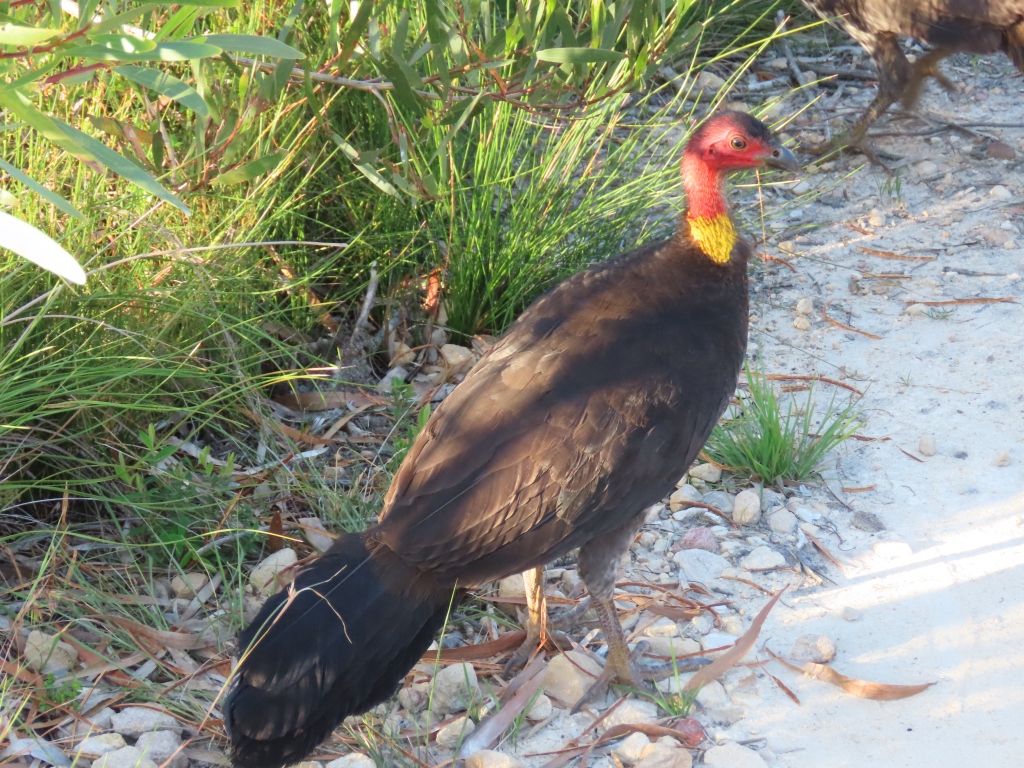
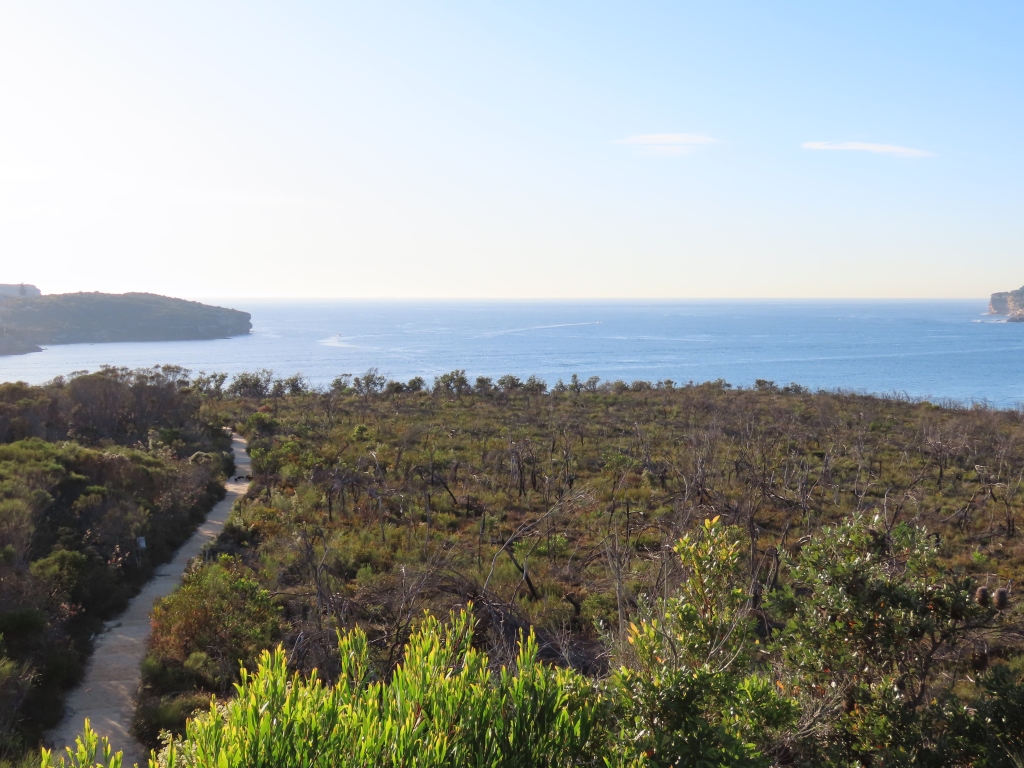
I reached the highest point of my walk and looked back down the path. The birds have found each other again and have the path to themselves:
On my way back, I encountered the same group of birds, but this time with an interloper:
A Swamp Wallaby, sometimes called a Black Wallaby, was peacefully examining the path alongside the brush-turkeys. I often see these kangaroo-like marsupials out in the early morning. They’re much smaller than kangaroos, typically reaching the height of my hips when standing on their back legs. Here’s a still photo of the wallaby with the brush-turkeys:

A few weeks ago, I filmed a Swamp Wallaby in the same area of the path. It could easily be the same animal. The video shows a good view of the animal’s head and front paws as it munches away at a bush:
In the background on the video, you hear some magpies carolling, a wattle bird squawking, and a lone whip bird calling.
Australian Brush-turkey
Scientific name: Alectura lathami
Approximate length: 60-70 cm
You can see more about this bird, including some chicks and the male’s strange call, in my other posts about Australian Brush-turkeys.
Swamp Wallaby
Scientific name: Wallabia bicolor
Approximate length: 66-85 cm
Date spotted: 12 November 2022 (spring)
Location: Dobroyd Head Track, New South Wales, Australia: 33°48’35.5″S 151°16’19.7″E

Cape Gulls at Melkbosstrand, South Africa
This is my last post from my holiday in sunny South Africa. The photos in this post come from my frequent early-morning walks along the beach at Melkbosstrand, about 40 minutes’ drive up the west coast from Cape Town.
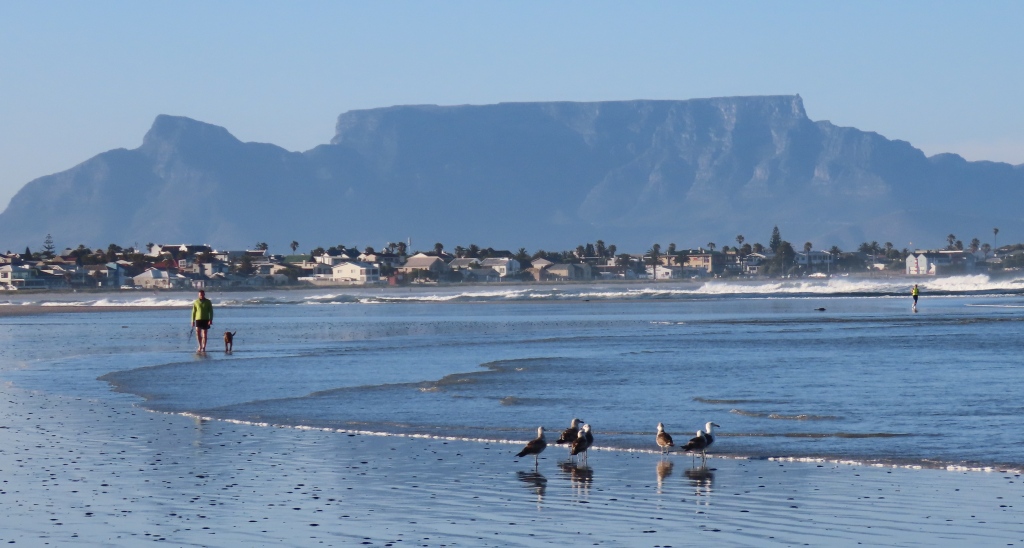
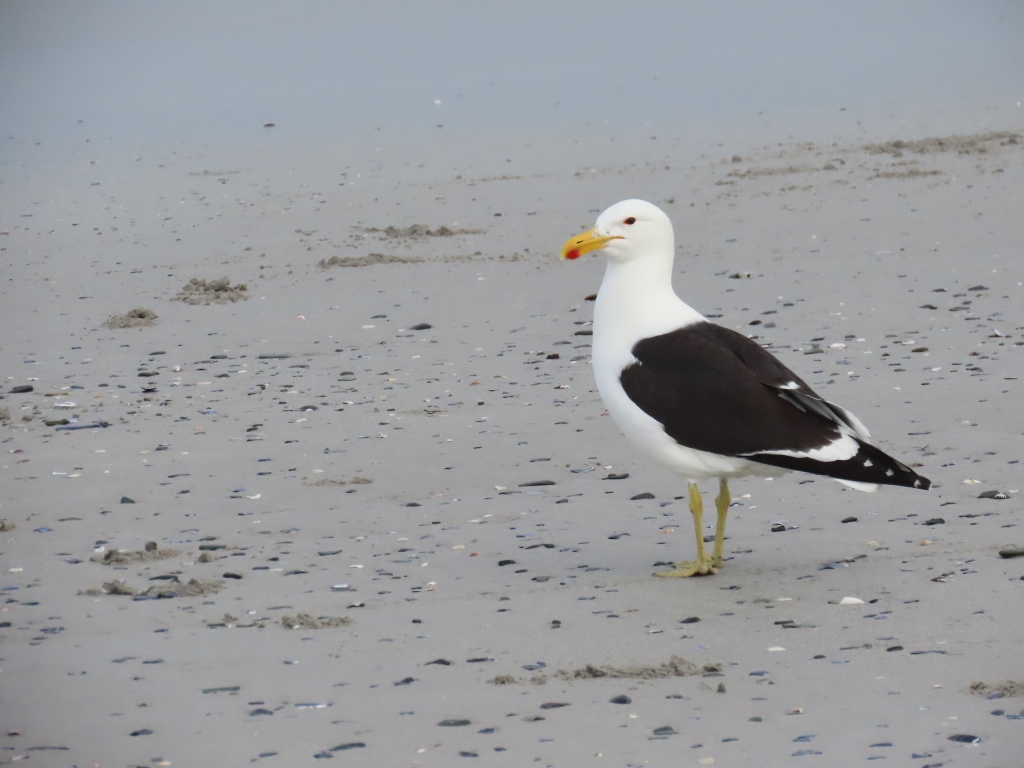
Most of the seagulls on the beach were Cape Gulls. Here’s a group of them with Table Mountain as a backdrop:
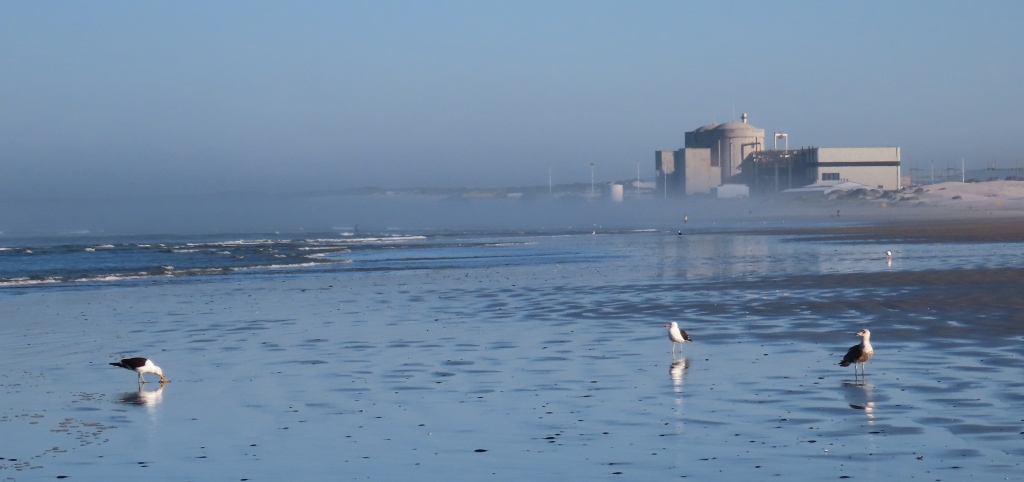
Looking in the other direction along the beach on a clear day, the backdrop is Koeberg nuclear power station:
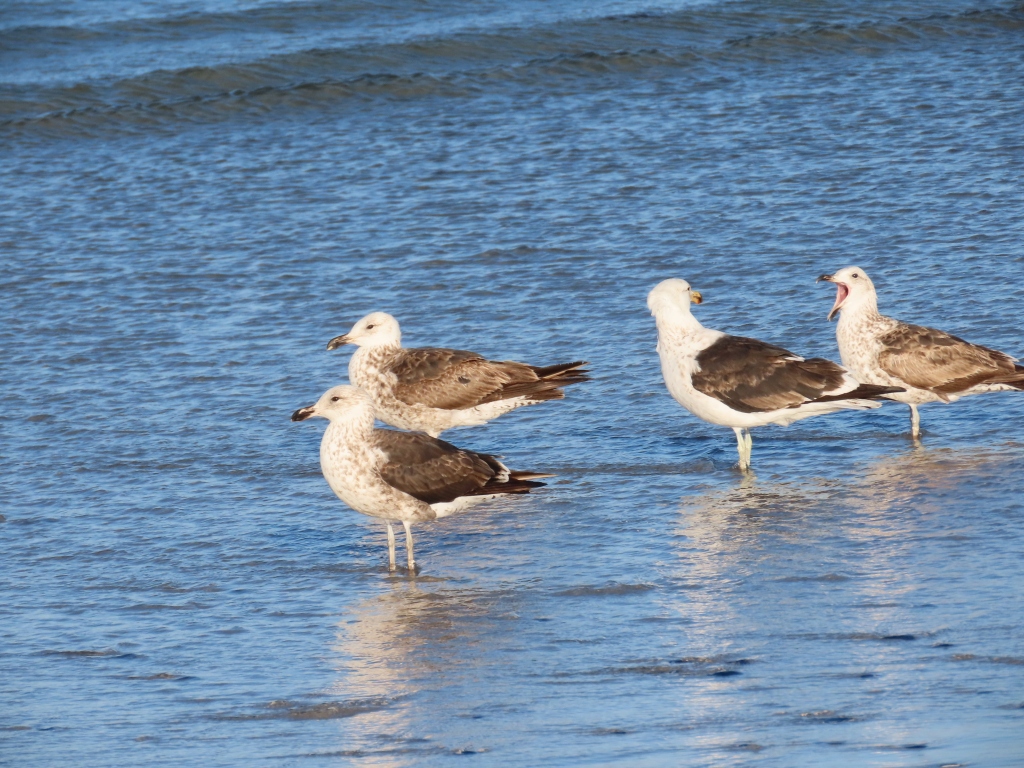
At first I thought I was seeing two different types of gulls, because the juveniles are large and have very different colouring from the adults. The adult is a neat black and white. The yellow beak ends with a distinctive red splotch:
The juveniles are a soft, mottled brown and cream:
Junior coming in to land:
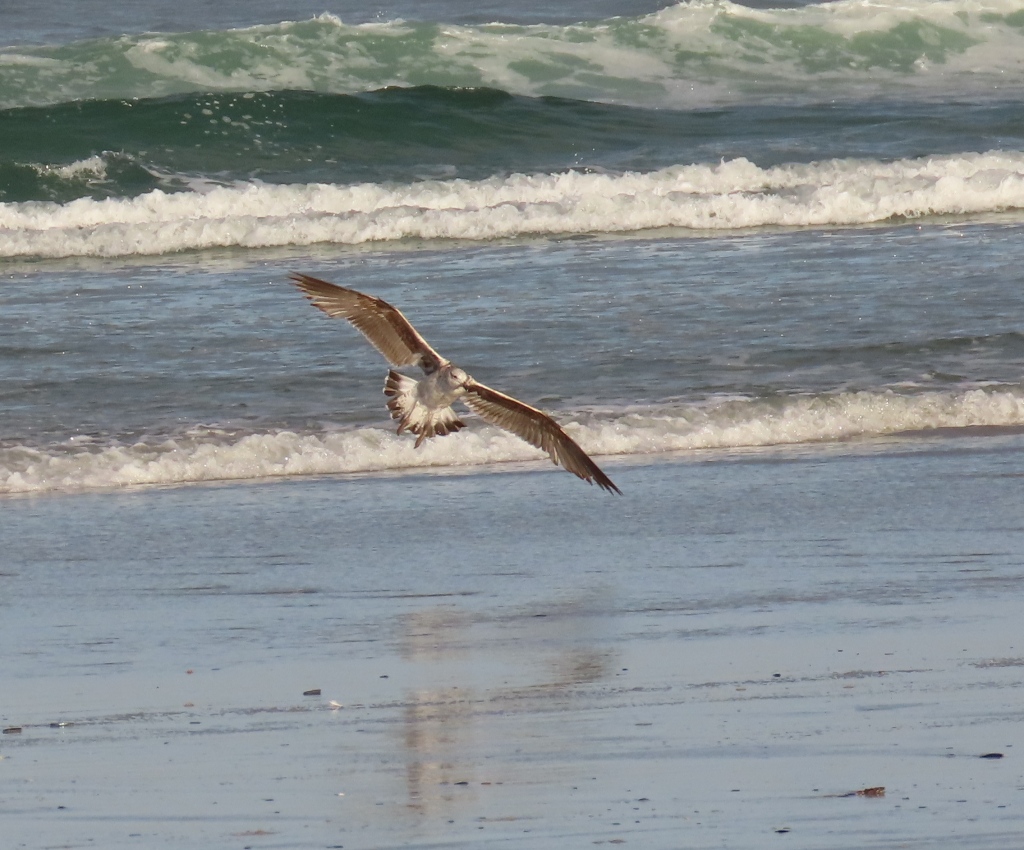
An adult performing a similar manoeuvre:

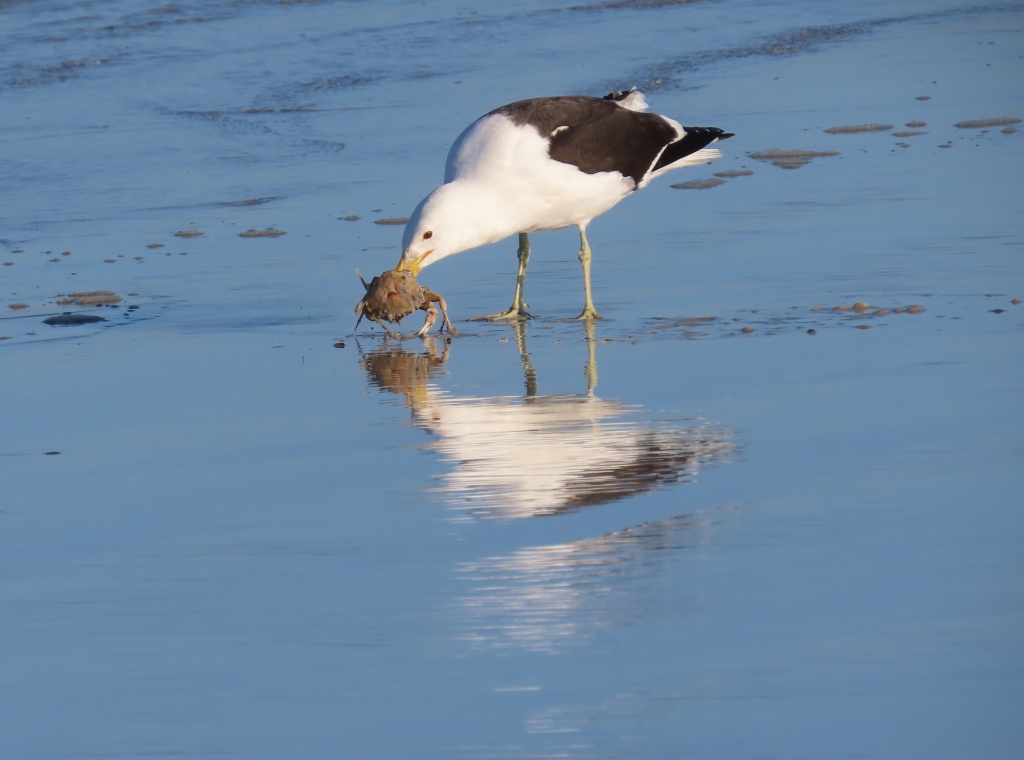
A story of a crab: I spotted a crab upside-down on its back, with its legs embedded in the wet sand. It was quite large, the body about the size of the palm of my hand. I picked up a shell and used it to gently tap the crab. Instantly, the pincers swung round and tried to grab the shell. Ah, it’s alive! I used the shell to flip the crab over. It immediately dug itself into the sand with its back legs, until just the top of its shell was showing:

A little while later, this scene made me doubly glad that I’d rescued that particular crab. Another crab had become a seagull’s meal:
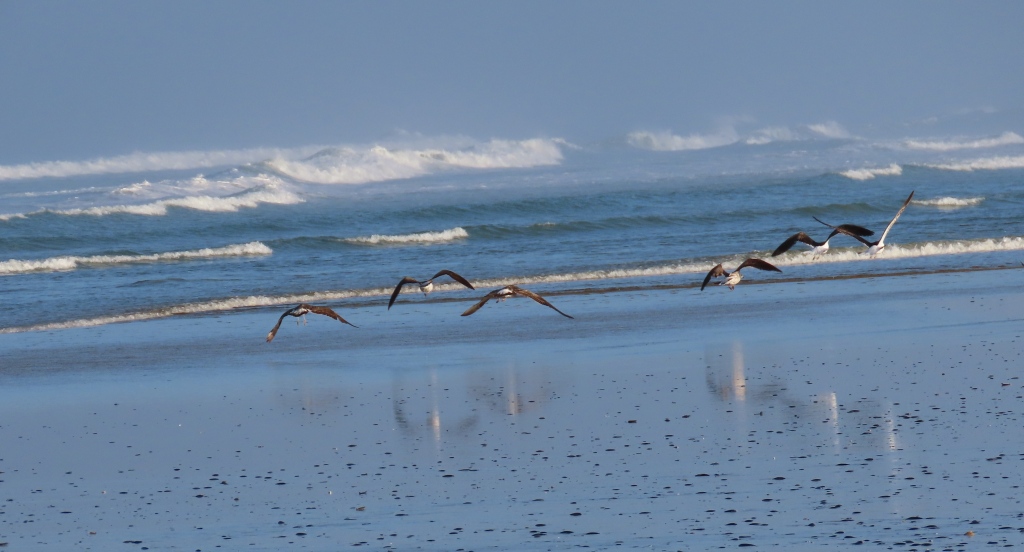
Cape Gulls in motion:
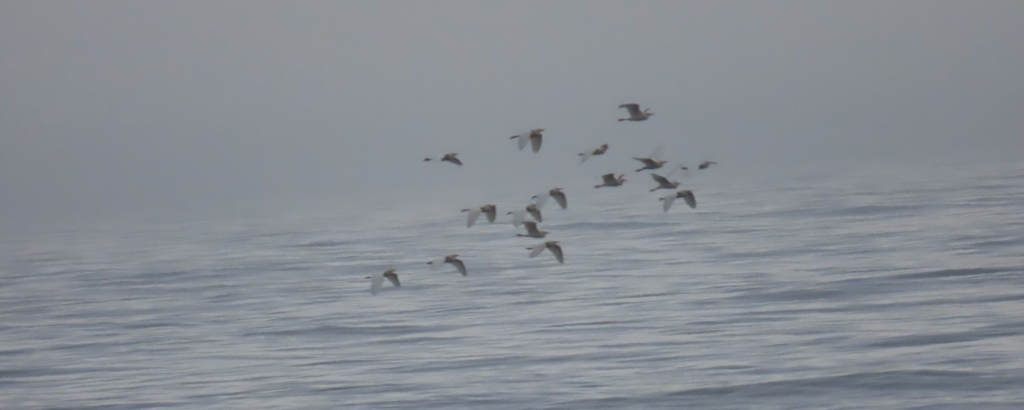
A moody, misty shot:
As a parting shot, seagull footprints on the sand:

My next post will be from back home in Australia!

Oystercatchers and White-fronted Plover at Melkbosstrand, South Africa
I’m in South Africa for a few days (so, not in Australia!). This morning I went for a walk along the beach at Melkbosstrand, which is on the west coast of Africa, about half an hour’s drive north of Cape Town.
Four African Oystercatchers roamed the beach. One of the birds was alone, patrolling the rocks for mussels and other shellfish:
African Oystercatchers, also called African Black Oystercatchers, are considered a threatened species. There are about 6,000 adult birds in the wild. Here’s a photo of the same bird:

Zooming out a bit to see more of the bird’s environment:

Further along the beach was a trio of Oystercatchers:

When I zoomed in on the birds, I noticed that they seemed rather solicitous about a specific patch of seaweed on the beach. I zoomed the camera in to the seaweed and spotted what I thought must be an Oystercatcher chick using the seaweed for shelter:
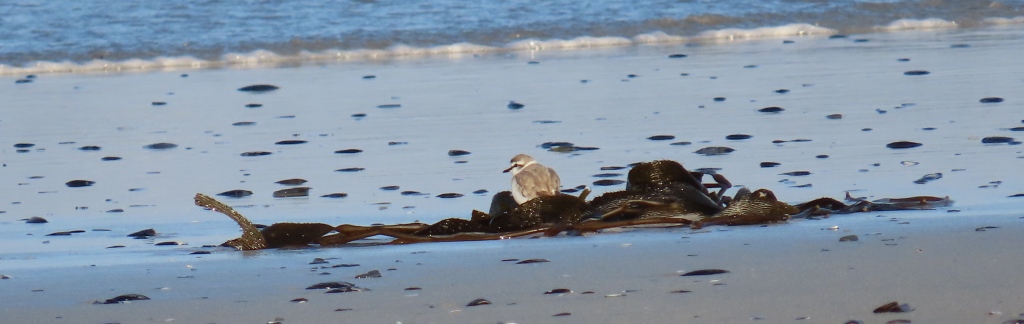
Update on 8 November 2022: Thank you to my friend Hamish Robertson who identified the little bird as an adult White-fronted Plover!
Here are two of the Oystercatchers with the Plover:

What’s the view like from the beach at Melkbosstrand? Looking one way, you have a view of Table Mountain:
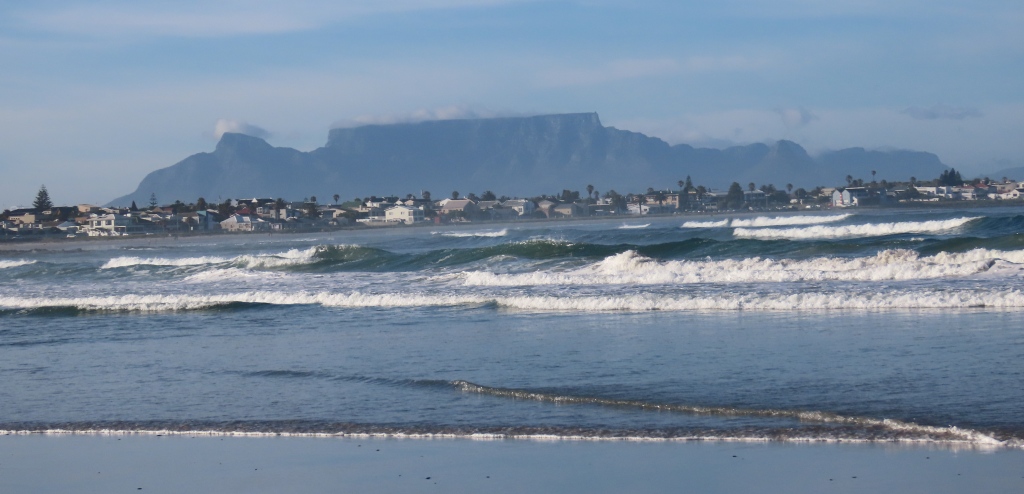
Turning round, you have a view of Koeberg nuclear power station in the distance:
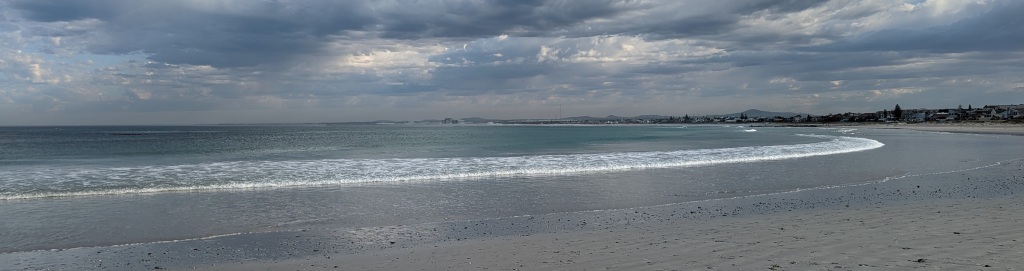
Here’s a zoomed in view of Koeberg:

I hope you’re enjoying my brief foray into South African birds. I’ll be back when I spot another bird!
Birds in Lonehill, South Africa
I’m in South Africa for a few days, enjoying the birds as well as other aspects of this interesting country. I photographed most of the birds in this post while on a short stroll through Lonehill Park. Lonehill is an outer suburb of Johannesburg, neighbouring on Witkoppen, and many of the bird species make their homes in both places. This post shows only the birds that I didn’t include in my earlier post about birds in Witkoppen Spruit Park.
First up, absorb the atmosphere of the park by watching this short video:
The centrepiece of the park is a large pond surrounded by reed beds and trees. In the background is the lone hill that gives the suburb of Lonehill its name:
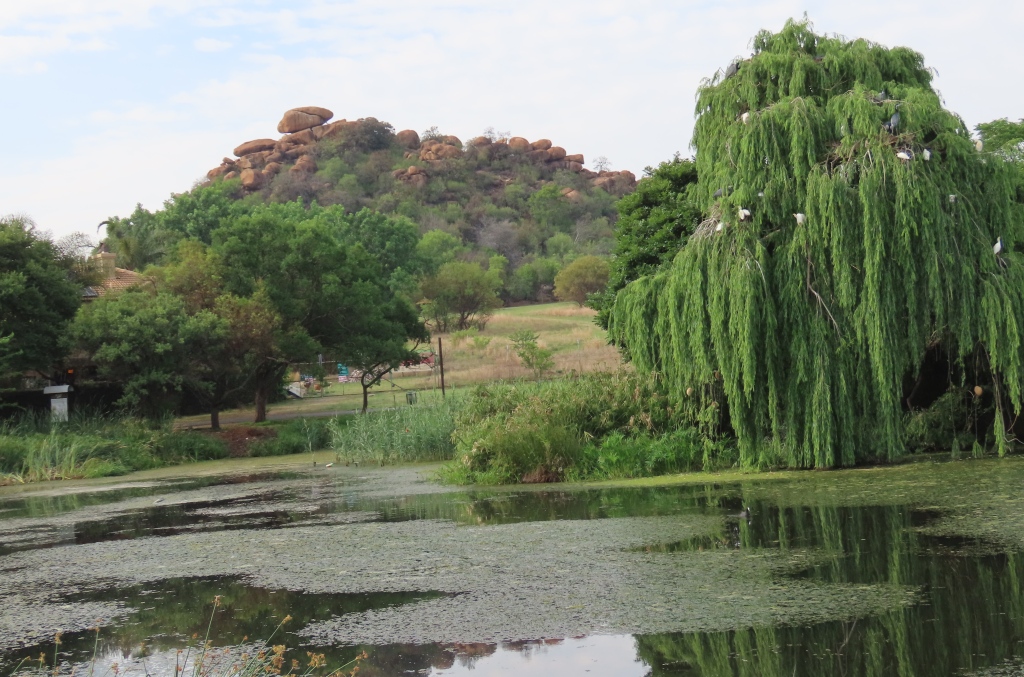
The tree on the right is home to several herons and egrets. They’re quite busy and noisy, as it’s breeding season. From the very top of the tree, a Black-headed Heron surveys its domain:

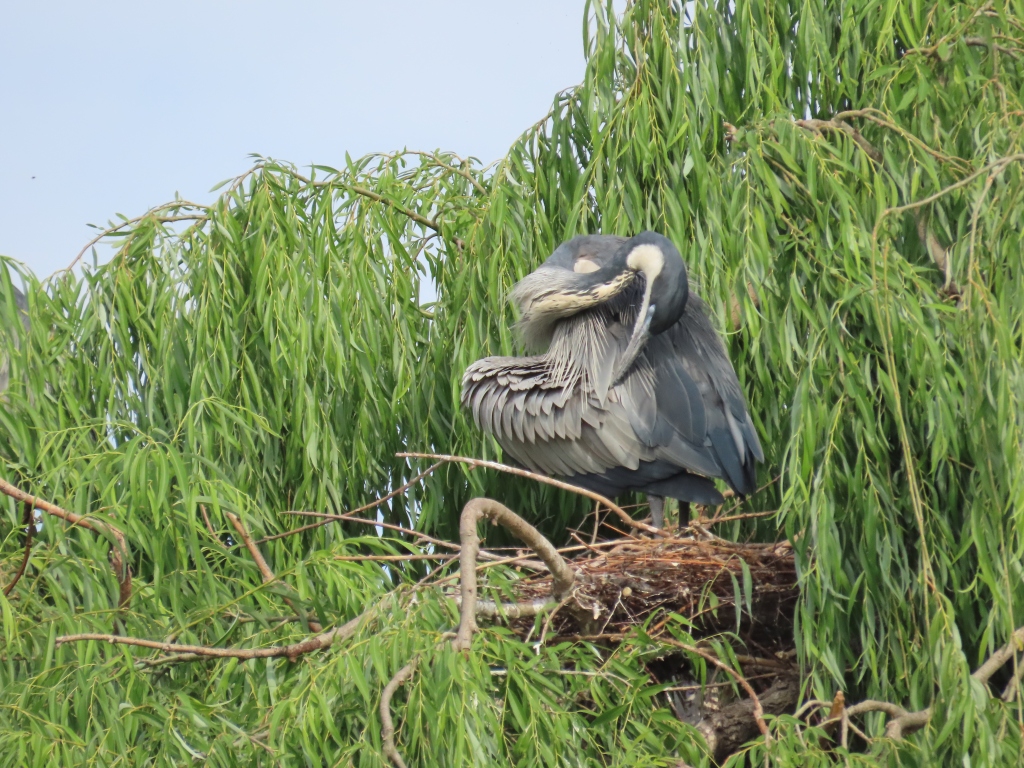
Lower down, another Black-headed Heron combines preening with sitting on a nest:
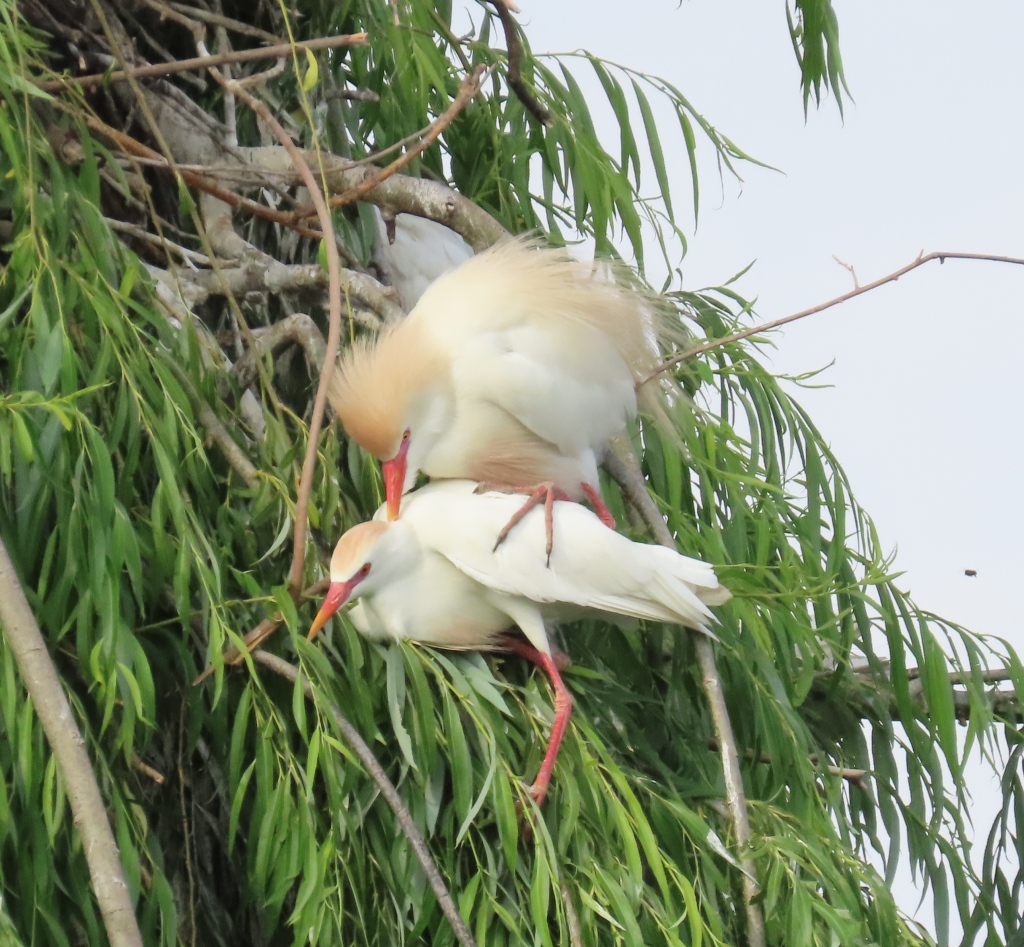
Two Cattle Egrets groom and strut their stuff:
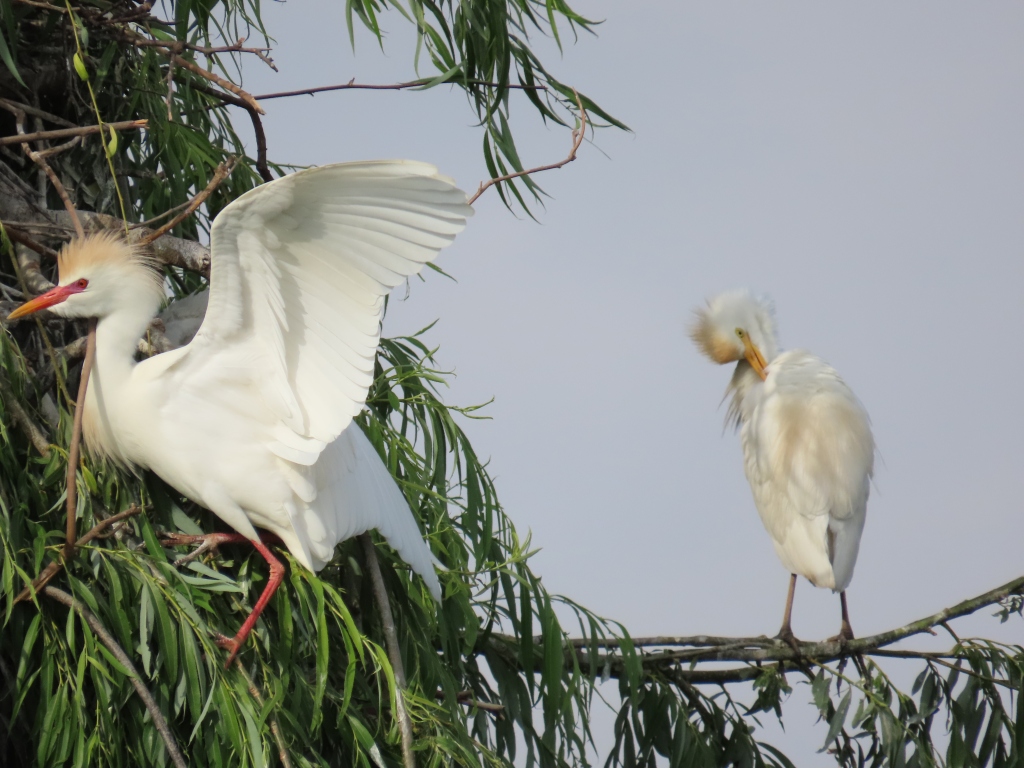
After a few more preliminaries, they get good and cosy:
Down below, a Bronze Mannikin perches on a reed stem. I love the colouring of this little finch, especially its two-tone beak:
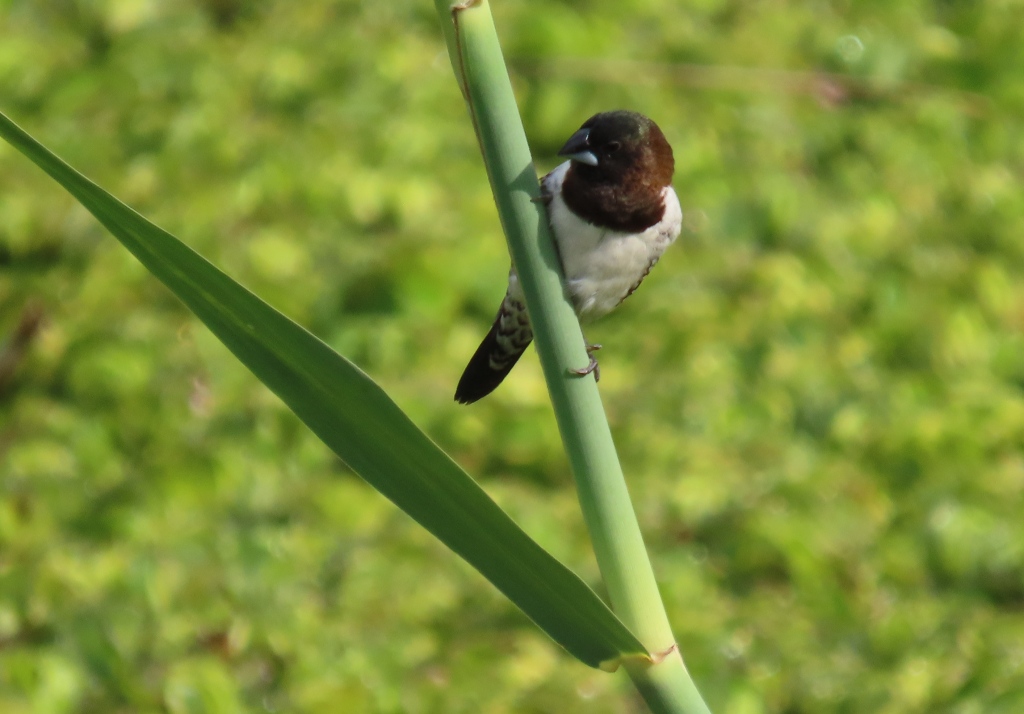
Several Bronze Mannikins were walking on the plants that covered part of the lake. Using my camera’s zoom, I managed to get this shot that shows the water droplets glistening on the plants around the bird:

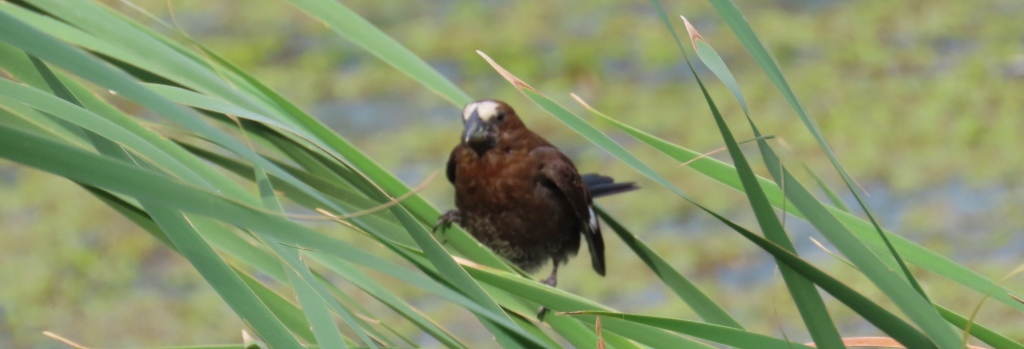
The next little fellow is a Thick-billed Weaver. Like the Red Bishops and Masked Weavers shown in my earlier post, Thick-billed Weavers build intricate woven nests from reeds and grass:
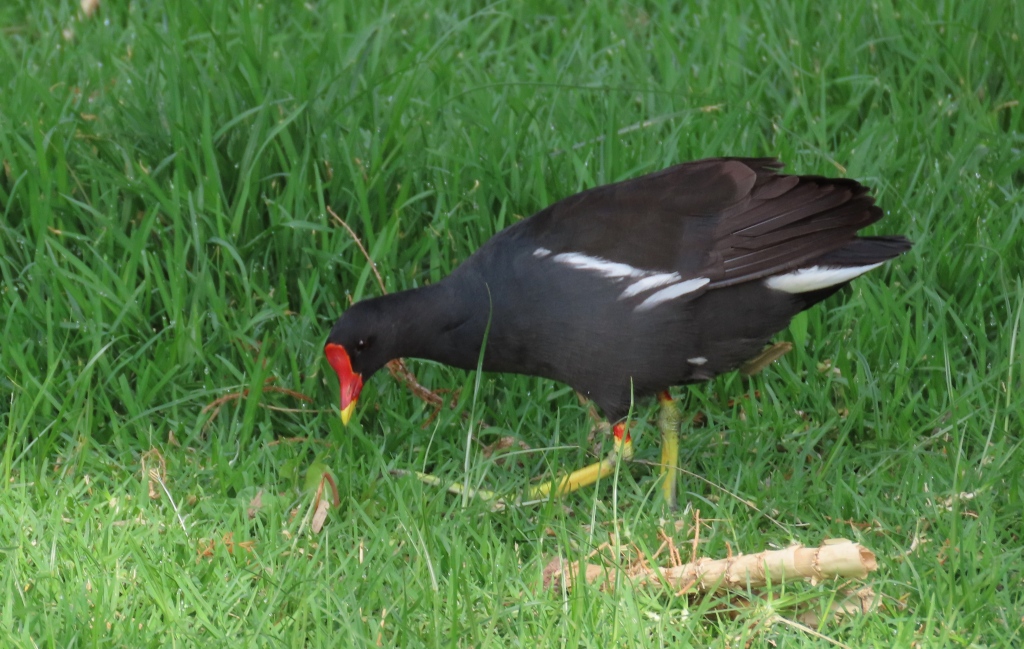
A Common Moorhen shows its red garters:
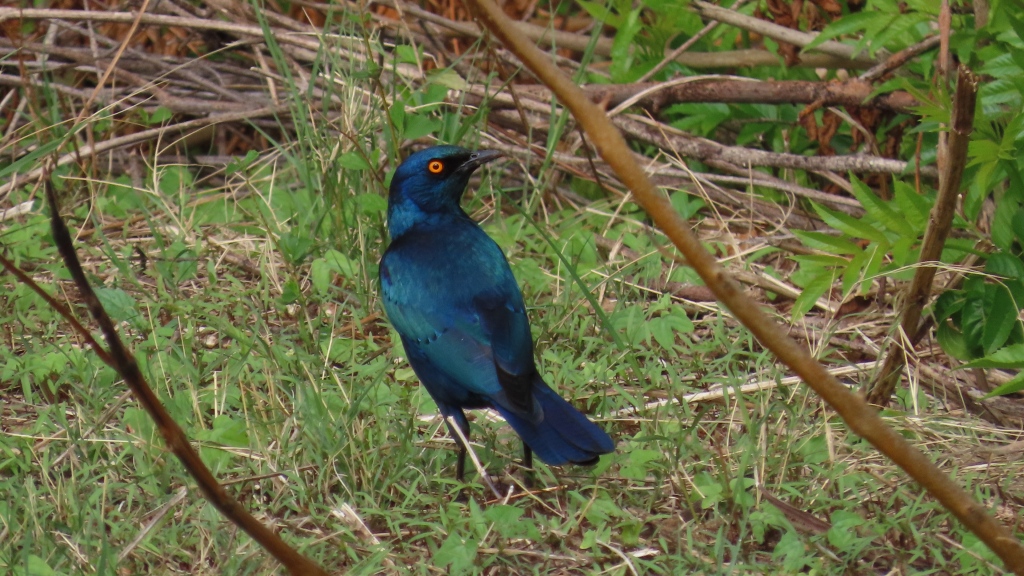
Striking in its coat of electric blue is a sharp-eyed Greater Blue-eared Starling:
A Laughing Dove and a Rose-ringed Parakeet brighten up some bare branches:

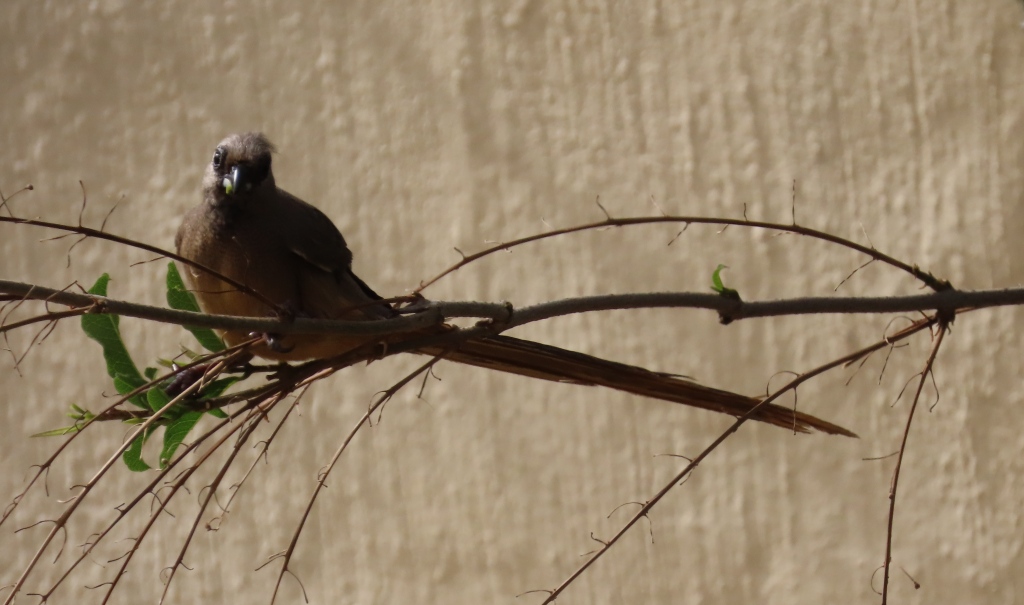
Next up is a Mousebird. I saw this particular bird not in the park, but in the garden of a friend in Lonehill:

Mousebirds get their name from the way they scurry around gathering food, which reminds people of mice. Here’s another shot of the same bird:
Also in a Lonehill garden, we saw a pretty pair of Rosy-faced Lovebirds, which are native to south-western Africa. There are feral colonies in various parts of South Africa. These two are frequent visitors to our friends’ bird feeder:

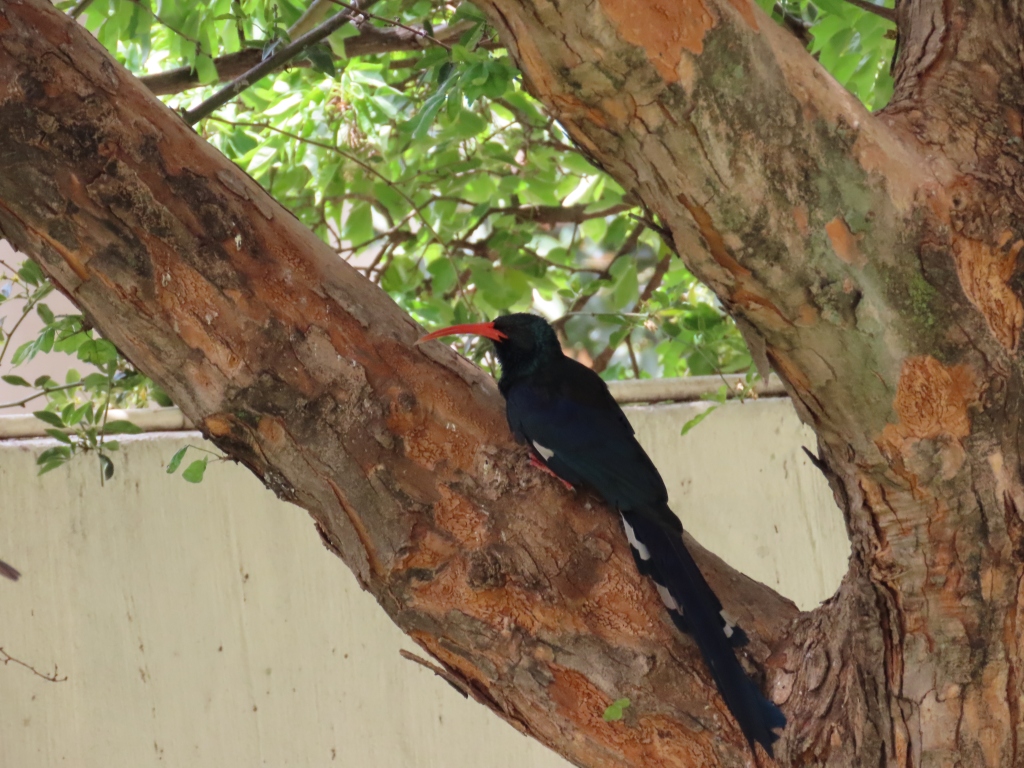
Another frequenter of the bird feeder is this Wood Hoopoe, also called a Scimitarbill. Like most of the birds in this post, Wood Hoopoes are native to this part of South Africa. They’re striking birds, almost entirely black with orange bills and feet, and white flares in their wings and tails:
That’s it That’s it for my collection of birds from the suburbs around Sandton. I’ll be back when I spot another bird!
Birds in Witkoppen, South Africa
I’m currently in South Africa, a little outside the usual geographical range of this blog! While here, I’m taking in a bit of the bird life. I photographed the birds in this post in a little patch of green called Witkoppen Spruit Park. Witkoppen is an outer suburb of Johannesburg, near Sandton. For such a small piece of land surrounded by residential suburbs, there’s an amazing variety of birds in the park. Well worth a visit, if you’re in the area.
To get in the mood, watch this short video and listen to the sounds of the birds all round:
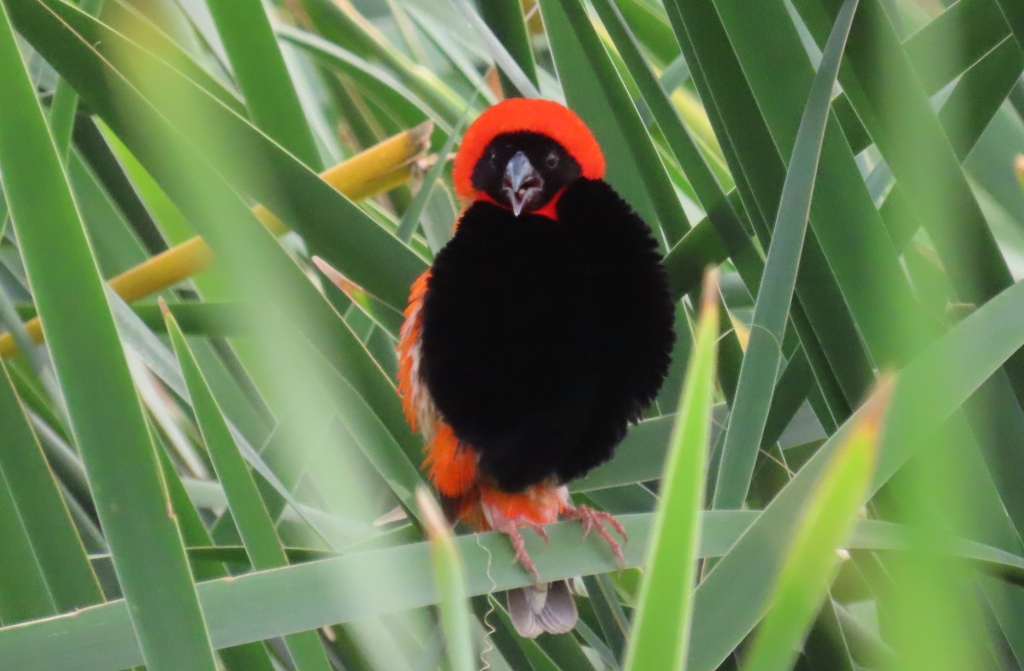
The flashes of red that you see in the video are Southern Red Bishops, a little bird in the weaver family. Here’s one of them caught in a rare moment of stillness:
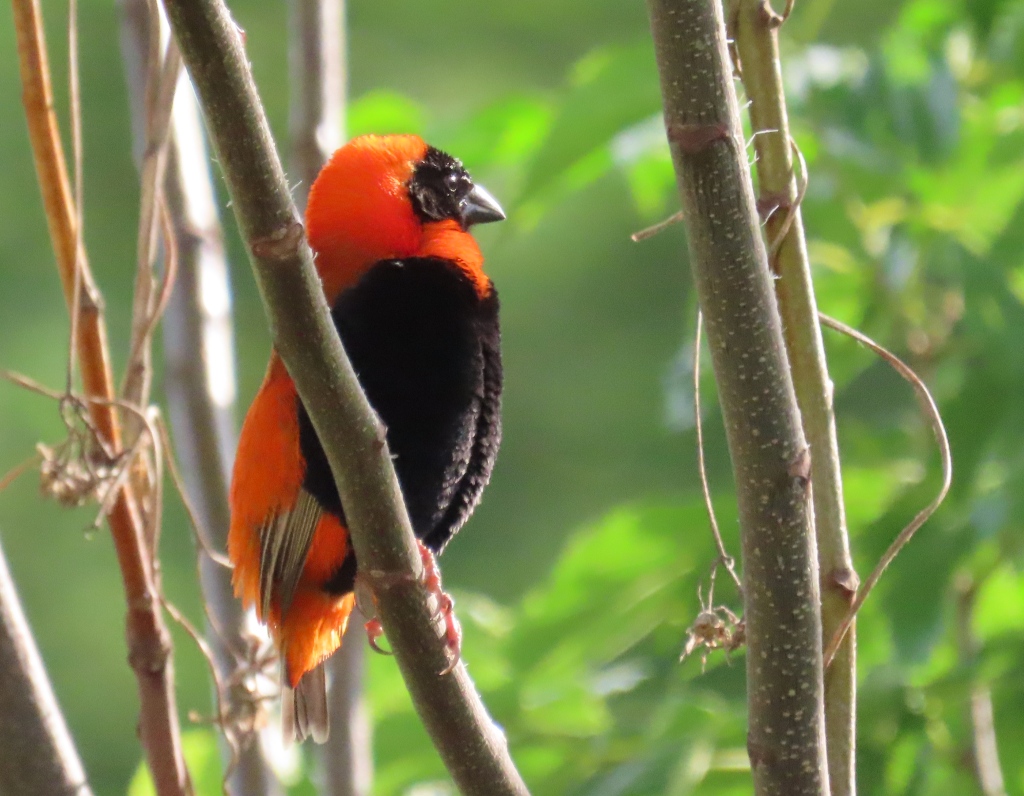
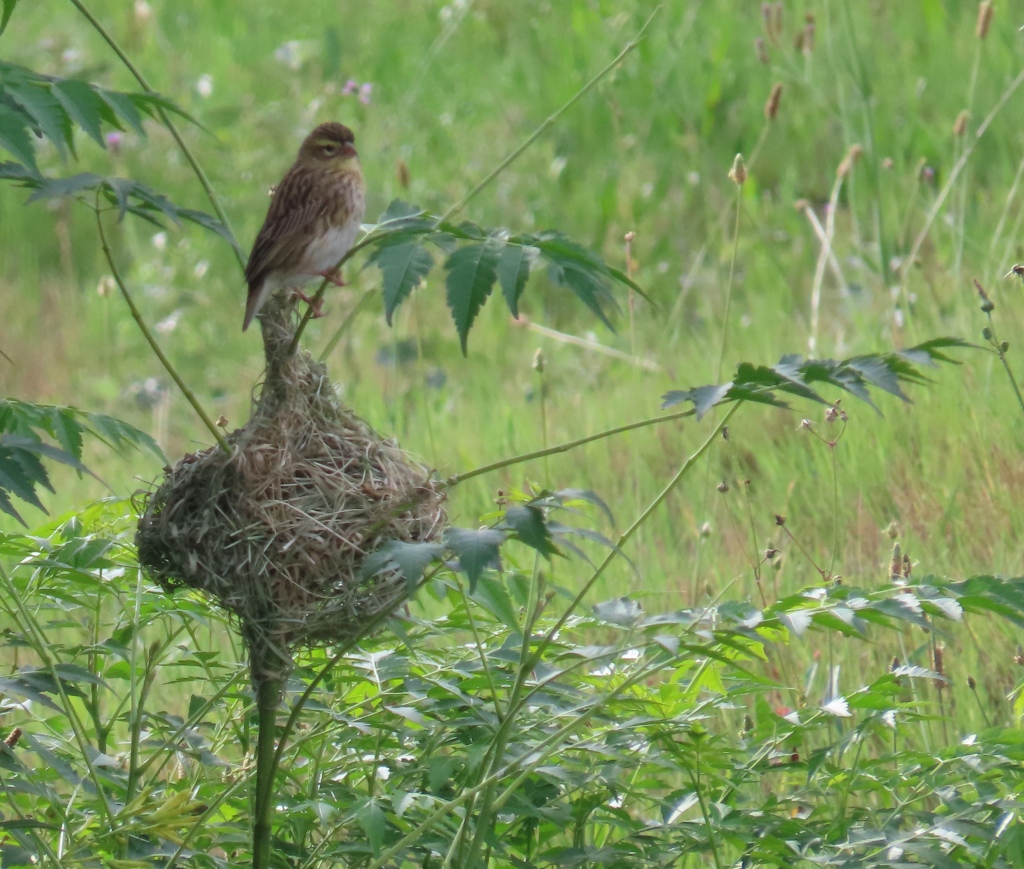
Like other weavers, Southern Red Bishops build nests of intricately woven reeds hanging from tree branches or tall reed stems:

Here’s one of the birds in a quarrelsome mood:
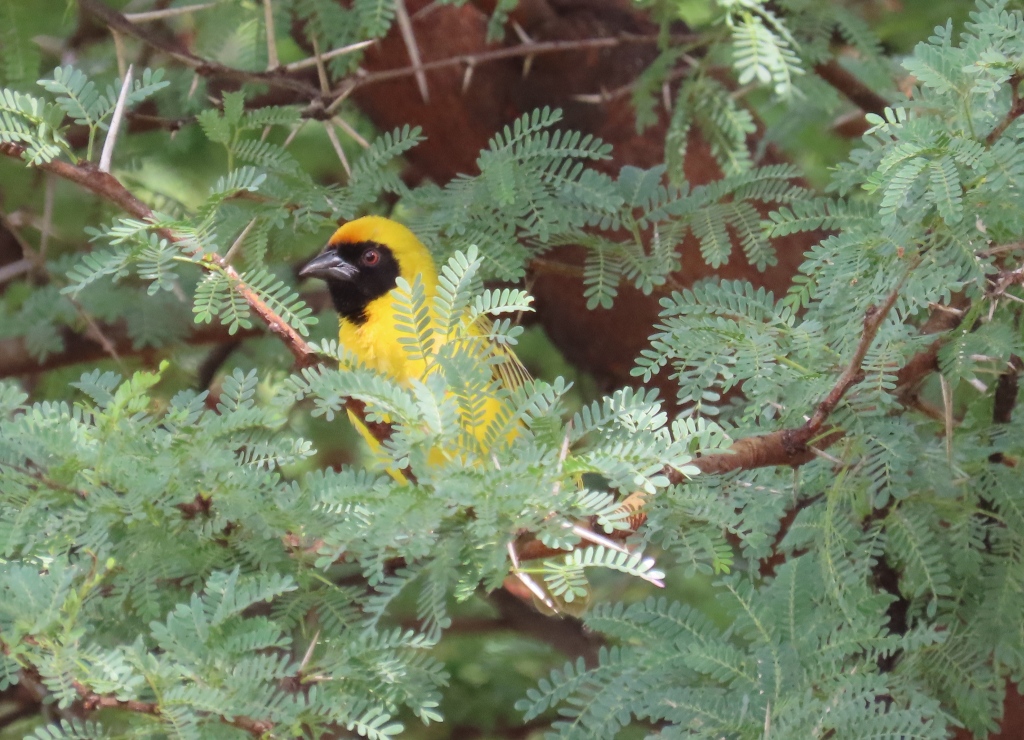
Nearby, a Southern Masked Weaver peers out from behind the leaves of a tree:
The bright colours belong to the males of the species. Here’s a female weaver perched above a nest. I don’t know if it’s a Red Bishop or a Masked Weaver:
Perched high in a tree, a Grey Lourie shows that you can look smart even in a low-key colour:

Grey Louries are also called the grey go-away bird. Here’s another one:

A Pin-tailed Whydah sports its long tail. This tiny bird’s body is about 12 cm long, while the tail adds another 20 cm to the bird’s overall length:

Some Lesser Striped Swallows gather around a small puddle in the middle of the path:
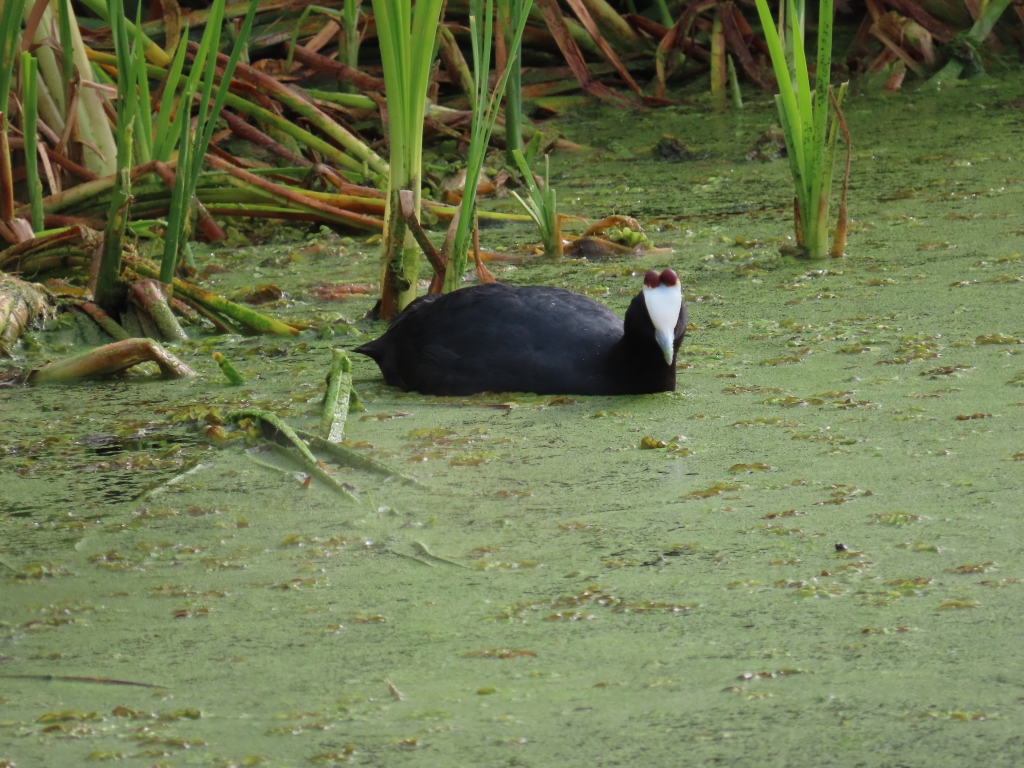
In the nearby pond, a Red-knobbed Coot feeds in the algae-rich water:
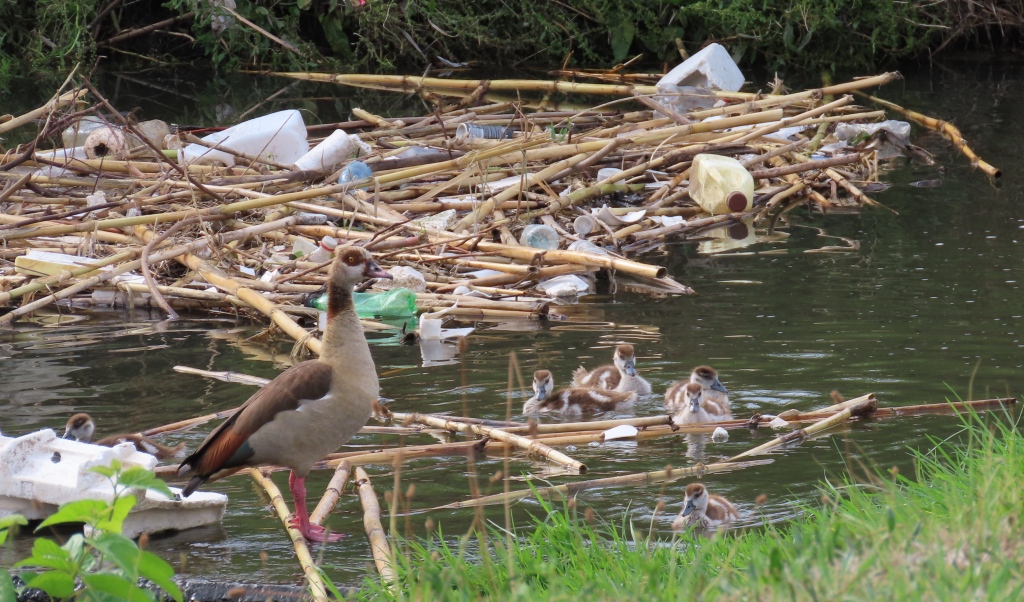
An Egyptian Goose shepherds its chicks through the flotsam and jetsam of the surrounding suburbs:
Sunlight adds a gloss to the plumage of a Hadada Ibis:

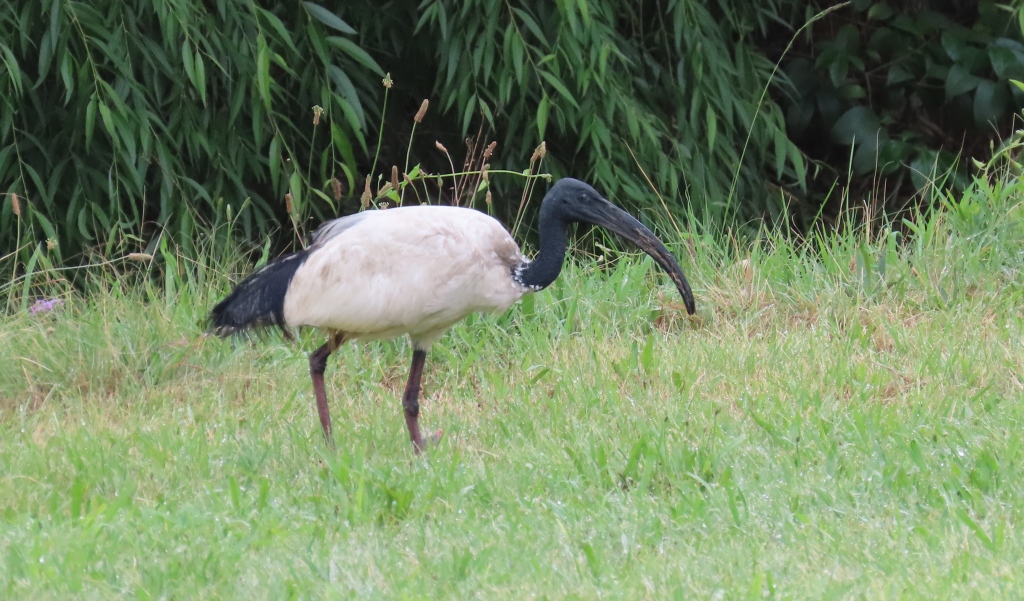
An African Sacred Ibis stalks through the undergrowth:
Another bird stalks the undergrowth, sometimes standing so still that it was almost impossible to spot. My camera’s super zoom brings it close enough to see that it’s an African Wattled Lapwing:

Fiscal Shrikes, also known as Butcher Birds, zoom from cover to cover. Here’s one that stayed still long enough to be caught in a photograph:

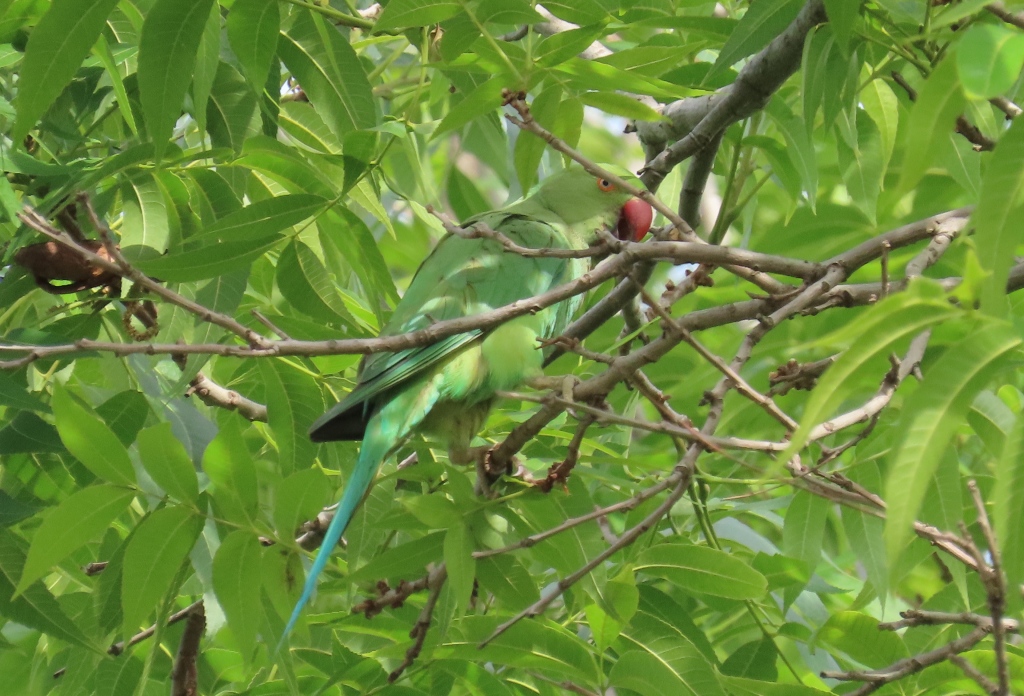
High in the trees, Rose-ringed Parakeets chat and screech. These little parrots aren’t native to South Africa. They established themselves in the suburbs after escaping from captivity in numbers large enough to start breeding:
In my next post I’ll show you some birds in Lonehill, a neighbouring suburb to Witkoppen.

Satin Bowerbird at Mount Annan
This morning I paid my first visit to the Australian Botanic Garden at Mount Annan. The gardens lie to the south west of Sydney, on the east coast of Australia. They’re well worth a visit, with beautifully laid out pathways and flower beds, and a number of different bird species.
A female Satin Bowerbird pottered around a bed of plants:

Female Satin Bowerbirds are gorgeous, with violet eyes and soft shades of green, yellow, and brown plumage. This is only the second time I’ve photographed a bowerbird. Both times they were female.
It was interesting to see this bird tucking into the carefully laid out plants. I didn’t know that birds can be this keen on eating their greens!
Common name: Satin Bowerbird
Scientific name: Ptilonorhynchus violaceus
Approximate length: 28-34 cm
Date spotted: 16 October 2022 (spring)
Location: Mount Annan, New South Wales, Australia: 34°04’16.3″S 150°45’58.1″E


 Sydney Birder