Blog Archives
Six kookies a-cackling
This morning I was treated to the sight of six kookaburras in a row, perched on the horizontal bar of an outlet pipe, all cackling away to each other. Australians fondly call these birds “kookies”. So, here you go, six kookies a-cackling:
Towards the end of the video, you’ll hear a jogger running up to me in excitement, exclaiming that she wished she had a camera. She obviously didn’t realize I was videoing!
After the birds flew off, I spotted two perched on a nearby TV antenna. It’s probably two of the six in the video, but not necessarily — there were quite a few kookaburras around:

Common name: Laughing Kookaburra
Scientific name: Dacelo novaeguineae
Approximate length: 47 cm
Date spotted: 28 January 2023 (summer)
Location: Balgowlah, New South Wales, Australia: 33°48’01.4″S 151°15’53.0″E

The quiet of the duck
It’s early morning on New Year’s Day in the park. The air is still, the crowds haven’t yet arrived. The ducks putter around as only ducks can do.
I’m at Manly Dam park near Sydney. On a quiet morning, the dam water reflects the hills and forest all round. The oranges, browns, and reds in this scene aren’t seasonal, though they do bring autumn to mind. They show the path of a recent fire — a hazard reduction burn conducted to reduce the risk of more damaging fires as summer draws on.
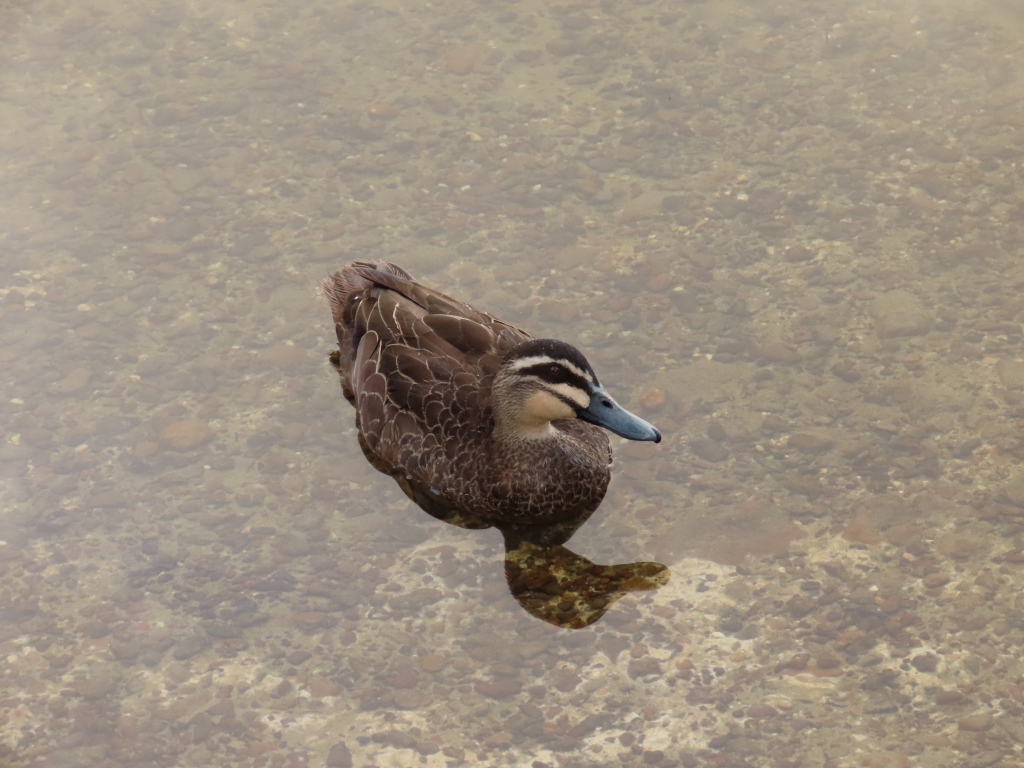
Among the ducks were this Pacific Black Duck:
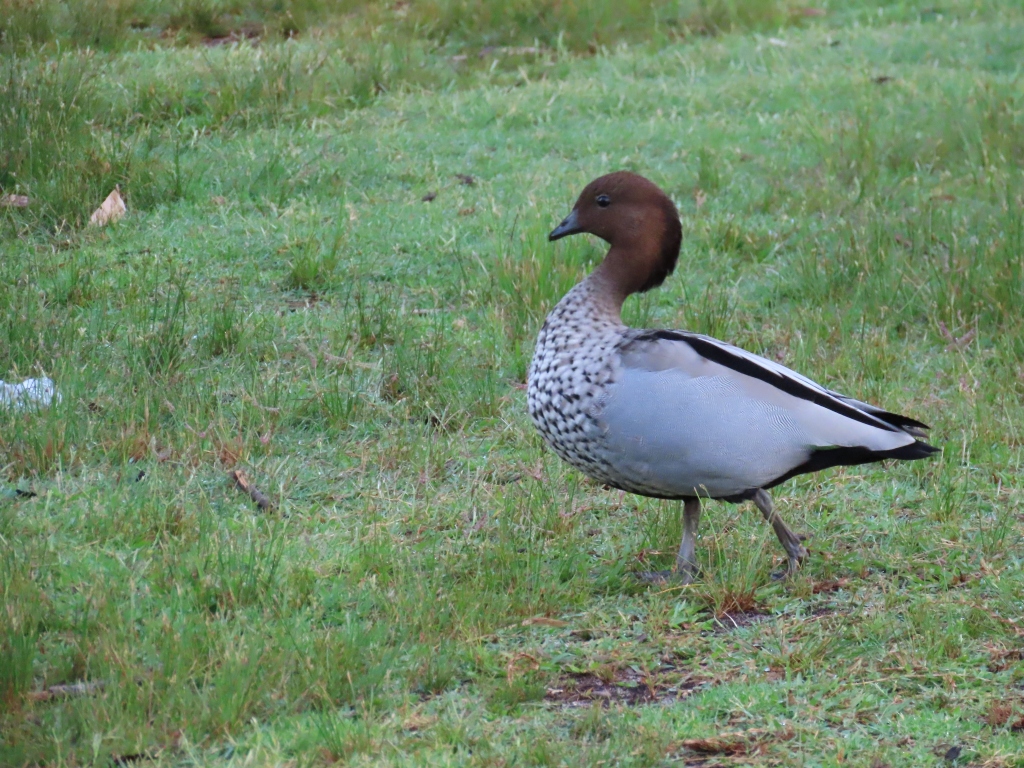
A male Australian Wood Duck:
A female Australian Wood Duck:
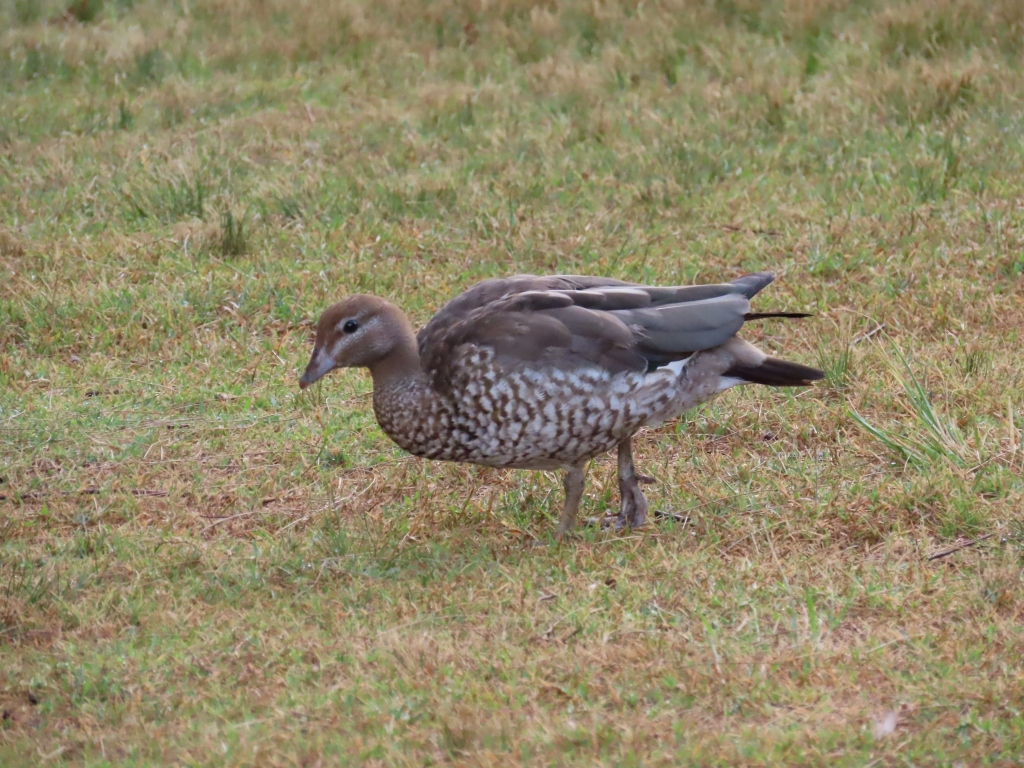
And a female Mallard with a gorgeous yellow-green beak:

For me as watcher, the meanderings of the ducks enhanced the quiet of the early morning scene.
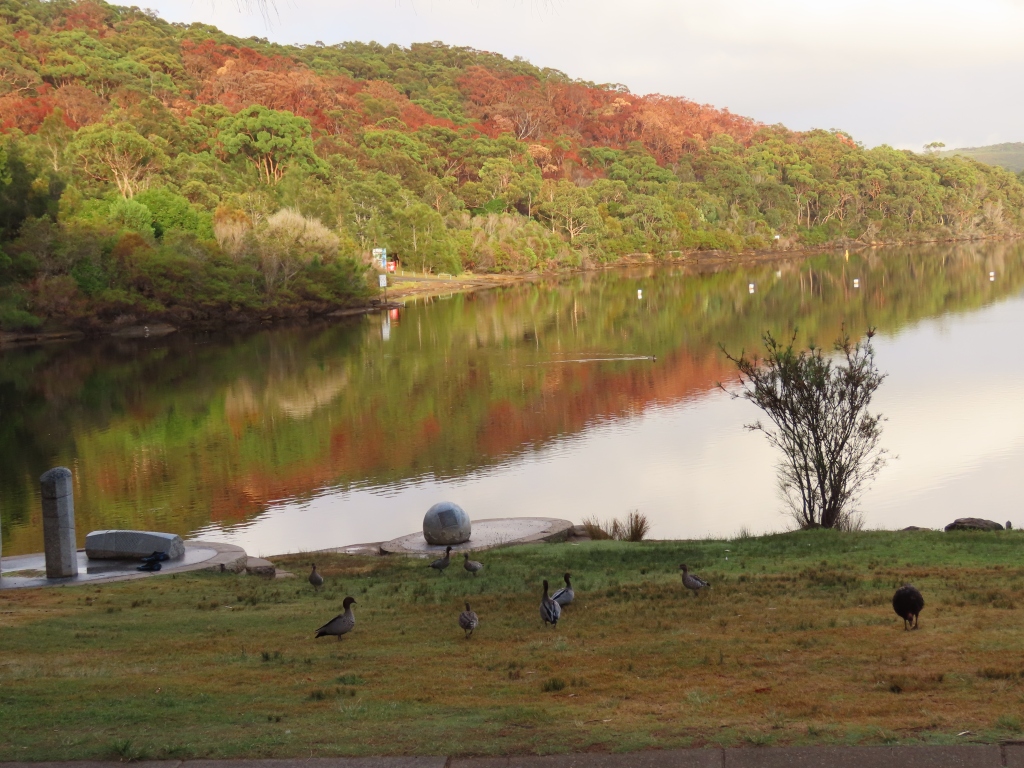
Oh yes, and there’s a Brush Turkey on the right too!

Young Channel-billed Cuckoos fed by currawongs
What’s that caterwauling? It’s a couple of young Channel-billed Cuckoos, awaiting their food. Are the patient bringers of food the parents of the young birds? No, they’re Pied Currawongs. Because, like other parasitic cuckoos, Channel-billed Cuckoos lay their eggs in the nests of other birds and leave it entirely to the adoptive parents to care for the youngsters.
The other ongoing noise that you hear in this video are the Cicadas. It’s the season of noisy beetles and noisy birds!
This is the second time that I’ve seen two young cuckoos being fed by currawongs, instead of just one. Evidently it’s quite common for these birds to lay more than one egg in someone else’s nest.
Here’s a still photo of the young cuckoo. What a big baby. It’s far larger than the currawongs that are taking care of it.

Here’s the youngster flapping its wings to make sure its carers don’t miss it:
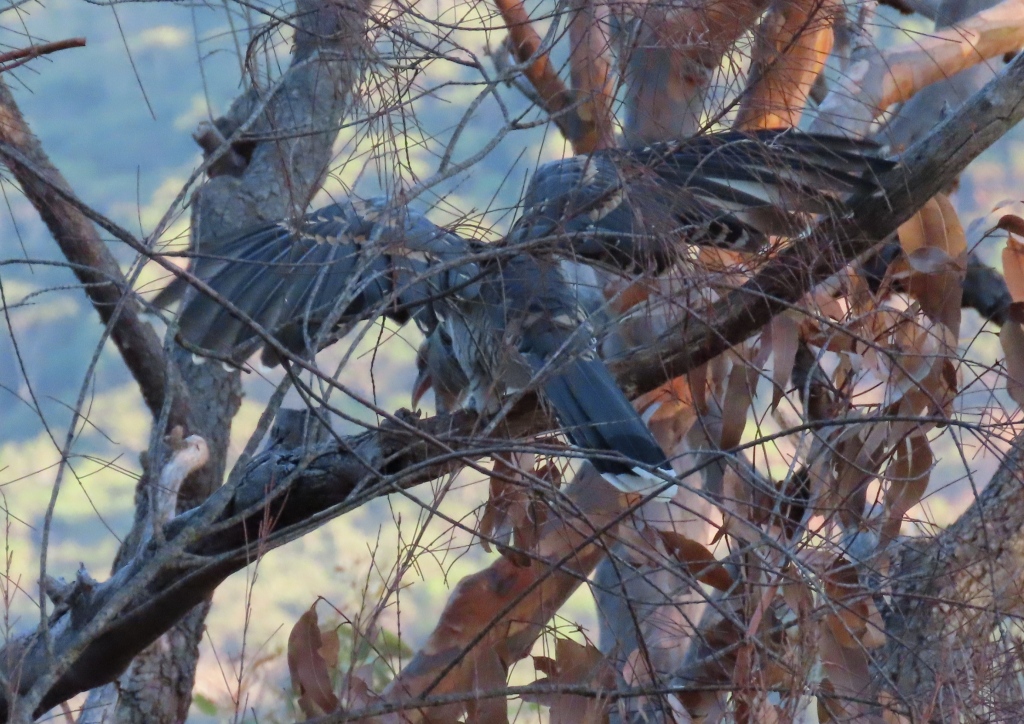
Channel-billed Cuckoo | Scythrops novaehollandiae | Approximate length: 58-65 cm
Pied Currawong | Strepera graculina | Approximate length: 45 cm
Date spotted: 28 December 2022 (summer)
Location: Manly Dam Park, New South Wales, Australia: 33°46’50.1″S 151°14’59.6″E

Noisy Friarbird on nest at Coxs River
Off the beaten track for a day, I was delighted to see a Noisy Friarbird. Even more delightful was the fact that the bird was one of two taking turns to look after a nest:
The video shows one of the birds on the nest. It looks like there might be a youngster already hatched, because the bird seems to be passing something down into the nest (food?) and taking something else out (excrement?). At the end of the video, I panned out to show the lovely setting that the birds have chosen for their nest. It’s above Coxs River, with high trees and flowing water all round.
This is the first time I’ve seen a Noisy Friarbird. Indeed, it’s only the second friarbird that I’ve ever seen — the first was a Helmeted Friarbird up in North Queensland.
The nest is quite large and deep. It’s made of leaves, bark, and grass. Evidently the birds bind it together with spiderweb. Here’s a picture of one of the two birds sitting on the nest:
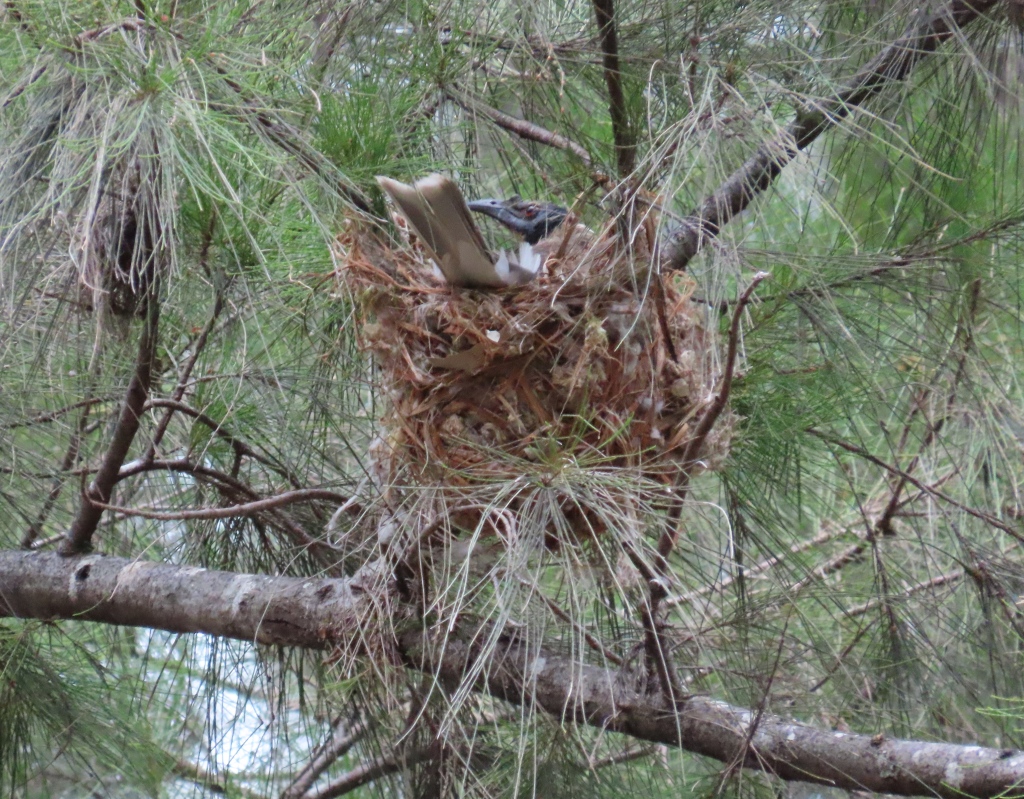
Noisy Friarbirds have a distinctive, slightly scary head: it’s bare of feathers, so that it looks a bit like a long black skull. Then there’s the large beak, with a knob on top. Not the prettiest of faces. The rest of the bird is quite pretty though, with creamy dappled white feathers below and soft browns and greys above, finished off with a white-tipped tail.
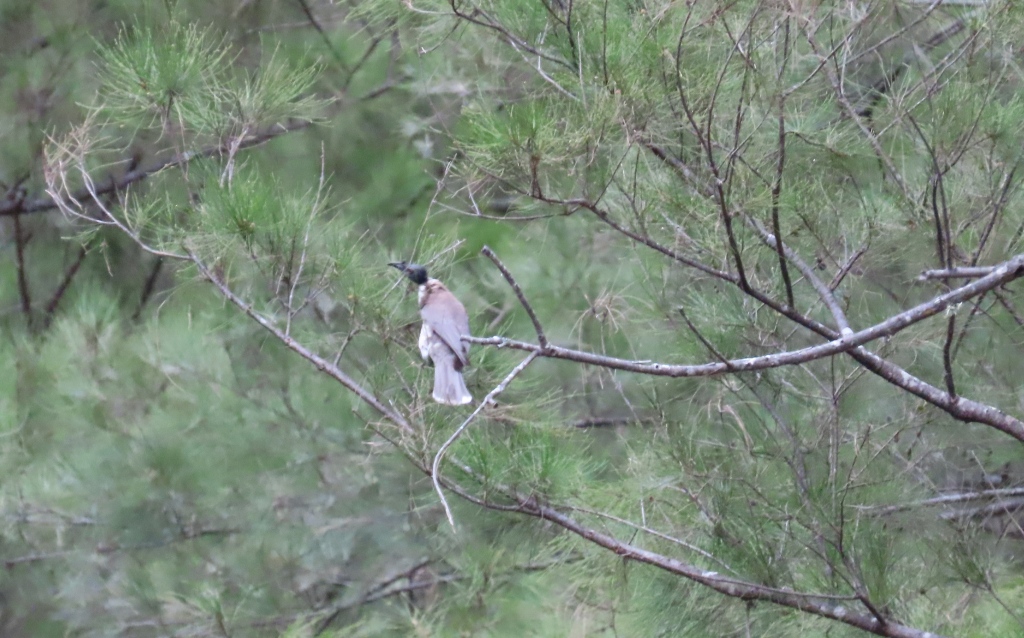
A few times, the birds would dive down steeply and fly horizontally just above the water. I think they were probably grabbing dragonflies and other insects as a tasty morsel:

This bird has something in its beak:

Common name: Noisy Friarbird
Scientific name: Philemon corniculatus
Approximate length: 30-35 cm
Date spotted: 23 December 2022 (summer)
Location: Coxs River Campground, Ganbenang, New South Wales, Australia: 33°44’35.1″S 150°10’45.1″E
Coxs River Campground is accessible only by four wheel drive. It’s a beautiful, restful spot, though it can get quite busy at times:


Brown pigeon in Sydney but not a Brown Cuckoo-Dove?
This lovely brown pigeon perched on a post at Pyrmont in Sydney. Does anyone know what type of pigeon it is?

Here’s a closeup of the bird:
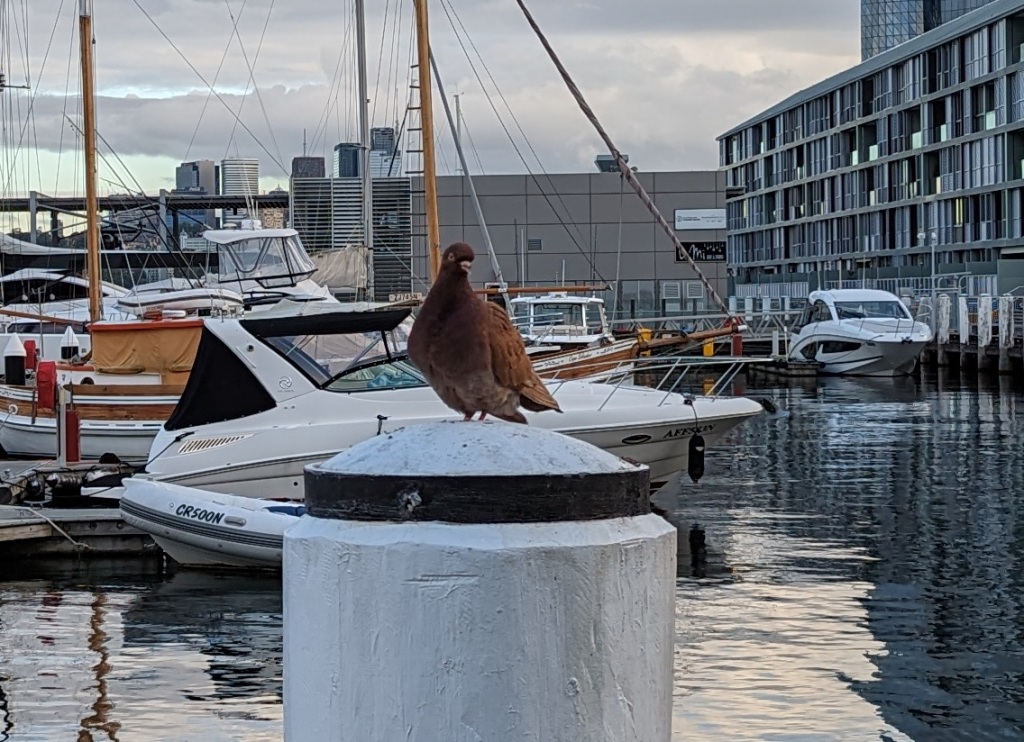
It doesn’t look like a Brown Cuckoo-Dove (Macropygia amboinensis) — the colouring isn’t quite right. This bird has a light-coloured beak and a light ring around its eye. Its chest plumage is as dark as the wings. Also, I don’t think its tail is long enough for a cuckoo-dove.
This picture shows the bird from a different angle, so that you can see its back, wings and tail:

Here’s a picture of the bird flying off:
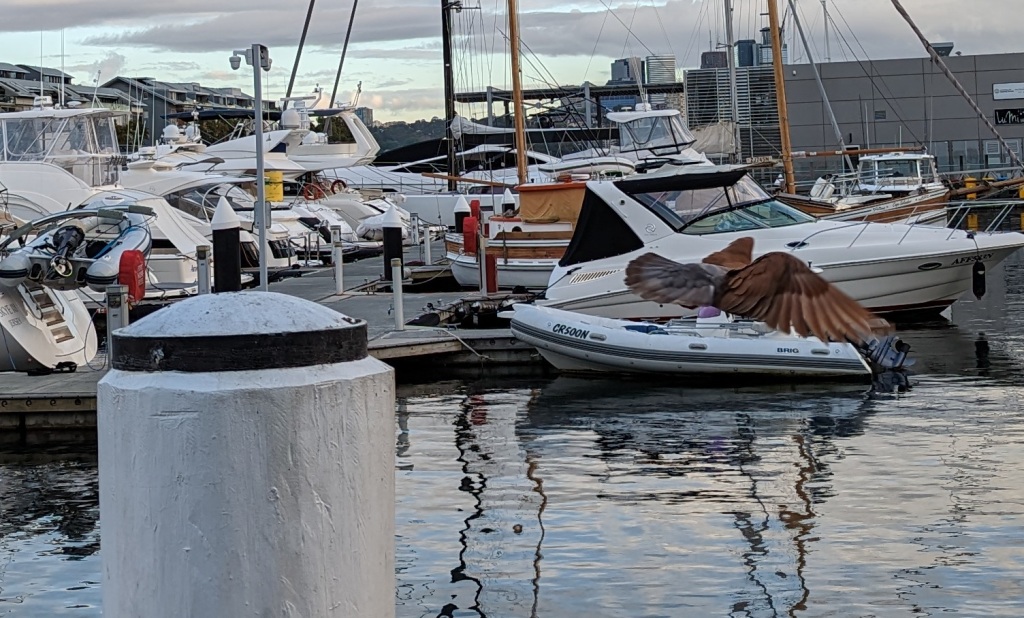
Common name: Pigeon
Scientific name: Unknown
Date spotted: 21 December 2022 (summer)
Location: Pyrmont, Sydney, New South Wales, Australia: 33°52’03.7″S 151°11’48.8″E
The gorgeous song of the Currawong
A couple of months ago, I heard these Currawongs exchanging snippets of song. It amazes me how varied the calls of these birds are, and how beautiful:
Common name: Pied Currawong
Scientific name: Strepera graculina
Approximate length: 45 cm
Date spotted: 15 October 2022 (spring)
In the video, the birds are just a silhouette. Here’s a photo of a Currawong from an earlier post:
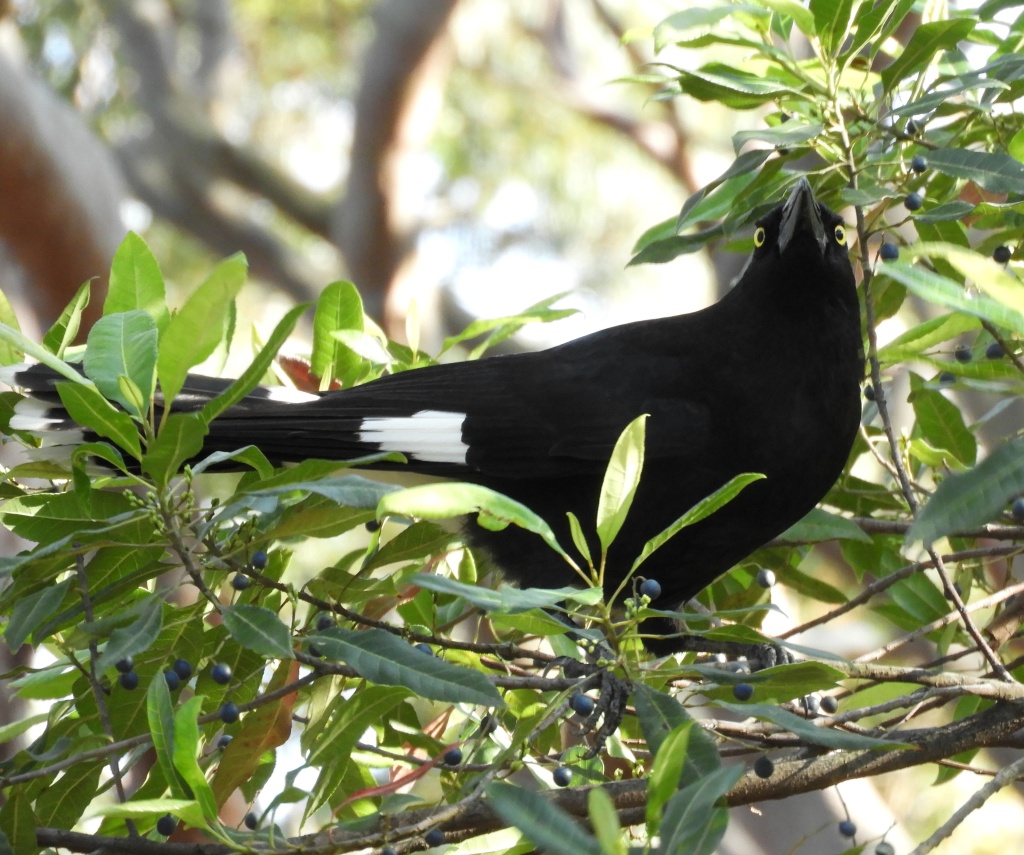
If you’d like to hear more of the Currawongs’ songs, take a look at my earlier post, where the birds are excited about the fruiting Blueberry Ash trees.

Kookaburra, grass trees, and the Australian bush after a fire
It’s early summer now in Australia, and the weather is still relatively cool. It’s a good time for the Parks and Wildlife services to do a hazard reduction burn, before the weather gets too extreme. They set fire to selected parts of the bush, after plenty of ground clearing and other preparatory work. On the day of the burn, the fire services are on hand to keep the fire within its boundaries. (This doesn’t always go according to plan, though!) The goal is to burn away undergrowth that could later result in a fierce, uncontrolled fire.
In the days since a recent burn in my area, I’ve noticed that a kookaburra often spends time in a particular area of the burned forest. Presumably there are small creatures around, even in the burned area, that offer a tempting snack.
This picture shows a kookaburra surveying the forest floor carefully. The blackened trunks and rocks are evidence of a burn that’s a few weeks old:

Here’s a closer view of the kookaburra:

The trees and many of the native plants survive fast-moving, relatively cool fires. Even the trees with blackened trunks are alive inside, and their leaves at the top of the canopy often remain green.
One plant that survives a fire amazingly well is the iconic grass tree (Xanthorrhoea). The trunk of a grass tree burns black, and sometimes all the spiky leaves are burned away. At other times, the leaves after a fire form a multi-coloured fan of green, orange, and brown.

The above grass tree is a few decades old. They grow very slowly, at the rate of 2 cm a year, and it can take about 20 years for them to form a trunk. Before that, they’re just a clump of spiky leaves sticking out of the ground.
Here’s a wider scene with a few small grass trees:

The next photo shows a bush area a couple of years after a burn. There’s plenty of regrowth happening:

And here’s a kookaburra under a bright blue sky, in a different area of Sydney:

I love walking in the post-fire forest in the early morning. Well, I love walking in any forest at any time, but after a fire there’s a surreal quality to the air. The Sydney Red Gums glow orange. Every sound is magnified, because there’s no muffling undergrowth. The rock formations show the structure of the land, usually hidden by plants. And bits of green start appearing almost immediately.


I hope you’ve enjoyed a stroll through some Ozzie bush, blackened but not daunted by hazard reduction burns.

Three Tawny Frogmouths gazing at me
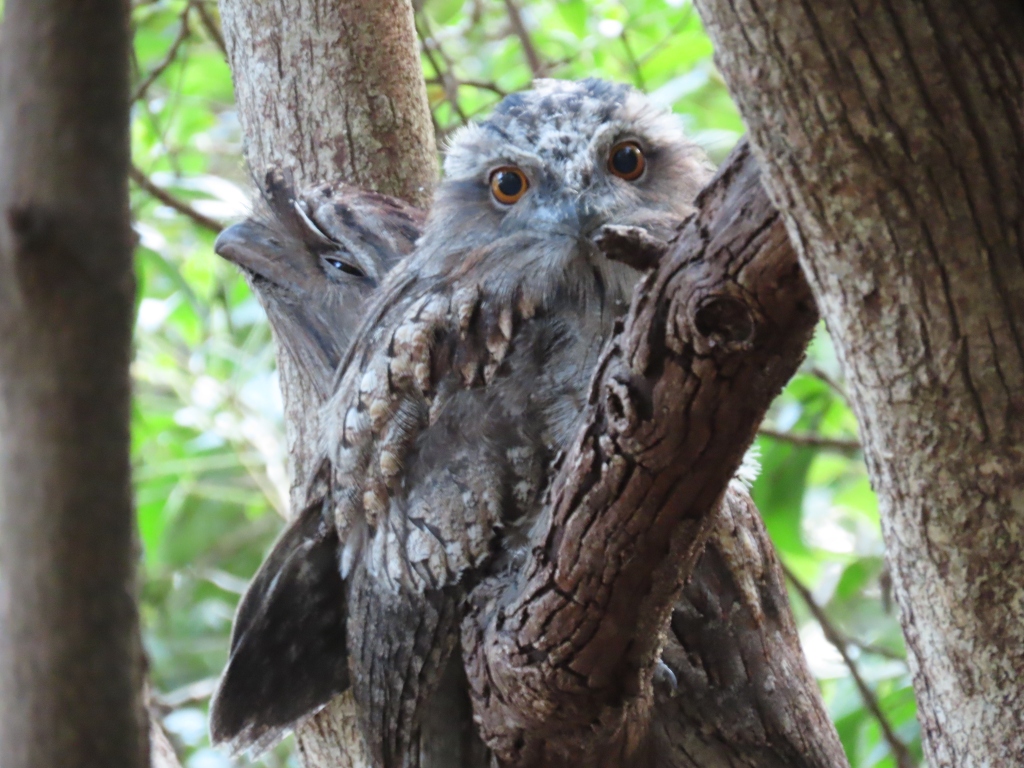
Tawny Frogmouths are some of the cutest birds around. They’re fluffy and cuddly, with an endearing tuft of feathers just above their beaks, and large eyes that glow brown and orange in the early light. I was strolling along a bush path when I noticed a group of three:
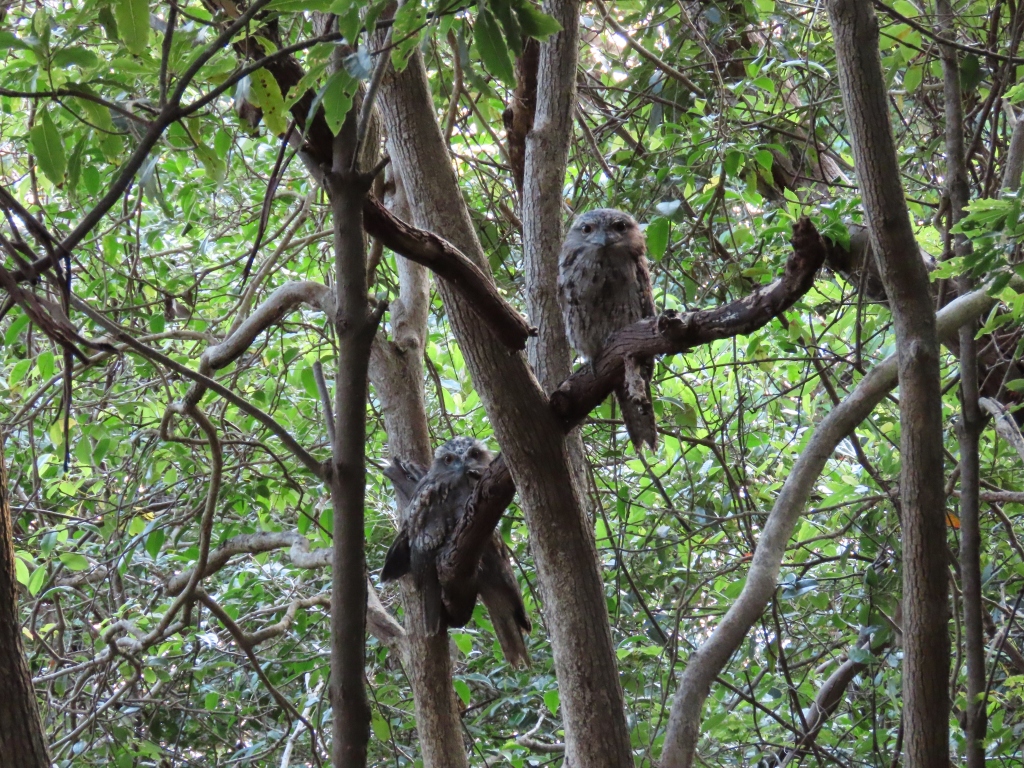
If you don’t spot the third bird immediately, that’s by design. Two of the birds are looking directly at me. The third is pretending to be part of the tree, with just one partly-open eye squinting at me. The bird is the furthest away of the three, and is partly hidden by the bird in the middle.
A closer view shows one bird hiding behind the other and trying to look like a broken tree branch:
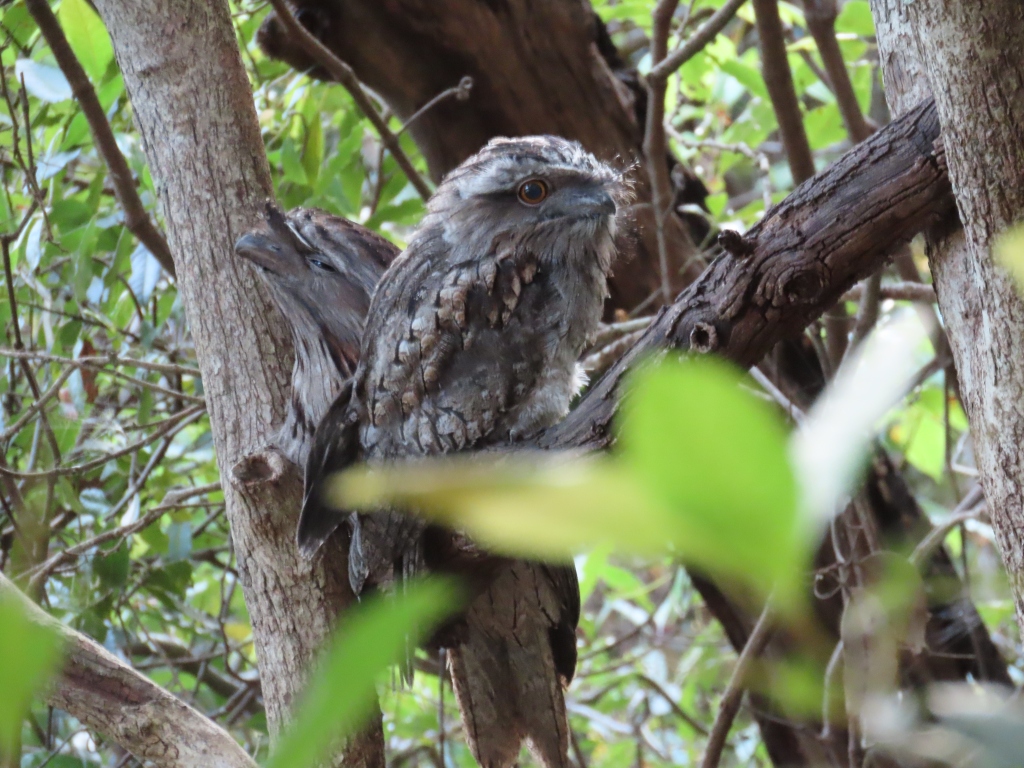
When I first came along, the closest bird had a similar stance:

It takes a practiced eye to spot a Tawny Frogmouth. They’re nocturnal, and tend to stay very still during the daytime. And their camouflage is impressive. I was excited and awed to see three of them at once.
Although they look like owls, Tawny Frogmouths are actually members of the nightjar family. Like owls, they hunt at night, preying on large insects, spiders, frogs, and small animals. Unlike owls, they don’t catch their prey with their feet. To catch insects, they sometimes fly with their beaks open. Hence the very wide beak! One theory about the tuft of feathers above the beak is that it protects the eyes when the bird is hunting.
Here’s another view of the two Tawny Frogmouths that were huddled together:
Common name: Tawny Frogmouth
Scientific name: Podargus strigoides
Approximate length: 34-52 cm
Date spotted: 5 December 2022 (summer)
Location: Reef Beach Track, Balgowlah Heights, New South Wales, Australia: 33°48’23.1″S 151°16’21.2″E

Fluffy little Scrubwren has big feet
At the entrance to Manly Dam Park, a little White-browed Scrubwren examines the tarmac for tasty bits of seeds. I watched this bird for a while as it hopped about. One thing that struck me is how big the bird’s feet are! The little wren is also quite fluffy, and the white markings on its face aren’t as distinct as I’ve seen in other birds of this type. Perhaps it’s a juvenile, the season being spring and all.

Common name: White-browed Scrubwren
Scientific name: Sericornis frontalis
Approximate length: 12 cm
Date spotted: 28 November 2022 (spring)
Location: Manly Dam Park, New South Wales, Australia: 33°46’55.7″S 151°15’25.3″E

3 parrots on one walk
A few days ago I went for a walk and saw three different types of parrots all within a few paces of each other. How amazing is that!
First up, a trio of King Parrots. Two were males, the other a female. This is one of the males:

King Parrots are quite large, at 44 cm from head to tail. The females have a lot more green in their colouring. I think they’re prettier than the males, with their softer shading:
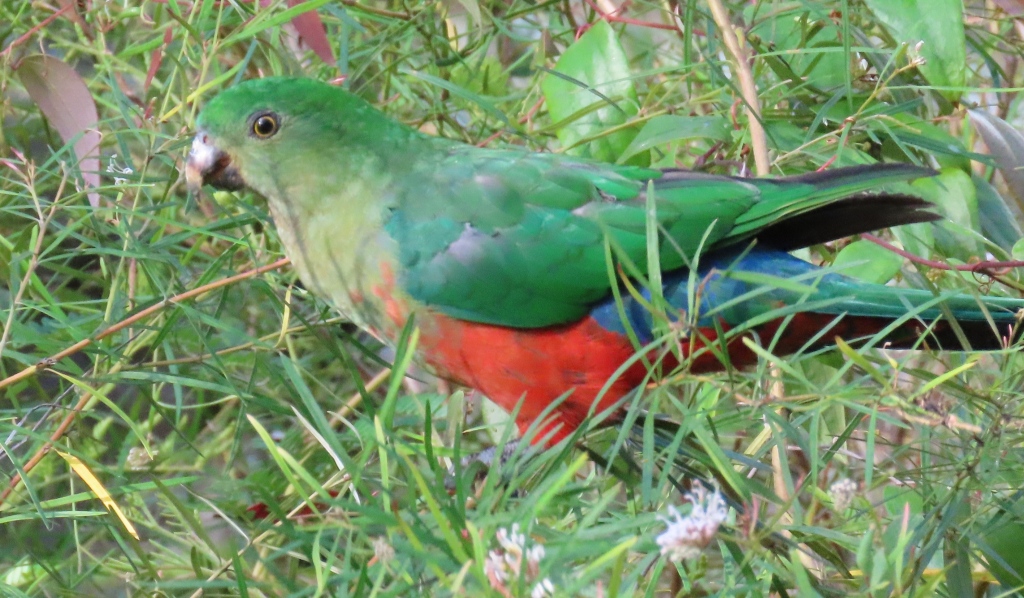
This video shows all three of the birds enjoying the flowers of a Grevillea bush. First you see the two males together. Then one of them flies over to join the female on the other side of the bush:
In the trees around the parrots, the smaller Rainbow Lorikeets chattered and scolded. Here’s one in a more contemplative mood than most:

One of them stood still for a while to examine me, before launching itself in my direction then swerving at the last moment as they are wont to do:
At the next tree, a group of Sulphur-crested Cockatoos examined a tree hollow. Perhaps a good place to raise a family? But competition is fierce!
Here’s one of the cockatoos making a point about ownership, or perhaps just being its usual excited self:

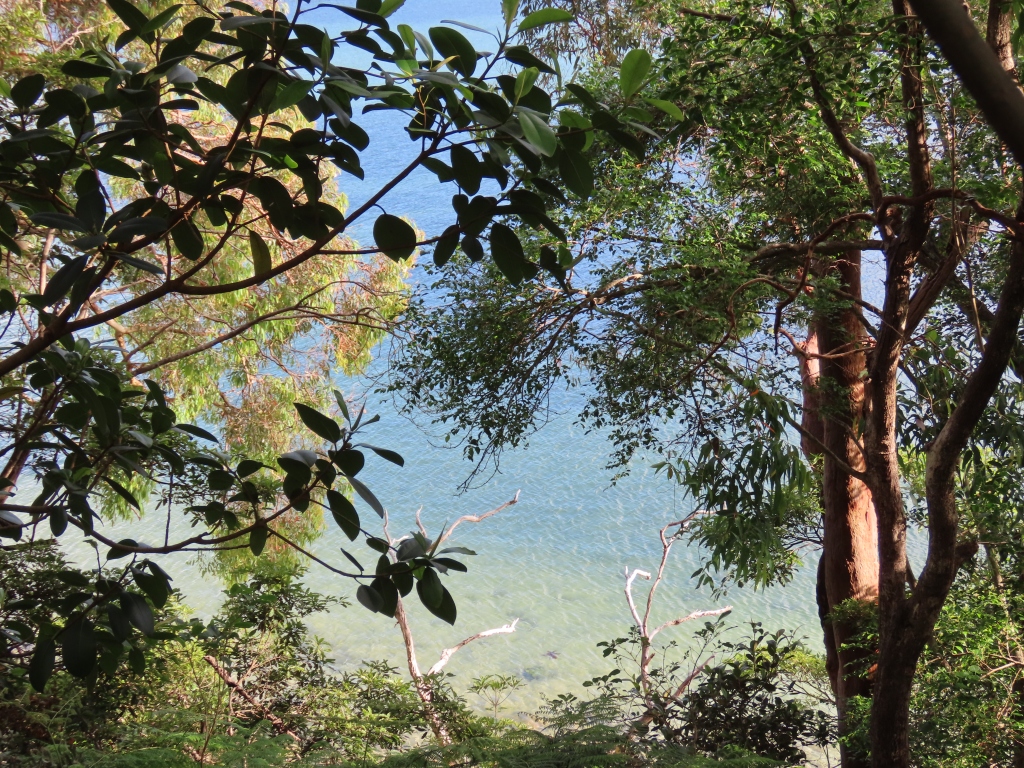
The walk itself is lovely, starting in Balgowlah and winding along the coast of Sydney Harbour, with bushland and forest on one side:

And pretty views of the waters of Sydney Harbour on the other side:
The birds:
Common name: Australian King Parrot
Scientific name: Alisterus scapularis
Approximate length: 44 cm
Common name: Rainbow Lorikeet
Scientific name: Trichoglossus haematodus
Approximate length: 30 cm
Common name: Sulphur-crested Cockatoo
Scientific name: Cacatua galerita
Approximate length: 50 cm
Date spotted: 26 November 2022 (spring)
Location: Near Forty Baskets beach, Sydney Harbour, New South Wales, Australia: 33°48’03.2″S 151°16’07.2″E


 Sydney Birder