Blog Archives
Australian Miner auditions for The Birds and Psycho
This little Australian Miner landed on a branch near me and started that incessant eep-eep noise that they’re renowned for. It’s as if the bird is auditioning to do the soundtracks for two Hitchcock movies at once: The Birds and Psycho.
Well? Do I get the job?

How about if I spin my head around. You know, like in The Exorcist?

No? OK then, on to the next audition…

Common name: Noisy Miner, also called Australian Miner
Scientific name: Manorina melanocephala
Approximate length: 26 cm
Date spotted: 3 March 2018 (Summer)
Approximate location: Allambie Heights, NSW, Australia: 33°46’23.3″S 151°15’43.1″E
Call of the Glossy Black-Cockatoo
Today I spotted a group of Glossy Black-Cockatoos, and I recorded a video so you can hear them chatting to each other. For two consecutive weeks I’ve seen a group of these birds at Manly Dam Reserve. I guess they’re the same birds each time, though on opposite sides of the dam. According to my bird book, this bird is reasonably uncommon, perhaps declining in number.
It’s a short video. As I was recording it, a bush ranger drove up and startled the birds. They flew off and came towards me, which gives you a good view of the orange-red flashes in their tails.
Last week’s post has still pictures of a Glossy Black-Cockatoo, probably from the same group.
Common name: Glossy Black-Cockatoo
Scientific name: Calyptorhynchus lathami
Approximate length: 50cm
Date spotted: 3 March 2018 (Summer)
Location: Manly Dam National Reserve, near Sydney: 33°46’49.2″S 151°15’04.1″E
Willie Wagtail sings to beauty at dawn
It’s early on a cold morning in Pyrmont. A little Willie Wagtail perches on a bollard and sings its heart out. Shades of silver dapple the water. Sydney Harbour Bridge decorates the skyline. All the requisites for an atmospheric scene are present and correct.
Apologies for the low quality of the picture. I was using my mobile phone to film the scene, and had to zoom because the bird was so small. However, this little Willie Wagtail has a big voice and a big heart.
In this second video, a Willie Wagtail harasses a Currawong, chittering and swooping at it. The birds are in the same place as the previous video, so it’s probably the same Willie Wagtail. It’s a common sight in Australia, to see the little birds chasing away the big ones.
Despite their name, Willie Wagtails are actually fantails rather than wagtails. The latter tend to waggle their tails up and down rather than side to side. However, Australians chose the name Willie Wagtail and it stuck.
Here’s a still photo of the same bird, also taken with my mobile phone, so also not wonderfully in focus.
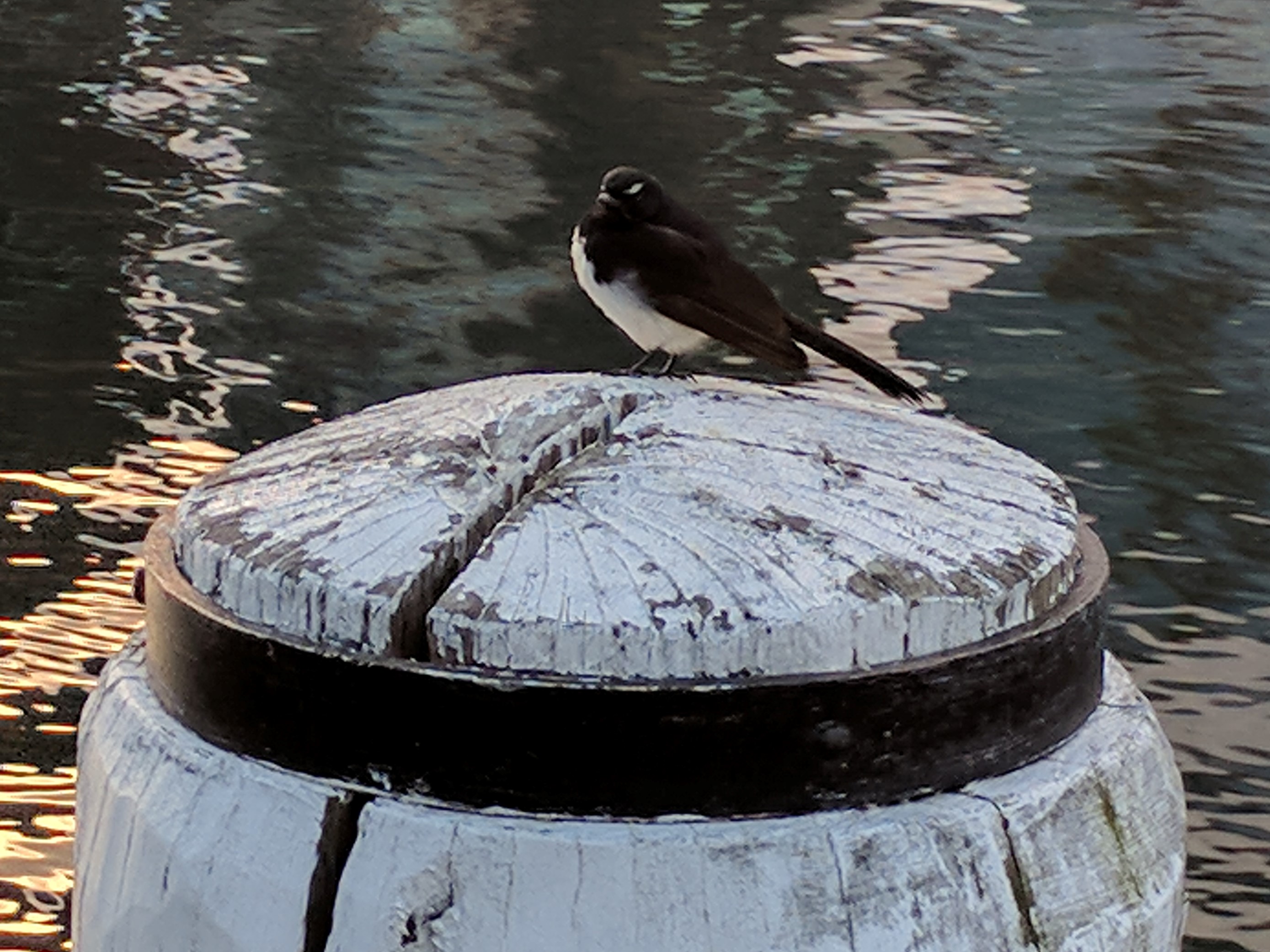
Common name: Willie Wagtail
Scientific name: Rhipidura leucophrys
Approximate length: 20 cm
Date spotted: August 2017 (Winter)
Location: Pyrmont, Sydney: 33°51’57.3″S 151°11’47.9″E
Australian Miner in dawn chorus
I’ve often wondered which bird makes that series of piercing calls that are so characteristic of the Sydney dawn. Now I know. It’s the common Australian Miner. This bird makes a lot of noise during the day too, though the daytime calls are different to this dawn song.
Common name: Noisy Miner, also called Australian Miner
Scientific name: Manorina melanocephala
Approximate length: 26 cm
Date spotted: 31 August 2017 (Early spring)
Location: Allambie Heights, NSW, Australia: 33°46’23.3″S 151°15’43.1″E
Song of Figbirds and a scary story
In a previous post I showed pictures of some Figbirds that have recently taken up residence in a patch of trees on my route to work. The birds make a lovely variety of noises, so I took my camera in again to make some videos with sound.
Here’s the scary bit of the tale. There I was, head in the clouds, filming the birds, when a man suddenly started shouting and swearing at me. He ran across the park towards me and stopped right in my face, uttering all sorts of expletives. “What the f*** are you doing? Get the f*** out of here!” and so on.
I was totally amazed and rather scared. He started making chopping motions with his hand, saying repeatedly that he was going to smack me, and then that he’d smack the camera out of my hand. At first I thought he might be concerned I’d been photographing him, though that’d be odd since I was quite clearly aiming very high in the trees.
Next he started pointing wildly at the camera. “What’s that? That’s not a camera. That’s a zapper. You’re harming the birds. I see you. You’re hurting the birds.” And so on. So, some sort of mental illness, I guessed.
I was scared that if I turned around, he’d hit me on the head. I said calmly that it was just a camera, not a zapper, but that I was going anyway. He continued windmilling his arms, and I still didn’t feel safe to turn my back to him. I said again that I was going. He was still being very aggressive. So I said, “I’m going to go now. Not because I’m doing anything wrong, but because you’re a horrible man.”
Well, that may not have been the wisest thing to say, but it did bring him up short long enough for me to turn and walk away fast. Then he became totally apoplectic, jumping up and down and shouting with fury. But I was safely away, though I do confess I kept turning around and checking he didn’t follow me for quite a while.
Anyway, here are the videos. In the first one, you’ll see a couple of female birds and hear the other birds all round them:
The second video shows a male Figbird making a slightly different call:
The third video shows a few birds in the rain. This is when the man ran across the park and threatened me (though there’s none of that in the video):
Common name: Figbird
Scientific name: Sphecotheres viridis
Approximate length: 28 cm
Date spotted: 31 August 2017 (Early spring)
Location: Pyrmont, Sydney: 33°52’06.5″S 151°11’52.2″E
Eastern Whipbird nesting, calling, and showing its colours
Eastern Whipbirds make the oddest noise. As their name implies, their call sounds a little like a whip cracking: p-p-peeeuuw pheuw-pheuw. Actually, to me, it sounds more like a laser gun in a child’s science fiction game.
I have two videos to show you. The first is cool because right at the beginning, the bird is in the sun, and you can see all the olive colour in its feathers. Usually, the birds are more like dark blobs because they stick to the shady parts of the bush. In the video you can also see the bird make its characteristic call.
At the beginning of the second video, the bird is tending a nest. I didn’t see that until I got the video home and looked on the wider screen. There’s more of the calling too, which takes a lot of energy. The little bird almost leaps off the branch with the effort.
Common name: Eastern Whipbird
Scientific name: Psophodes olivaceus
Approximate length: 30 cm
Date spotted: 13 August 2017 (Early spring)
Location: Manly Dam National Reserve, New South Wales, Australia: 33°46’36.9″S 151°15’16.7″E
Rainbow Lorikeets and a flowering grass tree
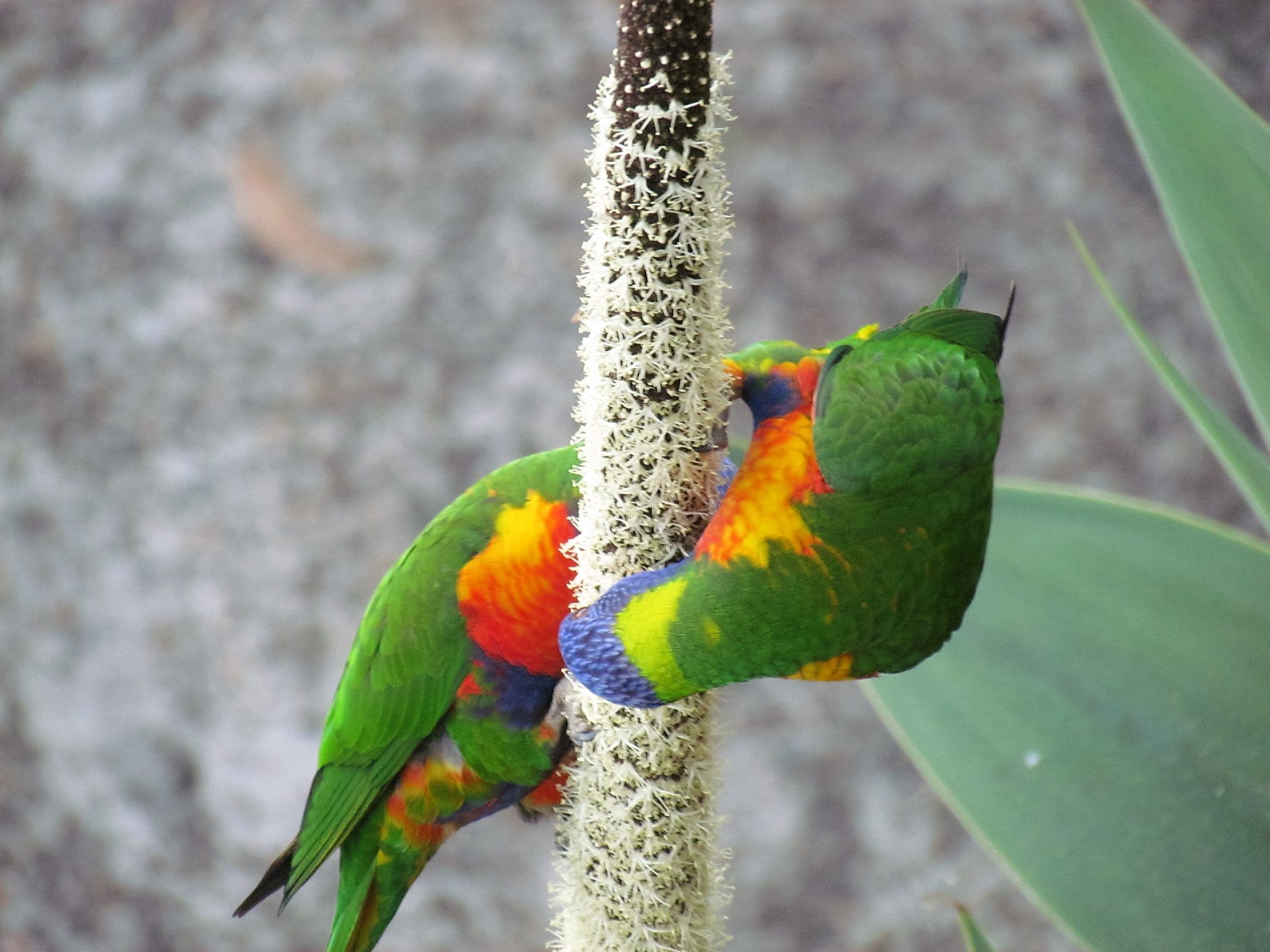
A grass tree (Xanthorrhoea) perches precariously on the edge of a cliff in our garden. Every couple of years, the grass tree throws up a flower spike—much to the delight of the Rainbow Lorikeets in the area. Here’s a closeup of a couple of the birds on the flower spike:
Here’s the grass tree on the cliff, with the flower spike shooting up. The grass tree is the one with long, thin, spiky leaves at the base of the flowering spike, not the fleshy big-leafed succulents that surround it:

You can only fit so many lorikeets on a flower spike at once. So, the trick is to line up on the nearest power line and take turns. This video shows the interaction between the birds as they wait in line:
Evidently the nectar from the flowers on the spike is deliciously sweet. Australian Aboriginal people use it to make a sweet drink. Europeans used to burn it as incense in churches. The birds feel it’s worth waiting in line:
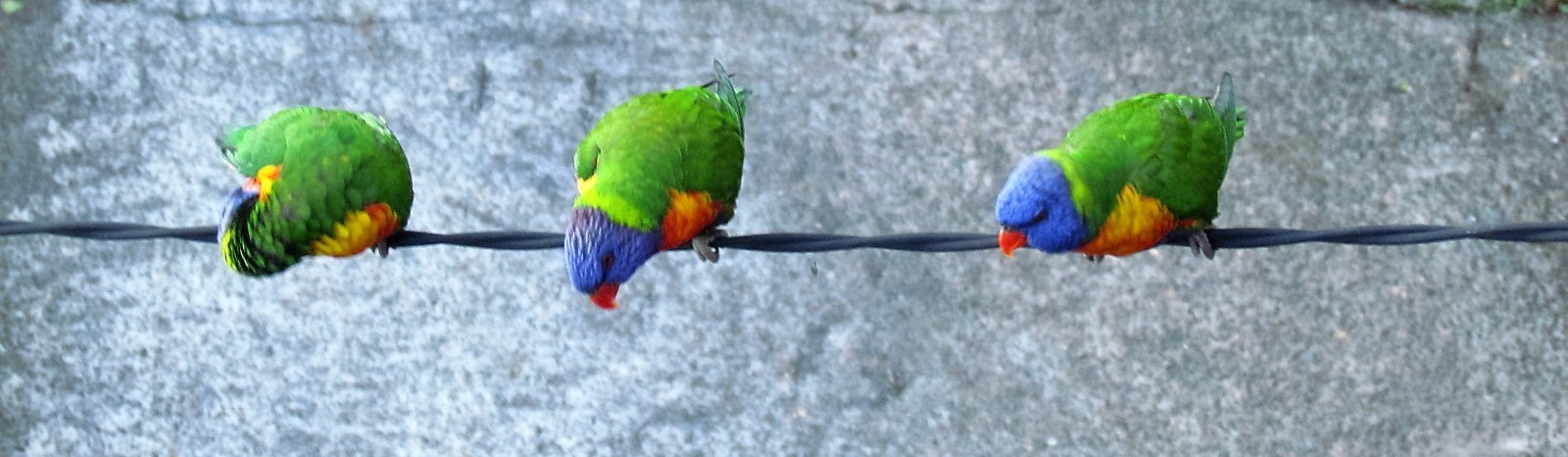
It turns out you can fit quite a few lorikeets on a flower spike:

Common name: Rainbow Lorikeet
Scientific name: Trichoglossus haematodus
Approximate length: 30 cm
Date spotted: 7 July 2017 (Winter)
Location: Allambie Heights, New South Wales, Australia
Blue puffballs: Male Variegated Fairy-wren and partner
Two Variegated Fairy-wrens dropped in for a flying visit. The most visible one, with electric blue feathers, is male. The female has softer colouring, with blue tail feathers. Their excited chirping drew me to the window in time to make a quick video.
Common name: Variegated Fairy-wren
Scientific name: Malurus lamberti
Approximate length: 13 cm
Date spotted: 13 February 2017 (Summer)
Location: Allambie Heights, New South Wales, Australia
Two chirpy Variegated Fairy-wrens
Followers of this blog will know that I’m building up a collection of pictures of fairy wrens, bit by hard-won bit! They’re tiny little birds that like to flit around the undergrowth, granting observers tantalising glimpses but not much more.
These two female Variegated Fairy-wrens were out in the open for a few seconds, which has to be some kind of record. They’re chirping sociably to each other as they hop along next to a bush path.
Common name: Variegated Fairy-wren
Scientific name: Malurus lamberti
Approximate length: 13 cm
Date spotted: 12 February 2017
Season: Summer
Location: Manly Dam Reserve, New South Wales, Australia: 33°46’47.9″S 151°15’02.7″E
Magpie serenade
Two magpies hopped onto a branch and serenaded each other as I walked past. They had to battle a fairly fierce wind, as you can see from the ruffled state of their feathers.
Common name: Australian Magpie
Scientific name: Gymnorhina tibicen
Approximate length: 40 cm
Date spotted: 26 January 2017
Season: Summer
Location: Long Reef near Dee Why, New South Wales, Australia: 33°44’21.1″S 151°18’30.8″E


 Sydney Birder