Blog Archives

Golden Whistlers calling
It’s a lovely experience walking through an Australian forest, with Golden Whistlers calling around you. In this video, the bird appears only as a shape flashing through the branches. There’s also a Grey Fantail echoing the whistler’s call:
That video is from my Soothing Musings channel. I’ve included it here because it’s such a tranquil scene.
The next video shows one of the birds calling to his mates:
At the start of the video, some Sulphur-crested Cockatoos are screeching, but they quieten down eventually. You can also hear a Grey Fantail at about 26 seconds into the video and again at the end. There’s an Olive-backed Oriole calling in the distance too.
Golden Whistlers are small birds, about the size of a wren. They have a black head, a white bib, and the golden chest, underbelly, and collar that gives them their name.

Common name: Golden Whistler
Scientific name: Pachycephala pectoralis
Approximate length: 16-18 cm
Date spotted: 30 August 2024 (end of winter)
Location: Manly Dam Reserve, New South Wales, Australia: 33°46’50.3″S 151°14’51.7″E

Three whipbirds calling
The noise that whipbirds make is strange: “eeeuuw-phwit”. It reminds people of a whip whistling and cracking, and that’s what gives the bird its name.
In this video, at least three Eastern Whipbirds are calling to each other. Twice in the video, you can hear two of them doing the long drawn-out whistle at the same time: the whistle vibrates and little. When you hear two (or three) chirps after the whistle and crack, like “eeeuuw-phwit-pheeuw-pheeuw”, the last two (or three) chirps are actually made by a second bird. The final chirps come so close after the first call that it sounds like one bird.
As you can see in the video, whipbirds are very good at hiding in the bushes. It’s hard to get a good picture. They’re quite pretty, in a subdued, forest-loving way.
Here’s one of the birds:

Its head and neck are black and white, with a nice little crest. The back and tail are a soft forest green. Here’s the same bird from a different angle:

Common name: Eastern Whipbird
Scientific name: Psophodes olivaceus
Approximate length: 30 cm
Date spotted: 22 August 2024 (winter)
Location: Dobroyd Head in Sydney Harbour, NSW, Australia: 33°48’35.6″S 151°16’04.6″E

Lyrebird imitating a shooting game and several birds
It was a rare treat to find this Lyrebird in Sydney’s Northern Beaches. The bird was dancing, displaying his tail, and calling. He had an impressive repertoire, including the pieuw-pieuw sounds of an electronic shooting game and the calls of various birds.
Hint: For the best experience, increase the default quality of the video. (Use YouTube’s cog icon to update the settings.)
At the start of the video, the Lyrebird is searching through the leaves and twigs on the ground. The rushing noise in the background is a small waterfall nearby. The bird starts gently crooning and chirping to himself. (Turn up the volume to hear the mutterings.) Then the urge to sing overcomes him, and he starts his performance. The full display starts at about 50 seconds into the video, with the rattling and pieuw-pieuwing of an electronic shooting game accompanied by side-to-side and frontwards steps. He mingles some bird chirps into the shooting sounds for dramatic effect. Next come the bird sounds. I heard the start of a kookaburra call, though he didn’t get fully into it. (He did the full call in another performance, which I haven’t posted here.) He adds the calls of magpies, wattlebirds, lorikeets, and whipbirds. I think I hear a Yellow-tailed Black-cockatoo and a magpie in there too, and other birds that I haven’t identified.
Between performances, the little fellow spent some time resting and picking through the leaves before starting up again.
The bird kept to the shadiest spots, making it hard to get a good photo. This is the best that I managed:

Common name: Superb Lyrebird
Scientific name: Menura Novaehollandiae
Length: 80-95 cm
Date spotted: 18 July 2024 (winter)
Location: Sydney’s Northern Beaches, New South Wales, Australia

Butcherbirds sang to me!
Early one morning, at the place I was staying at near Brisbane, two Grey Butcherbirds dropped down and sang to me.
It felt very special to have these birds come so close and sing their song. I suspect they were hoping I’d produce a snack. This is the first time I’ve had this experience, though a few magpies have sung to me in the past.
Here’s a still picture of one of the birds:
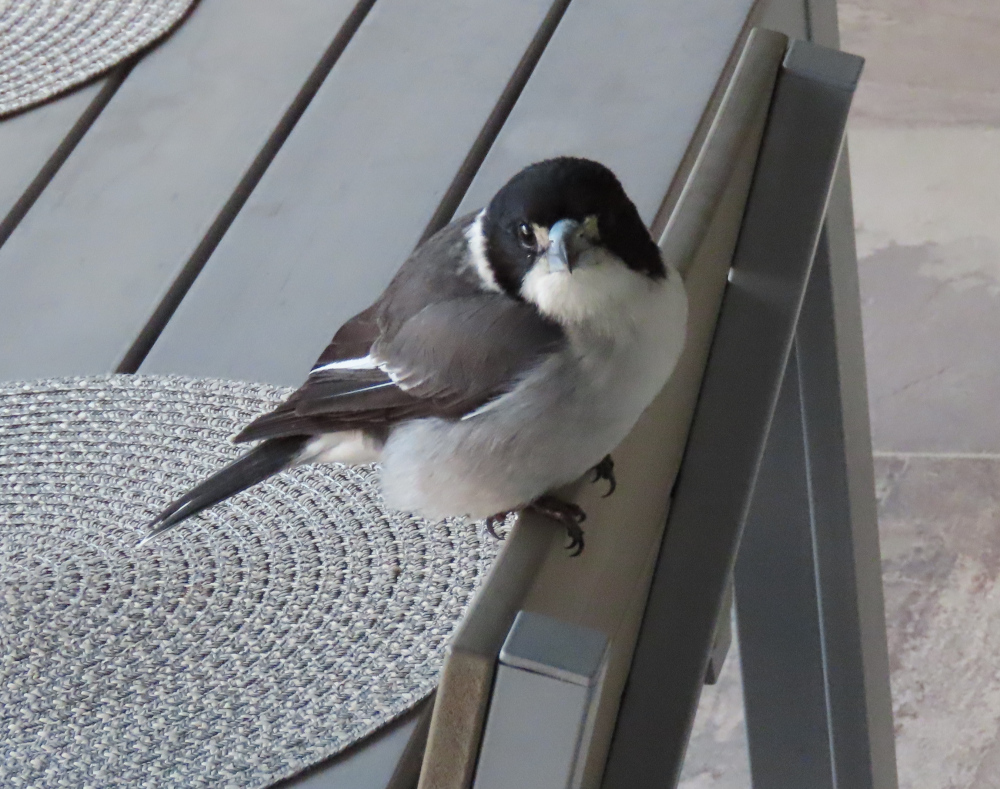
Butcherbirds are medium-sized songbirds, widely spread in Australia. They’re only distantly related to the South African shrikes that are also known as butcherbirds. Both groups of birds get their name from their habit of securing their captured prey on spikes or in crevices, to store the prey for youngsters or to make it easier to eat.
Common name: Grey Butcherbird
Scientific name: Cracticus torquatus
Approximate length: 30 cm
Date spotted: 6 July 2024 (winter)
Location: The Gap, Brisbane, Queensland, Australia: 27°26’55.3″S 152°55’50.2″E

Evocative call of the Spiny-cheeked Honeyeater
This is the last of my posts from our recent trip out west into the Great Outback, and I’ve left the best to last. Like almost all my postings from this trip, this is a first sighting for me.
While I was wondering around on Mungo Lodge, on the outskirts of Lake Mungo, a beautiful, mournful whistle seemed to follow me. At first I thought a person was whistling. (There were other people taking photos in the area.)
Eventually, after ducking under the low branches of trees and taking plentiful photos and videos, I found the whistler: A Spiny-cheeked Honeyeater. Even then, I wasn’t sure, and asked for confirmation on r/AustralianBirds.
Here’s a Spiny-cheeked Honeyeater:

They’re distinctive-looking birds, with that pink line extending from the beak under the eye, a pale blue eye, and a cinnamon-yellow chest.
This video is a bit shaky, but shows one of the birds singing. The call that particularly struck me is the five-note, falling whistle, at 13 seconds into the video and then again at 25 seconds:
In the next video, it’s not as clear which birds are making the call, but there are some nice instances of the call itself, especially from 32 seconds into the video:
Another still shot of one of the birds:

Common name: Spiny-cheeked Honeyeater
Scientific name: Acanthagenys rufogularis
Approximate length: 23-26 cm
Date spotted: 20-21 May 2024 (autumn)
Location: Mungo Lodge, Mungo National Park, New South Wales, Australia: 33°44’31.4″S 143°00’06.1″E

Whistling Kite on the Bogan River
Early one morning, on the banks of the Bogan River at Nyngan, I watched this raptor calling and flying. I was in the area, at the start of a trip heading west from Sydney into the Australian Outback.
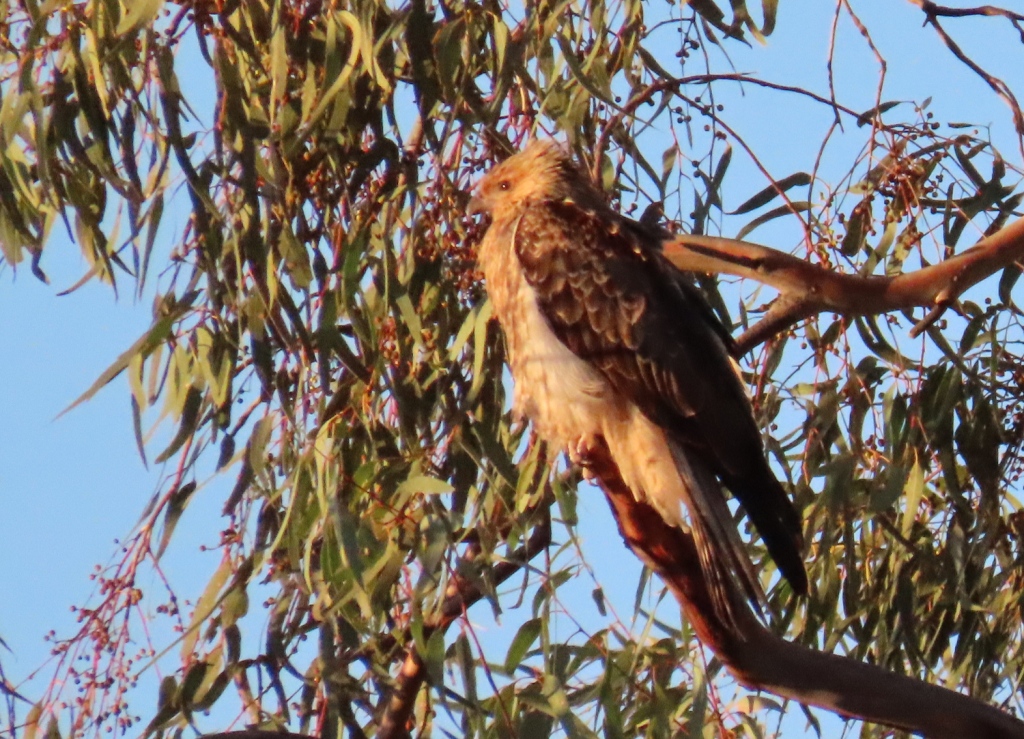
In this video, the piercing call of the bird echoes across the river. The background noise in the video is mostly from the wind. It was a cold and blustery morning:
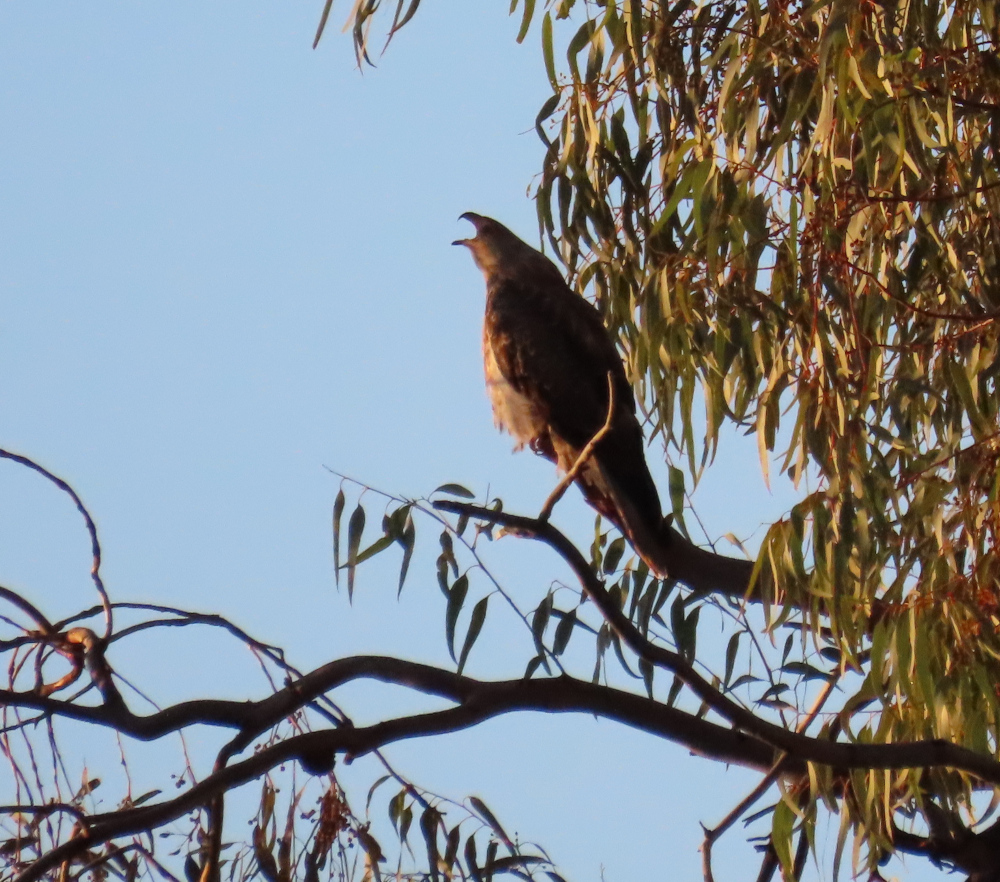
In the next shot, the bird’s head is up and its beak is opened wide, in the midst of making its call:
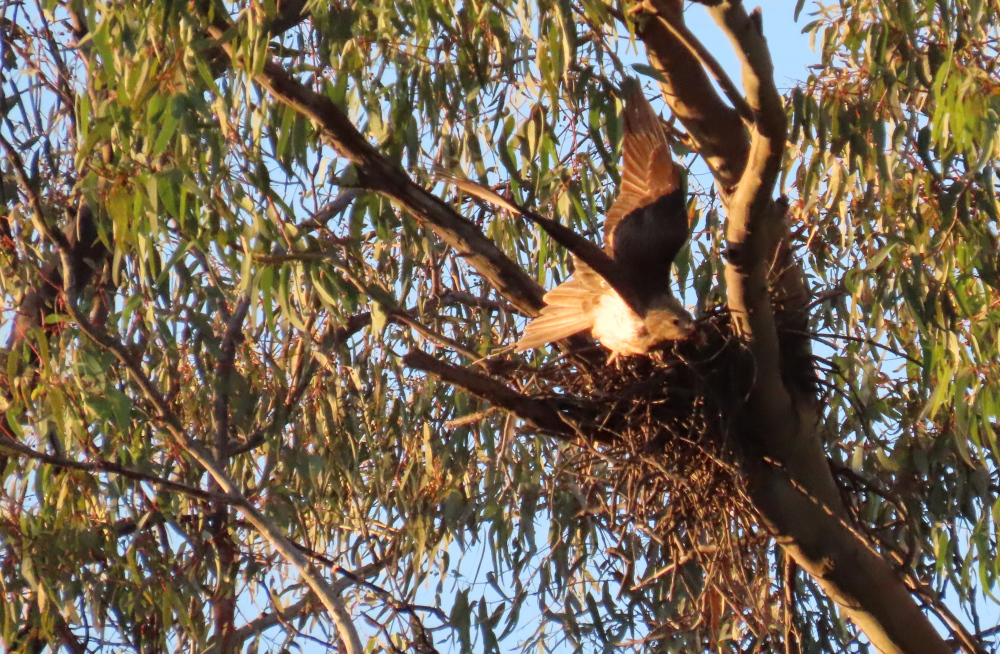
Nearby was the bird’s nest, a platform of loosely woven sticks:
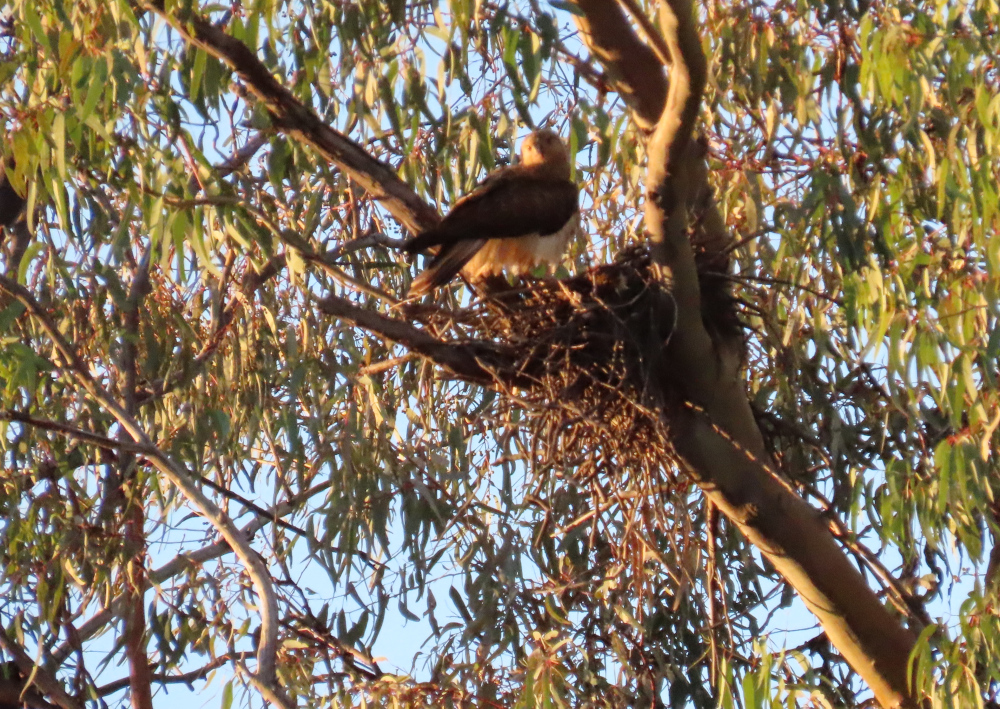
The bird departed from and returned to its nest a couple of times while I watched:
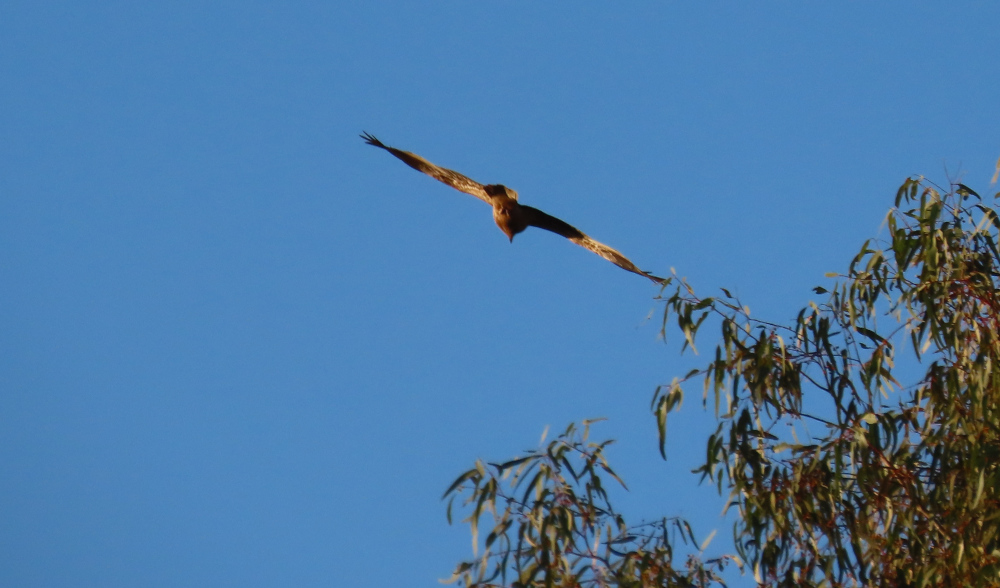
Each time it left the nest, the bird would circle high in the sky, or swoop down over the river. There were a few other birds circling too, so I can’t be sure that this is the same bird:
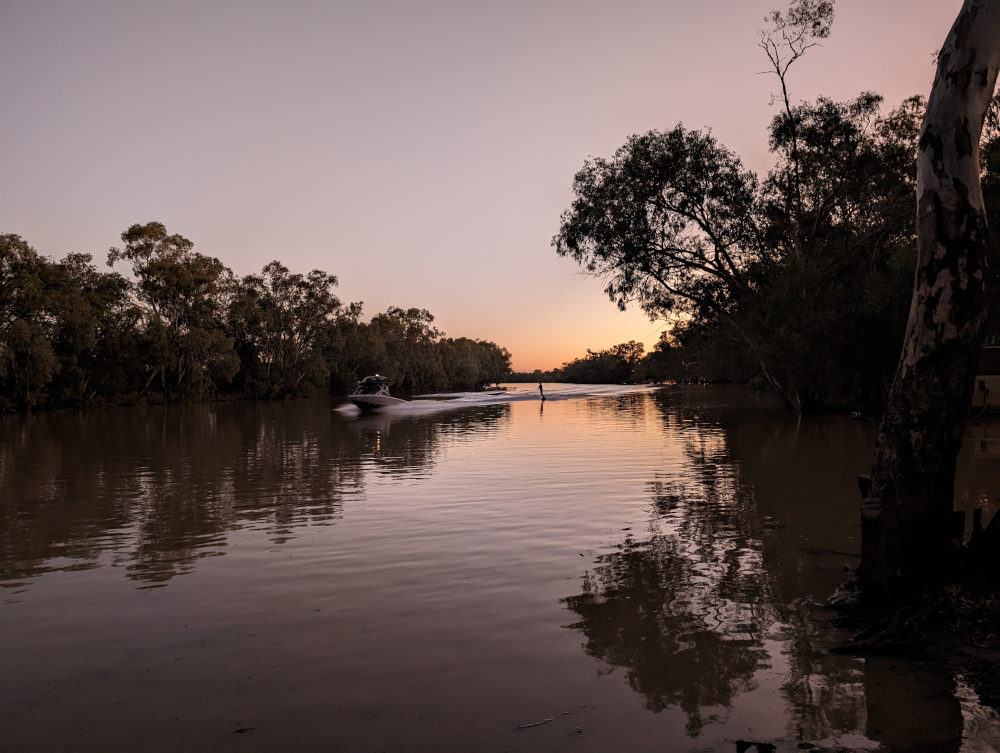
I saw the bird in the evening of 17 May, and then again the next morning. All my bird photos are morning shots. The next shot shows an evening shot of the Bogan River, near where the bird had built its nest. When taking all the photographs, I was on the opposite bank of the river from the bird and its nest:
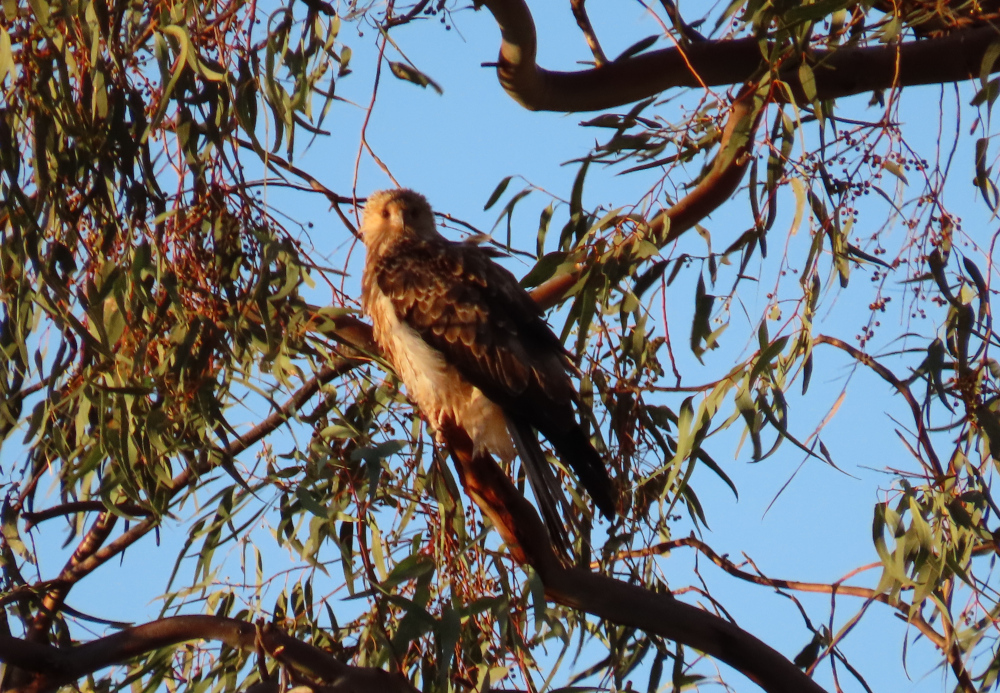
Here’s another shot of the same bird (again, a morning shot):
Common name: Whistling Kite
Scientific name: Haliastur sphenurus
Approximate length: 50-60 cm; wing span 1.2-1.5 m
Date spotted: 18 May 2024 (autumn)
Location: Nyngan Riverside Tourist Park, New South Wales, Australia: 31°33’39.1″S 147°10’45.2″E

Colourful Oriole singing
The colours on this Olive-backed Oriole are gorgeous: bright red eyes, olive green neck and shoulders, white underbelly with black stripes. The bird was uttering its typical ringing call, interspersed with the sounds of other birds that it was mimicking. The music in the background is from some nearby picnickers.
The sound that first drew me to look for this bird was the call of a Black-faced Cuckoo-shrike. Instead, I found an Olive-backed Oriole mimicking the call! (I didn’t catch that particular sound in the video, alas.)
The bird was on a Casuarina tree, looking for insects among the seed pods. Here’s a still photo:
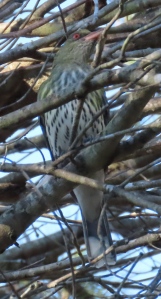
Common name: Olive-backed Oriole
Scientific name: Oriolus sagittatus
Approximate length: 25-28 cm
Date spotted: 25 March 2024 (summer)
Location: Manly Dam Park, New South Wales, Australia: 33°46’52.3″S 151°15’07.9″E

Bird spotting with Aussie Bird Tours
Yesterday my family and I went on a bird-spotting trip with Aussie Bird Tours. Mike Barrow led us on a wonderful half-day tour around the Dee Why Lagoon, Warriewood Wetlands, and Irrawong Reserve. We spotted a large number of birds (40-50 types) and heard others too. Here are the ones that I managed to get a half-decent photo of.
Our tour started at Dee Why Lagoon, where we saw a number of water birds: a darter, cormorants, ducks, a black swan, coots, a Silver Gull, and more. Songbirds were there too. A Magpie-lark strutted over the mud. Welcome Swallows darted across the water. A Willie Wagtail chirped in the distance. An Eastern Whipbird spent many minutes exploring the dense reeds a couple of metres from our feet. We could hear its characteristic chattering, but only saw it when it made a break for the higher foliage.
This male Olive-backed Oriole (Oriolus sagittatus) posed for a profile shot against the blue sky:
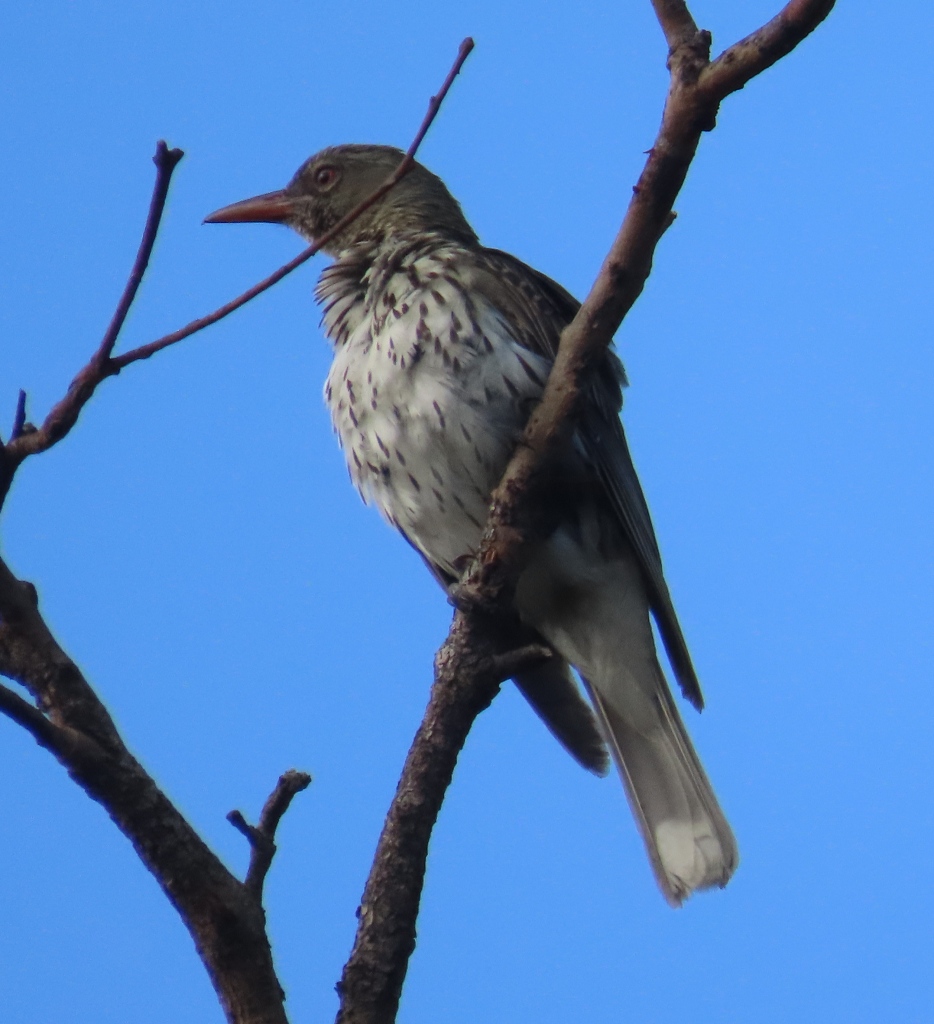
On this trip I learned what Olive-backed Orioles sound like (you can hear their call on eBird). I also learned the call of the Darter (hear it on xeno-canto). The latter sounds very like a Dollarbird, and I’ve probably mixed up those two calls in the past.
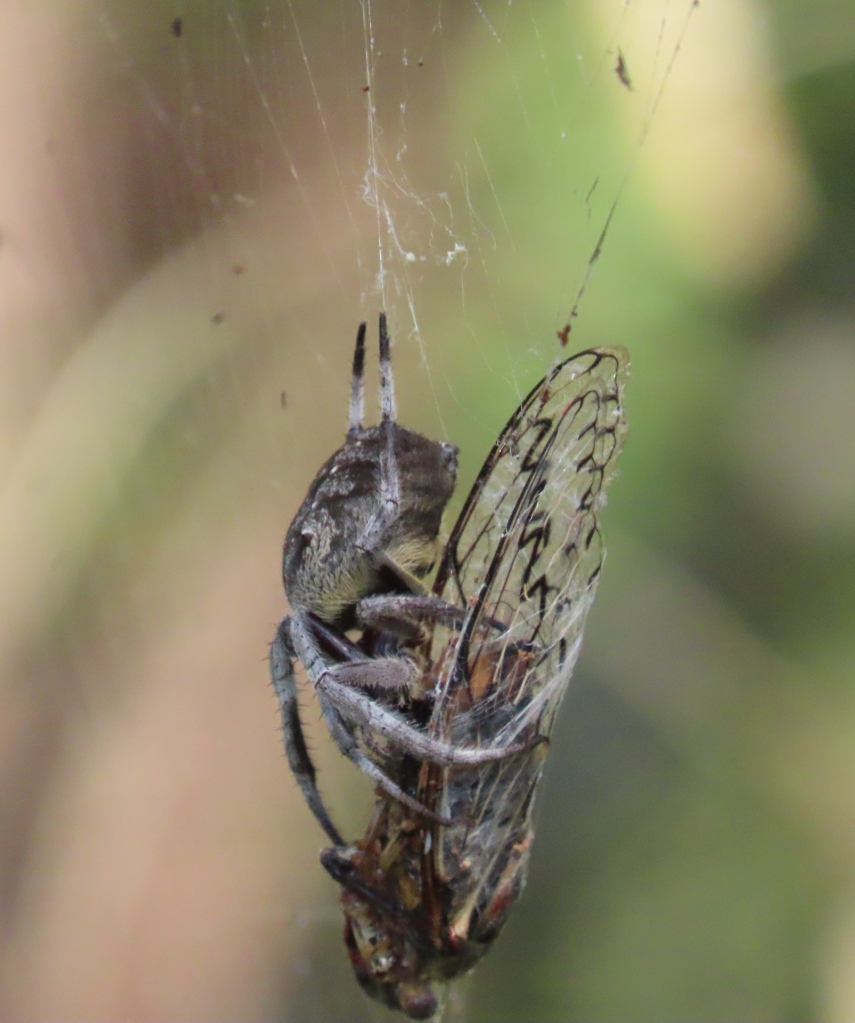
Our next stop was the Warriewood Wetlands, which is an interesting patch of swampy bushland. A raised path leads you across the reeds and water, with great views of wetlands all round you. The cicadas were out in full force, deafening us while providing food to other creatures. Here, a large spider has caught a cicada in its web and is having a feast:
Discarded cicada husks stuck to tree trunks, shed when the cicada larva emerges from the ground and morphs into the winged insect:

Bell Miners (Manorina melanophrys) have moved into the Warriewood Wetlands in large numbers. The call of these honeyeaters is a clear, single, oft-repeated clink, like the sound of a bell. They’re quite attractive birds, with olive wings and back, and a pale yellow chest:
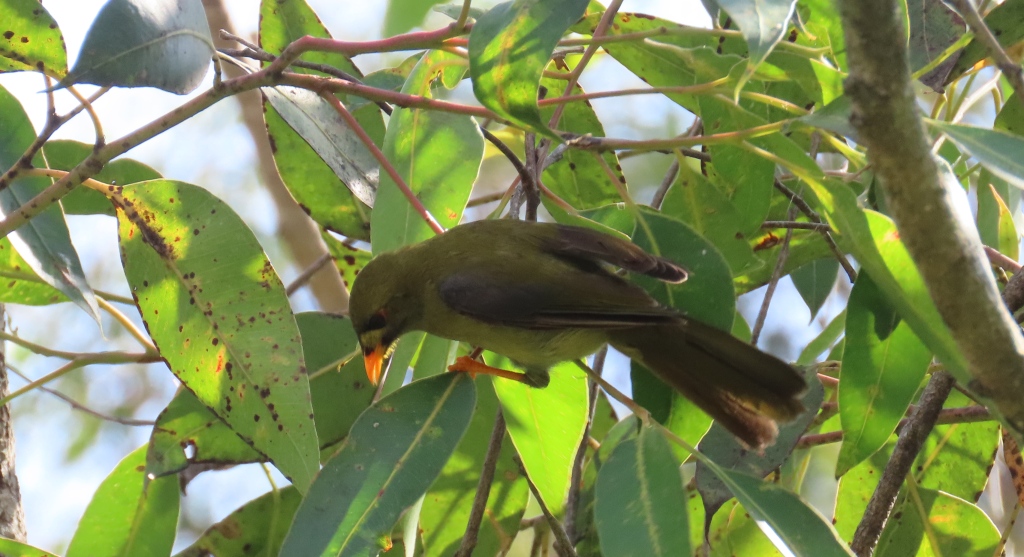
What with the screeching of the cicadas and the pinging of the Bell Miners, this was a noisy patch of bush!
The noise didn’t seem to bother the Purple Swamphens (Porphyrio porphyrio), who carried out a lively courtship beneath the wooden walkway:
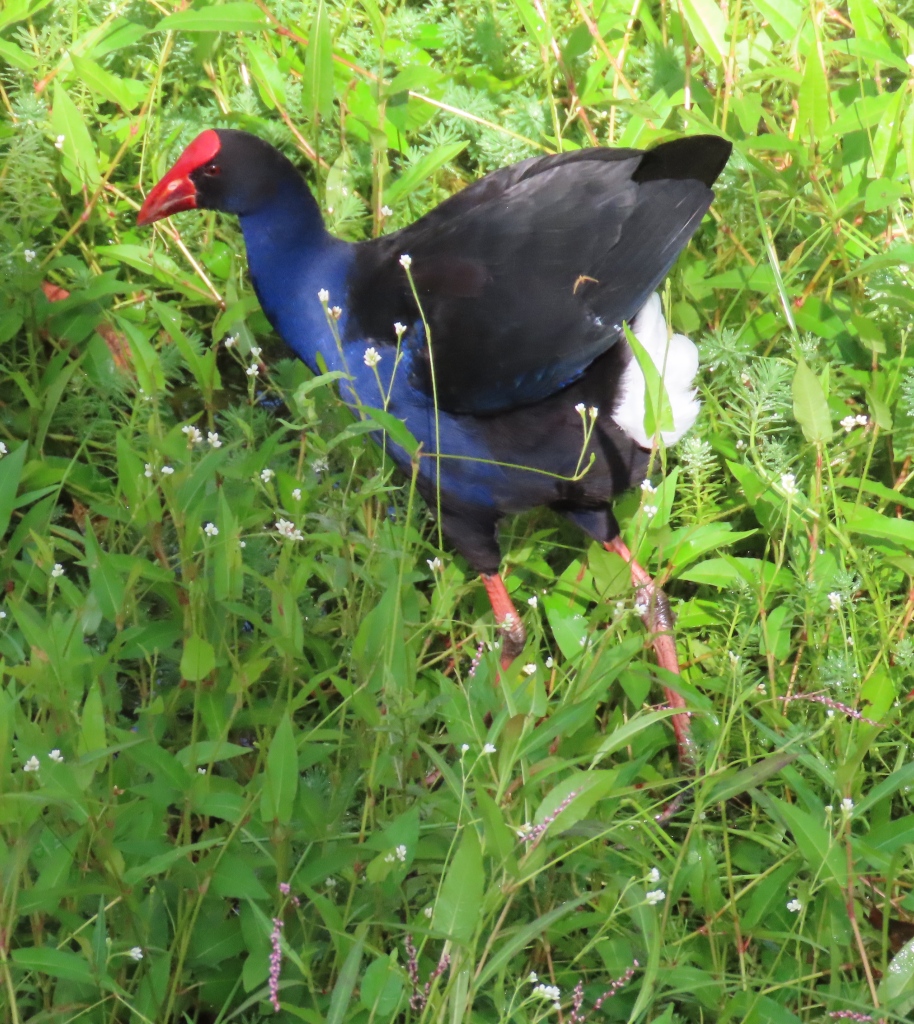
A small water dragon looked on:

A Dusky Moorhen (Gallinula tenebrosa) showed up in bold orange and yellow:

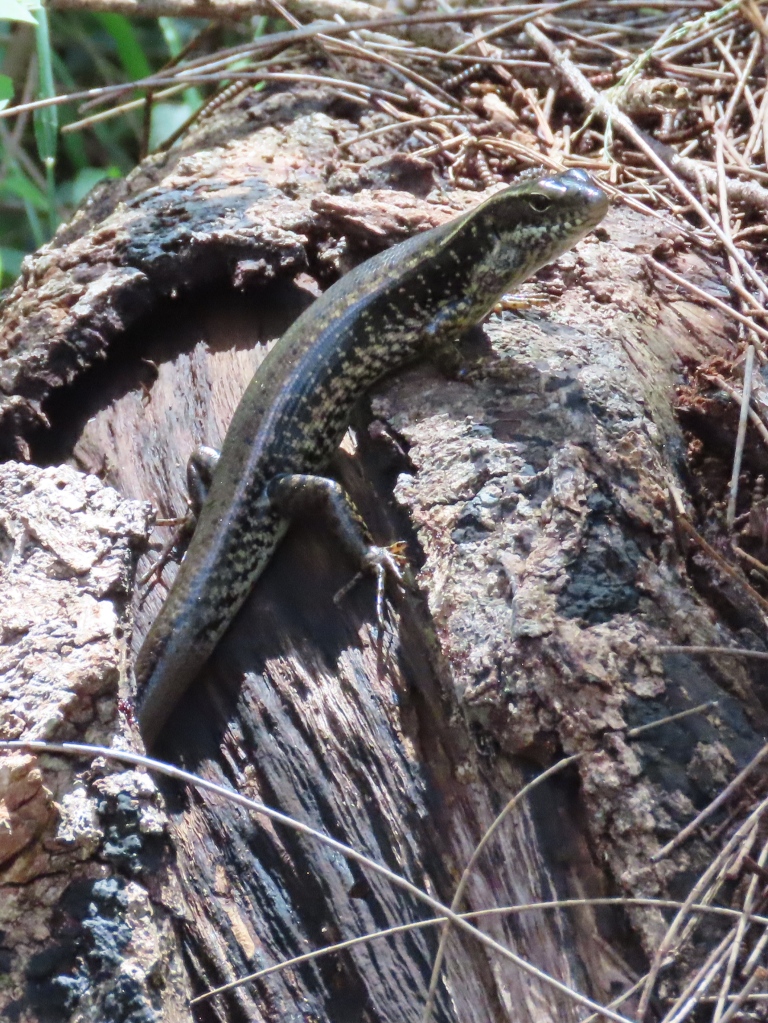
We didn’t see any snakes, though evidently they’re around. We did see a couple of largish skinks, like this one:
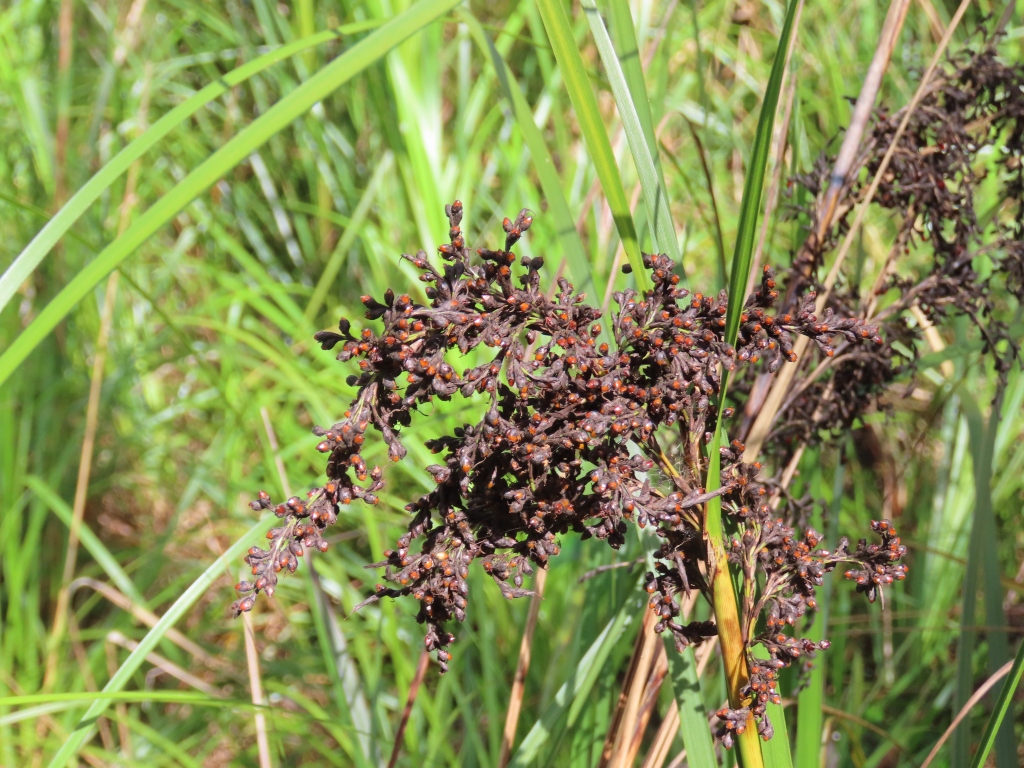
Striking dark grass flowers lined the way:
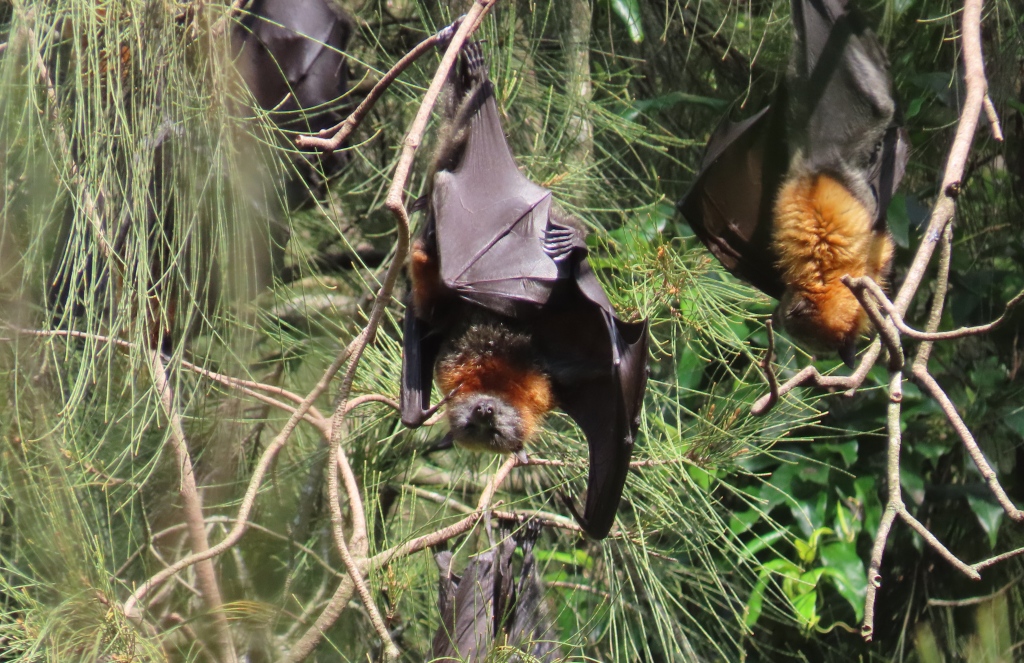
A colony of Flying Foxes (large fruit bats) occupies one corner of the wetlands:

Here’s a close-up of one of these attractive, intriguing mammals. They have a grey face, with a reddish fur collar and back. Their wings are black and leathery, strong enough to support these large bats in their long cross-country flights:
After the Warriewood Wetlands, we visited Irrawong Reserve. A Golden Whistler (Pachycephala pectoralis) carolled in the dense bush. This is the male bird:
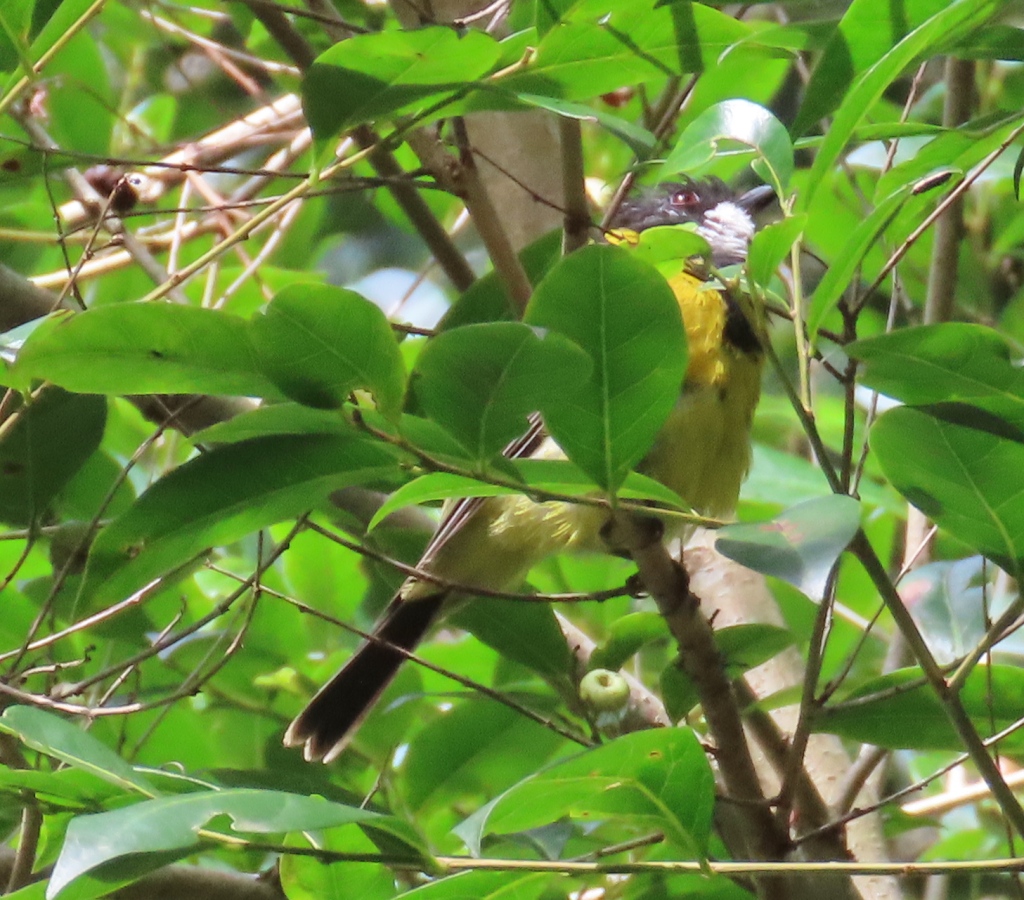
As you can see, it’s adept at hiding behind the foliage. Here’s another shot of the same bird, with its tail fanned:

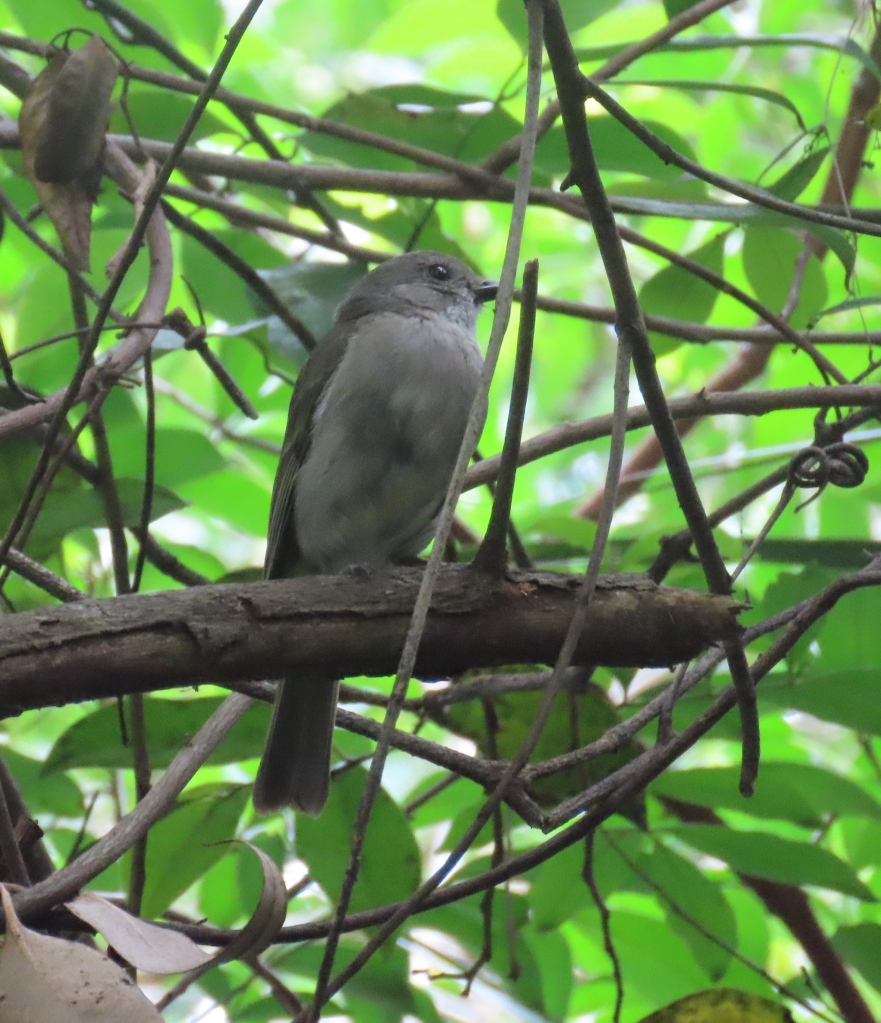
I think the next bird is a female Golden Whistler. They’re harder to identify because of their soft colouring:
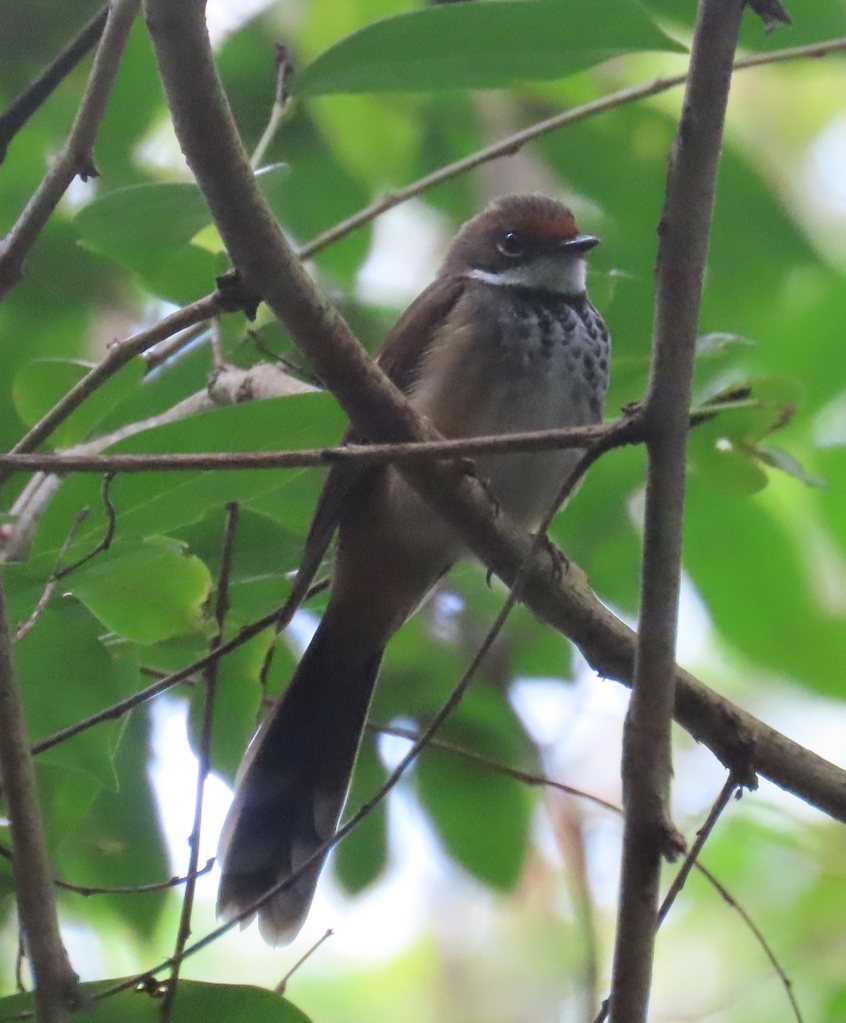
The next bird is a first sighting for me: a pretty Rufous Fantail (Rhipidura rufifrons):
This video is rather blurry, but it’s useful because you can hear the characteristic song of the fantail, similar to that of the Grey Fantail and Willie Wagtail:
My last bird of the day is a Brown Gerygone (Gerygone mouki), another first sighting for me:

The photograph of this bird is very similar to the earlier one of the female Golden Whistler. However, the Gerygone has grey markings running from beak to eye. The Gerygone (9-11 cm) is also smaller than the Golden Whistler (16-18 cm), though that’s hard to tell from the photos.

Young Shufflewing being fed
Black-faced Cuckoo-shrikes are often called Shufflewings, because they flip their wings up and down a little each time they land. I hear the birds calling often while walking in the bush, and see them sometimes too. Usually, though, they’re high in the treetops and difficult to spot. It’s been a long-time ambition of mine to catch a video of one doing the wing-shuffle.
Today was my lucky day. Not only did I film the wing-shuffle of an adult Black-faced Cuckoo-shrike, but I also saw a juvenile being fed by adults. The birds were quite low down in a Casuarina tree, probably because that’s where the youngster landed after emerging from its nest.
In the first video, an adult bird lands next to the youngster and feeds it a parcel of food before flying off to a higher branch. The adult sits up high for a while, holding another tasty morsel in its beak. Adult and child trill softly to each other. The adult then drops down and feeds the little one again. When it lands on another branch, it does one of its characteristic wing-shuffles.
The second video starts with an adult bird carrying some food in its beak. The bird visits the youngster, passes over the food and hangs around for a short time, then flies off. The youngster takes some time to swallow the food, while gazing around and calling for the next morsel.
Here’s a still picture of the young bird:

The youngster again, from a different angle:

Here’s the adult, posed neatly against a blue sky:
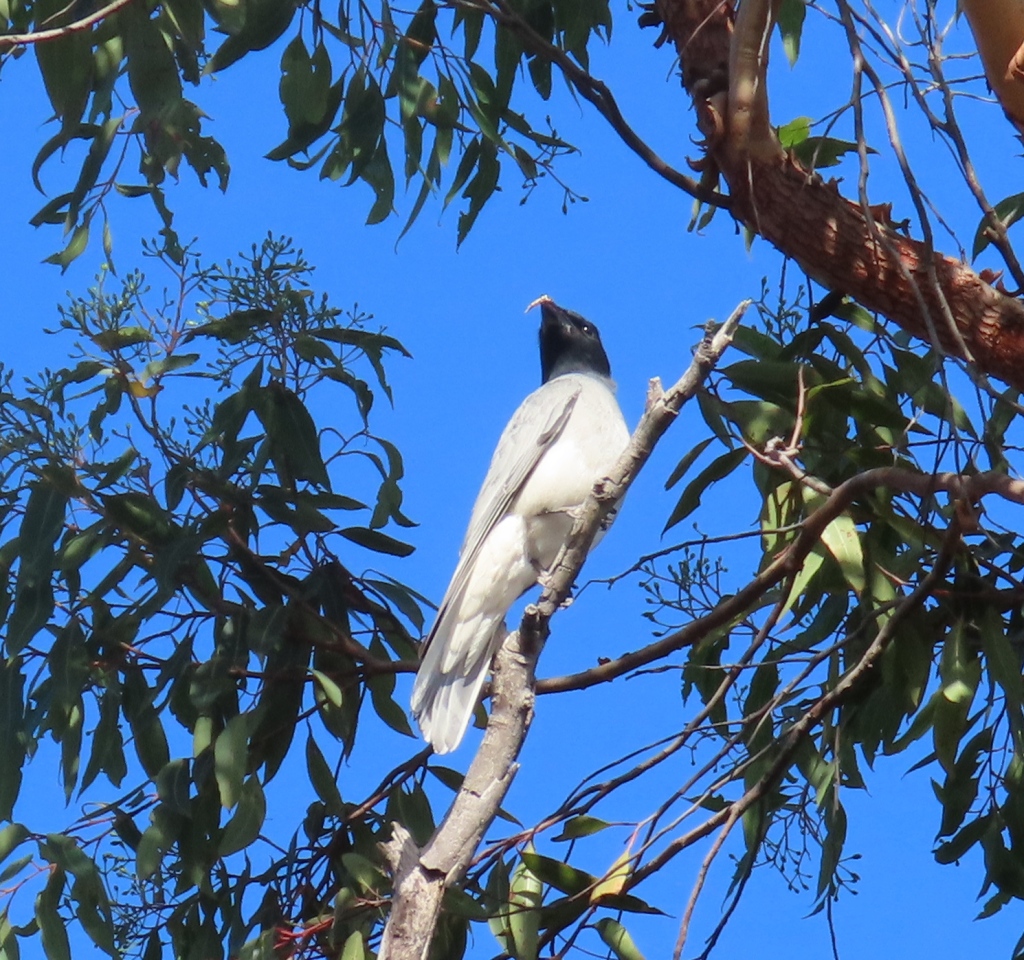
Despite their name, Black-faced Cuckoo-shrikes aren’t shrikes, nor even cuckoos. Evidently they acquired the name because their beaks have the same hooked end as a shrike’s and their feathers have similar patterns to some cuckoos.
These are beautiful, graceful birds to see and hear. I’ve posted descriptions of other Black-faced Cuckoo-shrikes that I’ve spotted over time.
Common name: Black-faced Cuckoo-shrike, also called a Shufflewing
Scientific name: Coracina novaehollandiae
Approximate length: 35 cm
Date spotted: 22 December 2023 (summer)
Location: Manly Dam Park, New South Wales, Australia: 33°46’53.2″S 151°15’08.0″E

Spitfire grubs and Kookaburras
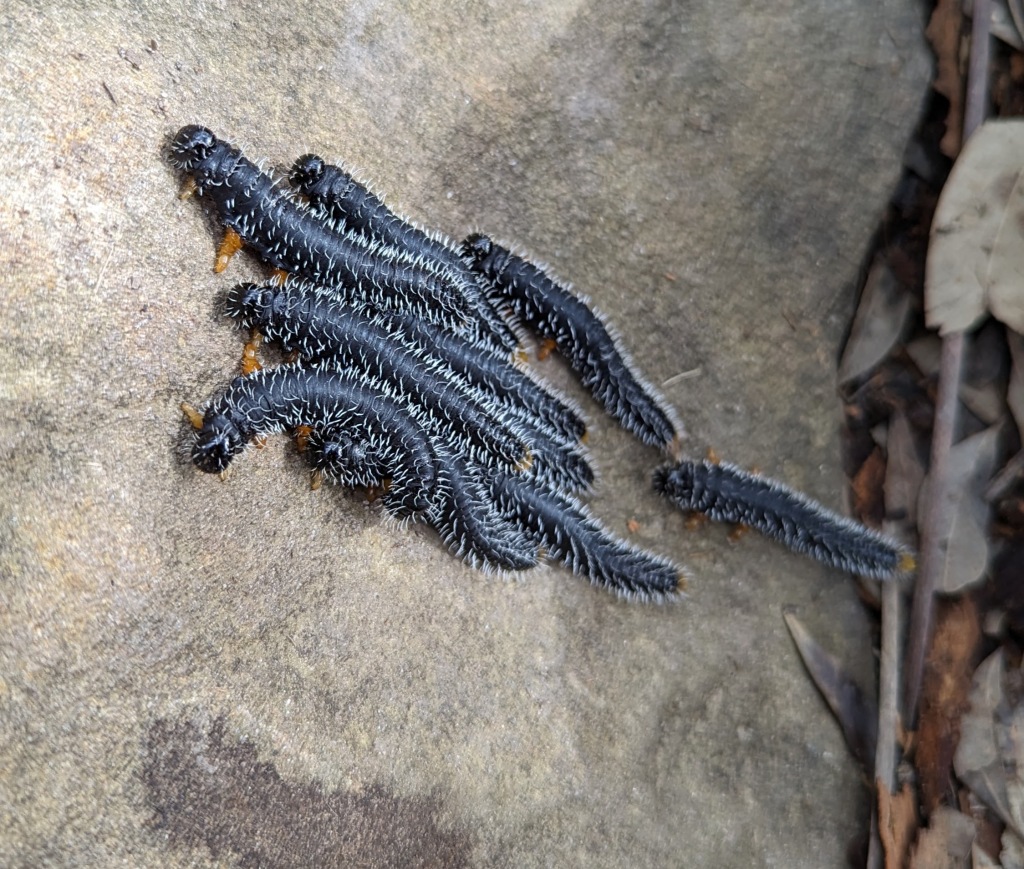
While wandering along a bush path, I came across a curious collection of grubs:
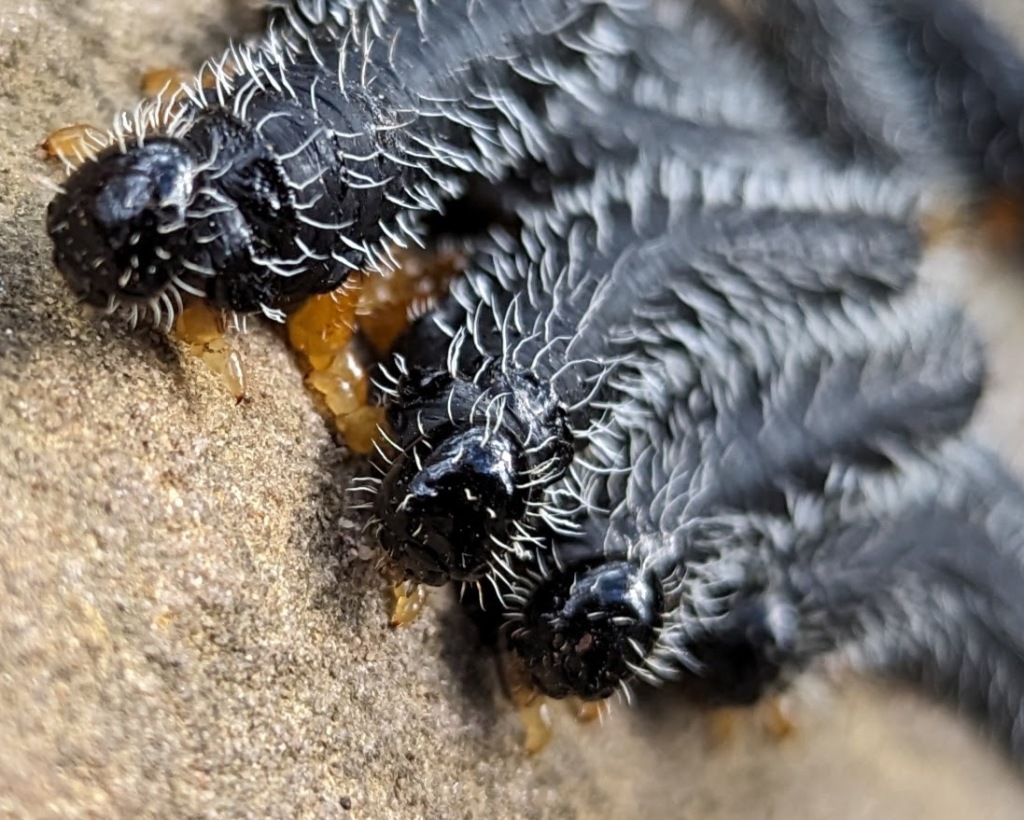
They’re spitfire grubs, which are the larvae of a type of wasp called a sawfly. The grubs look quite a lot like caterpillars with a don’t-mess-with-me attitude. They’re black and shiny, with white bristles, yellow feet, and a yellow tail. They’re quite long and fat: about the size of my little finger.
Despite the name “spitfire”, the grubs don’t actually spit anything, but if you touch them you can get a burning sting from the spikes. The grubs also spew out a thick yellow liquid from their mouths when threatened, but the liquid isn’t harmful to people. It’s made from eucalyptus oil, since the grubs feed on eucalyptus leaves.
In the video, you can see them tapping their tails on the rock. They do that to communicate their whereabouts with each other.
Here’s a close-up of some of their heads:
There were ten grubs in the clump:
Next on the scene was a riot of Kookaburras! The birds gathered above me while I was bent over the clutch of spitfire grubs. I was worried that the Kookaburras might swoop down and grab a grub as a snack!
The Kookaburras left the grubs alone. I guess they don’t taste great!
Common name: Laughing Kookaburra
Scientific name: Dacelo novaeguineae
Approximate length: 47 cm
Date spotted: 18 July 2023 (winter)
Location: Manly Dam park, New South Wales, Australia: 33°46’56.0″S 151°15’05.4″E


 Sydney Birder