Blog Archives
Local group of Glossy Black-Cockatoos now six strong!
Every now and then over the last few years, I’ve seen a group of Glossy Black-Cockatoos on the banks of Manly Dam. They have a few favourite spots, always where the Casuarina trees are in seed.
For the first couple of years, there were always three birds in the group. I don’t know if they were the same birds each time. Then suddenly there were five. And yesterday, for the first time, there were six. Glossies are rare compared to the other types of cockatoos in our area (Sulphur-crested, Yellow-tailed Black, and Corellas), so it’s wonderful to see this group growing in size.
Yesterday was a muggy, grey day. My camera kept misting up due to the high humidity. Every now and then the mist turned to light, drifting rain that settled into blotches on the lens. Still, the video gives you and idea of the gentle, calm presence of these large birds.
Glossies are a type of parrot. In Australia we have 56 species of parrots, including cockatoos, lorikeets, rosellas, ringnecks and budgerigars. Check out my previous sightings of Glossy Black-Cockatoos.
Common name: Glossy Black-Cockatoo
Scientific name: Calyptorhynchus lathami
Approximate length: 50cm
Date spotted: 19 March 2026 (autumn)
Location: Manly Dam Park, near Sydney: 33°46’23.8″S 151°14’39.5″E
Olive-backed Oriole calling and mimicking other birds
I listened to this Olive-backed Oriole for a while, trilling its characteristic call interspersed with imitations of other birds. I managed to get part of its performance on video. As well as being pretty and having a lovely song, this Oriole is an excellent mimic.
At the start of the video, the Oriole reacts to the shriek of Masked Lapwings (also known as Spur-winged Plovers). After a couple of seconds, the Oriole starts its own performance again.
Common name: Olive-backed Oriole
Scientific name: Oriolus sagittatus
Approximate length: 25-28 cm
Date spotted: 17 March 2026 (autumn)
Location: Manly Dam Park, New South Wales, Australia: 33°46’31.7″S 151°14’47.8″E
Tongue of the White-cheeked Honeyeater
A White-cheeked Honeyeater feeds off the flower of a Banksia bush. At 19 to 24 seconds into the video, you can see the bird’s long, thin, white tongue flicking quickly in and out of its beak. The bird chirps every now and then, no doubt commenting about me to the other birds in the area.
Like most honeyeaters, these birds feed on nectar from flowers and also will snap up a handy insect every now and then. Their tongues are long enough to stick out beyond the end of their beaks, making it easier to lap up nectar from a flower.
Common name: White-cheeked Honeyeater
Scientific name: Phylidonyris nigra
Approximate length: 16-19 cm
Date spotted: 25 February 2025 (summer)
Location: Manly Dam Reserve, New South Wales, Australia: 33°46’28.7″S 151°14’46.3″E
Golden Whistler calling – a short video
This morning, a Golden Whistler stayed in one spot for long enough for me to get out my camera and record a few seconds of his song. So, for your enjoyment, here it is!
Golden Whistlers are small birds, about the size of a wren. They have a black head and a white bib, and the golden chest, underbelly, and collar that give them the first part of their name. The second part of the name comes from their lovely whistling calls. I’ve published more videos and pictures of previous sightings.
Common name: Golden Whistler
Scientific name: Pachycephala pectoralis
Approximate length: 16-18 cm
Date spotted: 3 December 2025 (summer)
Location: Manly Dam Reserve, New South Wales, Australia: 33°46’45.0″S 151°14’54.2″E
Peaceful Dove calling
In Merriwa, NSW, the call of a Peaceful Dove sounds out above the early morning bird chorus:
Peaceful Doves are small doves, coloured shades of grey with an apricot tinge, and a blue ring of bare skin around the eye.
Common name: Peaceful Dove
Scientific name: Geopelia placida
Approximate length: 20-24 cm
Date spotted: 13 September 2025 (spring)
Location: Merriwa, New South Wales, Australia: 32°23’36.0″S 150°41’07.8″E
Learning how to be a Yellow-tailed Black Cockatoo
Strolling along a path at Manly Dam, I came across a group of Yellow-tailed Black Cockatoos. It’s always a treat being with these birds. They’re the quiet giants of the cockatoos in south eastern Australia. They sit on Banksia trees or, in this case, Casuarinas, chewing the seeds and chuntering to each other. Occasionally, one of the birds floats up into the air and glides to another branch.
In the group were two juveniles, making that almost-constant crooning noise that characterises them. I think it’s partially a request for food, and partially a reminder to the adult birds of where the little ones have got too.
This youngster hasn’t quite figured out what to do with a Casuarina seed pod. He finds one on the ground, touches it to his beak, then drops it. Nearby, an adult shows him how it’s done:
A little later, the youngster has climbed into a tree. Instead of tackling those hard seed pods, though, he practices wielding his beak on the bark:
Common name: Yellow-tailed Black Cockatoo
Scientific name: Calyptorhynchus funereus or Zanda funereus
Length: 58-65 cm
Date spotted: 24 July 2025 (winter)
Location: Manly Dam Reserve, New South Wales, Australia: 33°46’42.5″S 151°14’59.1″E
Pied Butcherbird singing on the beach
As I walked past this tree, on a grassy patch next to the sea at Port Macquarie, I heard a gentle experimental whistling. I thought it might be a person, but then I heard some bird sounds mixed in. It was a Pied Butcherbird, trying out its repertoire while perched in an Old Man Banksia tree. In the background is the sound of the surf, rather noisy alas.
We don’t see these birds around Sydney, so I’m not familiar with their calls. I wonder if this one is different from most, or perhaps they sing a variety of songs?
Common name: Pied Butcherbird
Scientific name: Cracticus nigrogularis
Approximate length: 33-36 cm
Date spotted: 5 June 2025 (winter)
Location: Town Beach, Port Macquarie, NSW, Australia: 31°25’47.6″S 152°55’09.5″E

Two songs of the Fan-tailed Cuckoo
I’ve heard Fan-tailed Cuckoos several times over the years, making their pretty downward trilling call. A few days ago, I heard a different call: a haunting, mournful whistle sighing in the mist.
In this 14-second video, the bird whistles five times:
At first I didn’t know what type of bird was calling. Then I saw a Fan-tailed Cuckoo fly onto a nearby branch:

They’re rather pretty birds, with a russet chest and belly, and a startling orange mouth. On this occasion, I could see only the back of the bird. Here’s a picture of another Fan-tailed Cuckoo, which I saw in June 2020:
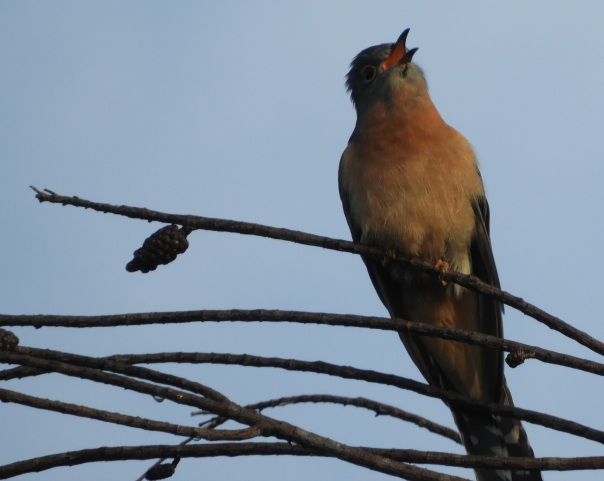
Shortly after I heard the whistles, the same bird or another started making the typical trilling call that I’ve heard more often. In this 17-second video, the bird calls four times:
Common name: Fan-tailed Cuckoo
Scientific name: Cacomantis flabelliformis
Approximate length: 26 cm
Date spotted: 11 May 2025 (autumn)
Location: Manly Creek, New South Wales, Australia: 33°46’21.3″S 151°14’34.8″E

More Noisy Friarbirds in Sydney’s Northern Beaches
Over the last couple of weeks, I’ve seen and heard several Noisy Friarbirds at Manly Dam in Sydney’s Northern Beaches. The birds seem to have moved in for the long haul. It’s exciting — I’ve only seen these birds further north and west before now.
Today I managed to actually get some images of the birds in a video, as well as their weird calls:
In the video, most of the noise is made by the friarbirds, but there are Rainbow Lorikeets chirping throughout, and the occasional Little Wattlebird too.
You can see more pictures of friarbirds in my other posts, taken in other areas of Australia.
Common name: Noisy Friarbird
Scientific name: Philemon corniculatus
Approximate length: 30-35 cm
Date spotted: 2 April 2025 (autumn)
Location: Manly Dam Reserve, New South Wales, Australia: 33°46’43.4″S 151°14’52.8″E
Noisy Friarbirds at Manly Dam!
I was excited to hear Noisy Friarbirds at Manly Dam park in Sydney’s Northern Beaches. I haven’t seen these birds in the area before — they’re more common further north and west.
Over the past couple of weeks, I’ve heard the unforgettable sounds that these birds make. Today I managed to take some photos. In the video, you can hear the odd sounds made by the Noisy Friarbirds amongst other bird calls, but you don’t actually see the friarbirds. They’re very hard to spot.
The first bird sound in the video is the chirping of Rainbow Lorikeets. The laugh-like cackle and chatter of the Noisy Friarbirds begins soon after the start, at about 0:02. The lorikeets continue chirping throughout. In the background is the cackle of some Little Wattlebirds, which is similar to the friarbirds’ call but less varied in tone and style.
I did manage to snap a few photos of two friarbirds, though they’re quite blurry. This photo shows one of the friarbirds perched briefly out in the open:

Another friarbird was having an altercation with a Rainbow Lorikeet. The friarbird was the one to cede ground:

You can see some better pictures of friarbirds in my other posts, taken in other areas of Australia.
Common name: Noisy Friarbird
Scientific name: Philemon corniculatus
Approximate length: 30-35 cm
Date spotted: 26 March 2025 (summer)
Location: Manly Dam Reserve, New South Wales, Australia: 33°46’42.5″S 151°14’54.3″E


 Sydney Birder