Blog Archives

Peregrine Falcon at Dobroyd Head near Sydney
On an early morning walk at Dobroyd Head in Sydney Harbour, I spotted this beautiful falcon:

The bird sat quietly on a bare branch, observing the world from on high. I think it’s a Peregrine Falcon. My other choice would be an Australian Hobby, but the lighter-coloured collar doesn’t curve upwards as much as I’d expect in an Australian Hobby:

On the other hand, adult Peregrine Falcons in this area of Australia have a white collar. This bird’s collar is buff-coloured. It could be a juvenile bird, or it could be one of the buff-fronted form of Peregrine Falcon strayed all the way from Western Australia.
Both Peregrine Falcons and Australian Hobbies are uncommon, though widely distributed. The Peregrine Falcons are more rare than the Australian Hobbies.
Here’s another view of the falcon. Let me know if you think it’s an Australian Hobby rather than a Peregrine Falcon:

The bird was far away from me. Here’s a picture using less of my camera’s zoom. The falcon is perched on the bare tree to the right. To the left is another bird, most likely a Noisy Miner:

Birds of prey in Australia are often accompanied by a minder — another bird, usually a Noisy Miner, ready to sound the alarm if the hunter looks likely to hunt. This falcon was so peaceful that even the Noisy Miners were quiet!
Common name: Peregrine Falcon
Scientific name: Falco peregrinus
Approximate length: 35-50 cm; wing span 85-100 cm
Date spotted: 27 November 2022 (spring)
Location: Dobroyd Head, Sydney Harbour, New South Wales, Australia: 33°48’35.5″S 151°16’27.5″E

Kookaburra snagged a goldfish from someone’s pond!
Kookaburras are members of the kingfisher family, after all, and it looks as if this kookaburra has raided someone’s garden pond!

I feel sorry for the fish. It looks very sad. I think it’s a goldfish, because of its size, but it could be a koi or something else. There might be some pond owners near by, wondering where their fish are disappearing to!

Common name: Laughing Kookaburra
Scientific name: Dacelo novaeguineae
Approximate length: 47 cm
Date spotted: 1 September 2022 (spring)
Location: Allambie Heights near Sydney, New South Wales, Australia

Majestic White-bellied Sea-Eagle
White-bellied Sea-Eagles are not uncommon in some areas around Sydney, but I’ve yet to get a good look at one. Today is the closest I’ve ever got to a decent picture, though my camera was at its maximum zoom (70x):

I was in Sydney Olympic Park, in the area around Newington Armory, doing the guided bird walk offered by the BirdLife Discovery Centre. The bird was on the far side of the Parramatta River.
White-bellied Sea-Eagles are very large and imposing birds. From head to tail, they measure approximately 85cm. They have a wing span of around 2 metres.
Here’s another picture of the bird:

The Birdlife Discovery Centre offers a webcam view of the sea-eages’ nest: Eagle Cam. The eagles currently have two chicks. You can watch them sleep, stretch, and be fed by their doting parents!
Common name: White-bellied Sea-Eagle
Scientific name: Haliaeetus leucogaster
Approximate length: 85 cm. Wing span: 2.2 m
Date spotted: 28 August 2022 (winter)
Location: Sydney Olympic Park, Newington, New South Wales, Australia: 33°49’16.7″S 151°04’06.3″E

Pacific Baza pays a visit
Exciting! We had a visit from a rare bird this morning. A juvenile Pacific Baza took refuge in the trees in our garden for a short time.
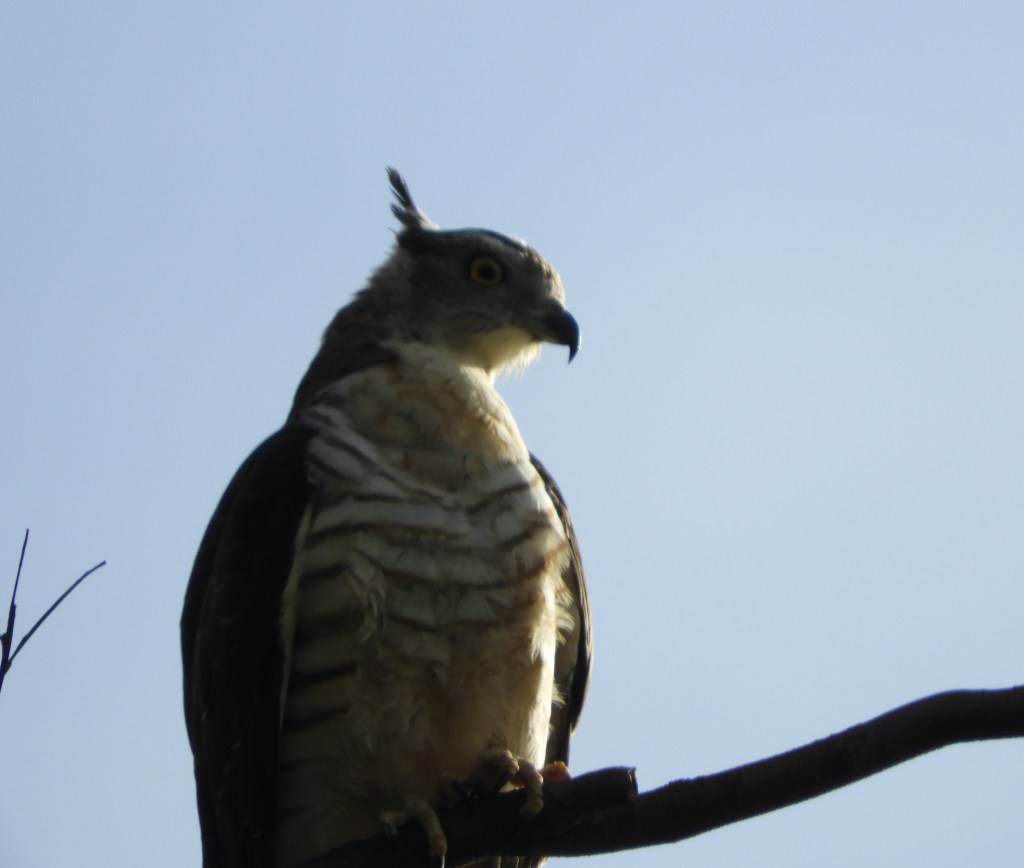
A Pacific Baza is a large bird of prey with a funny-looking crest on its head. The adults have a white head, neck, and shoulders, whereas this one still has the cinnamon colouring of a juvenile.
These birds are uncommon, mostly found in north and north-east Australia, and are rare in New South Wales (where I am). They eat small reptiles, and praying mantises and stick insects (both of which can be quite large in Australia).
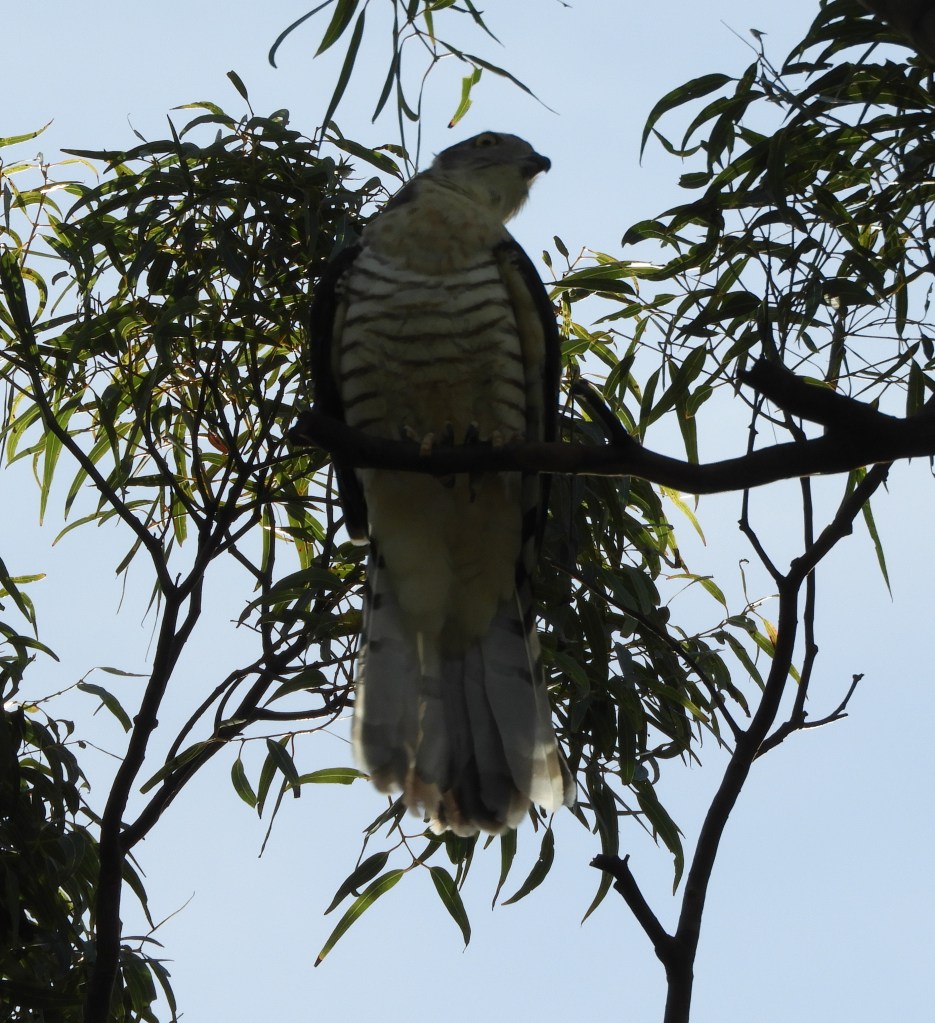
Common name: Pacific Baza
Scientific name: Aviceda subcristata
Length: 35-45 cm
Wing span: 1 metre
Date spotted: 6 July 2021 (winter)
Location: Allambie Heights, NSW, Australia
Collared Sparrowhawk
This sparrowhawk was sitting quietly on a branch above a scrubby patch of bush, on the edge of Manly Dam.
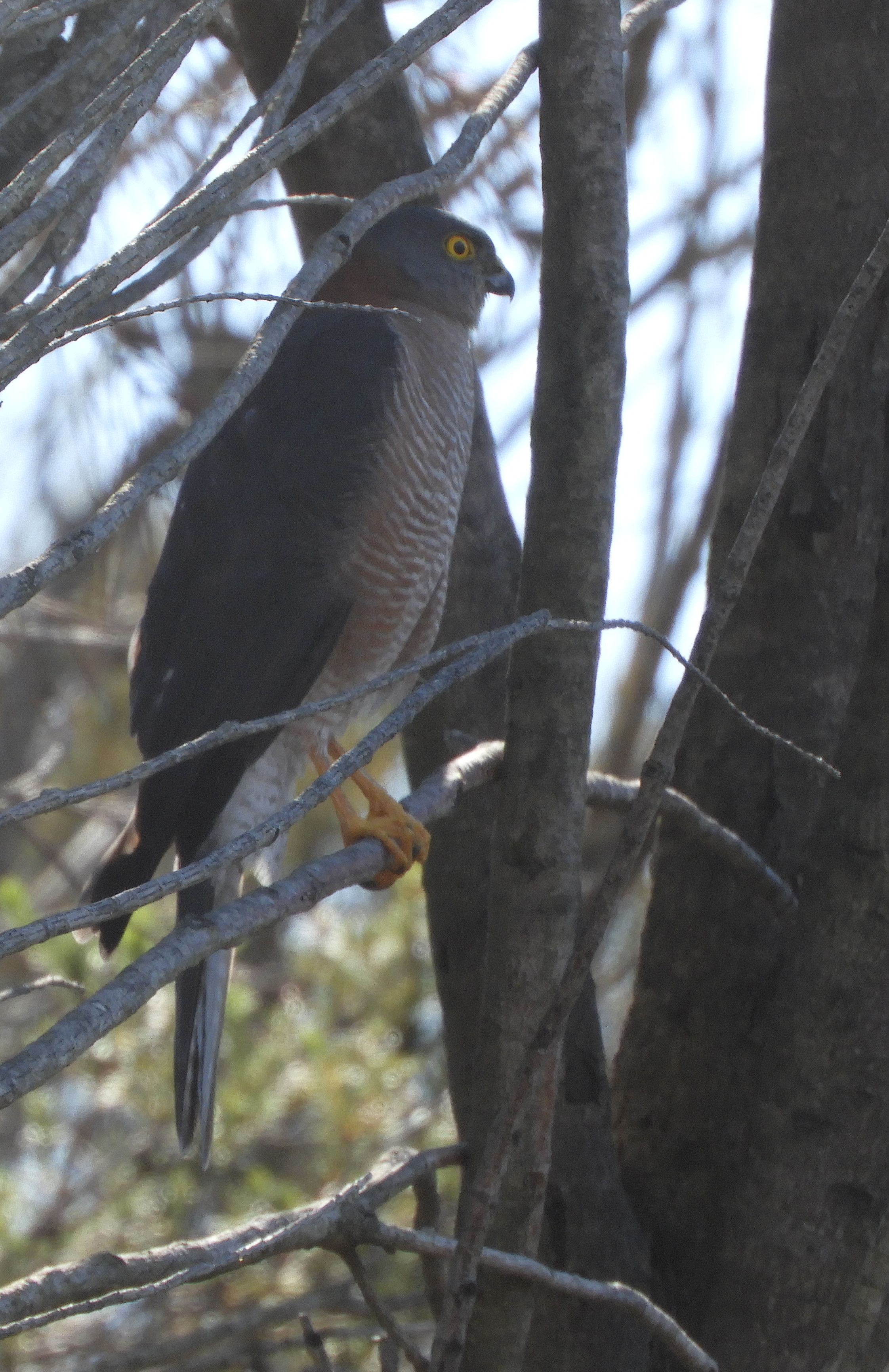
I think it’s a sparrowhawk, but it could be a Brown Goshawk. They’re very similar in appearance. Collared Sparrowhawks have a very long middle toe. This was the only photo I managed to take before the bird flew away, and the photo doesn’t show the toes too well. Brown Goshawks are larger than Collared Sparrowhawks, but it’s hard to judge the size of a bird.
Common name: Collared Sparrowhawk
Scientific name: Accipiter cirrhocephalus
Approximate length: 30-40 cm, wing span 55-80cm
Date spotted: 6 May 2020 (autumn)
Location: Manly Dam National Park, New South Wales, Australia: 33°46’31.8″S 151°14’46.8″E
Grey Goshawk has soft plumage, big eyes, and fierce beak
Although Noisy Miners are a nuisance, they do lead me to plenty of interesting sights. This time they were complaining about this Grey Goshawk that was invading their territory:

The Grey Goshawk looks soft and fluffy, with its light grey and white plumage and large eyes. But it has a fierce beak and strong feet, fit for catching and eating its prey. Evidently it can catch birds as large as a heron.
The Noisy Miners chased the hawk from perch to perch as I watched. The next picture shows the bird at the moment that it decides to take flight. The branch above the hawk seems to be in just the wrong place for optimal wing deployment:
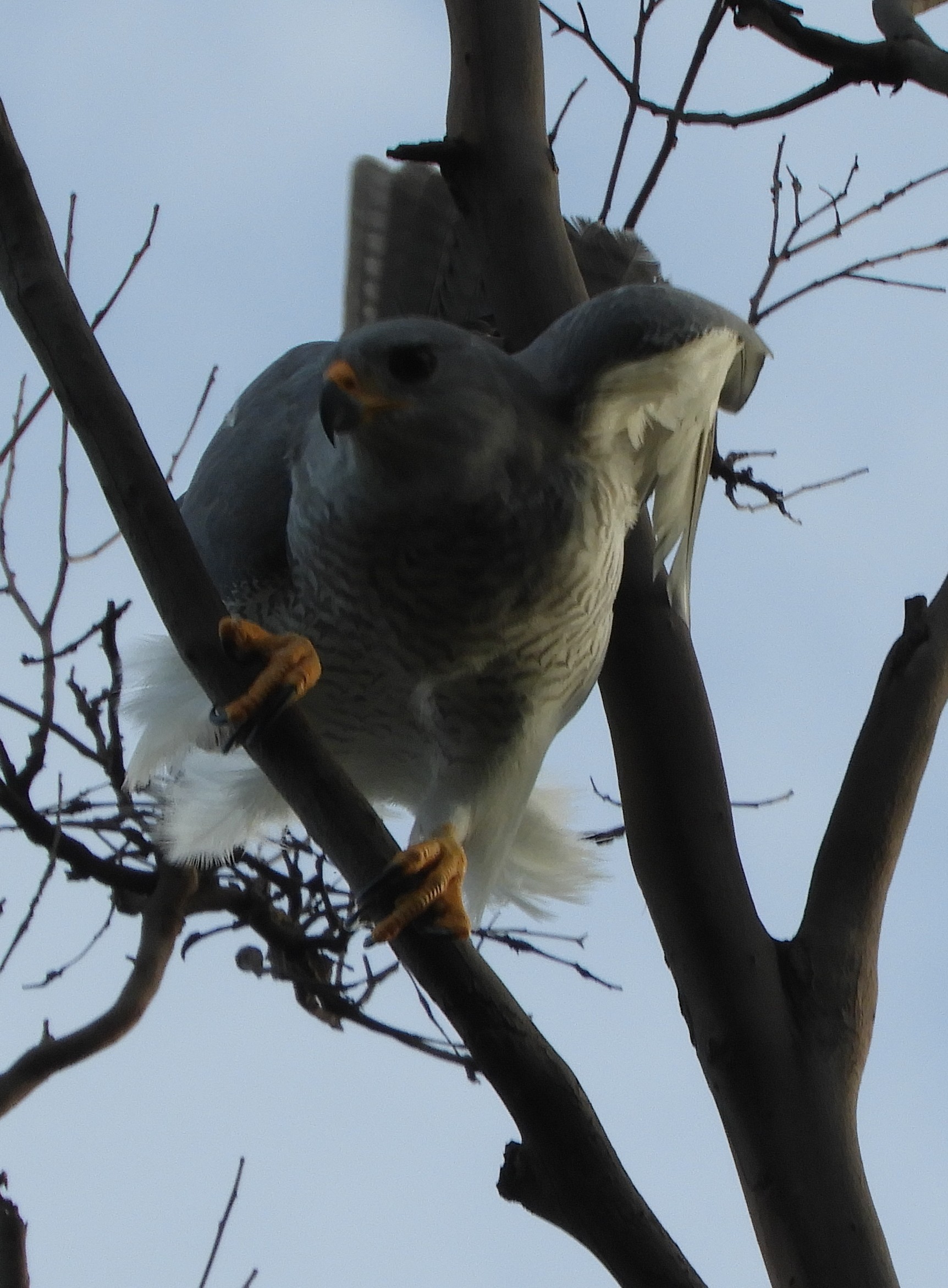
Each time it took flight, the Grey Goshawk uttered a series of short, high-pitched chirps that clashed with the shrieking of the Noisy Miners. Almost as if it was telling them off!
Wing deployment progressing despite unfortunate position of upper branch:

Wing deployment looking good, initiating detachment from lower branch:
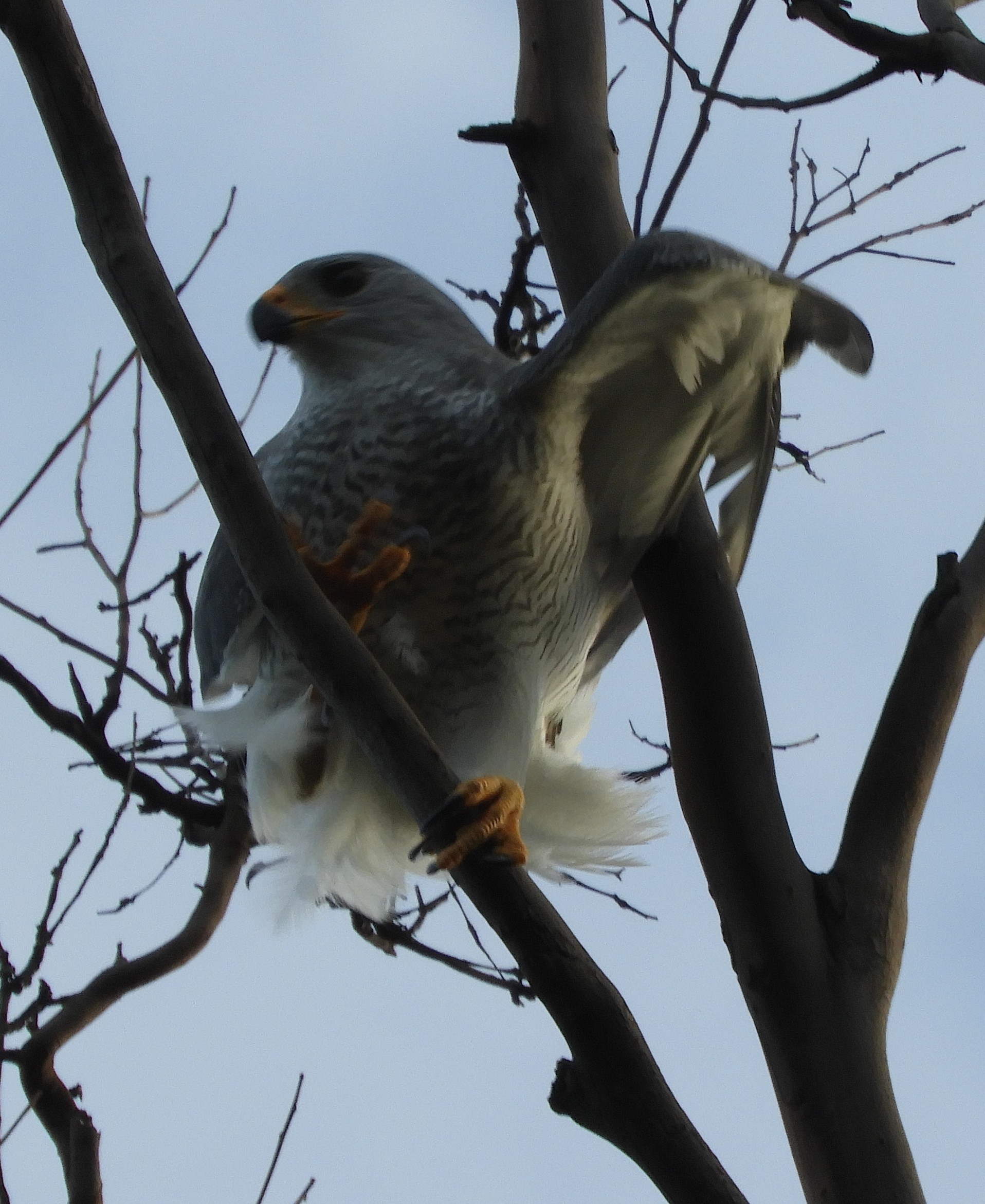
The hawk took off and coasted through the tops of the trees. Soon after it disappeared from view, a group of cockatoos burst from the tree tops and circled the area, shrieking and shouting in alarm.
This was my first sighting of a Grey Goshawk. What a beautiful bird.
Common name: Grey Goshawk
Scientific name: Accipiter novaehollandiae
Approximate length: 40-55 cm. Wing span: 70-110 cm.
Date spotted: 24 February 2020 (summer)
Location: Manly Dam Reserve, New South Wales, Australia: 33°46’36.9″S 151°14’47.7″E
Rescued a Powerful Owl from Australian Ravens
As I was walking in the bush this morning, I heard a lot of noise coming from an open space just off the track. Currawongs chiming, ravens yowling, miners bleating. I went to investigate, and found a Powerful Owl under attack.
Here’s the Powerful Owl, looking decidedly jaded after facing off the most recent jabs from a couple of Australian Ravens:
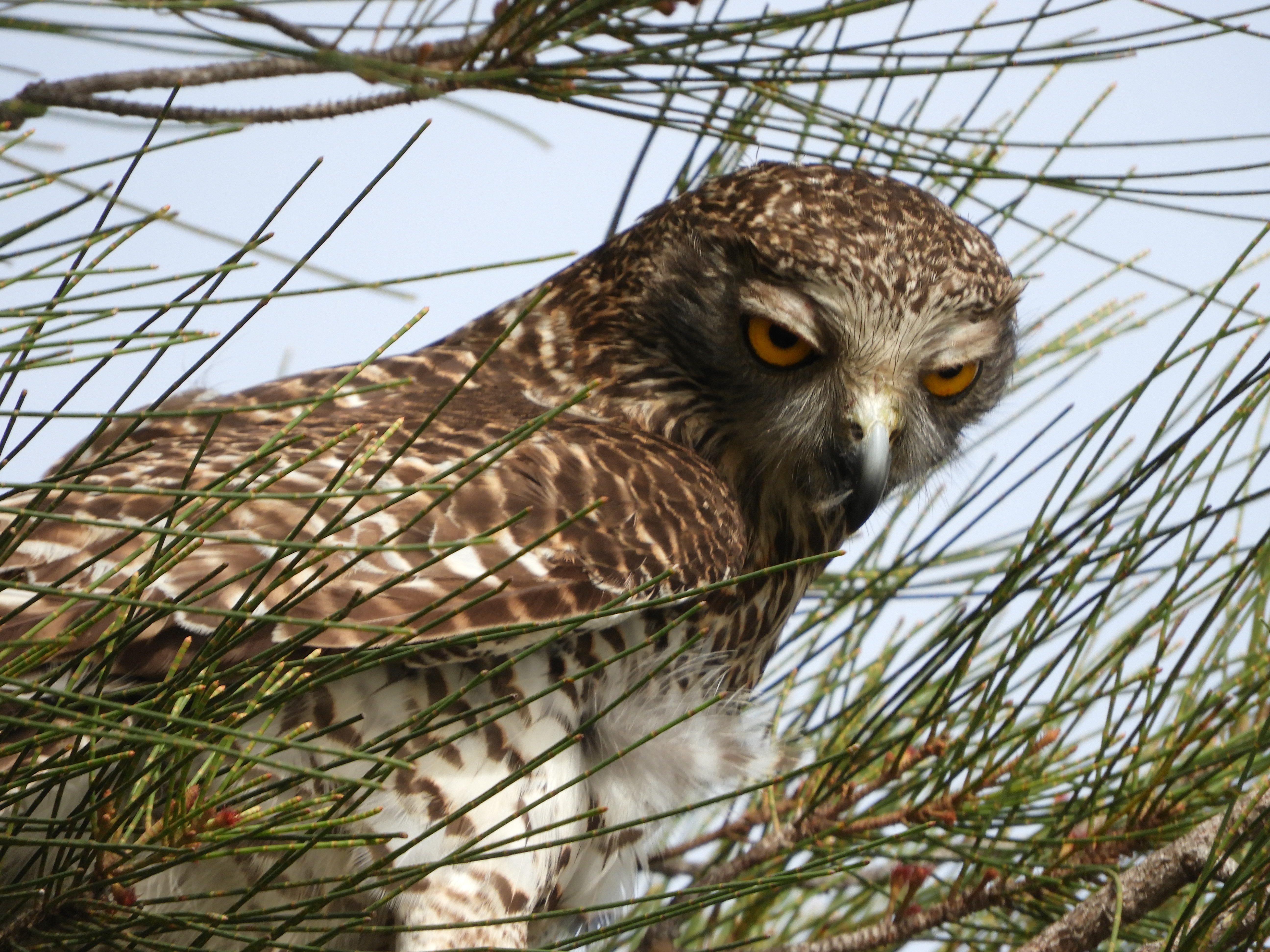
The Australian Miners and Currawongs were making a lot of noise, and even a couple of kookaburras swooped in to join the fight. But the principal attackers were the Australian Ravens.
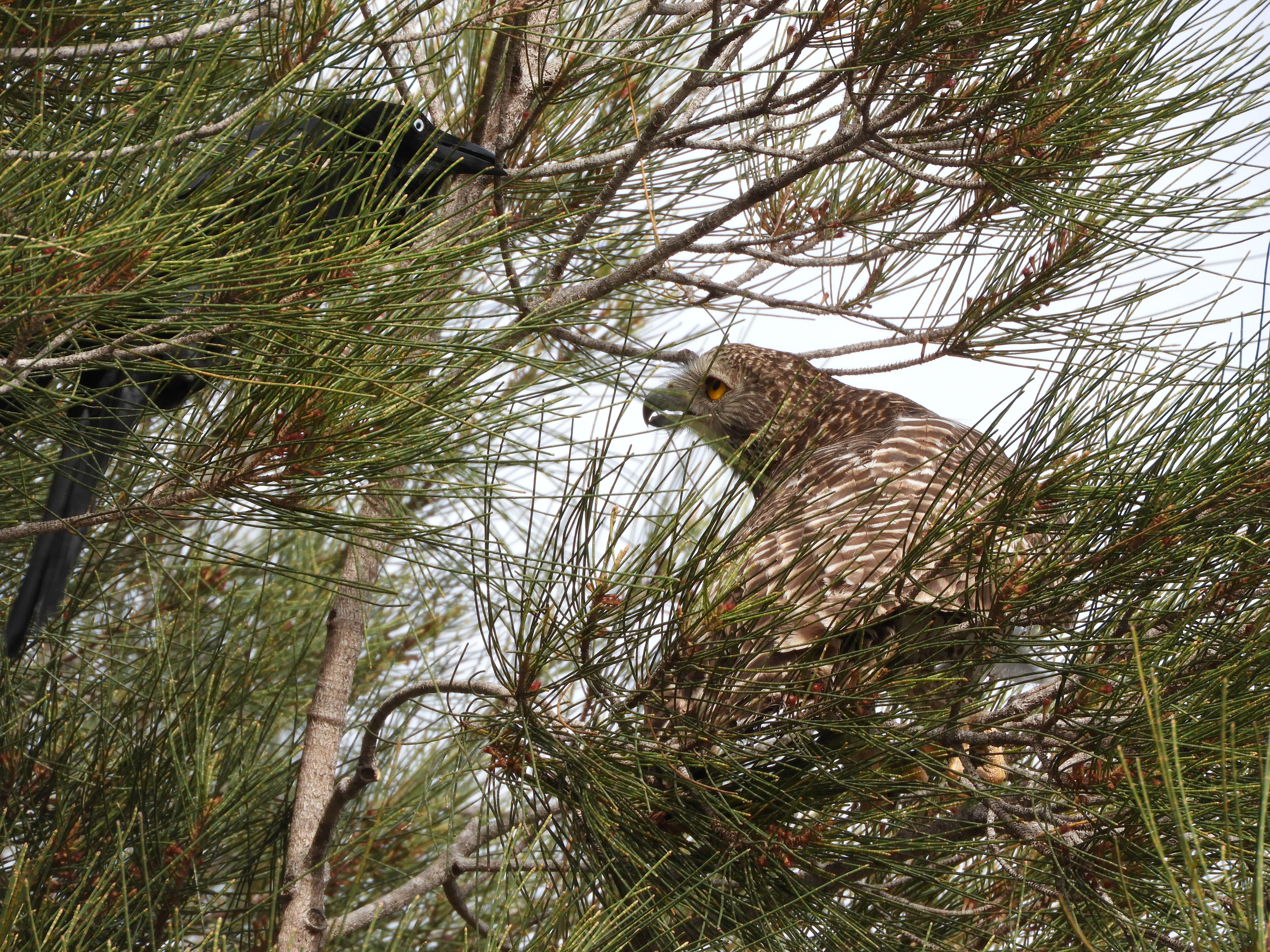

At first, the Powerful Owl was able to fend off the attack:
But the ravens were pretty vicious. The owl was high in the tree at this point, and there was nothing I could do to scare off the attackers.
I phoned the Manly Dam bush ranger centre and reported the problem. A ranger promised to come immediately. In the meantime, the owl was suffering and it was distressing not to be able to help:
At last, the owl ceded ground and flew to a lower spot in the tree:
At the same time, the attacks became more vicious, with the ravens grabbing both wings and pulling at the same time, stretching out the owl’s wings.
The owl was at this point only about 2.5 metres above the ground. A jogger came rushing in to help, and together she and I were able to scare off the ravens and other attackers.
The bush ranger arrived soon afterwards. After a bit of discussion, we decided the best thing was to phone WIRES for advice. WIRES is the Australian Wildlife Information, Rescue and Education Service.
In the meantime, we had to keep chasing away the ravens. They were extremely persistent, returning every few minutes to see if the coast was clear for another attack. The owl looked on, more relaxed than when under attack, but still alert:
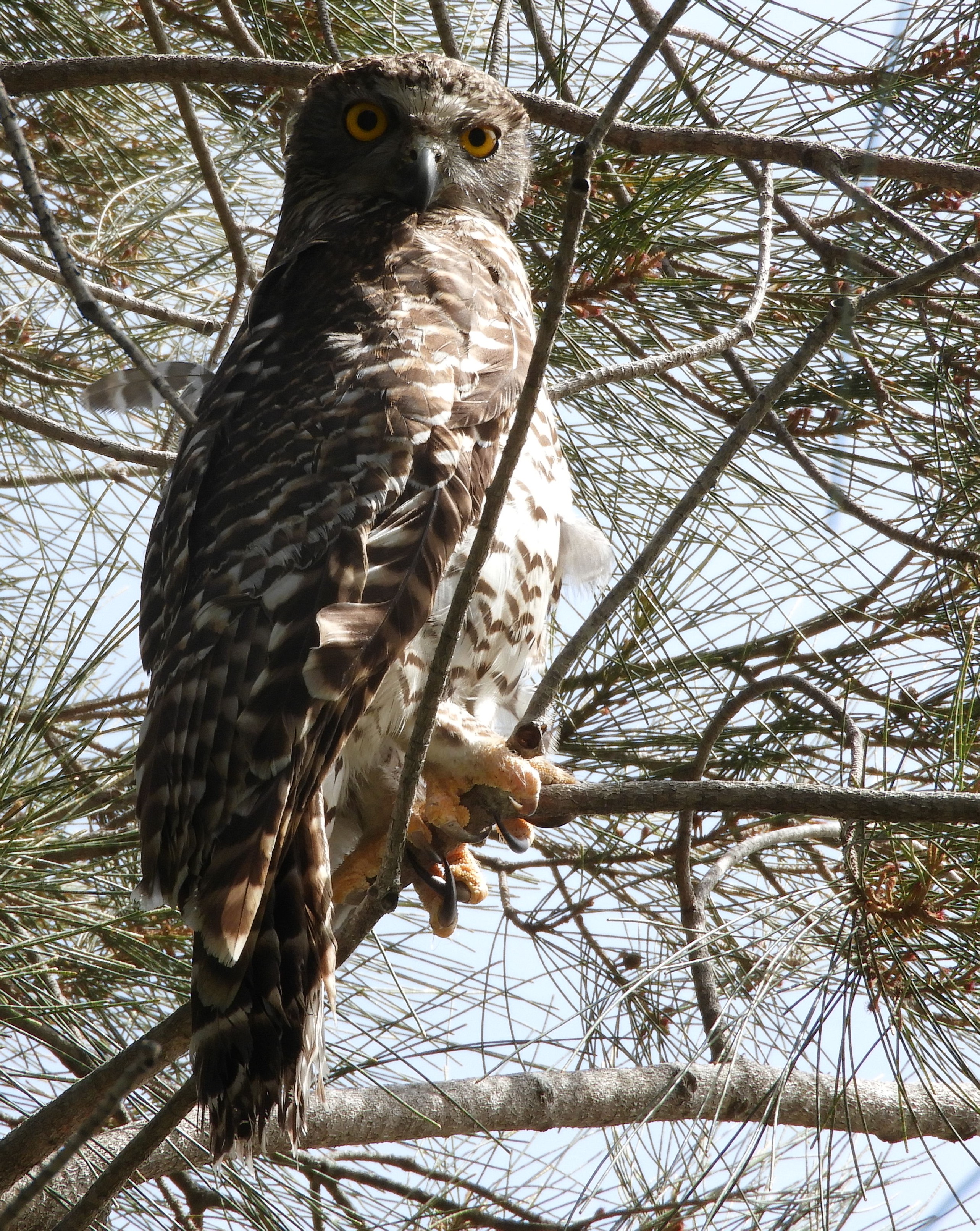
Common name: Powerful Owl
Scientific name: Ninox strenua
Approximate length: 65 cm
Date spotted: 7 October 2019 (spring)
Location: Manly Dam National Park, New South Wales, Australia: 33°46’55.8″S 151°15’12.1″E
The advice from WIRES was to leave the owl where it was (don’t try to scare it into flying away) and to keep chasing away the ravens. Evidently Powerful Owls tend to stay in one place during the day, even when under attack. Besides which, the jogger had seen the owl flying from one tree to another earlier that morning, with the ravens dive-bombing it in flight. So flying off was probably not a good option anyway.
So we kept chasing away the ravens. After a couple of hours, two families arrived and settled in for a day of boating and picnicking. We handed over the job of raven-scaring to them, and the bush ranger said she would drop by every couple of hours to check up on the owl.
Not a restful day for this nocturnal bird. But at least this is one case where it was a good thing for the bird that people were around. I do hope the Powerful Owl had a more peaceful time for the rest of the day.
Azure Kingfisher in Ku-ring-gai Chase Park near Sydney
Today I visited Bobbin Head in Ku-ring-gai Chase National Park. I started at the Mangrove Boardwalk, then followed the Gibberagong track along Cockle Creek. It’s a lovely walk. Quiet and cool.
At one point I started hearing something plopping into the water at regular intervals. A flash of colour swooped up into a tree. I stopped to watch. It was a tiny bird, shining blue and orange. Only the long zoom of my camera revealed what I was seeing.
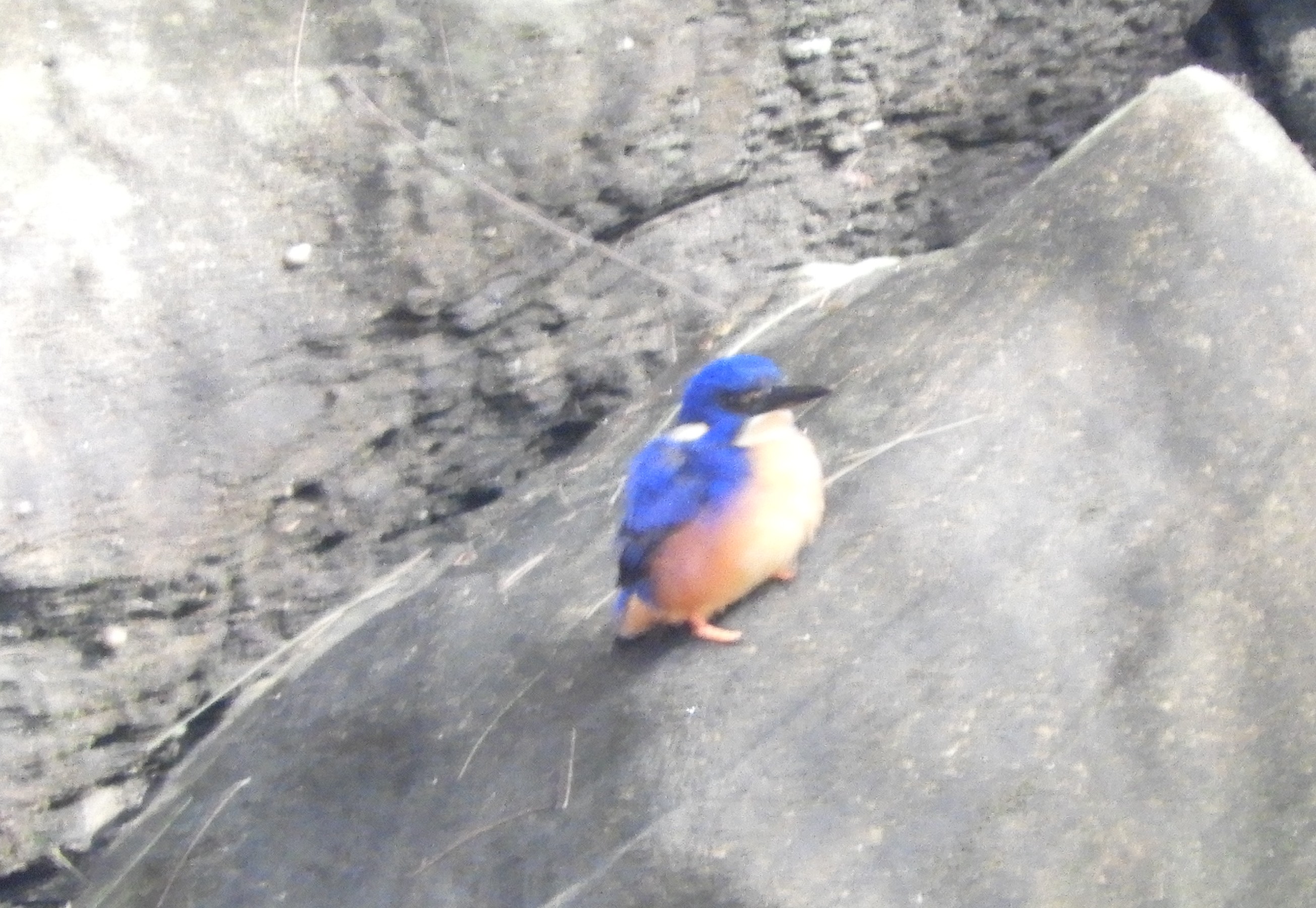
An Azure Kingfisher, sitting on a rock, waiting for prey to pass by in the river below:
Azure Kingfishers are common further north in Australia, but are uncommon this far south due to loss of habitat. They like banks of creeks with lots of vegetation and mangroves. This area of Ku-ring-gai Chase National Park certainly fits the bill.
The next video shows the bird diving into the water. It’s far away, so all you get is an impression, but it’s pretty to watch:
Here’s a still shot of the bird – fuzzy because of the max zoom on my camera:

Kingfishers are related to kookaburras. (See my previous post about a wet kookaburra.) At only 17-19 centimetres long, this kingfisher is a tiny cousin of the Laughing Kookaburra, which comes in at a whopping 40-47 centimetres.
The next photo gives a good idea of the very short length of the tail, which is an identifying mark of this bird:
Common name: Azure Kingfisher
Scientific name: Alcedo azurea
Approximate length: 18 cm
Date spotted: 28 August 2019 (late winter)
Location: Bobbin Head, Ku-ring-gai Chase National Park, New South Wales, Australia: 33°40’10.5″S 151°08’54.9″E
Wakeful Southern Boobook at Manly Dam
A little Southern Boobook was wide awake when I walked beneath its tree this morning. This is the first time I’ve seen one of these owls, though I’ve heard them hoot during the night hours.
I sat down on the ground and watched the bird for a while. It wasn’t disturbed by my presence, and grew quite sleepy, as you can see in the next video. At the end of the video I zoomed out so that you can see a bit of the bush surrounding the bird:
Southern Boobooks are quite small, at around 30cm in length from head to tail. Compare that to the Powerful Owl, which is around 65cm.
Here’s a still photo of the bird, showing a deep yellow eye and fluffy white feathers above its beak:
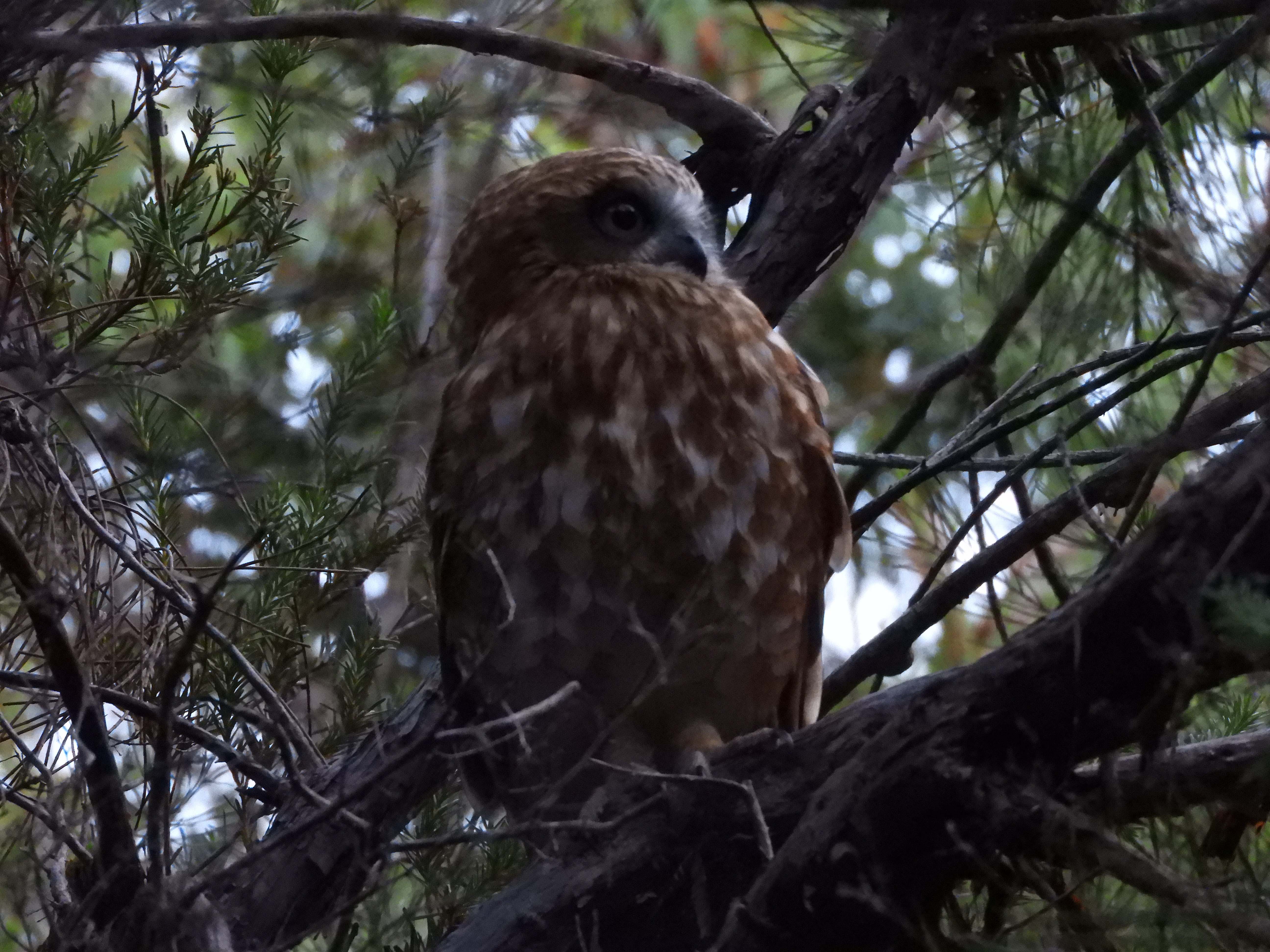
Southern Boobooks are quite common. They feed mostly on insects and spiders, but they do take the occasional small bird or animal too. Here’s a closeup of the owl’s face:

Common name: Southern Boobook
Scientific name: Ninox novaeseelandiae
Approximate length: 30cm
Date spotted: 20 March 2019 (late summer)
Location: Manly Dam National Reserve, near Sydney: 33°46’30.0″S 151°15’09.2″E
Powerful Owl pellet, also known as owl vomit or regurgitation
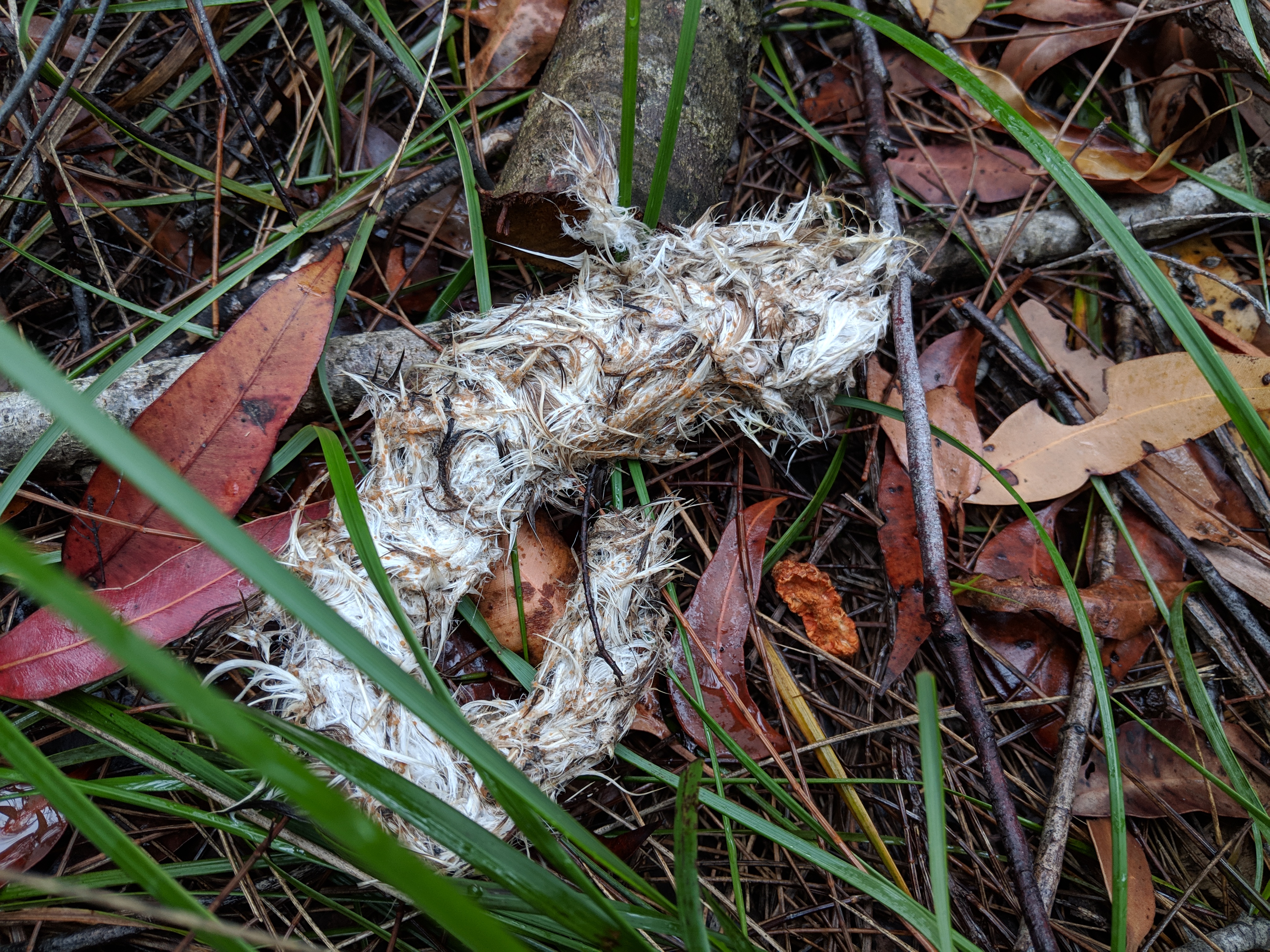
This morning I came across this weird-looking bundle of hair and stuff in the bush surrounding Manly Dam National Park near Sydney:
Date spotted: 20 January 2019 (Summer)
Location: Manly Dam National Park, New South Wales, Australia: 33°46’24.5″S 151°15’04.4″E
At first I thought it was some weird creature, but it had no visible eyes and didn’t really look alive, although it was obviously animal in nature. I picked up a stick and turned the object over gently. It didn’t try to move away. Definitely not alive. It looked the same on both sides. No obvious undercarriage.
So then I thought, maybe it’s some dead creature that’s become covered in a thick fungus. It’s summer here in Sydney—hot, humid, lots of fungus on the trees and mould on animal poo in the forest. In fact, I’ve seen animal poo that’s completely white and fuzzy, with long tendrils of mould standing up straight.
Still, the fungus idea didn’t quite fit the bill. The stuff covering this object looked more like fur than fungus.
So I took a photo and moved on.
When I got home and showed my husband the photo of this weird thing I’d seen, he suggested it might be owl’s vomit. They do that, he said. They regurgitate fur and stuff. So I looked it up. Indeed they do.
The official name for owl vomit is owl pellet. I think this one must be from a Powerful Owl (Ninox strenua), because I’ve seen those birds in the same area of the bush before, and because this pellet was big. It was around 6 inches long (15 cm) and 2 inches (5 cm) at its widest.
Here’s a Powerful Owl that I saw a while ago, also at Manly Dam. This owl has its prey (a dead possum) in its grip:

An owl’s pellet consists of fur, bones, and other bits and pieces of its prey that the owl can’t digest. An owl needs to regurgitate a pellet once or twice every night, six hours or more after the owl has eaten.
If you like, you can see more about the Powerful Owls I’ve seen around Manly Dam.


 Sydney Birder