Blog Archives

Cockatoo chases off a falcon
I was walking along a bush path at Manly Dam when I heard a cockatoo making a big fuss on the other side of the creek that feeds into the dam. I looked across the water in time to see the cockatoo leaping off its perch and launching itself towards a branch not far away. As the cockatoo landed on its new perch, a dark shape took off from that same branch and floated away to another tree.
I grabbed my camera and zoomed in on the bird that the cockatoo had chased off. It was a Nankeen Kestrel:
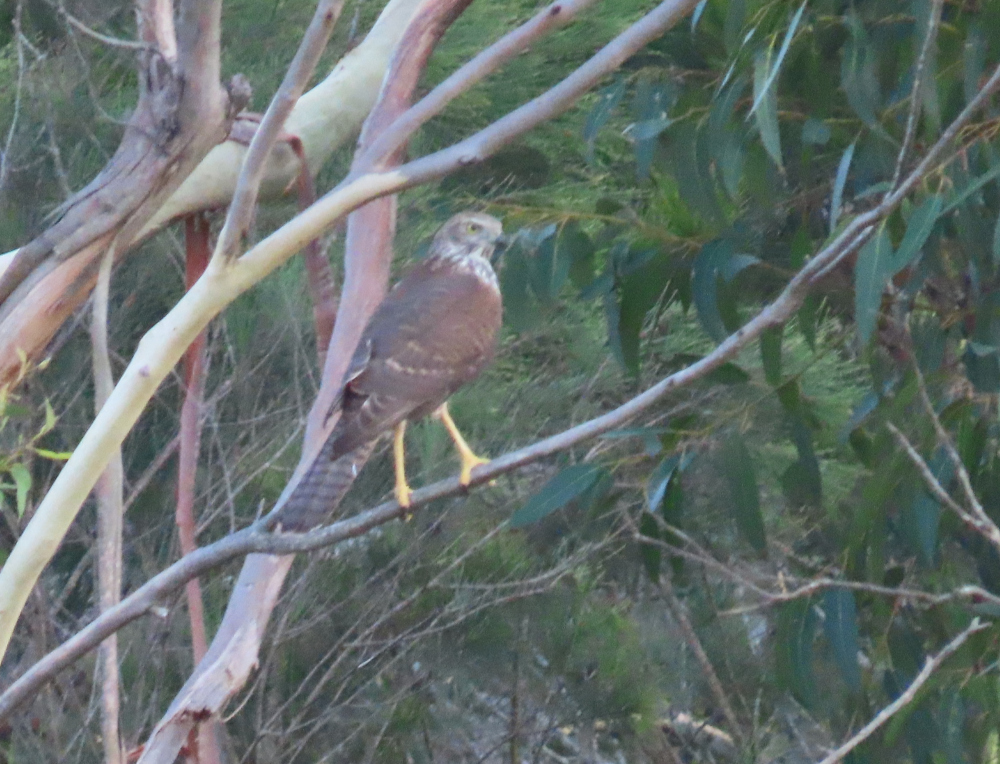
It looks like a female bird, with its light-coloured head and the dark-grey “tear mark” going down vertically from its eye.
Common name: Nankeen Kestrel
Scientific name: Falco cenchroides
Length: 30-35 cm; wing span: 60-80 cm
Date spotted: 29 January 2026 (summer)
Location: Manly Dam Park, New South Wales, Australia: 33°46’19.8″S 151°14’35.5″E
The Sulphur-crested Cockatoo looked very pleased with itself, now owning the area where the hawk had been resting:
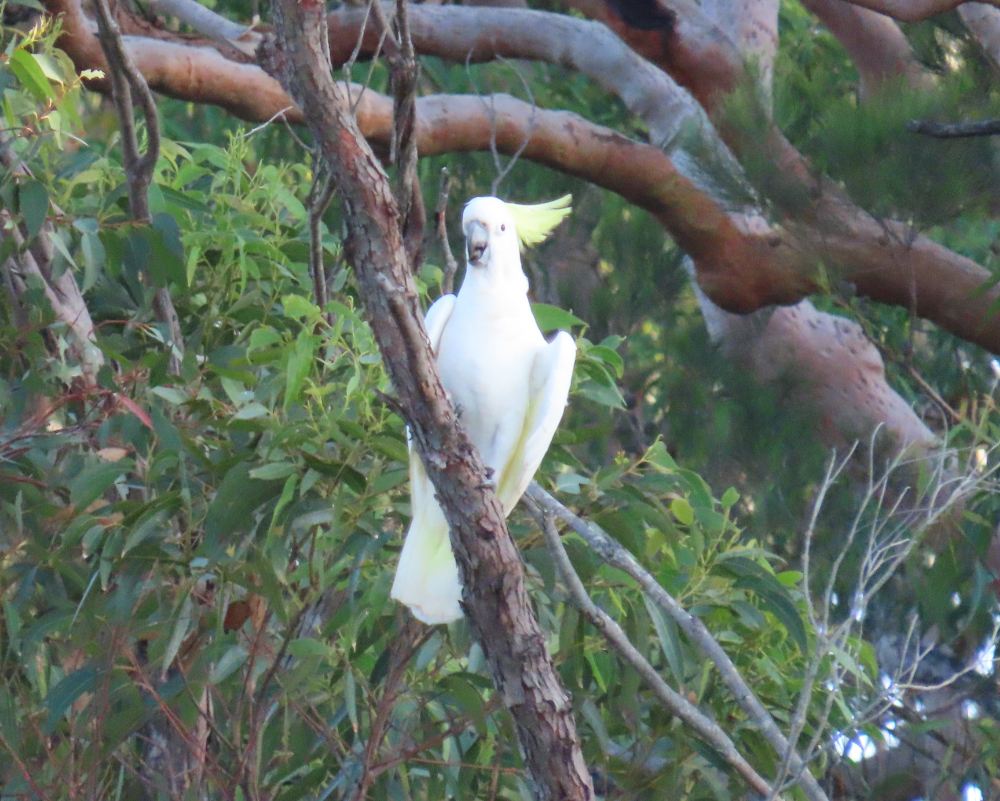
Common name: Sulphur-crested Cockatoo
Scientific name: Cacatua galerita
Approximate length: 50 cm; wing span: up to 103 cm
It takes a brave bird to attack a falcon. On the other hand, it takes a brave bird to stand up to a cockatoo, especially when the cockatoo is bigger than you. I think the falcon was vulnerable as it was perched on a branch. If it had been in the air, the cockatoo might have come off worse.
The photos aren’t very clear, since the birds were far away on the opposite side of the dam. Still, they’re good enough to identify the birds.
After a couple of minutes of enduring the cockatoo’s screeching and prancing, the kestrel decided enough was enough. It floated away in search of a quieter location:
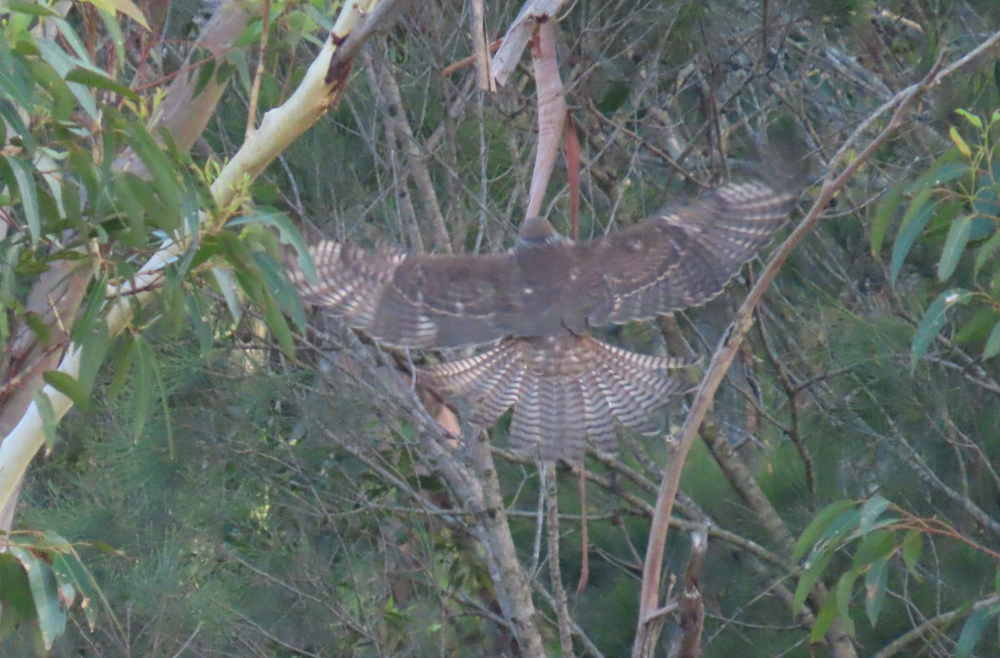
Nankeen Kestrels are small falcons, quite common in Australia. They feed on small mammals and birds, reptiles, and insects.
This is only the second time that I’ve spotted a Nankeen Kestrel. My first sighting was of a male bird in Victoria.
Happy bush-walking all!

My first Nankeen Kestrel
According to my bird book, Nankeen Kestrels are common in mainland Australia. Still, this is the first time I’ve spotted one. The bird has a distinctive light-coloured tail with dark tips to the tail feathers:

The bird was very far away, flying and diving above a valley in the Victorian Alps. For that reason, the photos aren’t great. But I do want to record the sighting!
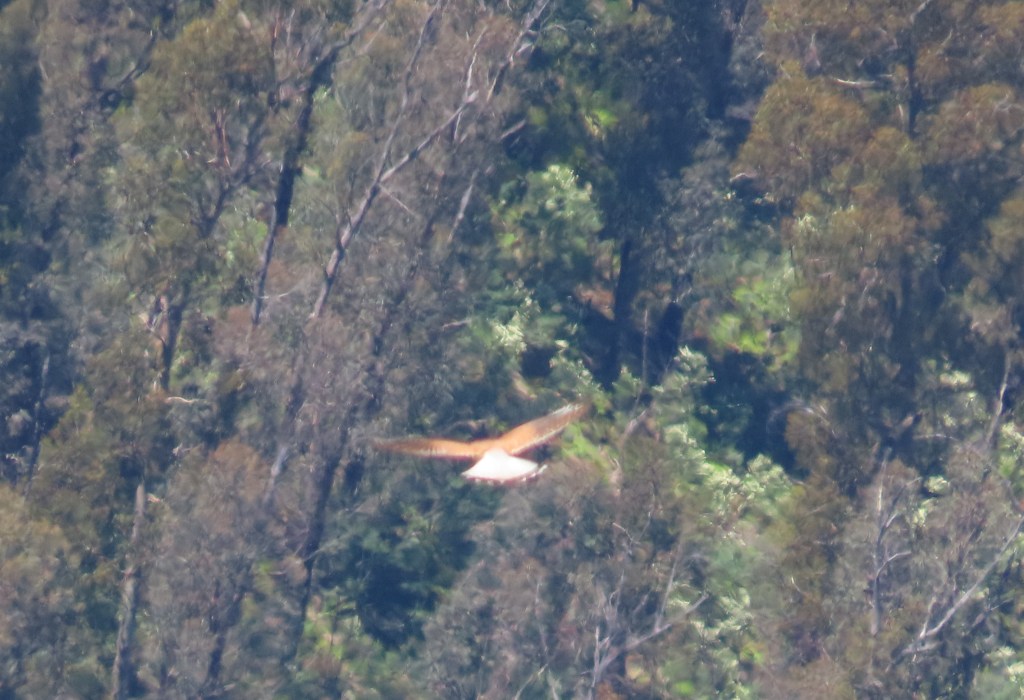
Common name: Nankeen Kestrel
Scientific name: Falco cenchroides
Length: 30-35 cm; wing span: 60-80 cm
Date spotted: 27 December 2025 (summer)
Location: Blue Rag Range Track, Victoria, Australia: 37°06’13.4″S 147°04’00.4″E

Brown Falcon and Black-shouldered Kite having a barney
I was looking for the silo art in Merriwa, New South Wales, when I came across a Brown Falcon and a Black-shouldered Kite having a disagreement.
This is my first sighting of a Brown Falcon. It was cool to see the bird doing some aerial acrobatics!
The action goes down very fast! I’ve taken some stills from the video, to make it easier to see what happens:
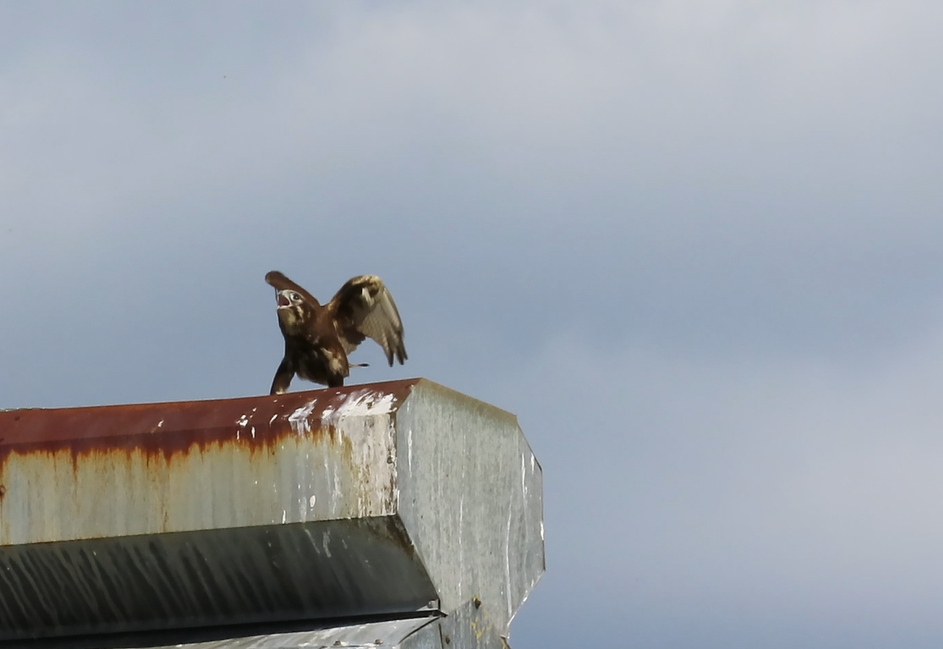


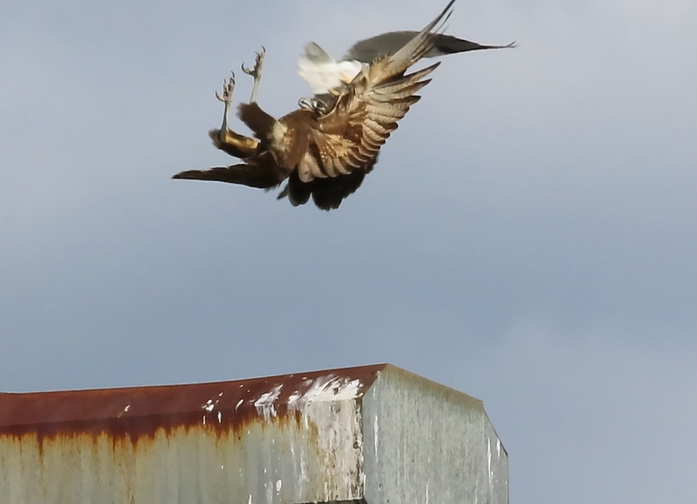
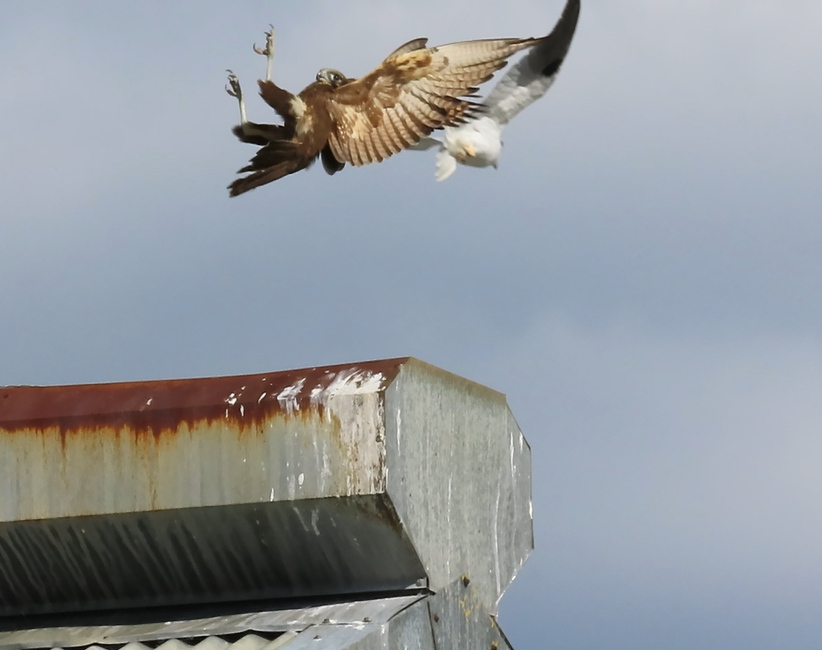

Despite the aerial competence, Brown Falcons feed mostly on the ground, eating reptiles, beetles and grasshoppers, mice, and carrion. Look at those long legs and strong feet, good for picking off the unwary prey as it makes its way across a field or a road.
Here’s a shot of the Brown Falcon taking a rest after the action was over:

Common name: Brown Falcon and Black-shouldered Kite
Scientific name: Falco Berigora and Elanus axillarus
Approximate length: 40-50 cm (Brown Falcon) and 35 cm (Black-shouldered Kite)
Date spotted: 12 September 2025 (spring)
Location: Merriwa, New South Wales, Australia: 32°08’14.9″S 150°21’50.6″E
For those interested in the silo art, here it is! The Merriwa Silos are the 29th addition to the Australian Silo Art Trail Collection. The artwork was completed by David Lee Pereira in April 2019:


Pacific Baza chased by cockatoos
I was walking along Forty Baskets Track on Sydney Harbour when the Sulphur-crested Cockatoos started making an enormous ruckus. They took to the sky in a large flock and circled overhead screaming blue murder.
When I managed to find a gap in the tree canopy, I saw that the cockatoos were chasing a large bird of prey:
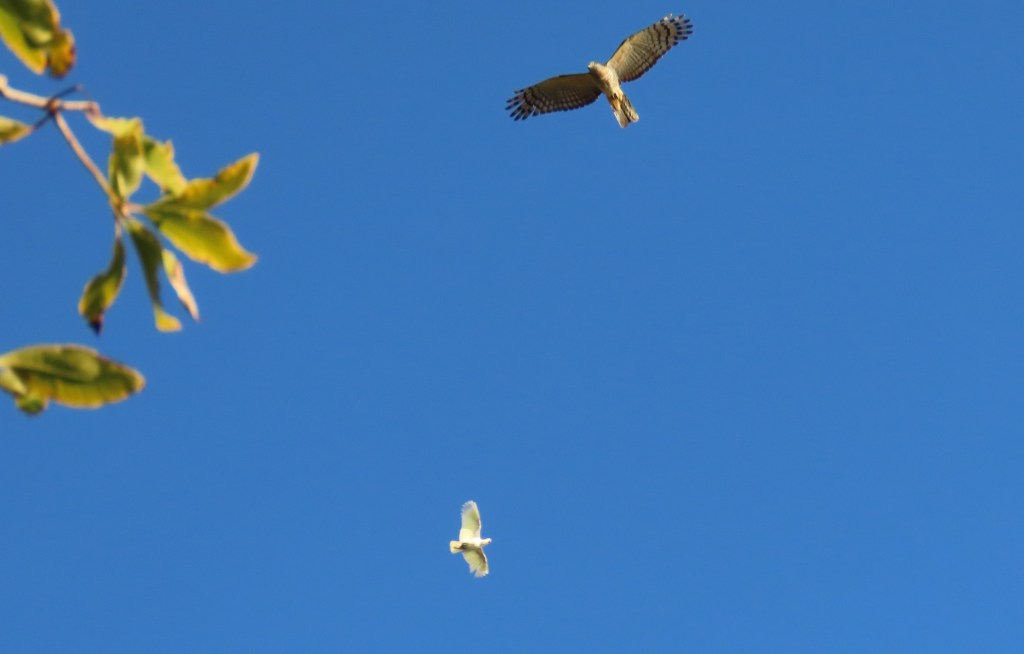
I followed the pack of birds for about 15 minutes, back and forth along the track. The bird of prey landed in the tree tops a few times, and I was able to identify it as a Pacific Baza. I managed to see the crest on its head, but didn’t get a good enough photo of the crest to post here. This is the best photo I got of the bird at rest:

Pacific Bazas are uncommon, mostly found in north and north-east Australia, and are rare in New South Wales (where I am). They eat small reptiles, and praying mantises and stick insects (both of which can be quite large in Australia).
Common name: Pacific Baza
Scientific name: Aviceda subcristata
Length: 35-45 cm
Wing span: 1 metre
Date spotted: 29 June 2025 (winter)
Location: Forty Baskets Track, Balgowlah, NSW, Australia: 33°48’18.2″S 151°16’18.2″E

Osprey nests at Rat Park
For a couple of years, I’ve been reading about the Ospreys that nest high on the lights at Rat Park in Warriewood, in Sydney’s Northern Beaches. The birds have earned their fame by returning year after year to the same spot. They build their nests and raise their young in what seems an unlikely and uncomfortable perch, twenty metres above the playing fields. So I went to take a look at them.

Ospreys are magnificent birds, with their large size and impressive fishing skills. They’re listed as vulnerable in NSW. Their numbers were in decline until the 1970s, but the great news is that they’re on the rise now.
Here’s a close-up of the same Osprey on the lamp post:

This photo shows the same nest from the other side:
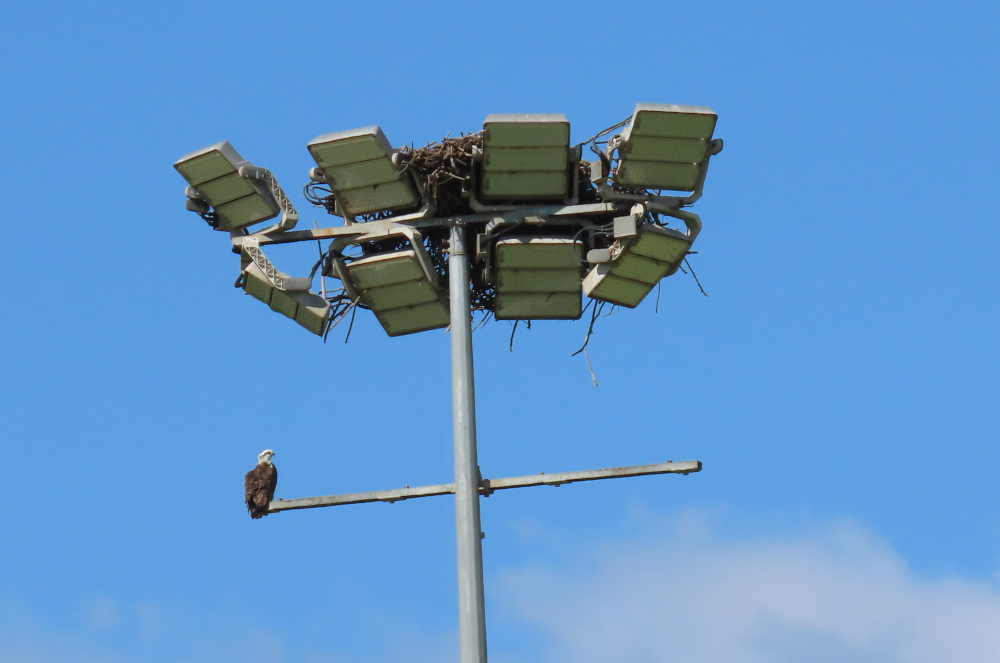
Zooming out to show the playing field and the 20-metre lamp post with the nest on top:

There were nests on top of a couple of the other lamp posts too, but no Ospreys tending them while I was there.
Here’s a front view of the Osprey with the sun behind it:
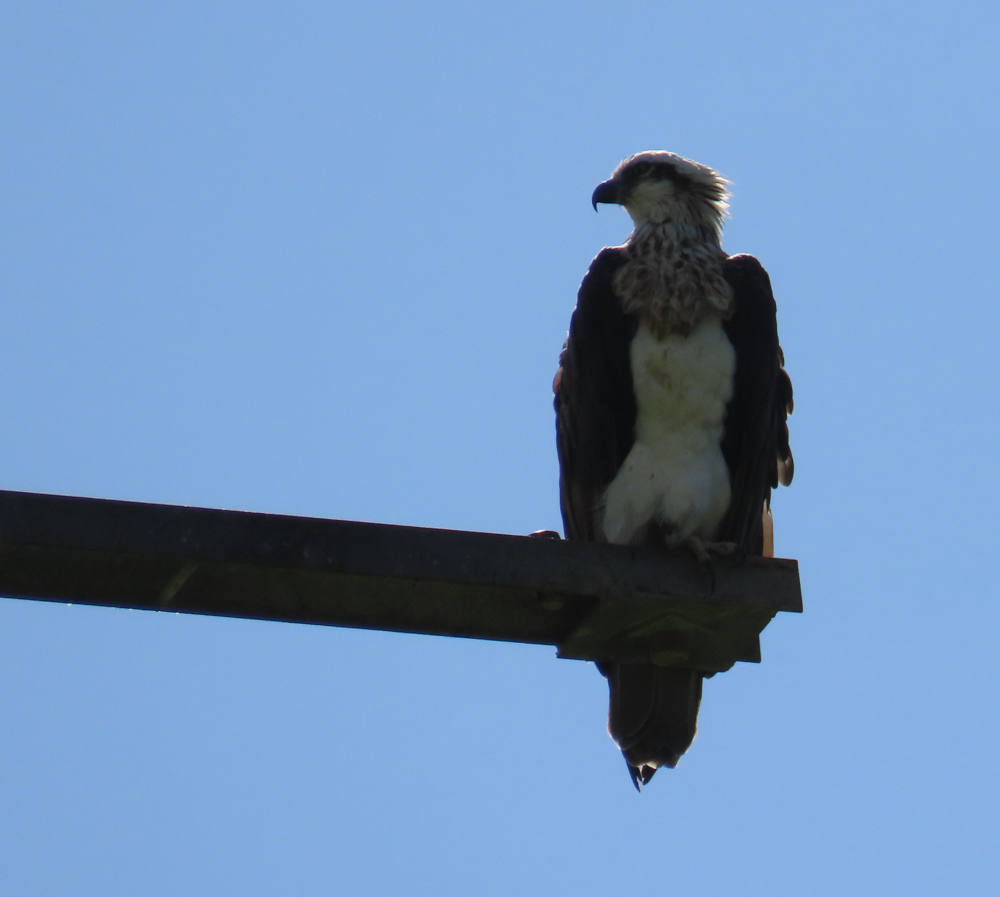
I’ve been lucky enough to see Ospreys a few times, most often at the Long Reef Aquatic Reserve in Collaroy. The Manly Observer has reported on the Ospreys of Rat Park, and they’ve featured on several other sites including Facebook.
Common name: Eastern Osprey
Scientific name: Pandion cristatus
Approximate length: 57 cm
Date spotted: 4 April 2025 (autumn)
Location: Rat Park, Warriewood, New South Wales, Australia: 33°41’50.6″S 151°18’21.8″E

Peregrine Falcon in the suburbs
It was good to see this Peregrine Falcon perched high in a tree above the rooftops in Sydney’s Northern Beaches.
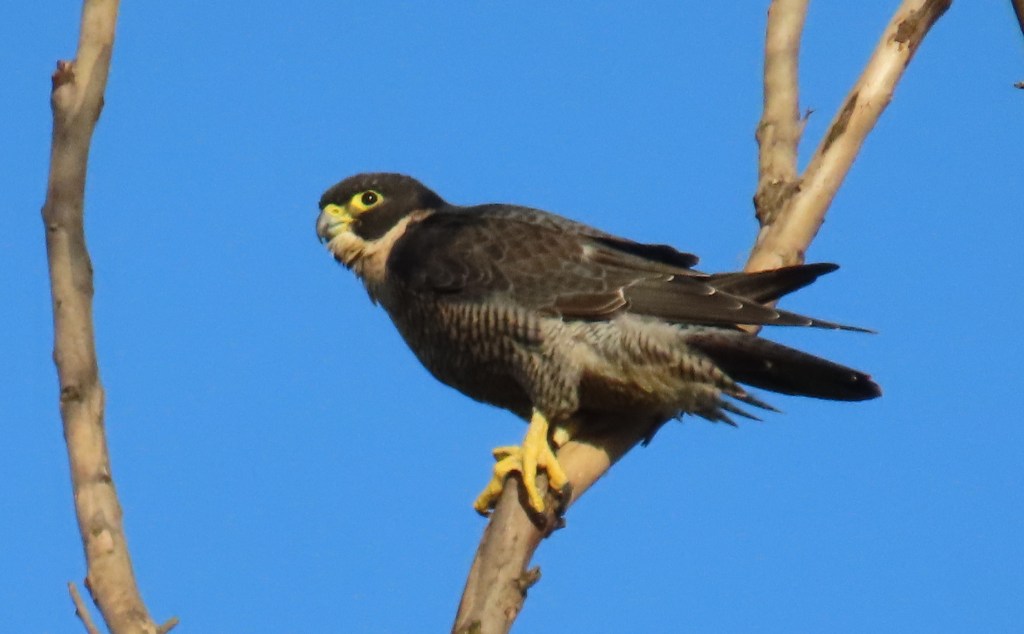
They’re beautiful birds, with that fierce eye and the contrast between yellow and black colouring. I’ve seen just a few Peregrine Falcons before, usually in a wilder setting. Check out the posts about my other sightings of Peregrine Falcons.
Common name: Peregrine Falcon
Scientific name: Falco Peregrinus
Approximate length: 42 cm
Date spotted: 15 February 2025 (summer)
Location: Allambie Heights, New South Wales, Australia. Approximate map reference: 33°46’18.2″S 151°15’39.4″E

Powerful Owl dozing in the treetops
It’s a while since I’ve spotted a Powerful Owl. A few days ago, I saw the tell tale dark blob high in the branches of the forest. Using my camera’s zoom, I could identify the bird. The only view I had is from behind, with the bird’s head turned slightly towards me and one eye partly open:
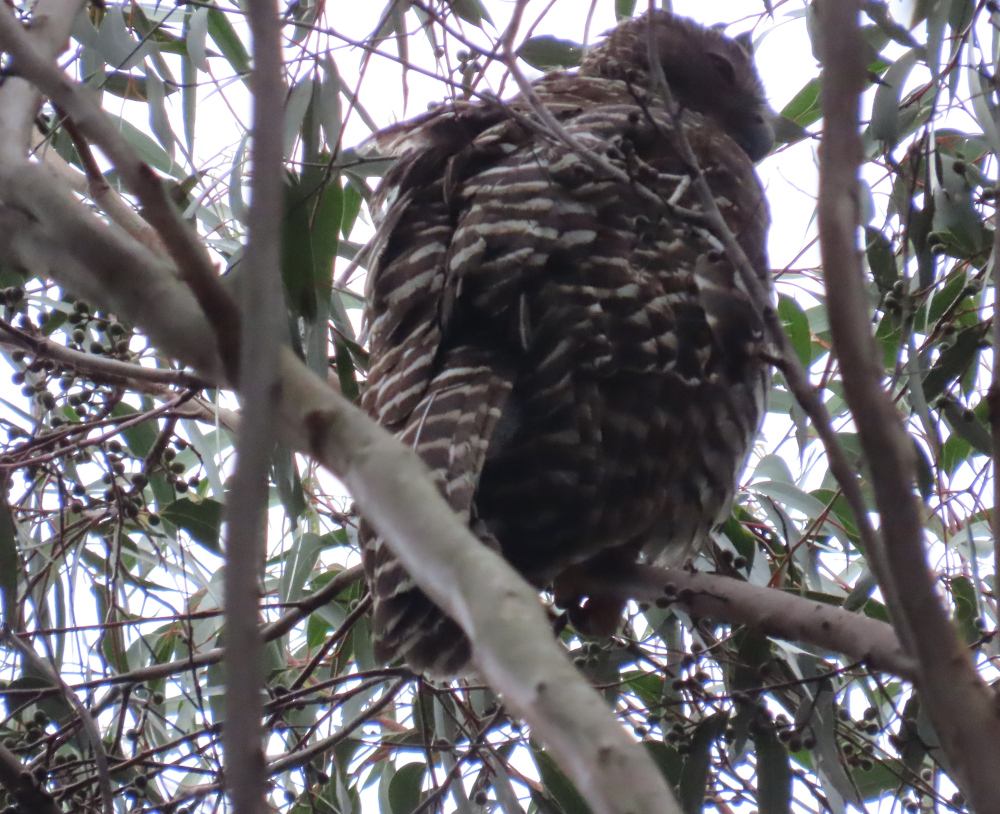
It’s always a privilege to see these impressive birds. Powerful Owls can weigh well over 2 kilograms, and reach up to 65 centimetres in height. They hunt at night and roost quietly during the day. Their prey consists of small creatures such as possums.
Common name: Powerful Owl
Scientific name: Ninox strenua
Approximate length: 65 cm
Date spotted: 7 November 2024 (spring)
Location: Manly Dam Park, New South Wales, Australia. Approximate map reference: 33°46’55.8″S 151°15’12.1″E

Whistling Kite at Myall Lakes
This weekend I took a walk from Mungo Brush Campground to the Tamboi picnic area at Myall Lakes. A bird of prey was calling and swooping far away on the opposite side of the wide, serene Myall River. After a bit of research, considering the appearance of the bird and the sound of its call, my conclusion is that it’s a Whistling Kite.
The pictures aren’t great, because the bird was far away. This one shows its head and body:

The next picture gives a better idea of its tail:

I did take some shots of the bird in flight, but they’re too fuzzy to be of much use. Still, you can see them on my Reddit post if you’re interested.
Whistling Kites are large birds of prey, found throughout most of Australia. They’re also called whistling eagles or whistling hawks. I’ve seen one before, on the Bogan River in western New South Wales, and another on Magnetic Island in Queensland.
Common name: Whistling Kite
Scientific name: Haliastur sphenurus
Approximate length: 50-60 cm; wing span 1.2-1.5 m
Date spotted: 20 October 2024 (spring)
Location: Myall Lakes National Park, New South Wales, Australia: 32°33’03.8″S 152°17’10.5″E

Very light-coloured Grey Goshawk
This is a Grey Goshawk, but it’s a lot lighter in colour than others I’ve seen, and it doesn’t seem to have the barring on its front (though I didn’t get to see it fully front on). It was at Manly Dam in Sydney’s Northern Beaches area.
There are two colour variations in the Grey Goshawk: the white morph and the grey morph. The white morph is found in north-western Australia, Tasmania, and the Victorian coast. It isn’t known to be found near Sydney. Besides which, this bird has light grey plumage as well as white, whereas the white morph is entirely white.

Whatever the answer to the question about its colour, this is a gorgeous bird.
Common name: Grey Goshawk
Scientific name: Accipiter novaehollandiae
Approximate length: 40-55 cm. Wing span: 70-110 cm.
Date spotted: 1 October 2024 (spring)
Location: Manly Dam Reserve, New South Wales, Australia: 33°46’22.5″S 151°14’35.7″E

Call of the Sacred Kingfisher
Ever wondered what a kingfisher sounds like? Well, you’ll know after watching this video, for a Sacred Kingfisher anyway. The call is a series of chirps, all on more or less the same note. Not very exciting really, for such a pretty bird! You hear them mostly around breeding time, when the calls can be quite insistent.
At the start of the video, you see and hear the kingfisher calling. The camera then zooms out to show the surroundings, including a Great Egret, a Darter, and a Coot. The scene is set at Manly Dam in Sydney’s Northern Beaches.
Set the video settings to HD for best results:
Despite their name, these kingfishers don’t often eat fish! Instead, they prey on small reptiles and large insects, and occasional crustaceans from the water’s edge.
Common name: Sacred Kingfisher
Scientific name: Todiramphus sanctus
Length: 20-23 cm
Date spotted: 8 September 2024 (spring)
Location: Manly Dam Park, New South Wales, Australia: 3°46’31.2″S 151°14’46.6″E


 Sydney Birder