Blog Archives
Red Wattlebird on Banksia
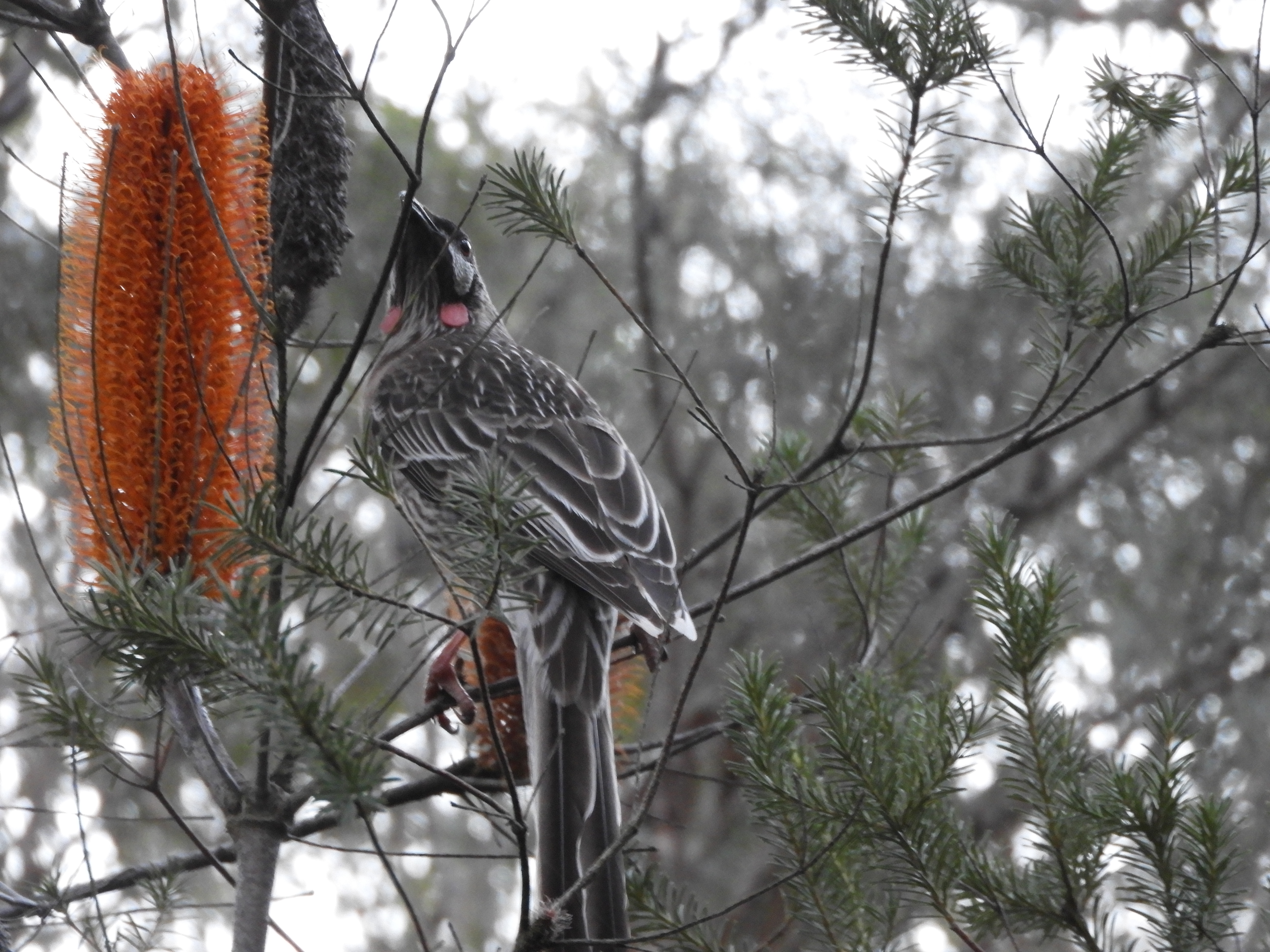
Red Wattlebirds are large, noisy honeyeaters. They get their name from the red flaps of skin below their eyes. This one was feeding on the nectar of a Heath Banksia flower:

The next picture shows both wattles on the bird’s neck:
Common name: Red Wattlebird
Scientific name: Anthochaera carunculata
Approximate length: 35 cm
Date spotted: 18 July 2020 (winter)
Location: Manly Dam National Park, New South Wales, Australia. Approximate map reference: 33°46’27.0″S 151°14’57.6″E
Little Wattlebirds are common in the area too. The two birds can be hard to tell apart. Red Wattlebirds are larger (approx 35 cm from head to tail) whereas Little Wattlebirds measure approximately 30 cm. Little Wattlebirds don’t have the large red wattles. Here’s a Little Wattlebird that I photographed a while ago:

The sinuous neck of a Darter
Darters are sometimes called snakebirds, because of their long, sinuous necks. I came across this small darter sheltering on a branch close to the footpath at Manly Dam.

The bird didn’t seem to be worried by my presence. I stood and watched it for a while, enjoying the supply movements of its wings and neck:
At one stage a couple of ravens started cawing. The darter showed some concern, looking skywards to see if there was any threat:
Darters use that long neck to hunt underwater, straightening it suddenly to dash out and catch their prey.
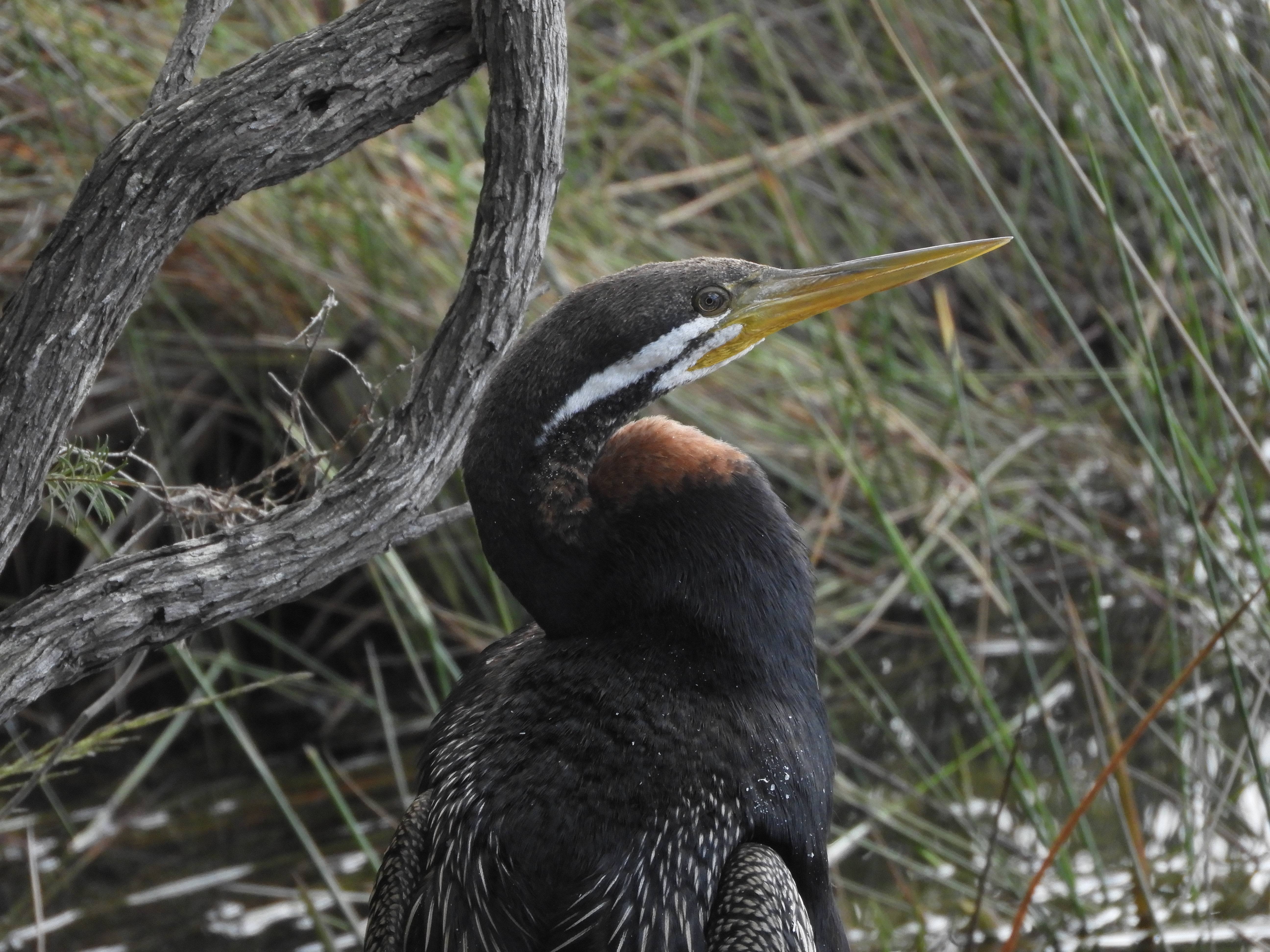
Here’s a close-up shot of the bird’s head, neck, and shoulders, with the neck coiled up in the resting pose:
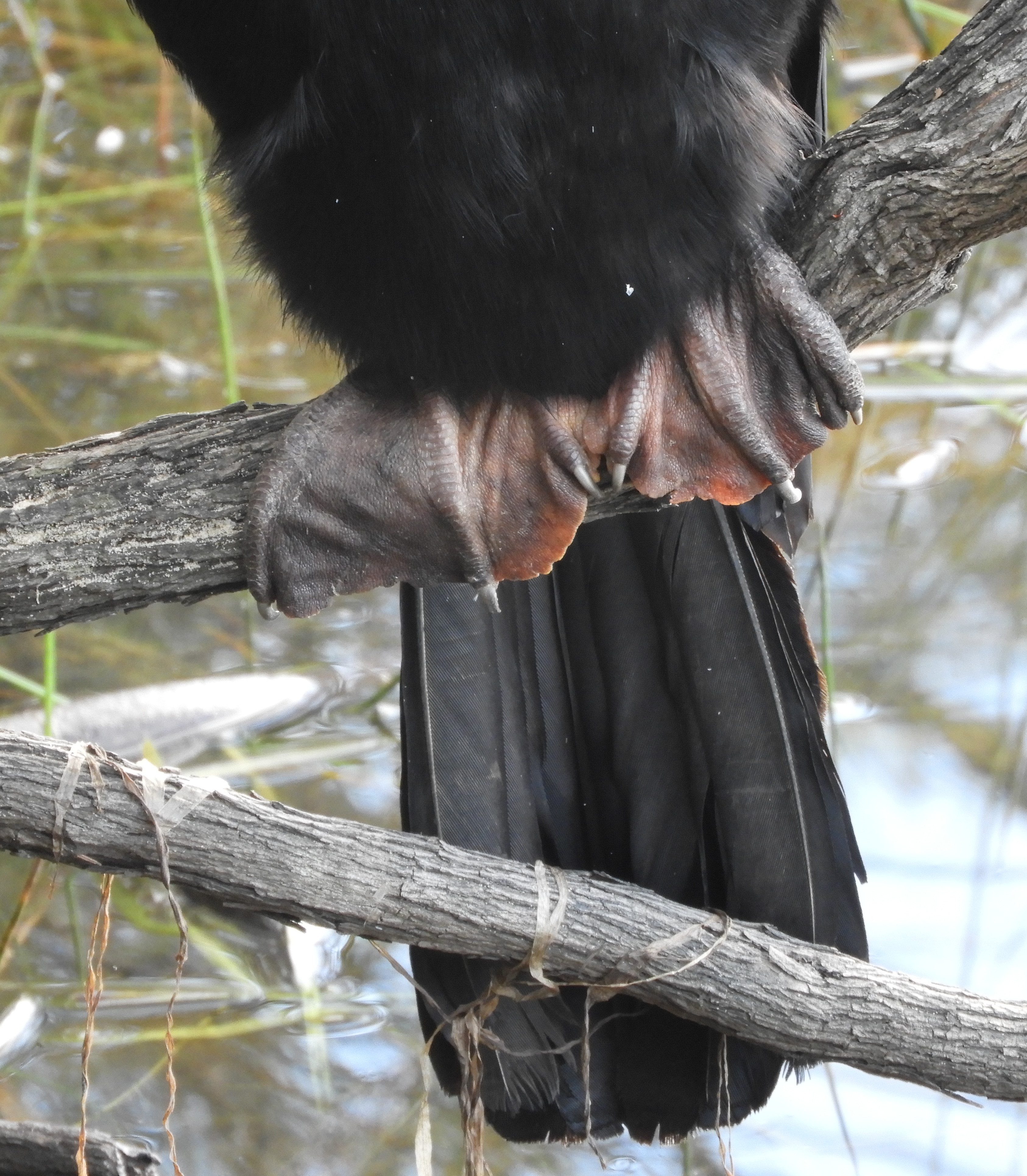
The bird’s feet are webbed, good for swimming and for clasping a branch:
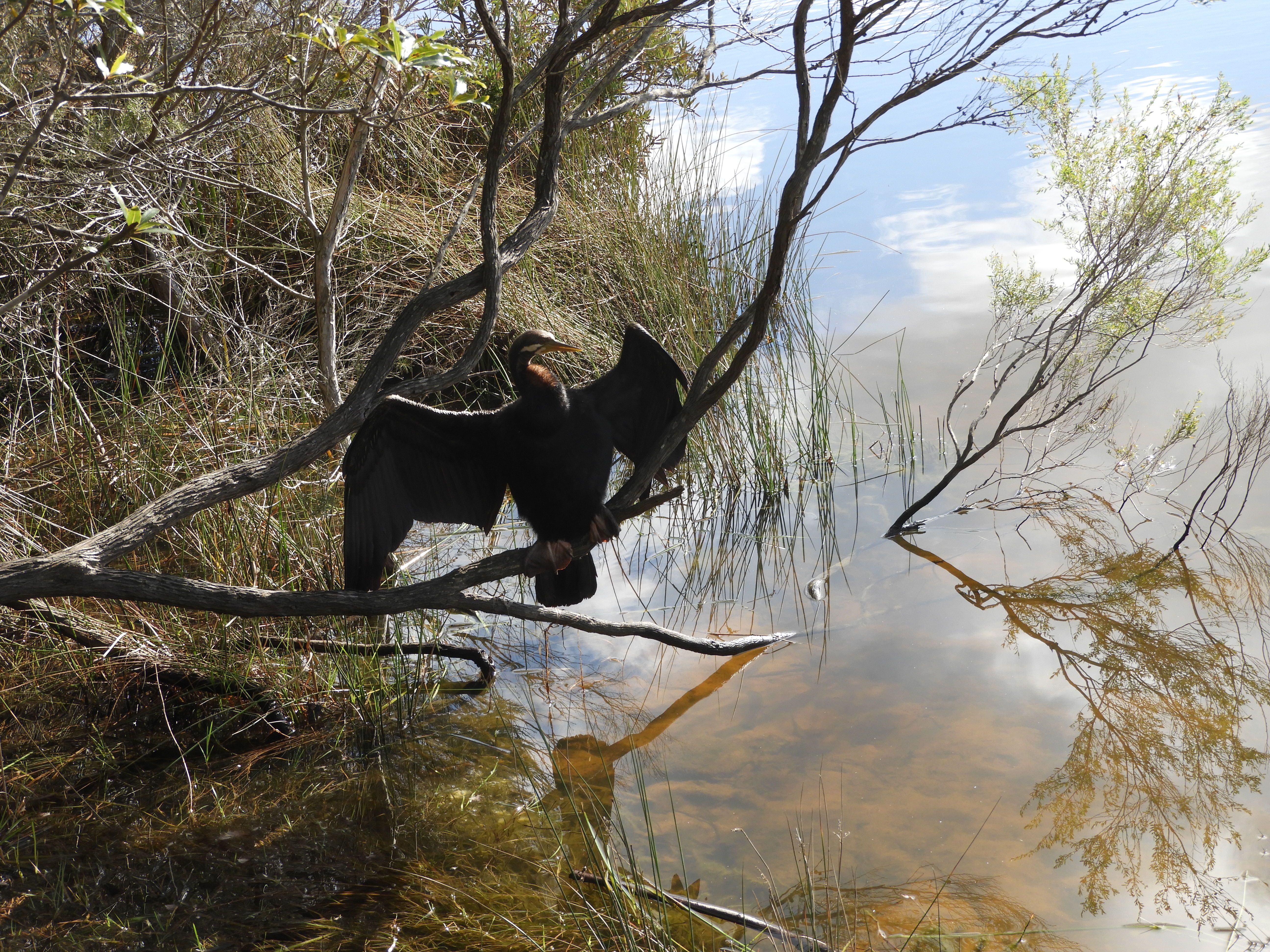
Spreading its feathers prior to a stretch:

Like cormorants, darters need to hold out their wings to dry:
Common name: Darter
Scientific name: Anhinga melanogaster
Approximate length: 90 cm; wing span: 1.2 m
Date spotted: 30 June 2020 (winter)
Location: Manly Dam Reserve, New South Wales, Australia: 33°46’38.5″S 151°14’57.0″E
Song of the Fan-tailed Cuckoo
Walking through the Aussie bush, I’m sometimes intrigued by a musical trill coming from the hidden depths of the forest. The sound starts high and drops rapidly down the scale to a lower pitch. Today, for the first time, I managed to spot the bird that makes this lovely noise: a Fan-tailed Cuckoo:
At first I thought it couldn’t be a cuckoo, because don’t all cuckoos leave for warmer climes when winter arrives on the Australian east coast? Evidently not. For the most part, Fan-tailed Cuckoos brave the cold weather, although those in Tasmania do move north into the mainland.
Here’s the cuckoo caught in mid trill:
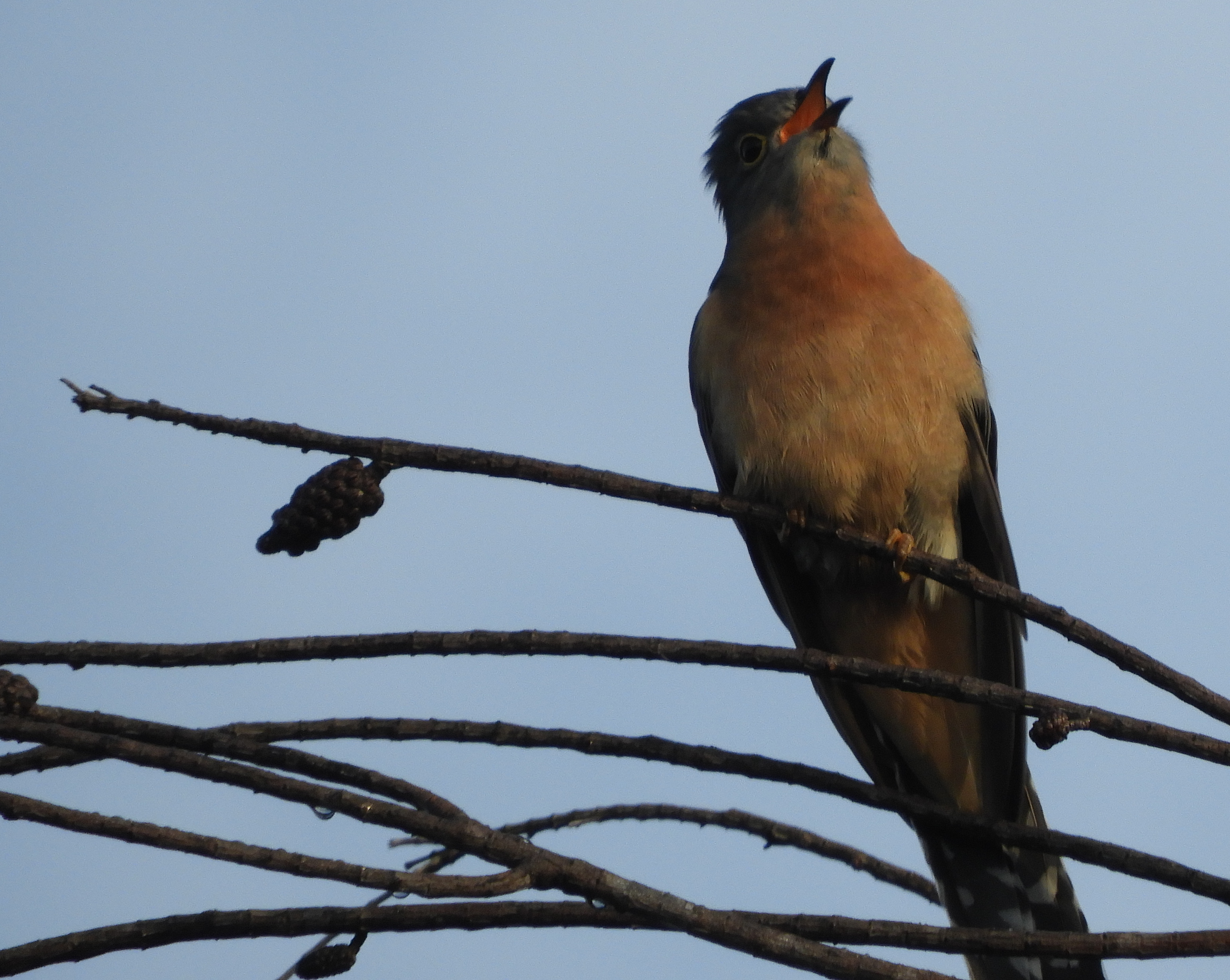
Like other cuckoos, these birds lay their eggs in the nests of other species. Fan-tailed Cuckoos choose fairy-wrens and thornbills as their hosts. Such small little parents to raise a cuckoo!
Here’s another shot of the bird, this time with its beak closed:

This particular bird has a lovely rich coloring. Other photos I’ve seen show less orange in the chest feathers, and a lighter grey on the head and back.
Singing again:
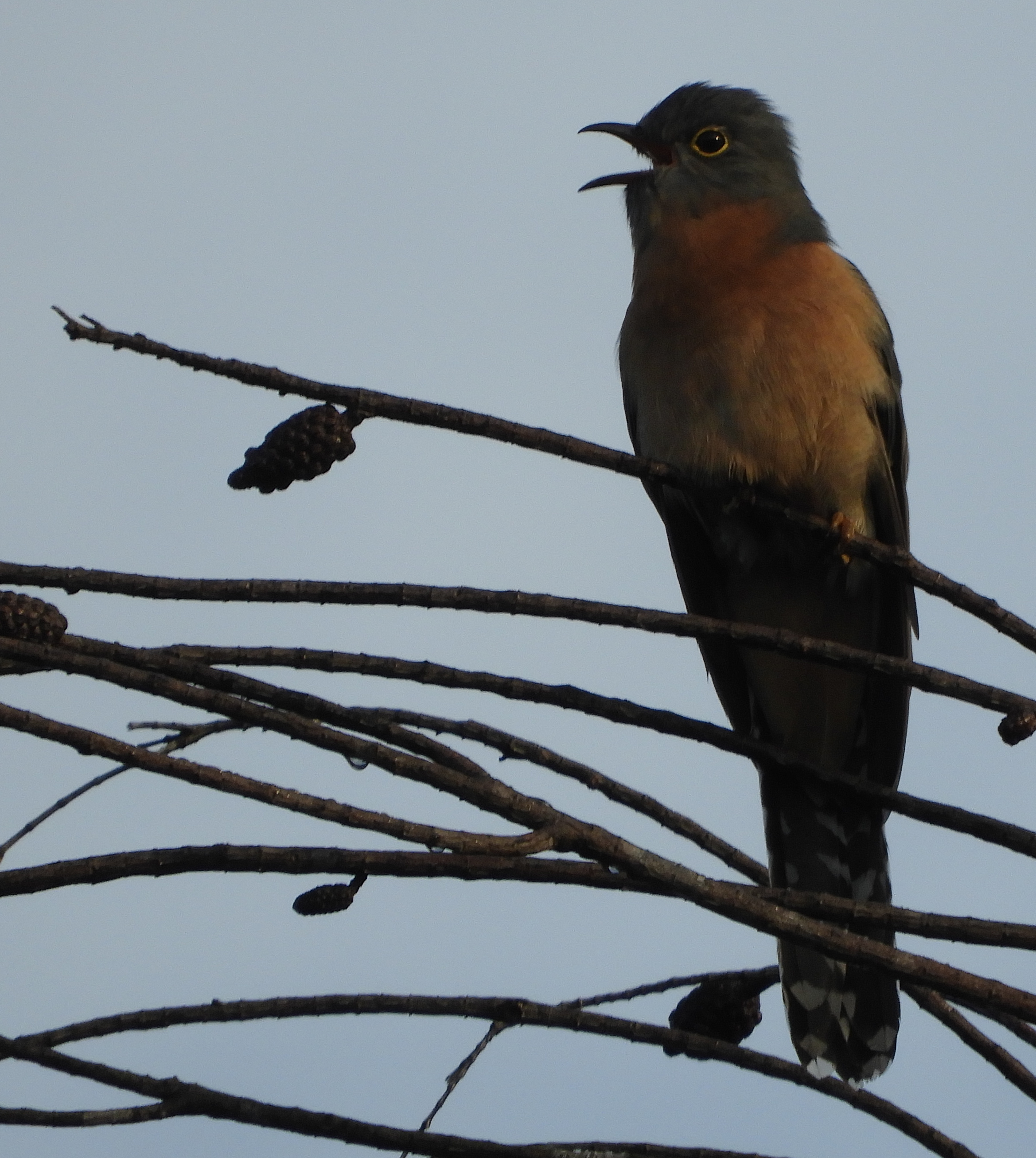
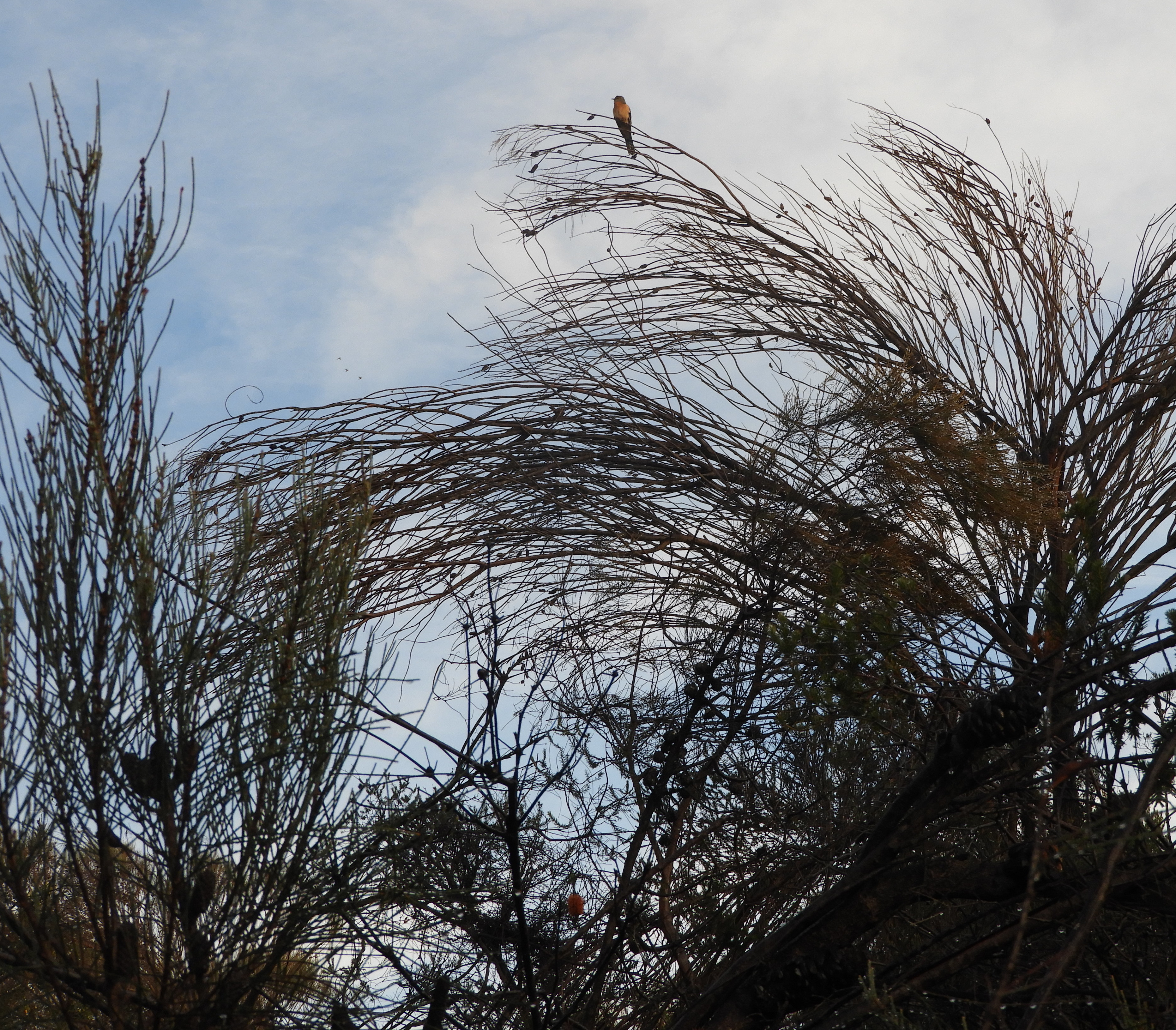
Fan-tailed Cuckoos feed on insects. Typical behaviour is to sit high up on a branch then swoop down when a meal crawls or flutters into view. Here’s a non-zoomed-in view of the bird:
Common name: Fan-tailed Cuckoo
Scientific name: Cacomantis flabelliformis
Approximate length: 26 cm
Date spotted: 13 June 2020 (winter)
Location: Manly Dam National Park, New South Wales, Australia: 33°46’29.5″S 151°14’46.3″E
Masked Woodswallow
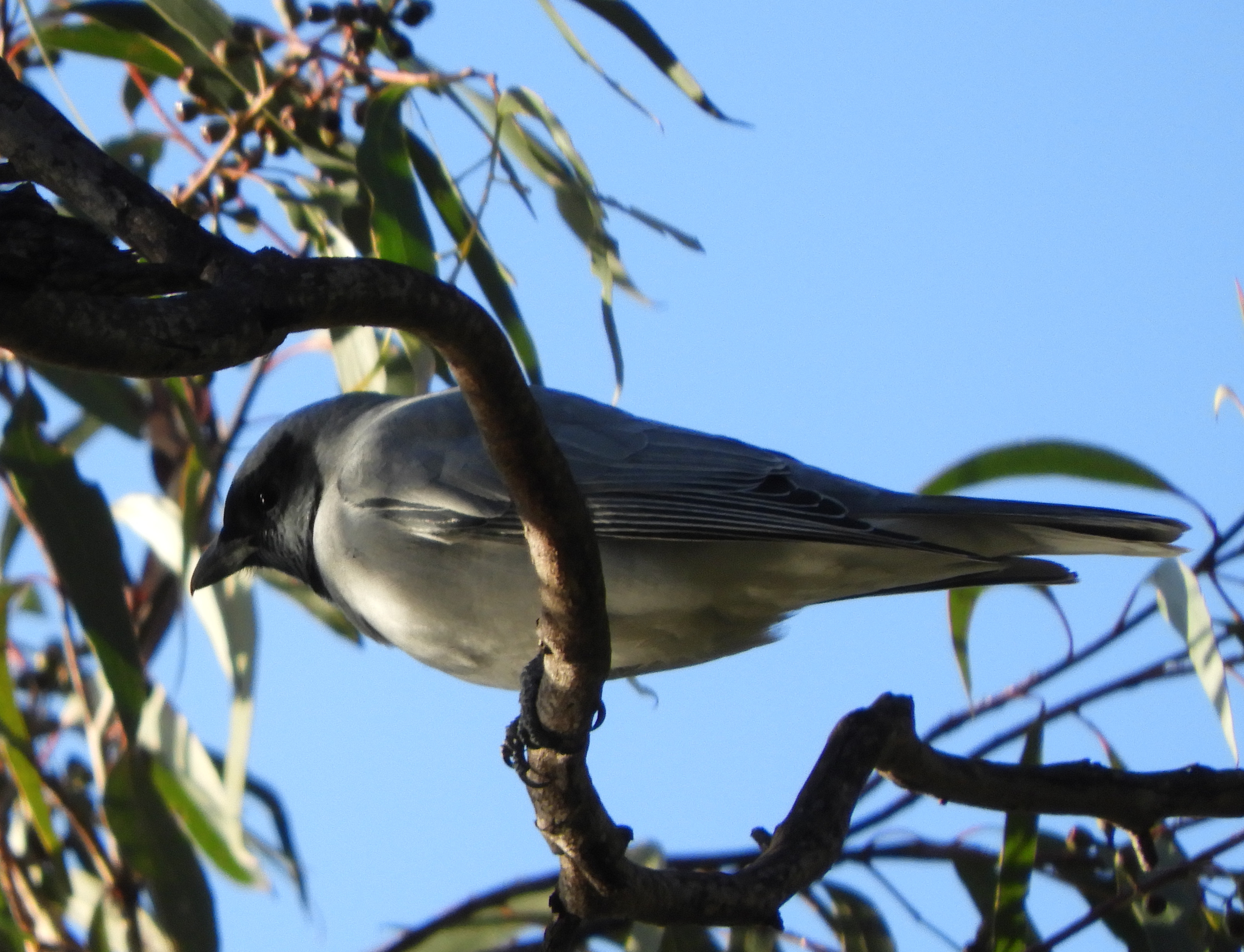
I was puzzled when I heard a series of different bird calls coming from one location. I looked up, expecting to see a butcherbird, as they’re good mimics. Instead I saw what looked like a Black-faced Cuckoo-shrike, also called a shufflewing. I decided the mimicked noises must be coming from a hidden bird, and I took a photo of what I thought was a cuckoo-shrike anyway.
Later, when I examined the photo and compared it to my bird book, I discovered that the bird doesn’t look quite like a cuckoo-shrike. The black mask is very well defined, whereas that of a cuckoo-shrike has fuzzier edges.
Looking further into birds of a similar appearance, I found that Masked Woodswallows do have some powers of mimicry. So, all in all, I think this is a woodswallow, and it’s the first one that I’ve spotted around Sydney:
Common name: Masked Woodswallow
Scientific name: Artamus personatus
Approximate length: 20 cm
Date spotted: 8 June 2020 (winter)
Location: Manly Dam National Park, New South Wales, Australia: 33°46’52.9″S 151°15’08.1″E
Rainbow Lorikeet feeding on Banksia flower
Rainbow Lorikeets have a brush-shaped tongue, which they use to lick nectar off flowers. This little lorikeet is feeding on a Heath Banksia flower:
Common name: Rainbow Lorikeet
Scientific name: Trichoglossus haematodus
Approximate length: 30 cm
Date spotted: 6 June 2020 (winter)
Location: Allambie Heights Heath Walk, New South Wales, Australia: 33°46’08.3″S 151°14’45.7″E
Little Corella and Sulphur-crested Cockatoo
Yesterday I came across a large group of Little Corellas on the sidewalk. In the midst of them was a Sulphur-crested Cockatoo. It was interesting to see the two birds up close, because from afar they look very similar. This video shows an interaction between the cockatoo and one of the corellas. You can also hear the corellas chatting to each other constantly.
These two corellas were cuddling up:
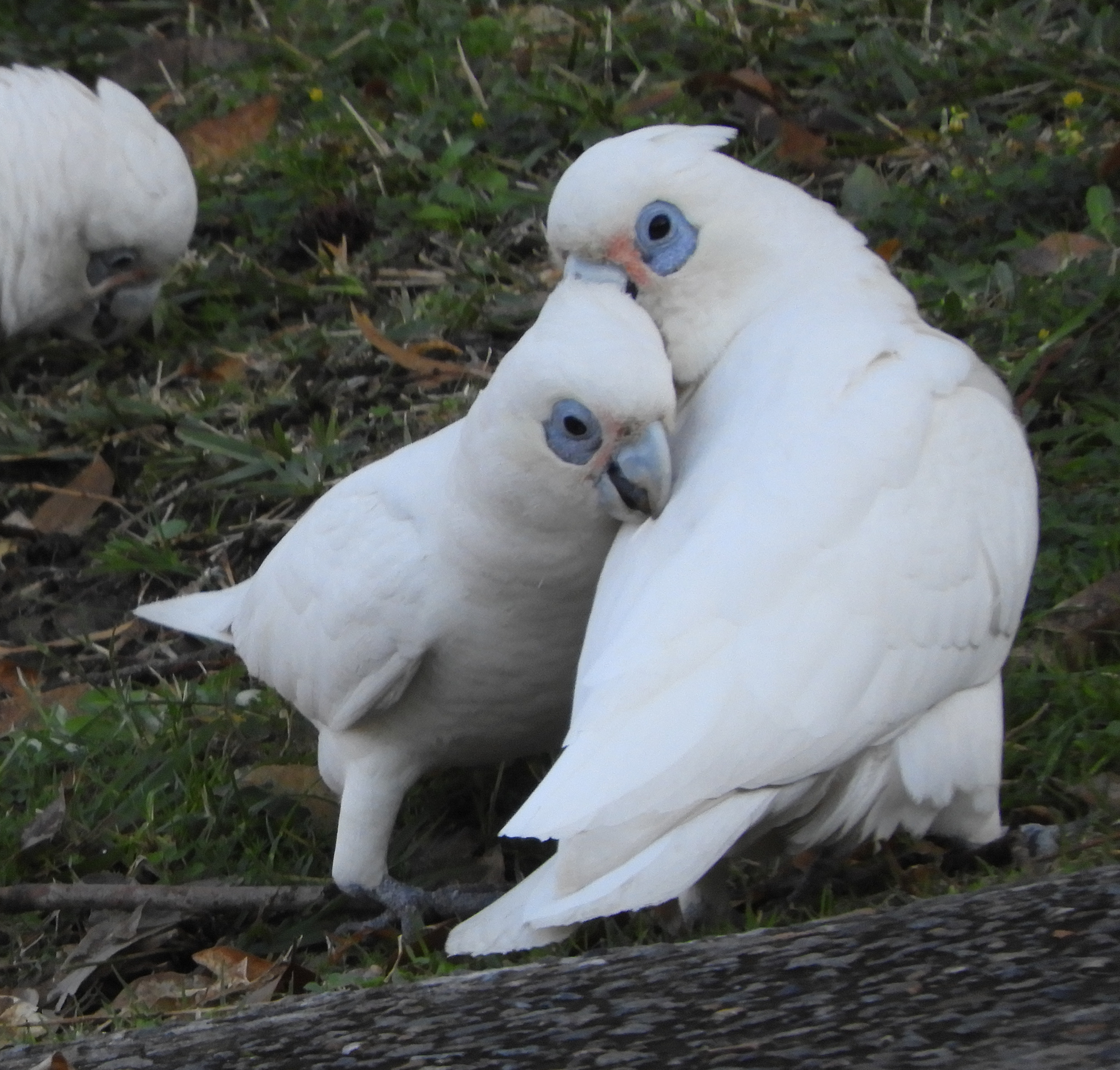
The crest of a Little Corella is white, and smaller than that of a Sulphur-crested Cockatoo:

Little Corellas have blue-grey feet, a blue patch of skin around the eye, and a pinkish patch of feathers between the eye and beak. The birds’ overall colouring makes them look rather cadaverous!
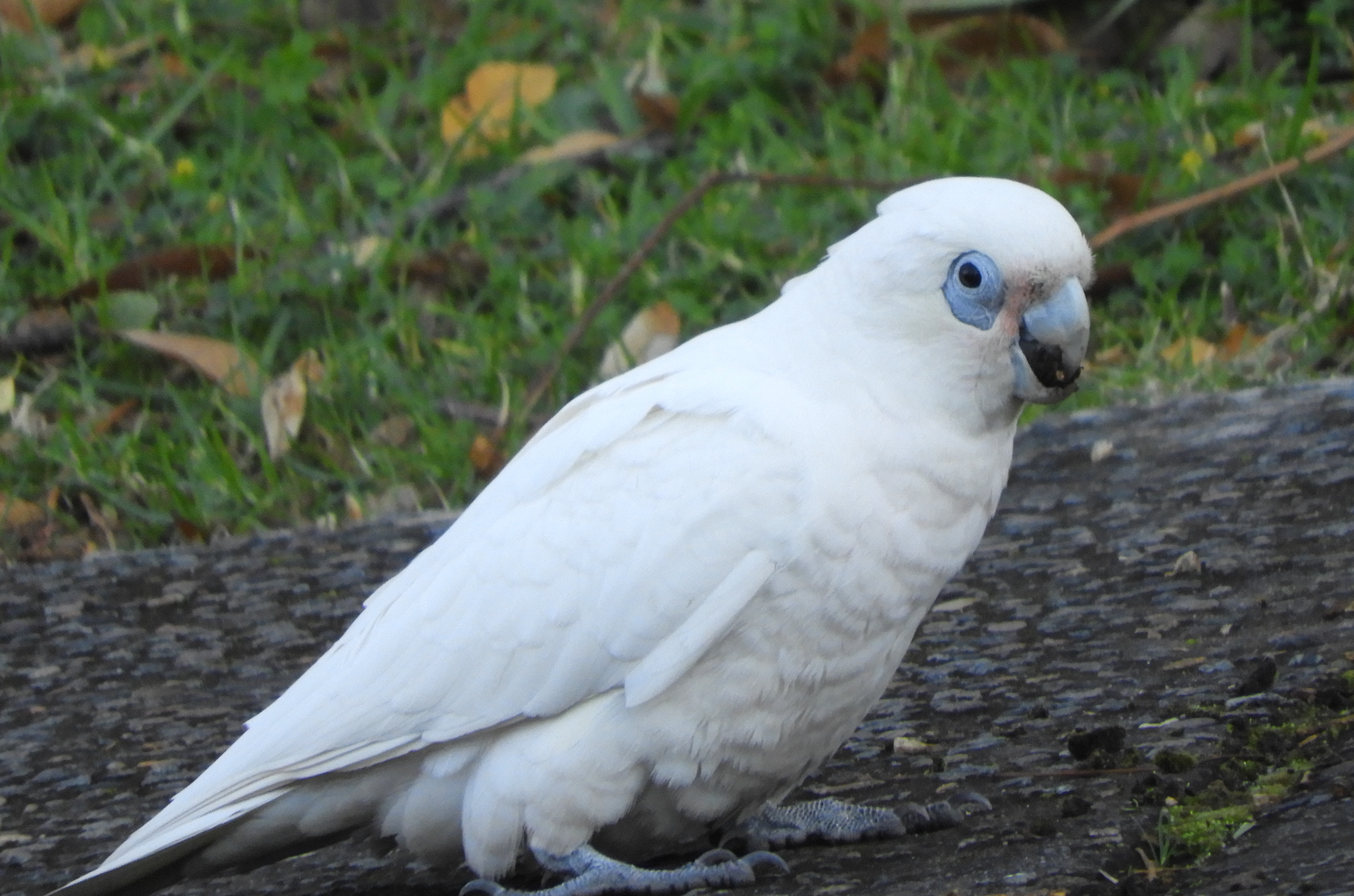
Common name: Little Corella
Scientific name: Cacatua sanguinea
Approximate length: 36-39 cm
Date spotted: 23 May 2020 (autumn)
Location: Allambie Heights near Sydney, Australia
Yellow-tailed Black Cockatoos in the garden
Three Yellow-tailed Black Cockatoos dropped in this afternoon. They chatted to each other with their weird squealing call, while demolishing parts of our Old Man Banksia bush.
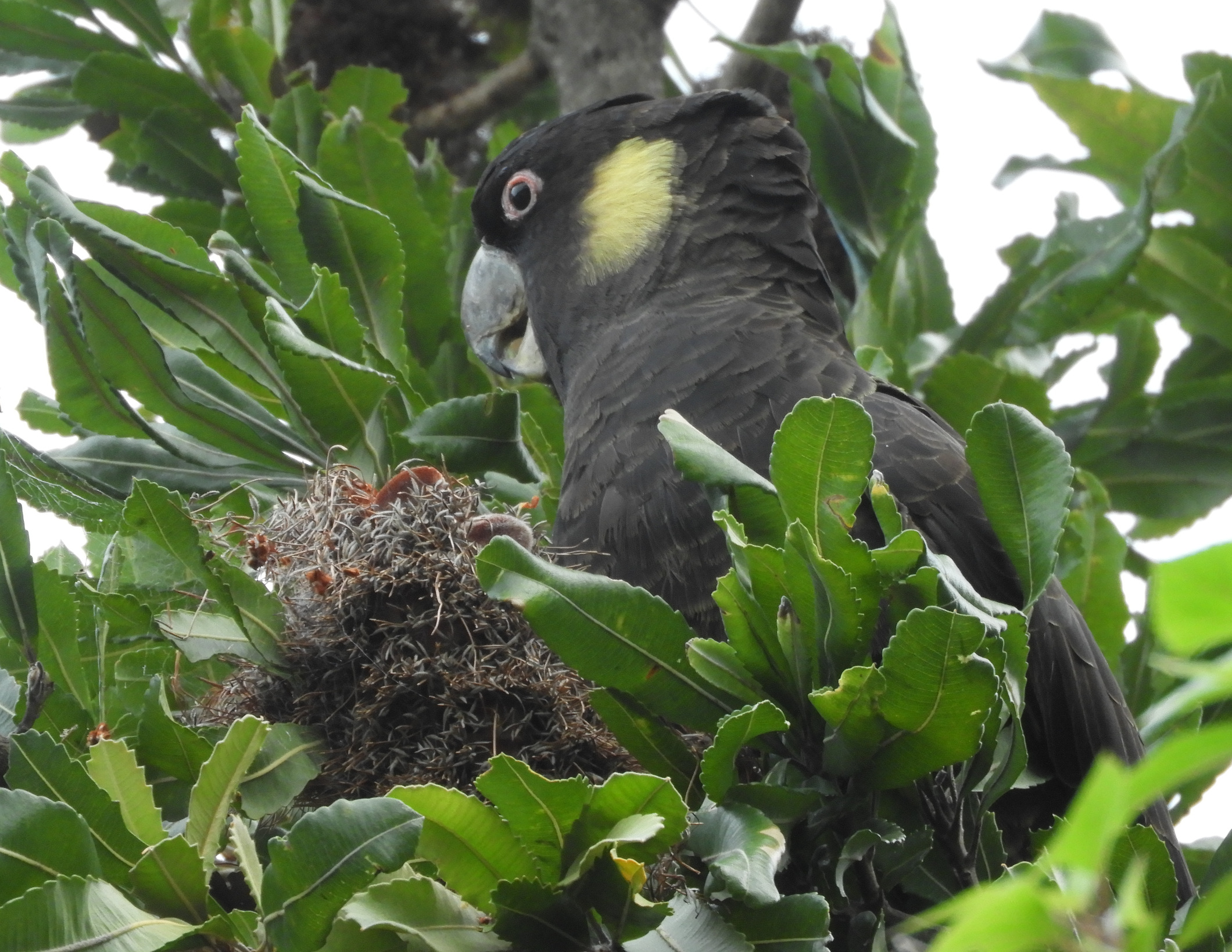
Here’s one of the birds. The pink ring around the eye identifies it as a male:
In this short video, you can hear them chatting to each other:
It’s lovely to have these big, gracious birds paying us a call.
Common name: Yellow-tailed Black Cockatoo
Scientific name: Calyptorhynchus funereus
Approximate length: 65 cm
Date spotted: 20 May 2020 (autumn)
Location: Allambie Heights, NSW, Australia
Yellow robin in shades of blue
A yellow-breasted robin contemplated a piece of blue plastic:
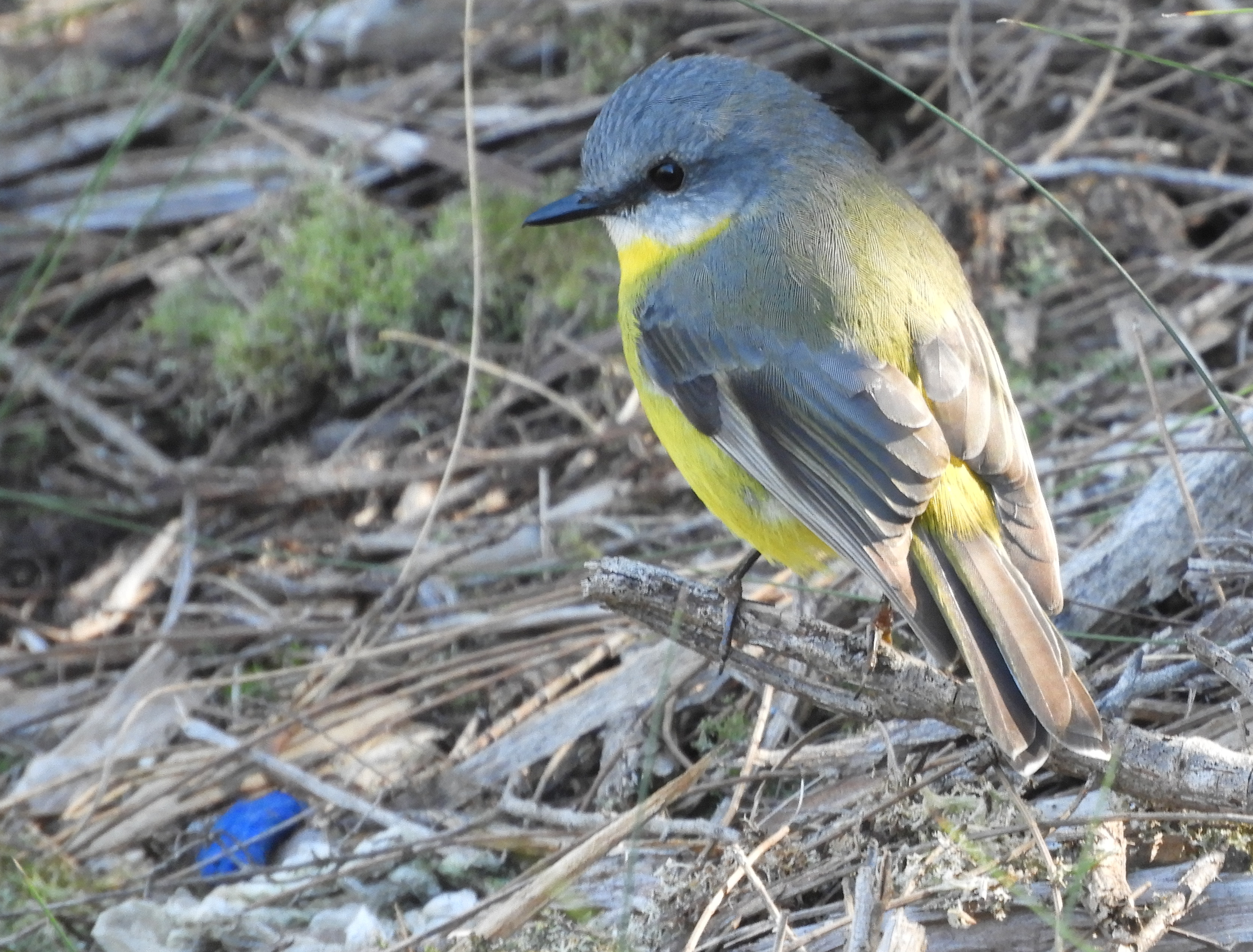
The bird then hopped onto an artistically faded green fence. The muted autumn light added shades of blue to its plumage:
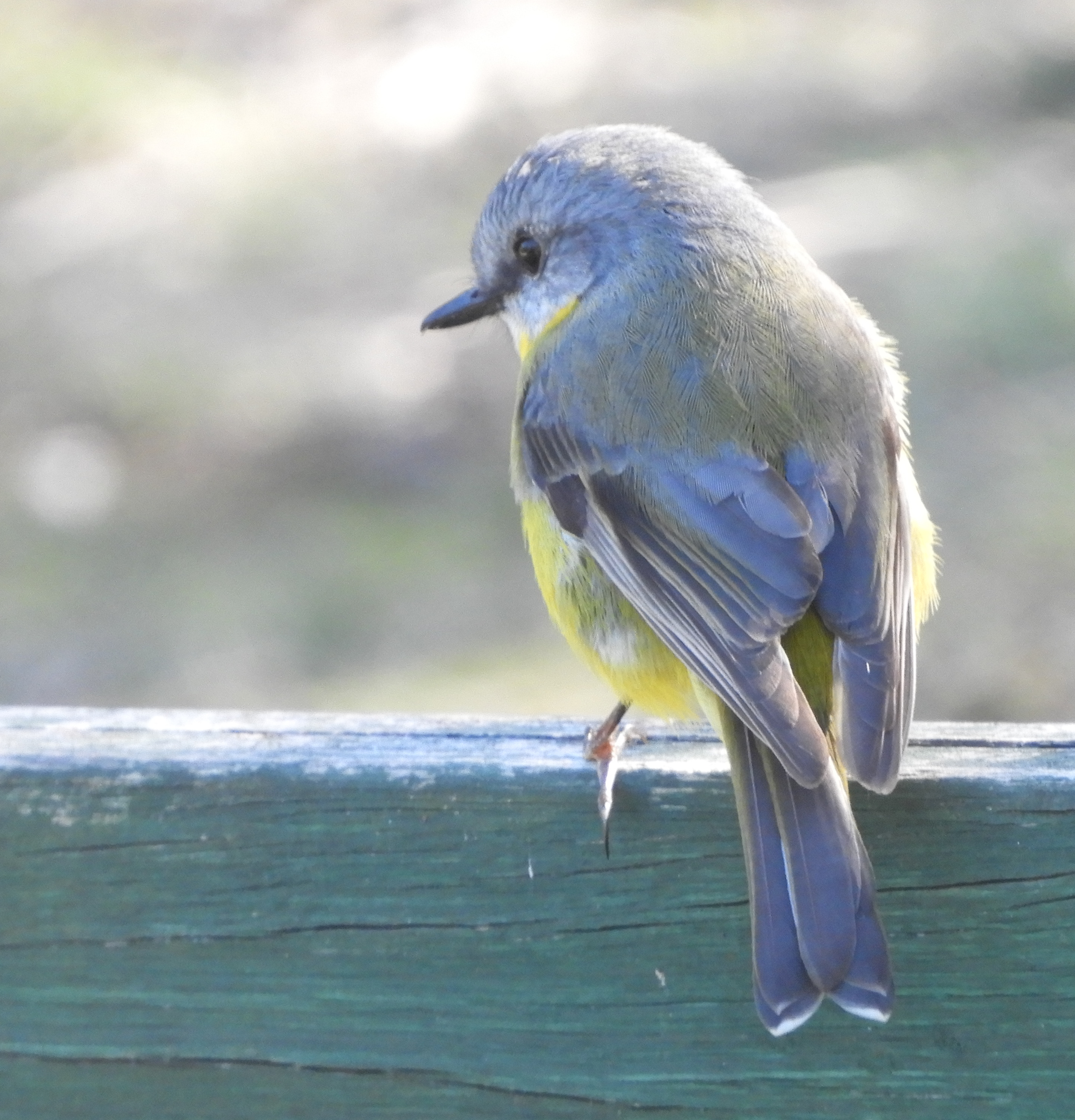
Common name: Eastern Yellow Robin
Scientific name: Eopsaltria australis
Approximate length: 15 cm
Date spotted: 12 May 2020 (autumn)
Location: Manly Dam National Park, New South Wales, Australia: 33°46’36.7″S 151°15’16.6″E
Grey Butcherbird on blue sky
A Grey Butcherbird posed on a dead tree branch against an autumn-clear sky:
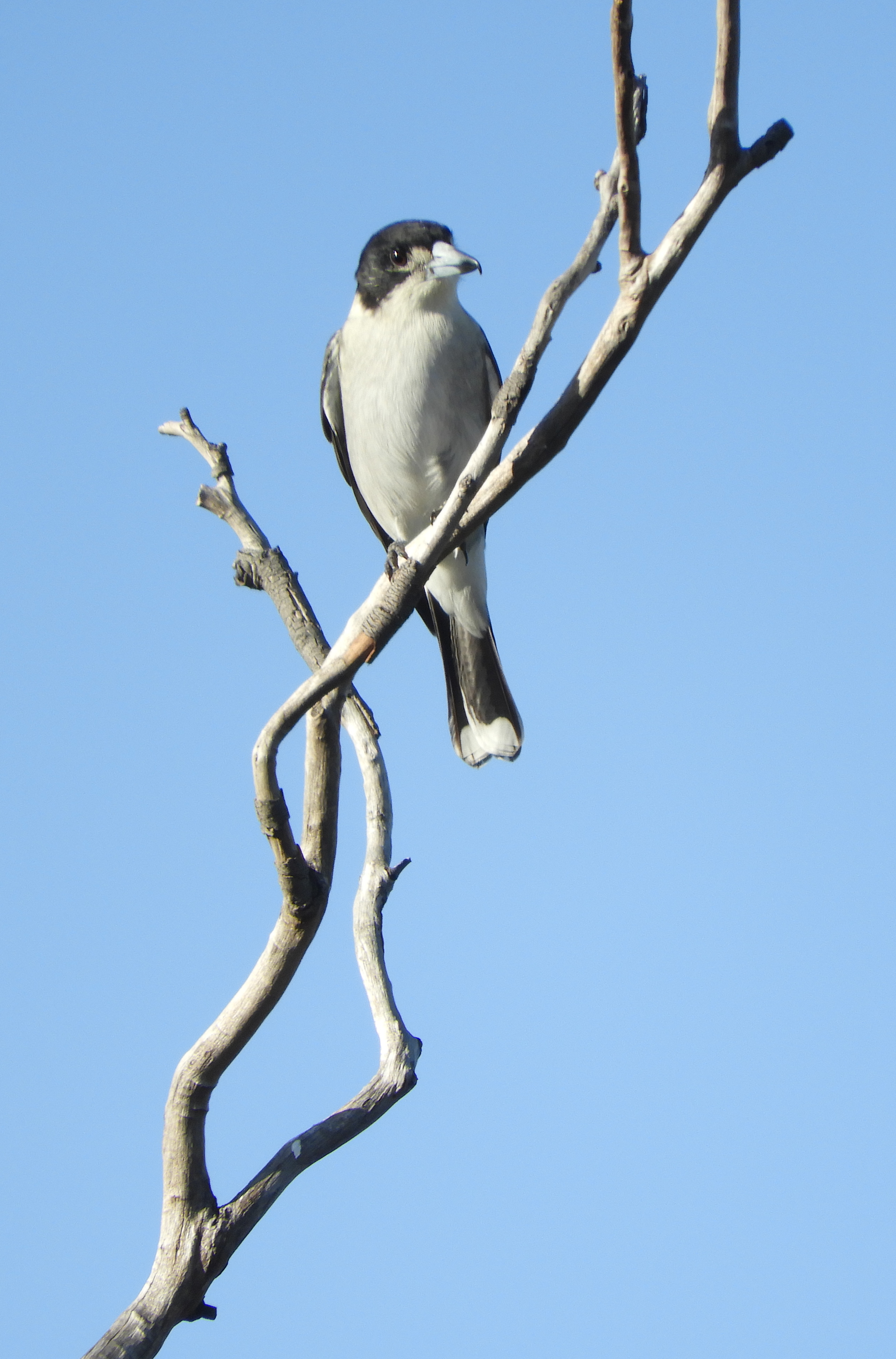
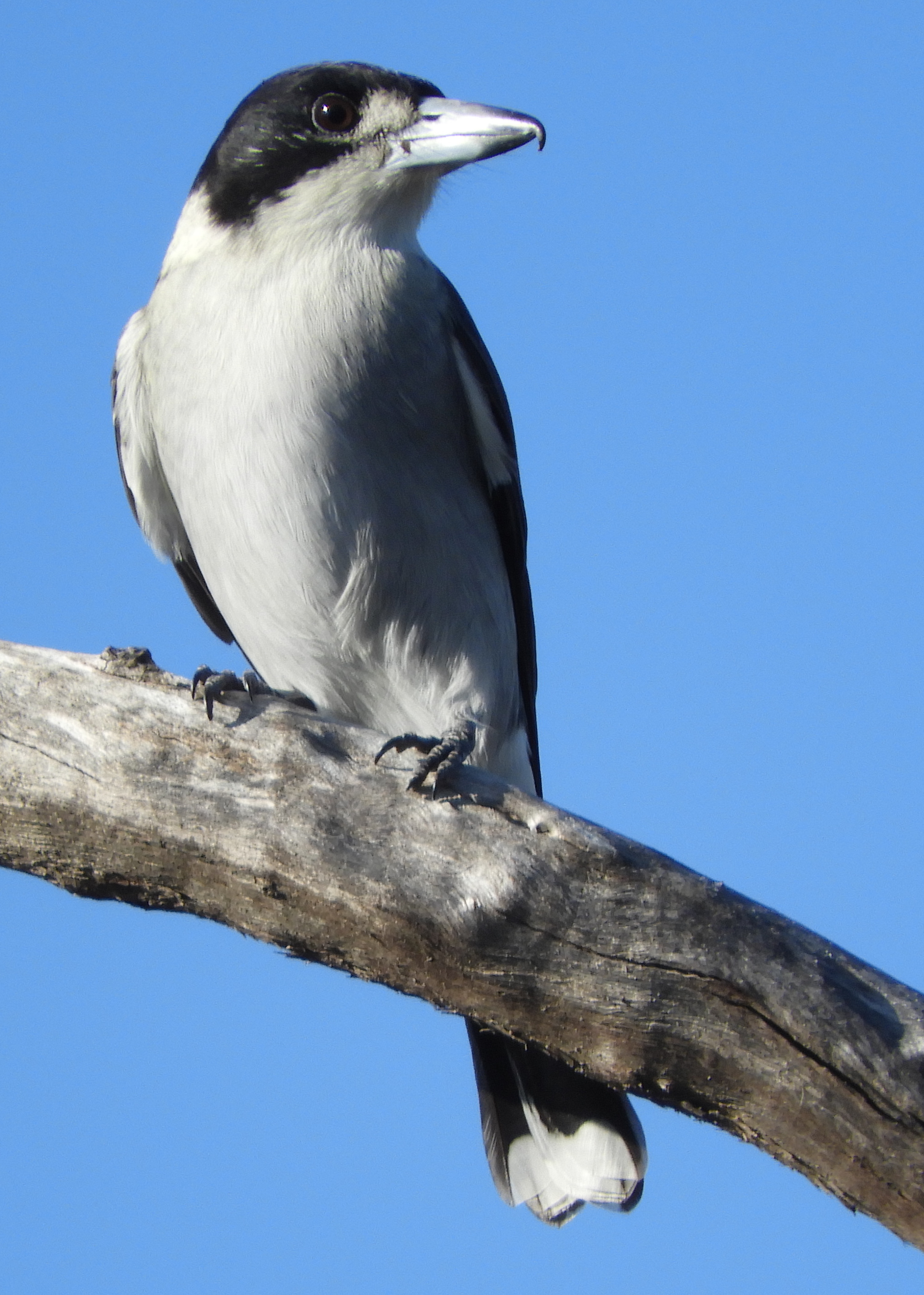
Butcherbirds are one of the types of black-and-white birds that frequent our area. They’re smaller than magpies and currawongs. When you manage to get a close-up view of a butcherbird’s beak, you notice the hook on the end. Magpies and currawongs have straight beaks without a hook:
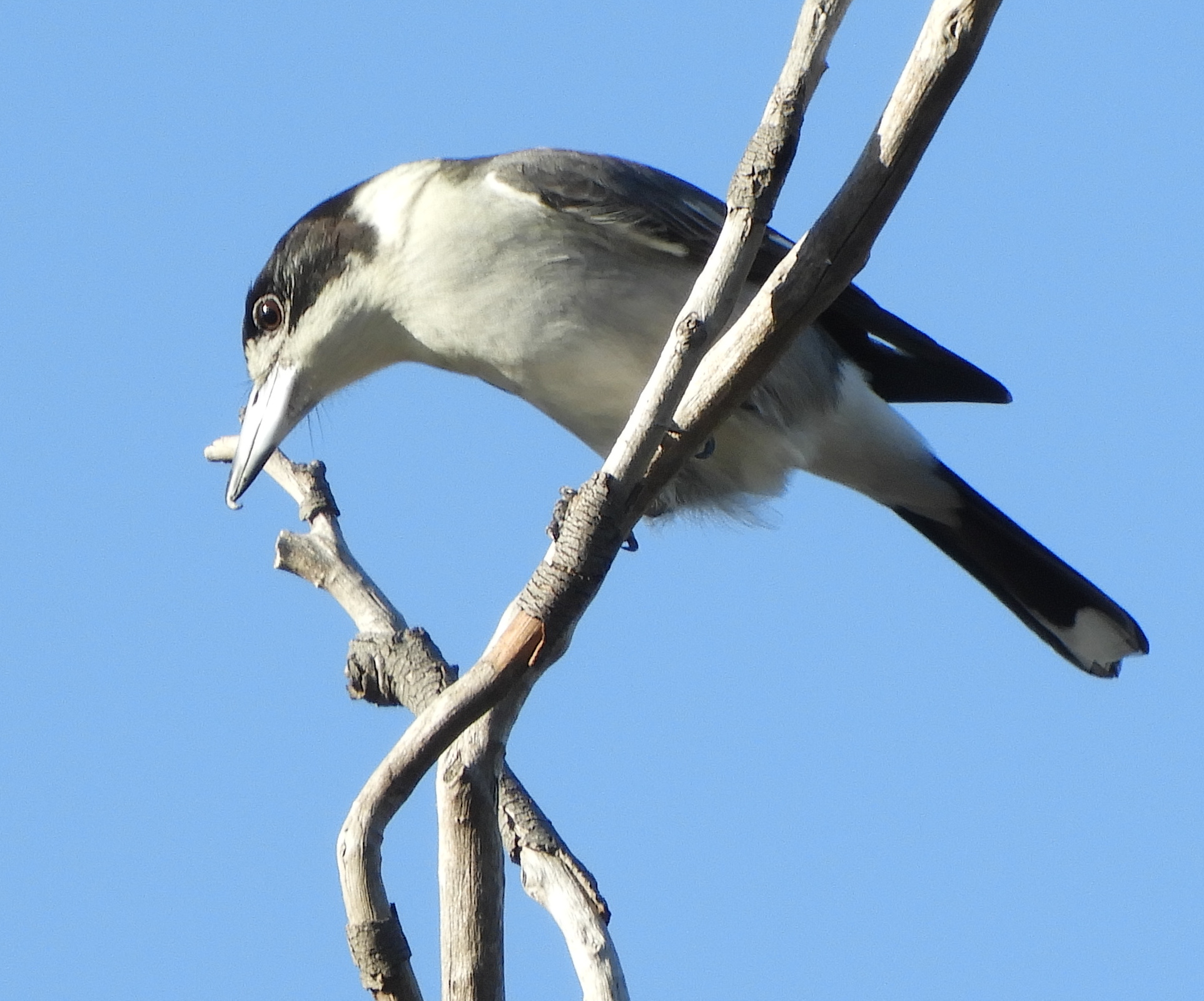
Butcherbirds eat lizards, mice, small birds, insects, and other small creatures. The next photo shows the bird spotting some small creature in the scrub below. After I captured this shot, the bird swooped down then returned to its perch without its prey.
Common name: Grey Butcherbird
Scientific name: Cracticus torquatus
Approximate length: 30 cm
Date spotted: 8 May 2020 (autumn)
Location: Manly Dam National Park, New South Wales, Australia: 33°46’33.1″S 151°14’47.9″E
Kookaburras at dawn
In my previous post about birdsong at dawn, I mentioned that dawn is a calm but not quiet time around here. One bird that was remarkable for its absence in yesterday’s video was the kookaburra. This morning the laughing cacklers made up for that!


