Blog Archives

Atmospheric pic of preening pelican in Cairns
I love the colours of this early-morning shot. The bird is an Australian Pelican, chilling out at the edge of the Coral Sea.
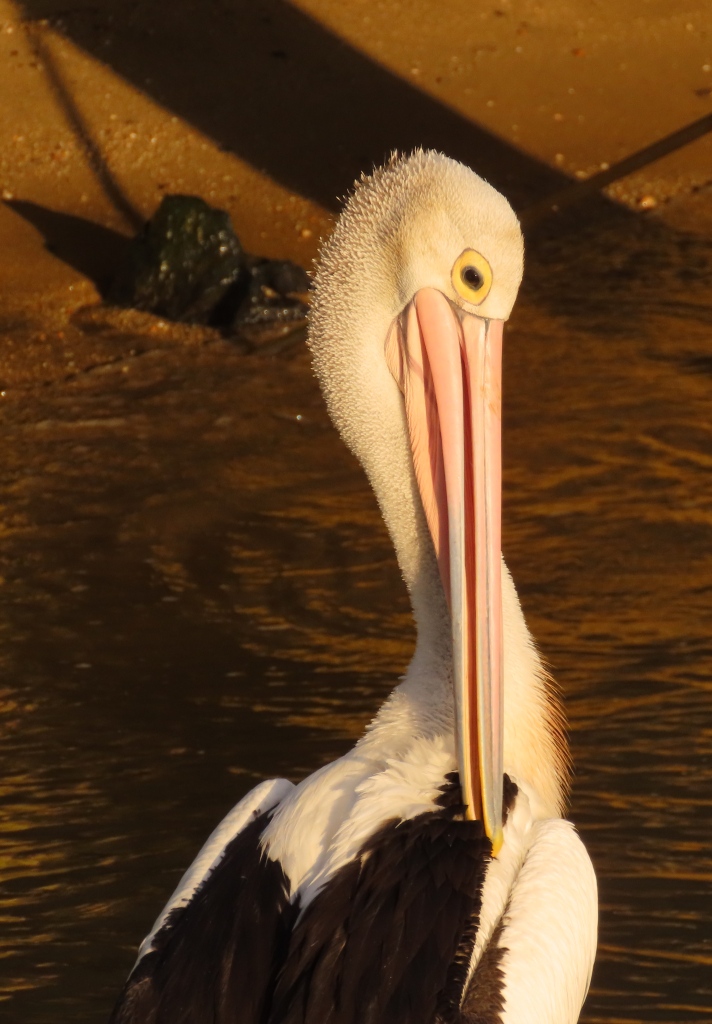
Common name: Australian Pelican
Scientific name: Pelecanus conspicillatus
Approximate length: 170 cm
Approximate wingspan: 2.5 m
Date spotted: 15 May 2022 (dry season)
Location: Cairns Esplanade, Far North Queensland, Australia: 16°55’05.0″S 145°46’33.3″E

The call of the Orange-footed Scrubfowl
In my previous post, I mentioned that many of the birds up in Far North Queensland have different calls from those down in my usual haunts near Sydney. Here’s another example: The Orange-footed Scrubfowl:
This sighting is another first for me. These birds are found in the far north of Australia, on the coastal rainforest edges of the continent. The noise and the way the bird moves remind me of the Velociraptors in Jurassic Park!
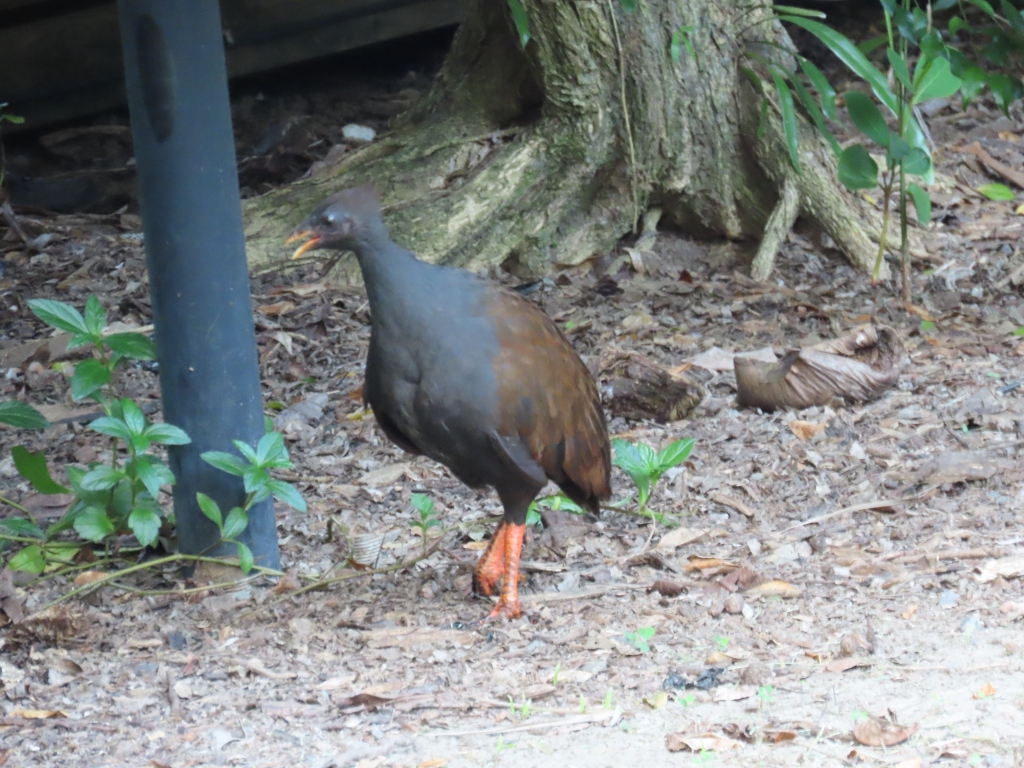
Common name: Orange-footed Scrubfowl
Scientific name: Megapodius reinwardt
Approximate length: 40-50 cm
Date spotted: 17 May 2022 (dry season)
Location: Port Douglas, Far North Queensland, Australia: 16°30’42.2″S 145°27’44.2″E

Black Butcherbird in Far North Queensland
A few days ago, I was visiting Port Douglas in Far North Queensland. Many of the birds up there have quite different calls from those further south. This Black Butcherbird is an example:
As you can see, the lighting was difficult. I did manage to get a couple of clearer still shots of the bird:
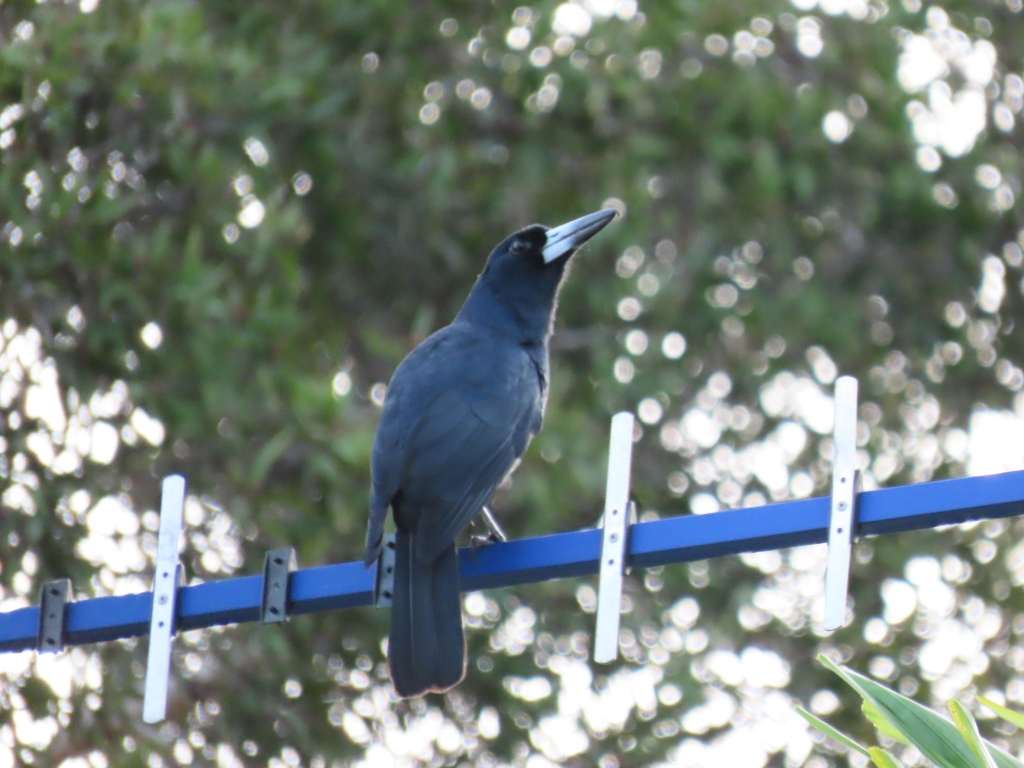
Black Butcherbirds are, as the name implies, entirely black. In Australia, they’re found only in the far north of the continent. Down near Sydney, where I’m based, I’ve only ever seen the Grey Butcherbird, which has a lot of white and grey as well as black plumage. According to my bird book, some Black Butcherbirds (the rulescens race) can be brownish as juveniles.
This is my first sighting of a Black Butcherbird! Here’s another picture of the same bird in full song:

Common name: Black Butcherbird
Scientific name: Cracticus quoyi
Approximate length: 38-44 cm
Date spotted: 17 May 2022 (autumn)
Location: Port Douglas, Far North Queensland, Australia: 16°30’42.2″S 145°27’44.2″E

Pelicans at Cairns Esplanade
I’m in Cairns for a couple of days! Cairns is in Far North Queensland, about 2,000 kilometres from Sydney as the crow flies. Early this morning, before the tropical heat set in, I took a stroll along the Esplanade.
This lovely sculpture by Brian Robinson is called Citizens Gateway to the Great Barrier Reef:

I love the way the artwork frames the bay and the entrance to the Coral Sea.
A little further along the Esplanade, two Australian Pelicans were chilling out in the shelter of the boardwalk:

Common name: Australian Pelican
Scientific name: Pelecanus conspicillatus
Approximate length: 170 cm
Approximate wingspan: 2.5m
Date spotted: 14 May 2022 (autumn)
Location: Cairns Esplanade, Far North Queensland, Australia: 16°55’05.0″S 145°46’33.3″E

Big Kookaburra in Kurri Kurri
Australia is a big place. Dotted around its landscape is an array of big animal statues. (Actually, the statues are of assorted things, not just animals, but most people think of them as big animals.) A couple of weeks ago, I was in Kurri Kurri and saw the town’s big Kookaburra:

The town of Kurri Kurri lies in the east of Australia, a couple of hours’ drive north of Sydney and close to the coastal city of Newcastle.
The Kurri Kurri Kookaburra is a sculpture by Chris Fussell, erected in 2009. Here’s another view of it:

If you’d like to know more about the town of Kurri Kurri, take a look at my travelling bookmark’s post: Kurri Kurri Kookaburra and murals.

Sleepy Corellas in Newcastle
A few days ago, I was in the city of Newcastle on Australia’s east coast. The city lies about two hours’ drive north of Sydney. Like its namesake in the UK, this Newcastle too is known as a coal-shipping port. A river runs through the city. In a small green area on the river bank, in the middle of the city, a large number of Corellas roost.
When we saw them, most of the Corellas looked sleepy:

This one looks like a cuddly toy nestled in a Christmas tree:

Little Corellas are a type of cockatoo. To me, they look rather ghostly, with their pale beaks and that ring of pale blue around their eyes.
The next one looks more interested in what’s happening:

If you’d like to see more pictures of the city of Newcastle itself, take a look at my travelling bookmark’s blog.
Common name: Little Corella
Scientific name: Cacatua sanguinea
Approximate length: 36-39 cm
Date spotted: 11 March 2022 (late summer)
Location: Newcastle, New South Wales, Australia: 32°55’32.3″S 151°46’45.4″E
Crested Tern taking a bath at Newcastle Ocean Baths
Yesterday I visited the city of Newcastle for the first time. This is Newcastle on the eastern coast of Australia, not the one in the UK. While strolling along the prom, approaching the Newcastle Ocean Baths, I saw a Crested Tern enjoying a bath in the rock pool that lies on one side of the baths:
Common name: Crested Tern
Scientific name: Sterna bergii
Approximate length: 45 cm
Date spotted: 11 March 2022 (late summer)
Location: Newcastle, New South Wales, Australia: -32.929794, 151.789490
Here’s a picture of the building that you glimpse at the end of the video — the Newcastle Ocean Baths:

Young Kookaburra learning call from adult
The bush is alive with the sound of young Kookaburras practising their call. They sound like rusty saws, or motor engines that can’t quite start. After crooning away to itself for a while, this little one approached an adult for a lesson!
Common name: Laughing Kookaburra
Scientific name: Dacelo novaeguineae
Approximate length: 47 cm
Date spotted: 3 March 2022 (summer)
Location: Manly Dam Park, New South Wales, Australia: 33°46’56.3″S 151°15’10.4″E

Baby Channel-billed Cuckoos fed by Currawongs
Walking along a shady path this morning, I heard a loud caterwauling from above. Two baby Channel-billed Cuckoos sat in the trees, yowling and shaking their wings. A Currawong arrived and fed a piece of meat to one of the cuckoos. Then another Currawong brought food to the second screeching youngster.
Like most cuckoos, Channel-billed Cuckoos lay their eggs in the nests of other birds and leave it to those other birds to hatch the egg and look after the growing chick. These particular cuckoos are very large (around 65 cm from head to tail) and so they need to pick the adoptive parents carefully. Currawongs are the usual choice.
This video shows one of the babies yowling and begging for food from its Currawong adoptive parent:
See how large the baby is in relation to the Currawong who’s looking after it! In the next video, one of the babies attempts to eat a largish morsel of meat that a Currawong has just fed to it:
I’ve never seen two babies together before. I wonder if they both came from the same nest, or if they found each other after leaving their nests?
Here’s a still picture of one of the baby cuckoos:
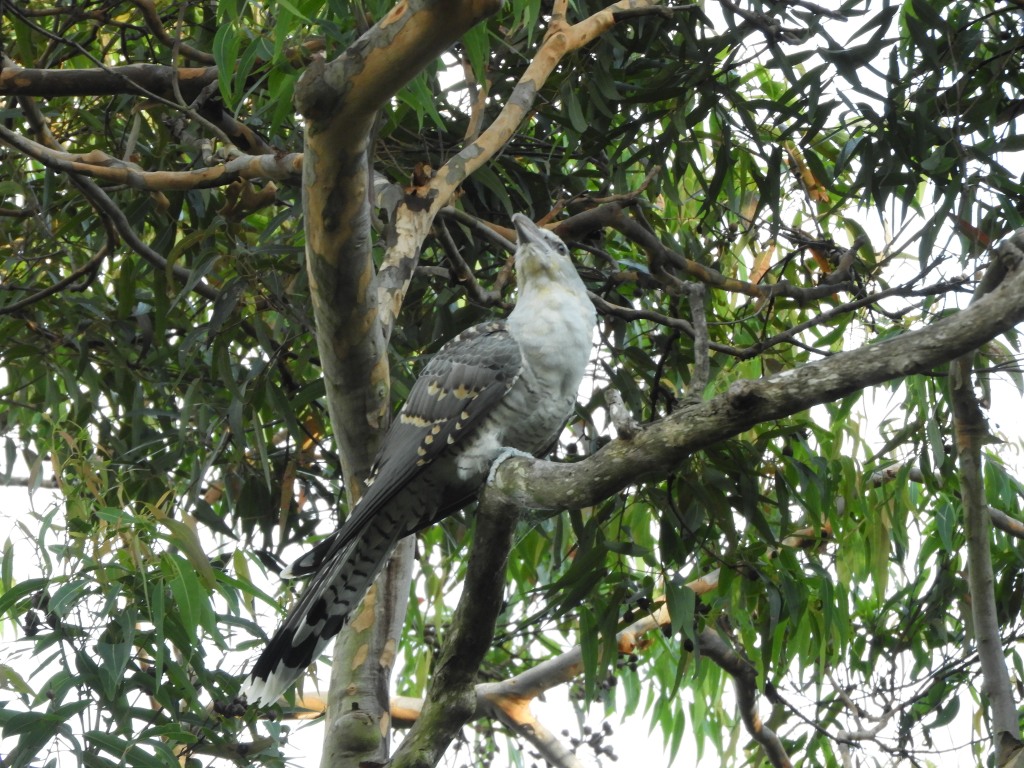
Being a youngster, its eyes are still light brown. The adult birds have fierce red eyes. They’re magnificently ugly birds.
In the next picture, one of the babies is pointing its beak at the sky, perhaps wondering where its next feed is coming from:
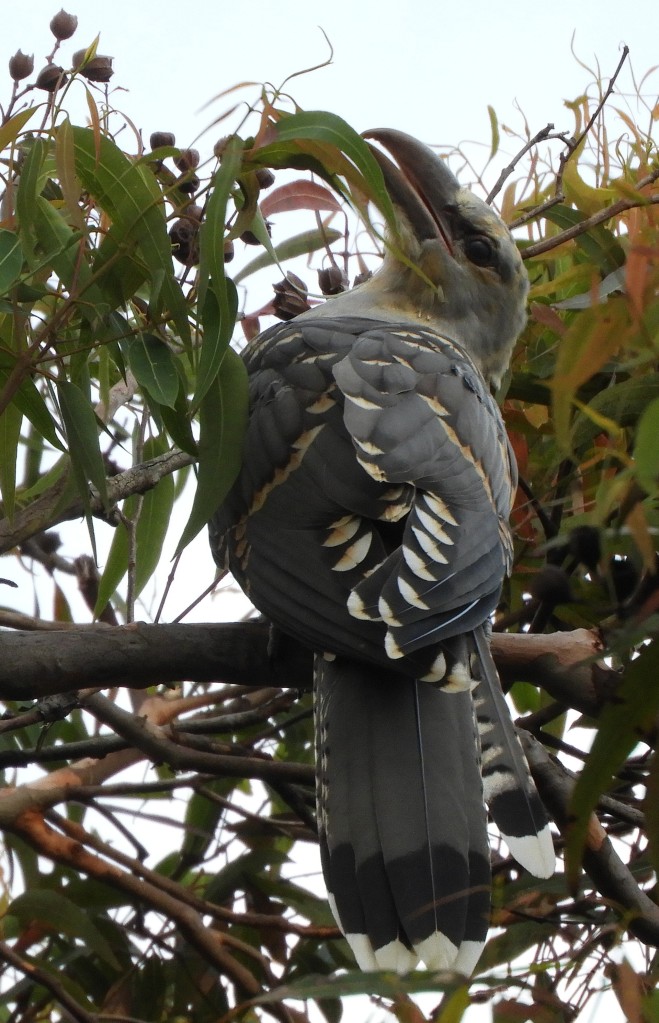
That picture gives a good view of the bird’s large beak and the markings on its back and tail.
One of the things you notice about Channel-billed Cuckoos is the supple way they move their neck and head. Here’s one of the babies leaning forward, in a pose that’s typical of these birds:
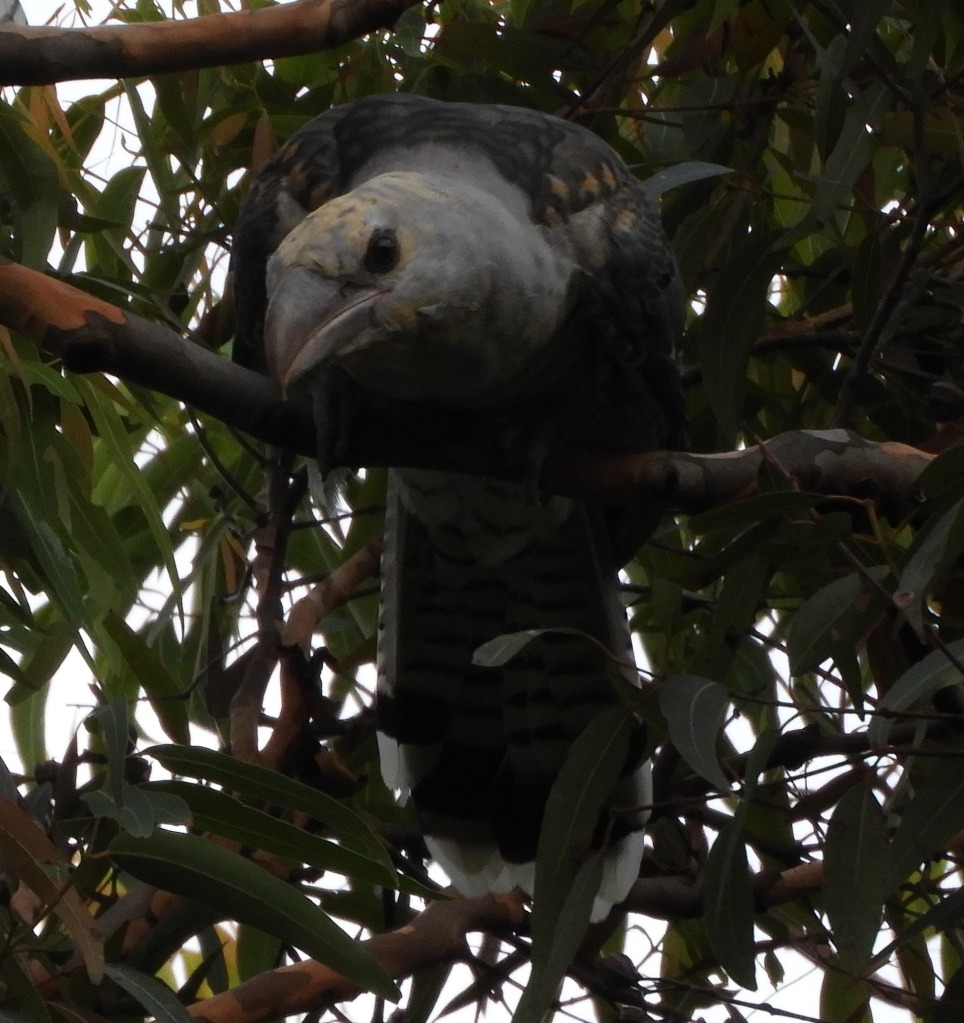
Oo-er, you probably wouldn’t want to bump into that bird one dark night. Here’s a picture of both baby cuckoos, looking at each other:

To finish off with, here’s a close up of one of the babies, head and neck only:

You can find out more about these birds in my other posts about cuckoos.
Common name: Channel-billed Cuckoo
Scientific name: Scythrops novaehollandiae
Approximate length: 58-65 cm
Date spotted: 18 December 2021 (summer)
Location: Manly-to-Spit Walk, Balgowlah, New South Wales, Australia: 33°48’00.9″S 151°15’54.9″E

Dollarbirds courting
It’s that time of year for birds on the south east coast of Australia: breeding season! I heard a cosy chattering sound high in the treetops. My superzoom camera revealed two Dollarbirds getting friendly:
Dollarbirds are migratory. They travel down to the south east coast of Australia for the summer months (roughly September to March) then fly up north to warmer climes for the winter.
They get their name from the white circular markings on the undersides of their wings. The white circles reminded people of the old silver Australian one-dollar coins. You can see the flash of white nicely when the male flies off at the end of the video.
This still photo shows the blue-green colouring of the birds. They have soft brown heads and pretty purple shading under the beak:
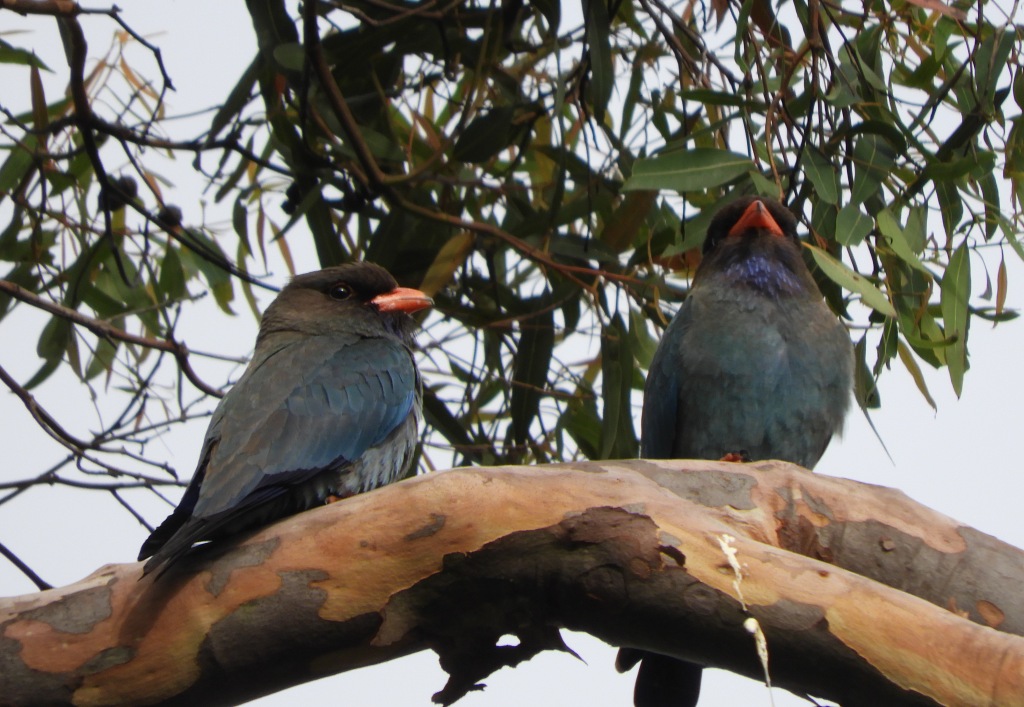
Common name: Dollarbird
Scientific name: Eurystomus orientalis
Approximate length: 30 cm
Date spotted: 29 November 2021 (late spring)
Location: North Harbour Reserve, Balgowlah, NSW: 33°47’59.4″S 151°15’57.8″E


 Sydney Birder