Blog Archives

Noisy Friarbird feeding on Grevillea
I recently visited The Gap in Brisbane, Queensland. Every morning, as the sun came up, Noisy Friarbirds visited the flowering Grevilleas outside our window.
For the most part, the Noisy Friarbirds did live up to their name: they were noisy. Funnily enough, though, there’s not much Noisy Friarbird noise in the above video. I did take another video in the same location, of a Pale-headed Rosella this time. And, again funnily enough, in that video you don’t hear the Rosella but you do hear the Noisy Friarbirds (and other birds) in the background.
Noisy Friarbirds aren’t the prettiest of birds. Their body and wings are attractive in a quiet way, but the head looks as if it belongs on a dinosaur! The video and this photo give a nice view of the bump at the top of the bird’s beak, the bare skin and exposed ear, and that red eye:

Common name: Noisy Friarbird
Scientific name: Philemon corniculatus
Approximate length: 30-35 cm
Date spotted: 6 July 2024 (winter)
Location: The Gap, Brisbane, Queensland (approximate map reference)
Pale-headed Rosella, my first
I recently paid a visit to Brisbane and stayed in an Airbnb with a gorgeous garden. Every morning, as the sun came up, birds visited the flowering Grevilleas outside our window. One morning, this beautiful bird was among them:
It’s my first sighting of a Pale-headed Rosella. They’re not found in the Sydney area, but are common further north in NSW and Queensland. I love the soft colours and gentle manner of this bird.
Common name: Pale-headed Rosella
Scientific name: Platycercus adscitus
Approximate length: 28-32 cm
Date spotted: 6 July 2024 (winter)
Location: The Gap, Brisbane, Queensland (approximate map reference)

A covey of Brown Quails on Old Grafton Road
I was recently on Old Grafton Road, in the vicinity of Glen Innes, NSW. On the road was a group of six to seven little birds that I’d never seen before. They were clustered together, but were quite timid and fled into the undergrowth when I got out of the car to take a look.
I thought they must be some type of small pheasant. They turned out to be Brown Quails. Evidently a group of quails is called a covey.
Here’s the best picture that I have of any of them.
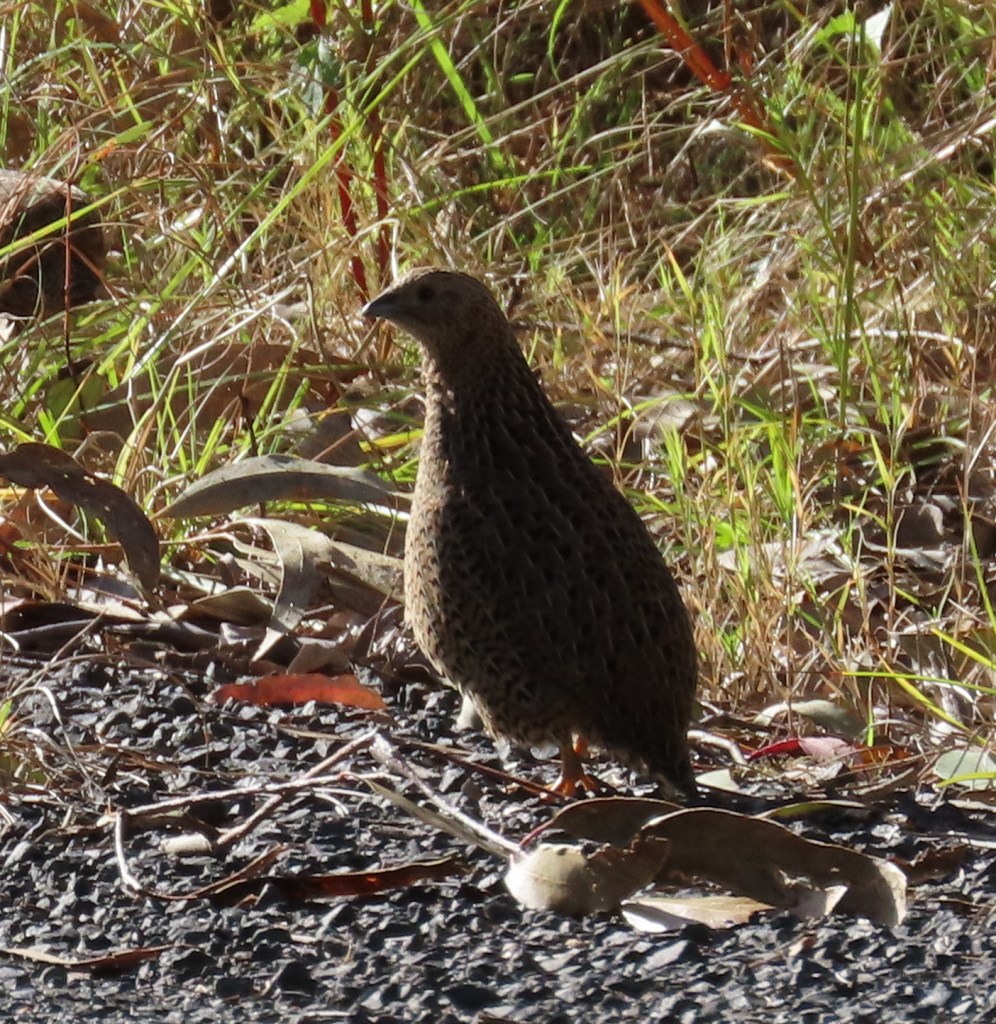
This picture of two of them shows the brownish eye:

Here are five of them clustered together:

It’s exciting to see a species for the first time! In the past, I’ve spotted little birds dashing into the undergrowth in various places, which might have been quails, but I’ve never before caught a good look.
Common name: Brown Quail
Scientific name: Coturnix ypsilophora
Approximate length: 17-20 cm
Date spotted: 5 July 2024 (winter)
Location: Old Grafton Road, NSW. Approximate map reference: 29°40’29.5″S 152°04’42.0″E

Pied Butcherbirds, adult and juvenile
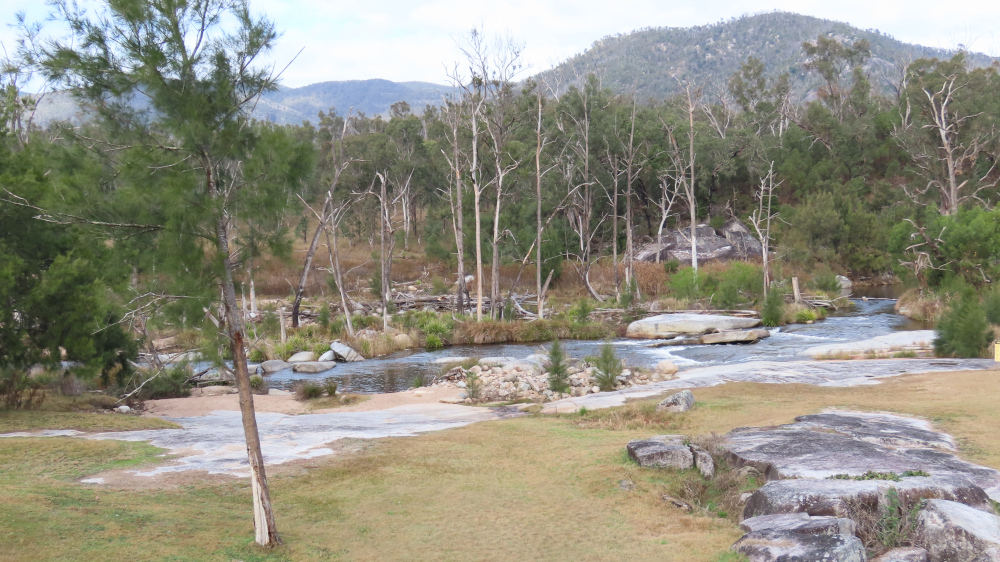
This is just my second sighting of a Pied Butcherbird, and this time I was lucky to see both an adult and a young bird. This was at the Mann River Nature Reserve near Glen Innes, NSW, just off the Old Grafton Road.
Note: Thank you to Sue, who corrected my original thought that the juvenile was a female. As Sue points out in her comment below, the male and female adult birds are very similar in appearance.
Here’s the adult bird:

In the next photo, the view from behind shows the wide white collar that goes all the way round the bird’s neck. I think it’s the same bird as in the previous photo, but I don’t know for sure:

Here’s the young bird, in the same tree:

Common name: Pied Butcherbird
Scientific name: Cracticus nigrogularis
Approximate length: 33-36 cm
Date spotted: 5 July 2024 (winter)
Location: Mann River Nature Reserve in NSW, just off the Old Grafton Road: 29°41’18.3″S 152°05’56.6″E
Mann River makes a pretty picture, meandering around grey-white rocks and surrounded by natural forest:

My first Tattler
A few weeks ago, I took some photos of a bird that I thought was a juvenile Oystercatcher. When I posted the pictures and location on eBird, a reviewer let me know that this is a Tattler, probably a Grey-tailed Tattler.
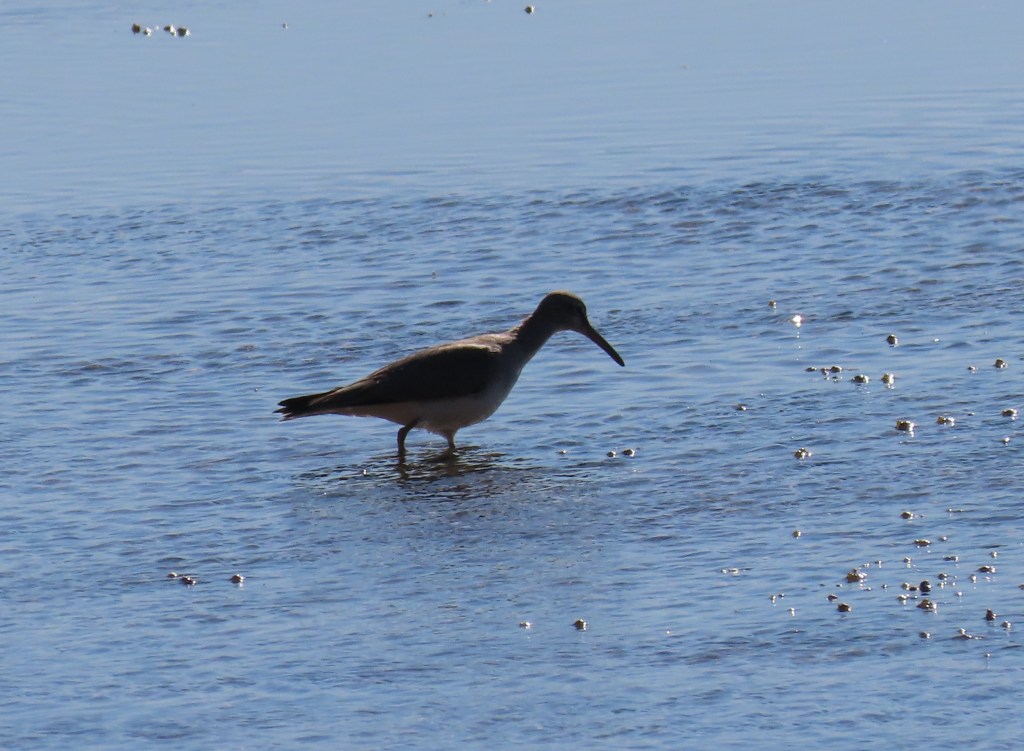
I was delighted to be corrected, and particularly so because this is the first time I’ve spotted a Tattler. These birds are uncommon in the south of Australia, particularly in winter.
The bird was wading in the shallows of the rocky plate that leads out into the ocean from Long Reef Headland. Every now and then, it probed the rocks below the water for food.
The lighting was harsh and the bird was far away, which made it difficult to get a good photo.

Common name: Tattler, probably a Grey-tailed Tattler
Scientific name: sp. Heteroscelus, probably Heteroscelus brevipes
Approximate length: 24-28 cm
Date spotted: 19 June 2024 (winter)
Location: Long Reef Aquatic Reserve, Collaroy, New South Wales, Australia: 33°44’19.7″S 151°18’42.0″E

Butcherbirds sang to me!
Early one morning, at the place I was staying at near Brisbane, two Grey Butcherbirds dropped down and sang to me.
It felt very special to have these birds come so close and sing their song. I suspect they were hoping I’d produce a snack. This is the first time I’ve had this experience, though a few magpies have sung to me in the past.
Here’s a still picture of one of the birds:
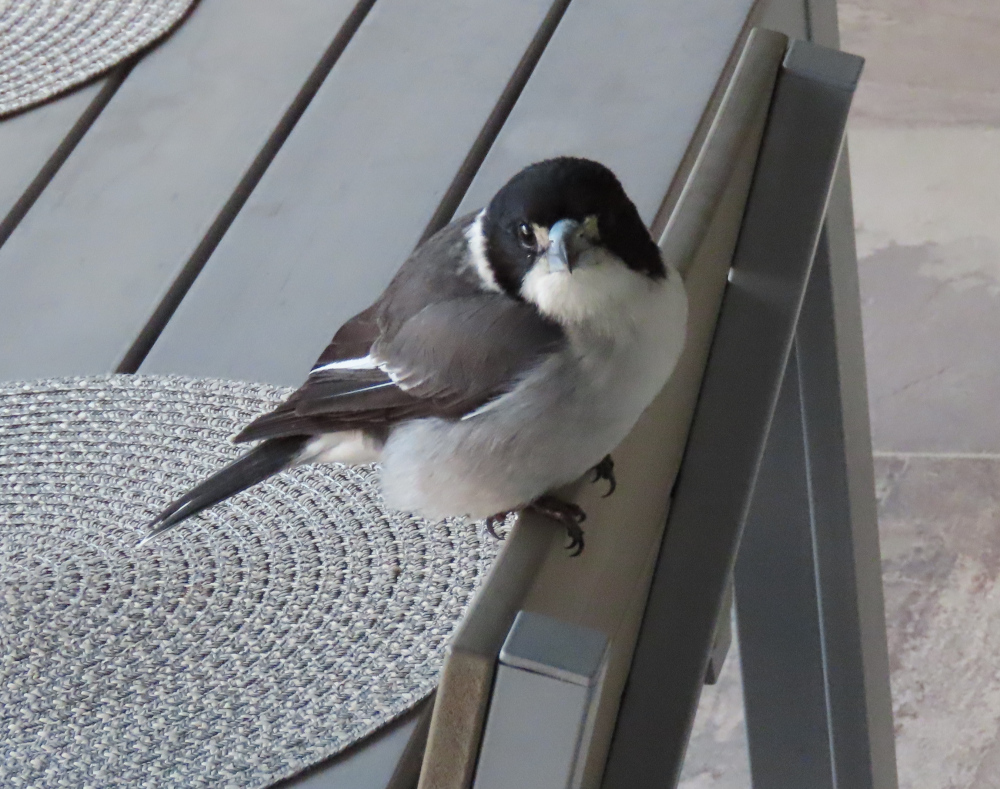
Butcherbirds are medium-sized songbirds, widely spread in Australia. They’re only distantly related to the South African shrikes that are also known as butcherbirds. Both groups of birds get their name from their habit of securing their captured prey on spikes or in crevices, to store the prey for youngsters or to make it easier to eat.
Common name: Grey Butcherbird
Scientific name: Cracticus torquatus
Approximate length: 30 cm
Date spotted: 6 July 2024 (winter)
Location: The Gap, Brisbane, Queensland, Australia: 27°26’55.3″S 152°55’50.2″E

The foot of the Coot
Coots are underrated. Their feet even more so.

Drama in monochrome and a touch of red:

How to own a reflection:

Common name: Eurasian Coot
Scientific name: Fulica atra
Approximate length: 35 cm
Date spotted: April and June 2024
Location: Manly Dam Reserve, New South Wales, Australia

Pardalotes nest-building in winter
It’s mid-winter here in Sydney: cold, wet, and grey. Yet I’ve noticed some of the birds are already preparing for breeding season. On Friday, I saw a group of Australian Ibises in breeding plumage. And a few days ago, I watched a Spotted Pardalote gathering material for its nest:

Pardalotes are tiny little birds (10 cm from head to tail). They nest in burrows in the ground, usually at around ankle level. This one was unusual, in that its nest was in the side of a low cliff, overlooking the water of Sydney Harbour. Here’s the view that the bird would see:

Some distance away on the same walk, another Spotted Pardalote stopped on a branch for a few seconds:

Even when stopped on a branch, these birds don’t stand still for any time at all! I was lucky to get some usable shots from the many that I took. Another view of the same bird:

Common name: Spotted Pardalote or Diamondbird
Scientific name: Pardalotus punctatus
Approximate length: 10 cm
Date spotted: 26 June 2024 (winter)
Location: Forty Baskets (33°48’05.7″S 151°16’09.3″E) and Dobroyd Head (33°48’35.0″S 151°16’18.8″E) in Sydney Harbour

Young Scarlet Honeyeater
It took me a while to identify this bird. The long, thin, curved beak made me think of a honeyeater or a spinebill. I’d seen Scarlet Honeyeaters in the area before, and this bird was the right sort of size and shape to be one of those. But it has no red around its head or throat, and its legs are orange instead of grey.
It’s a young Scarlet Honeyeater:

I’ve posted some pictures of previously-spotted Scarlet Honeyeaters, where you can see the lovely reds of the adult birds.
There’s a small hint of red on the back, just above the tail:

This is the view the bird was enjoying:

Common name: Scarlet Honeyeater
Scientific name: Myzomela sanguinolenta
Approximate length: 10 cm
Date spotted: 26 June 2024 (winter)
Location: Dobroyd Head, New South Wales, Australia: 33°48’34.0″S 151°16’14.8″E

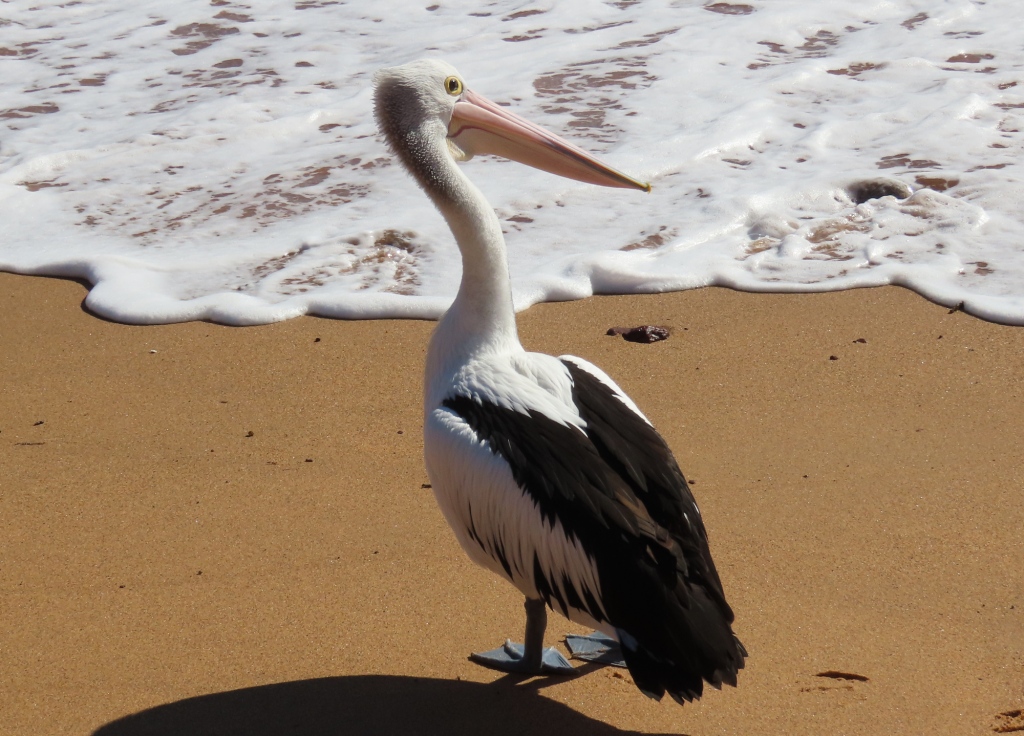
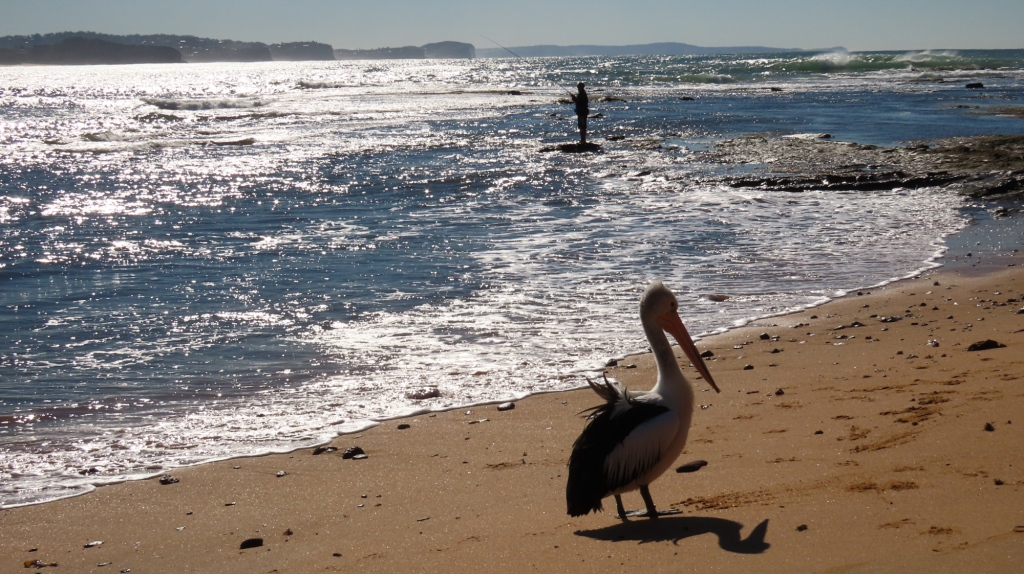
Pelicans prowling around fisherman
At Long Reef in Collaroy, a fisherman was washing out his bucket. Three pelicans followed in his footsteps, hoping for some tasty morsels to fall.
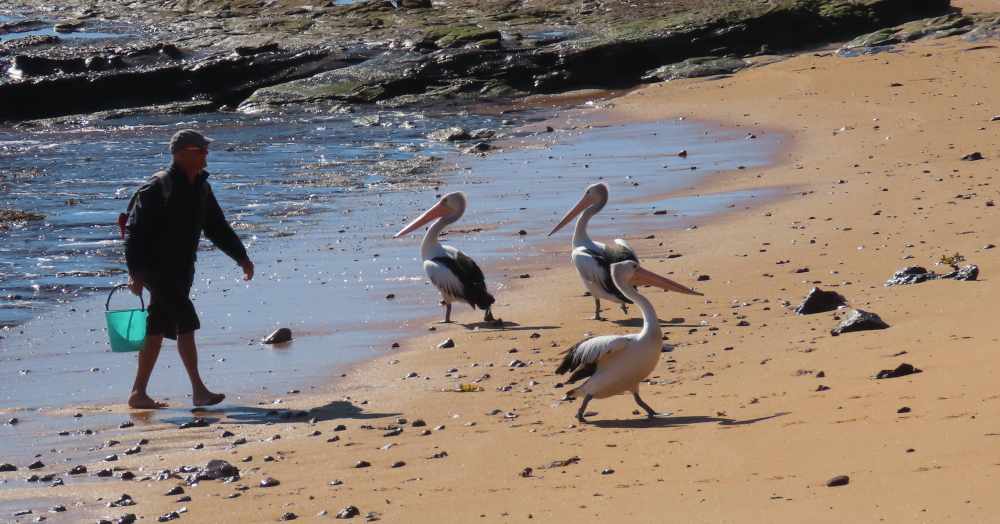
The birds weren’t too worried when I approached to take some photos.
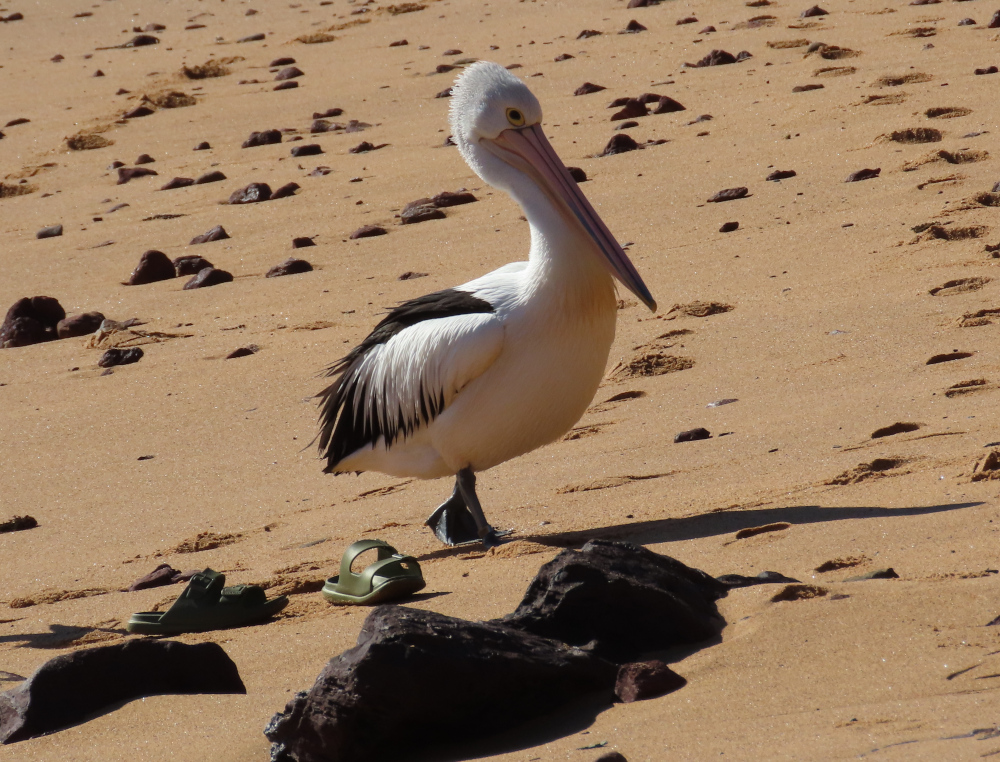
Cosying up to a pair of sandals that someone left on the beach:
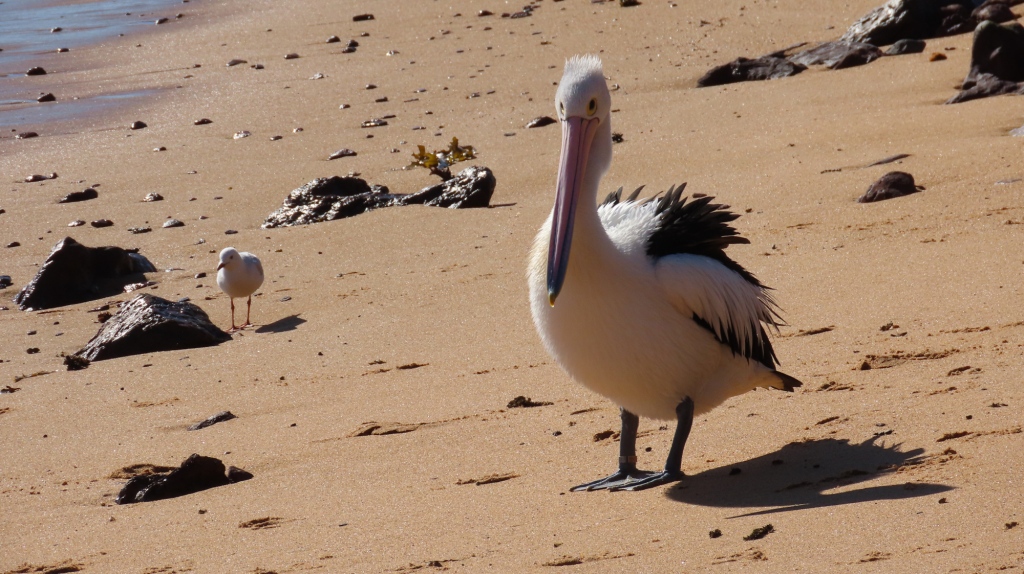
With a Silver Gull, giving some idea of scale:
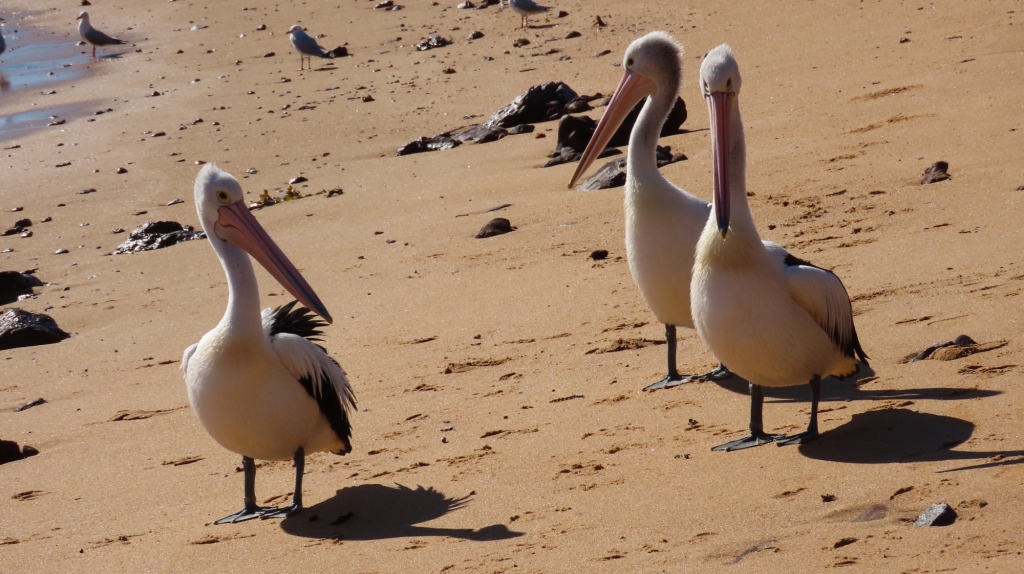
Three pelicans, three poses:
Surf as a backdrop:
A moody shot of fisherman and bird:
Common name: Australian Pelican
Scientific name: Pelecanus conspicillatus
Approximate length: 170 cm
Approximate wingspan: 2.5m
Date spotted: 19 June 2024 (winter)
Location: Long Reef Aquatic Reserve, Collaroy, New South Wales, Australia: 33°44’19.7″S 151°18’42.0″E


 Sydney Birder