Blog Archives

Brush-turkeys mating on a mound built by the male
A male Australian Brush-turkey has spent months building a wide, high mound of leaves and twigs. Now at last it’s ready, and a female comes to visit. She inspects the mound, while he ducks his head and pays court to her. She tidies things up a bit, moving the leaves around, then goes into the deep hollow he’s made in the centre of the mound. He follows her in, and the mating is done.
It takes just a few seconds. He hops on top of her, grabs the skin on her head with his beak, and covers her. Then he hops off, and she continues scratching the leaves and twigs. After a few moments, he decides to try his luck again, but she rejects him this time.
Here’s the male Brush-turkey, showing off his yellow collar, red head, and fierce eye:

When a male is wooing a female, he often makes a deep, booming call. It sounds a bit like an owl: oo-oo-oom. I managed to record one a while ago.
The female will lay her eggs, either in this male’s mound of leaves or in another one, and cover them with leaves. Then she’ll go on her way. The adults birds don’t look after the eggs. Instead, the eggs incubate in the warmth of the mound. When the chicks hatch, they have to fend for themselves. The parents don’t look after them. I sometimes see two or three chicks running around together, exploring their world. This picture of a Brush-turkey chick is from a while ago.
Common name: Australian Brush-turkey
Scientific name: Alectura lathami
Approximate length: 60-70 cm
Date spotted: 16 August 2024 (winter)
Location: Manly Dam Park, New South Wales, Australia: 33°46’59.5″S 151°15’18.2″E

Lewin’s Honeyeater, dark green and yellow
I watched this little honeyeater for a while, but it was adept at keeping parts of itself hidden. Still, I got a shot of the bird drinking from some bell flowers:

The bird is overall quite dark in colour, with olive-green back and wings and a dark head. A light yellow streak runs alongside its beak — I think this is called the gape. Behind the eye is a yellow tuft covering the bird’s ear.
Here’s a photo from a slightly different angle:

This is only the second time I’ve spotted a Lewin’s Honeyeater. The other one was nearby, just over a year ago (June 2023).
Common name: Lewin’s Honeyeater
Scientific name: Meliphaga lewinii
Approximate length: 19-22 cm
Date spotted: 15 August 2024 (winter)
Location: Just outside Manly Dam Reserve, New South Wales, Australia: 33°46’55.6″S 151°15’26.9″E

Brown Quails in Manly
A pair of plump Brown Quails sat picking at the grass, between the pellets of rabbit poo. I was out for a walk on North Head in Manly, and stopped amazed at the number of rabbits on a grassy patch. And lo, just a couple of metres away were the Brown Quails.
This is only the second time I’ve seen a Brown Quail. My first sighting was a few weeks ago, up near Grafton which is further north west of here.
At first I thought the birds were picking at the rabbit poo, but a closer look at the video shows that they were actually knocking the poo out of the way. Brown Quails eat plant shoots and insects. The birds live on the ground, but will fly to escape danger. This pair were nearby a handy bed of plants and grasses, which would provide shelter when needed.
This is one of the birds, sitting comfortably in between bouts of foraging:

This is the other bird, pecking at the grass:

Common name: Brown Quail
Scientific name: Coturnix ypsilophora
Approximate length: 17-20 cm
Date spotted: 9 August 2024 (late winter)
Location: Manly North Head, New South Wales, Australia: 33°48’38.0″S 151°17’59.3″E

Bar-shouldered Dove in Manly
A pair of Bar-shouldered Doves cooed to each other as I walked down a path on Manly North Head. It was a beautiful nearly-spring day. North Head is a headland that forms the northern natural gate to Sydney Harbour.
Only one of the doves was visible, but I could hear the other one replying from a distance.

These are large doves, and quite pretty with their soft cinnamons and grey colouring. This is only the second time that I’ve seen one. The other sighting was way back in 2018. My bird book says that they’re common in the north of Australia, but sedentary, uncommon, or vagrant in the south.
Common name: Bar-shouldered Dove
Scientific name: Geopelia humeralis
Approximate length: 30 cm
Date spotted: 9 August 2024 (late winter)
Location: Manly North Head, New South Wales, Australia: 33°48’38.9″S 151°18’03.1″E

Corellas chewing yacht ropes
A group of Little Corellas has lately taken a shine to the Forty Baskets Beach area in Balgowlah, NSW. They spend their time in the nearby trees and on the rocks.

The corellas seem to enjoy the sea water trapped in crevices on the rocks. Or perhaps it’s rain water.
The corellas are beautiful, and fun to watch, but I’m rather glad that I don’t have a yacht moored there.

The birds really get into the ropes, watched by their friends:
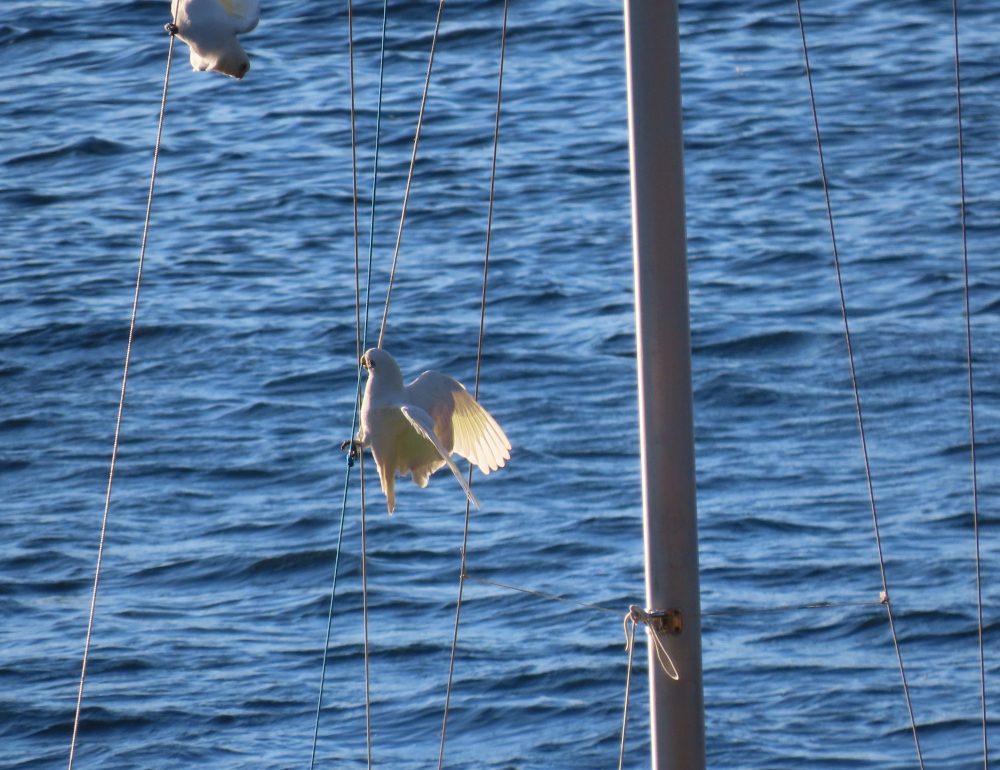

It’s a good time for all.

When fun at the beach palls, it’s time to find a nook for a bit of canoodling:

This grooming session ended in a squabble:
Common name: Little Corella
Scientific name: Cacatua sanguinea
Approximate length: 36-39 cm
Date spotted: 28 July 2024 (winter)
Location: Forty Baskets Beach, Sydney Harbour, New South Wales, Australia: 33°48’15.8″S 151°16’13.9″E

Great Egret at Manly Dam
This is the first time I’ve seen a Great Egret in this part of the world. My only other sightings were on a trip to Queensland a while ago.

They’re quiet and imposing birds. This one had a fluffy beak. I guess it had been doing some preening before I came along.

Common name: Great Egret
Scientific names: Ardea alba
Approximate length: 85 cm to 1.05 m
Date spotted: 26 July 2024 (winter)
Location: Manly Dam Park, near Sydney, Australia: 33°46’34.8″S 151°14’49.6″E

Red-browed Finch
I love these birds. They’re the only native finch that I see commonly around Sydney.
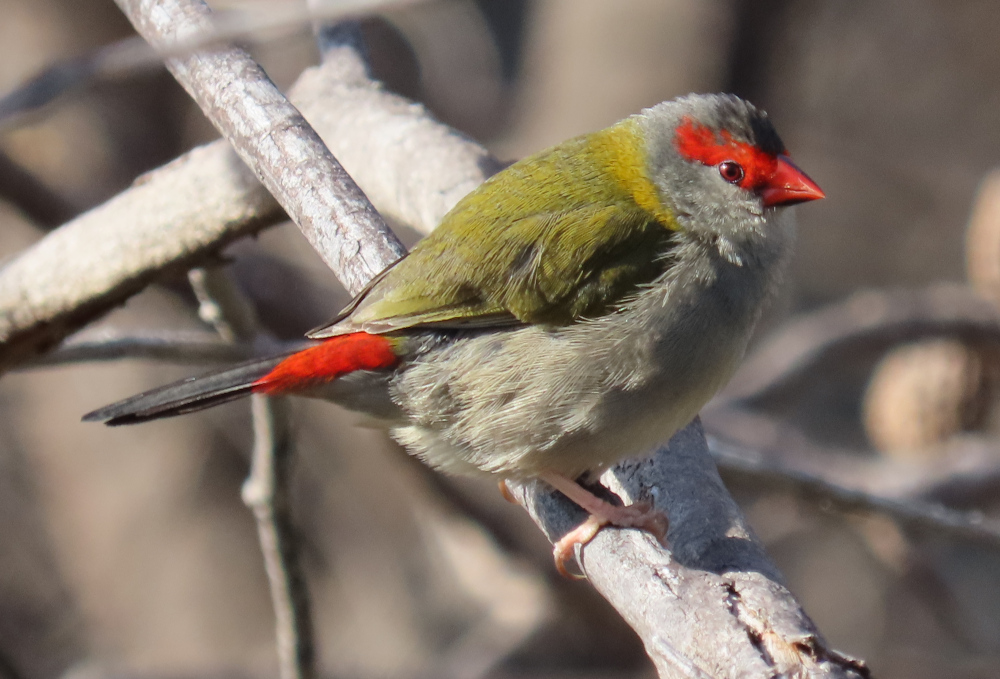
They usually look spiffing, all buffed and polished. This one looks a little less well turned out. Perhaps it’s a youngster. Standing straight and tall (well, tall for a finch anyway):

Common name: Red-browed Finch
Scientific name: Neochmia temporalis
Approximate length: 12 cm
Date spotted: 24 July 2024 (winter)
Location: Allambie Heights, NSW, Australia: 33°46’18.7″S 151°14’56.1″E

Lyrebird imitating a shooting game and several birds
It was a rare treat to find this Lyrebird in Sydney’s Northern Beaches. The bird was dancing, displaying his tail, and calling. He had an impressive repertoire, including the pieuw-pieuw sounds of an electronic shooting game and the calls of various birds.
Hint: For the best experience, increase the default quality of the video. (Use YouTube’s cog icon to update the settings.)
At the start of the video, the Lyrebird is searching through the leaves and twigs on the ground. The rushing noise in the background is a small waterfall nearby. The bird starts gently crooning and chirping to himself. (Turn up the volume to hear the mutterings.) Then the urge to sing overcomes him, and he starts his performance. The full display starts at about 50 seconds into the video, with the rattling and pieuw-pieuwing of an electronic shooting game accompanied by side-to-side and frontwards steps. He mingles some bird chirps into the shooting sounds for dramatic effect. Next come the bird sounds. I heard the start of a kookaburra call, though he didn’t get fully into it. (He did the full call in another performance, which I haven’t posted here.) He adds the calls of magpies, wattlebirds, lorikeets, and whipbirds. I think I hear a Yellow-tailed Black-cockatoo and a magpie in there too, and other birds that I haven’t identified.
Between performances, the little fellow spent some time resting and picking through the leaves before starting up again.
The bird kept to the shadiest spots, making it hard to get a good photo. This is the best that I managed:

Common name: Superb Lyrebird
Scientific name: Menura Novaehollandiae
Length: 80-95 cm
Date spotted: 18 July 2024 (winter)
Location: Sydney’s Northern Beaches, New South Wales, Australia
Two pretty little Silvereyes
Two Silvereyes perched on a twig, lending a touch of colour to the winter chill. Here’s one of them, showing the buff colouring on its front, under the wings. And, of course, that characteristic white-ringed eye:
Another view shows the olive green on the birds’ backs and wings:

Common name: Silvereye
Scientific name: Zosterops cornwalli
Length: 11-13 cm
Date spotted: 13 July 2024 (winter)
Location: Dobroyd Head, New South Wales, Australia: 33°48’36.1″S 151°16’24.1″E

Brown Honeyeater at Maleny
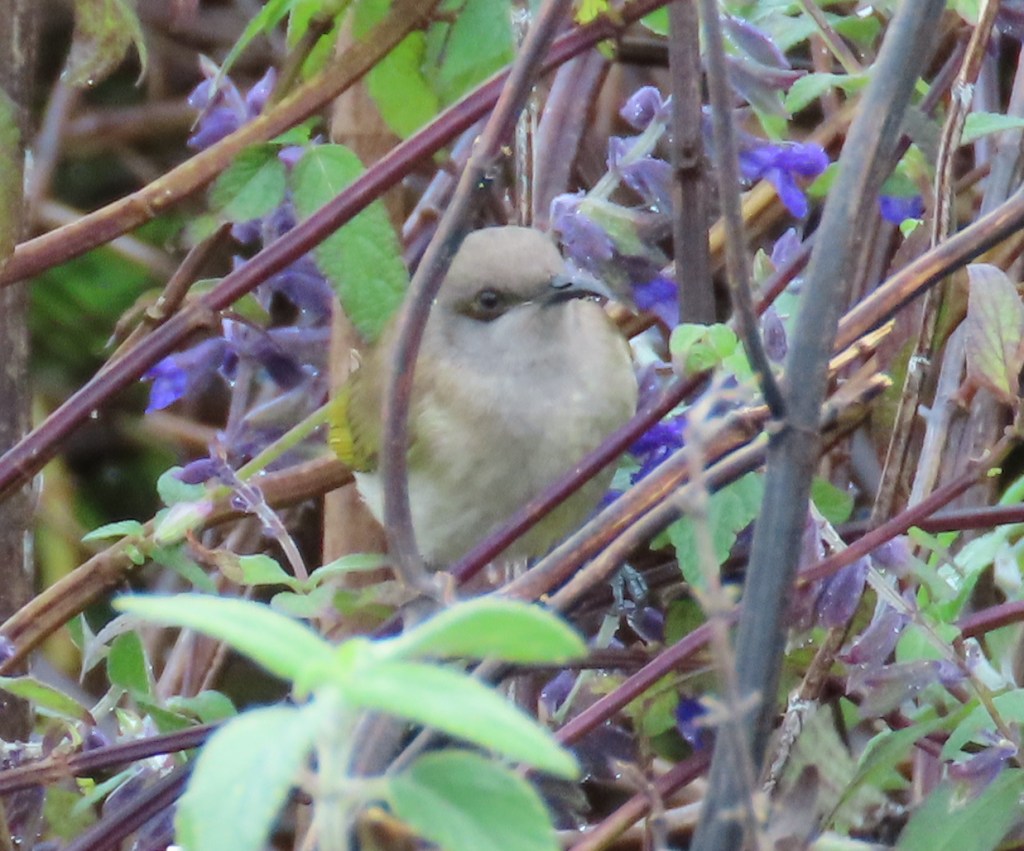
A little Brown Honeyeater was feeding on flowers at the botanical gardens in Maleny, Queensland. Brown Honeyeaters are rather drab little birds, and I didn’t get a good photo of this one. But it’s worth posting as a first sighting:

These little birds are very similar to Fuscous Honeyeaters. I identified this one with the help of the Australian Birds sub-Reddit. This bird doesn’t have the yellow patch on the neck that Fuscous Honeyeaters have. And this bird’s beak is more curved than the Fuscous beak. The next photo shows the curved beak, albeit on the other side of a twig!
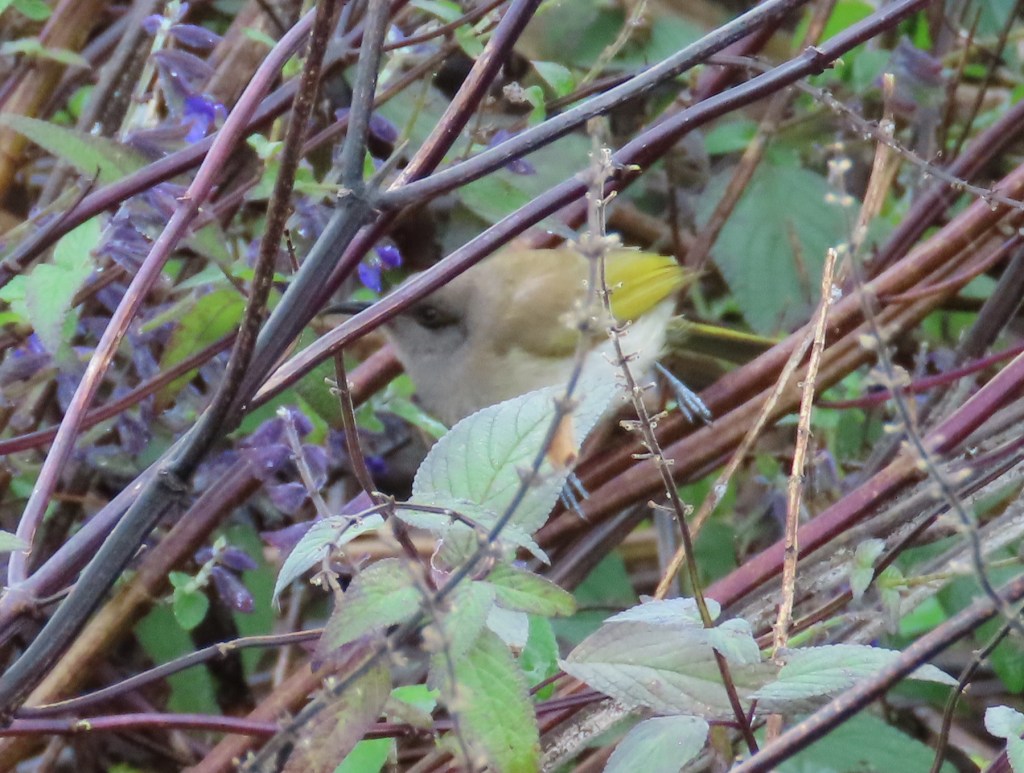
There’s also a hint of yellow at the edge of the eye, as well as that lovely dark eye mask:
Common name: Brown Honeyeater
Scientific name: Lichmera indistincta
Length: 12-16 cm
Date spotted: 6 July 2024 (winter)
Location: Maleny Botanic Gardens, Queensland: 26°46’54.7″S 152°50’04.0″E


 Sydney Birder