Blog Archives

Whistling Kite on the Bogan River
Early one morning, on the banks of the Bogan River at Nyngan, I watched this raptor calling and flying. I was in the area, at the start of a trip heading west from Sydney into the Australian Outback.
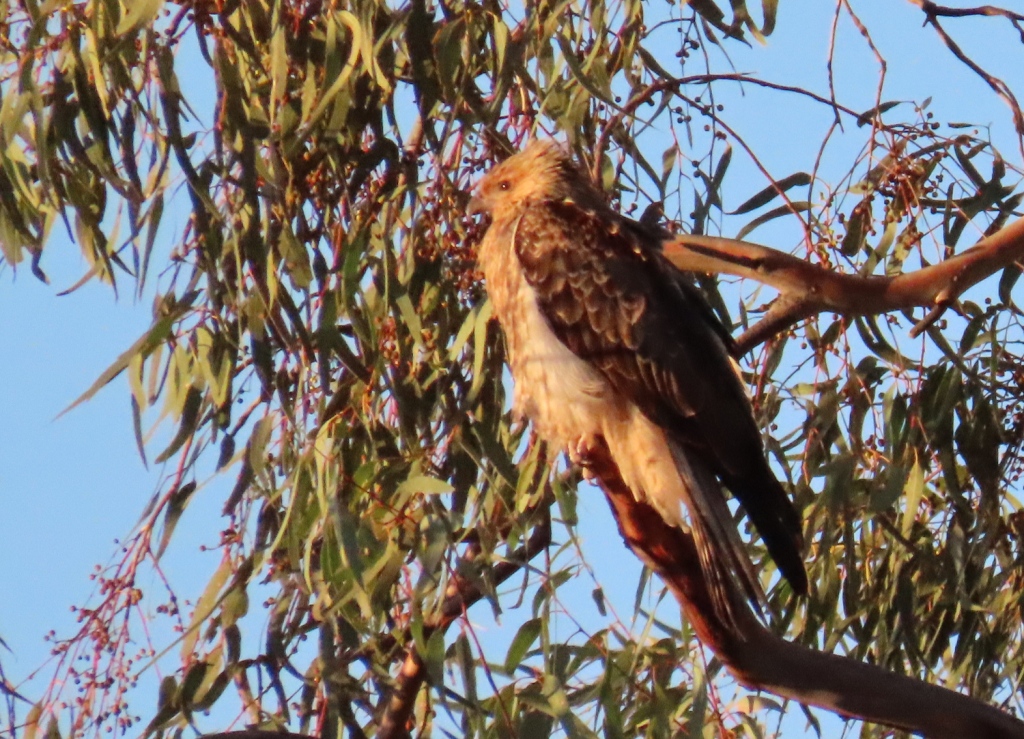
In this video, the piercing call of the bird echoes across the river. The background noise in the video is mostly from the wind. It was a cold and blustery morning:
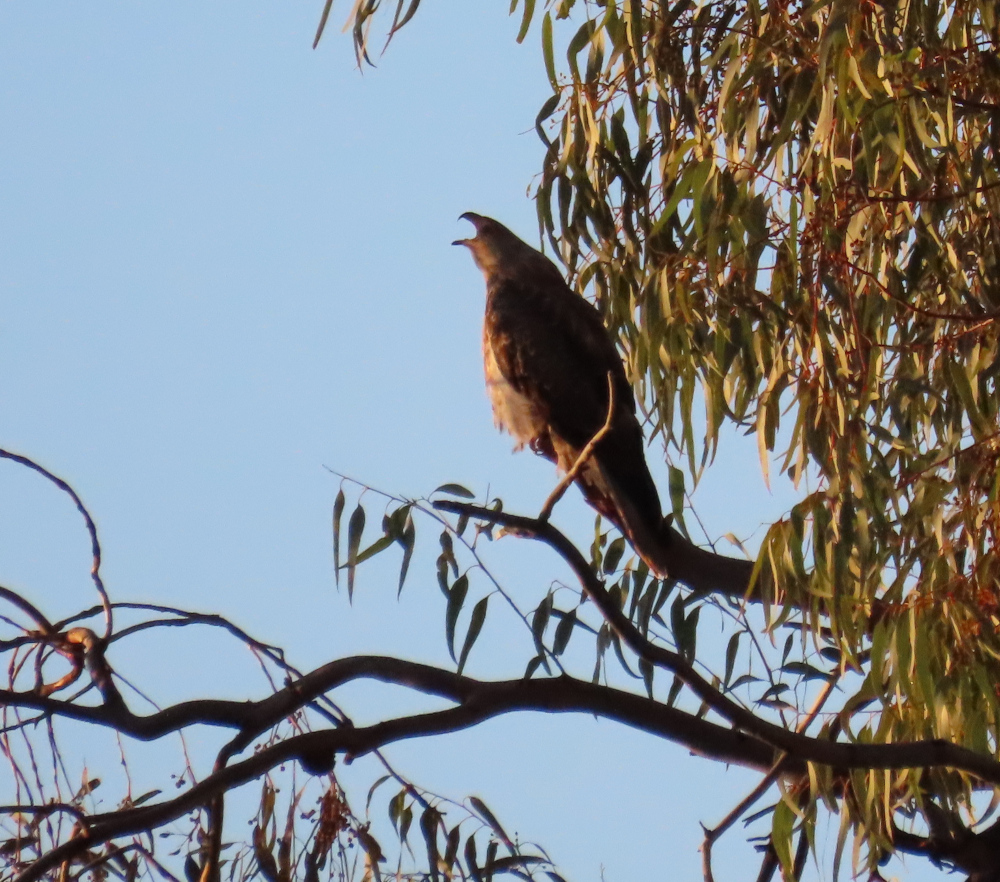
In the next shot, the bird’s head is up and its beak is opened wide, in the midst of making its call:
Nearby was the bird’s nest, a platform of loosely woven sticks:
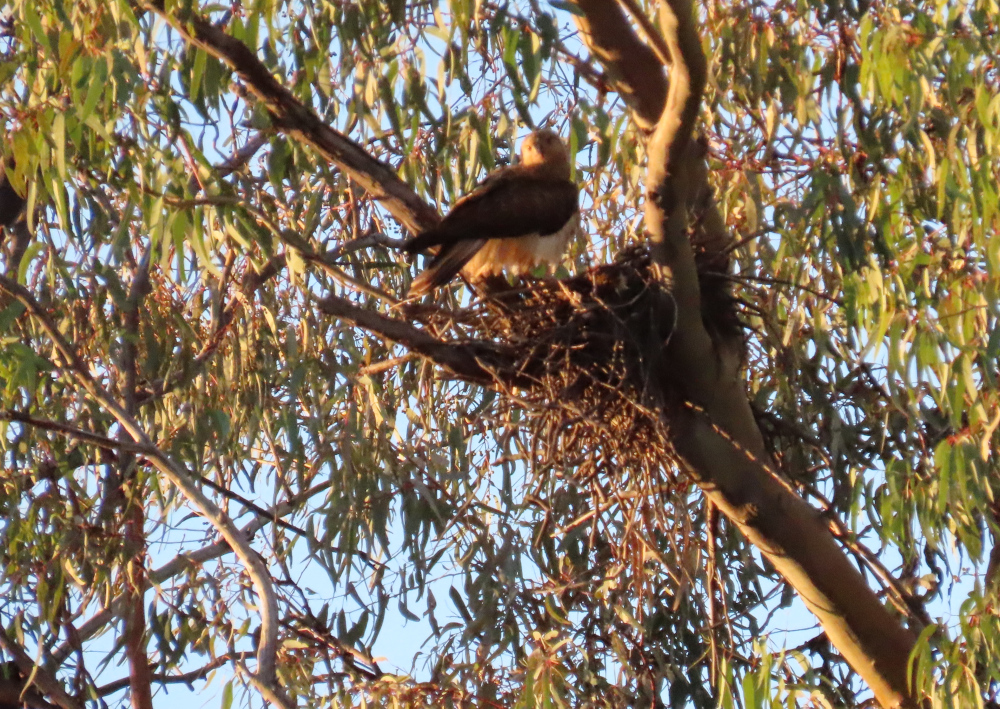
The bird departed from and returned to its nest a couple of times while I watched:
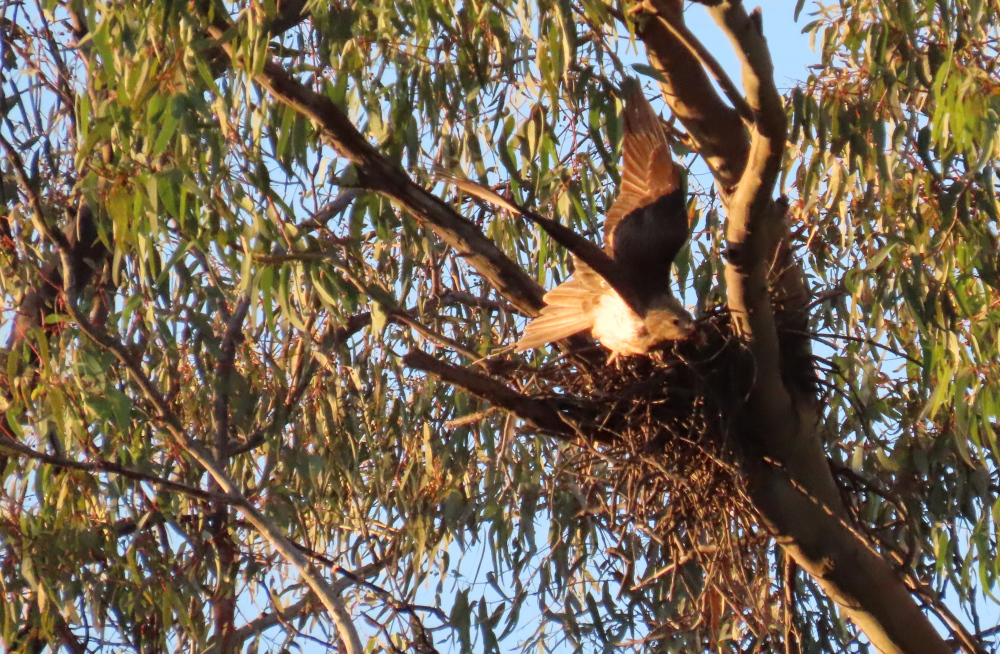
Each time it left the nest, the bird would circle high in the sky, or swoop down over the river. There were a few other birds circling too, so I can’t be sure that this is the same bird:
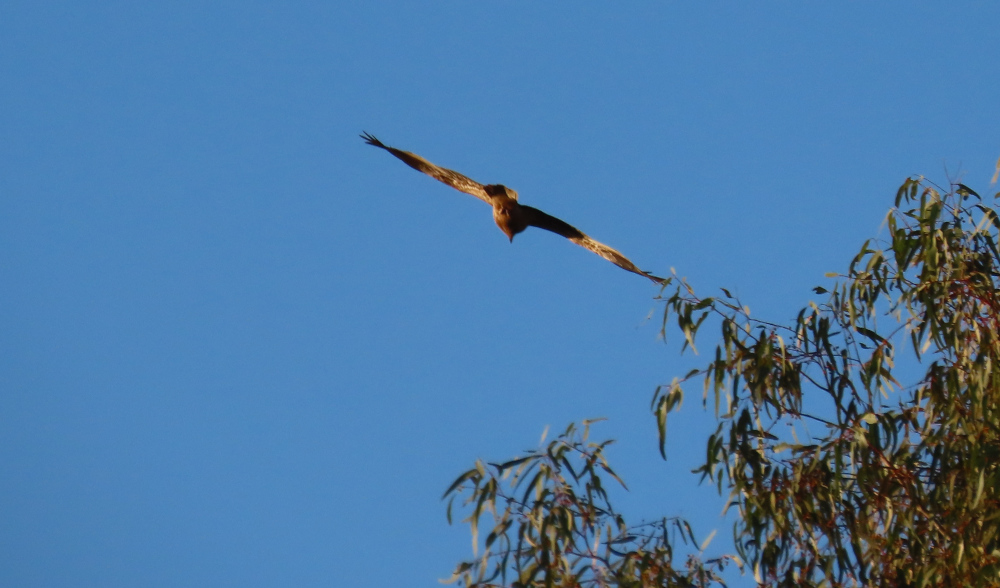
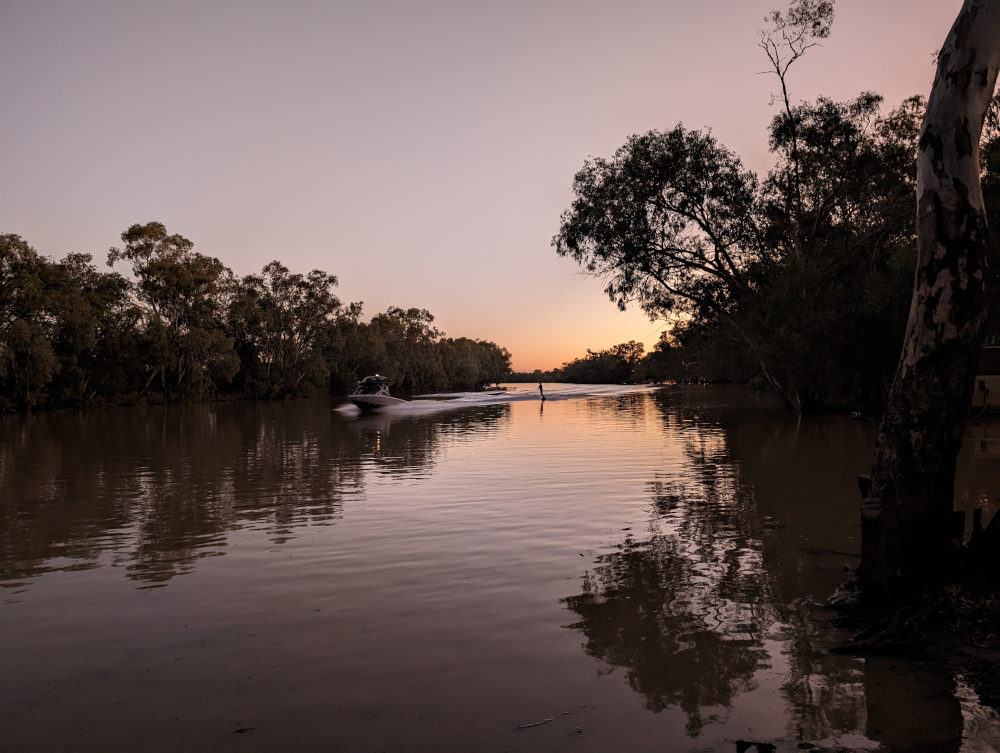
I saw the bird in the evening of 17 May, and then again the next morning. All my bird photos are morning shots. The next shot shows an evening shot of the Bogan River, near where the bird had built its nest. When taking all the photographs, I was on the opposite bank of the river from the bird and its nest:
Here’s another shot of the same bird (again, a morning shot):
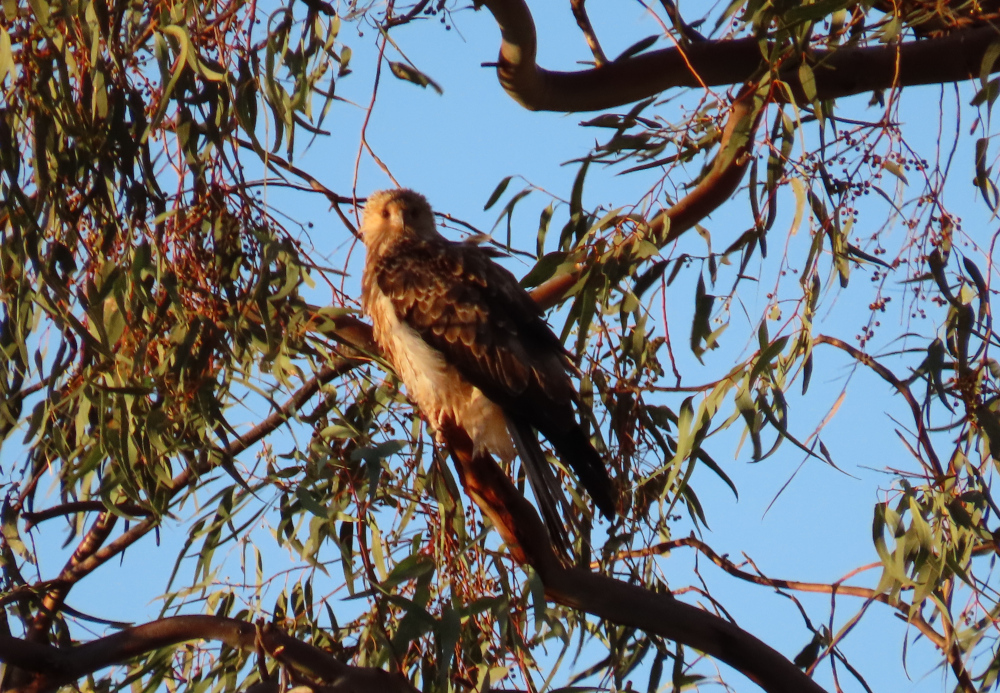
Common name: Whistling Kite
Scientific name: Haliastur sphenurus
Approximate length: 50-60 cm; wing span 1.2-1.5 m
Date spotted: 18 May 2024 (autumn)
Location: Nyngan Riverside Tourist Park, New South Wales, Australia: 31°33’39.1″S 147°10’45.2″E

Peregrine Falcon drops in to chat
This was such a wonderful experience! It was early one morning. I was strolling along the top of a cliff on North Head in Manly, and stopped to film some birds swooping around the cliff and the sea far below. To my surprise and delight, a Peregrine Falcon landed a few metres away and started calling.
You can see and hear the moment, at about 45 seconds into this video, when the falcon starts calling and the camera swings round to find it:
I don’t know if the birds swooping around the cliffs were Peregrine Falcons too. I suspect they were, as I heard their call, which came from a section of the cliff face that’s out of sight behind an outcrop. I’d been watching the birds for a while when one dropped in so suddenly.
The falcon stayed where it was, perched on a branch at the edge of the cliff, for a long time — at least 15 minutes. It was I who left in the end, not the bird.
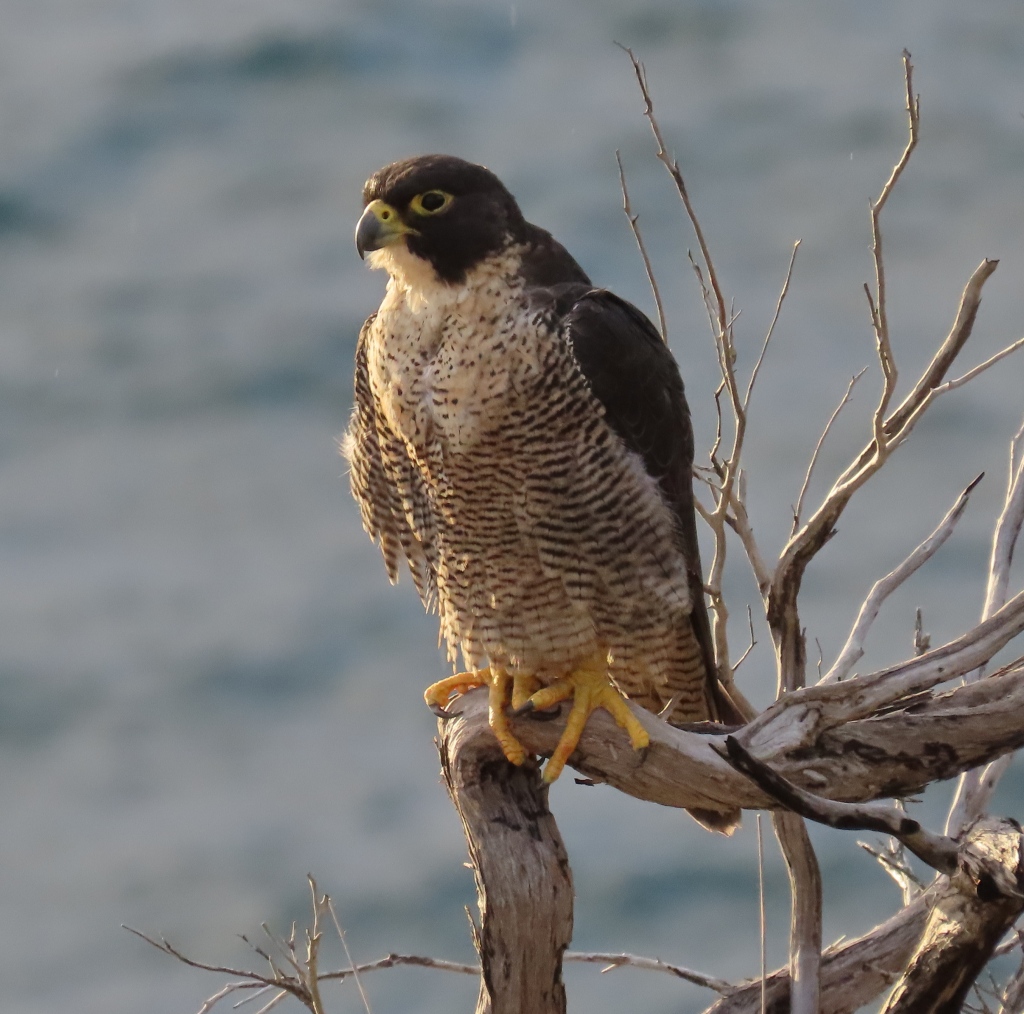
In the middle of a feather shuffle:
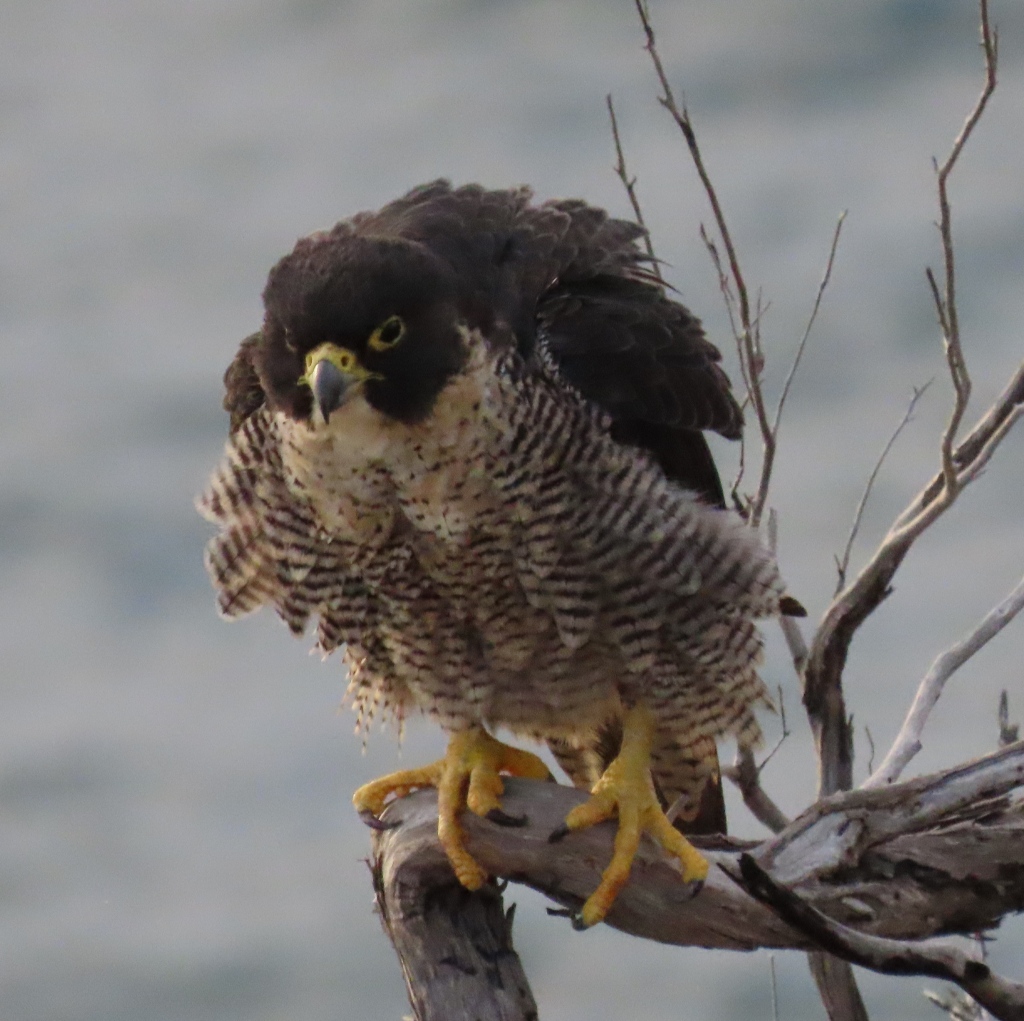
In the next video, the bird calls a few times (little chirps at the beginning; longer squeals at time stamp 1:02; squeals, hiccoughs, and chirps at 2:03; more at 2:35). It spends most of its time preening its feathers, which do seem to be in a bit of a state. Perhaps it’s a juvenile.
At about 50 seconds into the video, the view moves off the falcon to take in the ocean and the cliffs, but the bird calls attention back to itself quite soon.
At time stamp 2:16, both the falcon and I hear another bird calling overhead. The view wanders up into the sky to spot the other bird. Towards the end of the video, at 2:55, an aeroplane passes overhead and the bird quints up at it.
Although the falcon checked me out several times, it wasn’t in the least bit worried about me:

Common name: Peregrine Falcon
Scientific name: Falco peregrinus
Approximate length: 35-50 cm; wing span 85-100 cm
Date spotted: 7 May 2024 (autumn)
Location: Fairfax Track, North Head, Manly, New South Wales, Australia: 33°49’16.9″S 151°18’01.7″E

Colourful Oriole singing
The colours on this Olive-backed Oriole are gorgeous: bright red eyes, olive green neck and shoulders, white underbelly with black stripes. The bird was uttering its typical ringing call, interspersed with the sounds of other birds that it was mimicking. The music in the background is from some nearby picnickers.
The sound that first drew me to look for this bird was the call of a Black-faced Cuckoo-shrike. Instead, I found an Olive-backed Oriole mimicking the call! (I didn’t catch that particular sound in the video, alas.)
The bird was on a Casuarina tree, looking for insects among the seed pods. Here’s a still photo:
Common name: Olive-backed Oriole
Scientific name: Oriolus sagittatus
Approximate length: 25-28 cm
Date spotted: 25 March 2024 (summer)
Location: Manly Dam Park, New South Wales, Australia: 33°46’52.3″S 151°15’07.9″E

So lucky! King Parrots and Eastern Rosellas come to visit
Two days ago, a couple of Eastern Rosellas dropped by. The next day, I was getting ready to write this blog post when two King Parrots came visiting. We’re so lucky, to have such beautiful birds in the area.
Eastern Rosellas
It’s quite odd: we have visits from two of these little parrots at around this time every year. The pattern is always the same: I hear them twittering, and lean out of the window. A male perches on our telephone line, or on a branch near by, and gives a little show for his lady friend. The show consists of some twittering, and bit of feather fluffing and scratching, and some wing shuffling. Then, after a few minutes they fly away.
Eastern Rosellas are medium-sized parrots, measuring about 30cm from head to tail. This is the male:

Here he’s in the middle of a wing shuffle:

The female looks on:

Common name: Eastern Rosella
Scientific name: Platycercus eximius
Approximate length: 30 cm
Date spotted: 19 February 2024 (summer)
Location: Allambie Heights, NSW, Australia
King Parrots
Sitting in the lounge the next afternoon, I heard a soft thunk and then an inquisitive chirp from the veranda. A female King Parrot perched on the window sill, looking in to see what was happening:

The male sat on a branch close by, keeping watch:

At 44cm from head to tail, King Parrots are quite a bit larger than the Eastern Rosellas (30cm). The birds stayed for around 15 minutes. Of course, I talked to them, as you do. The female let me get within a couple of metres.
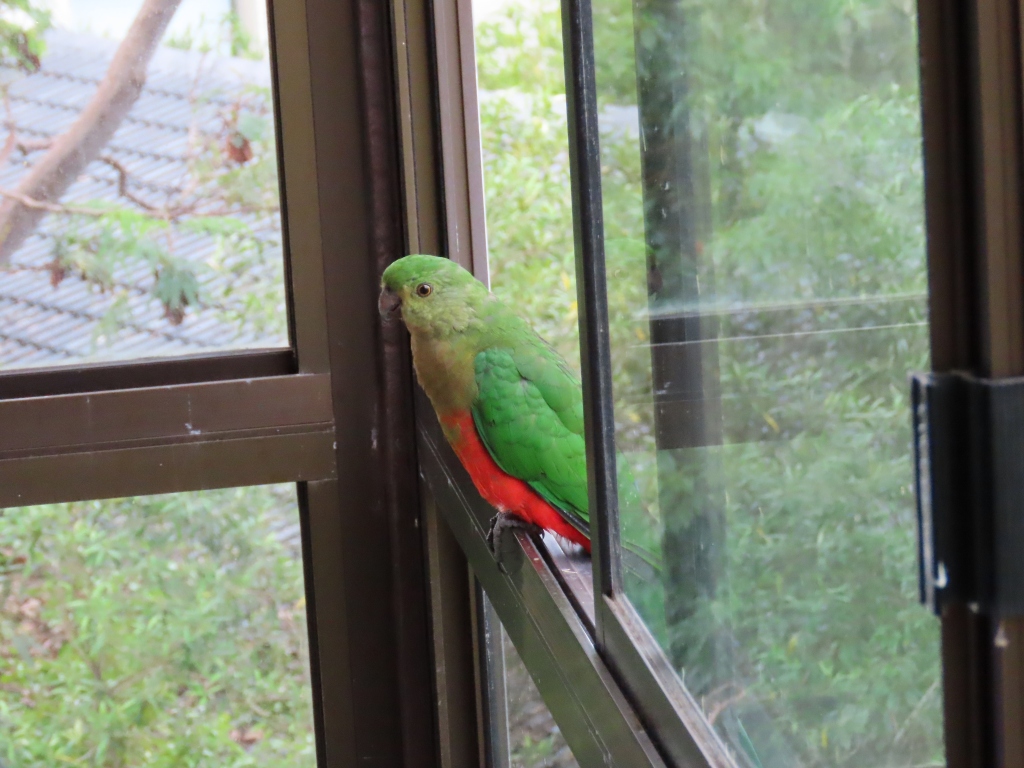
She was quite happy to turn her back on me and check out the goings on outside:

At the start of this video, the female perches on the window sill, peering in. I then find the male outside the window. The view judders a bit, as I need to kneel down to get the male in view. A cockatoo squawks as it flies past:
In the next video, the female is perched on the window sill looking outwards. If you turn up the volume, you’ll hear her soft chirps at around 6 to 12 seconds into the video. Then I manoeuvred carefully around some obstacles on the veranda, and moved the camera to outside the window. Now you can see the female’s head peering out at the bottom of the view, and the male perched on a branch higher up (and also reflected in the window pane). An Australian Raven wails. The camera pans out to show the view.
It felt like a huge privilege to be able to chat to these quiet, majestic birds.
Eventually, the female flew out onto a branch:
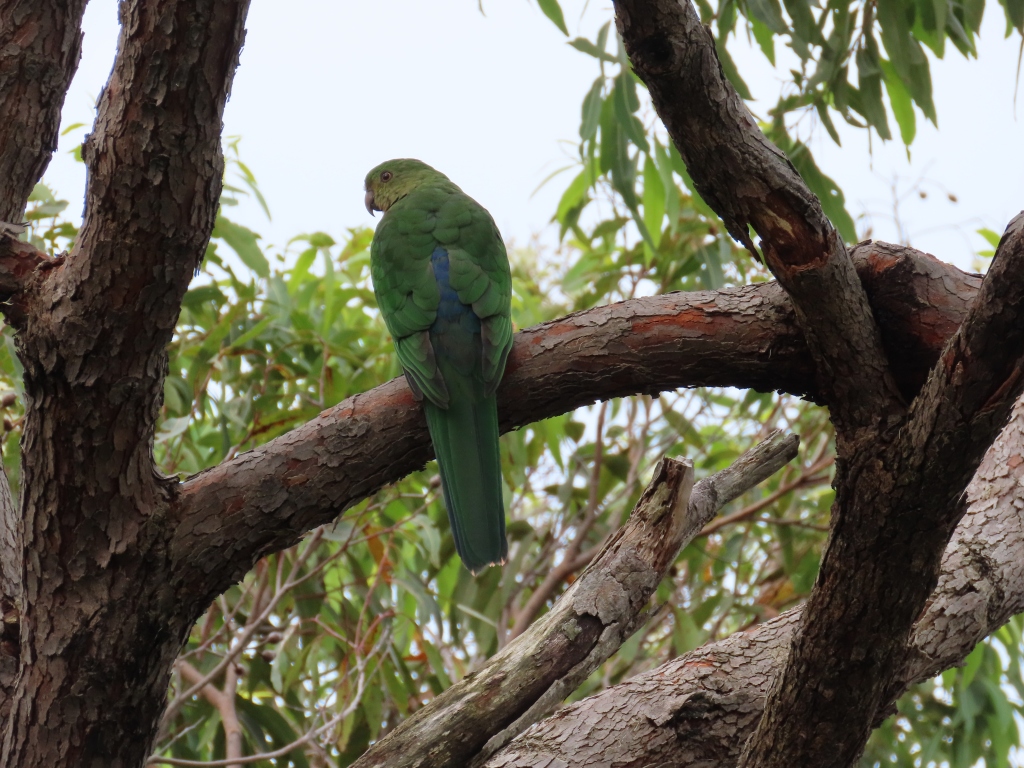
Both birds stuck around for a while. Maybe they were enjoying the view! Then they swooped away to grace another house or tree.
Common name: Australian King Parrot
Scientific name: Alisterus scapularis
Approximate length: 44 cm
Date spotted: 20 February 2024 (summer)
Location: Allambie Heights, New South Wales, Australia

Bird spotting with Aussie Bird Tours
Yesterday my family and I went on a bird-spotting trip with Aussie Bird Tours. Mike Barrow led us on a wonderful half-day tour around the Dee Why Lagoon, Warriewood Wetlands, and Irrawong Reserve. We spotted a large number of birds (40-50 types) and heard others too. Here are the ones that I managed to get a half-decent photo of.
Our tour started at Dee Why Lagoon, where we saw a number of water birds: a darter, cormorants, ducks, a black swan, coots, a Silver Gull, and more. Songbirds were there too. A Magpie-lark strutted over the mud. Welcome Swallows darted across the water. A Willie Wagtail chirped in the distance. An Eastern Whipbird spent many minutes exploring the dense reeds a couple of metres from our feet. We could hear its characteristic chattering, but only saw it when it made a break for the higher foliage.
This male Olive-backed Oriole (Oriolus sagittatus) posed for a profile shot against the blue sky:
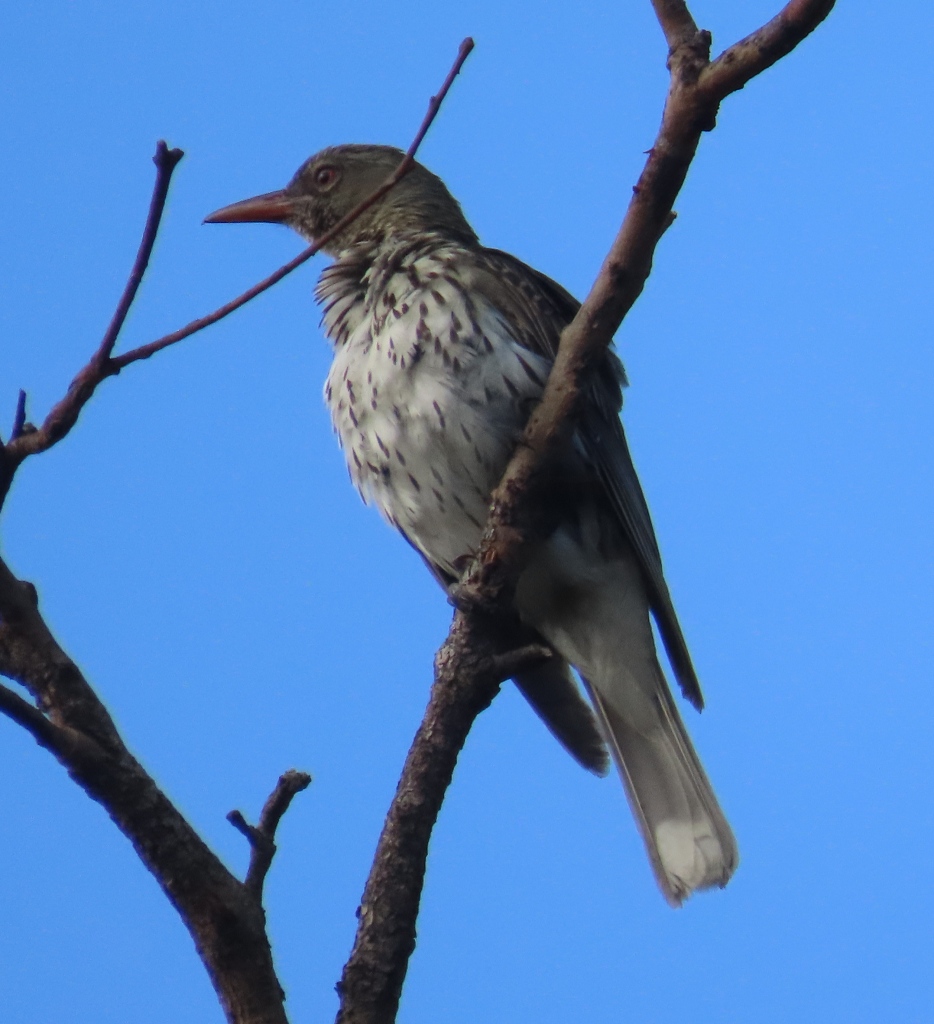
On this trip I learned what Olive-backed Orioles sound like (you can hear their call on eBird). I also learned the call of the Darter (hear it on xeno-canto). The latter sounds very like a Dollarbird, and I’ve probably mixed up those two calls in the past.
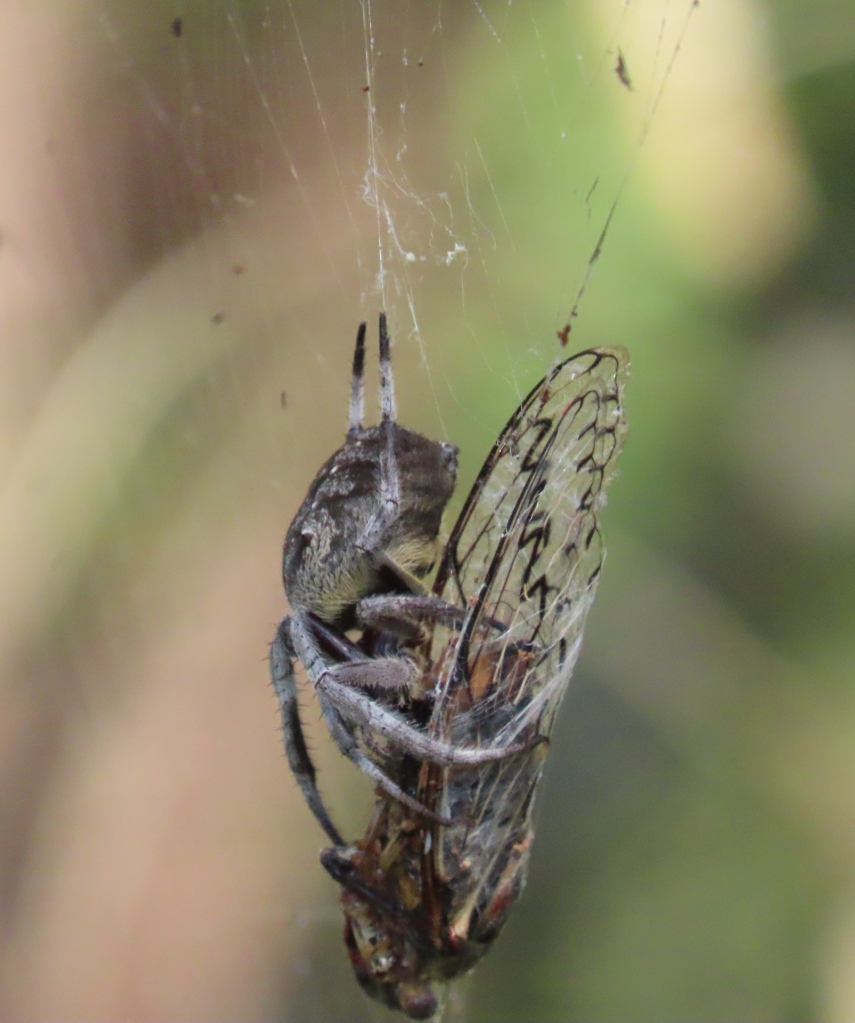
Our next stop was the Warriewood Wetlands, which is an interesting patch of swampy bushland. A raised path leads you across the reeds and water, with great views of wetlands all round you. The cicadas were out in full force, deafening us while providing food to other creatures. Here, a large spider has caught a cicada in its web and is having a feast:
Discarded cicada husks stuck to tree trunks, shed when the cicada larva emerges from the ground and morphs into the winged insect:

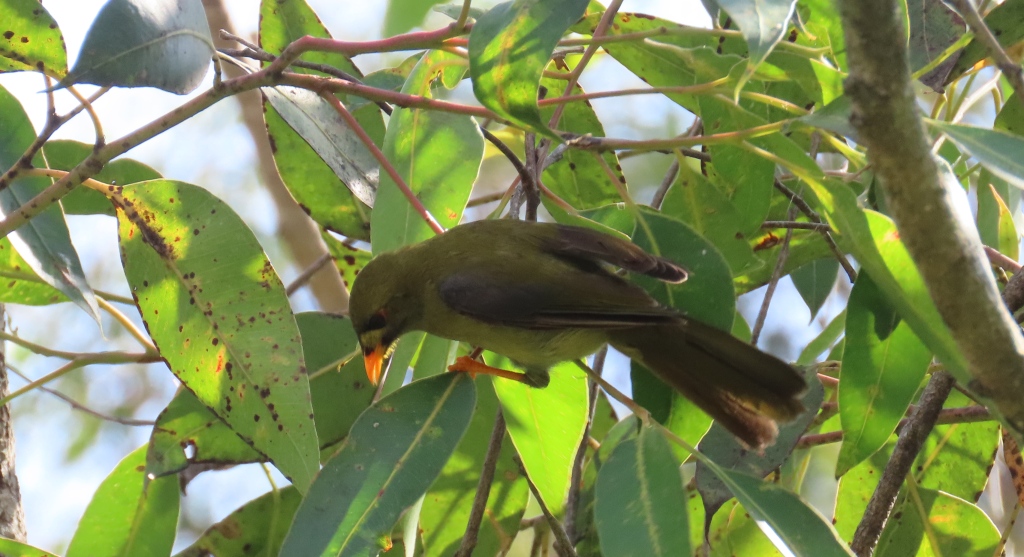
Bell Miners (Manorina melanophrys) have moved into the Warriewood Wetlands in large numbers. The call of these honeyeaters is a clear, single, oft-repeated clink, like the sound of a bell. They’re quite attractive birds, with olive wings and back, and a pale yellow chest:
What with the screeching of the cicadas and the pinging of the Bell Miners, this was a noisy patch of bush!
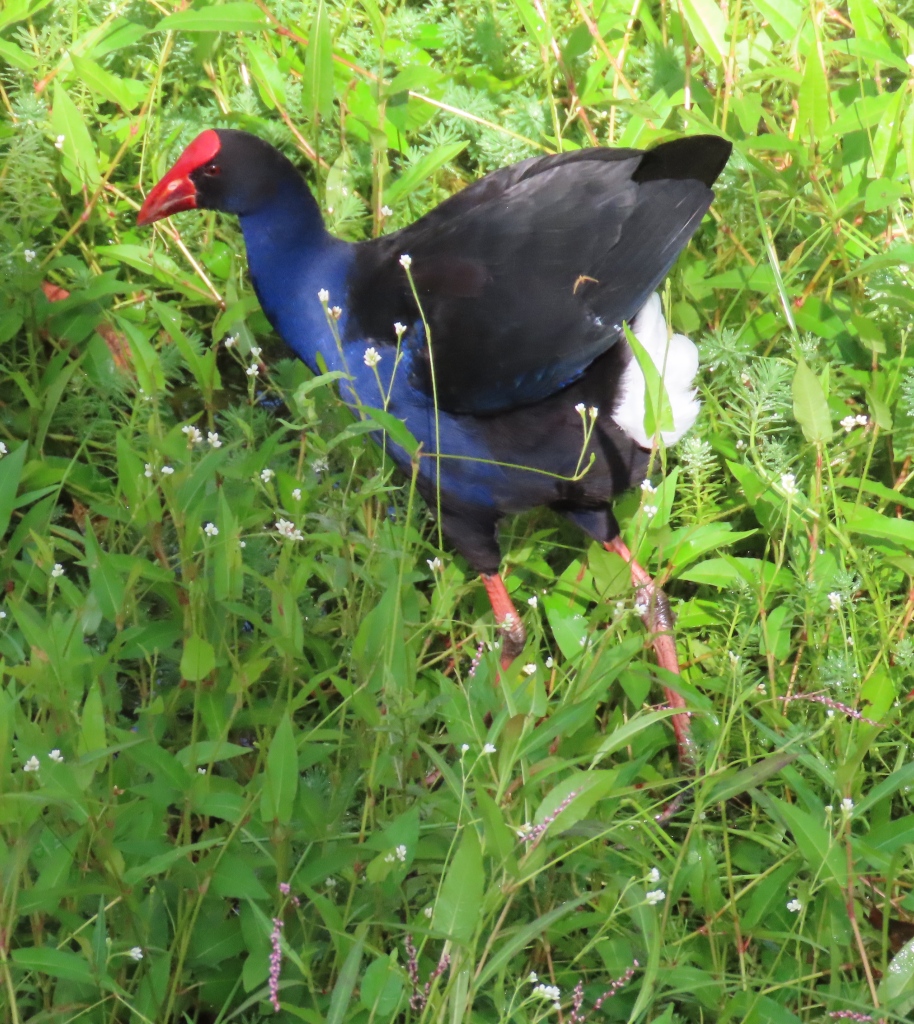
The noise didn’t seem to bother the Purple Swamphens (Porphyrio porphyrio), who carried out a lively courtship beneath the wooden walkway:
A small water dragon looked on:

A Dusky Moorhen (Gallinula tenebrosa) showed up in bold orange and yellow:

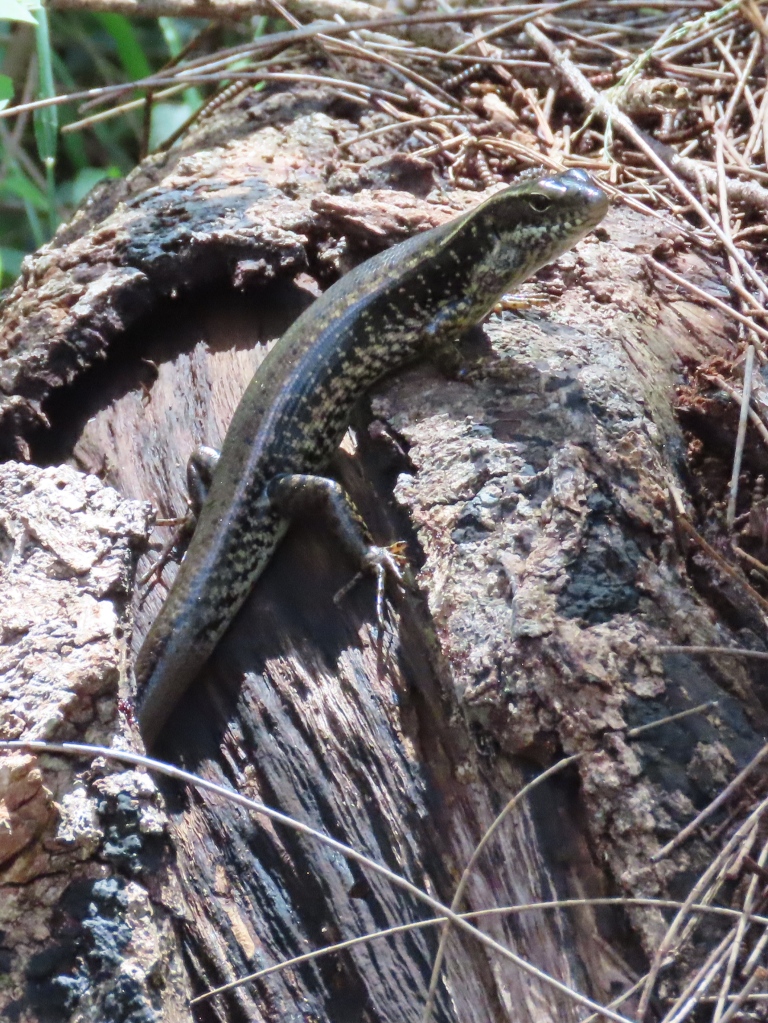
We didn’t see any snakes, though evidently they’re around. We did see a couple of largish skinks, like this one:
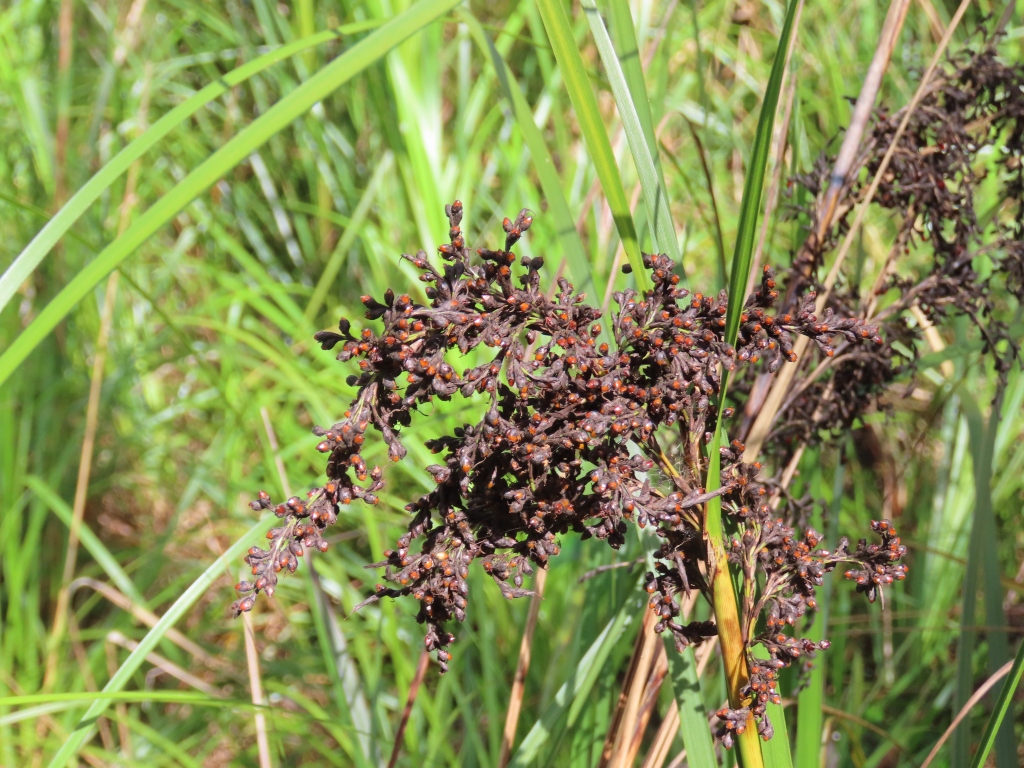
Striking dark grass flowers lined the way:
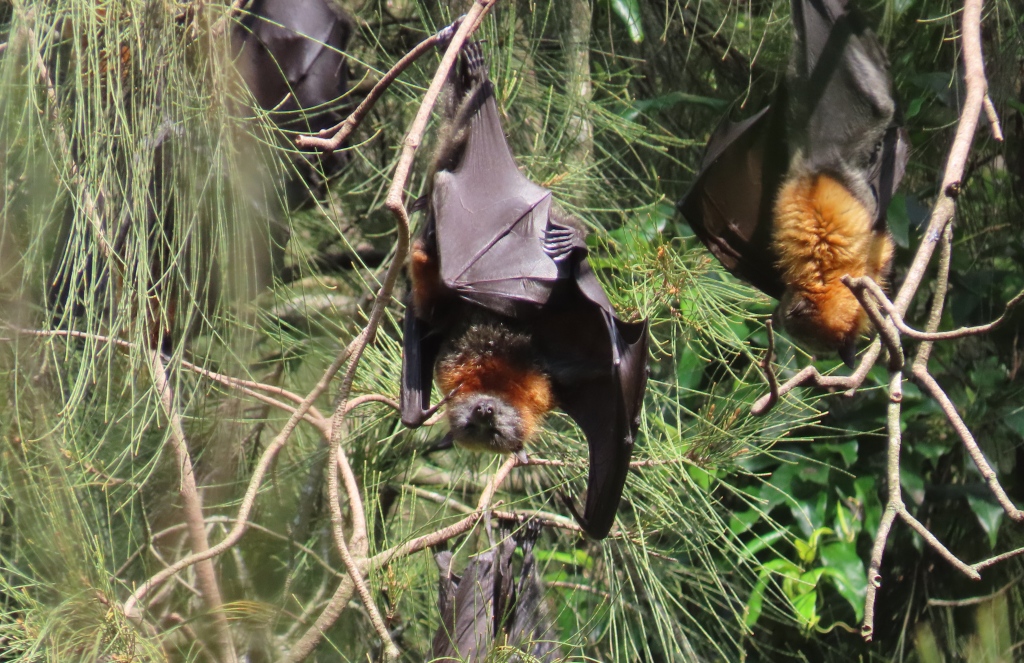
A colony of Flying Foxes (large fruit bats) occupies one corner of the wetlands:

Here’s a close-up of one of these attractive, intriguing mammals. They have a grey face, with a reddish fur collar and back. Their wings are black and leathery, strong enough to support these large bats in their long cross-country flights:
After the Warriewood Wetlands, we visited Irrawong Reserve. A Golden Whistler (Pachycephala pectoralis) carolled in the dense bush. This is the male bird:
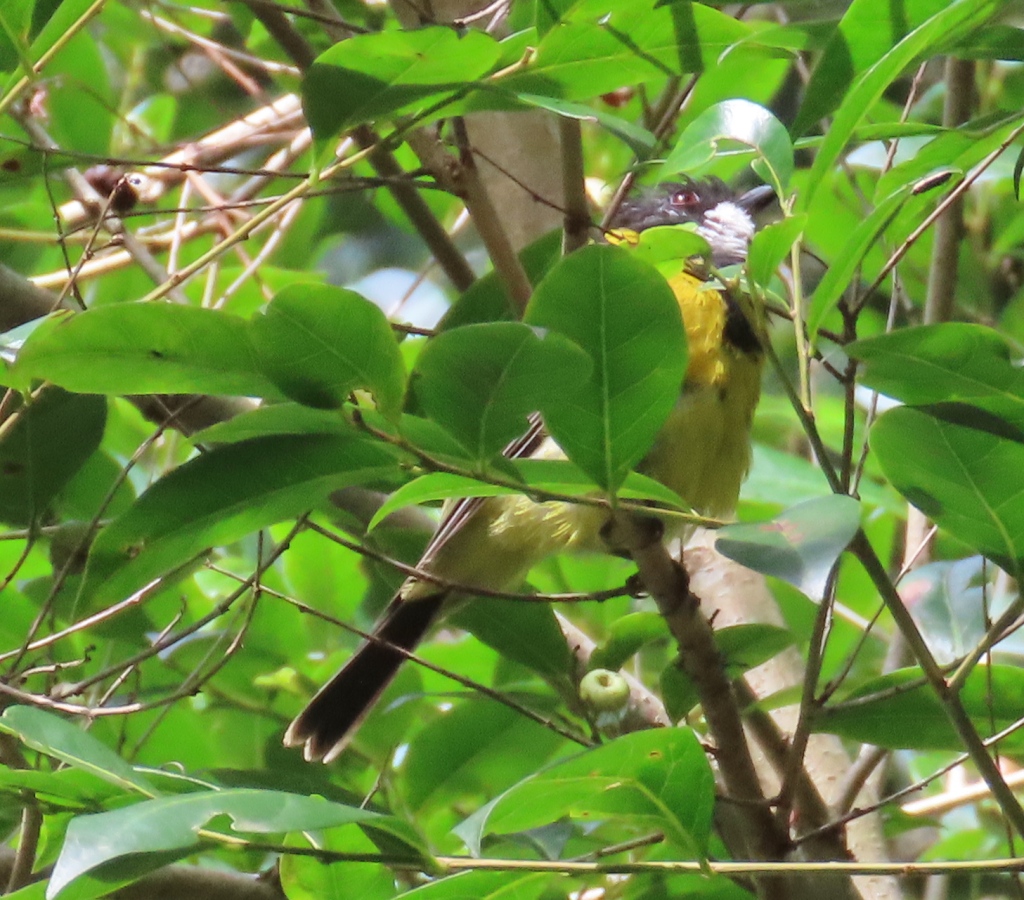
As you can see, it’s adept at hiding behind the foliage. Here’s another shot of the same bird, with its tail fanned:

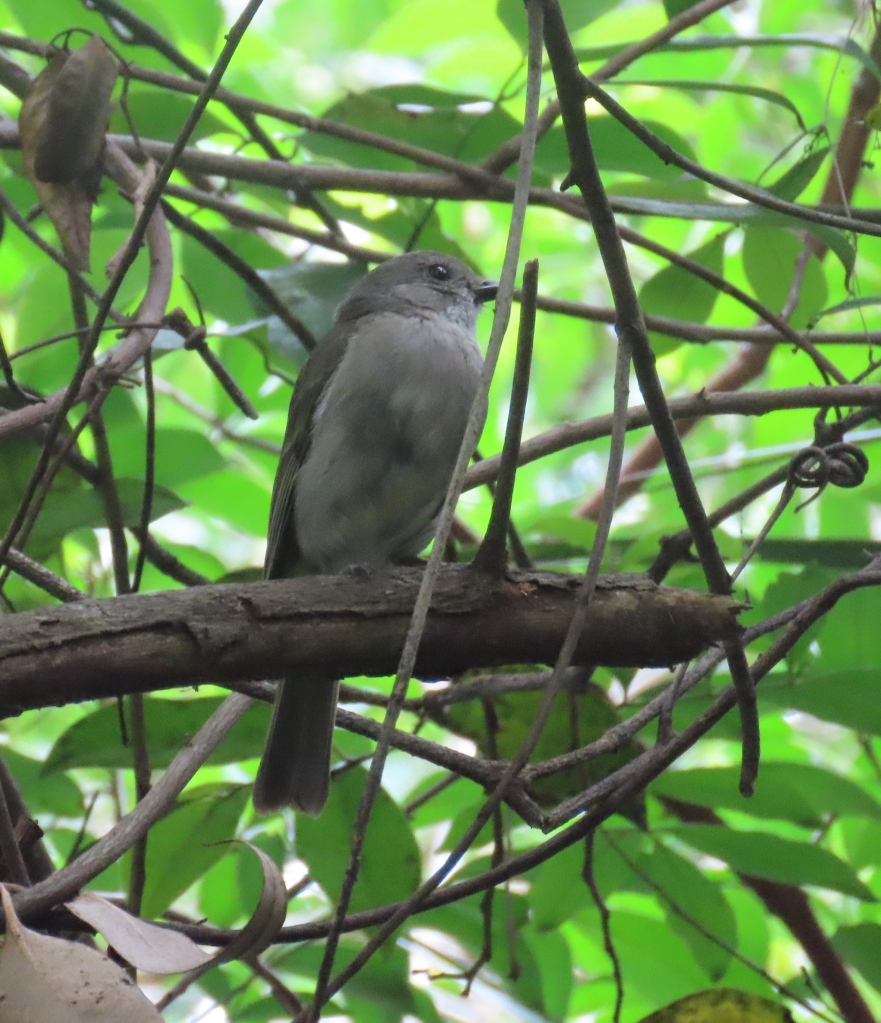
I think the next bird is a female Golden Whistler. They’re harder to identify because of their soft colouring:
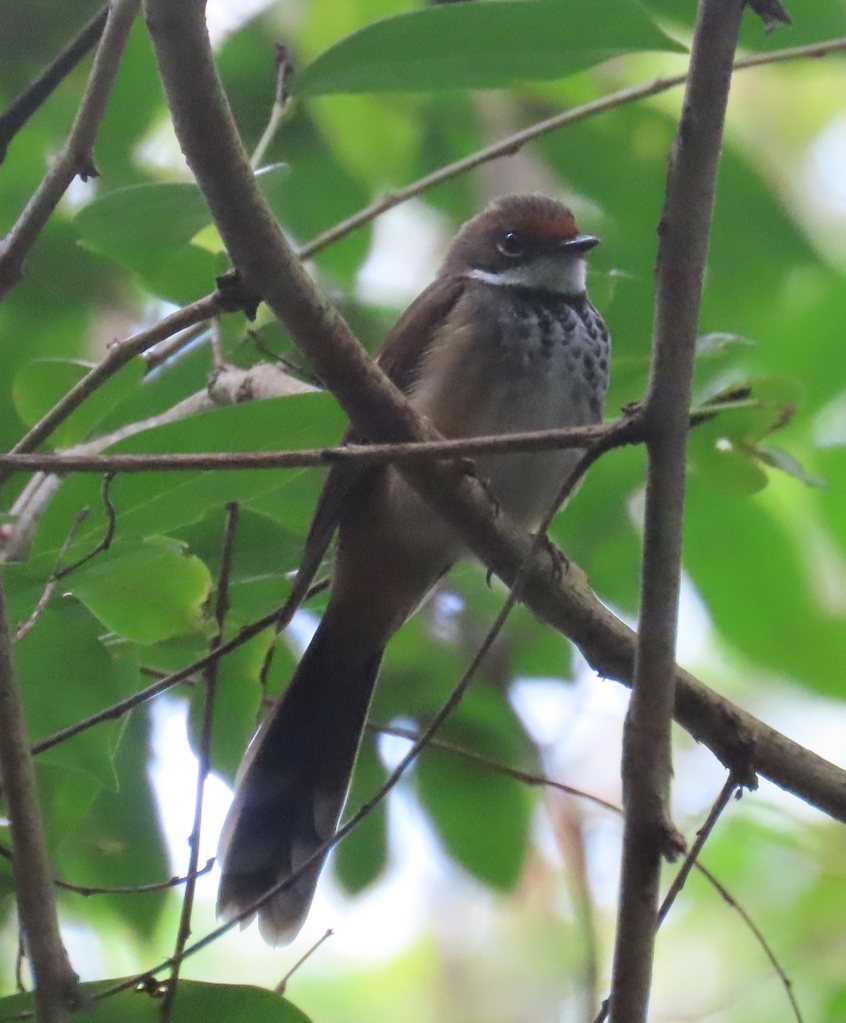
The next bird is a first sighting for me: a pretty Rufous Fantail (Rhipidura rufifrons):
This video is rather blurry, but it’s useful because you can hear the characteristic song of the fantail, similar to that of the Grey Fantail and Willie Wagtail:
My last bird of the day is a Brown Gerygone (Gerygone mouki), another first sighting for me:

The photograph of this bird is very similar to the earlier one of the female Golden Whistler. However, the Gerygone has grey markings running from beak to eye. The Gerygone (9-11 cm) is also smaller than the Golden Whistler (16-18 cm), though that’s hard to tell from the photos.

Spitfire grubs and Kookaburras
While wandering along a bush path, I came across a curious collection of grubs:
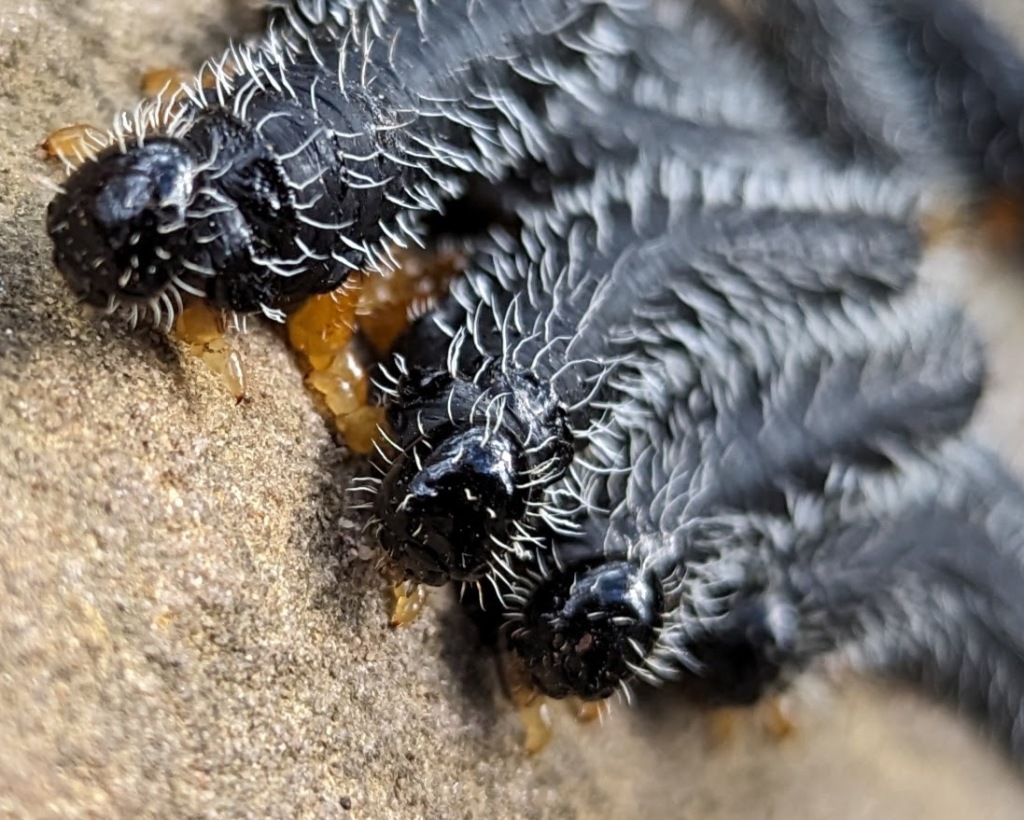
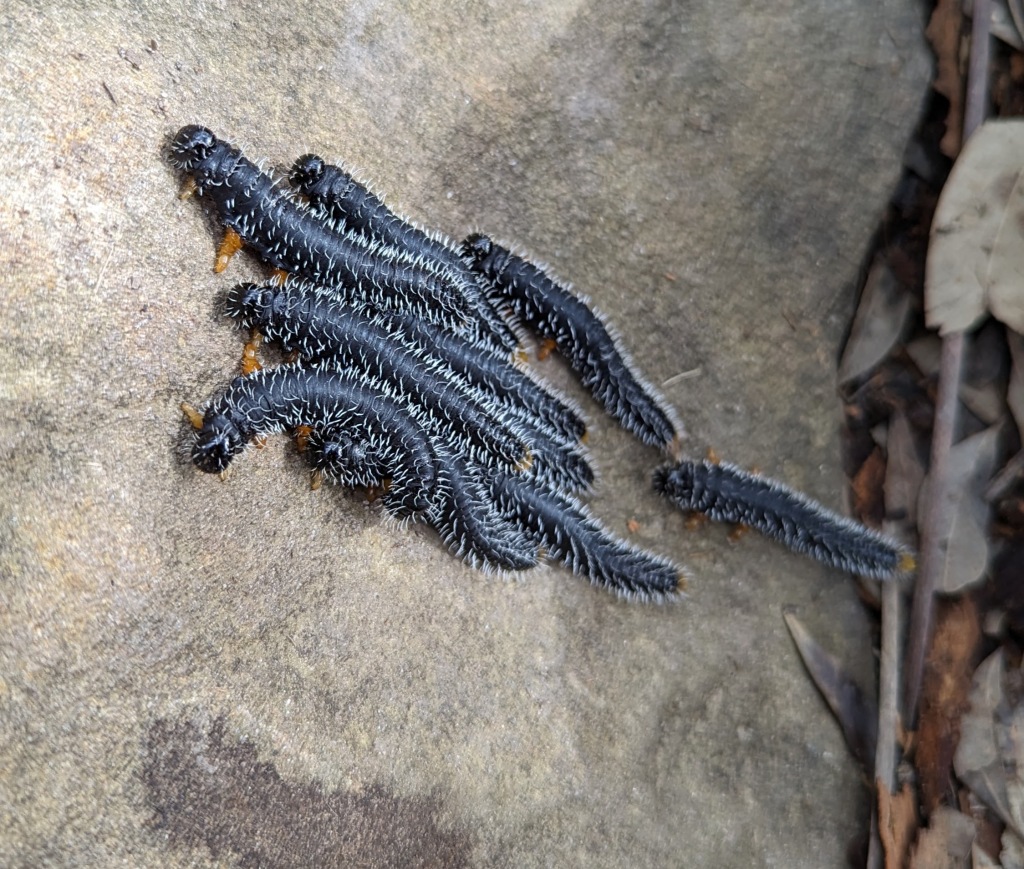
They’re spitfire grubs, which are the larvae of a type of wasp called a sawfly. The grubs look quite a lot like caterpillars with a don’t-mess-with-me attitude. They’re black and shiny, with white bristles, yellow feet, and a yellow tail. They’re quite long and fat: about the size of my little finger.
Despite the name “spitfire”, the grubs don’t actually spit anything, but if you touch them you can get a burning sting from the spikes. The grubs also spew out a thick yellow liquid from their mouths when threatened, but the liquid isn’t harmful to people. It’s made from eucalyptus oil, since the grubs feed on eucalyptus leaves.
In the video, you can see them tapping their tails on the rock. They do that to communicate their whereabouts with each other.
Here’s a close-up of some of their heads:
There were ten grubs in the clump:
Next on the scene was a riot of Kookaburras! The birds gathered above me while I was bent over the clutch of spitfire grubs. I was worried that the Kookaburras might swoop down and grab a grub as a snack!
The Kookaburras left the grubs alone. I guess they don’t taste great!
Common name: Laughing Kookaburra
Scientific name: Dacelo novaeguineae
Approximate length: 47 cm
Date spotted: 18 July 2023 (winter)
Location: Manly Dam park, New South Wales, Australia: 33°46’56.0″S 151°15’05.4″E
Territory! Ravens vs Lorikeets
The National Parks and Wildlife Service recently did a hazard reduction burn in the area where I often go for a walk. This morning, a group of Rainbow Lorikeets occupied some bare branches with a strategic view of the newly cleared area. Right next door, a collection of ravens had the same idea. They viewed each other for a while, then all hell broke loose.
Turn up the volume to get the full effect! Listen to the bawling ravens and the scolding parrots. When things really get hectic, hear the whop-whop-whop of wings swooping overhead.
Here’s a closeup of some of the ravens, in their best villain pose:
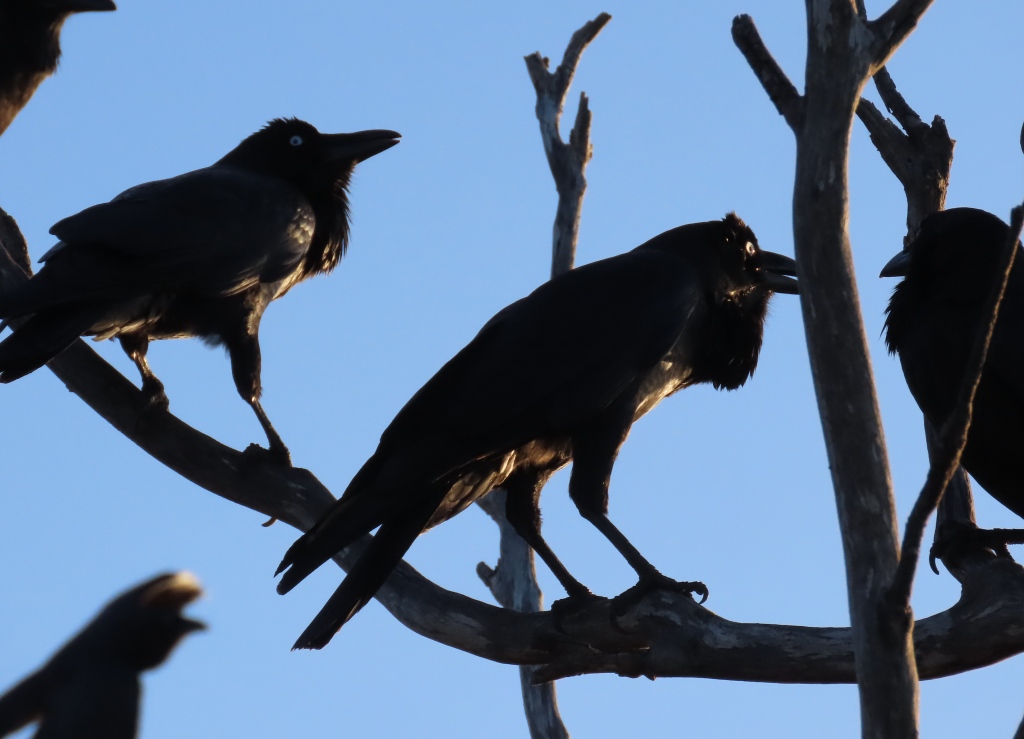
Common name: Australian Raven
Scientific name: Corvus coronoides
Approximate length: 50 cm
Date spotted: 10 June 2023 (winter)
Location: Dobroyd Head, New South Wales, Australia: 33°48’36.6″S 151°16’23.9″E
And the I’m-so-pretty, butter-wouldn’t-melt-in-my-mouth pose of the lorikeets:
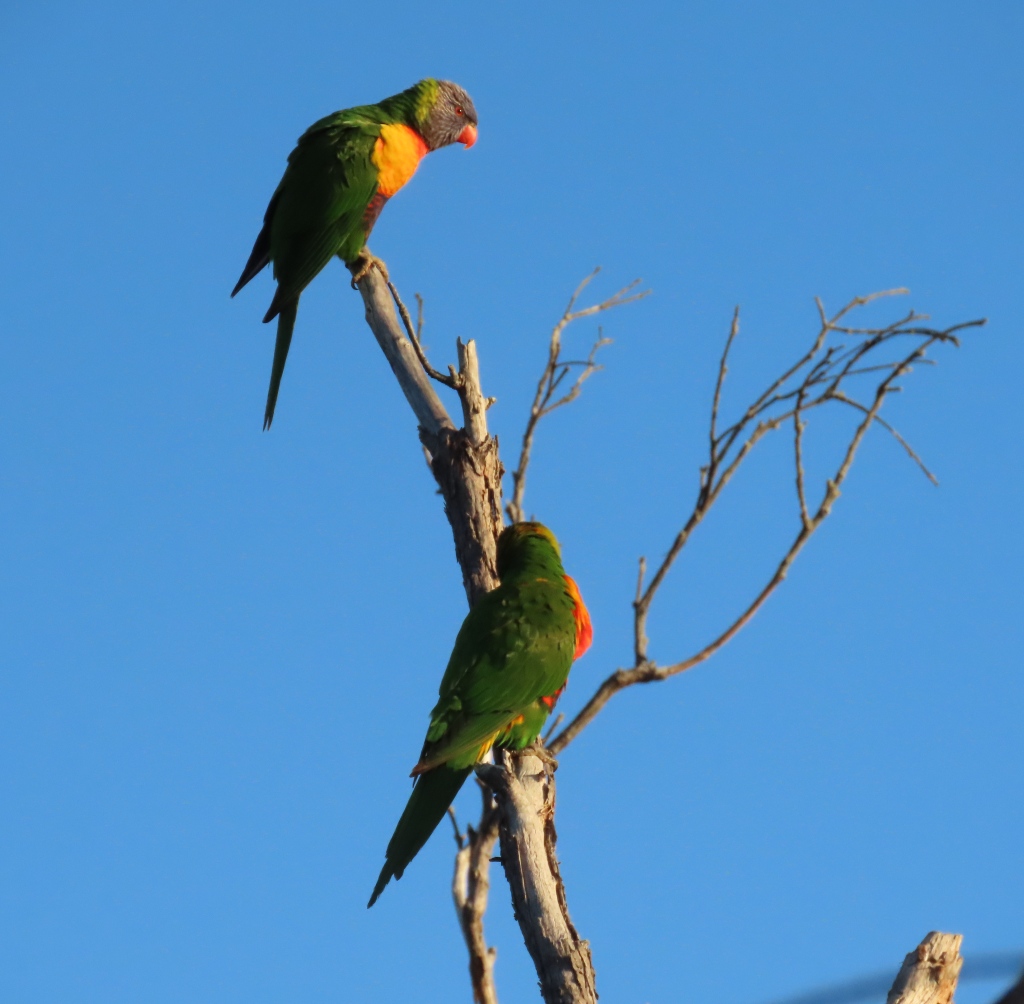
Common name: Rainbow Lorikeet
Scientific name: Trichoglossus haematodus
Approximate length: 30 cm
Date spotted: 10 June 2023 (winter)
Location: Dobroyd Head, New South Wales, Australia: 33°48’36.6″S 151°16’23.9″E

Bell Miners heard, and spotted at last!
Bell Miners, often called bellbirds, are well known in parts of Eastern Australia. We don’t have them in the area where I live, but I’ve heard them often when visiting nearby places. The odd thing is, though, that I’ve never before managed to actually see a Bell Miner. Until this weekend.
I was visiting the area of Capertee, about three hours’ drive west of Sydney. Bell Miners were chiming away in the trees:
For a while, as usual, I couldn’t spot a bird. There aren’t any clearly visible in the video either. Then, a flash of olive green, and a bird alighted for a brief moment:

The image is fuzzy, because I didn’t have time to focus on the bird. But at least I now know what they look like!
Here’s another Bell Miner in the same tree. This time it’s a juvenile bird, darker in colour than the adult:

Common name: Bell Miner, often called bellbird
Scientific name: Manorina melanophrys
Approximate length: 18-20 cm
Date spotted: 22 April 2023 (autumn)
Location: Long Ridge, Capertee, New South Wales, Australia: 33°09’53.9″S 150°00’06.2″E
Six kookies a-cackling
This morning I was treated to the sight of six kookaburras in a row, perched on the horizontal bar of an outlet pipe, all cackling away to each other. Australians fondly call these birds “kookies”. So, here you go, six kookies a-cackling:
Towards the end of the video, you’ll hear a jogger running up to me in excitement, exclaiming that she wished she had a camera. She obviously didn’t realize I was videoing!
After the birds flew off, I spotted two perched on a nearby TV antenna. It’s probably two of the six in the video, but not necessarily — there were quite a few kookaburras around:

Common name: Laughing Kookaburra
Scientific name: Dacelo novaeguineae
Approximate length: 47 cm
Date spotted: 28 January 2023 (summer)
Location: Balgowlah, New South Wales, Australia: 33°48’01.4″S 151°15’53.0″E

Young Channel-billed Cuckoos fed by currawongs
What’s that caterwauling? It’s a couple of young Channel-billed Cuckoos, awaiting their food. Are the patient bringers of food the parents of the young birds? No, they’re Pied Currawongs. Because, like other parasitic cuckoos, Channel-billed Cuckoos lay their eggs in the nests of other birds and leave it entirely to the adoptive parents to care for the youngsters.
The other ongoing noise that you hear in this video are the Cicadas. It’s the season of noisy beetles and noisy birds!
This is the second time that I’ve seen two young cuckoos being fed by currawongs, instead of just one. Evidently it’s quite common for these birds to lay more than one egg in someone else’s nest.
Here’s a still photo of the young cuckoo. What a big baby. It’s far larger than the currawongs that are taking care of it.

Here’s the youngster flapping its wings to make sure its carers don’t miss it:
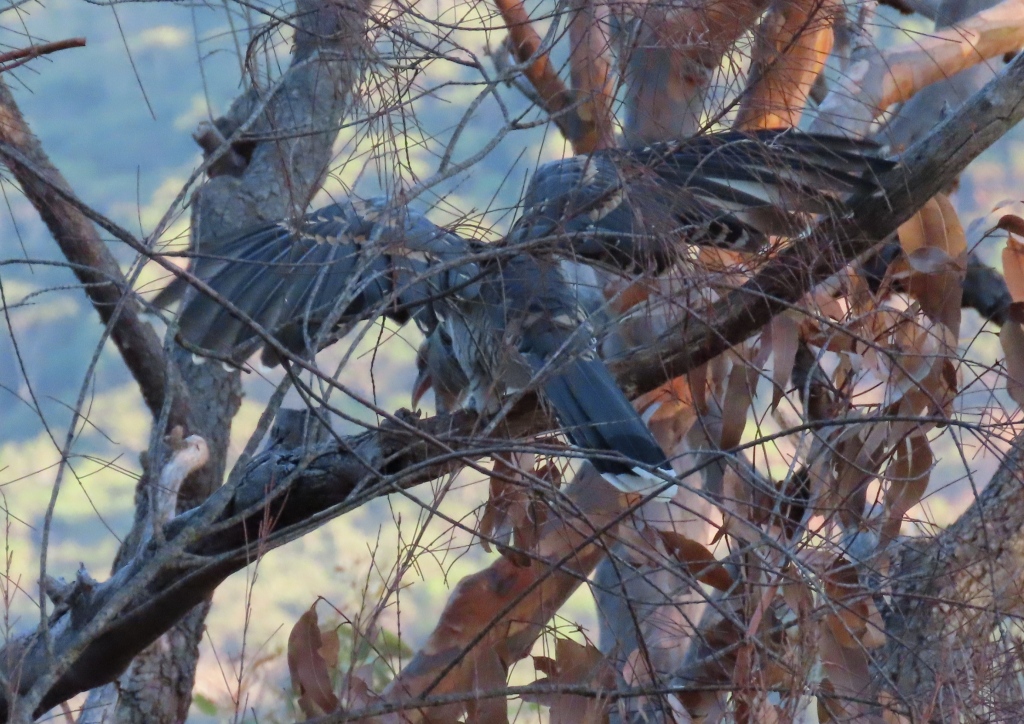
Channel-billed Cuckoo | Scythrops novaehollandiae | Approximate length: 58-65 cm
Pied Currawong | Strepera graculina | Approximate length: 45 cm
Date spotted: 28 December 2022 (summer)
Location: Manly Dam Park, New South Wales, Australia: 33°46’50.1″S 151°14’59.6″E


 Sydney Birder