Blog Archives

Scarlet Robin in Blue Mountains
I’m spending the weekend in the Blue Mountains, about two hours’ drive west of Sydney. A little Scarlet Robin was fascinated by the shiny surfaces of a row of cars. It kept swooping down to examine the mirrors and paintwork.
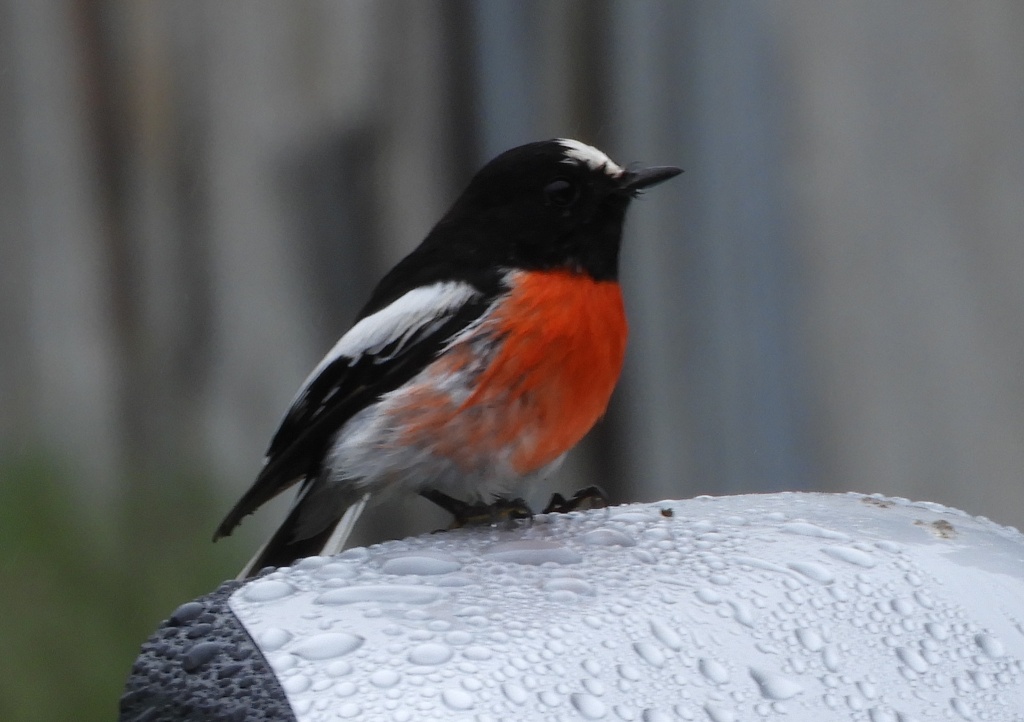
This is a male bird, with its scarlet patch on the chest and striking black and white markings on the rest of the body. The female was flitting around too, but didn’t stay in any one place long enough for a picture. She was light brown with a pale orange chest.
This is my first sighting of a Scarlet Robin, though I often see the Eastern Yellow Robin nearer home. Australian robins are not related to European or American robins. When Europeans came to Australia, they named these little birds “robins” because they reminded them of the birds they saw back home. The same applies to Australian magpies, and probably other birds too.
Common name: Scarlet Robin
Scientific name: Petroica boodang
Approximate length: 12 cm
Date spotted: 21 November 2021 (spring)
Location: Rydal Showground, NSW, Australia: 33°28’58.7″S 150°02’11.0″E

The weird case of the bagworm
(Not a bird, but most likely something that a bird would find interesting!)
Bagworms, sometimes called case moths, are interesting creatures. The larvae of the moth surround themselves with a case made of silk for protection. Then they go one step further: they attach leaves and sticks to the case, making a home that looks quite weird. Some of the cases can be large: up to 12 centimetres long.
I came across just such a case recently, when walking through a burnt area of bush. (The cases are hard to spot when the bush is lush and healthy.) I guess this larva was travelling around looking for food, and found itself exposed on a black tree trunk.

This particular case was quite large, at 11 centimetres long. At the top is the patch of silk that the larva uses to attach the case to the tree. When moving around, the larva detaches from the tree, pokes its legs out at the top of the case, and drags the case around with it.
I think is is most likely a Saunders’ case moth, also called the large bagworm (Metura elongatus), which is found in eastern Australia where I live.
Here’s a view from another angle:
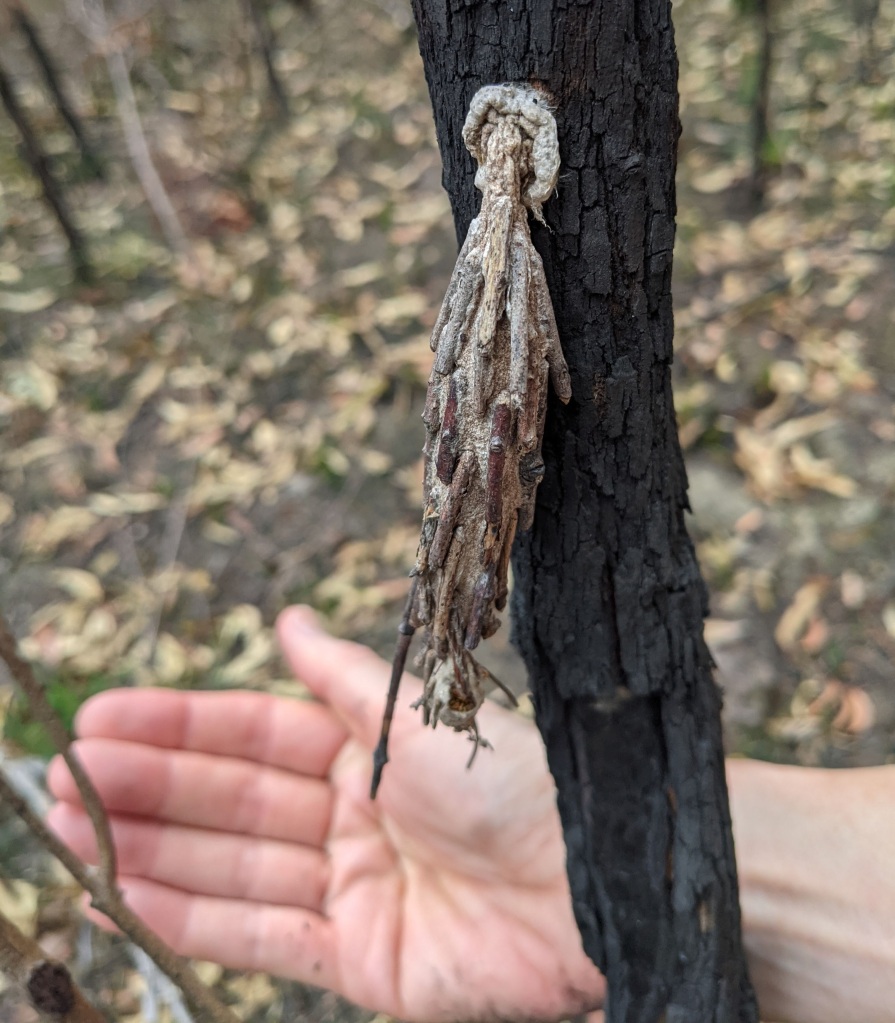
In the zoomed-out view, the bagworm is half way up the blackened tree trunk in the middle of the picture:

Spotted at this location in Manly Dam park, on the east coast of Australia. I’ve posted recently about other bagworms that I’ve encountered.
Whipbird takes a dip in a puddle
This is why they put puddles on paths, right? An Eastern Whipbird enjoys a quick dip in a puddle, on the path right in front of me:
The whipbird is so called because of the rather strange noise it makes: a long drawn-out whistle ending in a small explosion, which reminds people of the crack of a whip. Some of my other posts about this bird manage to capture the sound of the call too.
Common name: Eastern Whipbird
Scientific name: Psophodes olivaceus
Approximate length: 30 cm
Date spotted: 6 November 2021 (spring)
Location: Dobroyd Head Track, Balgowlah Heights, NSW, Australia: 33°48’37.6″S 151°16’23.9″E

Common Bronzewing pigeon in Blue Mountains
This weekend I spent a day in the region of Kurrajong in the Blue Mountains area west of Sydney. On an early morning walk, I came across this large, colourful pigeon:

It’s a Common Bronzewing. I’d heard their calls from all round me in the bush: a deep, booming coo that sounds like something from Jurassic Park rather than from a pigeon!
Common name: Common Bronzewing
Scientific name: Phaps chalcoptera
Approximate length: 30-36cm
Date spotted: 31 October 2021 (spring)
Location: Grose Wold, New South Wales: 33°36’41.7″S 150°39’50.0″E

Majestic Glossy Black-Cockatoo pair
Two Glossy Black-Cockatoos have taken to hanging out at Manly Dam. The Casuarina trees are currently full of seed pods, which are this bird’s favourite food. In fact, Glossies feed almost exclusively on Casuarina seeds.
This video shows the male bird first, its feathers gleaming a soft blue in the early morning light, and the red tail flares standing out nicely. Then the view moves to the female feeding on a nearby tree.
Glossy Black-Cockatoos are large parrots at around 15 cm in length. We’re lucky to see four different types of cockatoos in this area. Glossies are heavier than the white Sulphur-crested Cockatoos and Corellas, and shorter in length than the Yellow-tailed Black Cockatoos. Of the four types, Glossies are by far the least common.
This is the male bird, with that blueish gleam lent by the early morning light, and those red tail flares:
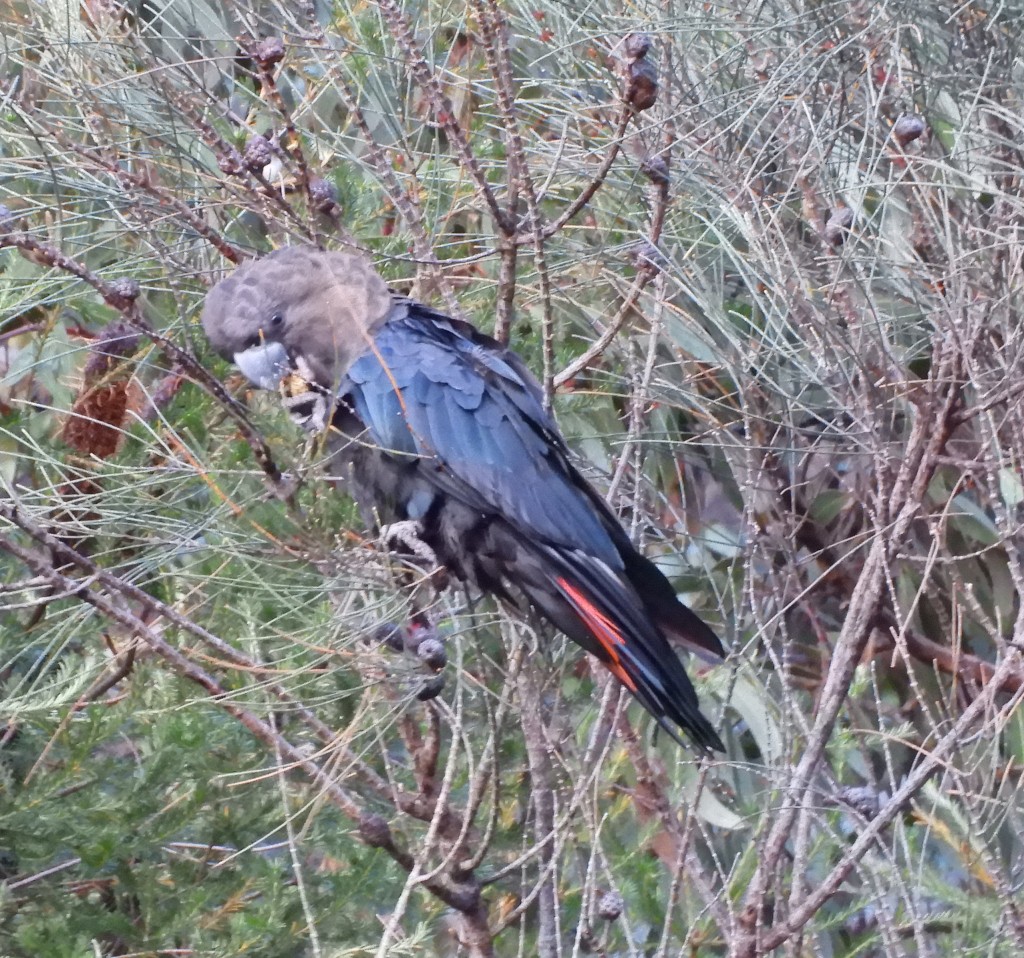
The female has yellow markings around her neck, and her tail flares are yellow and a softer shade of orange-red than the male’s:
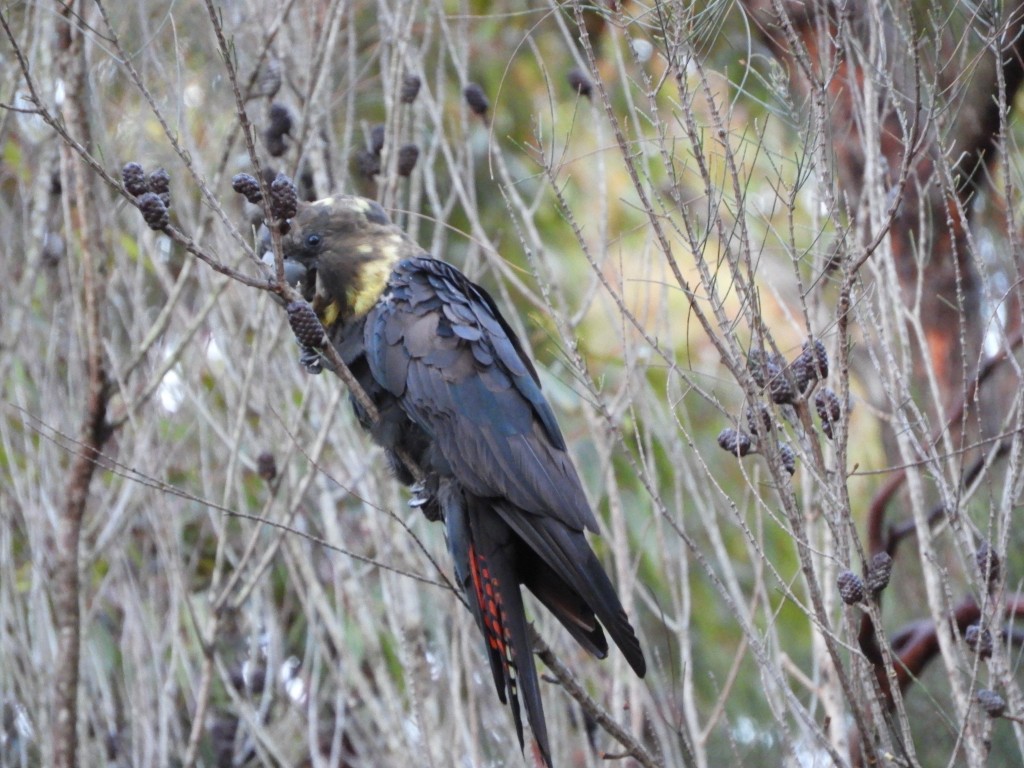
With their large heads and that mane of feathers, Glossies sometimes remind me of a bear. Here’s a close up of the male bird, taken a few days before the above shots:

Here are both birds, sharing a tree this time:
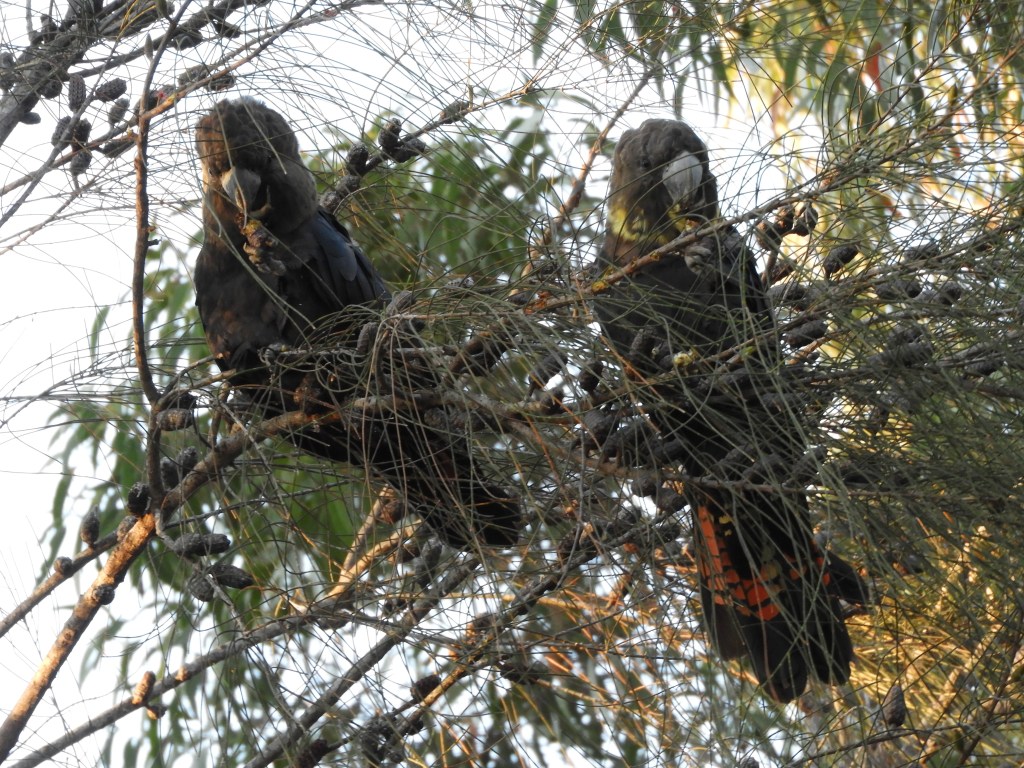
Common name: Glossy Black-Cockatoo
Scientific name: Calyptorhynchus lathami
Approximate length: 50cm
Date spotted: 5 October and 15 October 2021 (spring)
Location: Manly Dam Park, near Sydney: 33°46’56.5″S 151°15’10.3″E

Noisy Miner babies
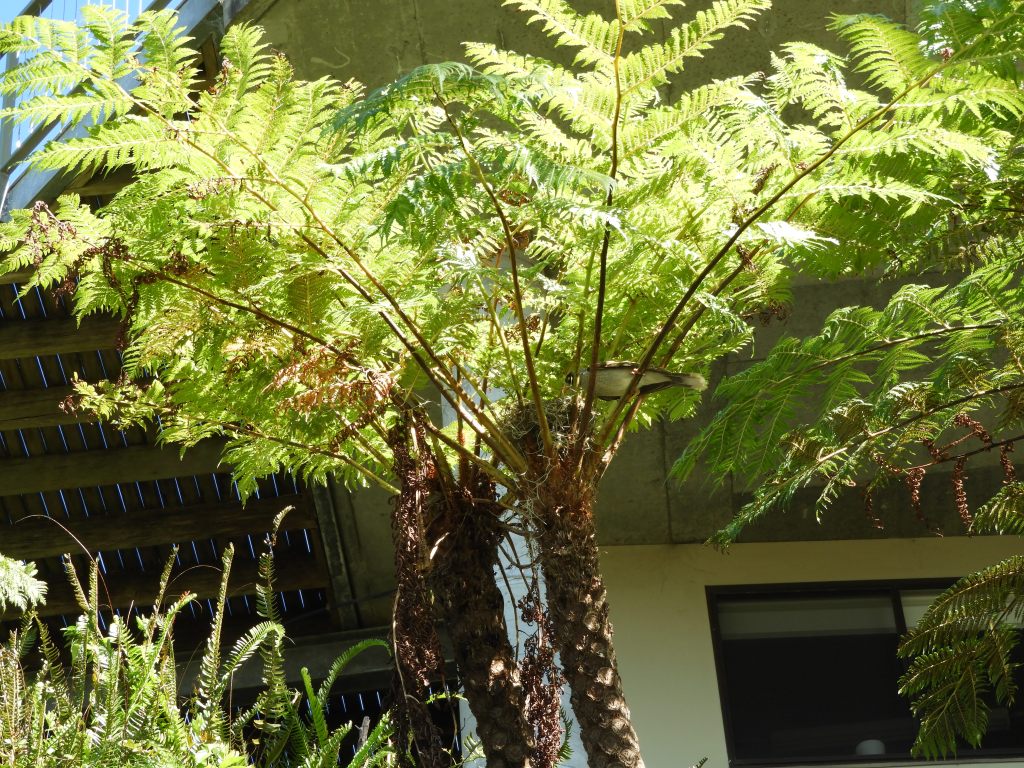
For a couple of weeks, we had the pleasure of hosting a nest of Noisy Miners in our garden. The adults built the nest in a tree fern, right in the hollow where the new fern leaves sprout. This picture shows the tree fern, with the nest and one of the adult birds in attendance:
It’s a good thing that little Noisy Miners grow so fast. A few years ago, some Red Wattle Birds attempted the same thing, and were forced to abandon the nest when the fern leaves pushed it out of place!
This video shows an adult bird feeding the babies:
With Noisy Miners, feeding the little ones is a communal responsibility. You can’t tell which are the parents. We sometimes saw three birds waiting in line with a goody for the growing babies.
In the above video, the adult is regurgitating nectar or other food. Its long, thin tongue flicks out occasionally. In the next video, a bird brings a large green bug and passes it to the babies. I’m not sure if the bug is a mantid or something else. It’s too early in the season for cicadas:
Here’s a still picture of the little ones begging for food:

After a couple of weeks of feeding and fast growing babies, the nest became pretty full. Then one day, the little ones left the nest. I wasn’t there to see this exciting event, alas. I took this video the day before the nest was suddenly empty:
The little ones are now all round the garden, peeping constantly to get the adults’ attention. For the most part, they’re tucked away safely in the foliage, hard to find from my vantage point on the ground. This picture is of one of the little ones, a few days after leaving the nest:

Here’s the empty nest, with a clothes peg for scale:

Common name: Noisy Miner, also called Australian Miner
Scientific name: Manorina melanocephala
Approximate length of adult bird: 26 cm
Date spotted: September 2021 (spring)
Location: Near Sydney, NSW, Australia
Magpies carolling with a view of Sydney Harbour
This morning I walked along a path overlooking Sydney Harbour and the headlands that act as a gateway to the ocean. A treeful of Australian Magpies provided musical accompaniment.
Common name: Australian Magpie
Scientific name: Gymnorhina tibicen
Approximate length: 40 cm
Date spotted: 3 October 2021 (spring)
Location: Dobroyd Head, Sydney Harbour: 33°48’36.7″S 151°16’03.4″E

First Channel-billed Cuckoo of the season
It’s spring down under, and the cuckoos are back on the east coast of Australia. Last week I heard the calls of Koel Cuckoos and Channel-billed Cuckoos. Now I’ve seen my first one of the season: A Channel-billed Cuckoo sheltering from the local birds in a gum tree.
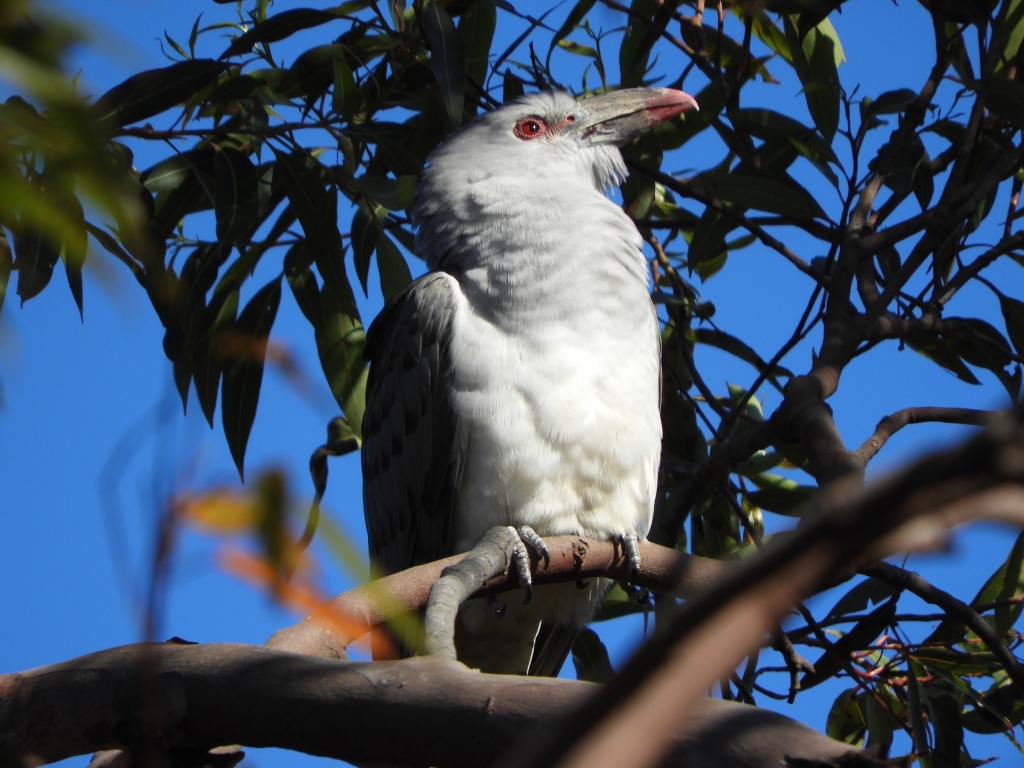
Channel-billed Cuckoos are large birds (approximately 60 cm long) with red eyes and a big beak. They often look a little scruffy, even ghoulish. The other birds seem to think so too, because they spend a lot of time dive-bombing the cuckoos and shouting at them. Usually the Noisy Miners (living up to their name) are the noisiest of the birds that strive to make the cuckoos feel unwelcome, but other birds play their part too.
This video shows the cuckoo enjoying the peace and quiet of a gum tree. At the start of the video, a Currawong swoops past in a threatening flyby. You don’t actually see the Currawong, but you can hear it and see the cuckoo flinch:
Here’s a photo showing the full length of the cuckoo, including its long, barred tail:
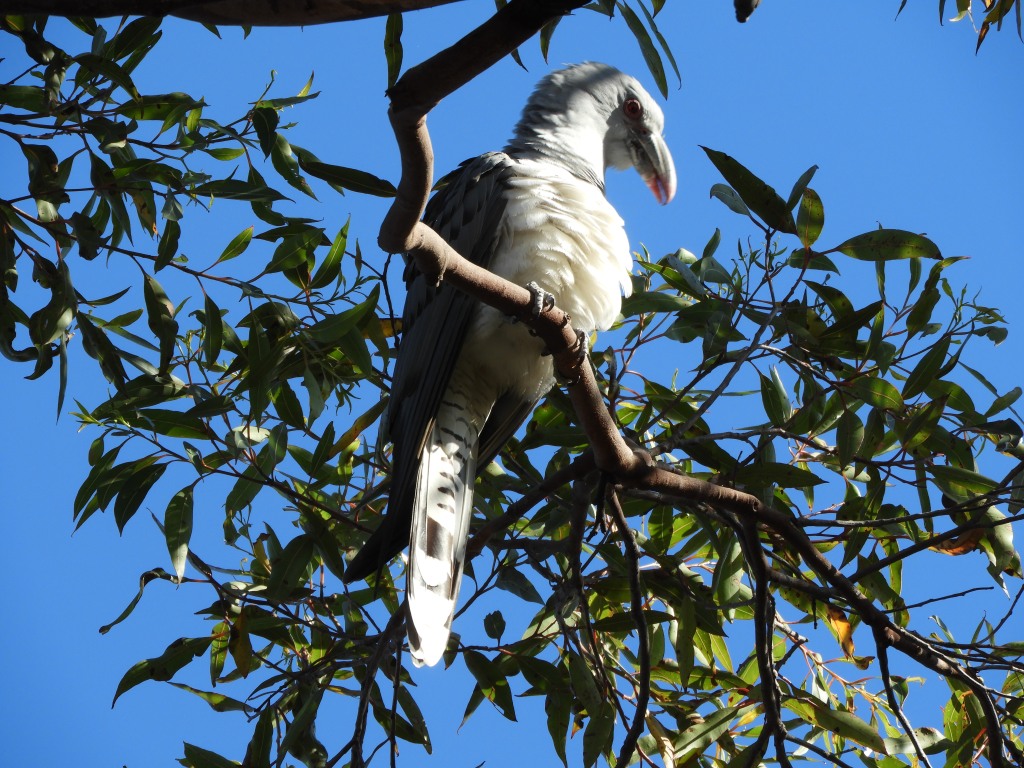
Here’s a view from the back:

Common name: Channel-billed Cuckoo
Scientific name: Scythrops novaehollandiae
Approximate length: 58-65 cm
Date spotted: 19 September 2021 (spring)
Location: Manly Dam Park, New South Wales, Australia: 33°46’33.8″S 151°15’17.8″E
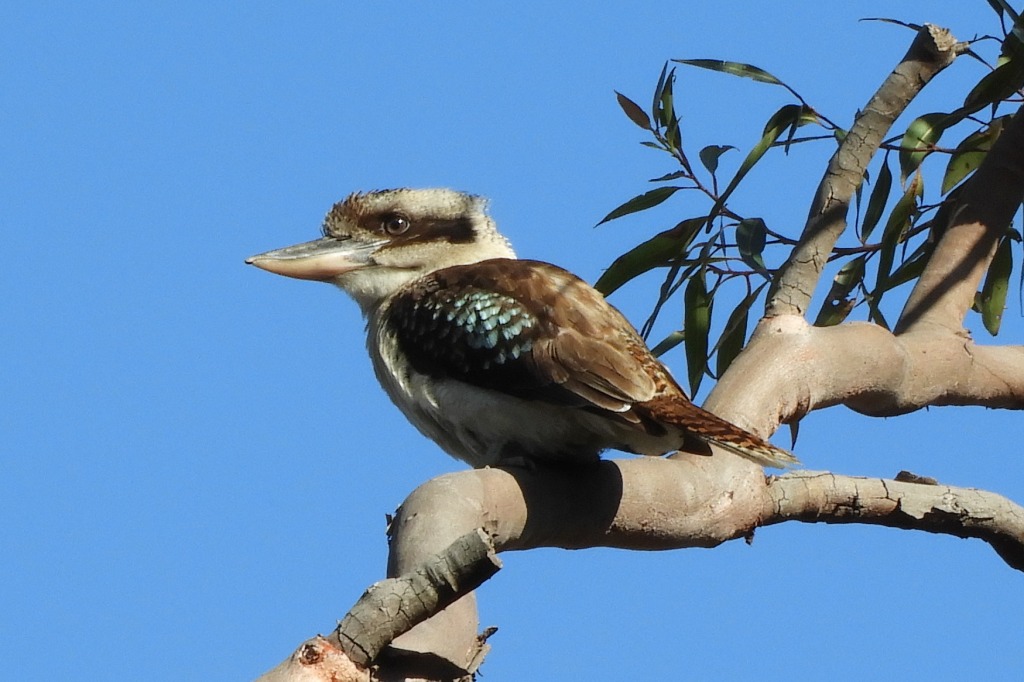
A bonus bird: Just after the Channel-billed Cuckoo flew off, a kookaburra landed on a nearby branch:

Spitfire Sawfly larva – the caterpillar that wasn’t
(Not a bird, but a creature that birds no doubt encounter either on the ground or high up in a gum tree.)
Walking along a bush path the other day, I saw a strange-looking caterpillar. It was large and black with short yellow spikes. Its front end was quite pudgy, but its body tapered off toward the back end.

When moving along, it often lifted up its front end to show its yellow legs:

After doing a bit of research, I realized that this interesting creature is a larva, not a caterpillar. Specifically, it’s the larva of the Spitfire Sawfly. Sawflies are related to wasps, ants, and bees.
Despite the name “Spitfire”, these larvae don’t actually spit anything, but if you touch them you can get a burning sting from the spikes. The larvae also spew out a thick yellow liquid from their mouths when threatened, but the liquid isn’t harmful. They often collect together in big clusters on a gum tree.
Here’s a short video of the larva moving across the forest floor:

Fairy-wrens in full finery
Variegated Fairy-wrens are quite common in my neck of the woods, but they’re very difficult to photograph. They move fast, pause only briefly, and prefer to keep hidden in the shrubbery. I took these shots over a few days, collecting mosquito bites at the same time as usable photos.
It’s spring, and the males are decked out in their breeding finery. They’re like blue fireflies lighting up the bush:
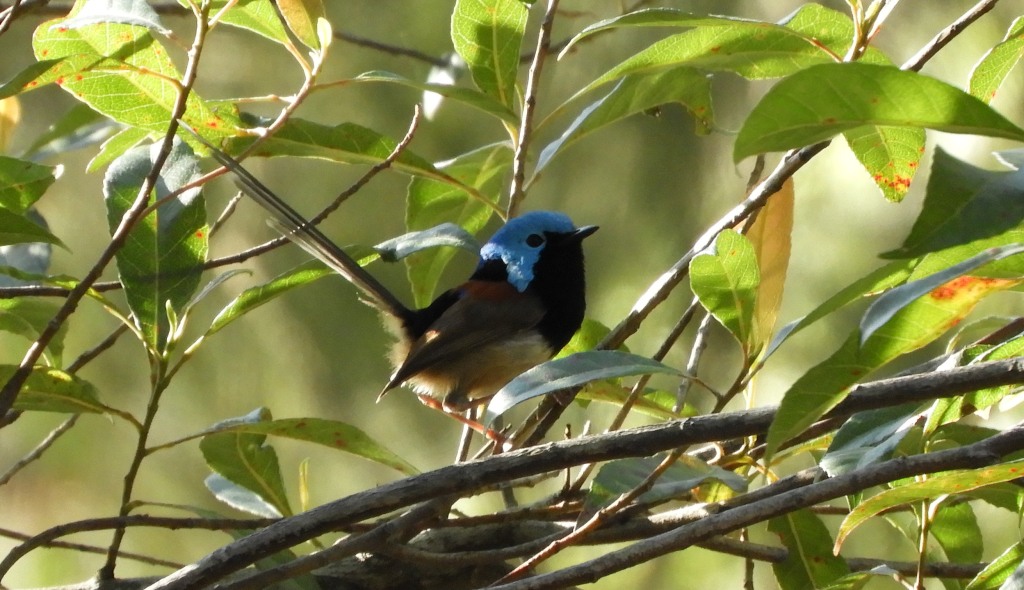
The long tail often sticks straight up. It must present quite a challenge to dashing around the shrubbery:

The females are a soft brown with pale blue hints in the tail. They have a red eye mask which can make them look slightly sardonic:
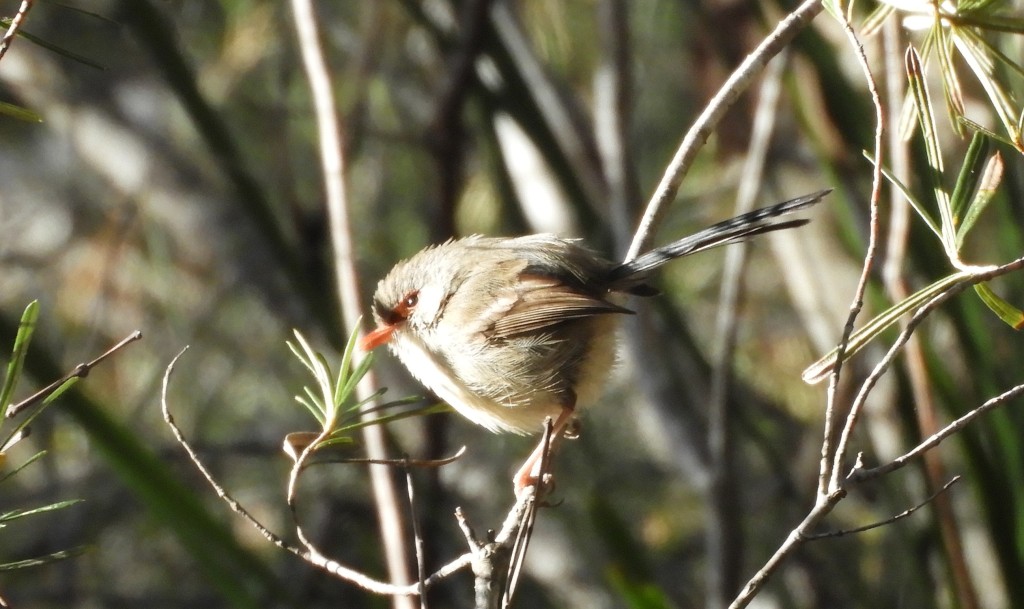
They’re like tiny little puffballs:

Like many bird names in Australia, the name “fairy-wren” is misleading. These birds aren’t actually wrens. They’re related to honeyeaters and pardalotes.
Common name: Variegated Fairy-wren
Scientific name: Malurus lamberti
Approximate length: 13 cm
Date spotted: September 2021 (spring)
Location: Manly Dam Park, New South Wales, Australia: 33°46’49.9″S 151°15’04.2″E (the male) and 33°46’20.8″S 151°14’30.6″E (the female)


 Sydney Birder