Blog Archives

Three Tawny Frogmouths gazing at me
Tawny Frogmouths are some of the cutest birds around. They’re fluffy and cuddly, with an endearing tuft of feathers just above their beaks, and large eyes that glow brown and orange in the early light. I was strolling along a bush path when I noticed a group of three:
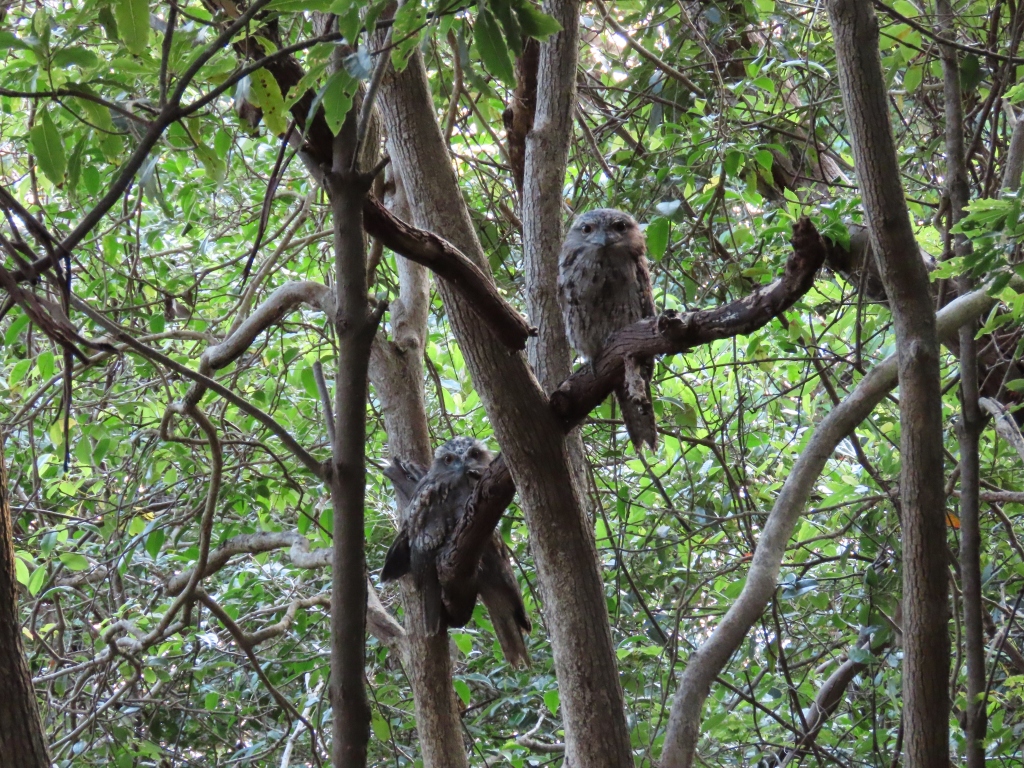
If you don’t spot the third bird immediately, that’s by design. Two of the birds are looking directly at me. The third is pretending to be part of the tree, with just one partly-open eye squinting at me. The bird is the furthest away of the three, and is partly hidden by the bird in the middle.
A closer view shows one bird hiding behind the other and trying to look like a broken tree branch:
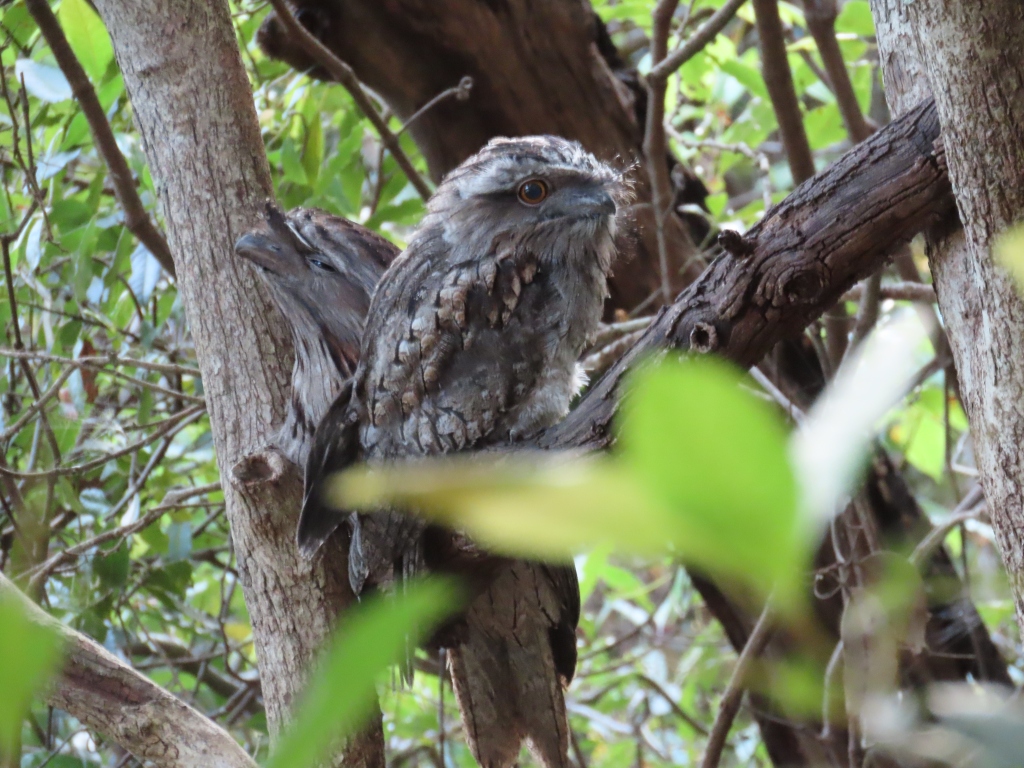
When I first came along, the closest bird had a similar stance:

It takes a practiced eye to spot a Tawny Frogmouth. They’re nocturnal, and tend to stay very still during the daytime. And their camouflage is impressive. I was excited and awed to see three of them at once.
Although they look like owls, Tawny Frogmouths are actually members of the nightjar family. Like owls, they hunt at night, preying on large insects, spiders, frogs, and small animals. Unlike owls, they don’t catch their prey with their feet. To catch insects, they sometimes fly with their beaks open. Hence the very wide beak! One theory about the tuft of feathers above the beak is that it protects the eyes when the bird is hunting.
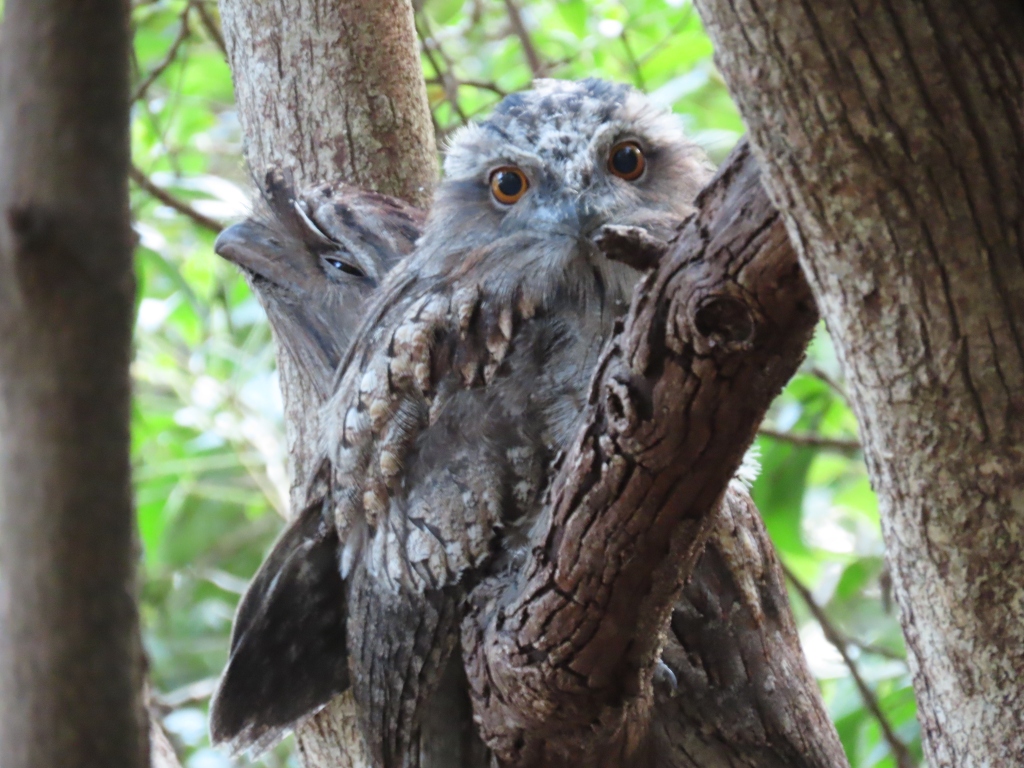
Here’s another view of the two Tawny Frogmouths that were huddled together:
Common name: Tawny Frogmouth
Scientific name: Podargus strigoides
Approximate length: 34-52 cm
Date spotted: 5 December 2022 (summer)
Location: Reef Beach Track, Balgowlah Heights, New South Wales, Australia: 33°48’23.1″S 151°16’21.2″E

Fluffy little Scrubwren has big feet
At the entrance to Manly Dam Park, a little White-browed Scrubwren examines the tarmac for tasty bits of seeds. I watched this bird for a while as it hopped about. One thing that struck me is how big the bird’s feet are! The little wren is also quite fluffy, and the white markings on its face aren’t as distinct as I’ve seen in other birds of this type. Perhaps it’s a juvenile, the season being spring and all.

Common name: White-browed Scrubwren
Scientific name: Sericornis frontalis
Approximate length: 12 cm
Date spotted: 28 November 2022 (spring)
Location: Manly Dam Park, New South Wales, Australia: 33°46’55.7″S 151°15’25.3″E

3 parrots on one walk
A few days ago I went for a walk and saw three different types of parrots all within a few paces of each other. How amazing is that!
First up, a trio of King Parrots. Two were males, the other a female. This is one of the males:

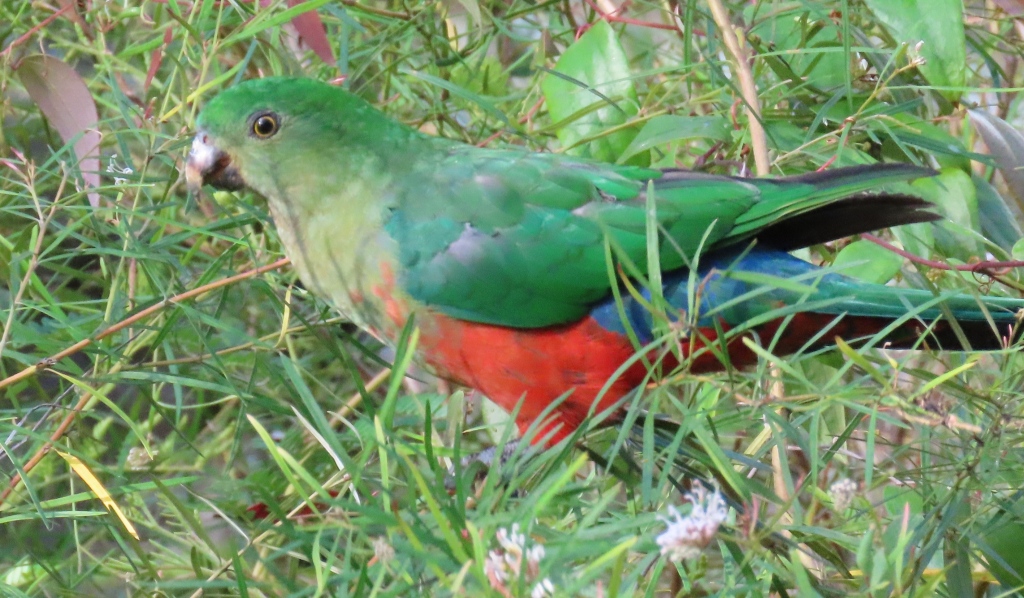
King Parrots are quite large, at 44 cm from head to tail. The females have a lot more green in their colouring. I think they’re prettier than the males, with their softer shading:
This video shows all three of the birds enjoying the flowers of a Grevillea bush. First you see the two males together. Then one of them flies over to join the female on the other side of the bush:
In the trees around the parrots, the smaller Rainbow Lorikeets chattered and scolded. Here’s one in a more contemplative mood than most:

One of them stood still for a while to examine me, before launching itself in my direction then swerving at the last moment as they are wont to do:
At the next tree, a group of Sulphur-crested Cockatoos examined a tree hollow. Perhaps a good place to raise a family? But competition is fierce!
Here’s one of the cockatoos making a point about ownership, or perhaps just being its usual excited self:

The walk itself is lovely, starting in Balgowlah and winding along the coast of Sydney Harbour, with bushland and forest on one side:

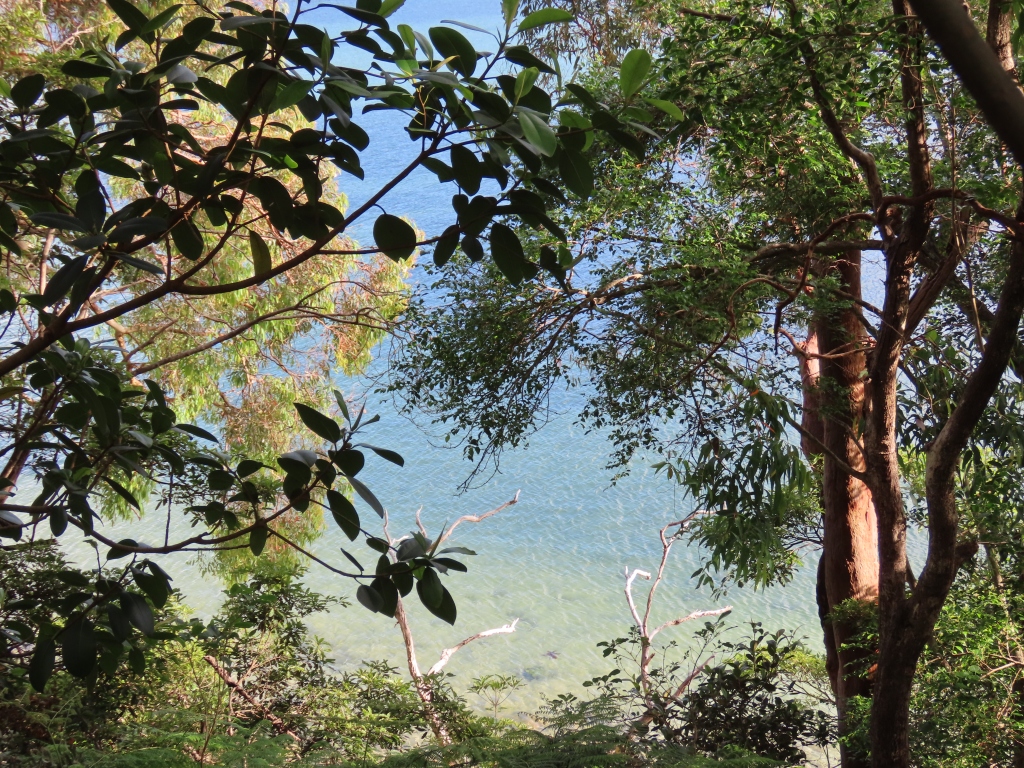
And pretty views of the waters of Sydney Harbour on the other side:
The birds:
Common name: Australian King Parrot
Scientific name: Alisterus scapularis
Approximate length: 44 cm
Common name: Rainbow Lorikeet
Scientific name: Trichoglossus haematodus
Approximate length: 30 cm
Common name: Sulphur-crested Cockatoo
Scientific name: Cacatua galerita
Approximate length: 50 cm
Date spotted: 26 November 2022 (spring)
Location: Near Forty Baskets beach, Sydney Harbour, New South Wales, Australia: 33°48’03.2″S 151°16’07.2″E
Great Cormorant reflections at Manly Dam
In the early morning, a Great Cormorant holds its wings up to dry:

The cormorant waves its wings gently in the still air. Every now and then, it turns to check the noisy Australian Ravens in the background. As I approach along the path, the cormorant decides to take off and head for a safer spot further up the dam:
Common name: Great Cormorant
Scientific name: Phalacrocorax carbo
Approximate length: 85 cm; wing span 1.5 m
Date spotted: 19 November 2022 (spring)
Location: Manly Dam, New South Wales, Australia: 33°46’34.5″S 151°14’50.5″E

Australian Brush-turkeys, a wallaby, and me
Back in Sydney after a short visit to South Africa, I’m delighted to walk among the Ozzie birds again. Among them are the endearingly stupid Australian Brush-turkeys.
Here I am, following some Brush-turkeys along a path. The birds make that peculiar grunting noise that is all their own. I suppose it’s a big chicken’s version of a cluck:
Australian Brush-turkeys are funny to watch when you’re sharing the same path as them. They’re a little concerned that you’re there, but they’re also very reluctant to cede the path to you. So if you walk at normal speed, they get quite flustered and rush around trying to race you. (While taking the video, I was walking very slowly.) Eventually, one smart bird stands aside just off the path. With luck, the others decide this is a wise strategy and do the same. Alas, though, they come to this conclusion at varied times, which means there’s a lot of clucking and fluttering involved to rally troops again after the danger (you) has passed.
Here’s a still picture of the birds making their way up the path ahead of me:

A closer view of one of the birds, who has realised that she’ll have a more peaceful life if she stands on the side of the path and waits for me to pass:
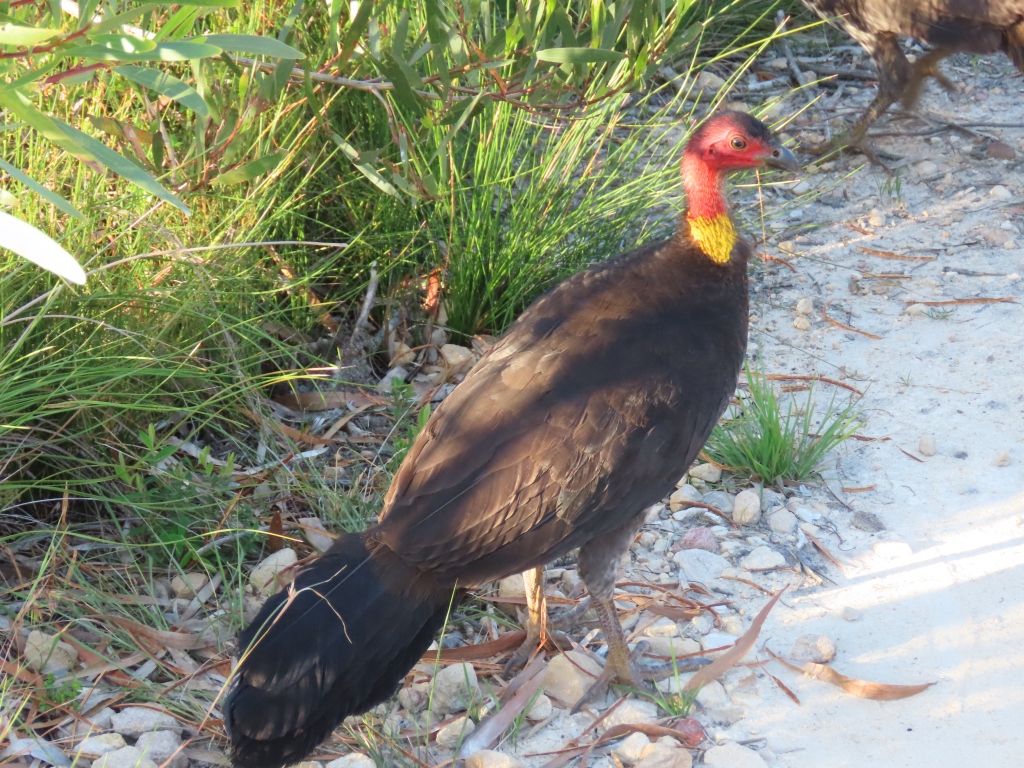
I reached the highest point of my walk and looked back down the path. The birds have found each other again and have the path to themselves:
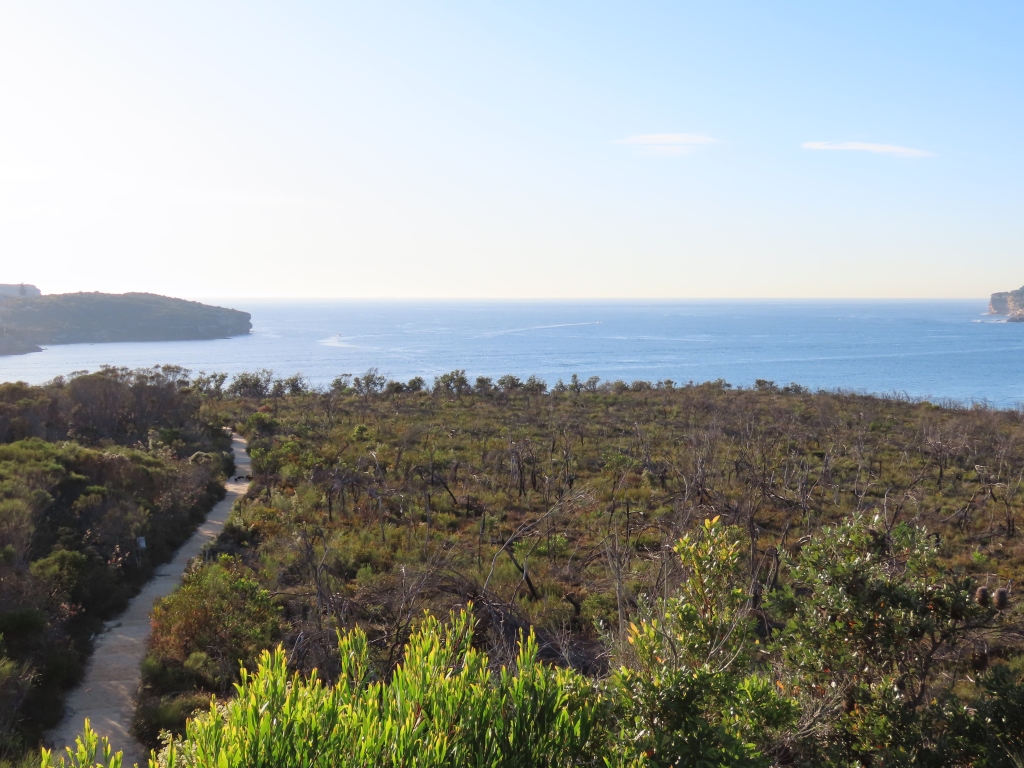
On my way back, I encountered the same group of birds, but this time with an interloper:
A Swamp Wallaby, sometimes called a Black Wallaby, was peacefully examining the path alongside the brush-turkeys. I often see these kangaroo-like marsupials out in the early morning. They’re much smaller than kangaroos, typically reaching the height of my hips when standing on their back legs. Here’s a still photo of the wallaby with the brush-turkeys:

A few weeks ago, I filmed a Swamp Wallaby in the same area of the path. It could easily be the same animal. The video shows a good view of the animal’s head and front paws as it munches away at a bush:
In the background on the video, you hear some magpies carolling, a wattle bird squawking, and a lone whip bird calling.
Australian Brush-turkey
Scientific name: Alectura lathami
Approximate length: 60-70 cm
You can see more about this bird, including some chicks and the male’s strange call, in my other posts about Australian Brush-turkeys.
Swamp Wallaby
Scientific name: Wallabia bicolor
Approximate length: 66-85 cm
Date spotted: 12 November 2022 (spring)
Location: Dobroyd Head Track, New South Wales, Australia: 33°48’35.5″S 151°16’19.7″E

Satin Bowerbird at Mount Annan
This morning I paid my first visit to the Australian Botanic Garden at Mount Annan. The gardens lie to the south west of Sydney, on the east coast of Australia. They’re well worth a visit, with beautifully laid out pathways and flower beds, and a number of different bird species.
A female Satin Bowerbird pottered around a bed of plants:

Female Satin Bowerbirds are gorgeous, with violet eyes and soft shades of green, yellow, and brown plumage. This is only the second time I’ve photographed a bowerbird. Both times they were female.
It was interesting to see this bird tucking into the carefully laid out plants. I didn’t know that birds can be this keen on eating their greens!
Common name: Satin Bowerbird
Scientific name: Ptilonorhynchus violaceus
Approximate length: 28-34 cm
Date spotted: 16 October 2022 (spring)
Location: Mount Annan, New South Wales, Australia: 34°04’16.3″S 150°45’58.1″E

Channel-billed Cuckoo at Mount Annan
Today I went for a stroll at the Australian Botanic Garden in Mount Annan, to the south west of Sydney. It’s a good place for a walk, with well-maintained pathways and beautifully laid-out gardens.
This Channel-billed Cuckoo sat high on a bare tree branch, basking in the morning sun:

Channel-billed Cuckoos are large, imposing birds. I often think they look a bit creepy, with their red eyes and huge curved beaks. They’re migratory, coming down to the south east coast of Australia during the summer months. I heard the first arrivals of the season just a couple of weeks ago.
You can find out more about these birds in my other posts about cuckoos.
Common name: Channel-billed Cuckoo
Scientific name: Scythrops novaehollandiae
Approximate length: 58-65 cm
Date spotted: 16 October 2022 (spring)
Location: Mount Annan, New South Wales, Australia: 34°04’29.9″S 150°45’48.5″E

Kookaburra snagged a goldfish from someone’s pond!
Kookaburras are members of the kingfisher family, after all, and it looks as if this kookaburra has raided someone’s garden pond!

I feel sorry for the fish. It looks very sad. I think it’s a goldfish, because of its size, but it could be a koi or something else. There might be some pond owners near by, wondering where their fish are disappearing to!

Common name: Laughing Kookaburra
Scientific name: Dacelo novaeguineae
Approximate length: 47 cm
Date spotted: 1 September 2022 (spring)
Location: Allambie Heights near Sydney, New South Wales, Australia

Black-winged Stilt in pretty Australian pool
Update on 23 July 2024: When entering this bird into eBird, I discovered that the bird has been renamed from Black-winged Stilt (Himantopus himantopus) to Pied Stilt (Himantopus leucocephalus).
This Black-winged Stilt marked another first for me on the guided bird walk that I did last weekend. It was in the area around Newington Armory – formerly the Royal Australian Navy Armaments Depot – at Sydney Olympic Park.

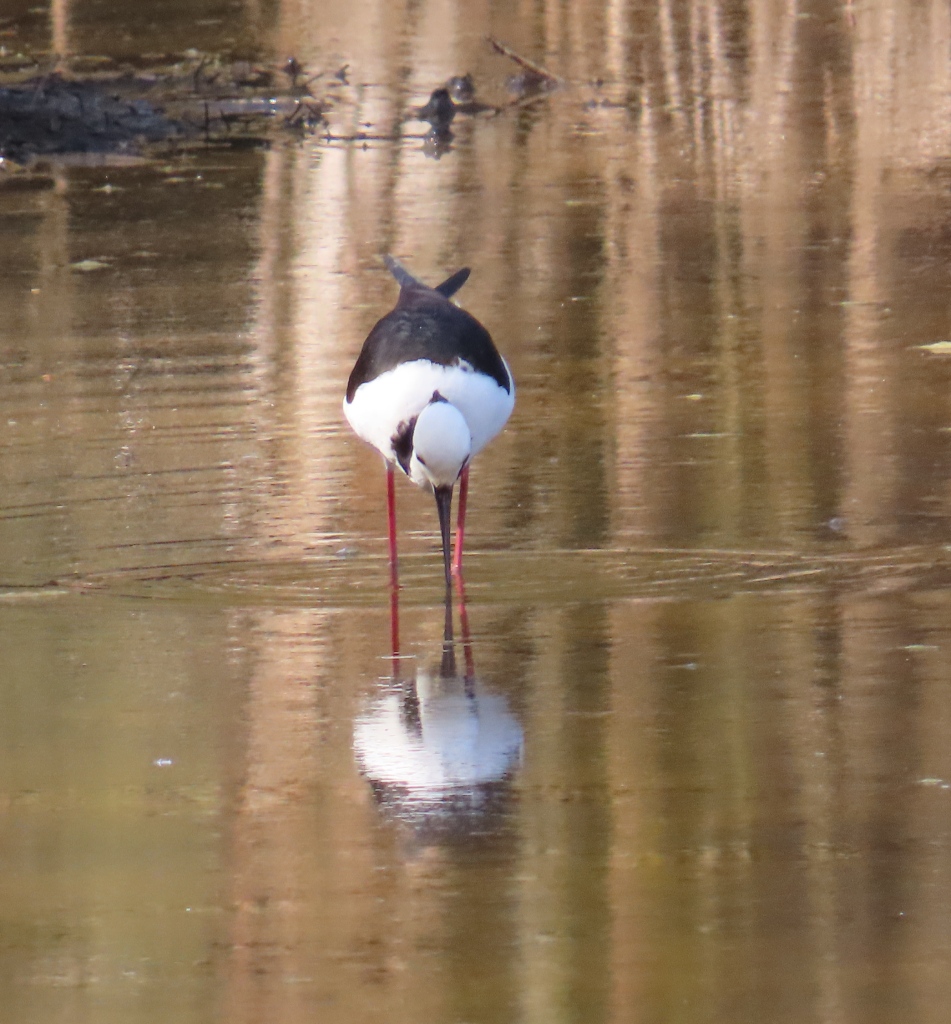
Stilts are waders, with long thin legs and a beak made for poking into muddy pool bottoms. I saw a stilt flying overhead too, with its legs trailing out behind it.
The next photo shows a rather comical view of the bird and its reflection. It’s hard to tell where the real beak and legs end and the reflection begins:
The guided bird walk is offered by the BirdLife Discovery Centre on the last Sunday of every month. It’s fun and a good way to get out, meet some people, and see some birds.
Here’s a zoomed-out view of the stilt and the surrounding water. We’ve had a lot of rain recently, which means that the water covers more ground than usual. It’s a pretty site, with the typical Australian vegetation and the reflections:
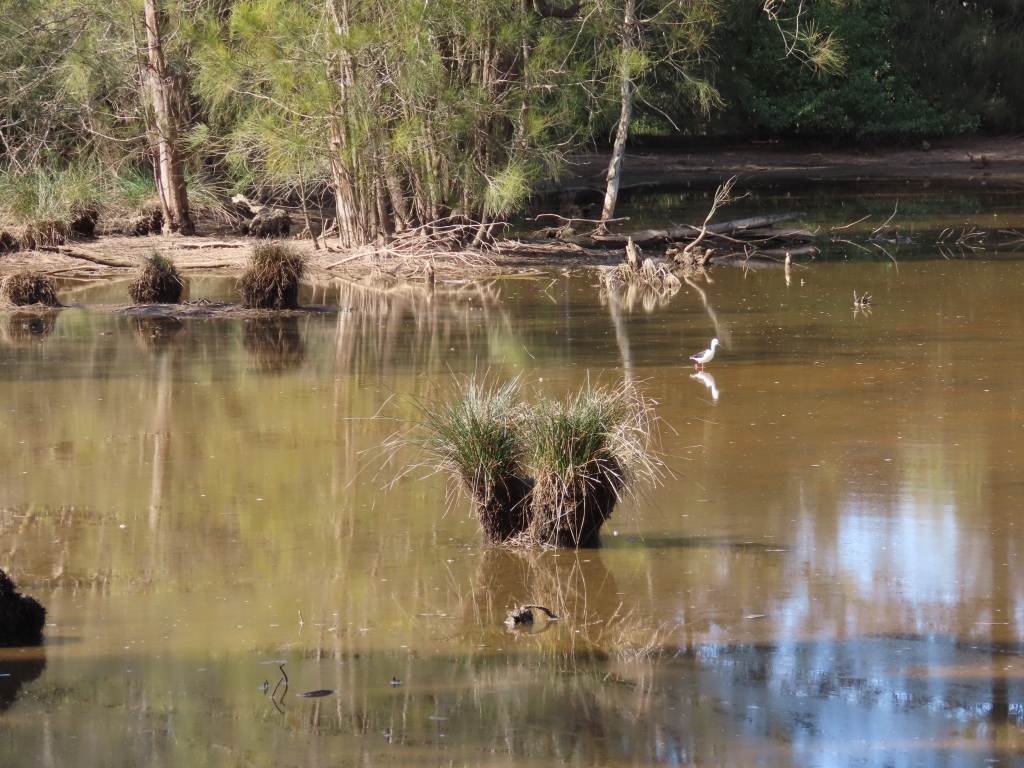
Common name: Black-winged Stilt — now Pied Stilt (Himantopus leucocephalus)
Scientific name: Himantopus himantopus
Approximate length: 33-37 cm
Date spotted: 28 August 2022 (winter)
Location: Sydney Olympic Park, Newington, New South Wales, Australia: 33°49’29.5″S 151°03’57.0″E

Majestic White-bellied Sea-Eagle
White-bellied Sea-Eagles are not uncommon in some areas around Sydney, but I’ve yet to get a good look at one. Today is the closest I’ve ever got to a decent picture, though my camera was at its maximum zoom (70x):

I was in Sydney Olympic Park, in the area around Newington Armory, doing the guided bird walk offered by the BirdLife Discovery Centre. The bird was on the far side of the Parramatta River.
White-bellied Sea-Eagles are very large and imposing birds. From head to tail, they measure approximately 85cm. They have a wing span of around 2 metres.
Here’s another picture of the bird:

The Birdlife Discovery Centre offers a webcam view of the sea-eages’ nest: Eagle Cam. The eagles currently have two chicks. You can watch them sleep, stretch, and be fed by their doting parents!
Common name: White-bellied Sea-Eagle
Scientific name: Haliaeetus leucogaster
Approximate length: 85 cm. Wing span: 2.2 m
Date spotted: 28 August 2022 (winter)
Location: Sydney Olympic Park, Newington, New South Wales, Australia: 33°49’16.7″S 151°04’06.3″E


 Sydney Birder