Blog Archives
White-faced Heron in Sydney Harbour
This White-faced Heron sat on a branch overlooking a Sydney Harbour inlet. I think the bird is a juvenile, judging by its soft colouring:
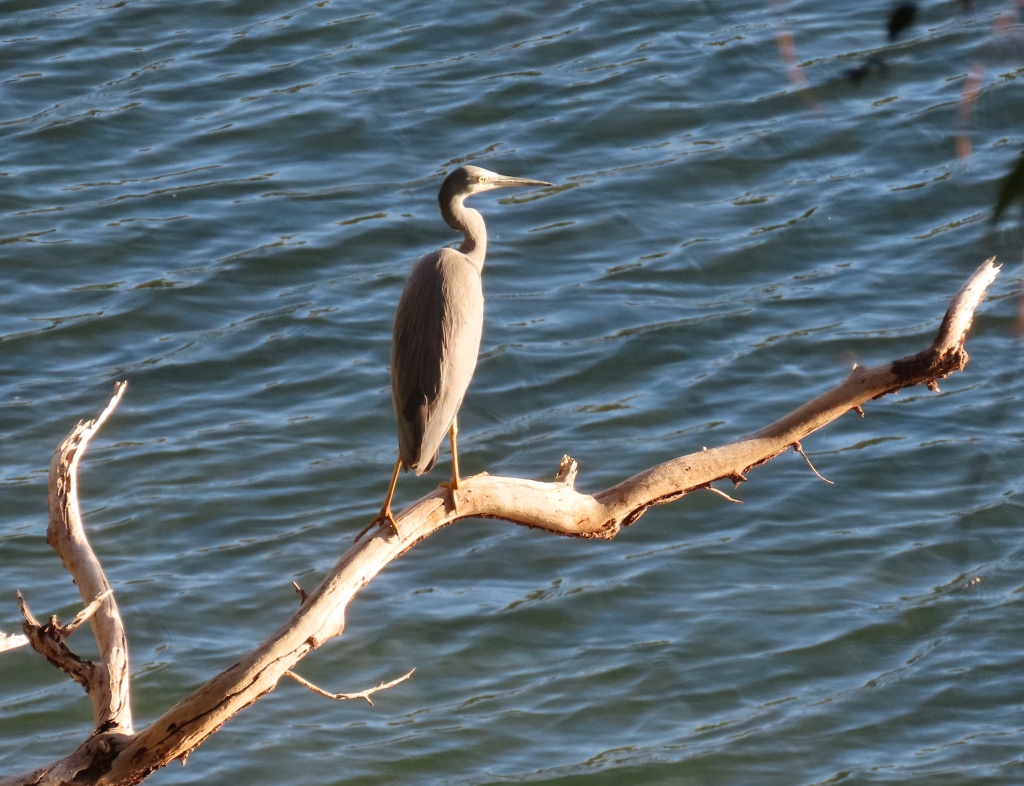
Common name: White-faced Heron
Scientific name: Ardea novaehollandiae
Approximate length: 66-69 cm
Date spotted: 1 April 2023 (autumn)
Location: North Harbour Walk, Sydney Harbour, New South Wales, Australia: 33°47’59.9″S 151°16’04.0″E

Soft colours of a young Little Wattlebird
This bird was busy gathering food on an Old Man Banksia tree (Banksia serrata). It has a small insect in its beak:

I think the bird is a Little Wattlebird, though others that I’ve seen have been darker and greyer in colour. Perhaps it’s a juvenile. I considered an oriole, but the stripes on this bird’s chest are more like those of a wattlebird than an oriole, and the shapes of the beak and head are closer to those of a wattlebird too.

Little Wattlebirds don’t have the red wattles that give this genus its name. These birds are classified as honeyeaters, but like most honeyeaters they’ll grab a passing insect too. This bird was at Dobroyd Head, one of the pieces of land that jut into Sydney Harbour.
Here’s a view that shows more of the wings and back:

Common name: Little Wattlebird
Scientific name: Anthochaera chrysoptera
Approximate length: 30 cm
Date spotted: 11 March 2023 (autumn)
Location: Dobroyd Head Track, Balgowlah, New South Wales, Australia: 33°48’33.2″S 151°16’14.1″E
Six kookies a-cackling
This morning I was treated to the sight of six kookaburras in a row, perched on the horizontal bar of an outlet pipe, all cackling away to each other. Australians fondly call these birds “kookies”. So, here you go, six kookies a-cackling:
Towards the end of the video, you’ll hear a jogger running up to me in excitement, exclaiming that she wished she had a camera. She obviously didn’t realize I was videoing!
After the birds flew off, I spotted two perched on a nearby TV antenna. It’s probably two of the six in the video, but not necessarily — there were quite a few kookaburras around:

Common name: Laughing Kookaburra
Scientific name: Dacelo novaeguineae
Approximate length: 47 cm
Date spotted: 28 January 2023 (summer)
Location: Balgowlah, New South Wales, Australia: 33°48’01.4″S 151°15’53.0″E

The quiet of the duck
It’s early morning on New Year’s Day in the park. The air is still, the crowds haven’t yet arrived. The ducks putter around as only ducks can do.
I’m at Manly Dam park near Sydney. On a quiet morning, the dam water reflects the hills and forest all round. The oranges, browns, and reds in this scene aren’t seasonal, though they do bring autumn to mind. They show the path of a recent fire — a hazard reduction burn conducted to reduce the risk of more damaging fires as summer draws on.
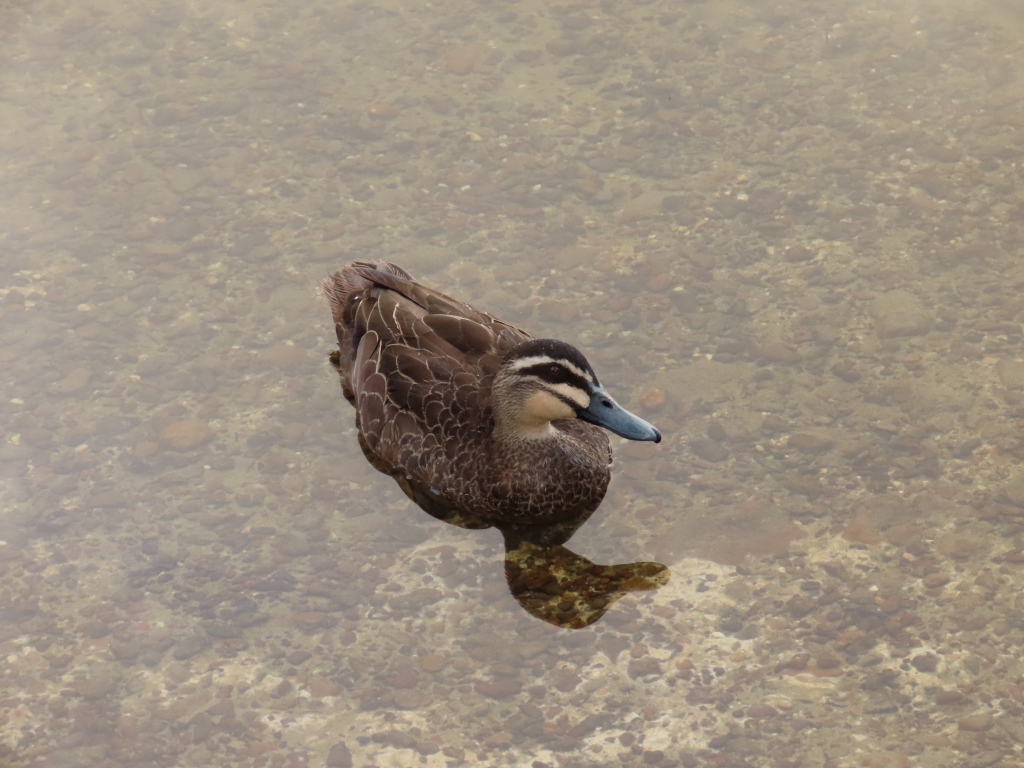
Among the ducks were this Pacific Black Duck:
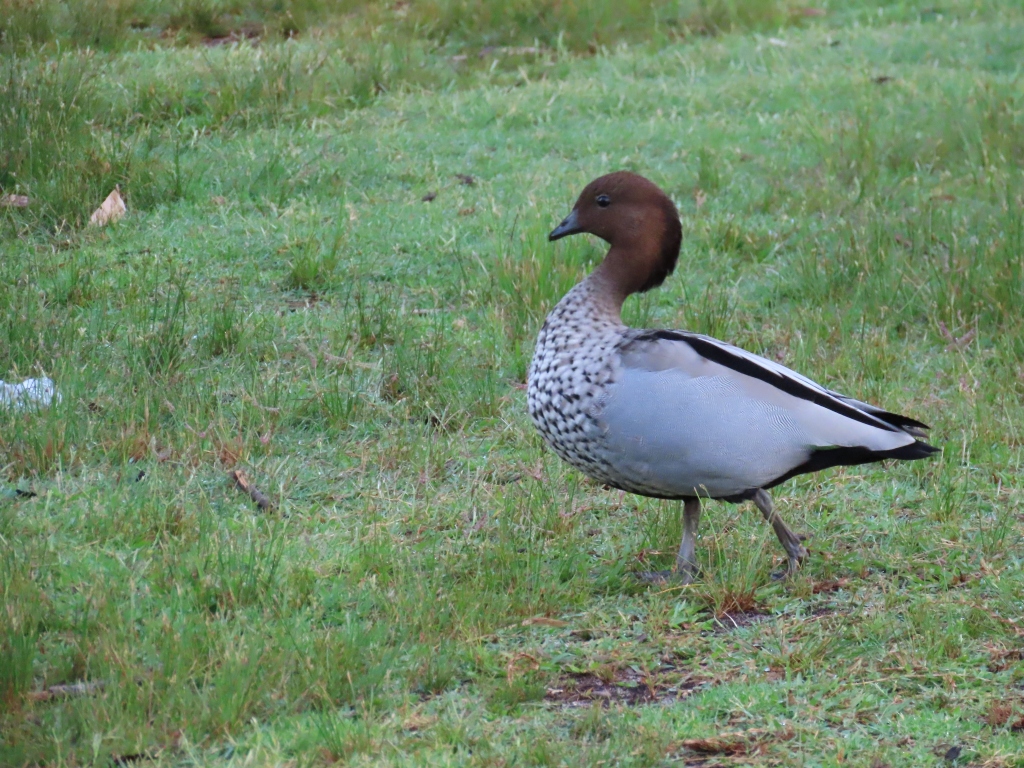
A male Australian Wood Duck:
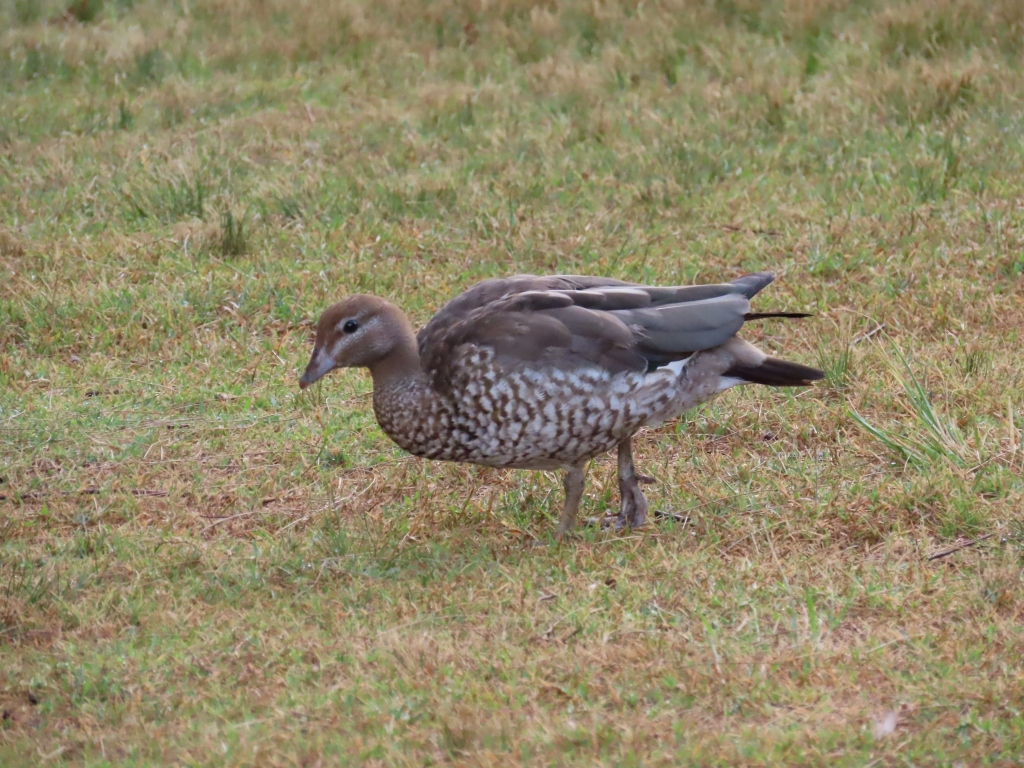
A female Australian Wood Duck:
And a female Mallard with a gorgeous yellow-green beak:

For me as watcher, the meanderings of the ducks enhanced the quiet of the early morning scene.
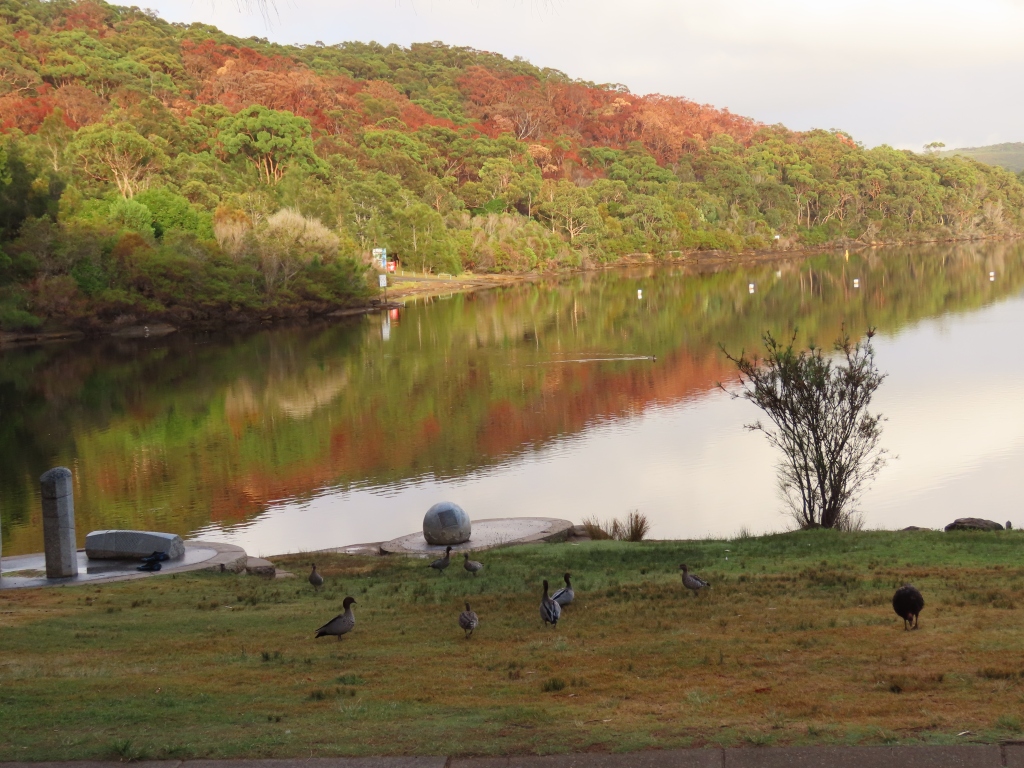
Oh yes, and there’s a Brush Turkey on the right too!

Young Channel-billed Cuckoos fed by currawongs
What’s that caterwauling? It’s a couple of young Channel-billed Cuckoos, awaiting their food. Are the patient bringers of food the parents of the young birds? No, they’re Pied Currawongs. Because, like other parasitic cuckoos, Channel-billed Cuckoos lay their eggs in the nests of other birds and leave it entirely to the adoptive parents to care for the youngsters.
The other ongoing noise that you hear in this video are the Cicadas. It’s the season of noisy beetles and noisy birds!
This is the second time that I’ve seen two young cuckoos being fed by currawongs, instead of just one. Evidently it’s quite common for these birds to lay more than one egg in someone else’s nest.
Here’s a still photo of the young cuckoo. What a big baby. It’s far larger than the currawongs that are taking care of it.

Here’s the youngster flapping its wings to make sure its carers don’t miss it:
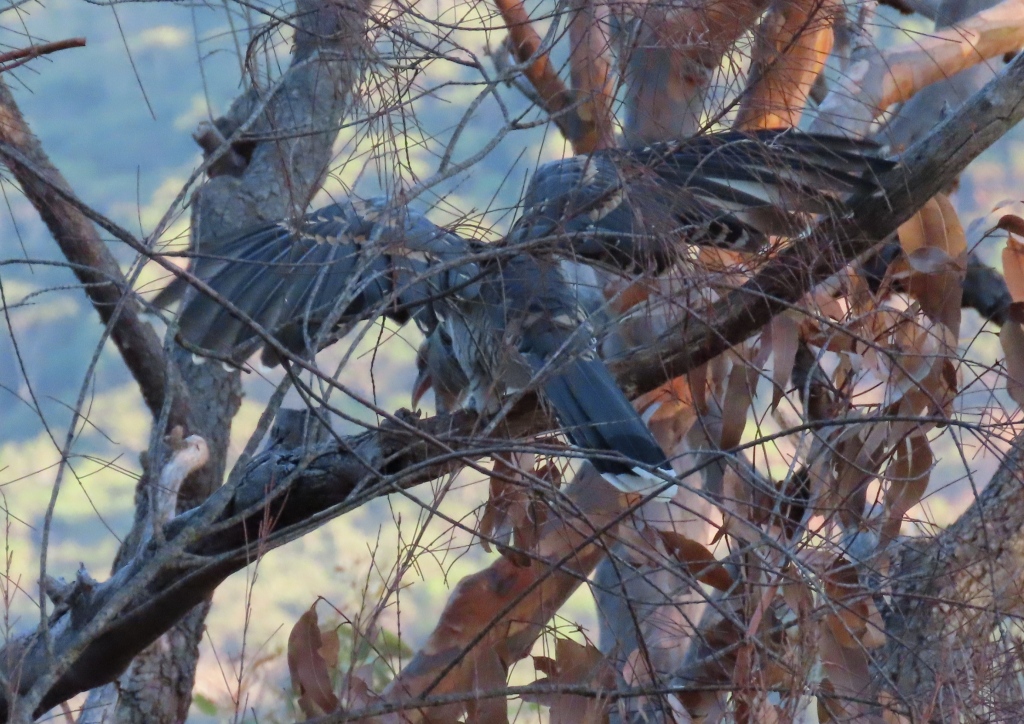
Channel-billed Cuckoo | Scythrops novaehollandiae | Approximate length: 58-65 cm
Pied Currawong | Strepera graculina | Approximate length: 45 cm
Date spotted: 28 December 2022 (summer)
Location: Manly Dam Park, New South Wales, Australia: 33°46’50.1″S 151°14’59.6″E

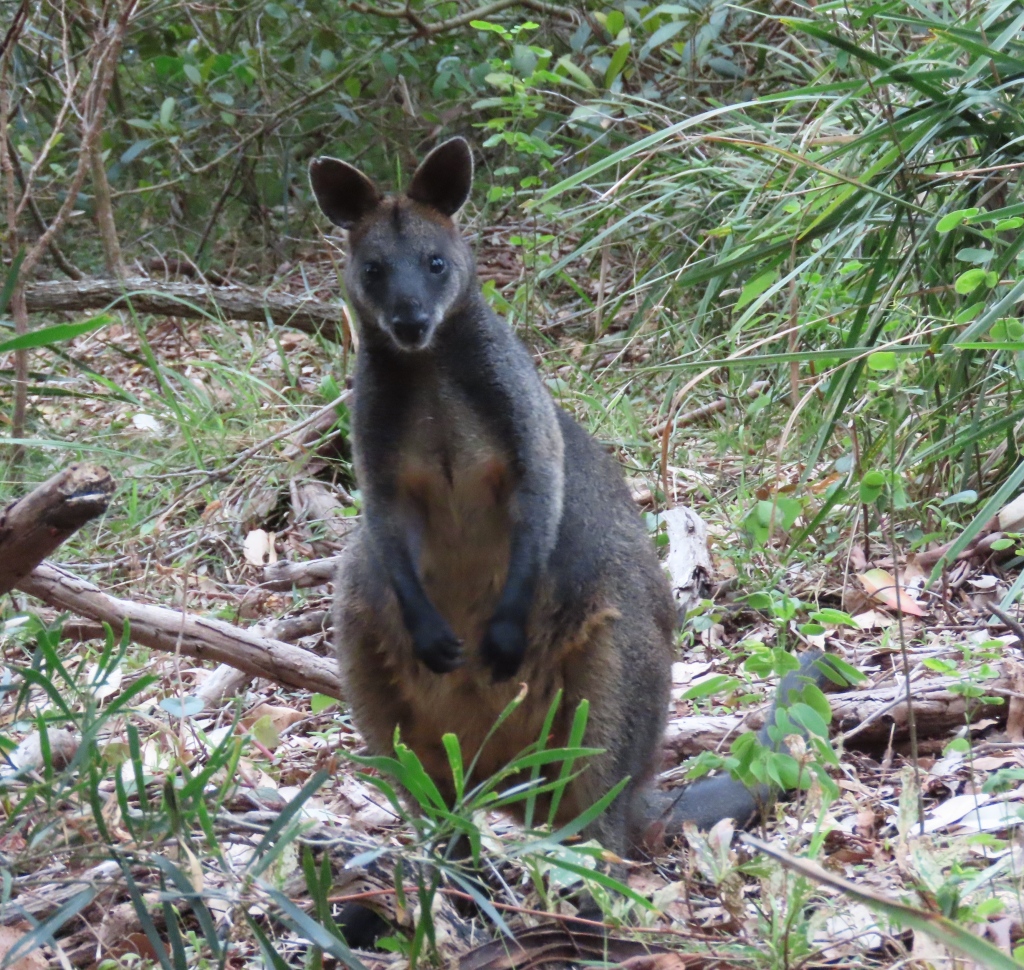
Mother wallaby with baby in pouch
Swamp Wallabies are a type of small kangaroo (macropod) found in eastern Australia. I see them relatively often when I’m out walking through the bushland areas in the early morning. Recently, the number of wallabies in my area of Sydney seems to have grown: at any rate, I see them more often I did than a few years ago.
This morning, I saw this mother at Manly Dam park, with a little one in her pouch:
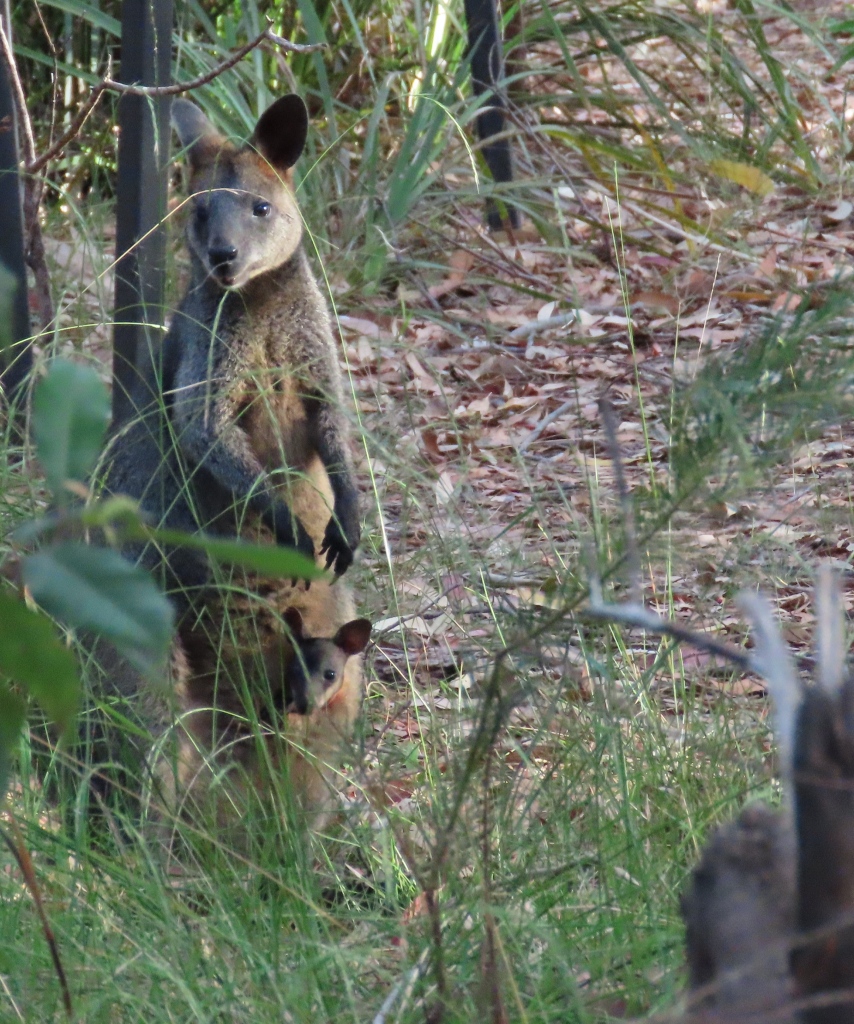
Swamp Wallabies are also called Black Wallabies. They’re relatively small, reaching up to my chest when they stand on their haunches. Their colour ranges from very dark grey to a lighter grey, with reddish patches around the ears and on the underbelly.
They’re marsupials. The little one, called a joey, stays in the pouch for around eight months, until it can live independently. In the picture above, you can see its head peeking out of the pouch.
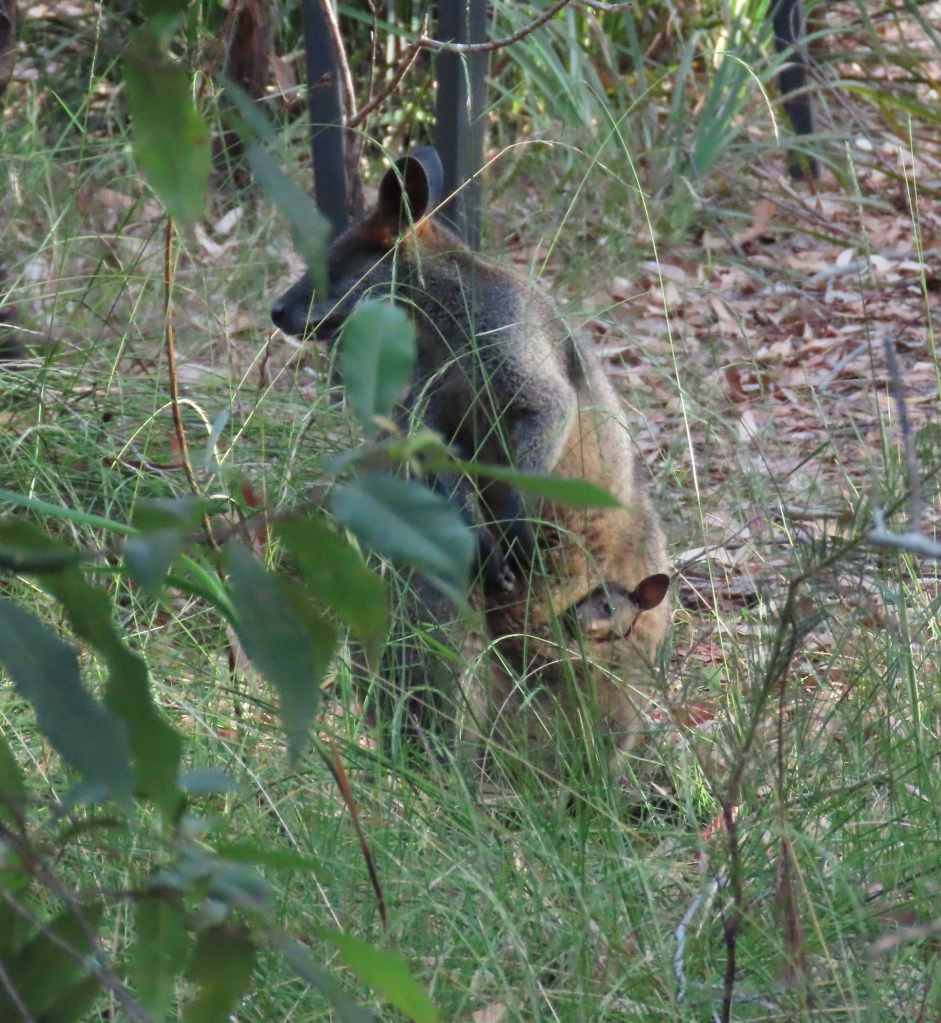
In the next picture, the joey was withdrawing into the pouch. Only one ear and part of its face are visible:
Here’s a short video showing the mother moving around and eating leaves while the youngster looks out at the world:
Generally, wallabies are quite timid and will move away when you approach them along a path. A few days ago, though, I came across one individual who squared up to me and held his ground. This was in a different area of Sydney, on a harbour walk near Balgowlah. The path passed within four metres of the wallaby. It’s breeding season at the moment, and I was probably getting a little close for comfort. I certainly felt a little uncomfortable too, as the animal rose up, turned to face me, and swished its strong tail through the undergrowth to get purchase for a potential fight:

Possums in the day time
A couple of days ago, when walking along a coastal path near Sydney, I saw a dark shape at the top of a bare tree:
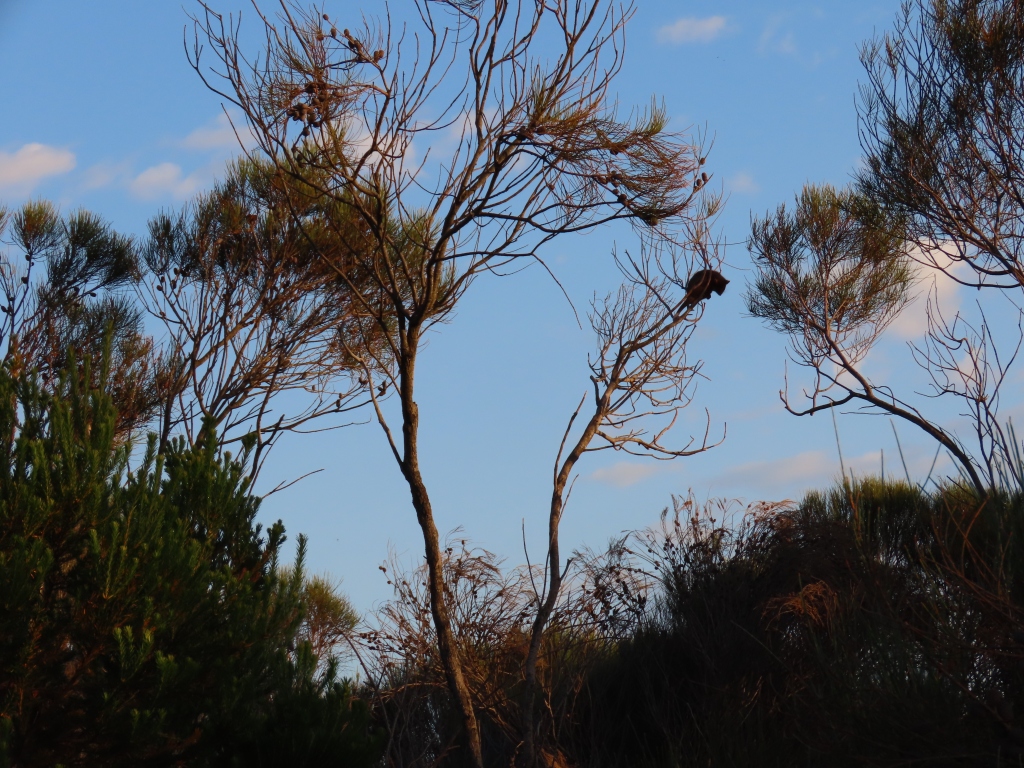
It’s very unusual to see possums out in the daylight. They’re usually active in the dusk and twilight hours. When the sun comes out, they’re tucked into their nests asleep.
This possum was very still. I watched it for about 10 minutes and it didn’t move an inch. I wondered whether it was dead. Perhaps it had been killed by an owl and left there while the bird went on an errand? Then, in a tree close by, I saw two more possums:
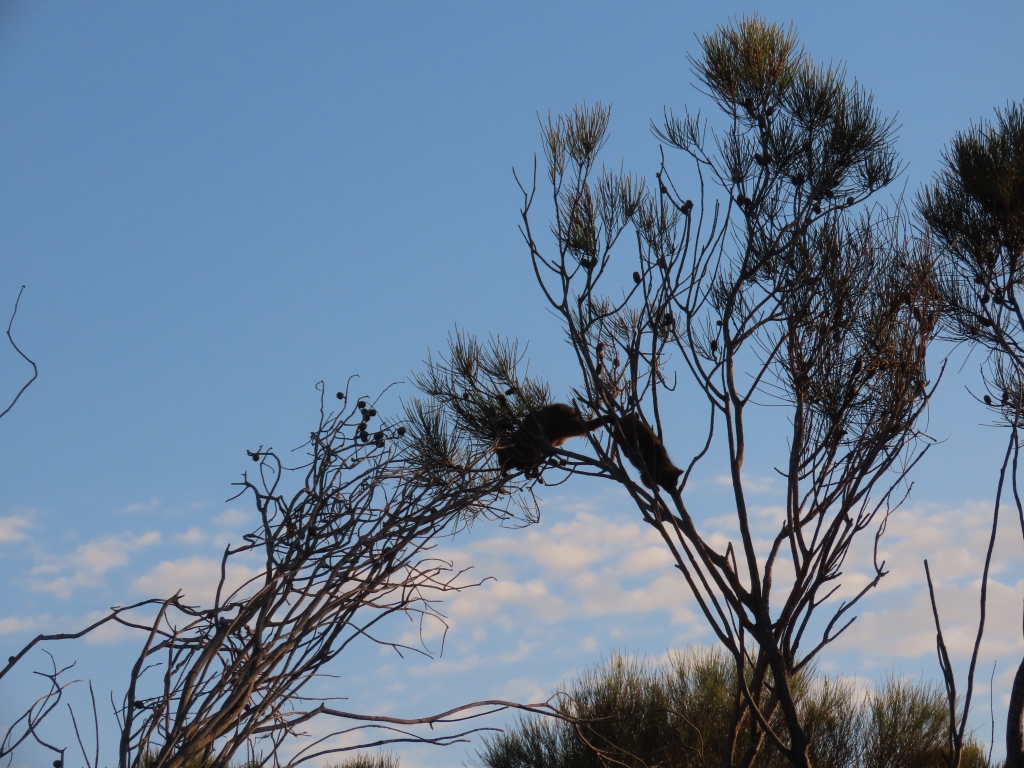
These two were similarly unmoving. No owl would kill three possums, so I felt a stirring of hope. Perhaps the animals were living up to their name and playing possum?
At last, one of the possums came to life:
These are Eastern Ringtail Possums. They’re about the size of a cat, and spend most of their time in trees. You can sometimes see them making their way along the phone lines in the early morning or evening. Their food consists mainly of leaves, fruit, and flowers. They build nests, called dreys, made out of twigs and bark. I’ve seen a couple of these nests, with the little animals inside. The nests are a bit messy, and are large compared to most bird nests.
I hope all three got back to their nests safely, before they could be found by the birds or cooked by the sun!
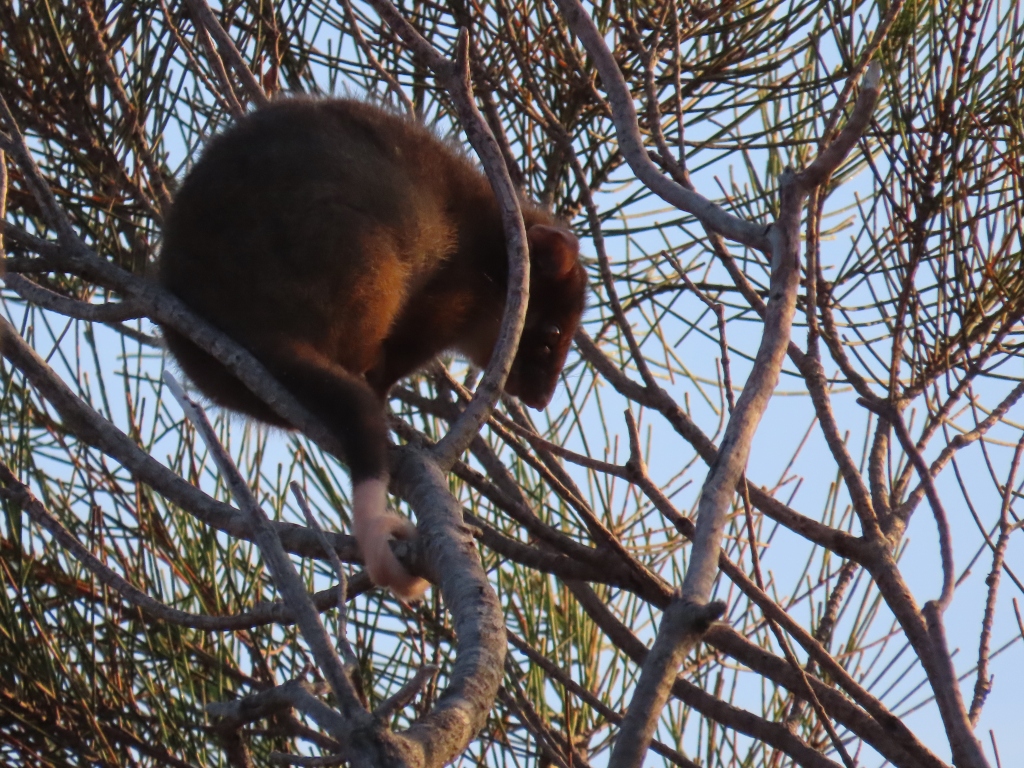
Common name: Eastern Ringtail Possum
Scientific name: Pseudocheirus peregrinus
Approximate length: 35 cm body plus another 30-35 cm tail
Date spotted: 24 December 2022 (summer)
Location: Dobroyd Head, Sydney Harbour, New South Wales, Australia: 33°48’36.6″S 151°16’21.2″E

Dolphins in Sydney Harbour on Christmas Day
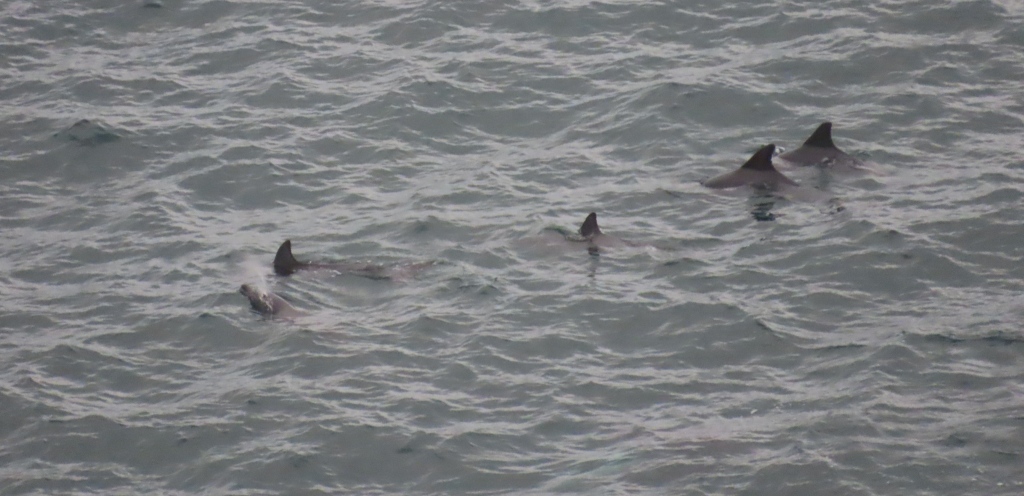
As I was walking at Dobroyd Head on the shores of Sydney Harbour this morning, I spotted a pod of dolphins swimming below me. I think they’re Bottlenose Dolphins, as those are the most common around Sydney.
In the photo below, I’ve added a black rectangle to show the approximate area where the dolphins were swimming:

It was 6.45 am on December 25th. Christmas day! I was standing at a lookout on Dobroyd Head, overlooking Sydney Harbour. At the top of the picture is North Head on the left, and on the right is one of the rocky promontories that defines the southern side of the harbour entrance.
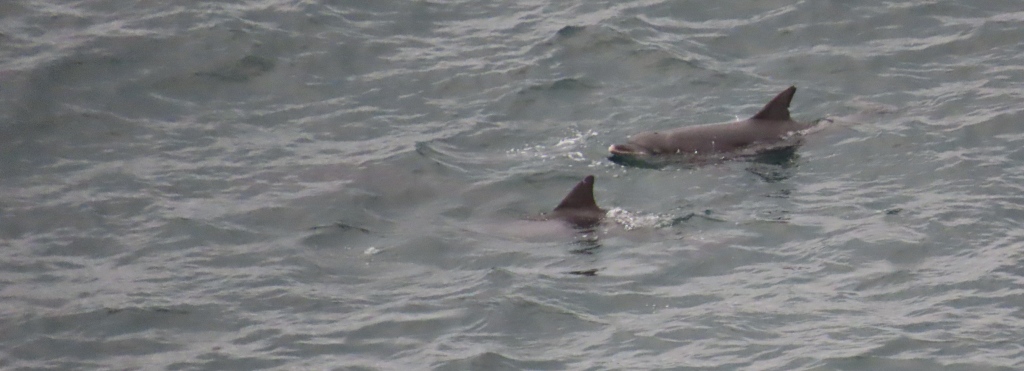
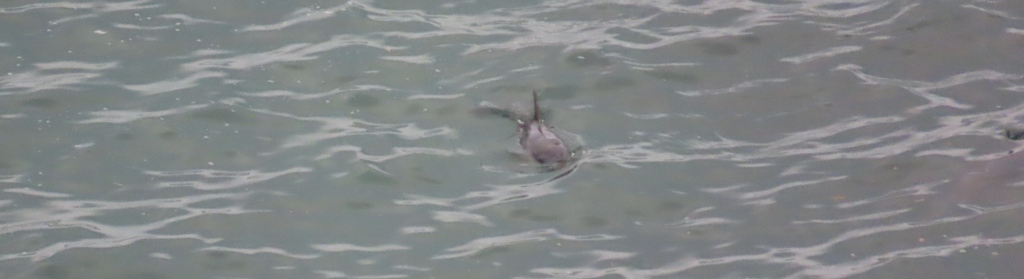
It was quite magical to see these creatures swimming below me. I’ve heard that there’s a study of the harbour’s dolphins happening at the moment, at Wild Sydney Harbour. The goal is to learn more about the behaviour of our dolphins and seals. I’ll let them know about this sighting.

Noisy Friarbird on nest at Coxs River
Off the beaten track for a day, I was delighted to see a Noisy Friarbird. Even more delightful was the fact that the bird was one of two taking turns to look after a nest:
The video shows one of the birds on the nest. It looks like there might be a youngster already hatched, because the bird seems to be passing something down into the nest (food?) and taking something else out (excrement?). At the end of the video, I panned out to show the lovely setting that the birds have chosen for their nest. It’s above Coxs River, with high trees and flowing water all round.
This is the first time I’ve seen a Noisy Friarbird. Indeed, it’s only the second friarbird that I’ve ever seen — the first was a Helmeted Friarbird up in North Queensland.
The nest is quite large and deep. It’s made of leaves, bark, and grass. Evidently the birds bind it together with spiderweb. Here’s a picture of one of the two birds sitting on the nest:
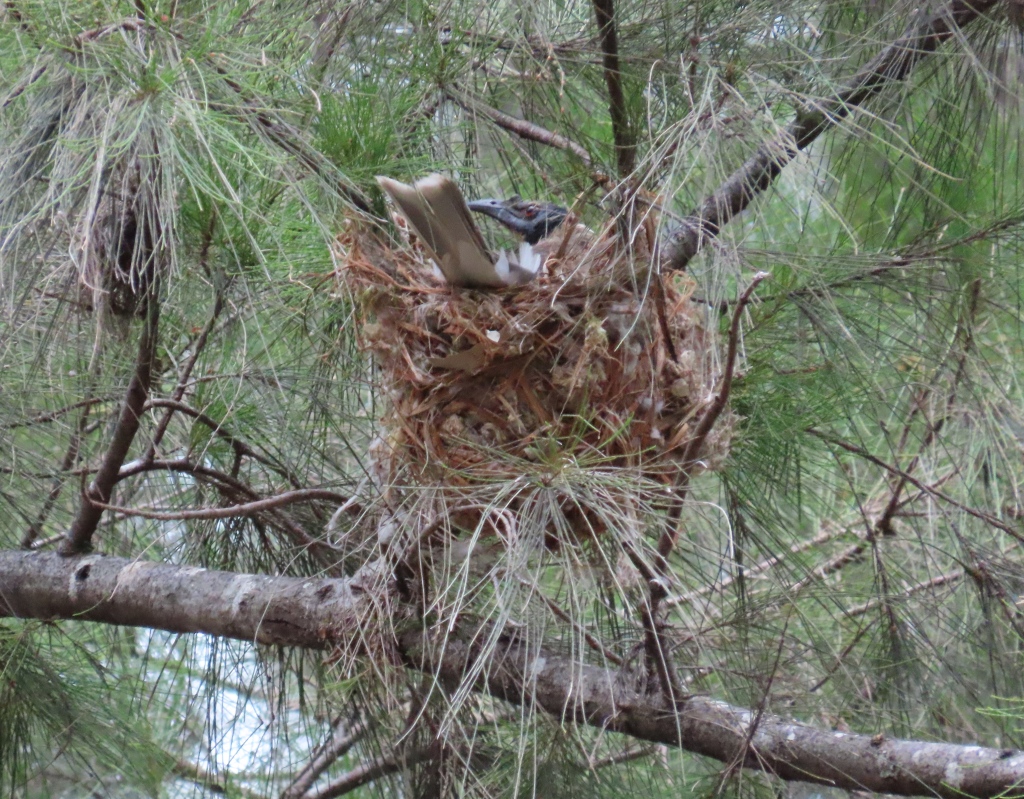
Noisy Friarbirds have a distinctive, slightly scary head: it’s bare of feathers, so that it looks a bit like a long black skull. Then there’s the large beak, with a knob on top. Not the prettiest of faces. The rest of the bird is quite pretty though, with creamy dappled white feathers below and soft browns and greys above, finished off with a white-tipped tail.
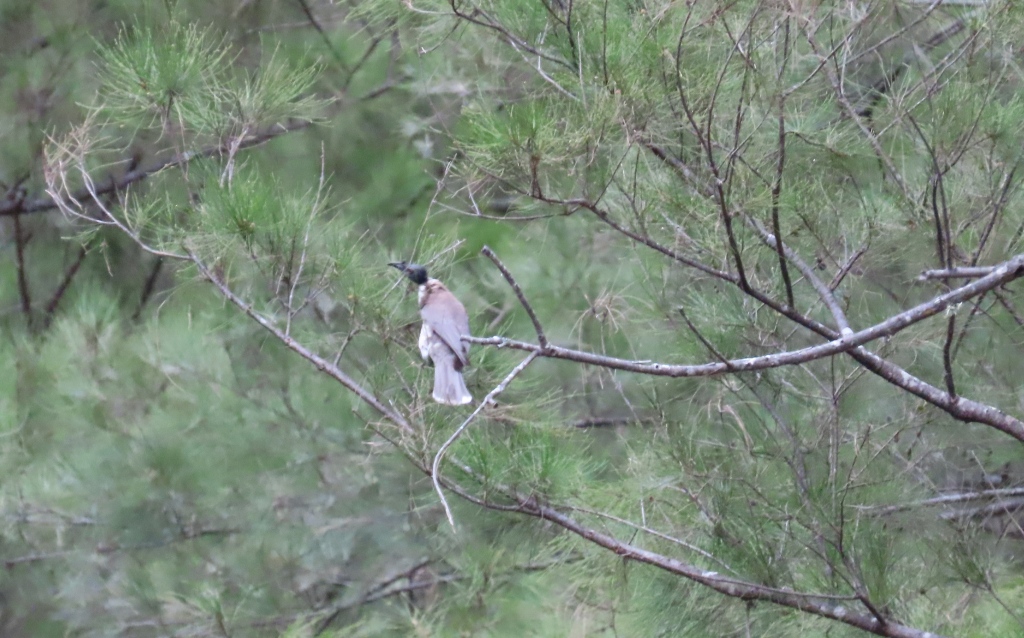
A few times, the birds would dive down steeply and fly horizontally just above the water. I think they were probably grabbing dragonflies and other insects as a tasty morsel:

This bird has something in its beak:

Common name: Noisy Friarbird
Scientific name: Philemon corniculatus
Approximate length: 30-35 cm
Date spotted: 23 December 2022 (summer)
Location: Coxs River Campground, Ganbenang, New South Wales, Australia: 33°44’35.1″S 150°10’45.1″E
Coxs River Campground is accessible only by four wheel drive. It’s a beautiful, restful spot, though it can get quite busy at times:


Brown pigeon in Sydney but not a Brown Cuckoo-Dove?
This lovely brown pigeon perched on a post at Pyrmont in Sydney. Does anyone know what type of pigeon it is?

Here’s a closeup of the bird:
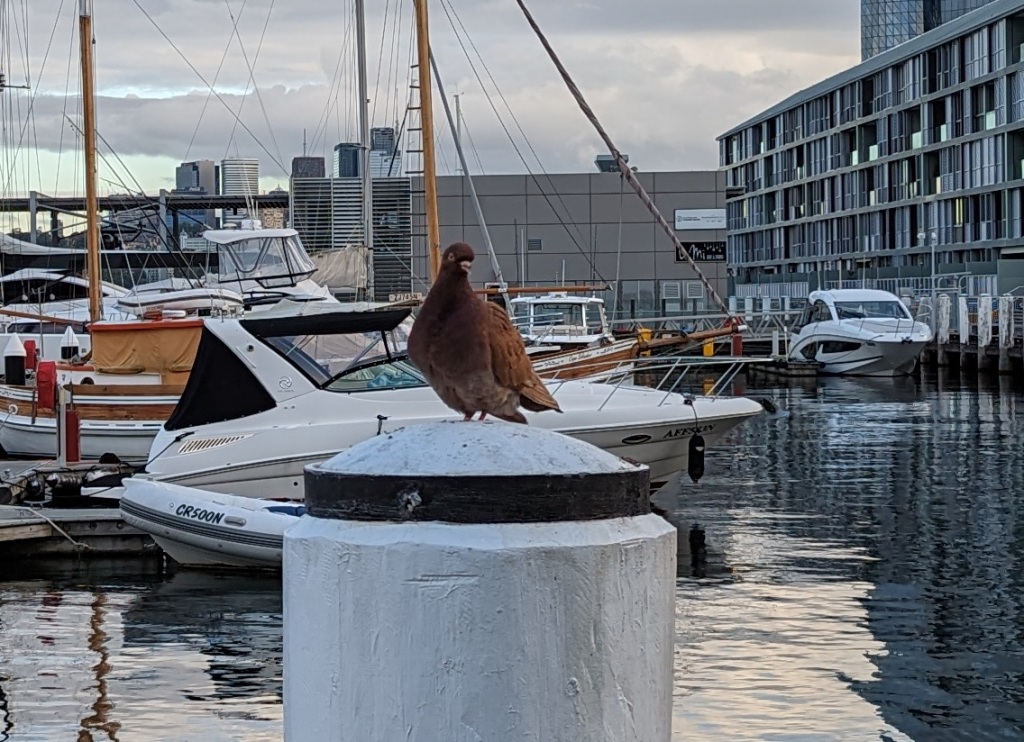
It doesn’t look like a Brown Cuckoo-Dove (Macropygia amboinensis) — the colouring isn’t quite right. This bird has a light-coloured beak and a light ring around its eye. Its chest plumage is as dark as the wings. Also, I don’t think its tail is long enough for a cuckoo-dove.
This picture shows the bird from a different angle, so that you can see its back, wings and tail:

Here’s a picture of the bird flying off:
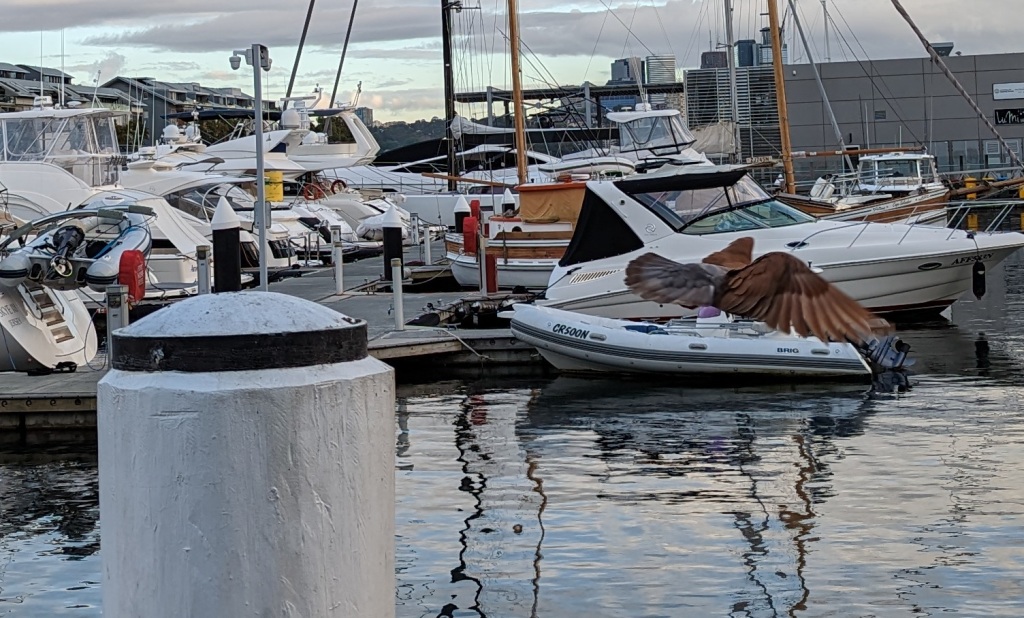
Common name: Pigeon
Scientific name: Unknown
Date spotted: 21 December 2022 (summer)
Location: Pyrmont, Sydney, New South Wales, Australia: 33°52’03.7″S 151°11’48.8″E


 Sydney Birder