Blog Archives

Two Darters for the price of one
Yesterday and again today I saw a Darter in an inlet of Manly Dam. I think they’re two different birds, because yesterday’s bird looks darker in colour. That could be because it’s more mature than the one in the same spot today, or it might be that yesterday’s bird was male while today’s was female.
Today’s Darter was perched in full sunlight on a dead tree. At the start of the video, the bird has stretched its wings out to dry, in the pose that’s characteristic of Darters and Cormorants. The bird is doing a bit of preening. The camera zooms out to show the surrounds: an inlet of Manly Dam near Sydney, Australia. Then a couple of joggers approach. The camera zooms back in to see the Darter’s slight unease at the sound of approaching people. The bird turns and stretches its long neck to check for danger. The joggers pass by underneath the bird, and all goes back to normal after a bit of a shuffle to get the feathers back in order:
Darters are often called snakebirds, due to their long, snake-like necks. It’s good to see the neck in action! They eat fish, which they catch by spearing them with that long sharp beak.
Here’s a still photo of the bird, showing a leery eye:
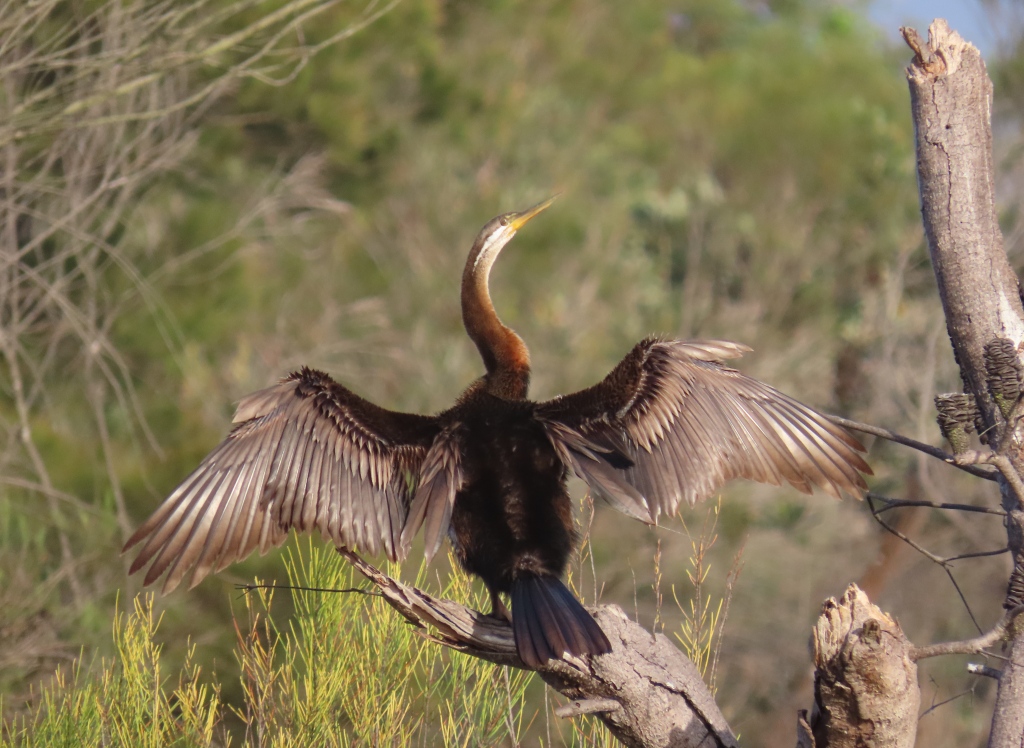
Yesterday’s bird was lower down, closer to the water and in shade. Its head, neck, and body look much darker in colour, and its wings more silvery:
Back in June this year, a cream-coloured Darter roosted in the same spot. The colouring of that bird surprised me, as I’d only seen dark brown or black ones up to that point.
Common name: Darter
Scientific name: Anhinga melanogaster
Approximate length: 90 cm; wing span: 1.2 m
Date spotted: 25 and 26 December 2023 (summer)
Location: Manly Dam Reserve, New South Wales, Australia: 33°46’34.7″S 151°14’48.9″E

Neon Cuckoo Bee perched on its face
A cuckoo bee visited our garden today. I’ve only seen these bees a few times, and posted once before about them on this blog. That was way back in 2020, and the bee that came to visit on that day was black and white, a Domino Cuckoo Bee.
Today’s bee had blue markings, which I think makes it a Neon Cuckoo Bee (Thyreus nitidulus):
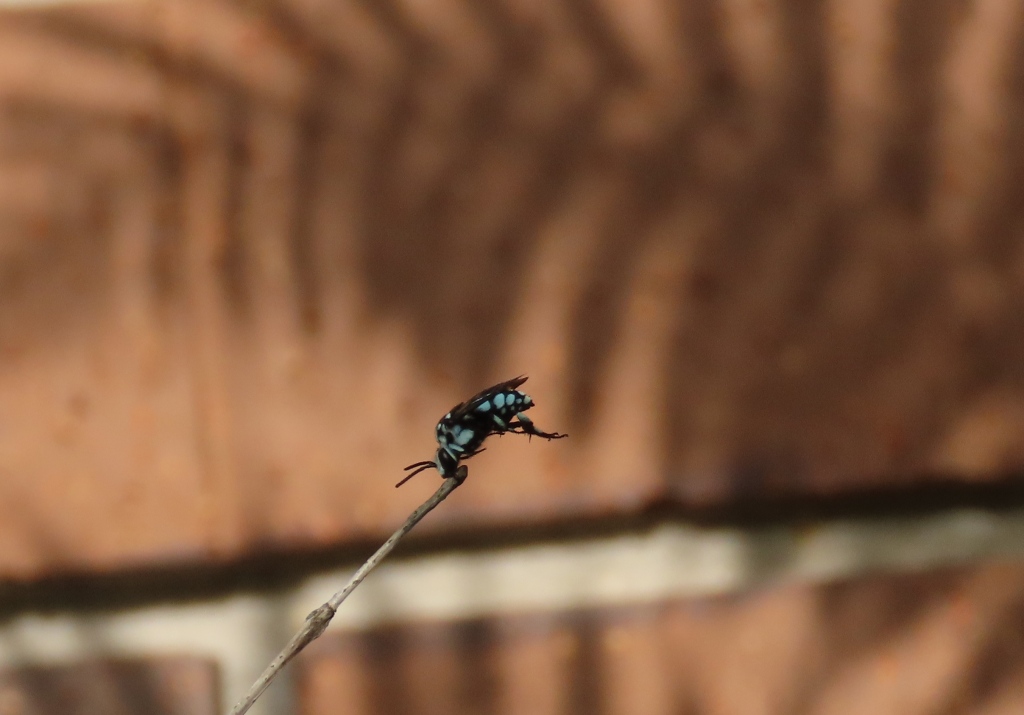
It looks as if the bee is resting on its face. In fact, it’s holding on to the twig with its mandibles — those are the strong jaw parts that it uses to chew its way out of its egg, shape wax into a honeycomb, feed its larvae, and more.
Cuckoo bees are native to Australia. They’re called “cuckoo bees” because they lay their eggs in other bees’ nests. In particular, Neon Cuckoo Bees target another Australian bee, the Blue-banded Bee. The Neon Cuckoo Bees’ eggs hatch more quickly than the host bee’s eggs, and the larva eats up all the nectar that the Blue-banded Bee parent has stored for its offspring!
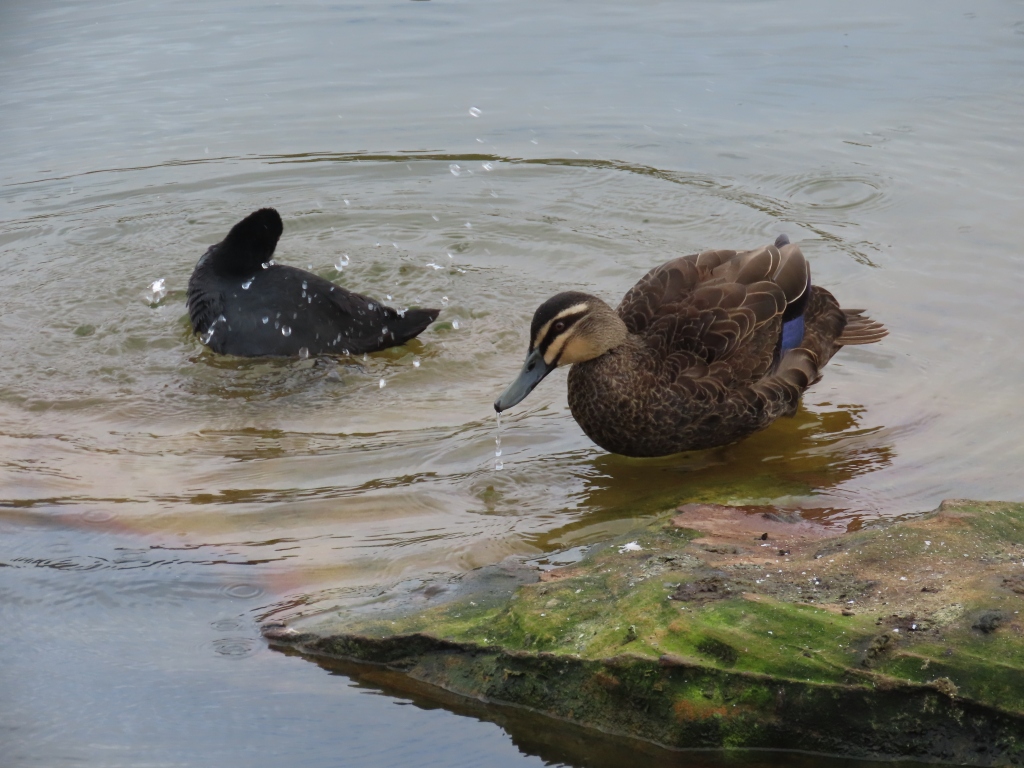
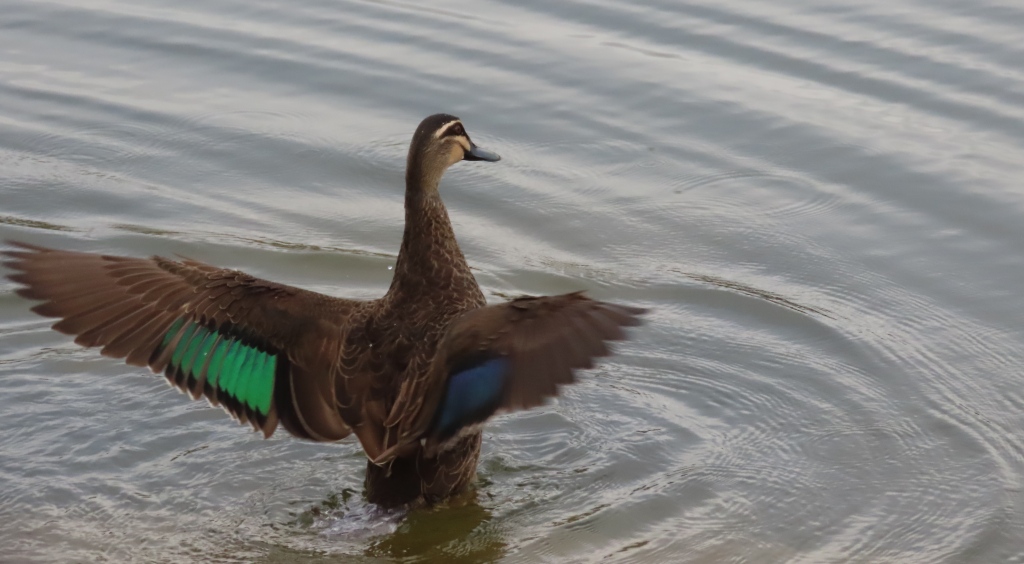
Pacific Black Duck with blue and green wing patches
The lighting this morning was perfect for catching the beauty of this Pacific Black Duck making her morning ablutions. I think this bird is a female, because the crown of the head and the feathers on the back are brown rather than black.
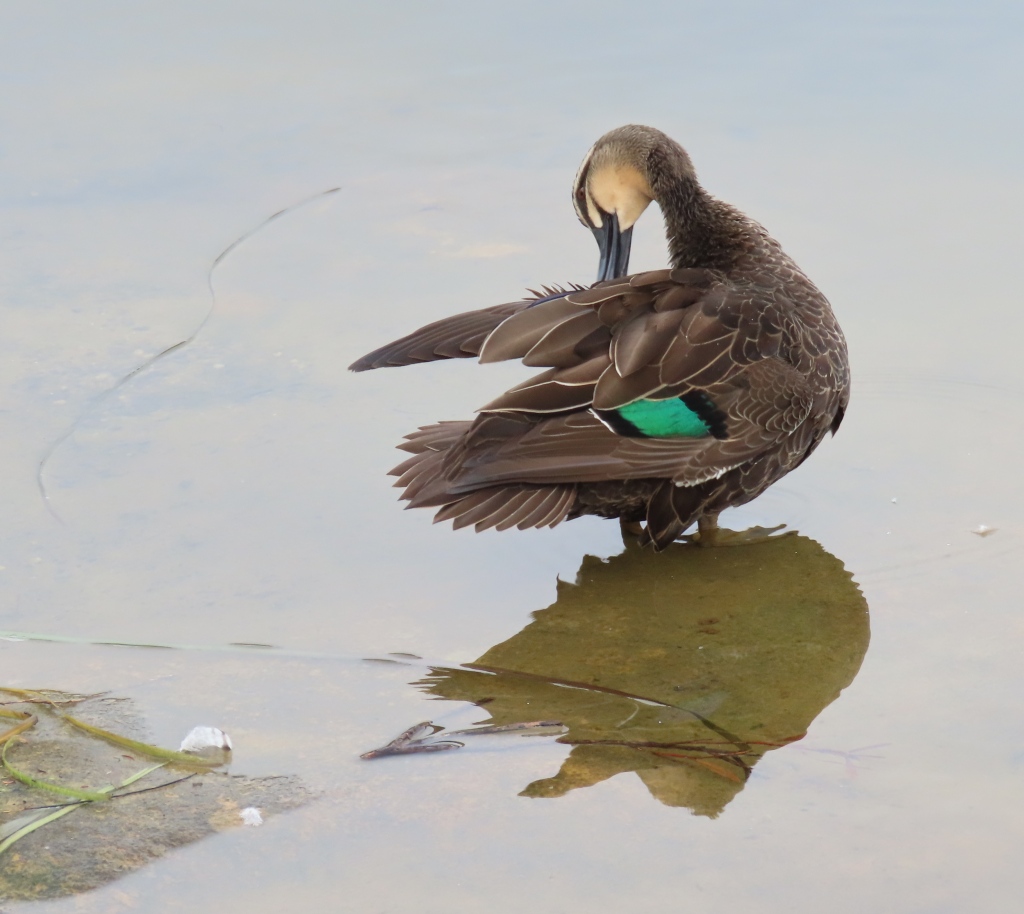
She spent many minutes preening, immersing herself in the water, then preening again.

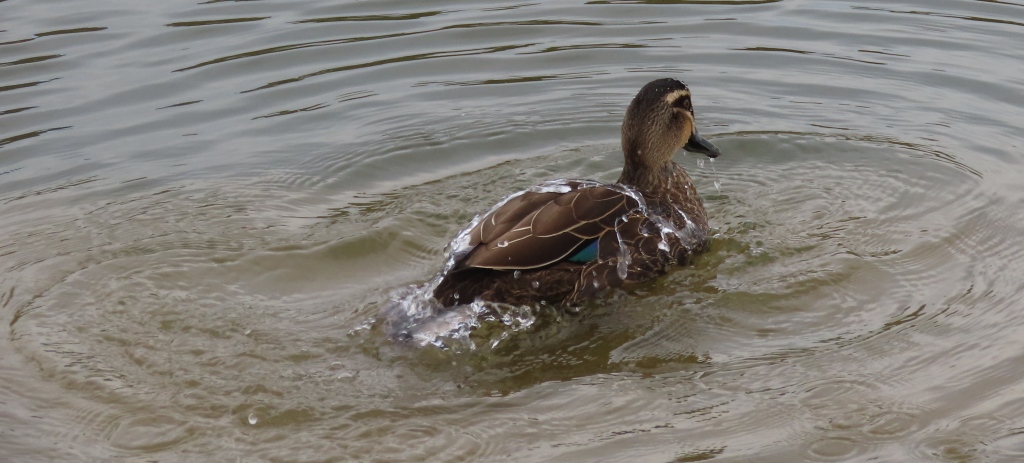
It was fascinating to see how the colour of her wing patches changed, depending on the lighting and the angle. In the first photo above, the patch is green. Here it’s purple:
In this wing stretch, it’s as if she has different colours on each wing, one green and one blue:
Common name: Pacific Black Duck
Scientific name: Anas superciliosa
Approximate length: 45-60 cm
Date spotted: 25 December 2023 (summer)
Location: Manly Dam park, near Sydney: 33°46’35.0″S 151°14’50.2″E

Red-browed Finch builds nest in lichen-covered tree
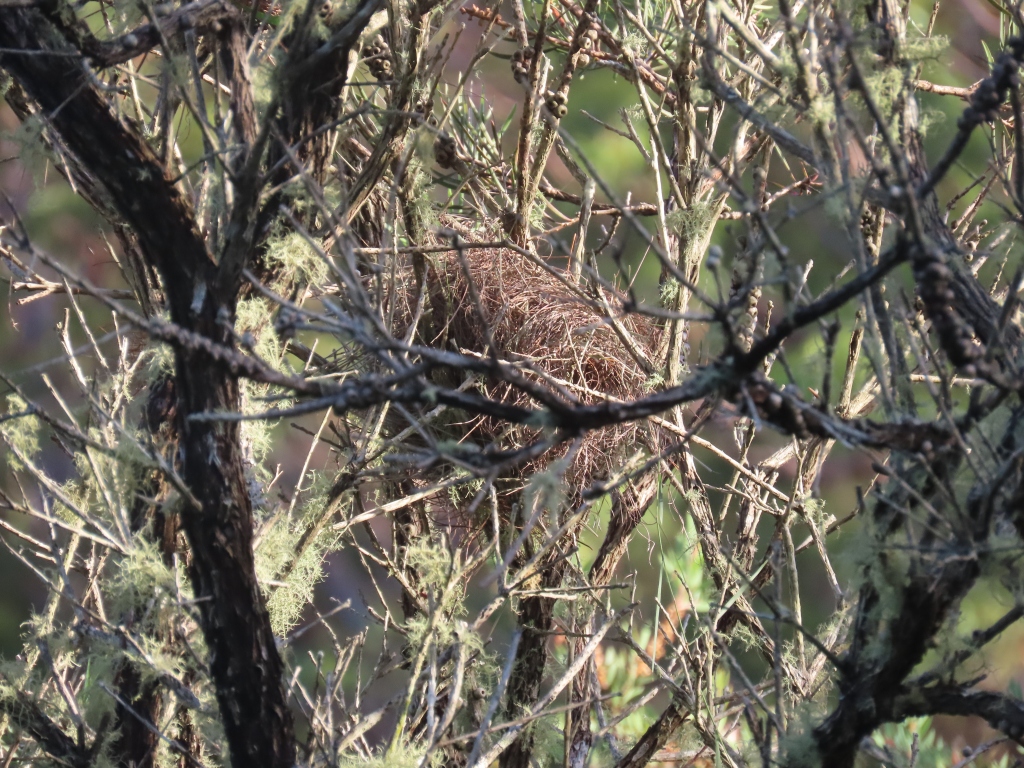
A little Red-browed Finch wrangles a long supple twig into its nest. The nest is in a lichen-covered tree, making a pretty scene with the red flashes on the bird against the green of the lichen.
The nest is barrel-shaped, bigger than I’d expect for such a small bird, with a small hole at one end:
The tree is in a swampy area of Manly Dam. When the weather is wet and humid, the lichen flourishes, as now:
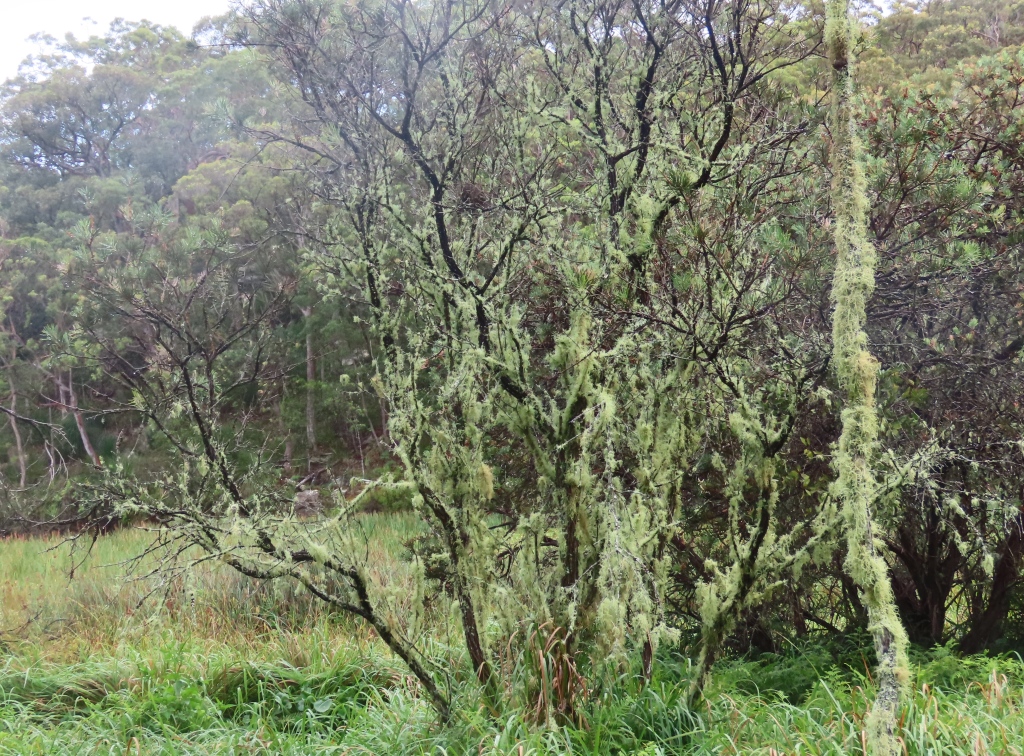
In the dry summer heat yet to come, the lichen will die away, but it always seems to come back.
Common name: Red-browed Finch
Scientific name: Neochmia temporalis
Approximate length: 12 cm
Date spotted: 22 December 2023 (summer)
Location: Manly Dam park, near Sydney: 33°46’23.1″S 151°14’35.9″E

Young Shufflewing being fed
Black-faced Cuckoo-shrikes are often called Shufflewings, because they flip their wings up and down a little each time they land. I hear the birds calling often while walking in the bush, and see them sometimes too. Usually, though, they’re high in the treetops and difficult to spot. It’s been a long-time ambition of mine to catch a video of one doing the wing-shuffle.
Today was my lucky day. Not only did I film the wing-shuffle of an adult Black-faced Cuckoo-shrike, but I also saw a juvenile being fed by adults. The birds were quite low down in a Casuarina tree, probably because that’s where the youngster landed after emerging from its nest.
In the first video, an adult bird lands next to the youngster and feeds it a parcel of food before flying off to a higher branch. The adult sits up high for a while, holding another tasty morsel in its beak. Adult and child trill softly to each other. The adult then drops down and feeds the little one again. When it lands on another branch, it does one of its characteristic wing-shuffles.
The second video starts with an adult bird carrying some food in its beak. The bird visits the youngster, passes over the food and hangs around for a short time, then flies off. The youngster takes some time to swallow the food, while gazing around and calling for the next morsel.
Here’s a still picture of the young bird:

The youngster again, from a different angle:

Here’s the adult, posed neatly against a blue sky:
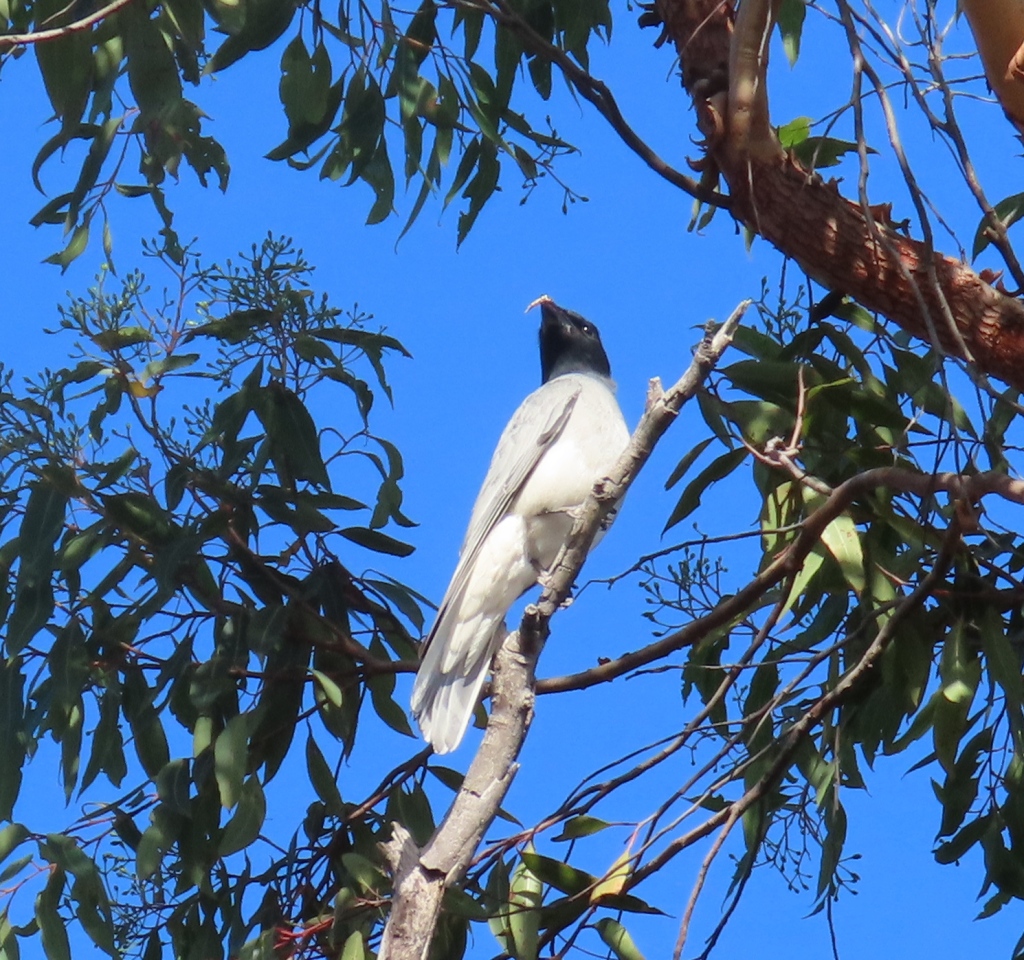
Despite their name, Black-faced Cuckoo-shrikes aren’t shrikes, nor even cuckoos. Evidently they acquired the name because their beaks have the same hooked end as a shrike’s and their feathers have similar patterns to some cuckoos.
These are beautiful, graceful birds to see and hear. I’ve posted descriptions of other Black-faced Cuckoo-shrikes that I’ve spotted over time.
Common name: Black-faced Cuckoo-shrike, also called a Shufflewing
Scientific name: Coracina novaehollandiae
Approximate length: 35 cm
Date spotted: 22 December 2023 (summer)
Location: Manly Dam Park, New South Wales, Australia: 33°46’53.2″S 151°15’08.0″E

White-winged Triller at Lake Lyell
A first recorded sighting for me, this White-winged Triller perched at the top of a bare branch long enough for me to photograph it:

White-winged Trillers are migrants to southern parts of Australia, arriving in spring.
I spotted the bird while camping at Lake Lyell, a lovely spot near Lithgow west of Sydney. The bird had perched very high up and quite far away, so my camera zoom was working at its max. The next shot is fuzzy, but does give a good idea of the grey-white colour of the bird’s back:
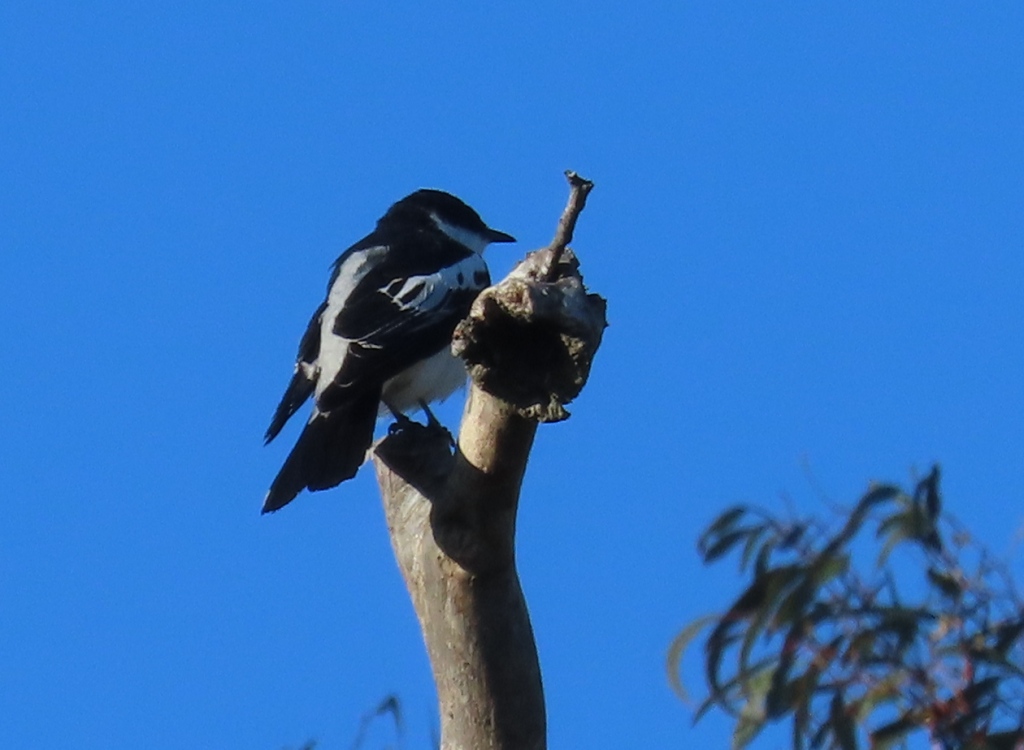
Common name: White-winged Triller
Scientific name: Lalage tricolor (suerii)
Approximate length: 16-19cm
Date spotted: 3 December 2023 (summer)
Location: Lake Lyell, New South Wales, Australia: 33°31’14.2″S 150°04’37.9″E
Interestingly, at first I thought the bird might be a Grey-crowned Babbler, because at the time when I saw it, there was also a very intriguing cackling sound. You can hear a Grey-crowned Babbler on Graeme Chapman’s site. I wasn’t sure, because I thought I’d also seen some birds of softer grey colours, flying lower down in the forest. And in fact, I’ve never identified a Babbler, and I’ve heard the same intriguing call several times in the past, at the same time as seeing birds of the more stark black and white colouring of the White-winged Triller. So, maybe the Triller and the Babbler hang out together a lot!
Next step: Photograph a Babbler, along with a sound track of that eerily beautiful call.

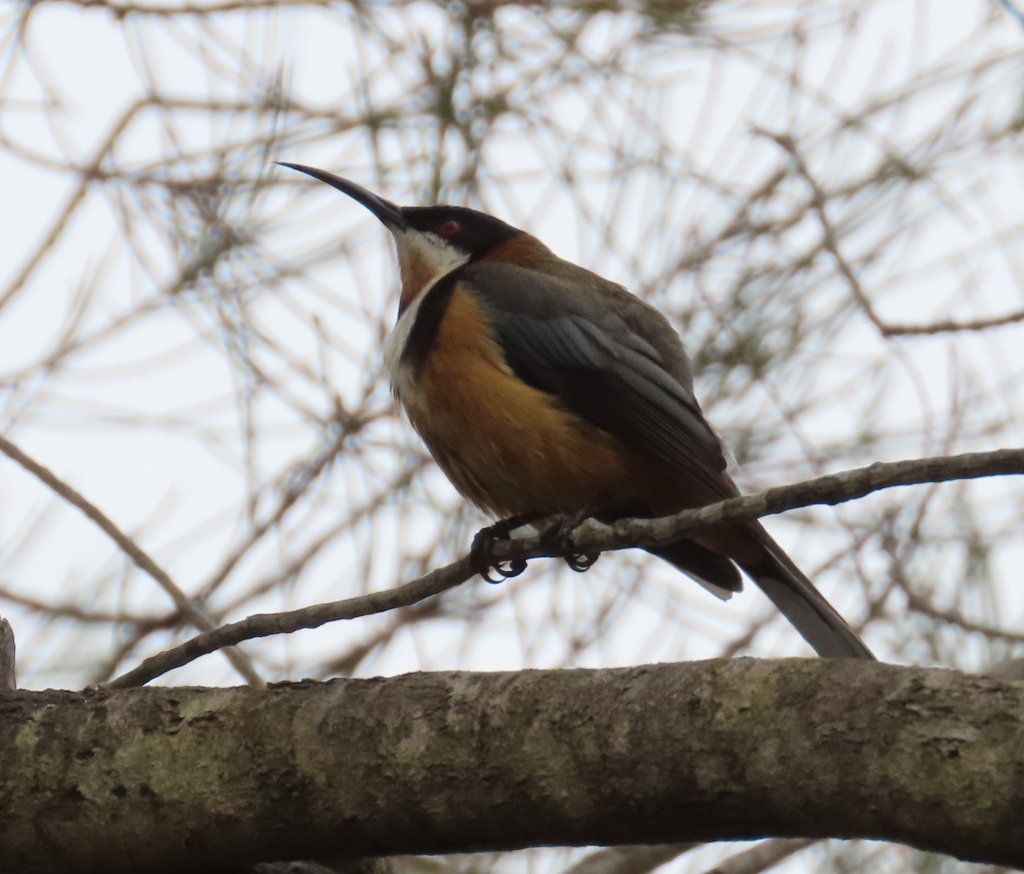
Eastern Spinebill all fluffed up
Usually, Eastern Spinebills look sleek and well groomed. This one seems to be having a bit of an off day.
Common name: Eastern Spinebill
Scientific name: Acanthorhynchus tenuirostris
Approximate length: 16cm
Date spotted: 19 November 2023 (spring)
Location: Manly Dam Park, New South Wales, Australia: 33°46’23.8″S 151°14’38.2″E

White-cheeked Honeyeater enjoying the spring blossoms
A White-cheeked Honeyeater peeks out from a flower-covered bush. The bird is mostly black and white, but you can just make out some of the yellow markings on its wings and tail:
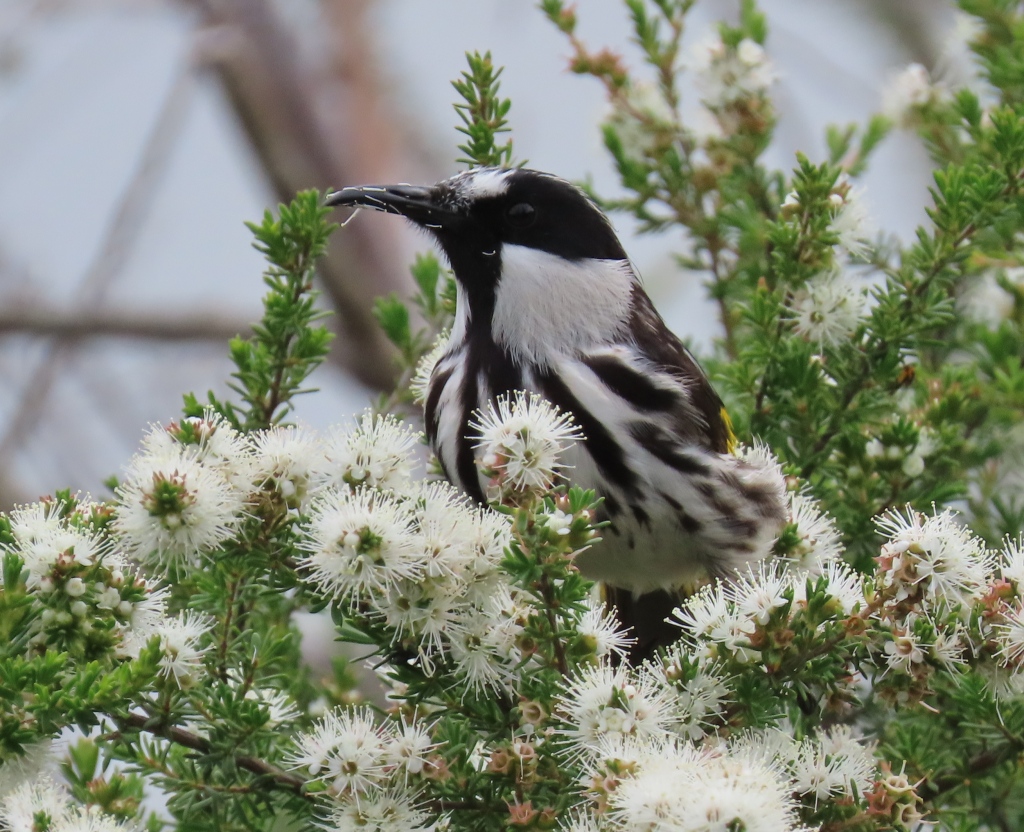
If you have trouble distinguishing these little birds from New Holland Honeyeaters, you’re not alone! This one has the black eye and large white cheek patch that identify it as a White-cheeked Honeyeater. A while ago, I took some photos of both birds to compare them.
Common name: White-cheeked Honeyeater
Scientific name: Phylidonyris nigra
Approximate length: 16-19 cm
Date spotted: 20 November 2023 (spring)
Location: Manly Dam Reserve, New South Wales, Australia: 33°46’30.3″S 151°14’46.6″E

Wombat sick with mange (reported to WIRES)
A few days ago, we were in a remote region of New South Wales near the Abercrombie River National Park. We saw a sick wombat on the side of the road. It was clear that the animal was in a lot of pain, but we didn’t know what was wrong with it.
Here’s a picture of the wombat having a rest after walking up a small incline. (Note: There’s a video later in this post, which can be distressing to watch. However, it shows that the wombat has a lot of energy and is eating well.)
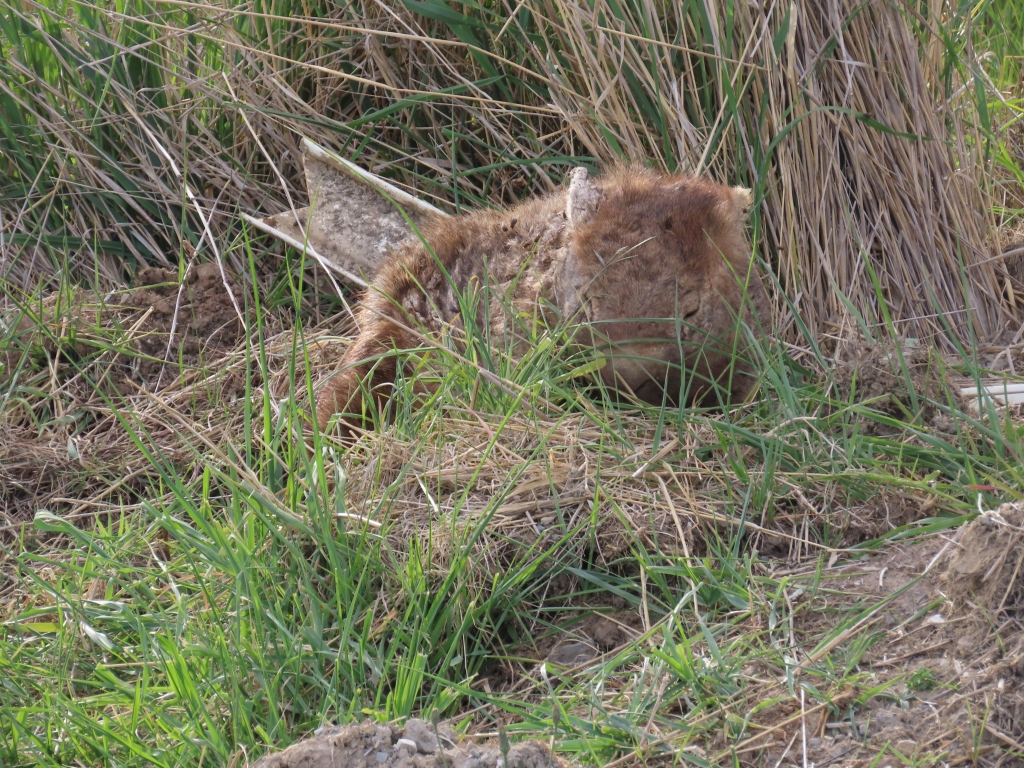
We passed the spot in the car, then turned round and went back to see if there was anything we could do to help. At first we thought maybe the animal had been hit by a car, because it was having obvious difficulty walking. It was eating well, which we took to be a good sign.
I didn’t get too close, because wombats are wild animals and deserve respect. The zoom on my camera was very useful in showing the animal’s condition.
I’d heard that a disease called mange is currently causing many wombats to fall ill, and I wondered if mange was the problem for this poor creature. But at that stage I didn’t know much about the condition.
We took some photos, then as soon as we had mobile service, we lodged an online report with WIRES, the Australian Wildlife Rescue Organization. We were able to give a Google Maps reference of the location of the animal. WIRES phoned us a couple of hours later, and confirmed the details. They then phoned us again the next day for further clarification, at which stage we were able to upload all our photos and the video too. A volunteer from nearby (that is, one and a half hours’ drive away!) would go out to look for the sick animal.
Mange is a skin disease, caused by tiny mites that burrow into the animal’s skin. It’s related to scabies in humans. One of the symptoms is the mass of flies attracted to the animal’s skin, which you can see if you magnify the photo in this post.
Evidently, treating a wombat with mange can be very successful. In most cases, treatment involves installing a flap on the entrance to wombat’s burrow and putting medication on the flap. The wombat thus gets dosed every time it enters and leaves home.
To compare this poor little wombat with a healthy one, take a look at the photos of a parent and baby wombat which we saw some distance away in Abercrombie River National Park.
Thank you and Kudos to Wires. Dealing with the people from WIRES was a very pleasant experience. I very much appreciate the hard work and dedication that the members of the organization and their network of volunteers put into rescuing wildlife in trouble.

Baby wombat in Abercrombie River National Park
In the lovely Abercrombie River National Park this weekend, I was lucky to come across a baby wombat and it’s parent on an early morning stroll. When I came on the scene, the parent nudged the baby towards a hole that led into its burrow. They stood there for a short time, then presumably decided I was safe enough, and continued their amble along the river bank.
Here they are in a lovely still photo. This was just after I saw them, and before I took the video. It looks as if the baby is emerging from another entrance to their burrow, though I didn’t go close enough to see:
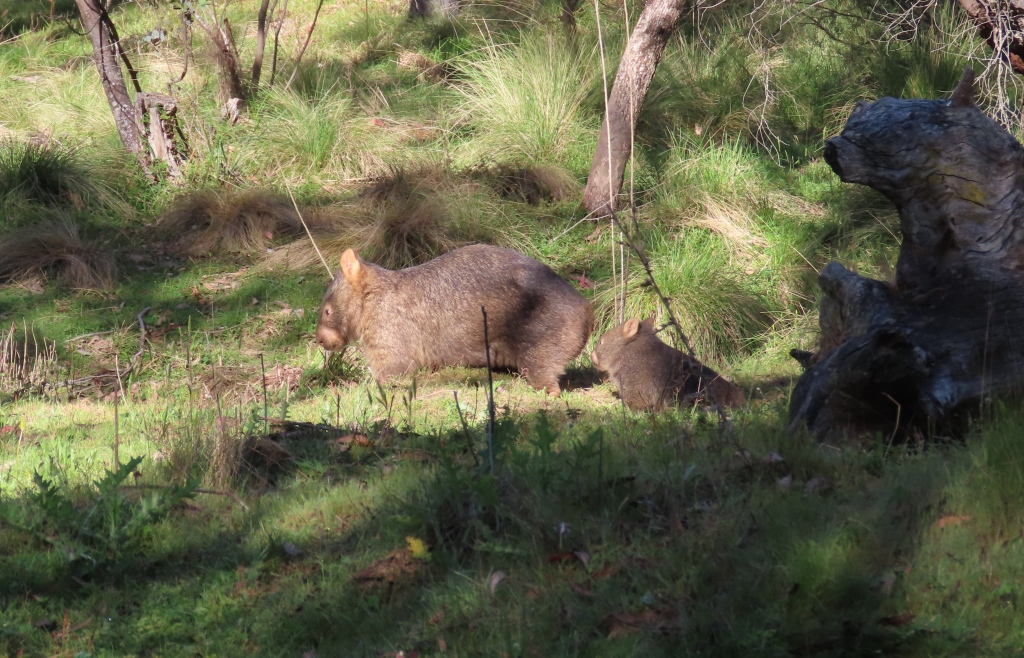
I count myself very lucky to have seen these animals, and such lovely healthy ones in such peaceful surroundings. Wombats are found only in Australia. Like many animals here, they’re marsupials. They’re also the koala’s closest relative.
They’re large, as far as burrowing animals go, at up to 1.3 metres in length and weighing more than 35 kilograms. They can also move very fast when they want to, although if you keep well away you’ll usually see them trundling along in a leisurely fashion like these two.


 Sydney Birder