Blog Archives
Golden Whistler calling – a short video
This morning, a Golden Whistler stayed in one spot for long enough for me to get out my camera and record a few seconds of his song. So, for your enjoyment, here it is!
Golden Whistlers are small birds, about the size of a wren. They have a black head and a white bib, and the golden chest, underbelly, and collar that give them the first part of their name. The second part of the name comes from their lovely whistling calls. I’ve published more videos and pictures of previous sightings.
Common name: Golden Whistler
Scientific name: Pachycephala pectoralis
Approximate length: 16-18 cm
Date spotted: 3 December 2025 (summer)
Location: Manly Dam Reserve, New South Wales, Australia: 33°46’45.0″S 151°14’54.2″E

Lone cygnet for this Black Swan couple
A pair of Black Swans in my neighbourhood has a single cygnet this year. Baby black swans are so cute! An adorable bundle of grey-cream fluff with black beaks, eyes, and legs:
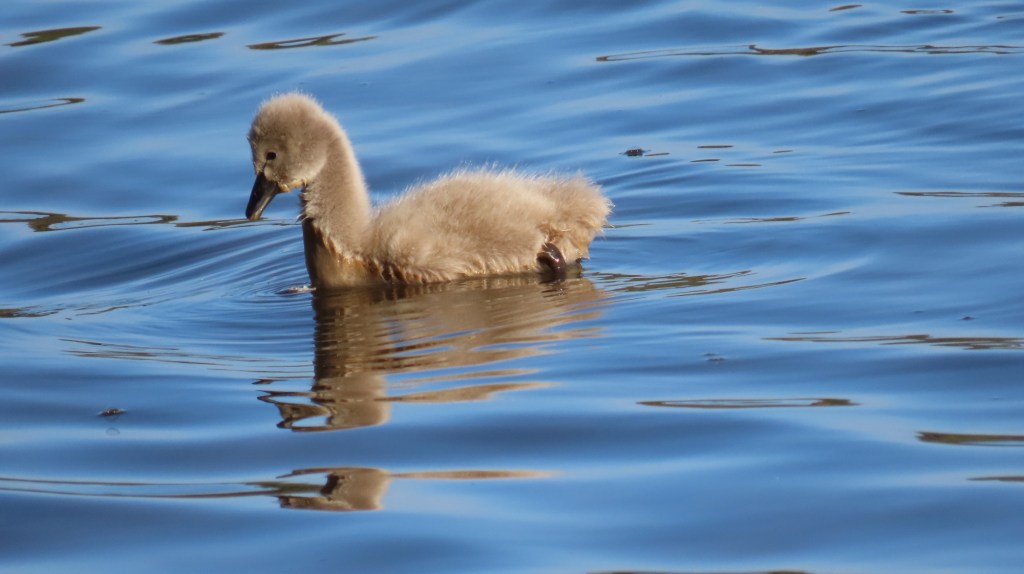
I don’t know how many eggs there were in the brood, nor how many of them hatched. Alas, baby swans are prey to several natural predators, especially hawks and eagles, as well as to introduced animals like dogs, cats, and foxes.
Here’s the baby and one of the adults, in a lovely mellow lighting:

It’s good to see any young swans at all — I didn’t spot any last year. In fact, I watched a pair of swans devotedly tend their nest for eight months without hatching any eggs! It’s possible they were both males, practising their nesting skills together in the absence of any females. I wrote about their vigil in two posts: part 1 and part 2.
So it’s great to see these two adults looking after the little one:
Common name: Black Swan
Scientific name: Cygnus atratus
Approximate length of adult bird: 120 cm
Date spotted: 25 November 2025 (spring)
Approximate location: Sydney’s Northern Beaches, New South Wales, Australia

Mudlarks building nest of mud
A few weeks ago, I watched a pair of Mudlarks building their nest. Mudlarks get their name from their construction of nests made of mud and reeds. Despite their name, Mudlarks are not larks. Another name for them is Magpie-larks — but they’re not Magpies either! Yet another name for them is Peewees, which is an imitation of the noise they make: pee-wee, pee-wee.
Building a good nest takes a lot of patience and skill. The birds use their beaks to pile globules of mud on top of each other to form a bowl, increasing the circumference of the bowl with each layer. Every now and then, the birds sit in the growing nest and wiggle their bodies around to smooth out the inside and make sure the nest is the right size and shape. Watch this video to see the nest-building:
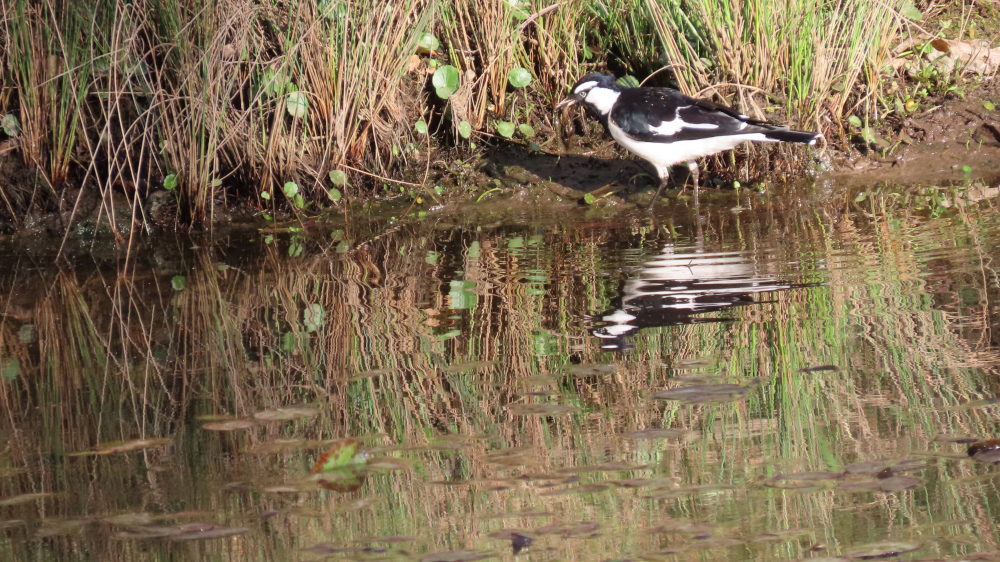
The birds collect mud and reeds from a nearby river or lake. Here’s a pair of them (male and female) collecting reeds at Manly Dam in NSW, Australia:
Here’s the female sitting in the nest, making sure it’s the right size and shape:

Here’s a still shot of the male gathering mud and reeds:
Common name: Magpie-lark, also called a Peewee or a Mudlark
Scientific name: Grallina cyanoleuca
Approximate length: 30 cm
Date spotted: 18 September 2025 (spring)
Location: Manly Dam National Park, New South Wales, Australia

My first Leaden Flycatcher
I spotted an interesting bird at Manly North Head a few days ago. It had prominent whiskers (actually, they’re rictal bristles), a chestnut breast and white belly, and large eyes:
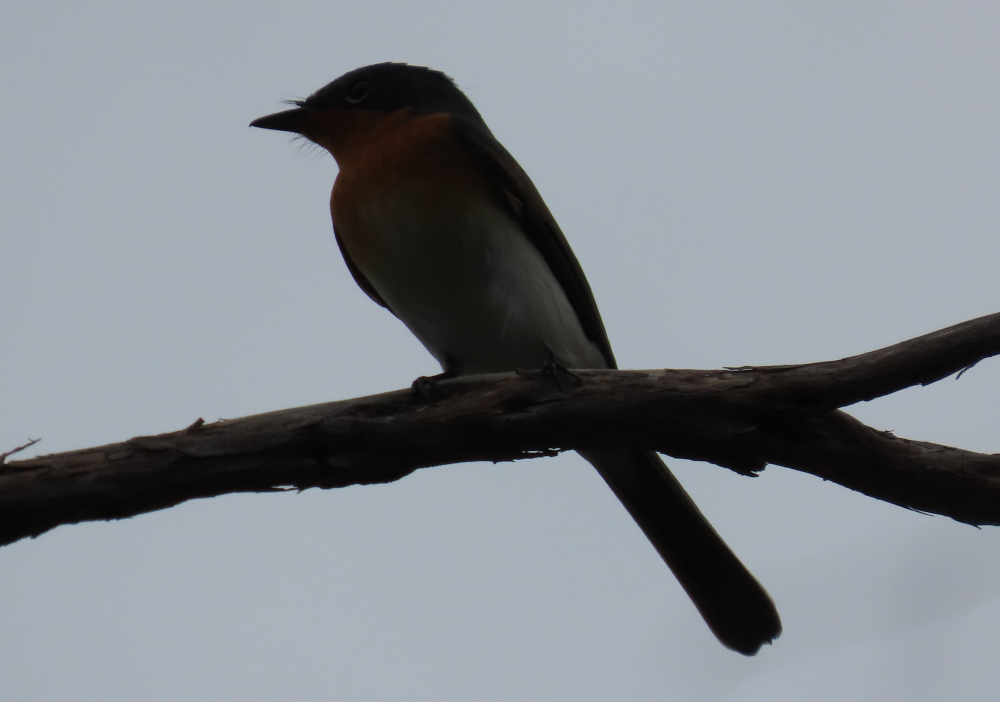
Was it a Spectacled Monarch? A Rufous Whistler? Maybe a female Flame Robin or Scarlet Robin? Eventually I asked the Australian Birds community on Reddit and received a likely identification: a female Leaden Flycatcher. This is a first sighting for me!
Leaden Flycatchers are common in north eastern Australia. They migrate southwards in the summer, but are uncommon in the south east where I am.
The whiskers around the beak are actually rictal bristles. They’re feathers that are modified to be sensors, helping the bird capture flying insects. After all, the bird has to earn its name, “flycatcher”!
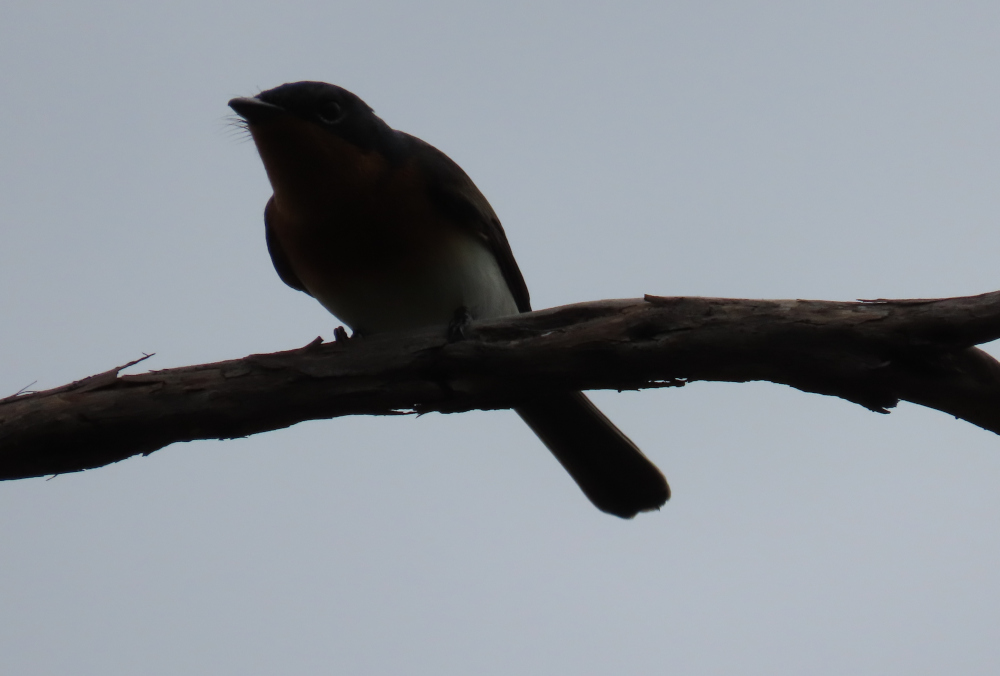
Unfortunately, it was early morning and the bird was silhouetted against the sky, so I couldn’t get a good photo. These are the best I have.

Here’s another shot of the front of the bird:
Common name: Leaden Flycatcher
Scientific name: Myiagra rubecula
Approximate length: 15-16 cm
Date spotted: 9 October 2025 (spring)
Location: Manly North Head, Sydney Harbour National Park, New South Wales, Australia: 33°48’58.5″S 151°17’56.6″E

Brush-turkey mound: I think she likes it!
Here’s a male Australian Brush-turkey showing a lady around his mound. The male is the one in front, with the bright yellow pouch dangling around his neck:

This particular Brush-turkey has been perfecting his mound for weeks. It’s good to see he’s getting some interest. Both birds are looking smart in their spring plumage.
This second picture is for scale, to show the size of the mound relative to some tree trunks and a fire gate:

The male builds and maintains the mound and invites a female to it. If she’s impressed, the female consents to mate with him and then lays her eggs in the mound. The eggs incubate and hatch without help, and the chicks emerge ready to take on the world.
Common name: Australian Brush-turkey
Scientific name: Alectura lathami
Approximate length: 60-70 cm
Date spotted: 23 September 2025 (spring)
Location: Manly Dam, New South Wales, Australia: 33°46’55.5″S 151°15’09.6″E

Alas, butcherbirds nest abandoned when tree fern sprouted
In my previous post, I wrote about a pair of Grey Butcherbirds that had built their nest in a tree fern below our house. The problem with tree ferns is that they sprout new fronds from the centre of the trunk, exactly where the birds had built their nest.
The photos of the nest in my earlier post were taken on the 18th of September. Just a few days later, the tree fern did indeed sprout a new frond, putting the nest at an uncomfortable angle. Still, the butcherbirds persevered. This photo, taken on the 25th of September shows one of the birds sitting determinedly on a very slanted nest, which presumably still contained the three eggs:
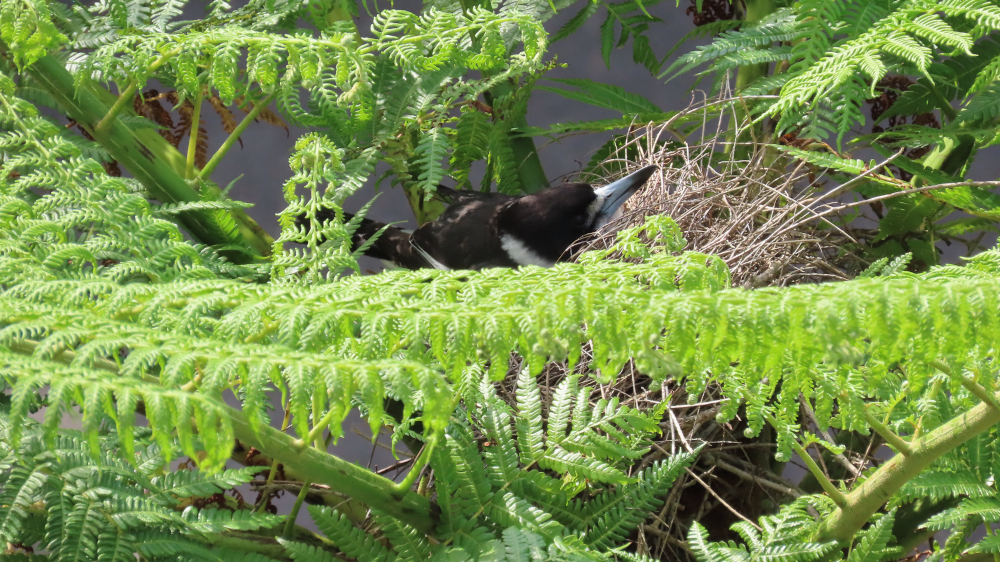
Just a day later, the birds had abandoned the nest. I don’t know if the eggs were still in the nest. The tree fern is way too high for me to go up and take a look:

By yesterday, the 5th of October, the new fern frond had pushed the nest to the top of the canopy:

Never mind little butcherbirds, there’s still plenty of time left this season to try again. Or next year perhaps.
Perhaps they’ll have learned something about real estate from this experience. Grey Butcherbirds live for around 20 years, so there’s plenty of time for learning!
Common name: Grey Butcherbird
Scientific name: Cracticus torquatus
Approximate length: 30 cm
Date spotted: 18 September to 5 October 2025 (spring)
Location: Allambie Heights, NSW, Australia

Noisy Friarbird reminds me of stretcher bearers in Bedknobs and Broomsticks
I have a childhood memory of a movie (I think it was Bedknobs and Broomsticks) where the vultures were the stretcher bearers on the sidelines of a sports match. Each time someone was injured, the birds would straighten up and look excited, then hunch down again dejectedly when the person didn’t need their attention.
This Noisy Friarbird reminds me of those cartoon stretcher bearers!

Common name: Noisy Friarbird
Scientific name: Philemon corniculatus
Approximate length: 30-35 cm
Date spotted: 12 September 2025 (spring)
Location: Denman, NSW, Australia: 32°23’33.7″S 150°41’00.4″E

Another White-plumed Honeyeater
This is my second-ever White-plumed Honeyeater, spotted this time in Denman NSW, about three hours’ drive north west of my usual haunts on the east coast of Australia. The picture shows nicely the white stripe that gives the bird the name “white-plumed”. As I remarked when posting my first sighting of a White-plumed Honeyeater, I’d expect a grander plume to match the name. Something along the lines of an ostrich’s tail feathers, perhaps!
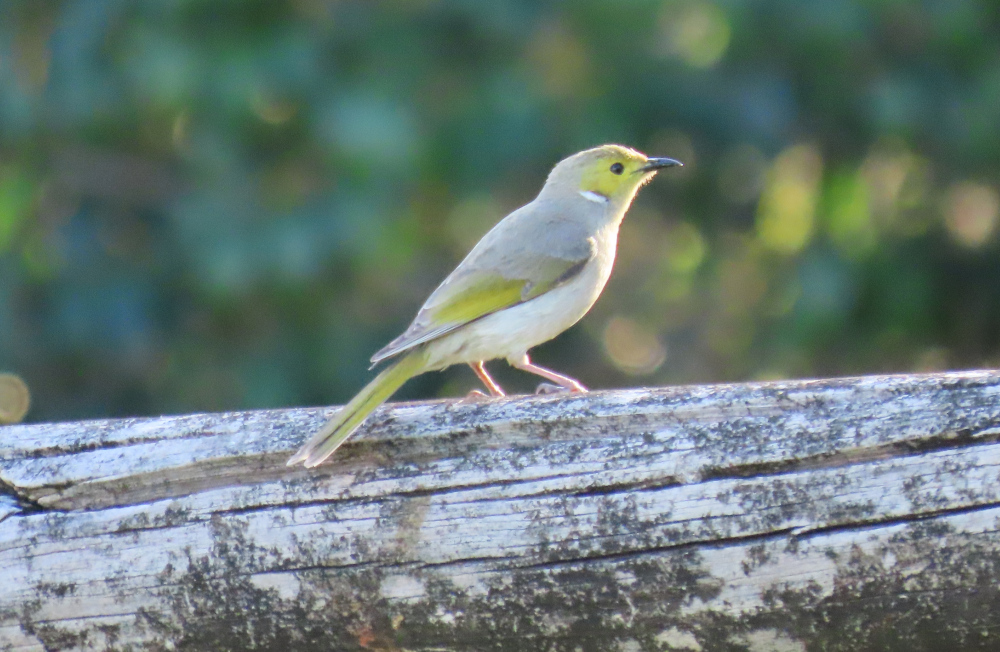
Common name: White-plumed Honeyeater
Scientific name: Lichenostomus penicillatus
Approximate length: 15-17 cm
Date spotted: 12 September 2025 (spring)
Location: Denman, NSW, Australia: 32°23’35.5″S 150°41’08.9″E
Peaceful Dove calling
In Merriwa, NSW, the call of a Peaceful Dove sounds out above the early morning bird chorus:
Peaceful Doves are small doves, coloured shades of grey with an apricot tinge, and a blue ring of bare skin around the eye.
Common name: Peaceful Dove
Scientific name: Geopelia placida
Approximate length: 20-24 cm
Date spotted: 13 September 2025 (spring)
Location: Merriwa, New South Wales, Australia: 32°23’36.0″S 150°41’07.8″E

Brown Falcon and Black-shouldered Kite having a barney
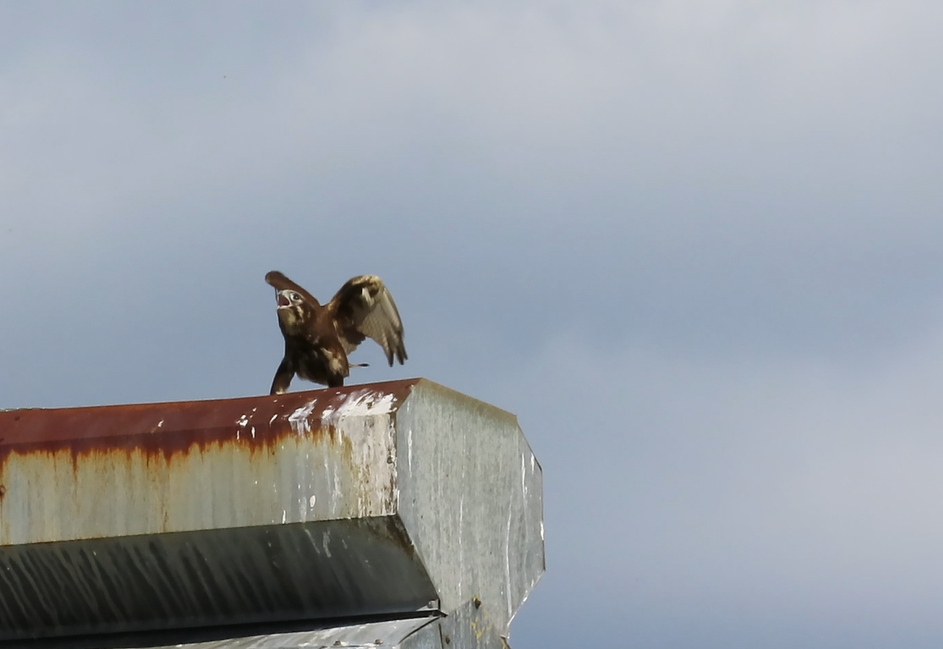
I was looking for the silo art in Merriwa, New South Wales, when I came across a Brown Falcon and a Black-shouldered Kite having a disagreement.
This is my first sighting of a Brown Falcon. It was cool to see the bird doing some aerial acrobatics!
The action goes down very fast! I’ve taken some stills from the video, to make it easier to see what happens:


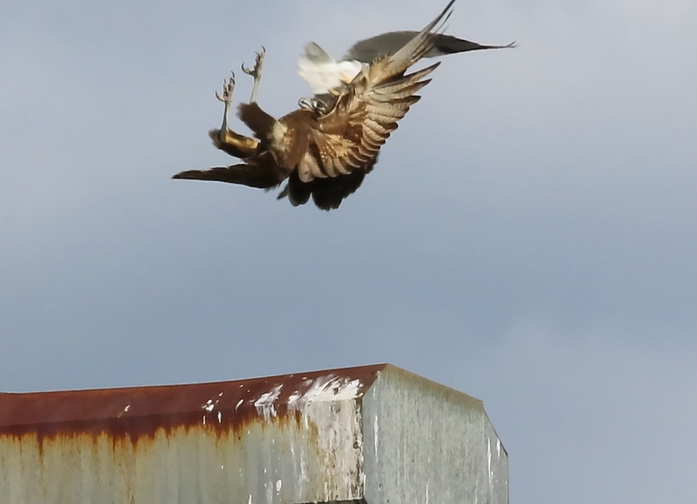
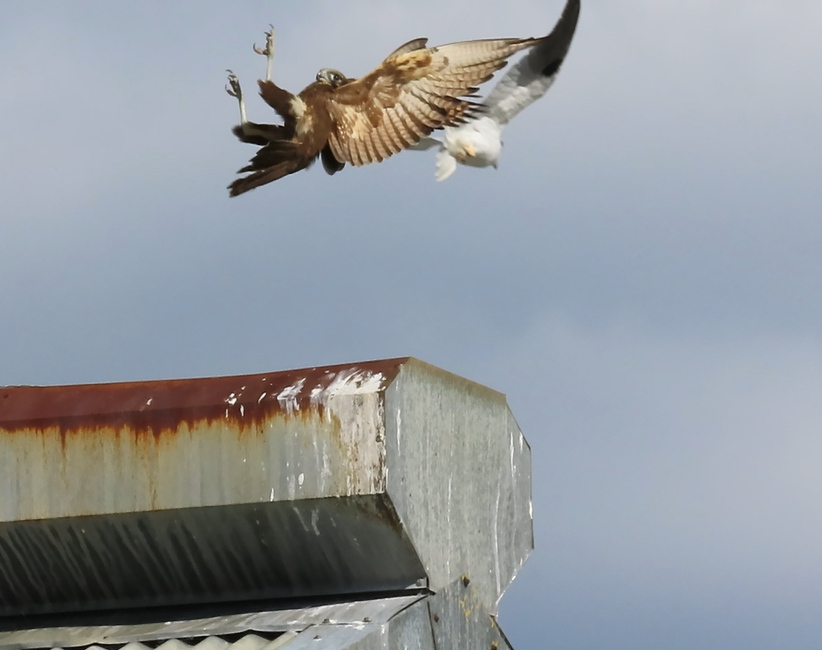

Despite the aerial competence, Brown Falcons feed mostly on the ground, eating reptiles, beetles and grasshoppers, mice, and carrion. Look at those long legs and strong feet, good for picking off the unwary prey as it makes its way across a field or a road.
Here’s a shot of the Brown Falcon taking a rest after the action was over:

Common name: Brown Falcon and Black-shouldered Kite
Scientific name: Falco Berigora and Elanus axillarus
Approximate length: 40-50 cm (Brown Falcon) and 35 cm (Black-shouldered Kite)
Date spotted: 12 September 2025 (spring)
Location: Merriwa, New South Wales, Australia: 32°08’14.9″S 150°21’50.6″E
For those interested in the silo art, here it is! The Merriwa Silos are the 29th addition to the Australian Silo Art Trail Collection. The artwork was completed by David Lee Pereira in April 2019:


 Sydney Birder