Blog Archives

Australian Ringneck parrot at Wilpena Pound
During a recent trip out west of Sydney, I spent a night at Wilpena Pound in the Flinders Ranges. Early the next morning, I went for a walk and spotted this lovely parrot sitting on a fence. It’s an Australian Ringneck.
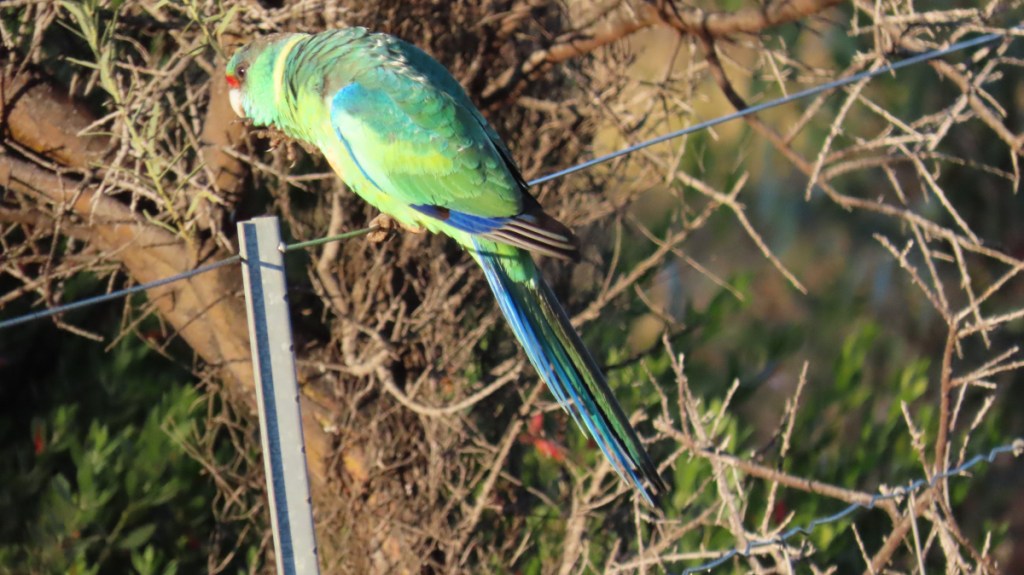
The name “ringneck” comes from the yellow collar on the back of the bird’s neck. This particular variety of Australian Ringneck is called a Mallee Ringneck. It has a green and blue head, whereas other races have a dark blue head. “Mallee” comes from an Australian aboriginal word meaning water, and is used to describe terrain covered in low-growing scrubby Eucalyptus trees.
Scientific name: Barnardius zonarius barnardi
Approximate length: 34-38 cm
Date spotted: 19 July 2026 (winter)
Location: Wilpena Pound, Flinders Ranges, South Australia: 31°31’36.5″S 138°36’11.6″E

Apostlebird looking spruce
I was recently at Wilpena Pound in the Flinders Ranges. A trio of Apostlebirds arrived at our campsite early in the morning and scampered around looking for scraps. Often these birds appear to be a darker, more bluish grey. This one was caught in a ray of sunshine next to the barbecue.

Apostlebirds are chatty, gregarious creatures. I love watching them move and interact with each other. My first recorded sighting of them was near Mungo Lake, NSW, a couple of years ago. That post includes some video footage: Apostle birds nesting and grooming.
Common name: Apostlebird
Scientific name: Struthidea cinerea
Approximate length: 29-33 cm
Date spotted: 18 July 2026 (winter)
Location: Wilpena Pound, Flinders Ranges, South Australia: 31°31’36.5″S 138°36’11.6″E

Little Corellas are brown in Broken Hill
They’re not really brown. They just look that way because they spend time rolling in the outback mud and in tree hollows. This Little Corella is examining the architecture in Argent Street, Broken Hill:
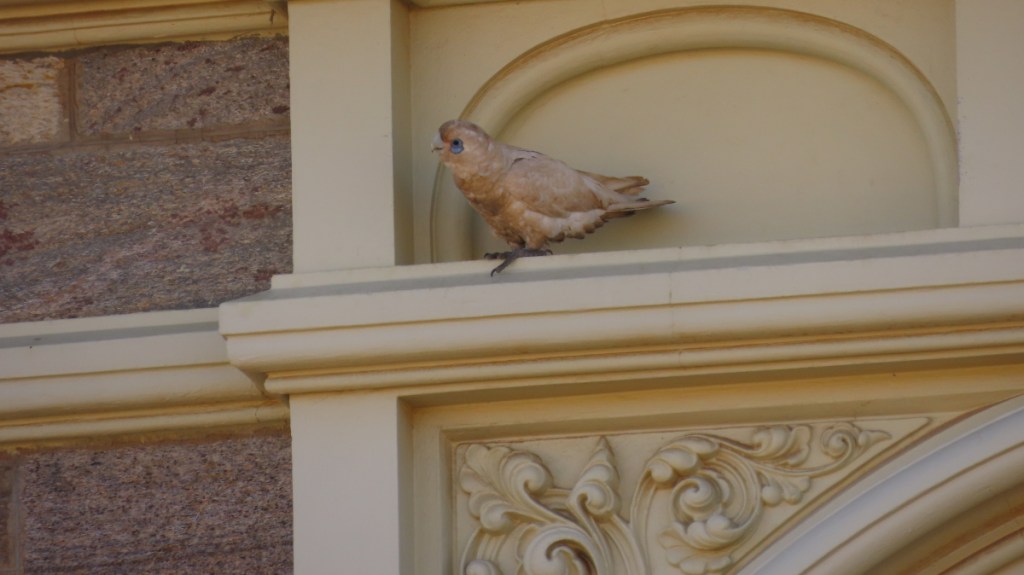
I haven’t seen such a soiled Corella before. The colouring brings out the blue around the bird’s eye. It does look rather dishevelled though!
Common name: Little Corella
Scientific name: Cacatua sanguinea
Approximate length: 36-39 cm
Date spotted: 21 July 2026 (winter)
Location: Broken Hill, NSW, Australia: 31°57’30.7″S 141°27’54.3″E

Singing Honeyeater unusually ruffled
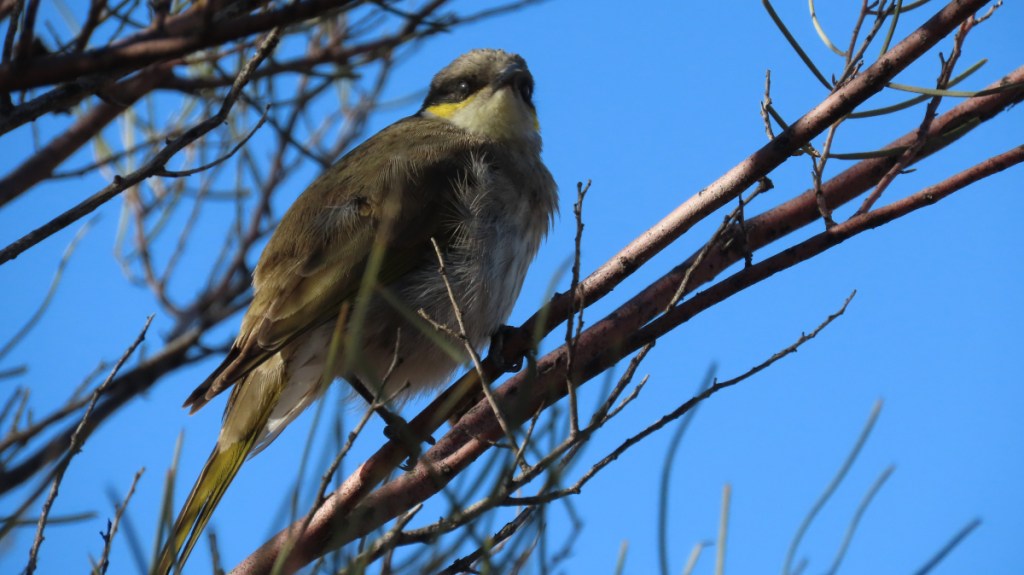
This is my first sighting of a Singing Honeyeater. According to my bird book, they’re abundant and widespread, but not on the east coast of Australia where I live.
Australia has many species of Honeyeater. So many that I wonder if I should split up the category of Honeyeater on this blog, to make them easier to find. My bird book lists 56 species under “Honeyeater” and there are more, like the Miners which are listed separately.
Most of the Honeyeaters that I see look suave and confident. This particular Singing Honeyeater, though, looks as if it’s awakening from a bad night. Or maybe it’s going for a raptor look:
Common name: Singing Honeyeater
Scientific name: Lichenostomus virescens
Approximate length: 18-22 cm
Date spotted: 21 July 2026 (winter)
Location: Living Desert State Park near Broken Hill, NSW, Australia: 31°54’03.2″S 141°26’23.1″E

Female Mistletoebird in the Living Desert State Park
This is another first sighting for me, from my trip out west of Sydney. A lovely little Mistletoebird perched in a bush:

I love the soft colours of this bird. She’s a female. I’ve yet to see a male, which are more dramatic in their colouring, with blocks of black, red, and white.
Mistloetobirds are tiny, measuring 10 to 11 cm from head to tail. Their favourite food is the fruit of mistletoes. In fact, they eat very little else. Australia has nearly 100 native species of mistletoe.
Common name: Mistletoebird
Scientific name: Dicaeum hirundinaceum
Approximate length: 10-11 cm
Date spotted: 21 July 2026 (winter)
Location: Living Desert State Park near Broken Hill, NSW, Australia: 31°54’03.2″S 141°26’23.1″E

Another Babbler, another first! White-browed Babbler
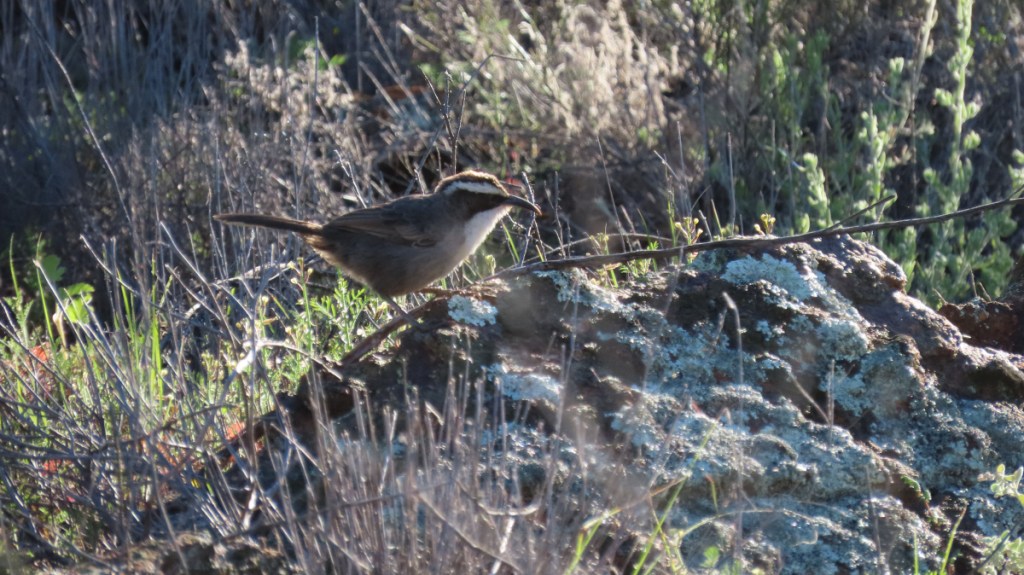
I’m excited to record my first White-browed Babbler, and to pair it with my first sighting of some Chestnut-crowned Babblers earlier in the day. The birds were in the Living Desert State Park near Broken Hill, NSW.
Common name: White-browed Babbler
Scientific name: Pomatostomus superciliosus
Approximate length: 19-22 cm
Date spotted: 21 July 2026 (winter)
Location: Living Desert State Park near Broken Hill, NSW, Australia: 31°54’03.2″S 141°26’23.1″E

My first Chestnut-crowned Babblers
In the Living Desert State Park near Broken Hill, NSW. Apologies for the fuzzy photos! I was far away and not sure what I was looking at. It’s exciting to see these Chestnut-crowned Babblers. They’re super pretty, and they’re found in a relatively small area of the world. They’re considered to be generally uncommon.
Here’s one of the birds on the ground. You can see it’s red cap, the white line above its eye, and its white chest:

Here are three of them in a bush:

Common name: Chestnut-crowned Babbler
Scientific name: Pomatostomus ruficeps
Approximate length: 21-23 cm
Date spotted: 21 July 2026 (winter)
Location: Living Desert State Park near Broken Hill, NSW, Australia: 31°54’03.2″S 141°26’23.1″E

Excited to see a White-winged Fairy-wren
It’s always exciting when I see a bird species for the first time. And the lovely White-winged Fairy-wren is no exception:
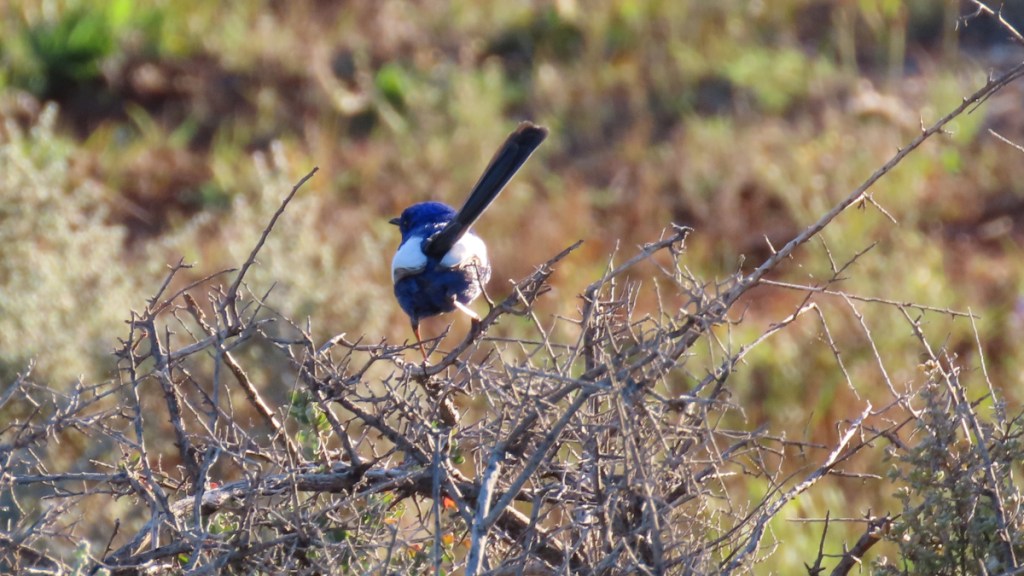
There are several species of Fairy-wren in Australia: my bird book lists nine. In the area where I live, we most often see Variegated Fairy-wrens. Not too far away are Superb Fairy-wrens. But White-winged Fairy-wrens are found further west, in the interior of the continent.
I spotted this one on the edge of the road in the Living Desert State Park, outside Broken Hill. Its bright blue caught my eye, and when I got the photos home I could see the white wings that give it its name.
Common name: White-winged Fairy-wren
Scientific name: Malurus leucopterus
Approximate length: 12-13 cm
Date spotted: 21 July 2026 (winter)
Location: Living Desert State Park near Broken Hill, NSW, Australia: 31°54’03.2″S 141°26’23.1″E

Spiny-cheeked Honeyeater near Broken Hill
I’ve been out west of Sydney, in western New South Wales and South Australia. I’ll be posting a few birds that I spotted along the way!
Just outside the Living Desert State Park near Broken Hill, the melodious whistles of some Spiny-cheeked Honeyeaters carried above the chirrups of other birds.

This photo shows the bird’s characteristic pink bill and gape, with a black tip on the bill. Its front is mottled cream and grey with a yellow blush on the chest.
I’ve seen these birds on a previous trip out west, near Mungo Lake, where I managed to get a recording of the birds’ song: Evocative call of the Spiny-cheeked Honeyeater.
Common name: Spiny-cheeked Honeyeater
Scientific name: Acanthagenys rufogularis
Approximate length: 23-26 cm
Date spotted: 21 July 2026 (winter)
Location: Outside the Living Desert State Park near Broken Hill, NSW, Australia: 31°53’12.1″S 141°25’20.5″E

My first Chirruping Wedgebill
I’ve been out west of Sydney, in western New South Wales and South Australia. I’ll be posting a few birds that I spotted along the way!
Near Broken Hill, I saw a group of small, active birds flitting from tree to tree and chirruping busily. After consulting the Merlin Bird ID app, and confirming with The Michael Morcombe Field Guide to Australian Birds, I’ve decided they were Chirruping Wedgebills. Here’s one of them:

This is my first identified Chirruping Wedgebill, and in fact the first Wedgebill I’ve posted too.
Common name: Chirruping Wedgebill
Scientific name: Psophodes olivaceus
Approximate length: 19-21 cm
Date spotted: 21 July 2026 (winter)
Location: Outside the Living Desert State Park near Broken Hill, NSW, Australia: 31°53’12.1″S 141°25’20.5″E


