Wait for it! Echidna emerges from the undergrowth
Echidnas are egg-laying mammals found in Australia. Along with platypuses, they’re the only mammals that lay eggs. They look like a cross between a porcupine (long quills) and an anteater (long nose). At approximately 50 centimetres long, an echidna is about the size of an anteater too.
Occasionally, I’m lucky enough to come across an echidna when I’m out walking in the bush near Sydney. The most recent one was just a few days ago, in Manly Dam conservation area.
This video shows the echidna pushing its way out of the undergrowth. I heard it rustling in the long tufts of grass, and got my camera ready. The little creature waved its nose in the air to check for danger, then decided it was safe to cross the patch of bare ground in front of me.

Biggest Yabby I’ve ever seen
A Yabby (Cherax destructor) is a freshwater crayfish found in Australia. I’ve seen a couple of them when I’m out in the forests of New South Wales, but the Yabbies I’ve seen up to now were quite small: about the wide of two fingers, and about as long as my longest finger.
Yesterday, I was strolling along a path at Manly Dam, NSW, when I heard a loud rustling at foot level. I looked down and saw a huge black Yabby. It saw me at the same time, and raised its front claws in a defensive position:
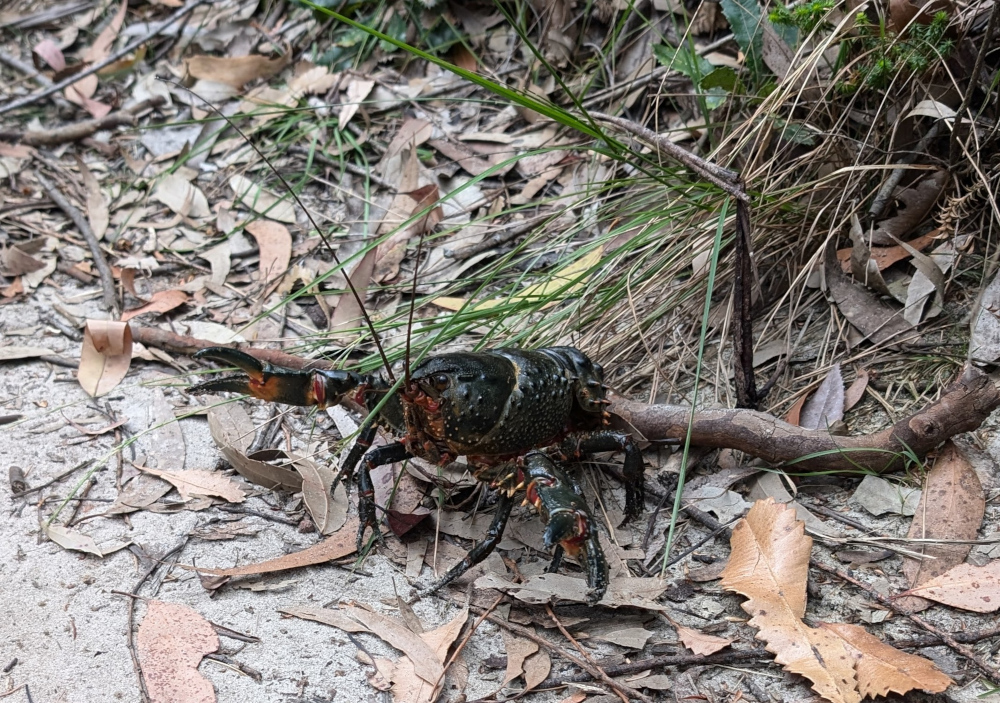
Look at those enormous spread claws and that knowing eye! By my estimate, the Yabby was 20 cm long and 4 cm high, and the spread of the claws was about 20 cm.
We gazed at each other for a while, then I carefully stepped over and past the creature. It immediately started retreating backwards towards the footbridge that I had just walked over. I’d been in the way of its getaway. Here’s a picture taken from my video of the retreat (coming up next), to show the scale of the Yabby alongside the footbridge and path:

This video shows the Yabby’s retreat:
If you’re walking along a bush path near fresh water in Australia, and you notice some large holes in the ground, they might be made by Yabbies. (Or by spiders, snakes, ants, etc —you know the story!) Evidently Yabbies got their scientific name, Cherax destructor, from the damage they can do to farmland.
Birds such as cormorants and ibis do eat Yabbies. So do people, large fish, other Yabbies, platypus, and rats. I think most creatures, apart from people, would have quite a fight with this particular specimen though.

Should be named “Zigzag-winged Wren”
Putting words into the bird’s mouth: “I should be called Zigzag-winged Wren coz White-browed Scrubwren is kinda boring!” Or perhaps her name should be Buttercup, to match her colouring and sweetness.
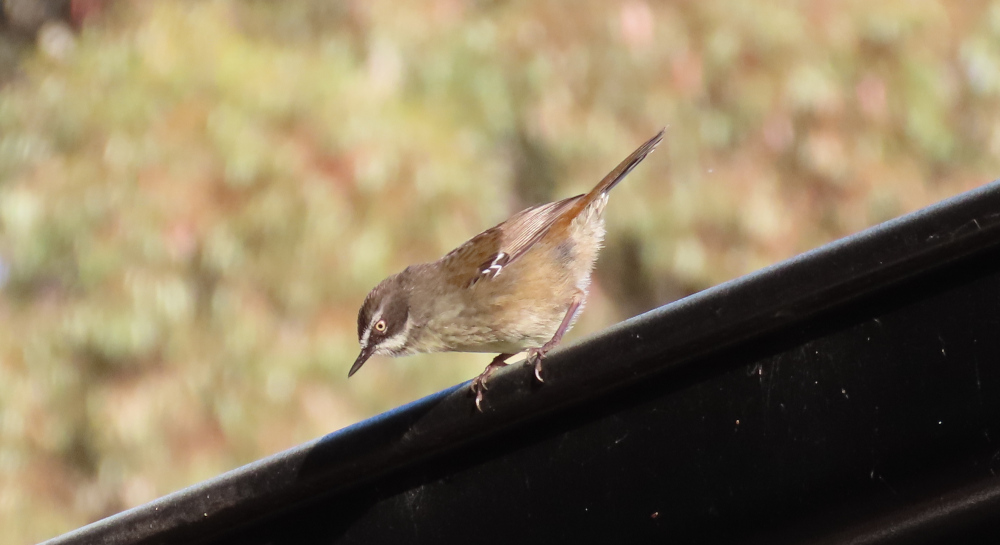
Common name: White-browed Scrubwren
Scientific name: Sericornis frontalis
Approximate length: 12 cm
Date spotted: 9 November 2024 (spring)
Location: Oberon, New South Wales, Australia: 33°46’03.3″S 149°53’09.0″E

Coot cuddles
Coots always look so calm and cute. Here are two of them having a Coot cuddle.

And a Coot conversation:

Common name: Eurasian Coot
Scientific name: Fulica atra
Approximate length: 35 cm
Date spotted: 7 November 2024 (spring)
Location: Manly Dam Reserve, New South Wales, Australia: 33°46’35.4″S 151°14’49.5″E

Powerful Owl dozing in the treetops
It’s a while since I’ve spotted a Powerful Owl. A few days ago, I saw the tell tale dark blob high in the branches of the forest. Using my camera’s zoom, I could identify the bird. The only view I had is from behind, with the bird’s head turned slightly towards me and one eye partly open:
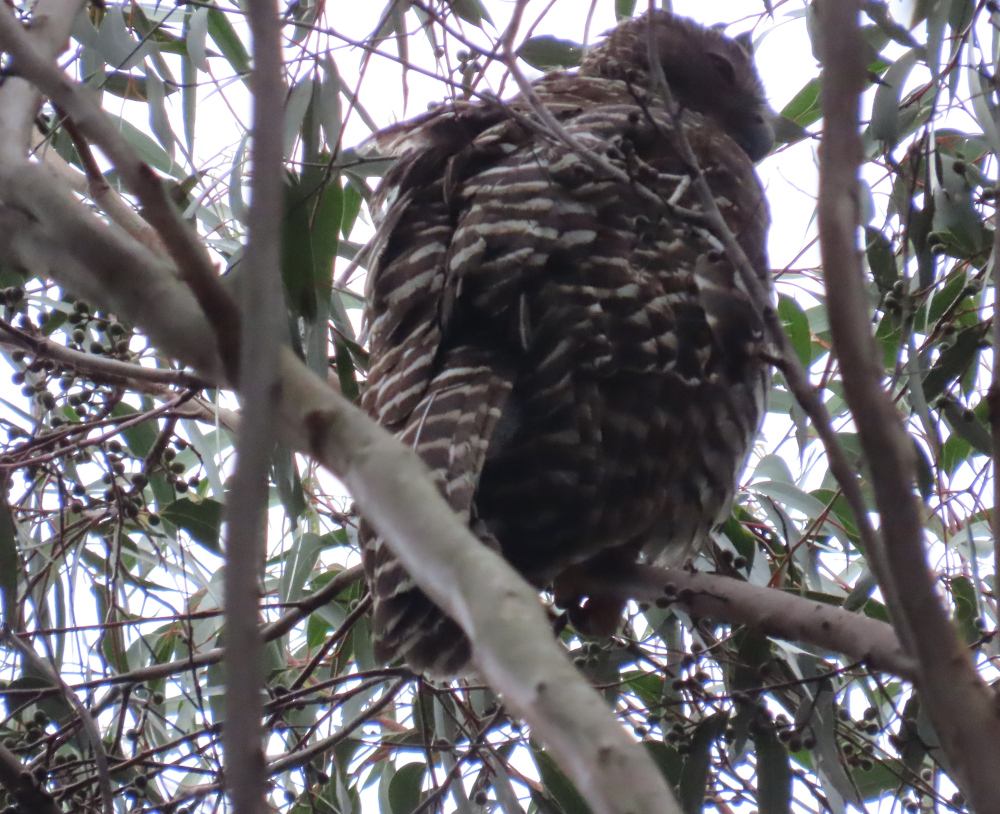
It’s always a privilege to see these impressive birds. Powerful Owls can weigh well over 2 kilograms, and reach up to 65 centimetres in height. They hunt at night and roost quietly during the day. Their prey consists of small creatures such as possums.
Common name: Powerful Owl
Scientific name: Ninox strenua
Approximate length: 65 cm
Date spotted: 7 November 2024 (spring)
Location: Manly Dam Park, New South Wales, Australia. Approximate map reference: 33°46’55.8″S 151°15’12.1″E
White-winged Choughs dust-bathing and feeding youngsters
A few days ago, I spent some time at Coolendel Campground in New South Wales. A group of White-winged Choughs strutted around the area, picking up grubs, taking dust baths, and chattering from the trees.
In this video, the adults are feeding grubs to two noisy youngsters.
White-winged Choughs look quite similar to currawongs and crows, but they belong to a different family. Along with Apostlebirds, they’re the only members of the Corcoracidae family. And like Apostlebirds, White-winged Choughs build nests by forming a bowl out of mud.
At first sight, these birds seem entirely black, but when they open their wings you notice the white wing flares. Adults have striking red eyes.
Here, two of them take a dust bath. It’s interesting to see that they pick up beakfuls of dust and dump it on their feathers, rather than lying in the dust:
Common name: White-winged Chough
Scientific name: Corcorax melanorhamphos
Length: 43-47 cm
Date spotted: 1 November 2024 (spring)
Location: Coolendel Campground, Buangla, New South Wales, Australia: 34°50’39.3″S 150°25’18.5″E

Bird on a wire – Eastern Rosella
Eastern Rosellas are medium-sized parrots, found on the east coast of Australia. We’re lucky enough to be visited regularly by a pair of them. I don’t know if it’s the same two birds each time, or if our phone line is somehow part of the flight lines for a family of birds.
In this video, the male Eastern Rosella struts along a phone line, spiffy in his breeding colours. Alas, the background sound is noisy, but you can just hear the bird chirping as he does his little hello dance:
The next picture is somewhat whimsical. It’s what my camera made up when the bird flew off. I love the colours and motion in this picture, even if the bird’s head is off camera:

The female glowed in the sunlight:

The male’s colours are brighter, with the divisions between the coloured sections more clearly defined. Deep blue and black scallops outline the wings, while the rest of the bird is yellow and black, and red and white:
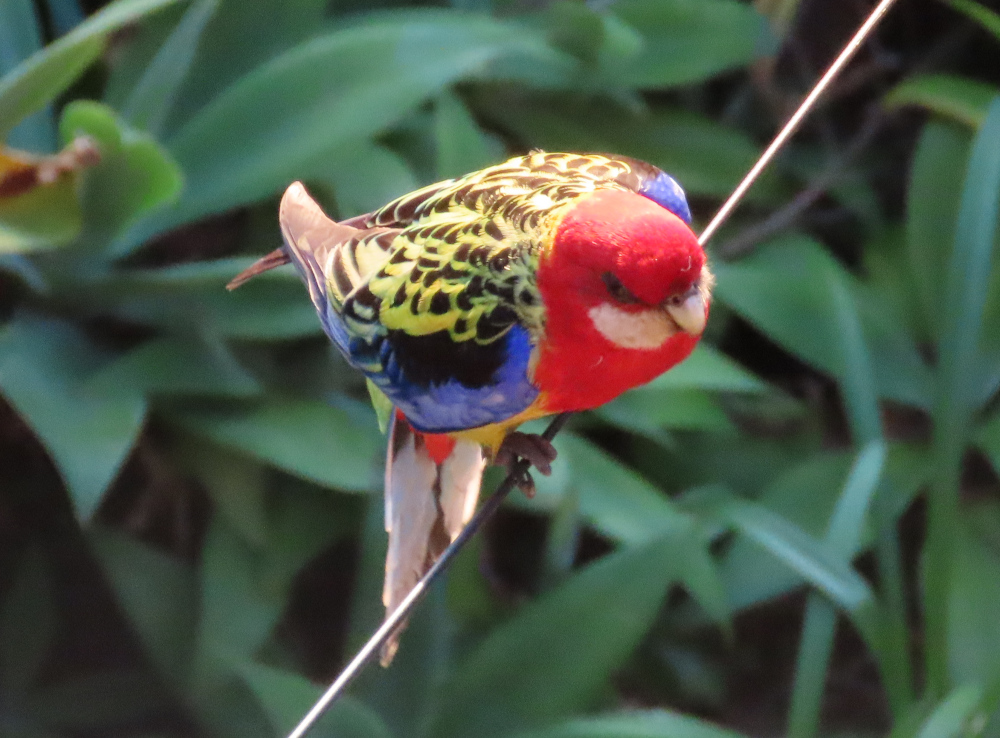
He knows he’s gorgeous!
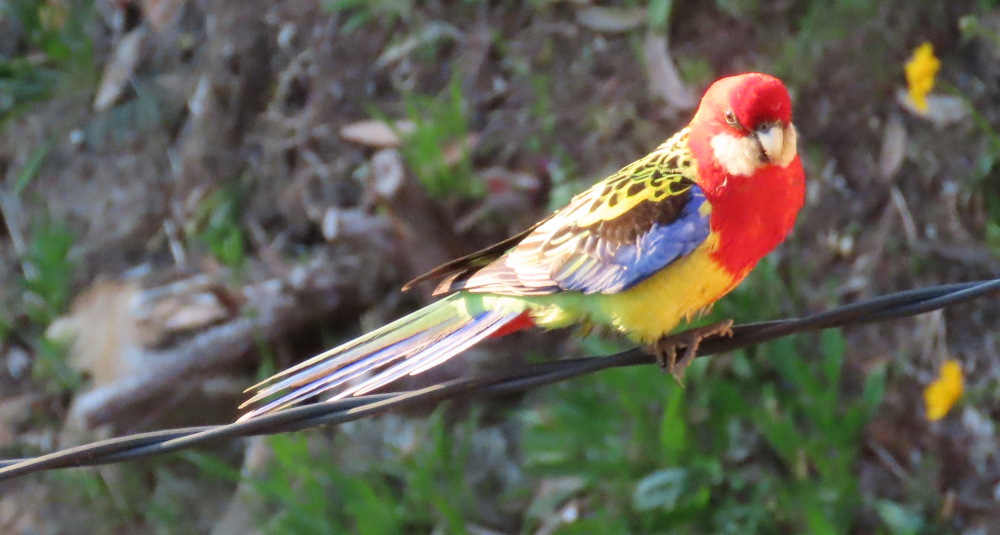
Common name: Eastern Rosella
Scientific name: Platycercus eximius
Approximate length: 30 cm
Date spotted: 28 October 2024 (spring)
Location: Allambie Heights, NSW, Australia

My first Buff-banded Rail
This bird is very very shy. I’ve seen it twice, and this is the best photo I have. It’s my first sighting of a Buff-banded Rail, or any kind of rail.
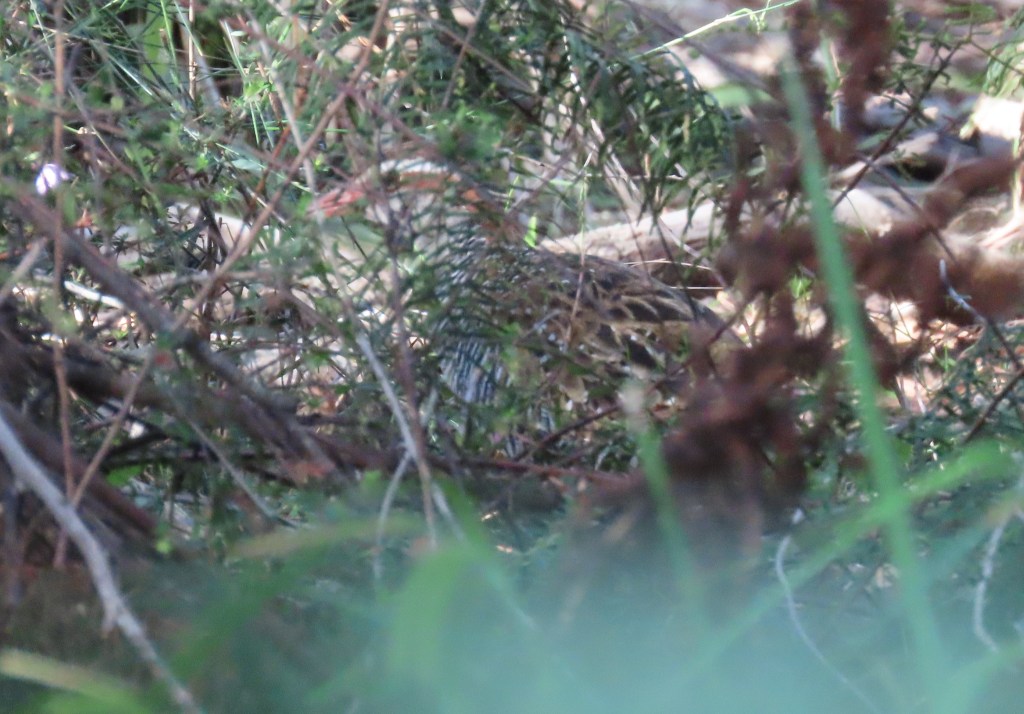
The bird has a distinctive wide white eyebrow, with a chestnut stripe through the eye. The top of the head is a darker brown, and the beak is orange and quite long. (At first I thought the bird was some sort of quail, but I couldn’t find any quails with orange beaks.) The body has black and white barring on the sides, whereas the plumage on the back is mottled brown and cream.
The bird hides in the low growth at the edge of Manly Dam, on Sydney’s northern beaches. I’ll keep a look out, to try and get a better photo.
Common name: Buff-banded Rail
Scientific name: Gallirallus philippensis
Length: 28-32 cm
Date spotted: 26 October 2024 (spring)
Location: Manly Dam Reserve, New South Wales, Australia: 33°46’40.0″S 151°14’50.2″E

Glossy Black-Cockatoo
Five Glossy-Black Cockatoos are frequent visitors to the Casuarina trees on the edge of Manly dam at the moment. Here’s one of the birds:
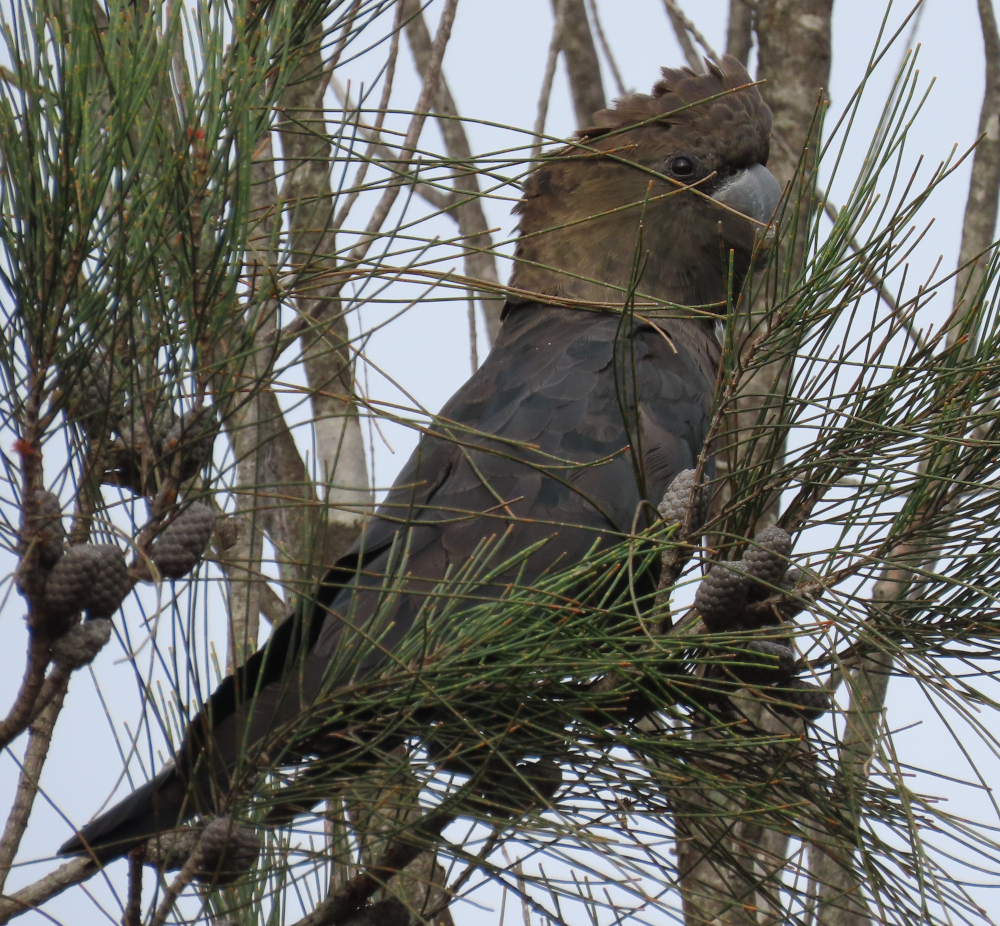
Common name: Glossy Black-Cockatoo
Scientific name: Calyptorhynchus lathami
Approximate length: 50cm
Date spotted: 27 October 2024 (spring)
Location: Manly Dam Park, near Sydney: 33°46’16.4″S 151°14’30.9″E

Mmm, Mountain Devil flowers make a nice change from those tough Banksia pods!
A Yellow-tailed Black-cockatoo contemplates life while demolishing the flower of a Mountain Devil bush.
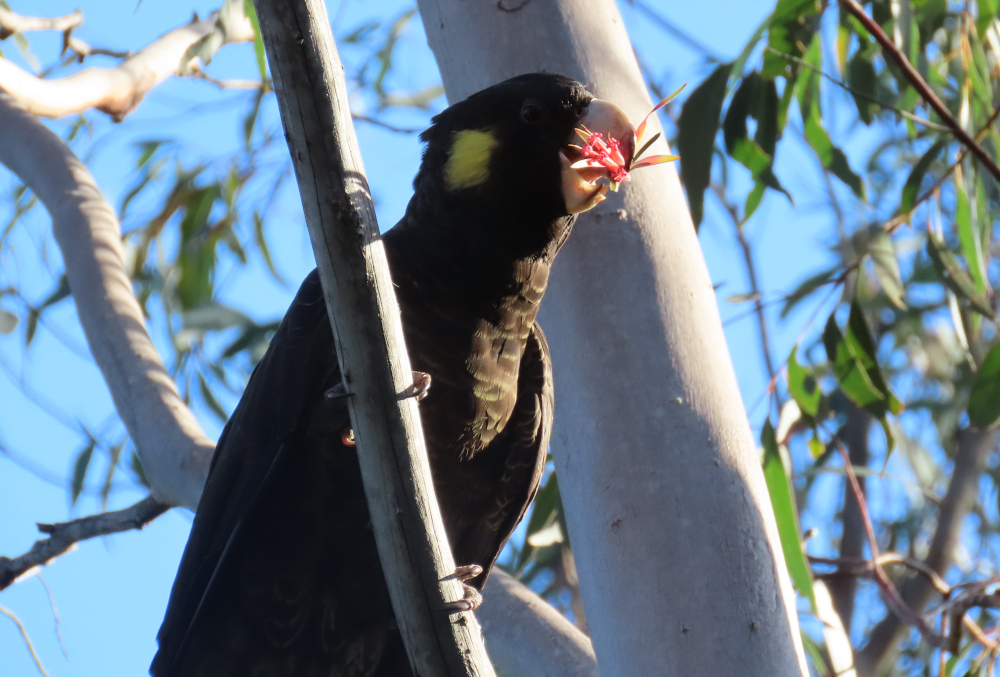
Common name: Yellow-tailed Black Cockatoo
Scientific name: Calyptorhynchus funereus or Zanda funereus
Length: 58-65 cm
Date spotted: 26 October 2024 (spring)
Location: Manly Dam Reserve, New South Wales, Australia: 33°46’40.0″S 151°14’50.2″E


 Sydney Birder