White-bellied Sea-Eagle at Manly Dam near Sydney
Yesterday I spotted a White-bellied Sea-Eagle flying along the shore of Manly Dam. It flew up and down the shore a few times, and across the water, then landed at the edge of the water in a baylet, with its legs in the water.
I was on the opposite side of the dam, so I couldn’t get a close look at the bird. I did take some photos and videos, but they’re fuzzy and unsatisfactory, although they’re good enough to satisfy me about the identification of the bird. So I decided to record the sighting here, and hope I get to see this beautiful bird again soon.
Common name: White-bellied Sea-Eagle
Scientific name: Haliaeetus leucogaster
Approximate length: 85 cm. Wing span: 2.2 m
Date spotted: 22 April 2017 (Autumn)
Location: Manly Dam Reserve, New South Wales, Australia: 33°46’35.2″S 151°15’08.0″E
Square-tailed Kite at Manly Dam near Sydney
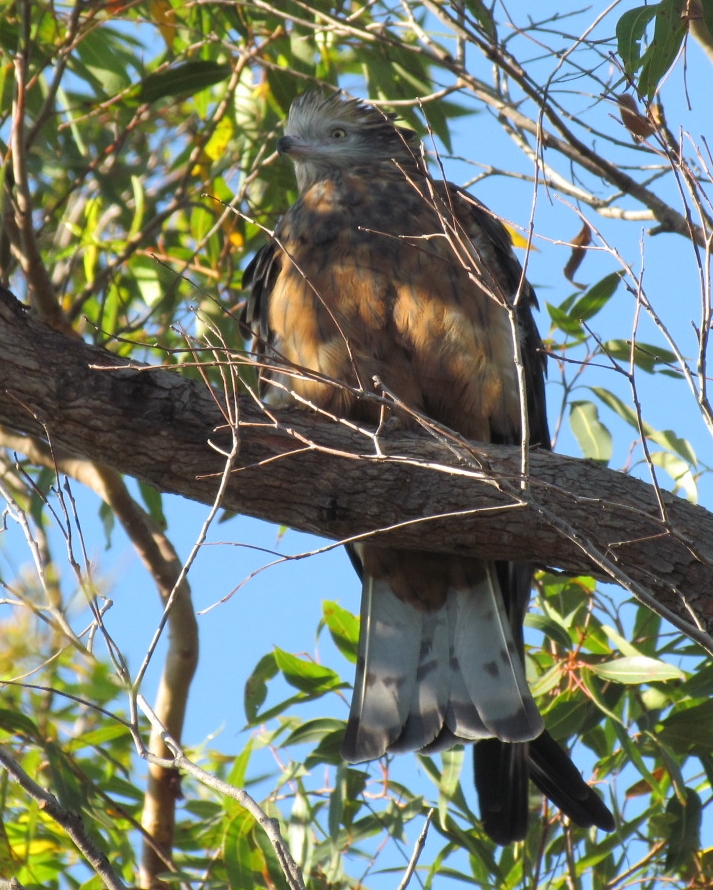
This magnificent bird was sitting quietly in a tree, occasionally squinting down at the path, when I passed by. It’s a Square-tailed Kite – a large bird, at approximately 55 centimetres from head to tail (half a metre) with a wing span of 1.4 metres.

Square-tailed Kites are classified as rare in my bird book. Also, they’re not often seen around Sydney. I identified this one by the white markings around the face, and the characteristically long wing tips. When folded, they’re significantly longer than the tail, as you can see in the photo below:
This video shows the bird having a good grooming session, feathers flying:
In the next video, the bird moves its head back and forward in a slightly eery way, perhaps scanning for prey:
Common name: Square-Tailed Kite
Scientific name: Lophoictinia isura
Approximate length: 55 cm. Wing span: 1.4 m
Date spotted: 15 April 2017 (Autumn)
Location: Manly Dam Reserve, New South Wales, Australia: 33°46’35.3″S 151°15’13.3″E
Musk Lorikeets feeding and chatting
A tree outside our house is in flower, and attracting many avian visitors. This is the first time I’ve seen a Musk Lorikeet. They’re pretty little birds, very fast moving and well camouflaged amongst the green leaves. They chatter to each other constantly, often making a pleasant trilling sound. For some reason, that sound makes me of a phone ringing in a sunlit roof-top apartment.
You can also hear water running down the hill, as it’s been raining a lot recently.
Common name: Musk Lorikeet
Scientific name: Glossopsitta concinna
Approximate length: 23 cm
Date spotted: 27-28 February 2017 (Summer)
Location: Allambie Heights, New South Wales, Australia
In this second video, an Australian Miner joins the lorikeet in the floral feast. The miners and lorikeets usually have a bit of a squawking match over feeding territory, but they managed to co-exist on the same branch for a short period.
The loud chirping you can hear is a Rainbow Lorikeet flying by. (There’s a picture of one further down in this post.)
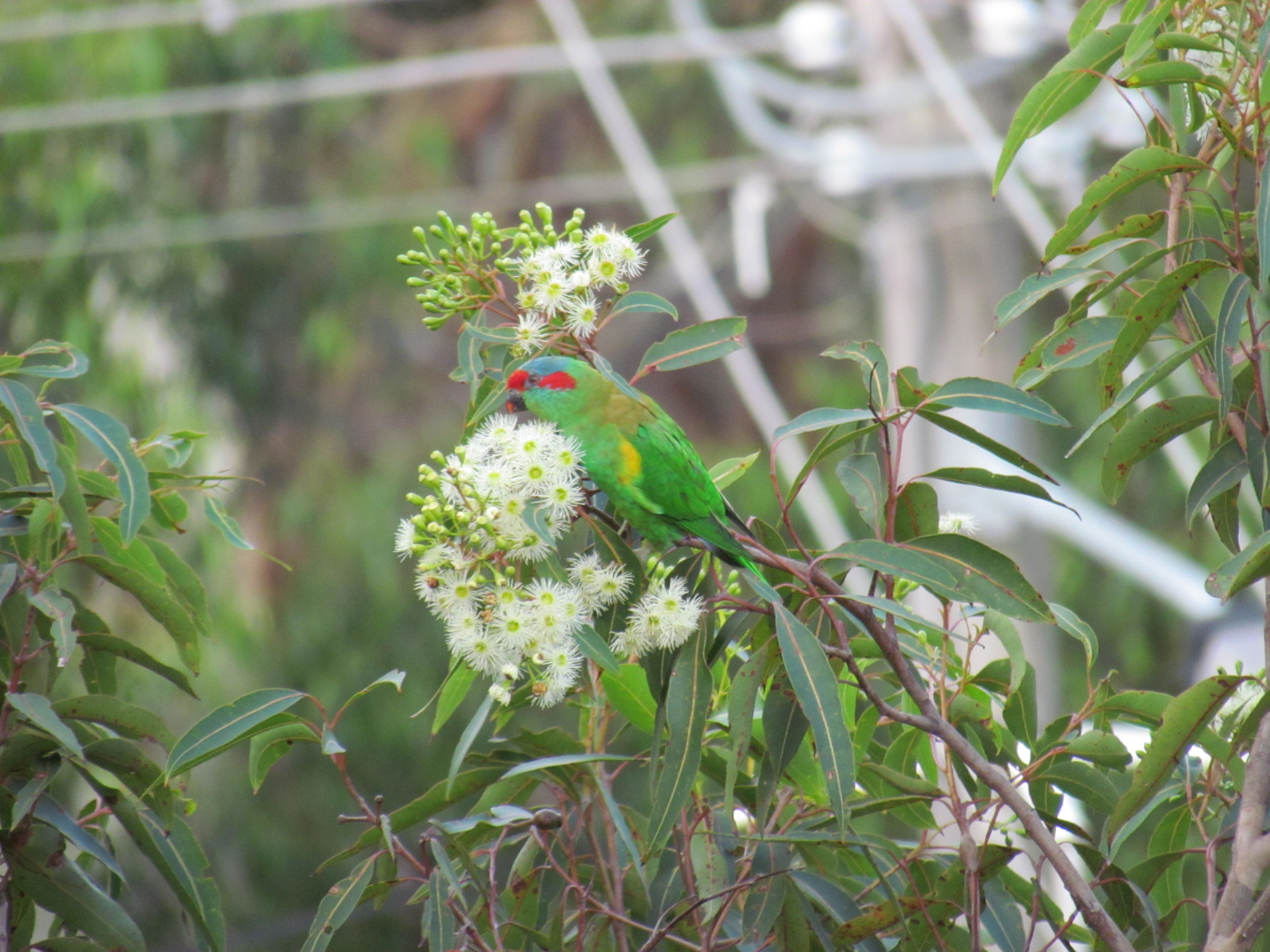
Musk Lorikeets are mainly green, with a red mask around the eyes, a blue cap, and a yellow stripe along the wing:
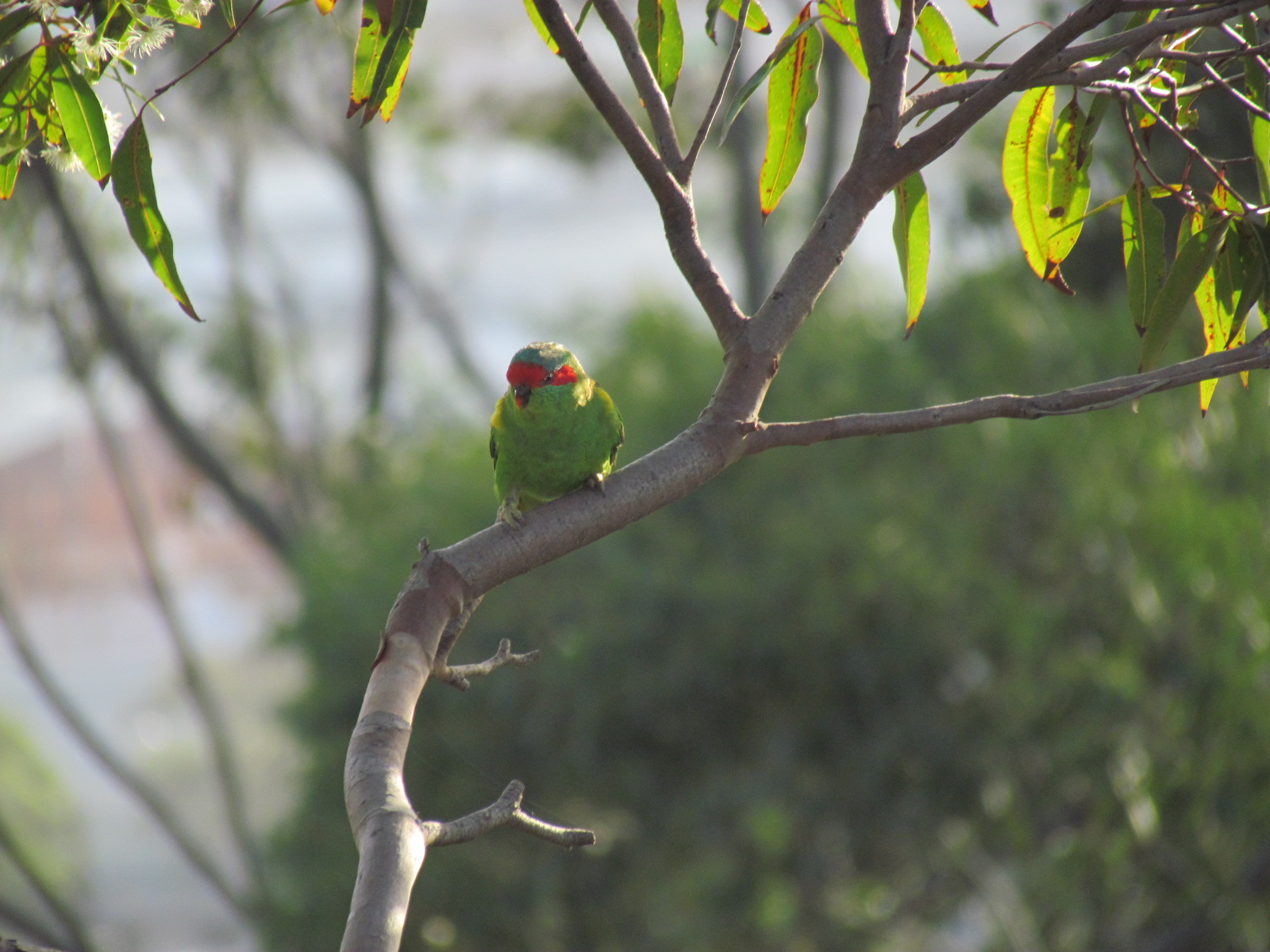
They never seem to stop moving! This one stood still for a short time, but you can see it’s thinking of launching itself into the air any time:
Other visitors to the tree include Rainbow Lorikeets like this one:
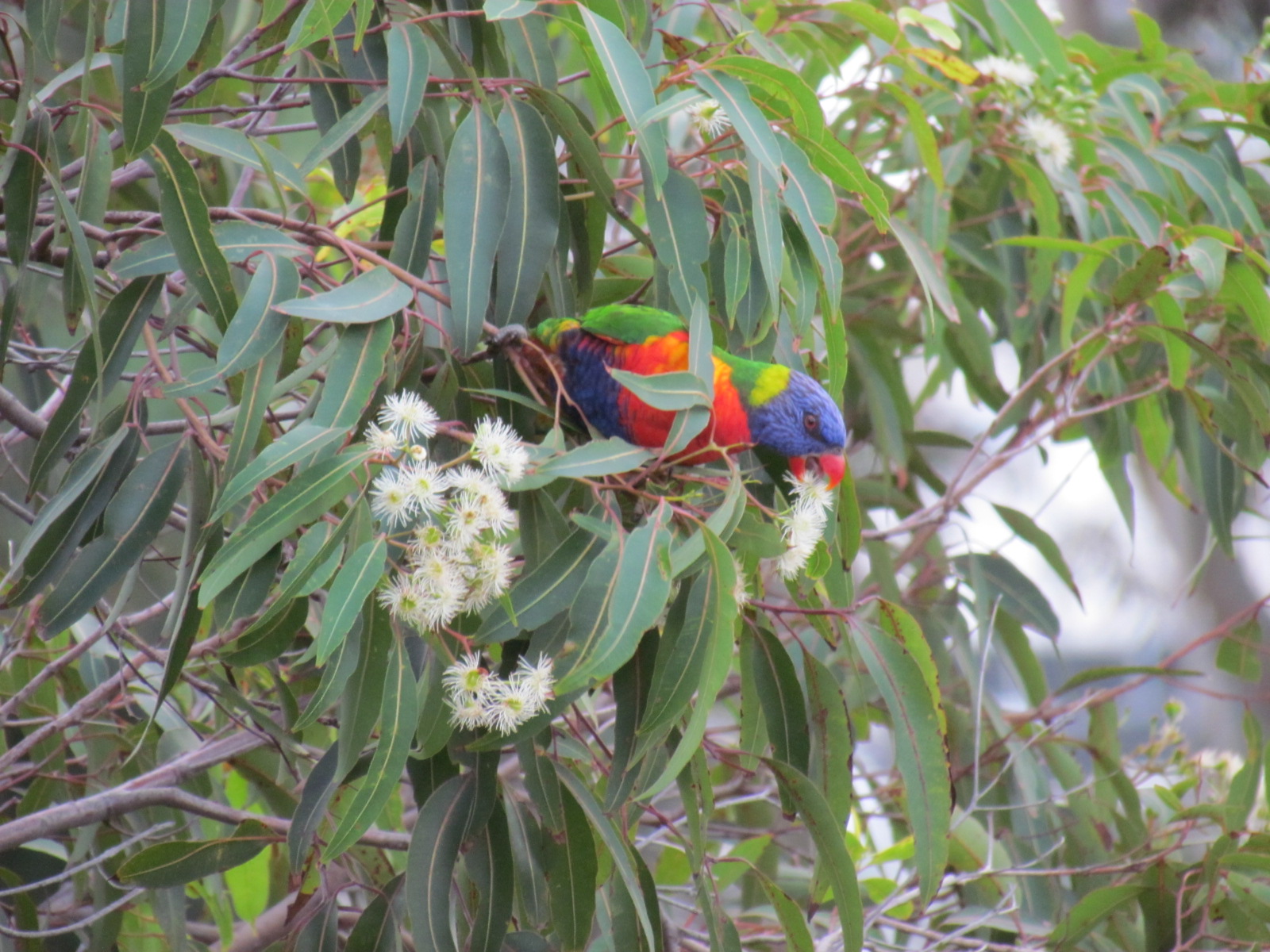
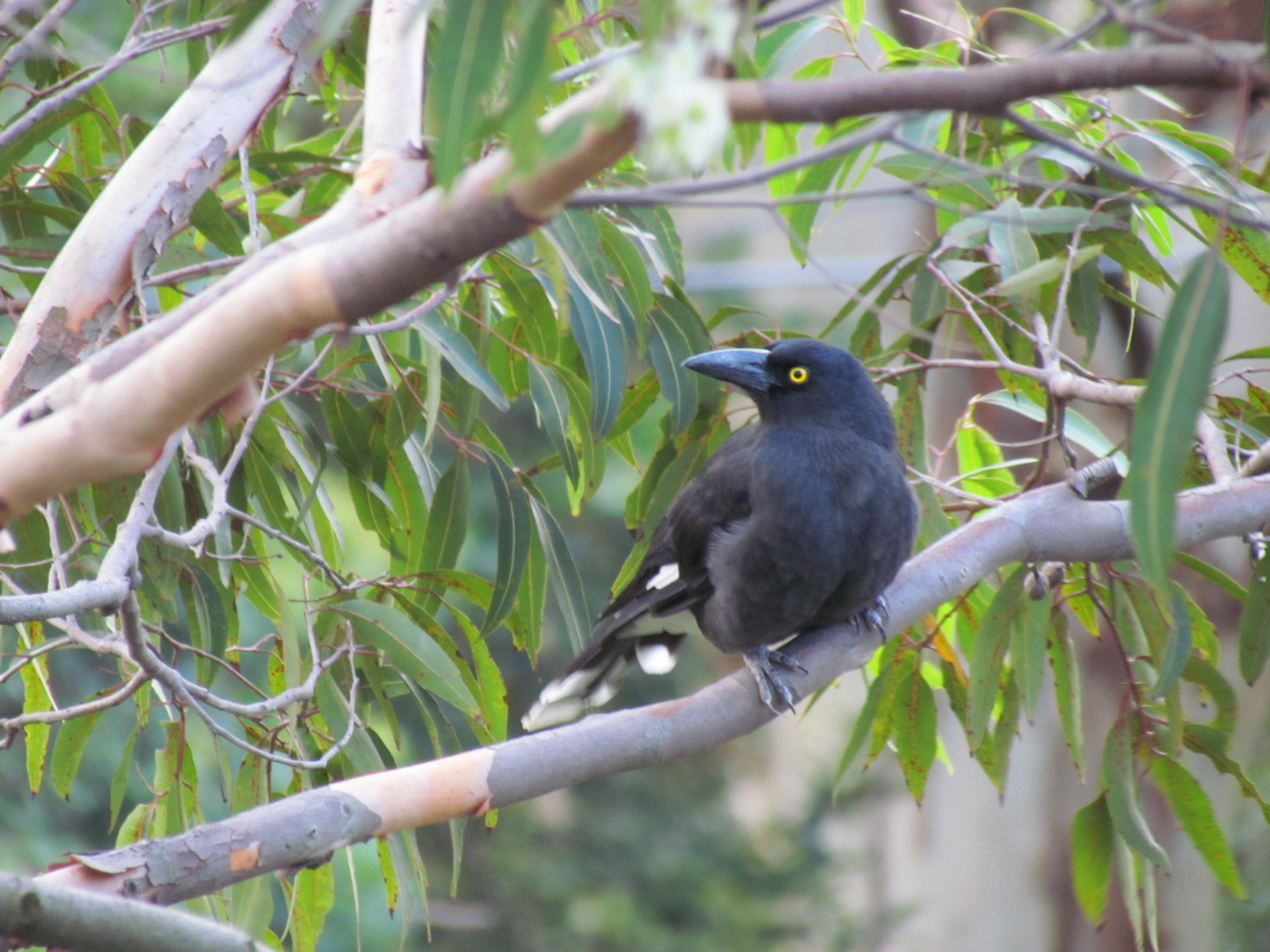
They’re much more common around here than the Musk Lorikeets. Also Currawongs:
Blue puffballs: Male Variegated Fairy-wren and partner
Two Variegated Fairy-wrens dropped in for a flying visit. The most visible one, with electric blue feathers, is male. The female has softer colouring, with blue tail feathers. Their excited chirping drew me to the window in time to make a quick video.
Common name: Variegated Fairy-wren
Scientific name: Malurus lamberti
Approximate length: 13 cm
Date spotted: 13 February 2017 (Summer)
Location: Allambie Heights, New South Wales, Australia
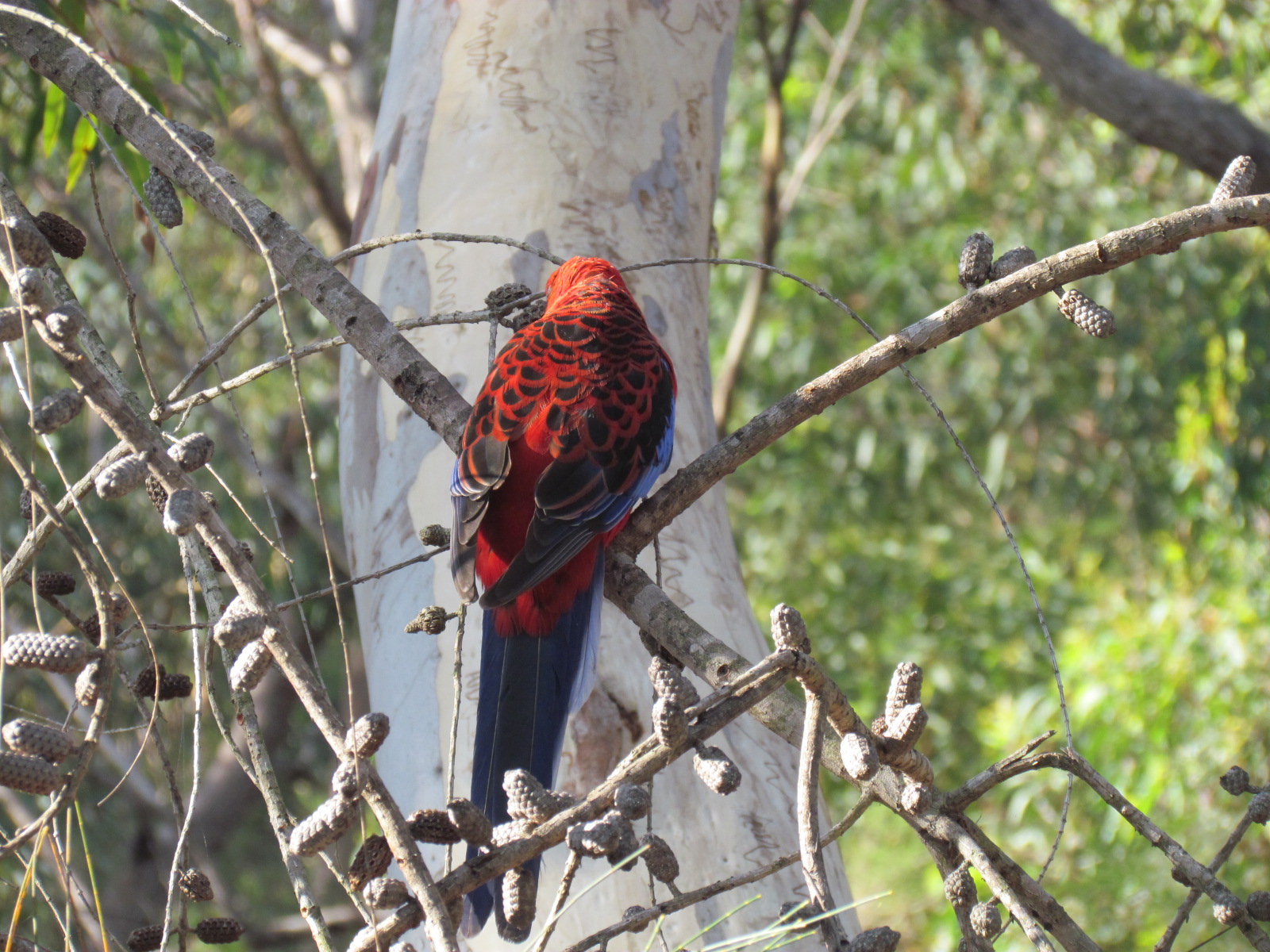
Crimson Rosella feeding on bottlebrush seeds
Usually when you spot a Crimson Rosella, there’s another one close by. This time, though, I could only see one. It was contentedly nibbling at the seeds on a bush – a bottlebrush, I think. [Update on 24 April: It’s not a bottlebrush, but Scrub She-oak, Allocasuarina distyla. Thanks to Carol Probets for the comment!]
The male and female Crimson Rosella look very similar, with the male being larger. I don’t know whether this one was male or female.

These birds are so pretty, even though this one was moulting, so a little shabby in places.

From the rear, the feathers are quite intricate in pattern:
Common name: Crimson Rosella
Scientific name: Platycercus elegans elegans
Approximate length: 35 cm
Date spotted: 12 February 2017 (Summer)
Location: Manly Dam Reserve, New South Wales, Australia: 33°46’58.4″S 151°15’11.8″E
Darter drying wings then taking off
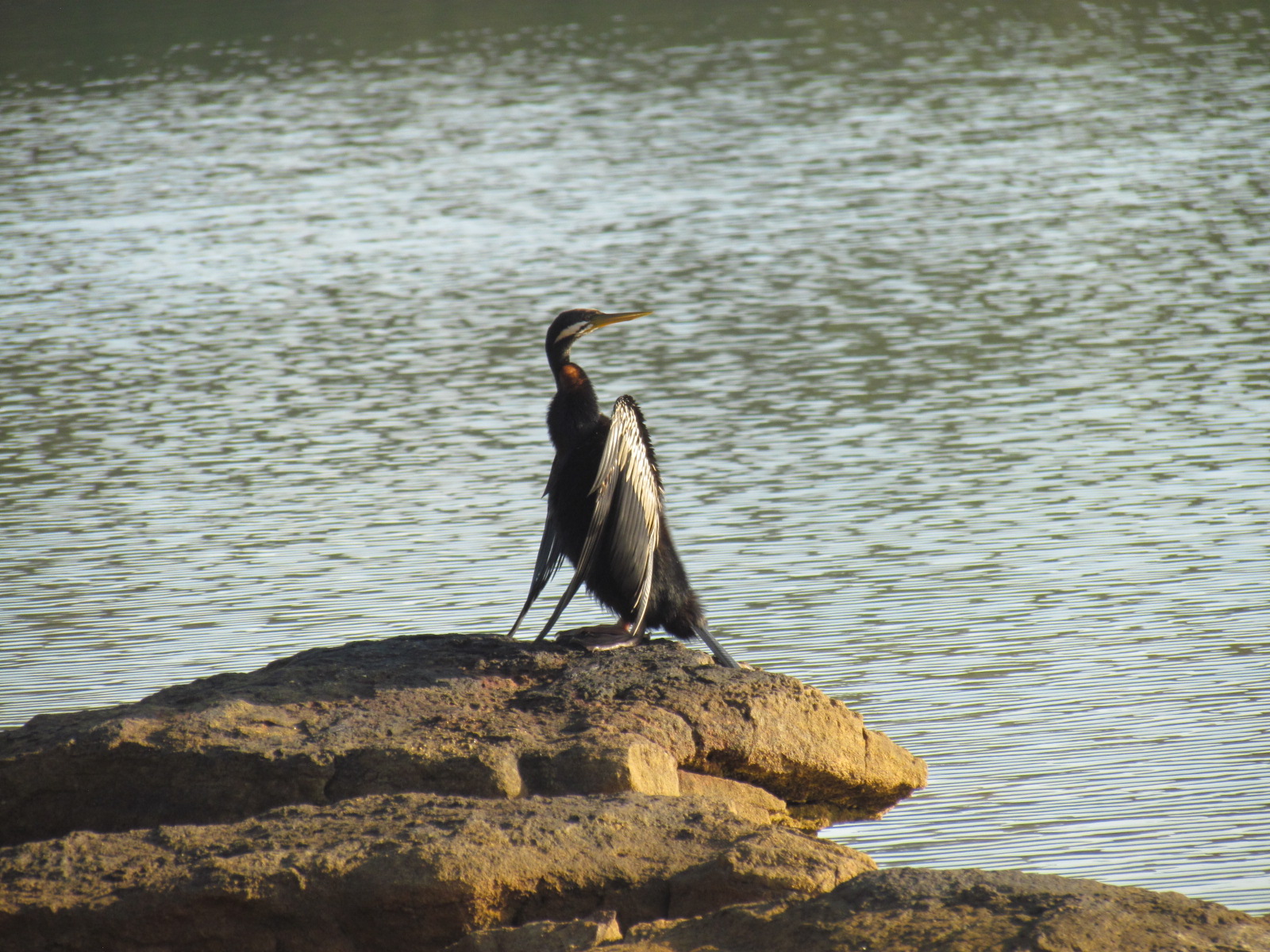
At first sight I thought this bird was a cormorant, but it’s actually a darter, also known as a snake bird because of its long, snake-like neck. Darters are related to cormorants, and also to boobies and gannets. They swim fast under water, hunting and impaling fish with their formidable long, thin beak.
Like cormorants, they sit on shore with their wings spread to dry. After I’d been watching this one for a few minutes, it decided to take off and fly over the water. It’s interesting to see how low it flies, with the wing tips actually tapping the water as it goes.
This pose reminded me of the ballet, the Dying Swan:

Here you can see the characteristic chestnut colouring at the base of the darter’s neck:
Common name: Darter
Scientific name: Anhinga melanogaster
Approximate length: 90 cm; wing span: 1.2 m
Date spotted: 12 February 2017 (Summer)
Location: Manly Dam Reserve, New South Wales, Australia: 33°46’49.6″S 151°15’05.7″E
Two chirpy Variegated Fairy-wrens
Followers of this blog will know that I’m building up a collection of pictures of fairy wrens, bit by hard-won bit! They’re tiny little birds that like to flit around the undergrowth, granting observers tantalising glimpses but not much more.
These two female Variegated Fairy-wrens were out in the open for a few seconds, which has to be some kind of record. They’re chirping sociably to each other as they hop along next to a bush path.
Common name: Variegated Fairy-wren
Scientific name: Malurus lamberti
Approximate length: 13 cm
Date spotted: 12 February 2017
Season: Summer
Location: Manly Dam Reserve, New South Wales, Australia: 33°46’47.9″S 151°15’02.7″E
Purple Swamphens tending a nest
A pair of Purple Swamphens busily tends a nest. This video shows the changing of the guard, as one parent arrives to relieve the other from nest duties.
Sometime later, the bird on the nest had been calling for some time, perhaps growing lonely or bird. The roaming parent suddenly started flapping its wings and making a big fuss about approaching the nest. But then it veered away and continued foraging, apparently not yet ready to resume nest sitting.
I don’t know if there are eggs in the nest yet, though the way the bird moves around in the second half of the video makes me think it’s carefully positioning itself over an egg or two.
Common name: Purple Swamphen
Scientific name: Porphyrio porphyrio
Approximate length: 50 cm
Date spotted: 29 January 2017
Season: Summer
Location: Manly Dam Reserve, New South Wales, Australia: 33°46’35.4″S 151°14’49.1″E
Willie Wagtail attacks Raven
Australian Ravens are big, fierce birds. Willie Wagtails are round little balls of fluff with a faintly ridiculous habit of waving their tails around. But don’t let appearances deceive you. Willie Wagtails are plucky, if reckless. This one took objection to the spot a raven had chosen for a perch, and pestered the larger bird until it flew away.
The characters:
- Willie Wagtail (Rhipidura leucophrys), approximate length 20 cm
- Australian Raven (Corvus coronoides), approximate length: 50 cm
Date spotted: 29 January 2017
Season: Summer
Location: Manly Dam Reserve, New South Wales, Australia: 33°46’35.0″S 151°14’48.5″E
Mystery bird at Manly Dam
This bird puzzles me. It’s about the size of a Red Wattlebird, and I’m thinking it’s some sort of Honeyeater, but I can’t find a match in my bird book. Perhaps it’s a juvenile.
Does anyone have any ideas what it is? I saw it today at Manly Dam Reserve near Sydney (on the map: 33°46’37.5″S 151°14’49.5″E).
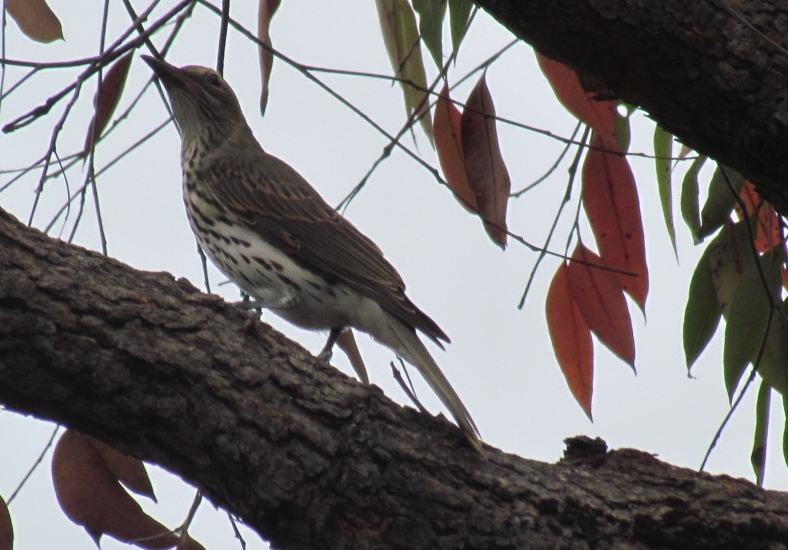
Here’s the uncropped version of the same picture:

Update on 24 April 2017: Carol Probets identified the bird as a young Olive-backed Oriole, in a comment on this post.
Common name: Olive-backed Oriole
Scientific name: Oriolus sagittatus
Approximate length: 25-28 cm
Date spotted: 29 January 2017 (Summer)
Location: Manly Dam Reserve, New South Wales, Australia: 33°46’37.5″S 151°14’49.5″E


 Sydney Birder