Eastern Rosellas brighten a work day
Today I’m working from home. I heard a gentle twittering outside the window, and looked out just in time to see a male Eastern Rosella serenading his lady love.

I’ve seen and heard these birds a few times before, but this is the first time I’ve managed to see the female before they both fly away. Here she is, looking rather coy:

In my previous post you can see and hear the dance and calls that the male birds make. Interestingly, that post was almost exactly a year ago.
Common name: Eastern Rosella
Scientific name: Platycercus eximius
Approximate length: 30 cm
Date spotted: 10 March 2020 (late summer)
Location: Allambie Heights, NSW, Australia
Grey Goshawk has soft plumage, big eyes, and fierce beak
Although Noisy Miners are a nuisance, they do lead me to plenty of interesting sights. This time they were complaining about this Grey Goshawk that was invading their territory:

The Grey Goshawk looks soft and fluffy, with its light grey and white plumage and large eyes. But it has a fierce beak and strong feet, fit for catching and eating its prey. Evidently it can catch birds as large as a heron.
The Noisy Miners chased the hawk from perch to perch as I watched. The next picture shows the bird at the moment that it decides to take flight. The branch above the hawk seems to be in just the wrong place for optimal wing deployment:
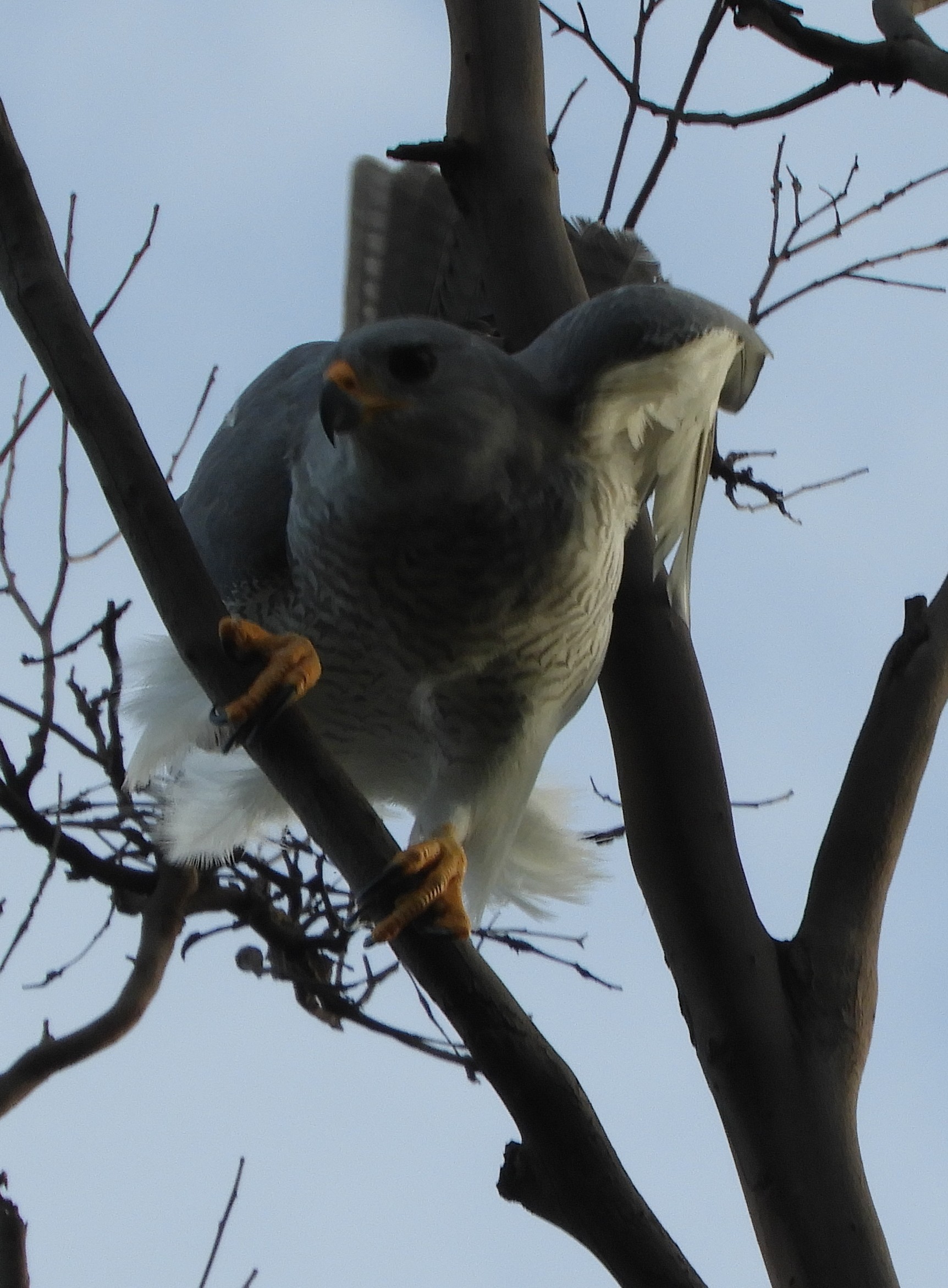
Each time it took flight, the Grey Goshawk uttered a series of short, high-pitched chirps that clashed with the shrieking of the Noisy Miners. Almost as if it was telling them off!
Wing deployment progressing despite unfortunate position of upper branch:

Wing deployment looking good, initiating detachment from lower branch:
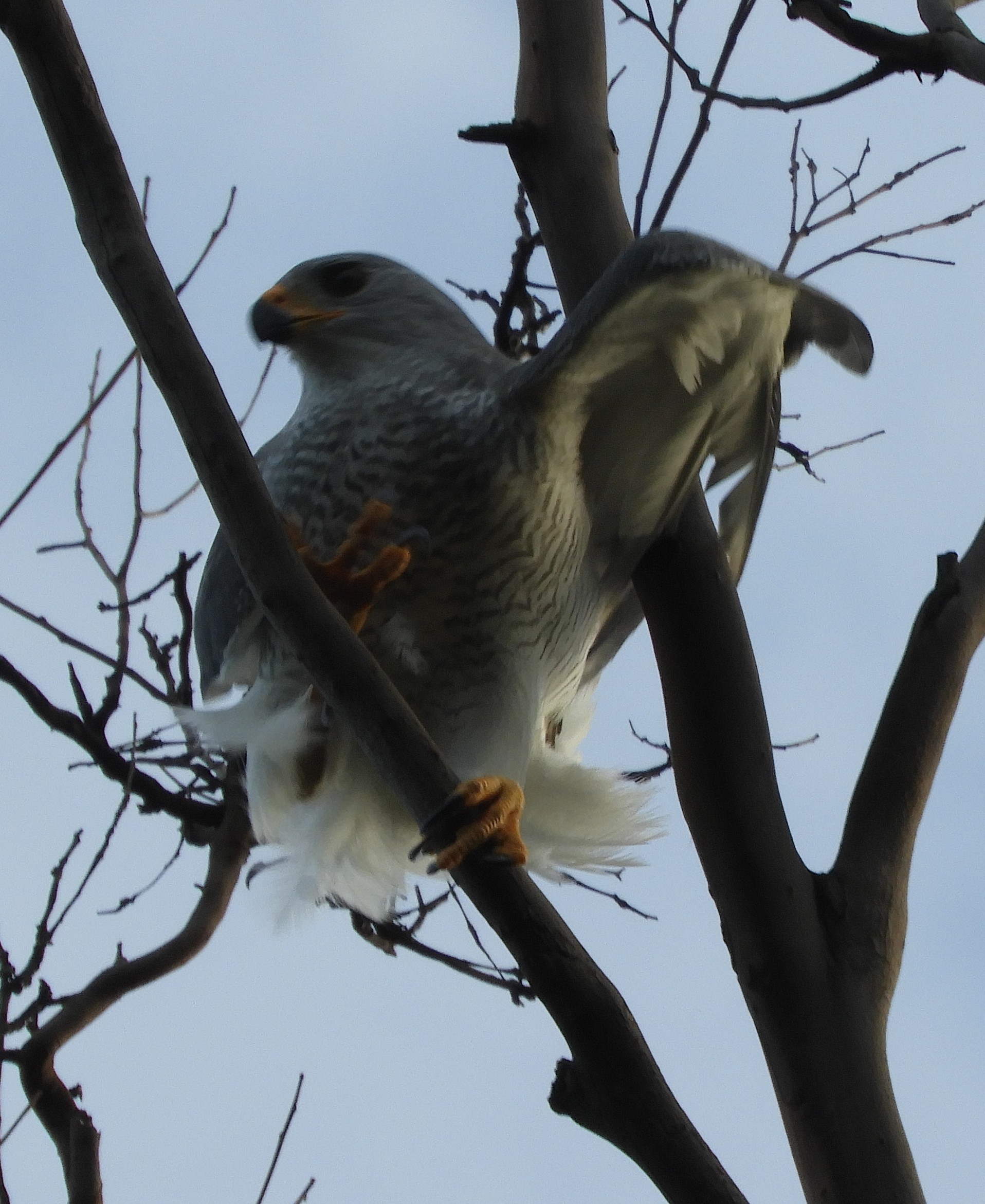
The hawk took off and coasted through the tops of the trees. Soon after it disappeared from view, a group of cockatoos burst from the tree tops and circled the area, shrieking and shouting in alarm.
This was my first sighting of a Grey Goshawk. What a beautiful bird.
Common name: Grey Goshawk
Scientific name: Accipiter novaehollandiae
Approximate length: 40-55 cm. Wing span: 70-110 cm.
Date spotted: 24 February 2020 (summer)
Location: Manly Dam Reserve, New South Wales, Australia: 33°46’36.9″S 151°14’47.7″E
Young Channel-billed Cuckoo fed by a currawong
A plaintive caterwauling drew my attention to the treetops this morning. A large bird sat high in a tree, calling and flapping its wings. It was a juvenile Channel-billed Cuckoo, waiting to be fed. As I watched, the adoptive parent arrived: a currawong. The currawong stuffed some food down the baby’s throat:
The baby cuckoo is already larger than its adoptive parent. Channel-billed Cuckoos are very large birds. In fact, they’re the largest of all parasitic birds. The body of the adult is more than half a metre long, and the wingspan is almost a metre. As the term parasitic implies, the cuckoo parents lay their eggs in the nests of other birds—in this case, a currawong’s nest—and the hapless host then raises the cuckoo chick.
In the next video, the young cuckoo is more restful, which gives you a chance to see its colouring. The very young birds have yellowish and brown colouring, whereas adults are light grey and dark grey. This youngster is close to adult colouring, but you can still see yellow here and there. The chirping noise that you hear throughout is the cicada beetles that rule the bush at this time of year.
Near the start of the video, the bird takes a sudden dislike to a dead twig nearby. Who knows why. Perhaps the bird is bored. Then a Noisy Miner arrives to alleviate the boredom. Noisy Miners, also known as Australian Miners, are noisy, as you may have guessed. They broadcast an alert whenever anything unusual appears in their territory. The young cuckoo reacts with alarm. In the nick of time, the host currawong arrives with another tasty treat.
I noticed that the currawong retreats hastily after delivering each morsel of food, and the cuckoo gives chase. I’d probably retreat too if my baby were that size!
Here’s a still photo of the young cuckoo. It’s eyes have not yet reached the dramatic red of the adult Channel-billed Cuckoo:

Bits of yellow and brown are still visible in the feathers, but this young ‘un has nearly attained the grey colouring of the adult.

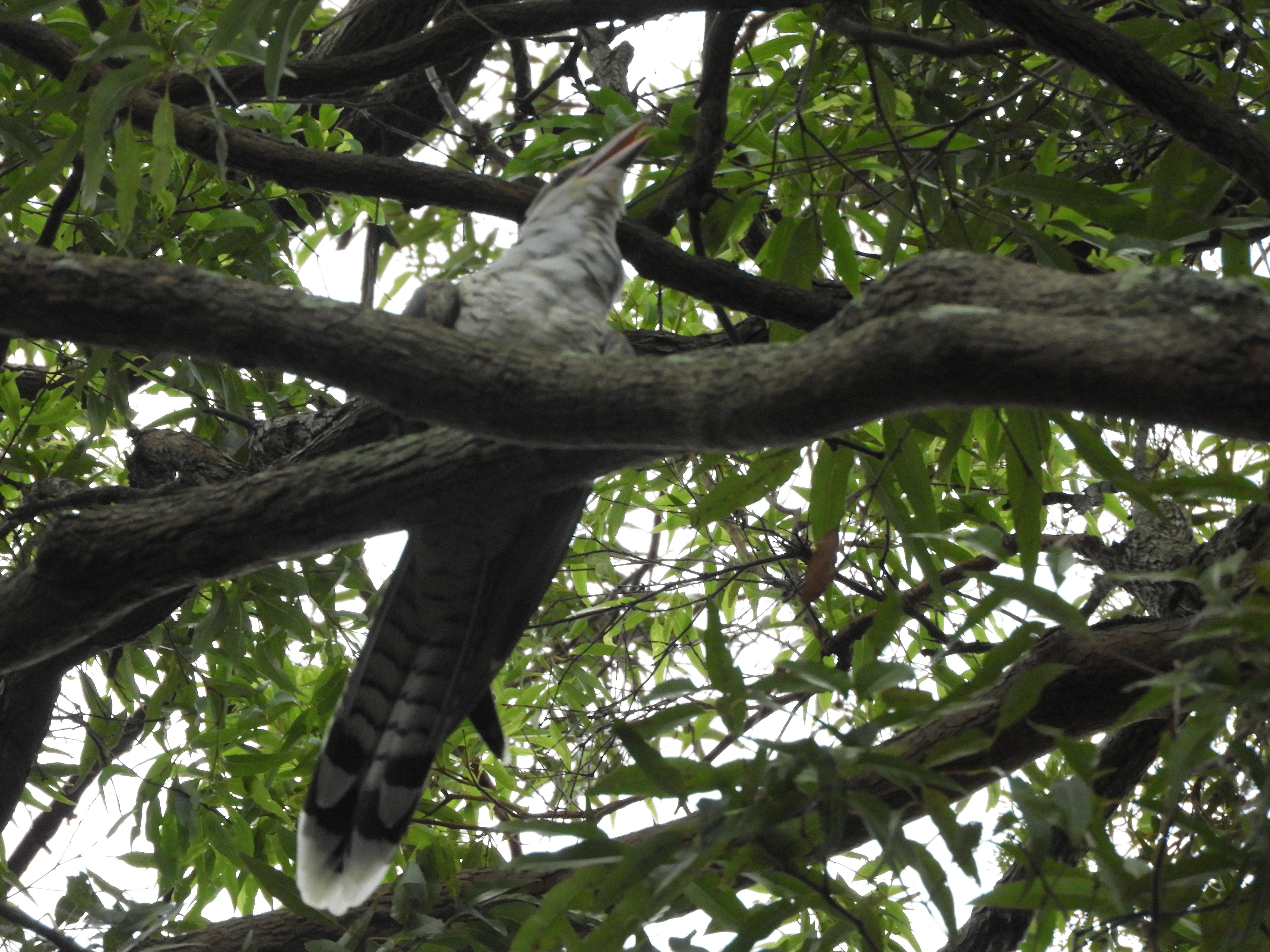
The next photo gives a good view of the youngster’s tail, which looks to be fully developed. I saw the bird flying from tree to tree, and it did a very good job of it. It will need its flying skills in a few weeks’ time, as these cuckoos are migratory. They come down the eastern coast of Australia in spring, around September, then fly back up north to Indonesia and other islands around March.
To see more pics and videos of these cuckoos, and to hear the horrendous noise the adults make, check out my list of cuckoo posts.
Common name: Channel-billed Cuckoo
Scientific name: Scythrops novaehollandiae
Approximate length: 58-65 cm
Date spotted: 25 January 2020 (summer)
Location: Manly Dam Reserve, New South Wales, Australia: 33°46’59.6″S 151°15’15.5″E
Australian Magpie singing
This young Australian Magpie dropped in to sing me a song! I think it’s a juvenile, as its eyes are brownish rather than red. It may be a female, as males tend to have a clearer demarcation between the black and the white sections of feathers, whereas females have more grey. But the colouring could be due to the bird being a juvenile.
The magpie spent at least ten minutes minutes singing, maybe more. I had time to grab my camera, make my way into the garden, film a few minutes from far away, then walk up and sit down near the bird and film again. This video is the result of the second set of filming.
Cool fact: Evidently magpies can hear the sounds of grubs and worms moving underground.
Common name: Australian Magpie
Scientific name: Gymnorhina tibicen
Approximate length: 40 cm
Date spotted: 6 January 2020 (summer)
Location: Near Sydney, Australia
St Andrew’s Cross spider – X marks the spot
This gorgeous spider created its web in a bush in my garden. I nearly stuck my nose into it when reaching to pull out a weed! It’s a female St Andrew’s Cross spider:

We see these spiders quite often. They always spin thick twirls radiating out from the centre of the web, usually four as this one has done. The spider arranges itself carefully so that its body and legs complete the pattern. X marks the spot where the spider lurks!
It’s not a four-legged spider! It’s arranged its legs in pairs. As you can see in this photo. the female has silvery squiggles on its thorax, and stripes of yellow, silver and black on its abdomen, with some polka dots thrown in for good measure. The male spiders are smaller and less colorful, primarily light brown and beige.
St Andrew’s Cross spiders aren’t dangerous to humans. They’ll try their best not to bite you, and their venom doesn’t do too much harm. I’m glad, though, that I didn’t actually bump it with my nose!
Scruffy Channel-billed Cuckoo
Are you often woken up in the early hours of the summer morning by a hoarse hooting noise? It sounds like giants boasting about a joke they’ve played on the world. The call puts the Kookaburras to shame, in terms of melody (lack thereof) and loudness (excess thereof).
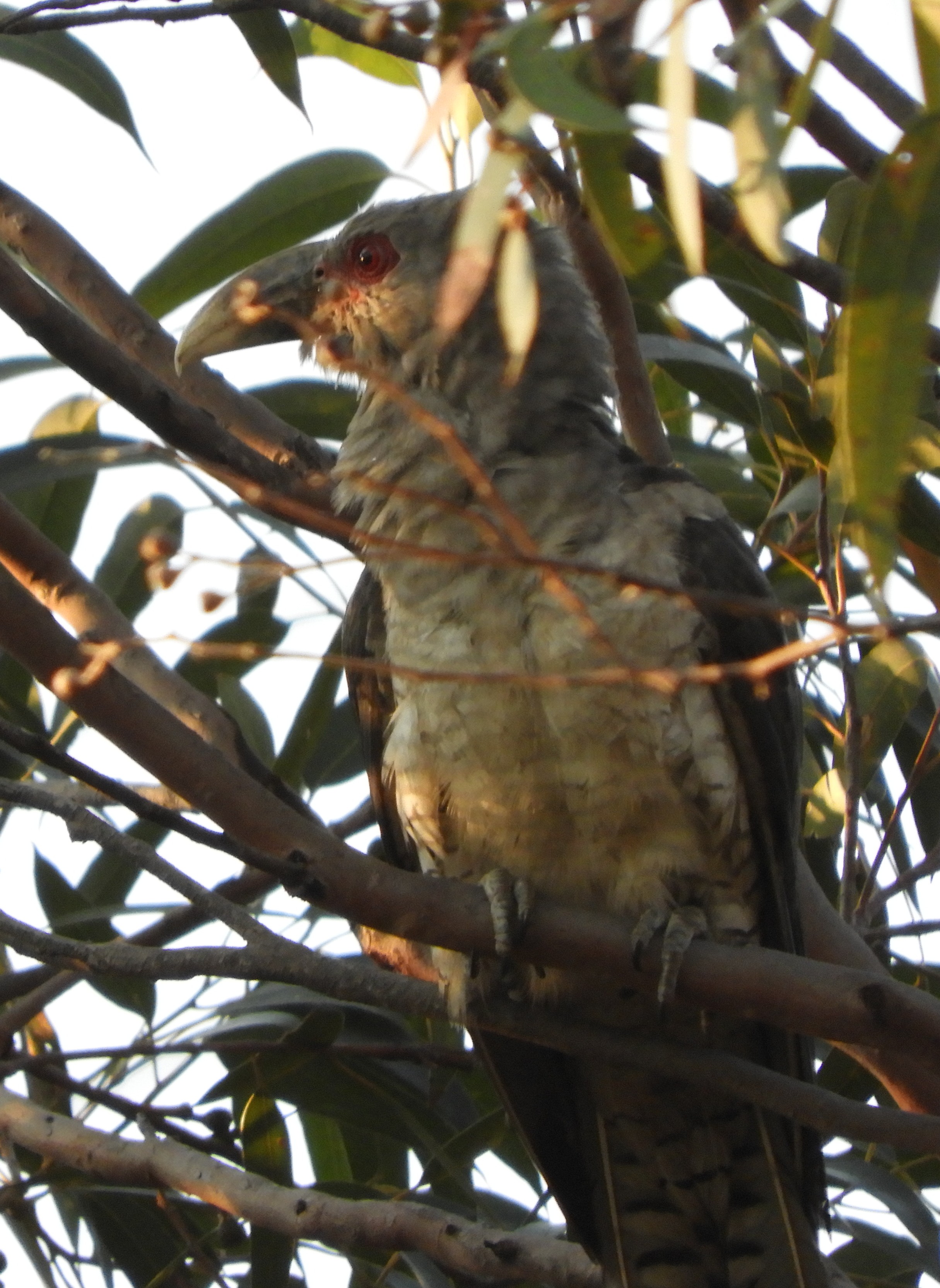
That noise is made by the Channel-billed Cuckoos. One of my earlier posts has a recording of the call. This picture shows a rather scruffy-looking example of these birds. It’s probably spent the night out on the town:
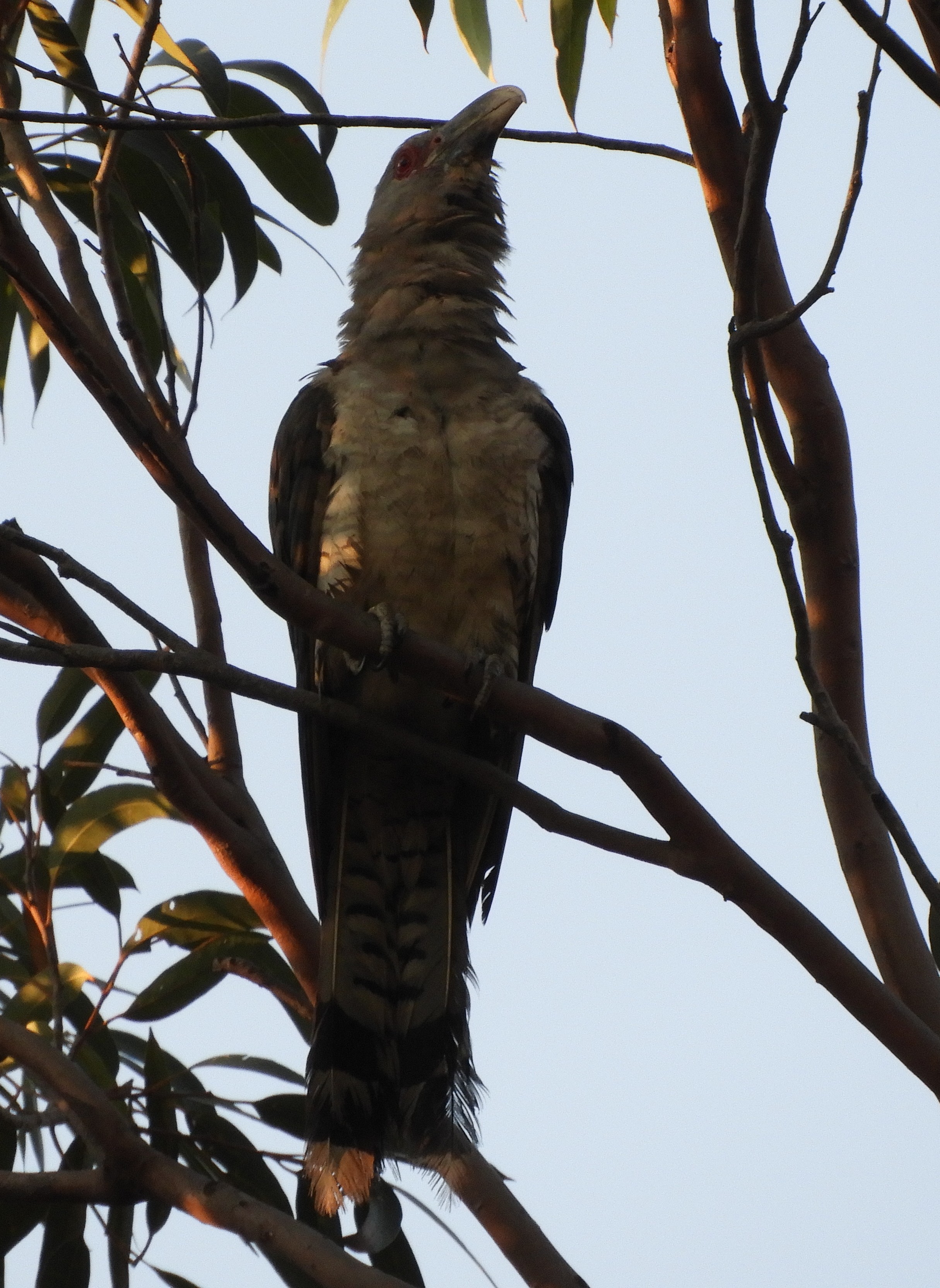
Channel-billed Cuckoos spend the winter in Papua New Guinea and Indonesia, then migrate southwards to Australia for the summer. We see them in the Sydney area from September through to March each year. The first time I hear their raucous call, I know that spring has arrived.
Like many cuckoos, these birds lay their eggs in the nest of another species. Often, the parent cuckoo breaks the eggs of the host birds. When the young cuckoo hatches, the luckless host parents then feed and protect the cuckoo chick until it’s ready to leave the nest.
Channel-billed Cuckoos are large birds. Their appearance matches their call: Take no nonsense from no-one. Here’s a view of the bird’s head in profile, with that impressive red eye and hooked beak:
To see more pics and videos, check out my list of cuckoo posts.
Common name: Channel-billed Cuckoo
Scientific name: Scythrops novaehollandiae
Approximate length: 58-65 cm
Date spotted: 28 December 2019 (summer)
Location: Manly Dam Reserve, New South Wales, Australia: 33°47’00.6″S 151°15’10.1″E
Crested Pigeon doing what pigeons do
This pretty little Crested Pigeon isn’t doing much. It’s pecking at food, as pigeons do. But I found the colouring of the scene attractive:
Common name: Crested Pigeon
Scientific name: Ocyphaps lophotes
Approximate length: 31-35 cm
Date spotted: 26 December 2019 (summer)
Location: Long Reef Headland, Collaroy, New South Wales, Australia: 33°44’37.0″S 151°18’20.2″E
Darter fends off Australian Ravens
Darters are large, decorative birds with long, snake-like necks and intricate feather patterns on their backs. This Darter drew the attention of some Australian Ravens. I watched for a few minutes as the ravens dropped in to harass the larger bird. The Darter came out on top every time:
Here are some still pictures of the Darter, to give you a better idea of what it looks like. First, in an argument with a raven:

The next one gives a good view of the Darter’s long neck:
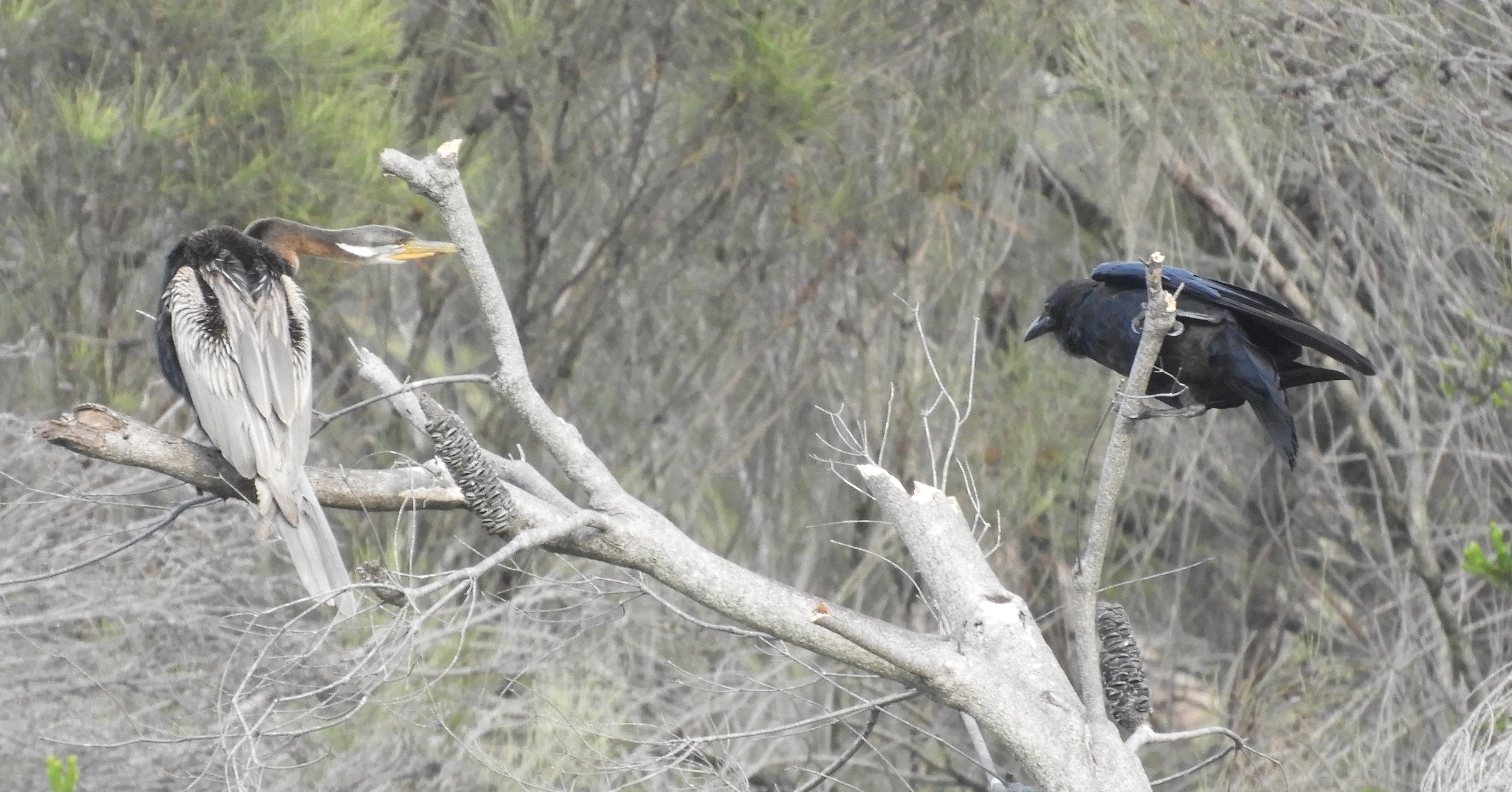
The Darter in a more contemplative pose:
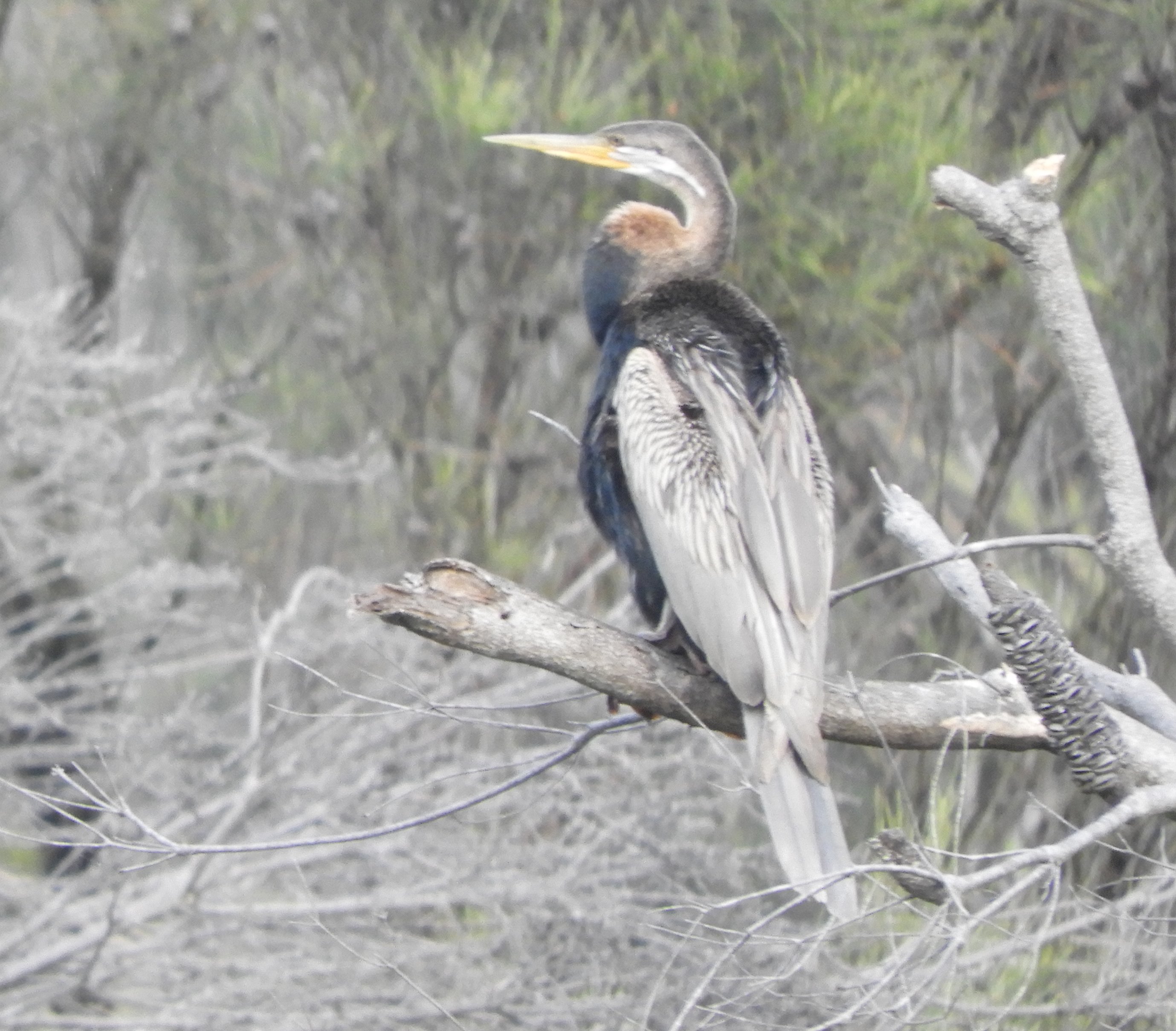
I think the patterns of the feathers on the bird’s back are lovely:

The last time I saw one of these birds was a couple of years ago, when it was hanging out its wings to dry in a pose that reminded me of a ballerina.
Common name: Darter
Scientific name: Anhinga melanogaster
Approximate length: 90 cm; wing span: 1.2 m
Date spotted: 15 December 2019 (summer)
Location: Manly Dam Reserve, New South Wales, Australia: 33°46’34.3″S 151°14’48.6″E
Dollarbirds are in town again
Dollarbirds are migratory, coming down to the Sydney area for the summer months after wintering on islands further north. I spotted this one this morning, perched high on a dead tree:

The Dollarbird was behaving exactly as my bird book says it’s supposed to behave. They typically sit high up on a dead branch and watch for insects to catch.
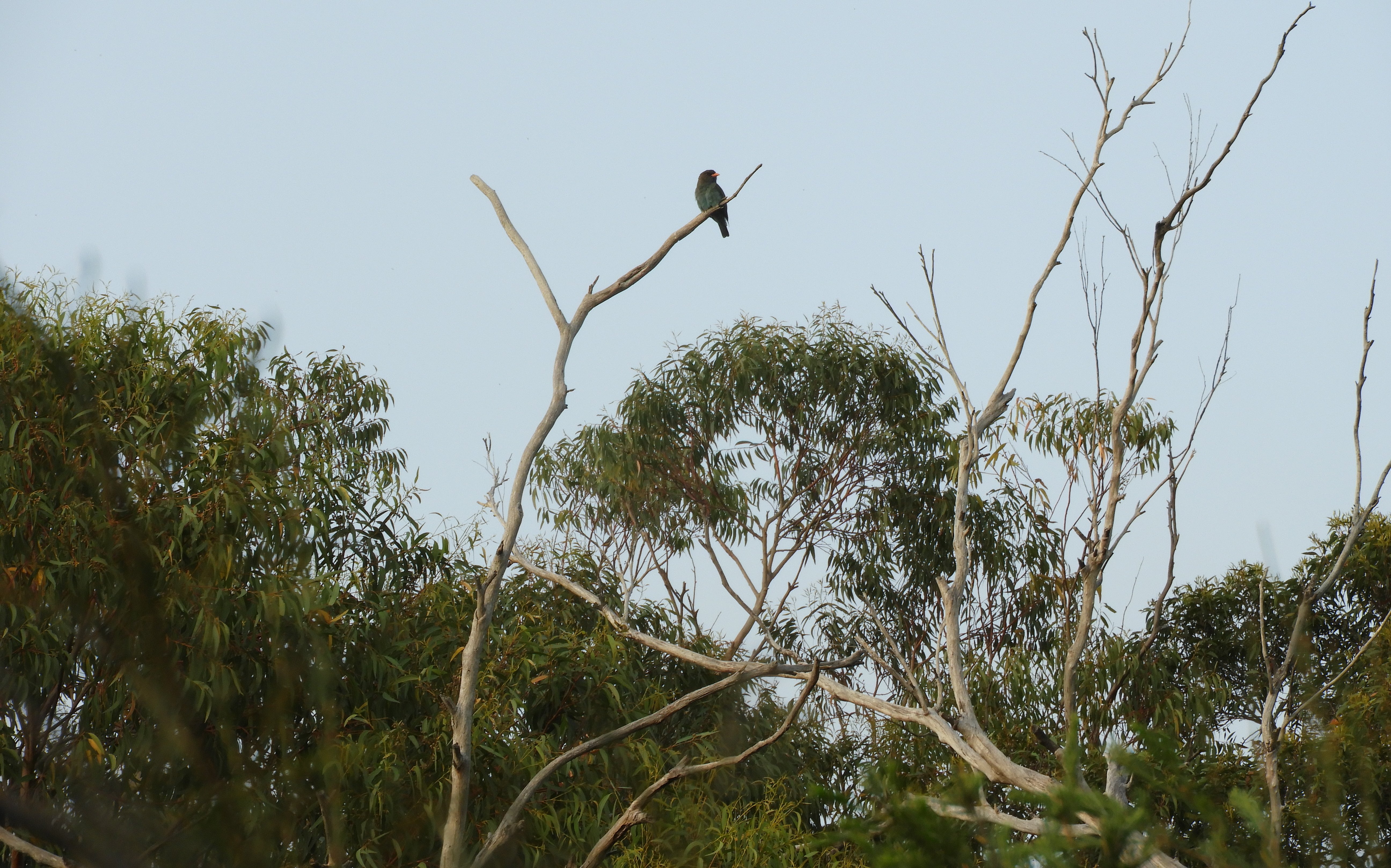
My photos are a little fuzzy, alas, because the bird was so far away and my camera wason maximum zoom. Luckily it’s quite a large bird, at approximately 30 centimetres from head to tail, which makes it easier to spot.
Here’s a picture of the front of the bird, showing some of its blue/green colouring:
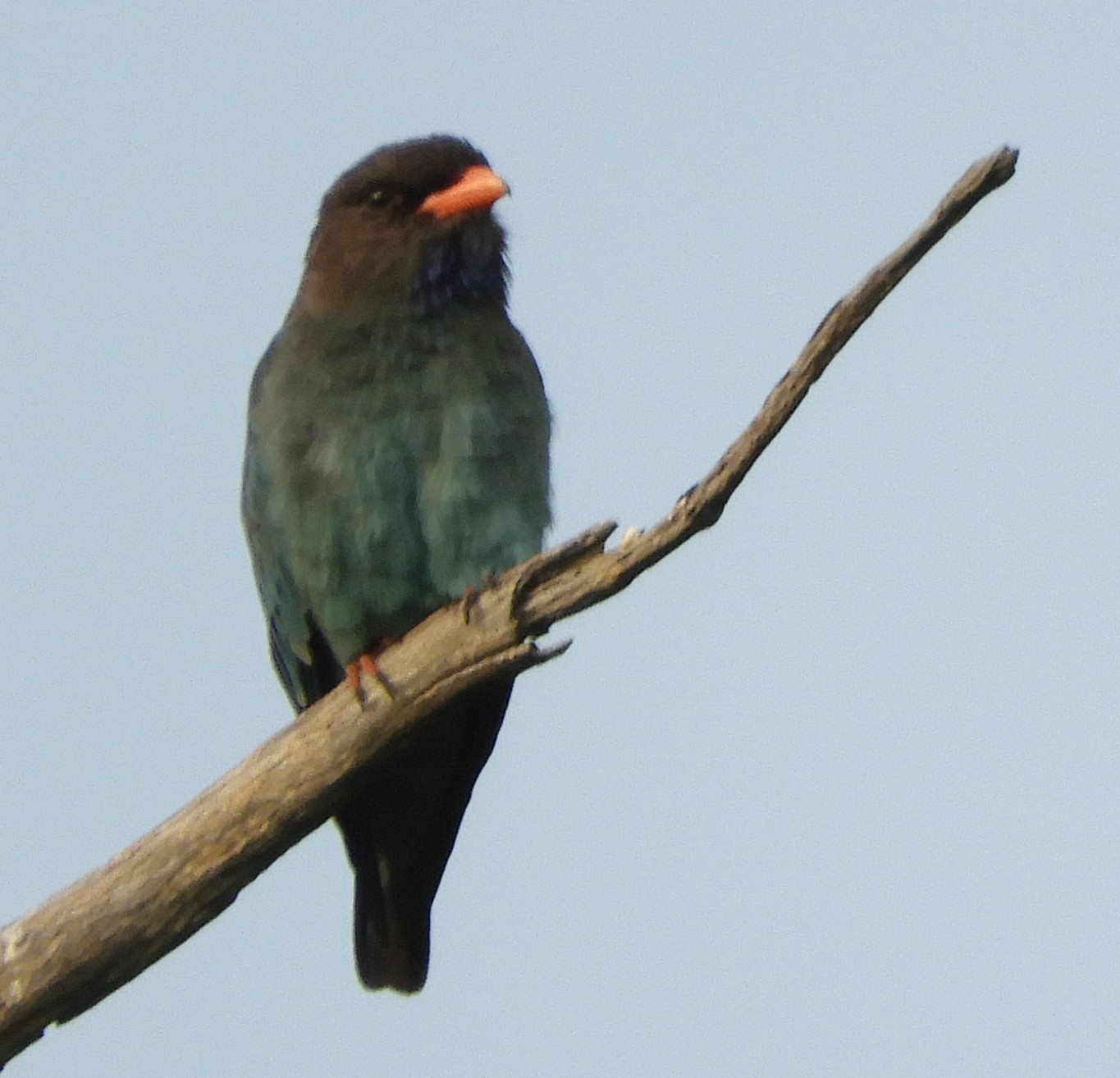
Its throat is a lovely purple colour:

The next bit amused me. The bird was grooming, and seemed surprised and even a little piqued when a feather escaped:
The Dollarbird gets its name from the white patches on its wings, which look like silver dollar coins when the bird is flying. Here you can see a bit of the white patch as the bird stretches its wing:

As well as the white patch, this photo shows the feathers on its back nicely:

In this short video clip, you see the flashes of white on the wings as the Dollarbird flies off:
Dollarbirds make a strange, insistent chattering noise. I didn’t catch this one in a noisy mood, but you can hear another Dollarbird in my post from five years ago. Wow, it’s been a while since I’ve seen one of these birds!
Common name: Dollarbird
Scientific name: Eurystomus orientalis
Approximate length: 30 cm
Date spotted: 14 December 2019 (summer)
Location: Manly Dam Reserve, New South Wales, Australia: 33°47’02.2″S 151°15’18.3″E
Sulphur-crested Cockatoo with orange chest feathers
The Sulphur-crested Cockatoos were out in full force early this morning. I enjoy hearing their conversations, whilethey chatter, scold, and screech at each other. I zoomed in to take this video of one of the birds from close up. It’s interesting to see that the cockatoo has pinkish orange feathers on its chest. I wonder if this is a seasonal variation of the more usual pure white? It’s late spring, and perhaps the colour is an attempt to appear more attractive to the opposite sex.
The next video shows a group of birds wheeling around the trees. You can hear the sounds of other birds when the cockatoos are quiet enough to allow it!
Common name: Sulphur-crested Cockatoo
Scientific name: Cacatua galerita
Approximate length: 50 cm
Date spotted: 1 December 2019 (summer)
Location: Manly Dam Reserve, New South Wales, Australia: 33°46’49.7″S 151°14’56.0″E


 Sydney Birder