Grey Goshawk at Manly Dam
Yesterday, in the quiet early-morning hours, I spotted a Grey Goshawk at Manly Dam. This is only the second time I’ve seen one of these birds (the first was two years ago). Both times, I’ve been impressed with the atmosphere of calm that the bird projects. I guess if I were a mouse, my impression might be different!
In the video, you can hear Rainbow Lorikeets scolding and a wattlebird croaking. The hawk itself is silent. At the end, the hawk turns and drops off the branch to fly away. I watched this bird for a while, as it flew from tree to tree. The way it dropped off the branch at the start of flight was similar each time.
Common name: Grey Goshawk
Scientific name: Accipiter novaehollandiae
Approximate length: 40-55 cm. Wing span: 70-110 cm.
Date spotted: 14 January 2022 (summer)
Location: Manly Dam Reserve, New South Wales, Australia: 33°46’53.6″S 151°15’08.7″E

Baby Channel-billed Cuckoos fed by Currawongs
Walking along a shady path this morning, I heard a loud caterwauling from above. Two baby Channel-billed Cuckoos sat in the trees, yowling and shaking their wings. A Currawong arrived and fed a piece of meat to one of the cuckoos. Then another Currawong brought food to the second screeching youngster.
Like most cuckoos, Channel-billed Cuckoos lay their eggs in the nests of other birds and leave it to those other birds to hatch the egg and look after the growing chick. These particular cuckoos are very large (around 65 cm from head to tail) and so they need to pick the adoptive parents carefully. Currawongs are the usual choice.
This video shows one of the babies yowling and begging for food from its Currawong adoptive parent:
See how large the baby is in relation to the Currawong who’s looking after it! In the next video, one of the babies attempts to eat a largish morsel of meat that a Currawong has just fed to it:
I’ve never seen two babies together before. I wonder if they both came from the same nest, or if they found each other after leaving their nests?
Here’s a still picture of one of the baby cuckoos:
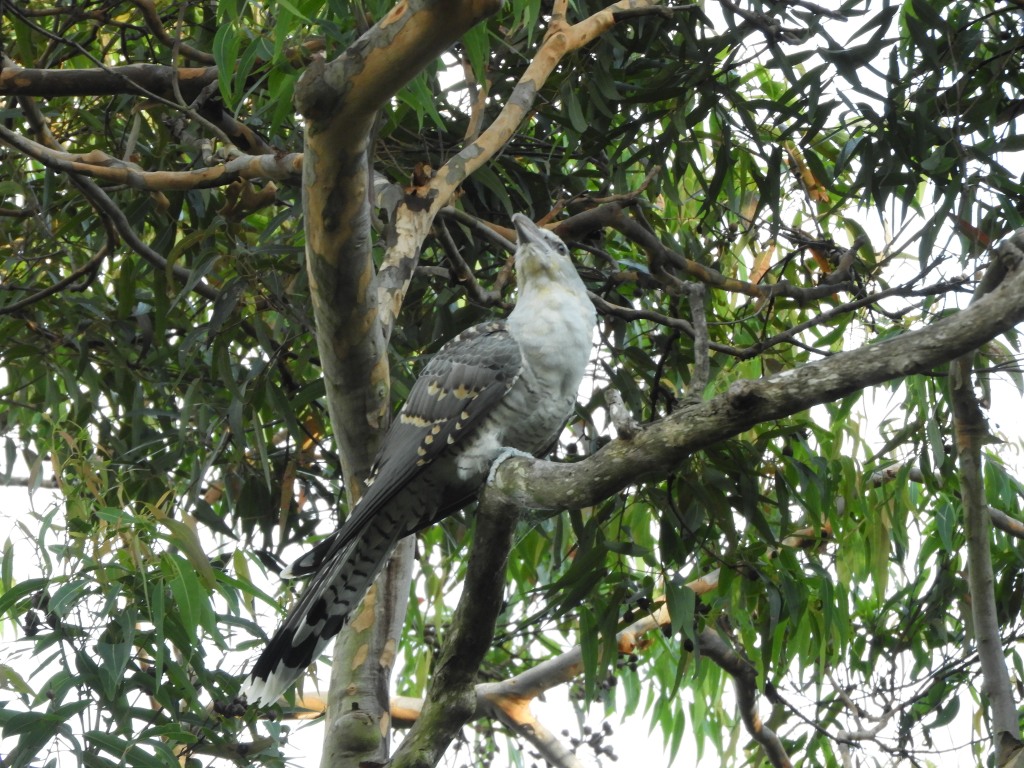
Being a youngster, its eyes are still light brown. The adult birds have fierce red eyes. They’re magnificently ugly birds.
In the next picture, one of the babies is pointing its beak at the sky, perhaps wondering where its next feed is coming from:
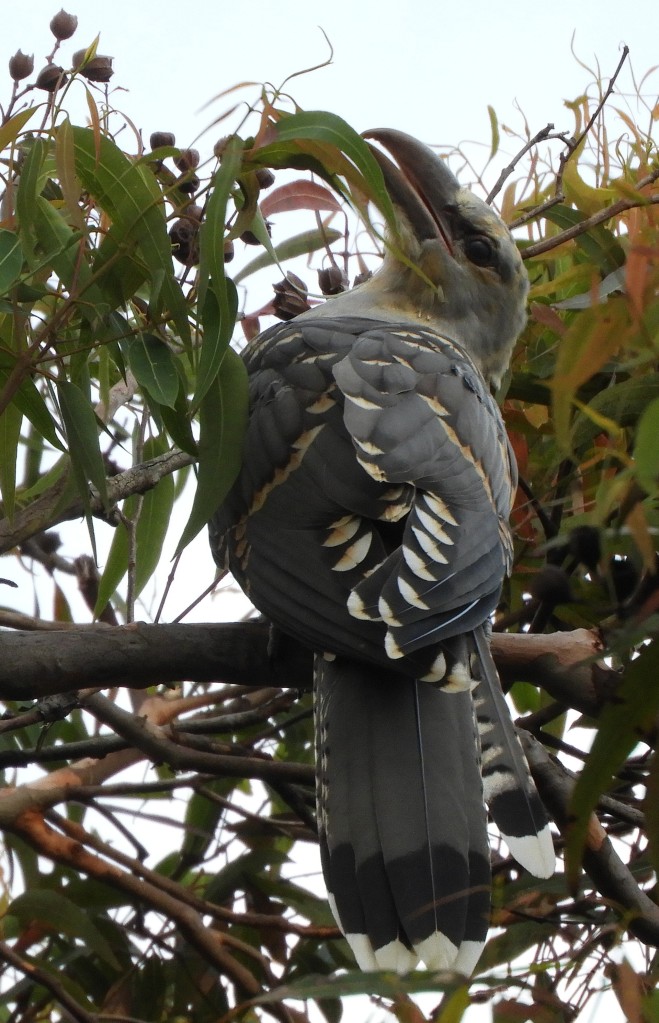
That picture gives a good view of the bird’s large beak and the markings on its back and tail.
One of the things you notice about Channel-billed Cuckoos is the supple way they move their neck and head. Here’s one of the babies leaning forward, in a pose that’s typical of these birds:
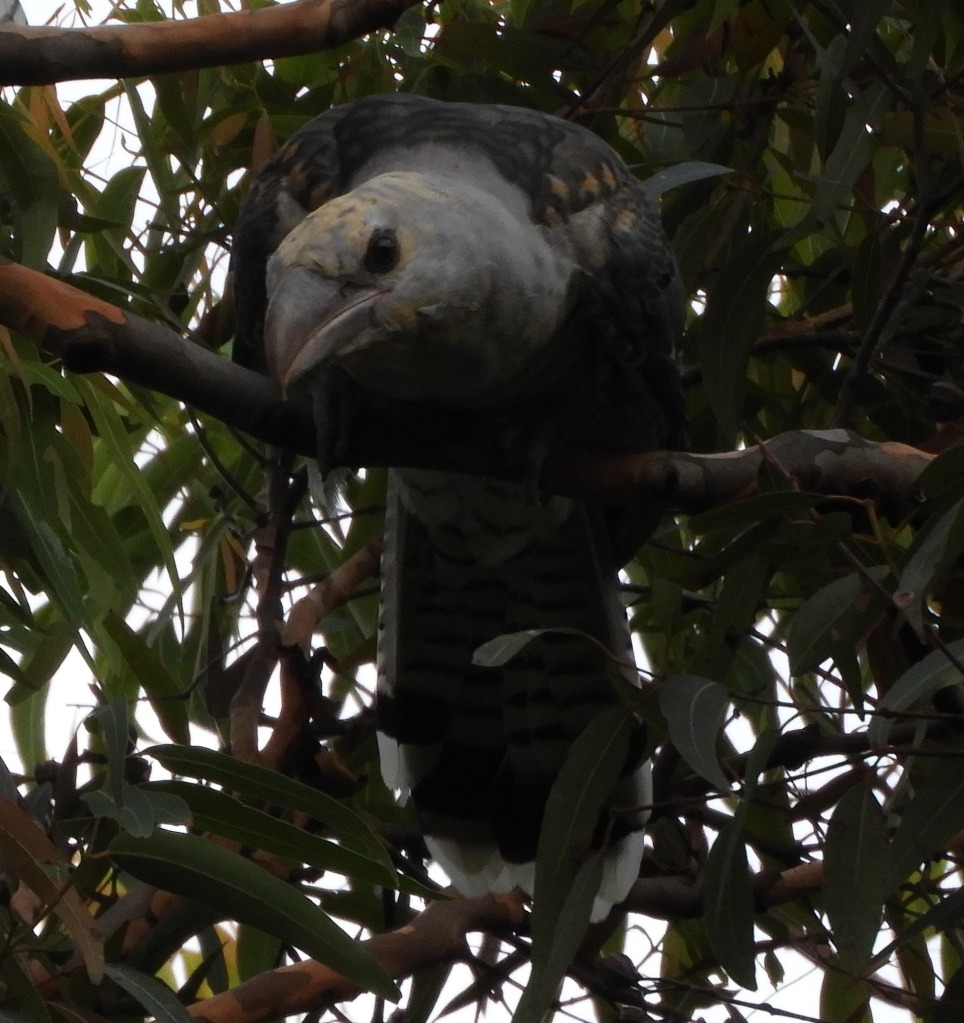
Oo-er, you probably wouldn’t want to bump into that bird one dark night. Here’s a picture of both baby cuckoos, looking at each other:

To finish off with, here’s a close up of one of the babies, head and neck only:

You can find out more about these birds in my other posts about cuckoos.
Common name: Channel-billed Cuckoo
Scientific name: Scythrops novaehollandiae
Approximate length: 58-65 cm
Date spotted: 18 December 2021 (summer)
Location: Manly-to-Spit Walk, Balgowlah, New South Wales, Australia: 33°48’00.9″S 151°15’54.9″E

Dollarbirds courting
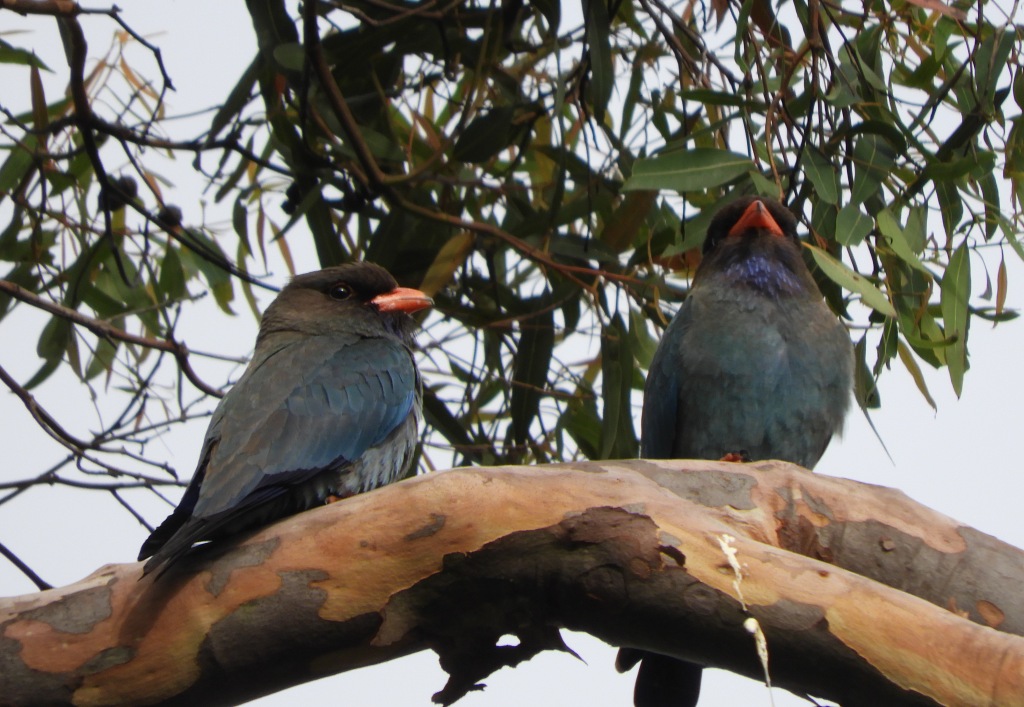
It’s that time of year for birds on the south east coast of Australia: breeding season! I heard a cosy chattering sound high in the treetops. My superzoom camera revealed two Dollarbirds getting friendly:
Dollarbirds are migratory. They travel down to the south east coast of Australia for the summer months (roughly September to March) then fly up north to warmer climes for the winter.
They get their name from the white circular markings on the undersides of their wings. The white circles reminded people of the old silver Australian one-dollar coins. You can see the flash of white nicely when the male flies off at the end of the video.
This still photo shows the blue-green colouring of the birds. They have soft brown heads and pretty purple shading under the beak:
Common name: Dollarbird
Scientific name: Eurystomus orientalis
Approximate length: 30 cm
Date spotted: 29 November 2021 (late spring)
Location: North Harbour Reserve, Balgowlah, NSW: 33°47’59.4″S 151°15’57.8″E

Rainbow Lorikeets enjoying our Banksia flowers
One of our Banksia trees has covered itself in blooms. The local Rainbow Lorikeets are delighted. A delighted lorikeet is a noisy lorikeet! In fact, anyone who lives near these birds will tell you that a lorikeet in any type of mood is a noisy creature.
One day was quite breezy. I like this video because of the way the bird hangs on to the Banksia flower as it sways in the wind, and because you get a chance to see the bird’s colourful underside as well as its topside.
Here are a couple of the birds lurking on a nearby tree before making the hop down to the Banksia:
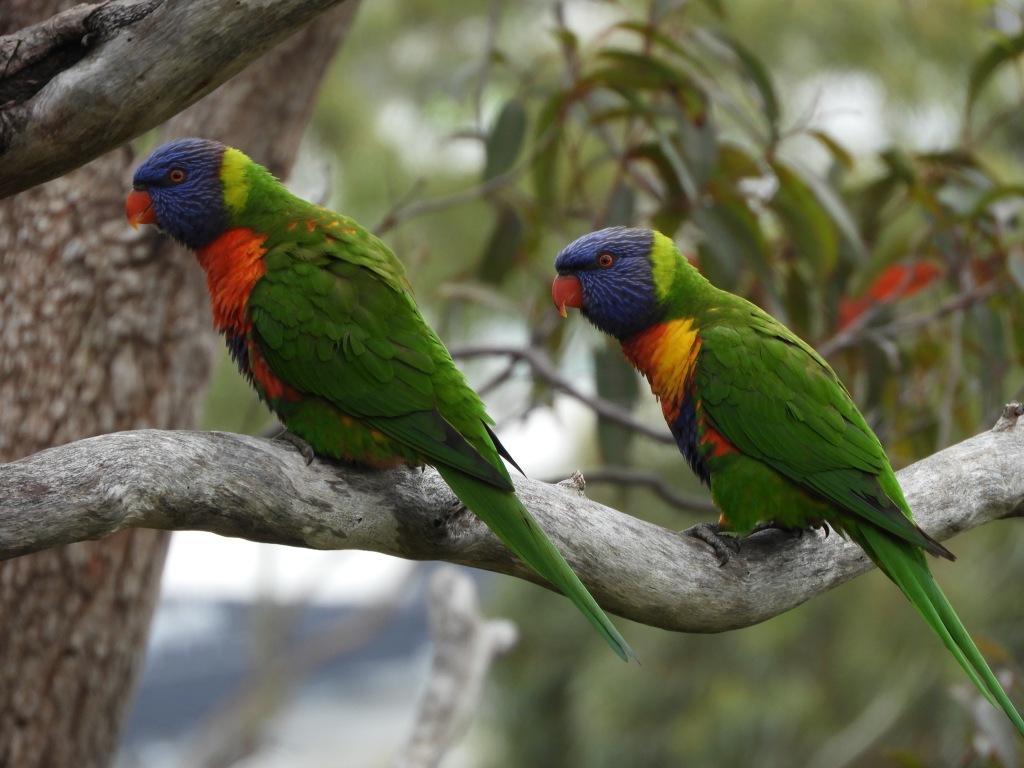
I’m so lucky to have these pretty, chatty little birds dropping in regularly to see what’s what.
Common name: Rainbow Lorikeet
Scientific name: Trichoglossus haematodus
Approximate length: 30 cm
Date spotted: November 2021 (spring)
Location: Australian east coast, about 20km north of Sydney

Bugs: Yellow, orange, and black stripes
A couple of days ago, I saw a pretty bug on the window of my car. It was long, and striped with yellow, orange, and black. It had long feelers which it waved around, and large feet.
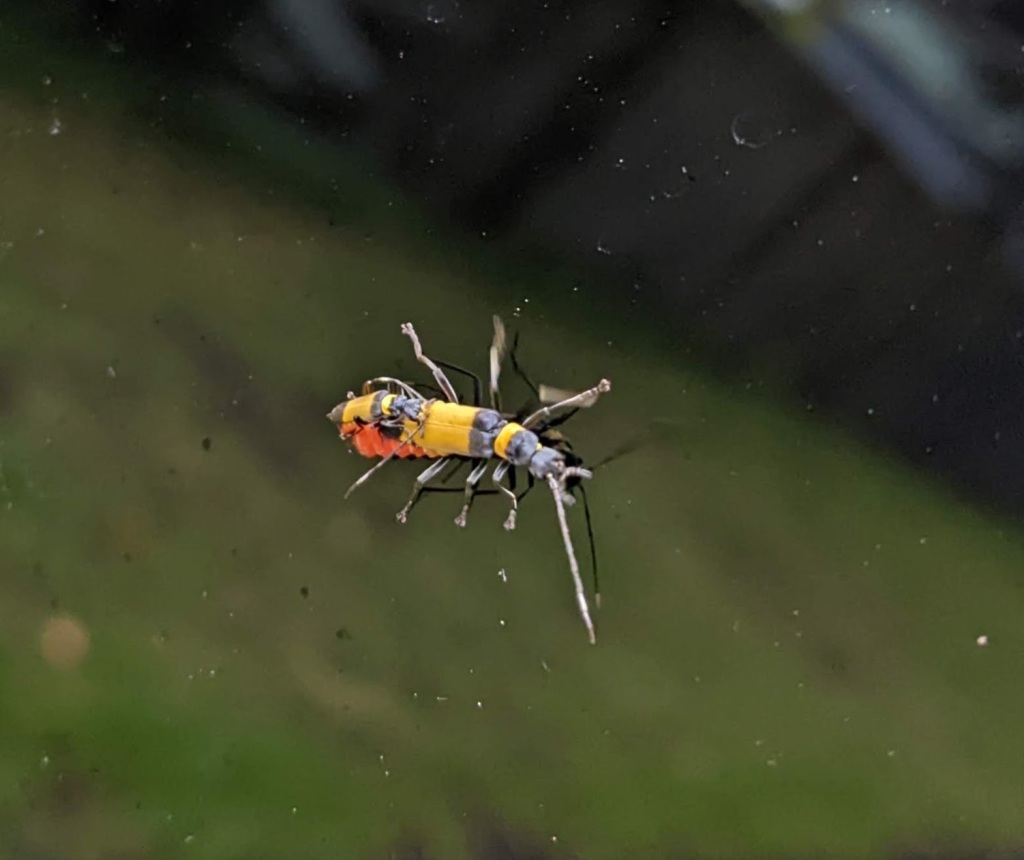
On looking closer, I noticed that it’s not one but two bugs. There’s a small bug on top of the larger one. I’m guessing the smaller one is a male and that they’re mating. Or maybe it’s a baby bug hitching a ride on an adult? Here they are again, from a slightly different angle:

Does anyone know anything about these bugs? I saw them on Sydney’s Northern beaches in late spring.
Update on 30 November 2021: It’s an Imperial Soldier Beetle (Chauliognathus imperialis). Sightings of this beetle seem to be quite rare. Thank you to Hamish Robertson for the identification. And indeed, the smaller beetle is the male, the larger is the female.

Satin Bowerbird has purple eyes
I spent this weekend in the Blue Mountains, a beautiful area to the west of Sydney. On an early morning walk this morning, I heard some interested chattering and calling from a group of birds. I went to investigate, and found this lovely creature:

That purple eye isn’t a trick of the light. This bird really does have purple eyes. It’s a female Satin Bowerbird. My first sighting!
Bowerbirds are so called because of their unique behaviour around breeding time. The male bird (which I didn’t see) builds a large construction on the ground, made up of various bits of vegetation. The shape and size of the construction depends on the type of bowerbird. Satin Bowerbirds use upright-standing dry grass or twigs to form an intriguing tunnel. It’s almost heart-shaped. Then they gather decorations to entice the female to their bower. Satin Bowerbirds love blue. They’ll use blue petals, berries, bits of plastic, even entire spoons and other utensils — provided they’re blue!
Here’s another of the birds that I saw this morning, looking alert as I hove into view, and showing off her spangled front feathers, with a light green blush on the chest:

The next picture shows the back of the bird:
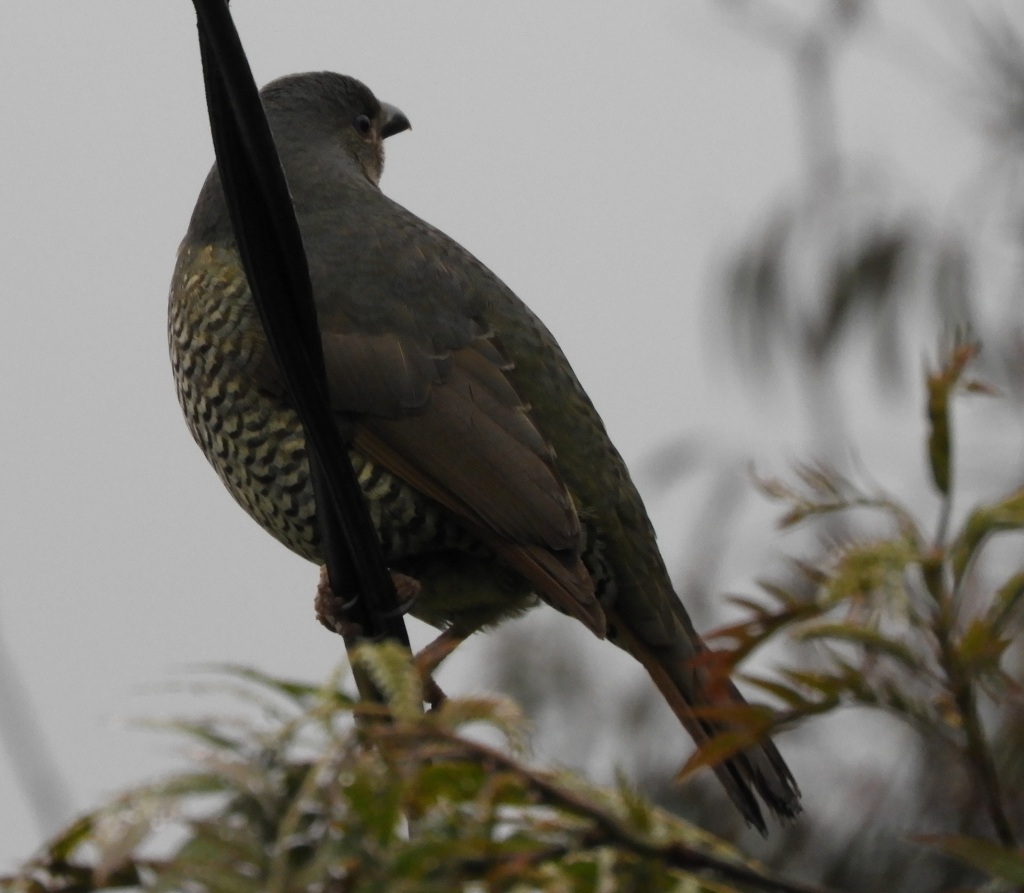
Common name: Satin Bowerbird
Scientific name: Ptilonorhynchus violaceus
Approximate length: 28-34 cm
Date spotted: 22 November 2021 (spring)
Location: Mount Victoria, NSW, Australia: 33°35’11.4″S 150°15’15.8″E

Scarlet Robin in Blue Mountains
I’m spending the weekend in the Blue Mountains, about two hours’ drive west of Sydney. A little Scarlet Robin was fascinated by the shiny surfaces of a row of cars. It kept swooping down to examine the mirrors and paintwork.
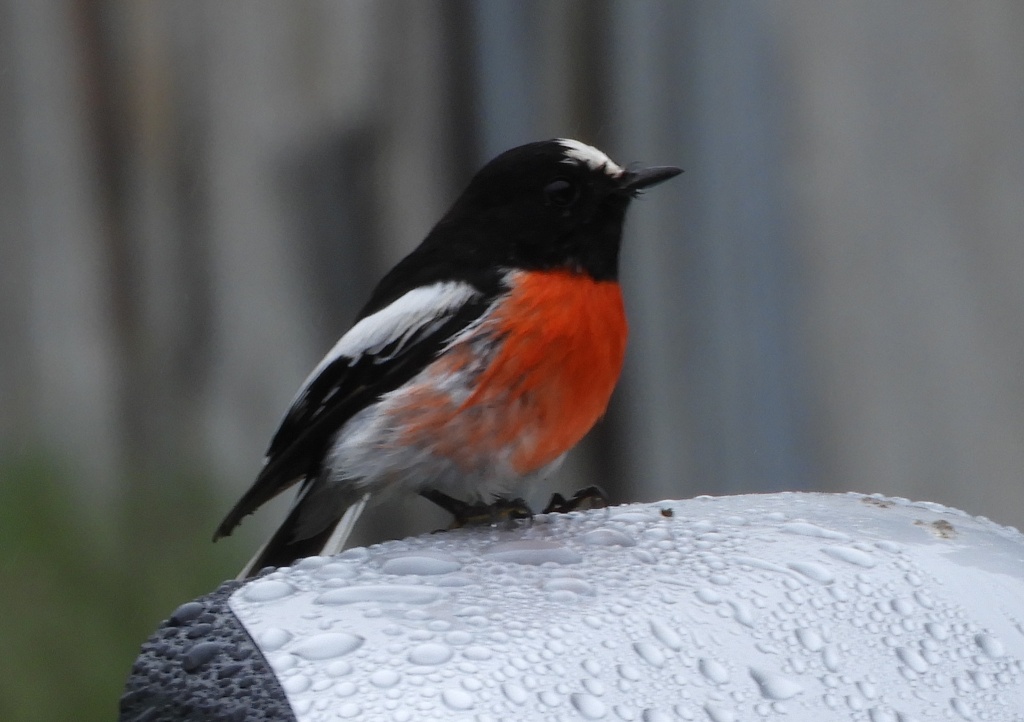
This is a male bird, with its scarlet patch on the chest and striking black and white markings on the rest of the body. The female was flitting around too, but didn’t stay in any one place long enough for a picture. She was light brown with a pale orange chest.
This is my first sighting of a Scarlet Robin, though I often see the Eastern Yellow Robin nearer home. Australian robins are not related to European or American robins. When Europeans came to Australia, they named these little birds “robins” because they reminded them of the birds they saw back home. The same applies to Australian magpies, and probably other birds too.
Common name: Scarlet Robin
Scientific name: Petroica boodang
Approximate length: 12 cm
Date spotted: 21 November 2021 (spring)
Location: Rydal Showground, NSW, Australia: 33°28’58.7″S 150°02’11.0″E

The weird case of the bagworm
(Not a bird, but most likely something that a bird would find interesting!)
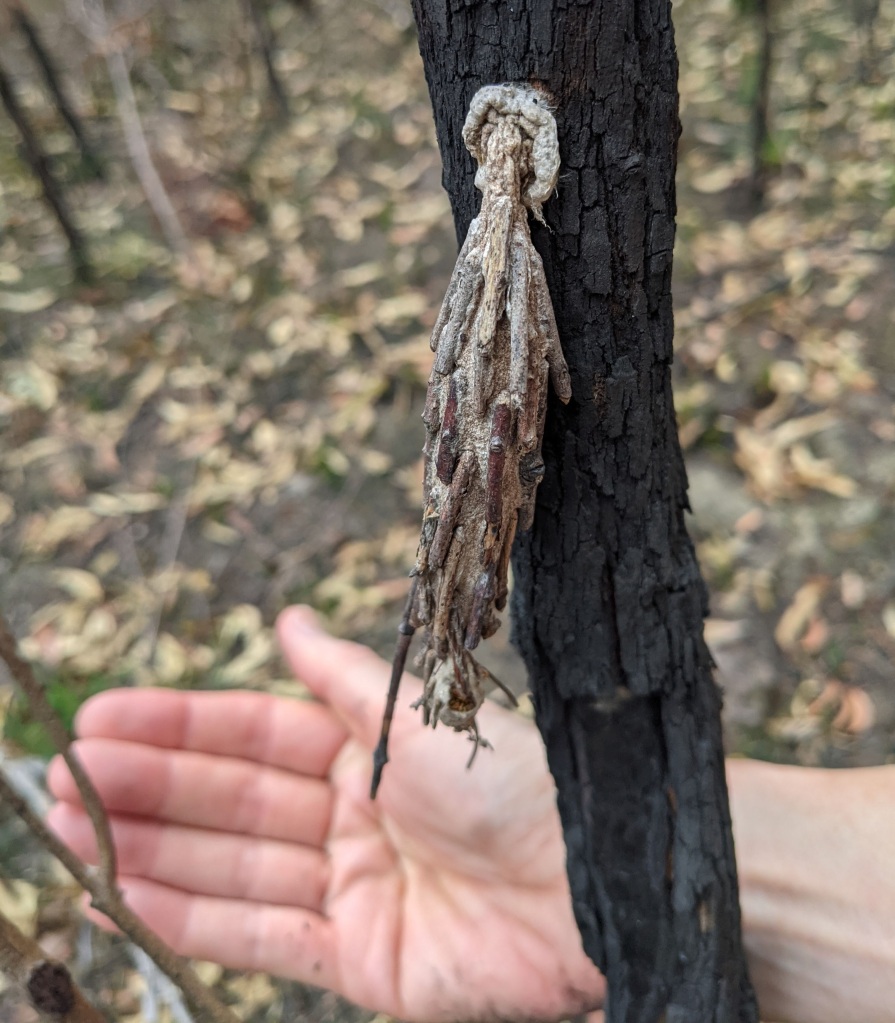
Bagworms, sometimes called case moths, are interesting creatures. The larvae of the moth surround themselves with a case made of silk for protection. Then they go one step further: they attach leaves and sticks to the case, making a home that looks quite weird. Some of the cases can be large: up to 12 centimetres long.
I came across just such a case recently, when walking through a burnt area of bush. (The cases are hard to spot when the bush is lush and healthy.) I guess this larva was travelling around looking for food, and found itself exposed on a black tree trunk.

This particular case was quite large, at 11 centimetres long. At the top is the patch of silk that the larva uses to attach the case to the tree. When moving around, the larva detaches from the tree, pokes its legs out at the top of the case, and drags the case around with it.
I think is is most likely a Saunders’ case moth, also called the large bagworm (Metura elongatus), which is found in eastern Australia where I live.
Here’s a view from another angle:
In the zoomed-out view, the bagworm is half way up the blackened tree trunk in the middle of the picture:

Spotted at this location in Manly Dam park, on the east coast of Australia. I’ve posted recently about other bagworms that I’ve encountered.
Whipbird takes a dip in a puddle
This is why they put puddles on paths, right? An Eastern Whipbird enjoys a quick dip in a puddle, on the path right in front of me:
The whipbird is so called because of the rather strange noise it makes: a long drawn-out whistle ending in a small explosion, which reminds people of the crack of a whip. Some of my other posts about this bird manage to capture the sound of the call too.
Common name: Eastern Whipbird
Scientific name: Psophodes olivaceus
Approximate length: 30 cm
Date spotted: 6 November 2021 (spring)
Location: Dobroyd Head Track, Balgowlah Heights, NSW, Australia: 33°48’37.6″S 151°16’23.9″E

Common Bronzewing pigeon in Blue Mountains
This weekend I spent a day in the region of Kurrajong in the Blue Mountains area west of Sydney. On an early morning walk, I came across this large, colourful pigeon:

It’s a Common Bronzewing. I’d heard their calls from all round me in the bush: a deep, booming coo that sounds like something from Jurassic Park rather than from a pigeon!
Common name: Common Bronzewing
Scientific name: Phaps chalcoptera
Approximate length: 30-36cm
Date spotted: 31 October 2021 (spring)
Location: Grose Wold, New South Wales: 33°36’41.7″S 150°39’50.0″E


 Sydney Birder