Category Archives: Birds

My first White-headed Pigeons, near Taree NSW
I was in Moto, near Taree, a few days ago, soon after the floods that have devastated much of the area. Driving along a country road next to a creek, I spotted a flock of about 7 large white-bodied, dark-winged pigeons on the side of the road. They flew up into the trees and onto the fences as I passed, but I managed to snap a shot of two of them with my phone:
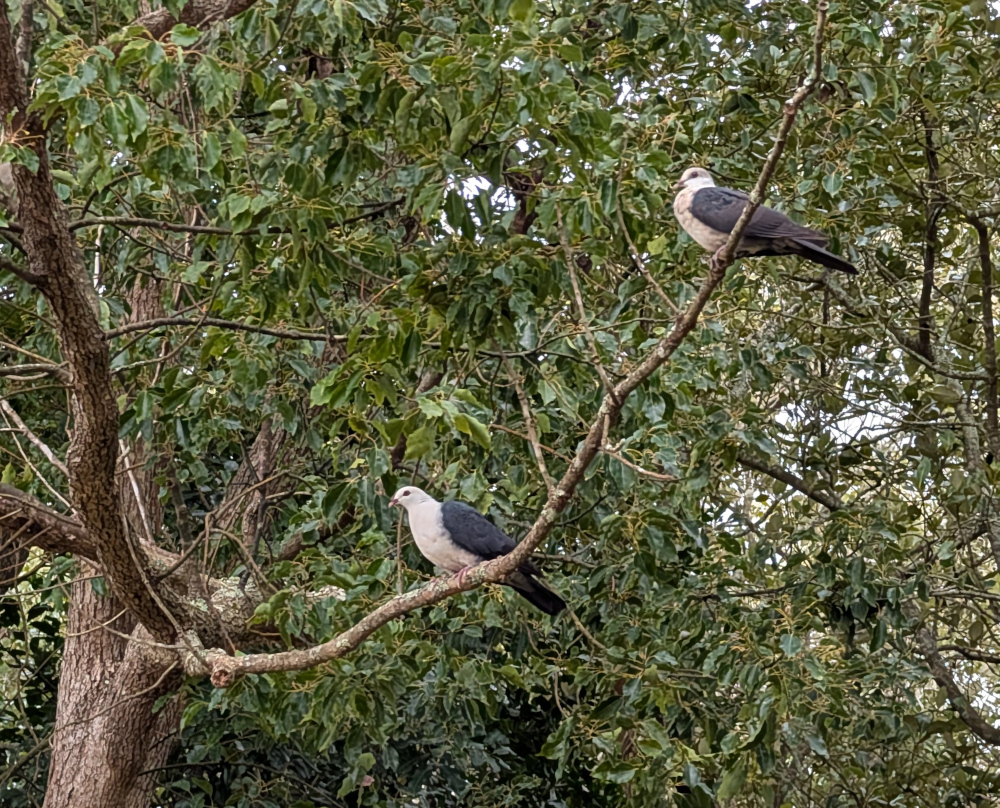
They’re White-headed Pigeons, my first sighting of these birds. The one on the left is a male. The one on the right is an immature male or female.
They’re larger than most pigeons, and exude an atmosphere of calm — until they fly away! My bird book lists them as scarce, and common in NE NSW. It comments that they’re “one of the shyest and wariest of pigeons”, so I count myself lucky to have seen them. eBird lists them as “Least Concern”.
Common name: White-headed Pigeon
Scientific name: Columba leucomela
Length: 38-40 cm
Date spotted: 4 June 2025 (winter)
Location: Moto, NSW, Australia: 31°51’16.8″S 152°35’00.9″E

Red-whiskered Bulbul at Bombo Headland
A few days ago, I visited Bombo Headland Geological Site on the east coast of Australia, south of Sydney. There were several Red-whiskered Bulbuls flitting around the bushes. This one was perched on a messy clump of Lantana, with the impressive cliffs of the headland in the background.
Red-whiskered Bulbuls are pretty little birds, with striking black, red, and white markings. They’re native to southern Asia (India, Myanmar, Laos, Cambodia, Vietnam, and Malaysia), and were introduced into Sydney in the late 1800s.

Common name: Red-whiskered Bulbul
Scientific name: Pycnonotus jocosus
Approximate length: 20 cm
Date spotted: 31 May 2025 (autumn)
Location: Bombo Headland Geological Site, NSW, Australia: 34°39’03.6″S 150°51’42.3″E
Bombo Headland is worth a visit, with its impressive rock formations and churning sea currents:

Would you like to know more about this amazing, slightly eery location? My bookmark, the Travelling Worm, has published a post about our visit to Bombo Headland Geological Site.

My second White-throated Treecreeper
These little birds move fast and tend to pick dim lighting for their appearances. My photo is a bit blurry, but you get the idea:
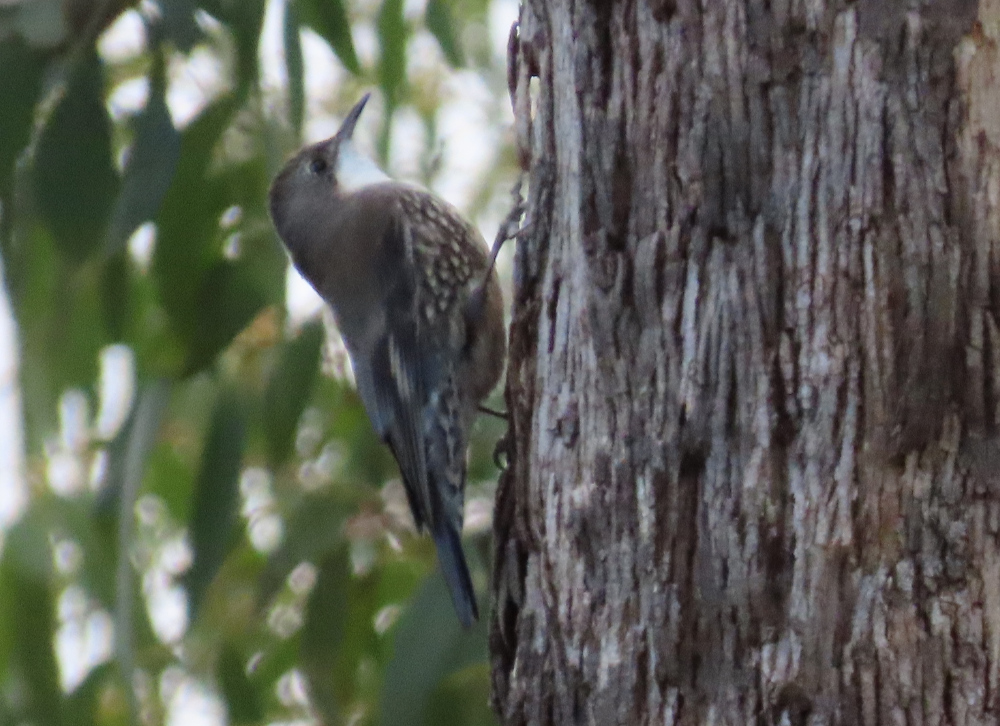
The bird sped up a tree trunk, dashing from side to side of the tree. Its white throat flashed in the dim light. The rest of the bird is mottled grey and brown, merging well with its surrounds.
This is only the second time that I’ve managed to identify a White-throated Treecreeper. The other time was at Capertee in 2023, when I managed to make a short video of a female bird. I think today’s bird is male: there’s no red spot at the top edge of the white throat.
Common name: White-throated Treecreeper
Scientific name: Cormobates leucophaeus
Approximate length: 13-15 cm
Date spotted: 18 May 2025 (autumn)
Location: Golden Gully near Hill End, New South Wales, Australia: 33°00’45.4″S 149°25’05.0″E

My first White-plumed Honeyeater
White-plumed Honeyeaters are common and wide-spread, according to my bird book, but this is the first one I’ve identified. I spotted it at Mary Flynn Campground on the Turon River in New South Wales. It’s an unassuming little bird, with plumage of soft greys and yellows, and quite large eyes relatively speaking.
In the photo, below the yellow face, you can just make out the white stripe that gives the bird the name “white-plumed”. Personally, I’d expected a grander plume to match the name, but there you go.

Common name: White-plumed Honeyeater
Scientific name: Lichenostomus penicillatus
Approximate length: 15-17 cm
Date spotted: 17 May 2025 (autumn)
Location: Mary Flynn Campground on the Turon River, NSW, Australia: 33°04’46.6″S 149°23’55.6″E

Crimson Rosella looking gorgeous
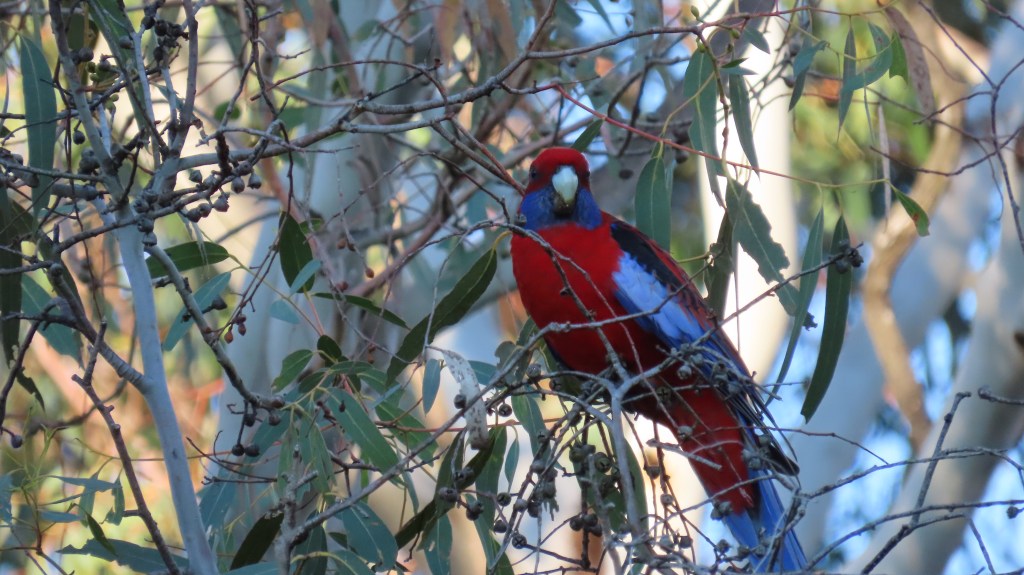
This stunning Crimson Rosella was browsing on the seeds of a gum tree late one afternoon. We were at the Macquarie Woods Forestry Reserve Campground, to the west of the Blue Mountains in New South Wales. These parrots are quite common in eastern Australia. Even so, their beauty is always amazing.
This bird is a male, with his purple and crimson colouring. The females have more green on their bodies and wings, like the one I saw a few months ago in Whitfield, Victoria.
Common name: Crimson Rosella
Scientific name: Platycercus elegans elegans
Approximate length: 35 cm
Date spotted: 16 May 2025 (autumn)
Location: Macquarie Woods Forestry Reserve Campground, Vittoria, NSW, Australia: 33°24’29.0″S 149°18’41.8″E

Two songs of the Fan-tailed Cuckoo
I’ve heard Fan-tailed Cuckoos several times over the years, making their pretty downward trilling call. A few days ago, I heard a different call: a haunting, mournful whistle sighing in the mist.
In this 14-second video, the bird whistles five times:
At first I didn’t know what type of bird was calling. Then I saw a Fan-tailed Cuckoo fly onto a nearby branch:

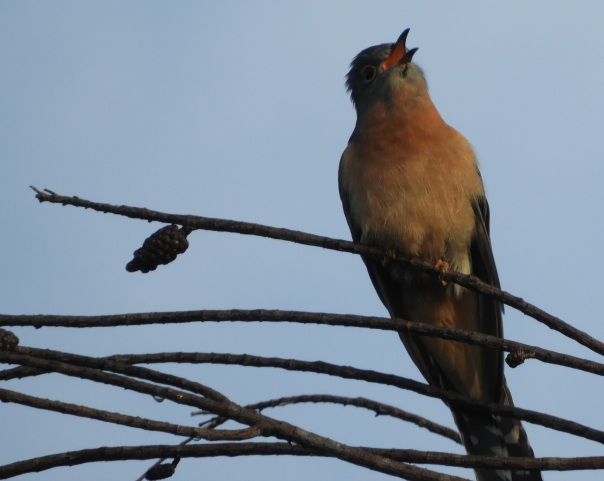
They’re rather pretty birds, with a russet chest and belly, and a startling orange mouth. On this occasion, I could see only the back of the bird. Here’s a picture of another Fan-tailed Cuckoo, which I saw in June 2020:
Shortly after I heard the whistles, the same bird or another started making the typical trilling call that I’ve heard more often. In this 17-second video, the bird calls four times:
Common name: Fan-tailed Cuckoo
Scientific name: Cacomantis flabelliformis
Approximate length: 26 cm
Date spotted: 11 May 2025 (autumn)
Location: Manly Creek, New South Wales, Australia: 33°46’21.3″S 151°14’34.8″E
Muscovy ducks meet a Brush-turkey
Two Muscovy ducks hiss and wag their tails to warn off an Australian Brush-turkey. The Brush-turkey had been investigating my shoes, then it decided to see what the two interesting ducks were up to. The encounter ends peacefully. No feathers flying this time!
Muscovy ducks come from the Americas, and are actually more like a cross between a goose and a duck than just a duck. They hiss like geese, although it’s a very quiet hiss. Their faces and heads look like geese, but their body shape is more like a duck’s.
I’ve seen this pair of Muscovies at Manly Dam often — they’ve made this area their home.
Common name: Australian Brush-turkey and Muscovy duck
Scientific name: Alectura lathami (Brush-turkey) and Cairina moschata (Muscovy)
Approximate length: 60-70 cm (Brush-turkey) and 76–84 cm (Muscovy)
Date spotted: 29 April 2025 (autumn)
Location: Manly Dam park, New South Wales, Australia: 33°46’44.9″S 151°14’58.4″E

Little Corella enjoying a snack
This Little Corella was one of a group enjoying a tasty snack (fruit from a nearby fir tree of some kind):
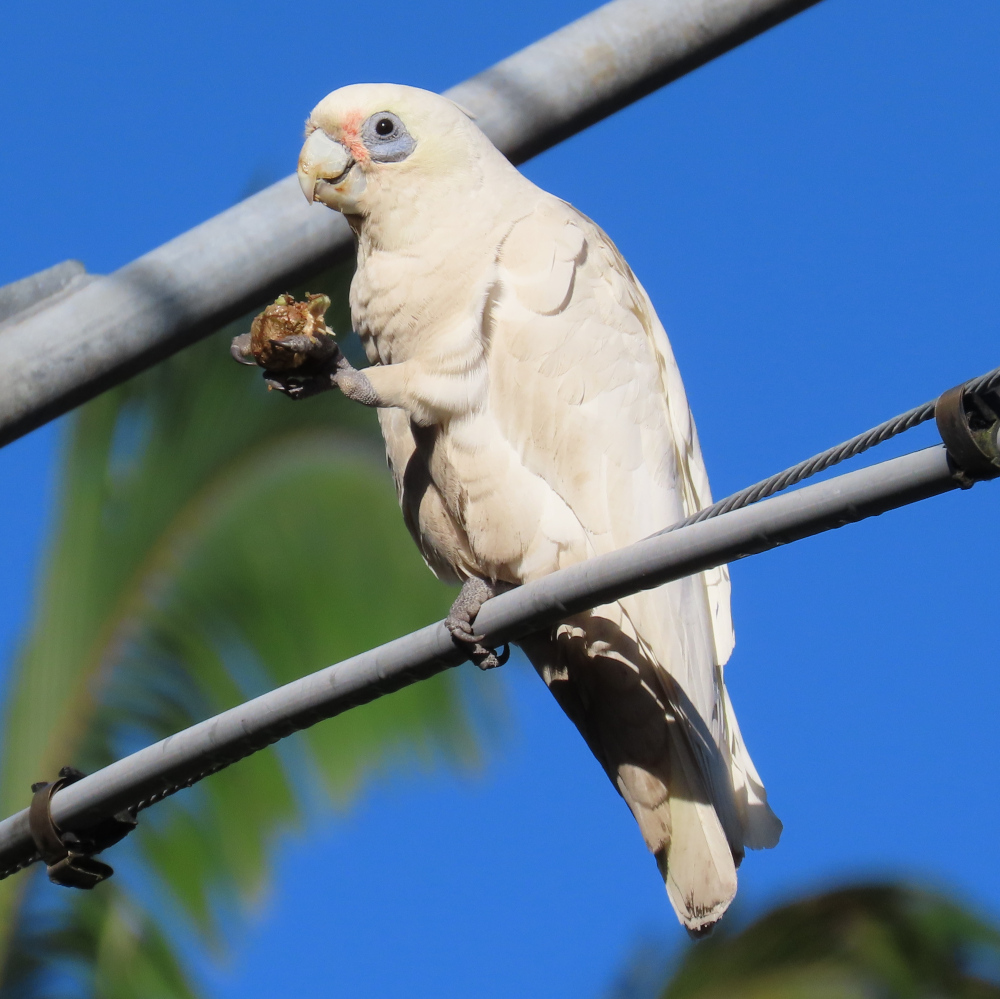
People have a love-hate with these birds. On the one hand, corellas are cute, pretty, and smart. On the other hand, they’re noisy and fiendishly good at destroying property!
Common name: Little Corella
Scientific name: Cacatua sanguinea
Approximate length: 36-39 cm
Date spotted: 22 April 2025 (autumn)
Location: Balgowlah, New South Wales, Australia: 33°47’57.2″S 151°15’50.9″E

Osprey nests at Rat Park
For a couple of years, I’ve been reading about the Ospreys that nest high on the lights at Rat Park in Warriewood, in Sydney’s Northern Beaches. The birds have earned their fame by returning year after year to the same spot. They build their nests and raise their young in what seems an unlikely and uncomfortable perch, twenty metres above the playing fields. So I went to take a look at them.

Ospreys are magnificent birds, with their large size and impressive fishing skills. They’re listed as vulnerable in NSW. Their numbers were in decline until the 1970s, but the great news is that they’re on the rise now.
Here’s a close-up of the same Osprey on the lamp post:

This photo shows the same nest from the other side:
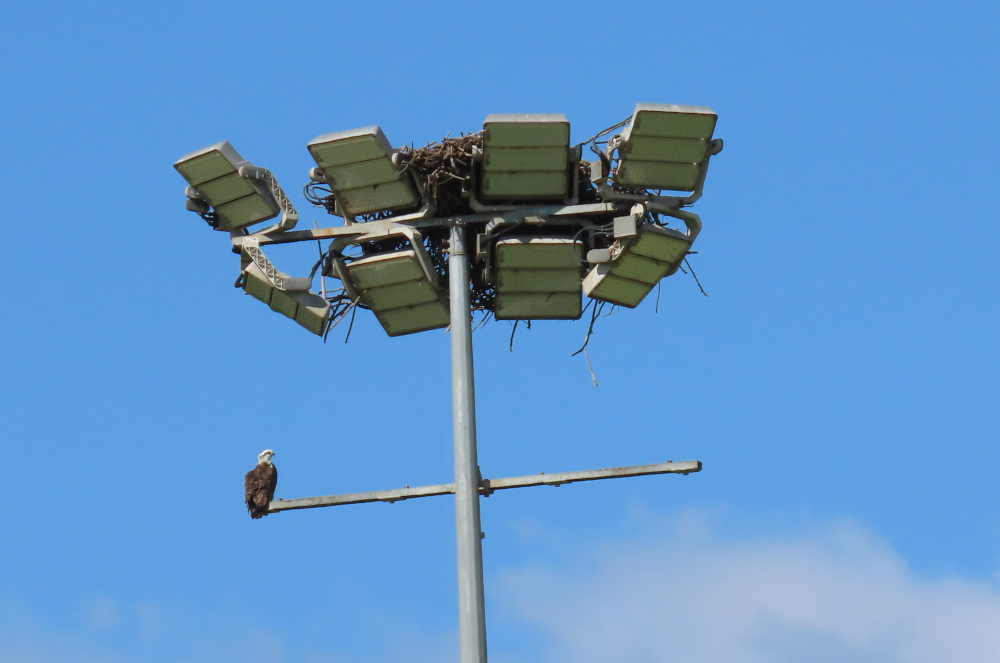
Zooming out to show the playing field and the 20-metre lamp post with the nest on top:

There were nests on top of a couple of the other lamp posts too, but no Ospreys tending them while I was there.
Here’s a front view of the Osprey with the sun behind it:
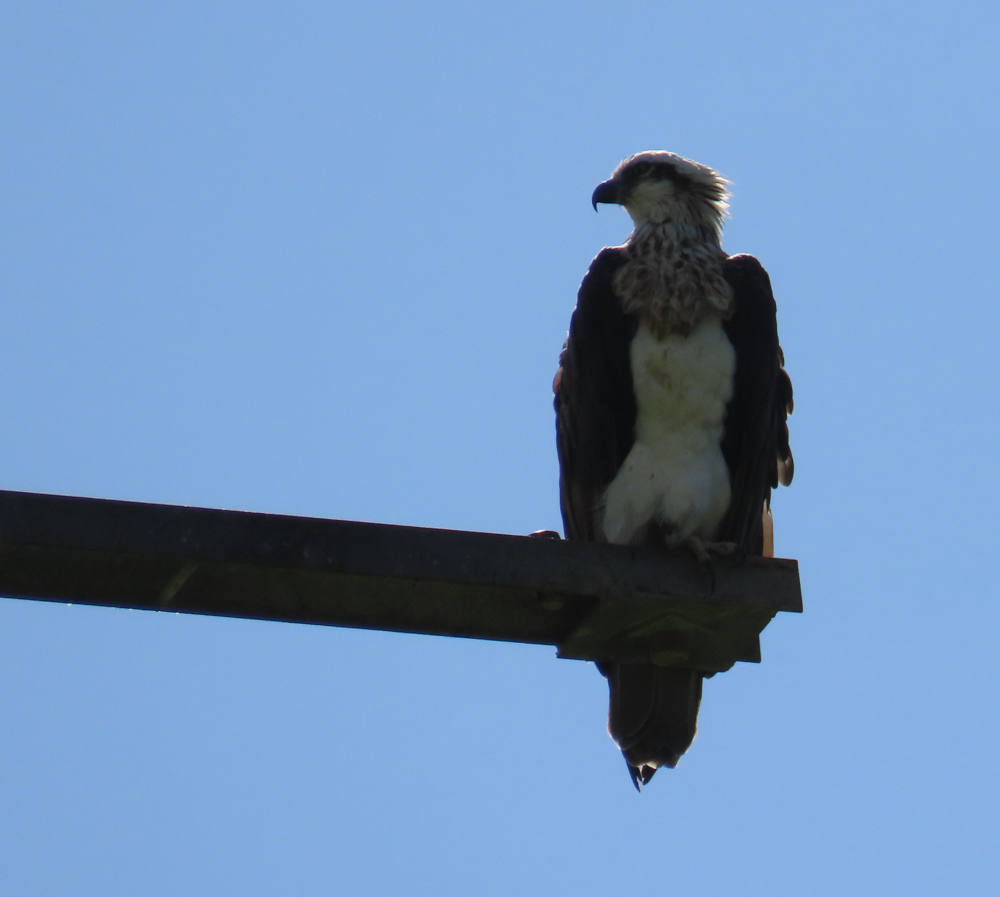
I’ve been lucky enough to see Ospreys a few times, most often at the Long Reef Aquatic Reserve in Collaroy. The Manly Observer has reported on the Ospreys of Rat Park, and they’ve featured on several other sites including Facebook.
Common name: Eastern Osprey
Scientific name: Pandion cristatus
Approximate length: 57 cm
Date spotted: 4 April 2025 (autumn)
Location: Rat Park, Warriewood, New South Wales, Australia: 33°41’50.6″S 151°18’21.8″E

Longest nest-sitting ever: Black Swans abandon nest after 8 months (part 2 of story)
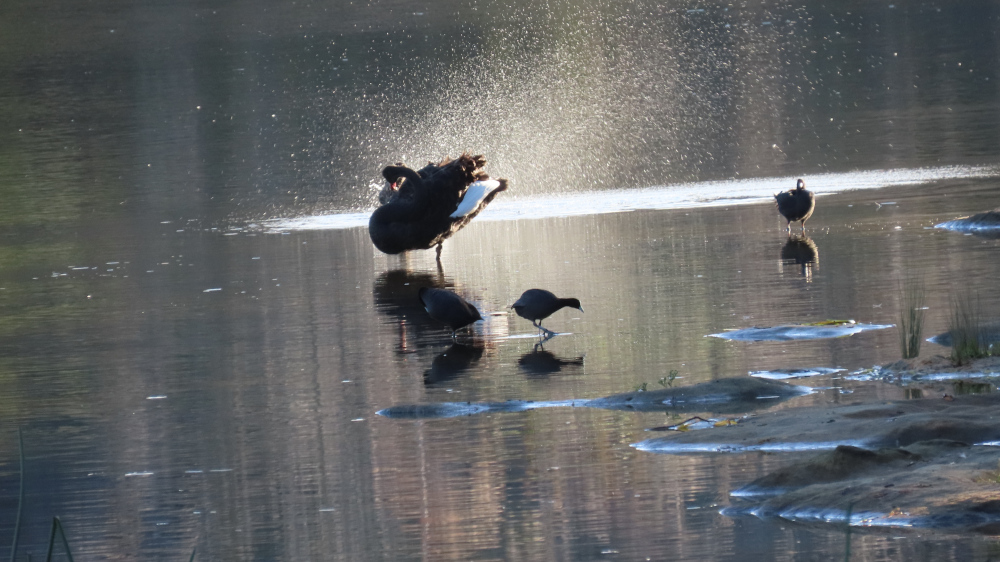
Over the past 8 months, two Black Swans have been diligently tending a nest in Manly Dam Park, in Sydney’s Northern Beaches. In the early days (August 2024), spring was in the air. Nature was blooming and the swans were devoted and diligent. As spring turned to summer, the heat bore down. Cicadas shrieked, reeds grew up and died down again. Still, the pair tended the nest, rebuilding regularly, looking after each other, and clearing the water around their nest. (Story of two nesting Black Swans: Part 1)
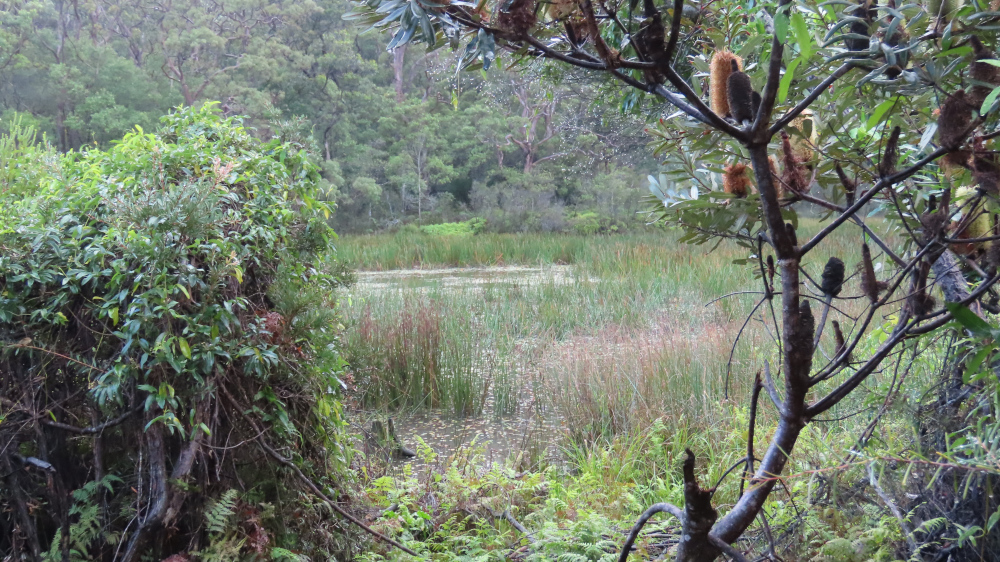
Yesterday (9 April 2025), for the first time, the nest was empty when I walked past. The nest is the large circle of brown reeds lying horizontal behind the green reeds:

A hundred metres away, one of the swans was drifting on the water, hooting quietly and persistently:
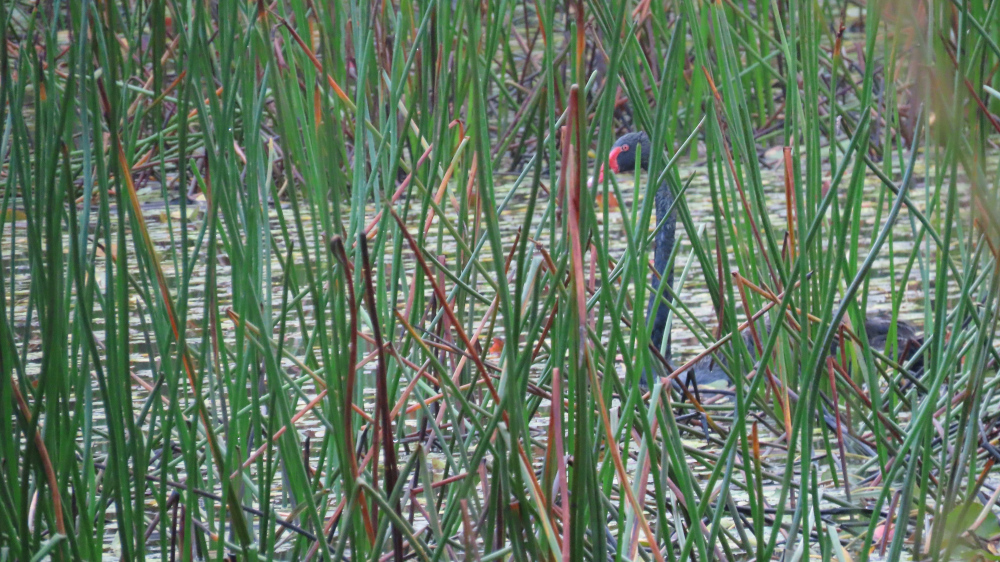
Once or twice I heard the other swan replying from deep in the reeds, but I didn’t see it.
At my previous visit a week ago, the swans had moved their nest to a slightly different location, just ten metres or so away from the original location. I wondered if this meant that at last, there was hope for an egg or two. Who knows, perhaps the pair will proudly emerge with a train of cygnets to show. Alas, though, I doubt that there were ever any eggs in the nest. From a discussion on Reddit, it seems that the most likely explanation is that the swans are two males, practising nest-building and nest-sitting in the absence of a female to lay an egg.
Here’s a photo from October 2024, showing both swans at the nest:

Here’s one of the swans in early February 2025, off shift for a moment while its partner sits on the nest:
This is the tranquil site of the nest, now empty, but ready perhaps for a new attempt come spring:
Common name: Black Swan
Scientific name: Cygnus atratus
Approximate length: 120 cm
Date spotted: 23 August through to 9 April 2025 (late winter, through spring and summer, into autumn)
Approximate location: Manly Dam Park, New South Wales, Australia


 Sydney Birder