Category Archives: Birds

Red-whiskered Bulbul
Red-whiskered Bulbuls are evidently quite common around Sydney, but this is the first time I’ve seen one! It’s a pretty little bird, with striking black, red, and white markings and a tall crest on its head like a woodpecker.
In this video, the bird is very far away and I had to do some radical zooming with my camera. You can hear the bulbul’s pretty call:
These birds are native to south Asia, and introduced into Sydney in the late 1800s. They tend to stay in areas close to human habitation.
Here’s a still picture of the bird:

Common name: Red-whiskered Bulbul
Scientific name: Pycnonotus jocosus
Approximate length: 20 cm
Date spotted: 5 June 2022 (winter)
Location: Dobroyd Head, Sydney Harbour, Australia: 33°48’38.6″S 151°16’05.4″E

Those magnificent black cockatoos are back!
For the past couple of years, a group of Yellow-tailed Black Cockatoos has visited our garden to snack on our Banksia tree when the seeds are ripe. This happens around May-June and again in October. It’s a real privilege to have such magnificent birds in the garden. At approximately 65 cm (more than 2 feet) from head to tail, they’re much larger than the more common white Sulphur-crested Cockatoos (50 cm).
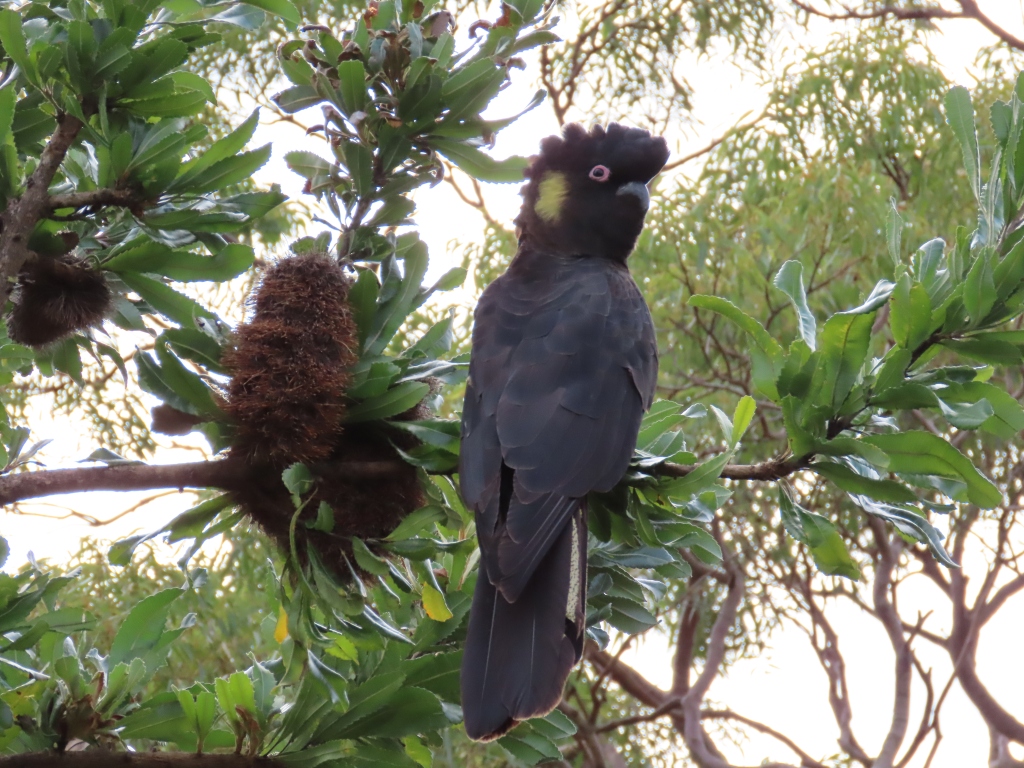
The bird on the left is a female. Toward the end of the video, you see the male higher up in the tree (he’ll be near the top right), keeping watch. You can tell the male by the pinkish colour of the ring surrounding his eye.
The bird on the right at the start of the video (in the middle when all three birds are in view) is making a constant low crooning sound. I think the noisy one must be a juvenile, because I’ve noticed that the juvenile birds of many species keep up a constant noise, perhaps to reassure their parents that they’re still around. Early on in the video, the female on the left calls out in that lovely, wild squeal that’s characteristic of these birds. They also chitter companionably to each other throughout.
Here’s a still picture of the male:
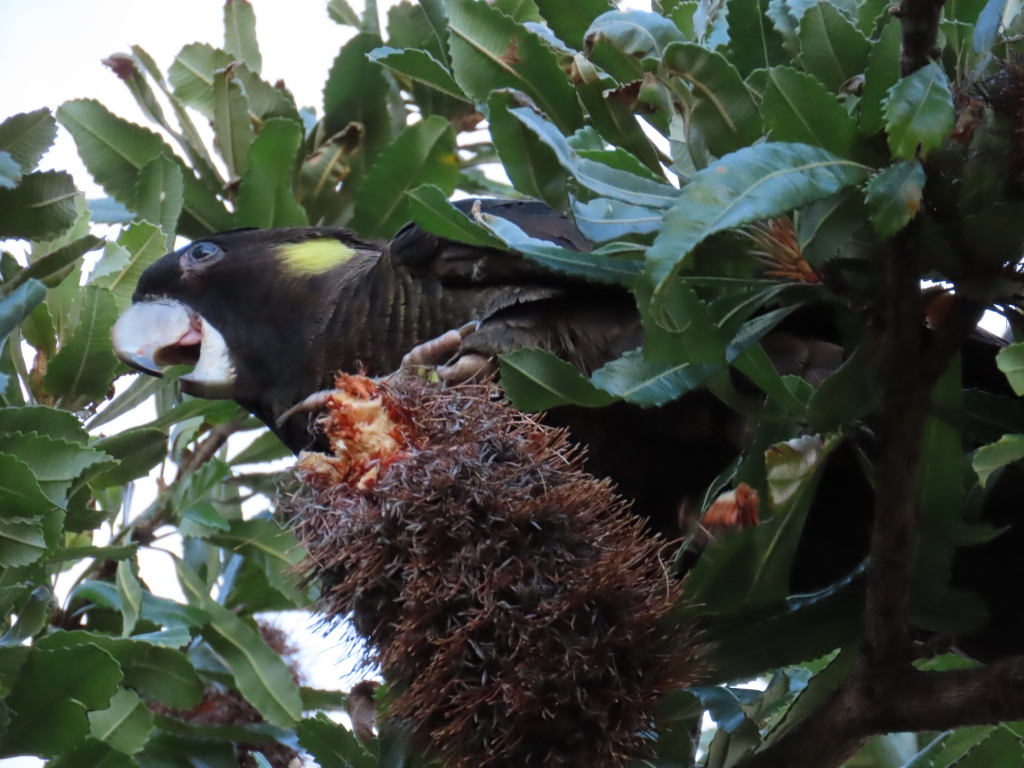
The next video shows one of the birds (probably the female, though it might be the juvenile) tucking into a Banksia seed pod:
It’s funny to see how ruthless the bird is. She basically tears the dead flower apart, chucking bits onto the floor seemingly at random, until she finds a tasty morsel. Our neighbour was giggling from his verandah, from where he had a birds’ eye view of the feasting! Our garden quickly became littered with half-eaten seeds:
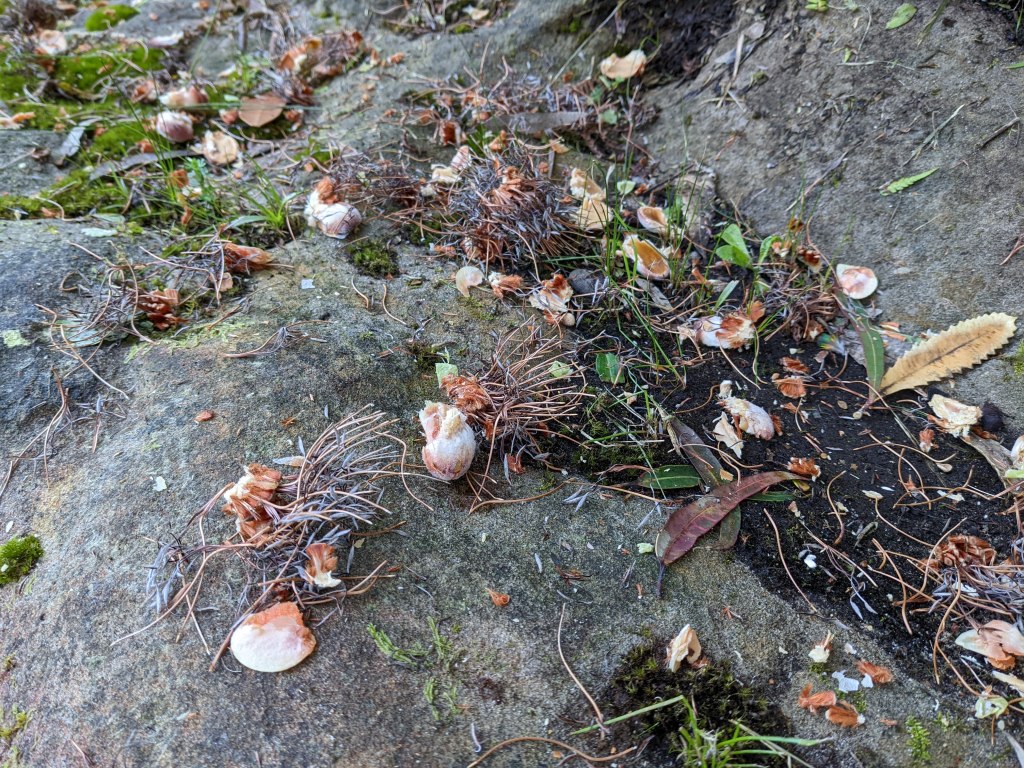
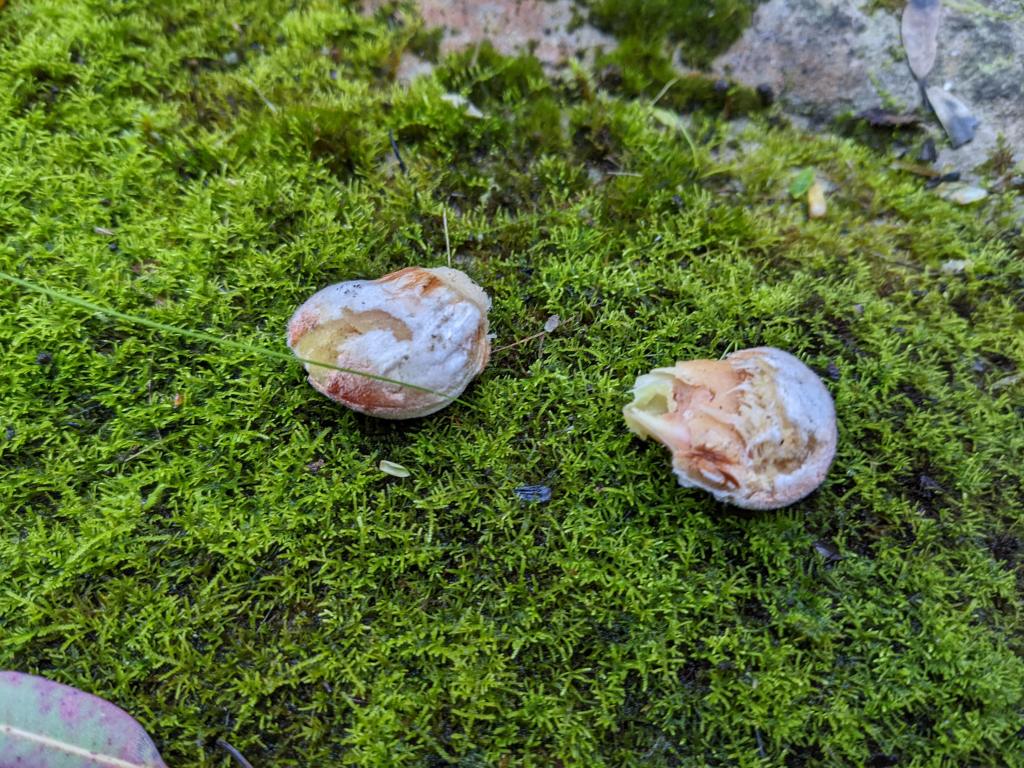
The tree is a Banksia serrata, also known as Old Man Banksia. See the marks of that huge beak on these seeds!
Here’s a closeup of a cockatoo on a seed pod:
The scientific name of these birds is Calyptorhynchus funereus. Evidently the funereus part of the name stems from the dark, somewhat gloomy colouring of the birds. George Shaw, the naturalist who first named the birds, thought that the colouring was suited to a funeral! The bird was even called the “funereal cockatoo” for a while.
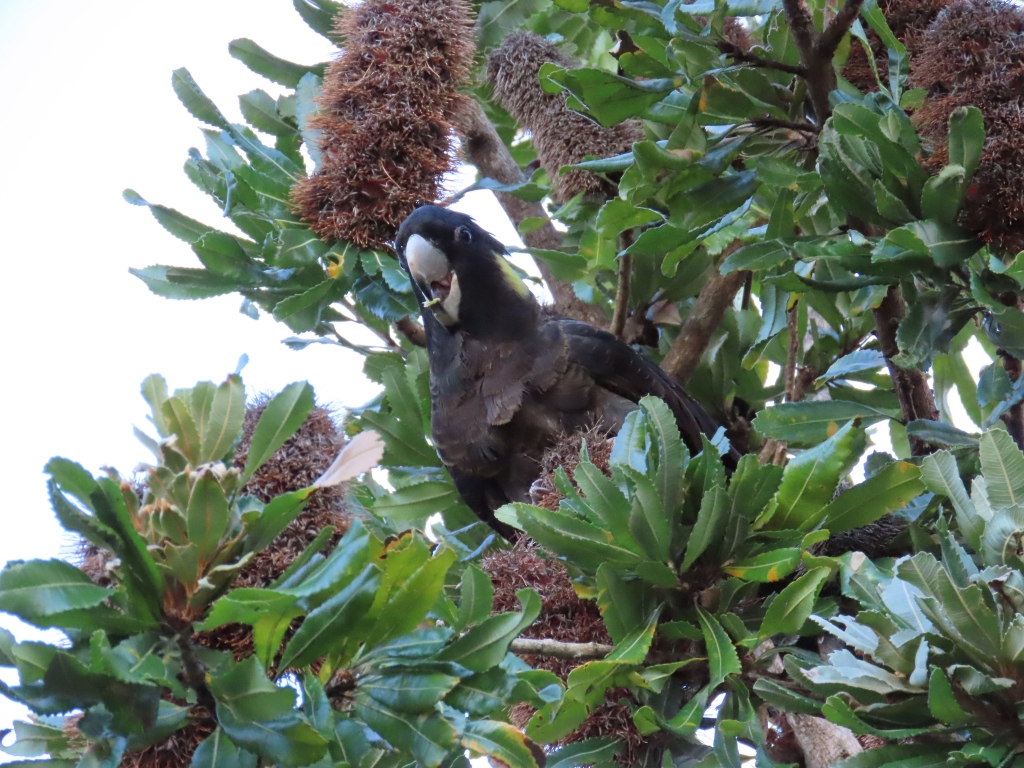
There’s also some dispute in the birding community about whether these birds are actually part of the genus Calyptorhynchus. Some people group them into a different genus, Zanda, based on genetic diversity.
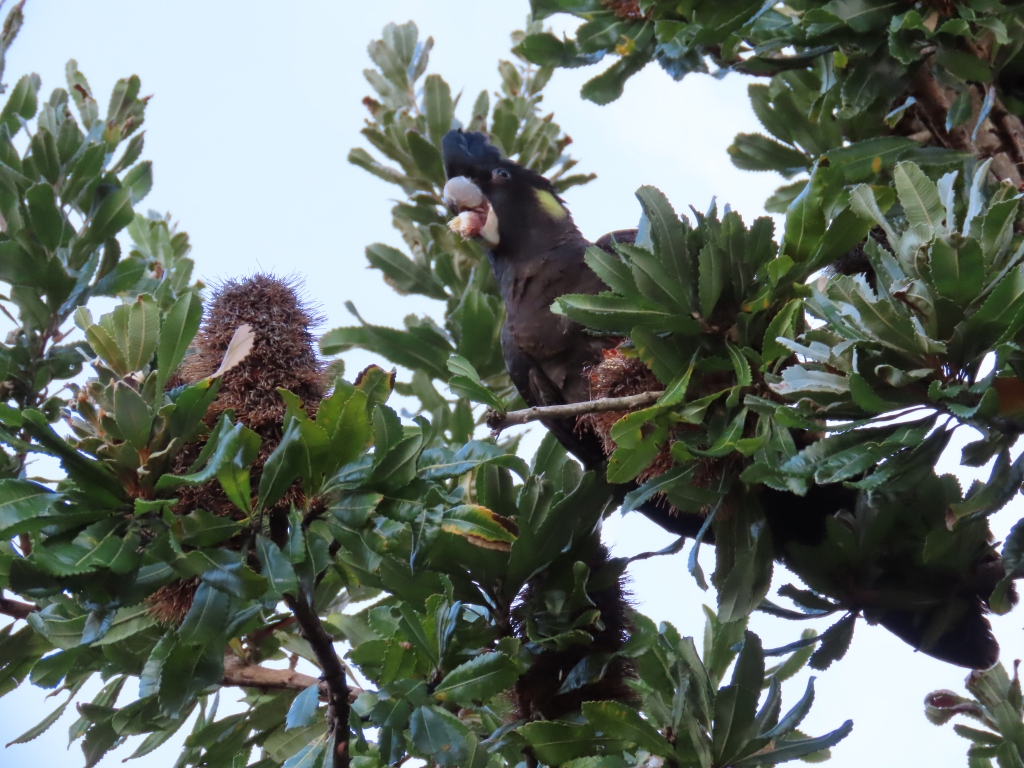
The next photo shows the bird that I think is a juvenile. With its beak feathers fluffed up, it seems to be sleepy or wanting attention!

A shot from the back gives a nice view of the crest on the bird’s head:
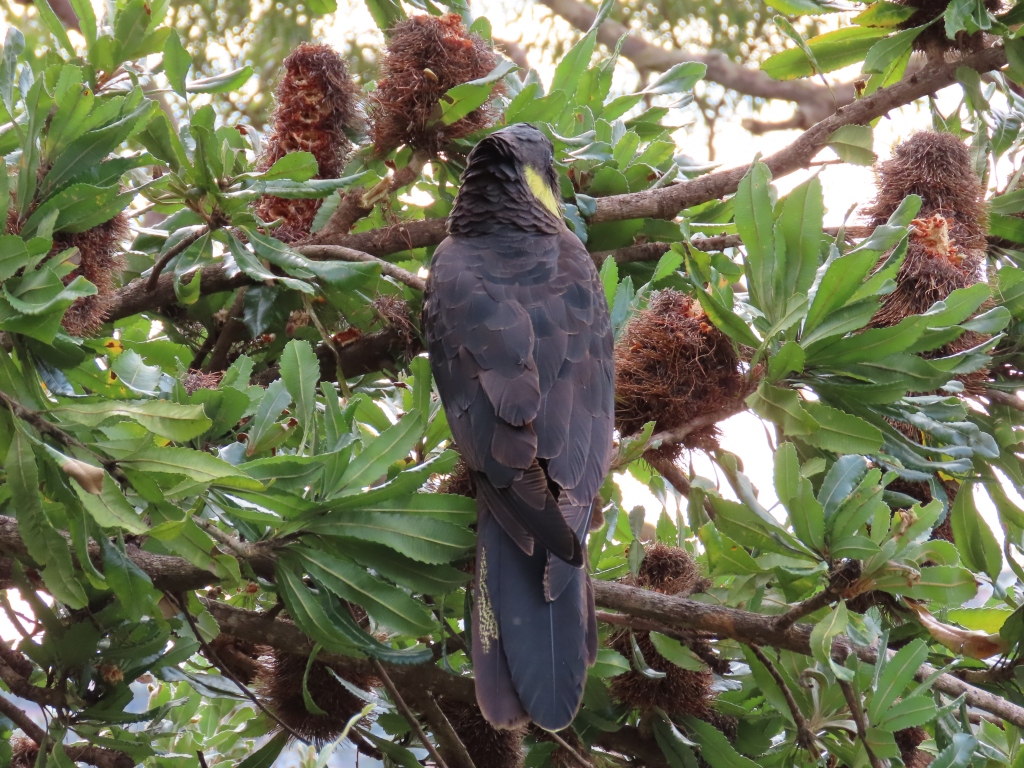
Common name: Yellow-tailed Black Cockatoo
Scientific name: Calyptorhynchus funereus or Zanda funereus
Length: 58-65 cm
Date spotted: 2nd and 3rd June 2022 (winter)
Location: Allambie Heights, NSW, Australia

Atmospheric pic of preening pelican in Cairns
I love the colours of this early-morning shot. The bird is an Australian Pelican, chilling out at the edge of the Coral Sea.
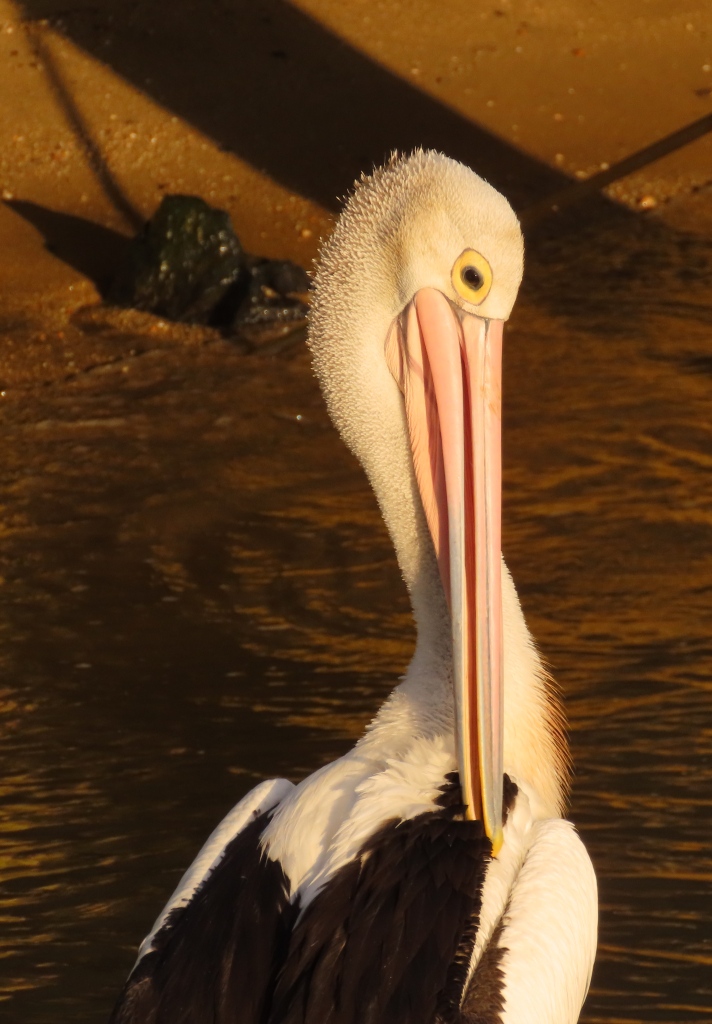
Common name: Australian Pelican
Scientific name: Pelecanus conspicillatus
Approximate length: 170 cm
Approximate wingspan: 2.5 m
Date spotted: 15 May 2022 (dry season)
Location: Cairns Esplanade, Far North Queensland, Australia: 16°55’05.0″S 145°46’33.3″E

The call of the Orange-footed Scrubfowl
In my previous post, I mentioned that many of the birds up in Far North Queensland have different calls from those down in my usual haunts near Sydney. Here’s another example: The Orange-footed Scrubfowl:
This sighting is another first for me. These birds are found in the far north of Australia, on the coastal rainforest edges of the continent. The noise and the way the bird moves remind me of the Velociraptors in Jurassic Park!
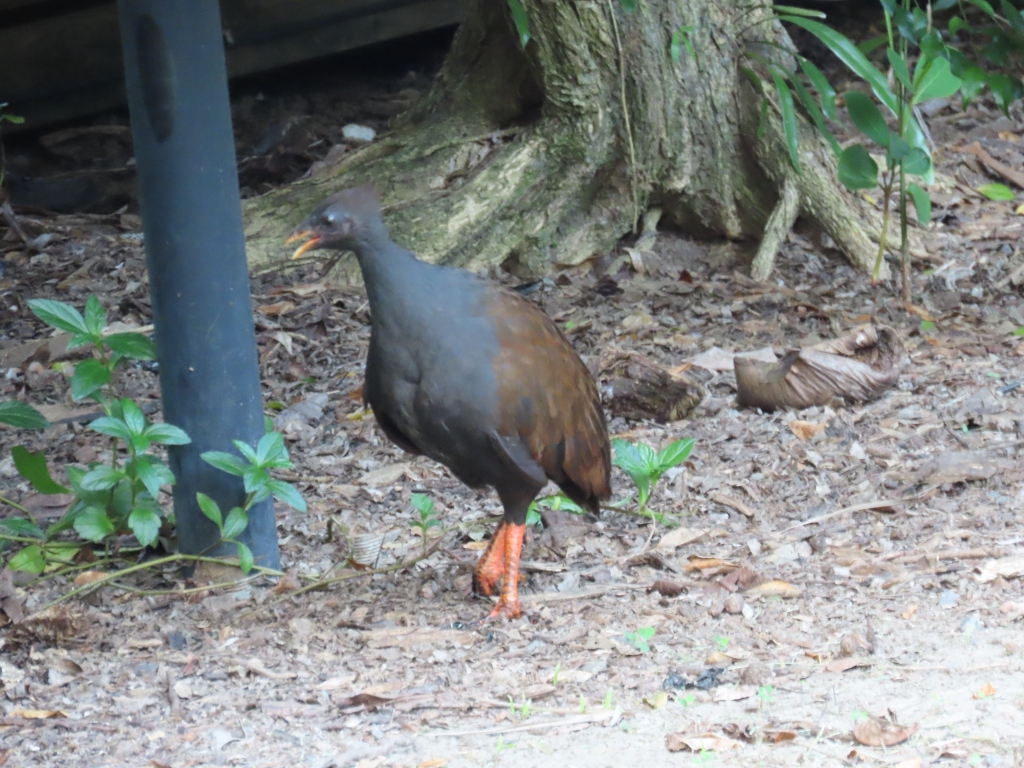
Common name: Orange-footed Scrubfowl
Scientific name: Megapodius reinwardt
Approximate length: 40-50 cm
Date spotted: 17 May 2022 (dry season)
Location: Port Douglas, Far North Queensland, Australia: 16°30’42.2″S 145°27’44.2″E

Black Butcherbird in Far North Queensland
A few days ago, I was visiting Port Douglas in Far North Queensland. Many of the birds up there have quite different calls from those further south. This Black Butcherbird is an example:
As you can see, the lighting was difficult. I did manage to get a couple of clearer still shots of the bird:
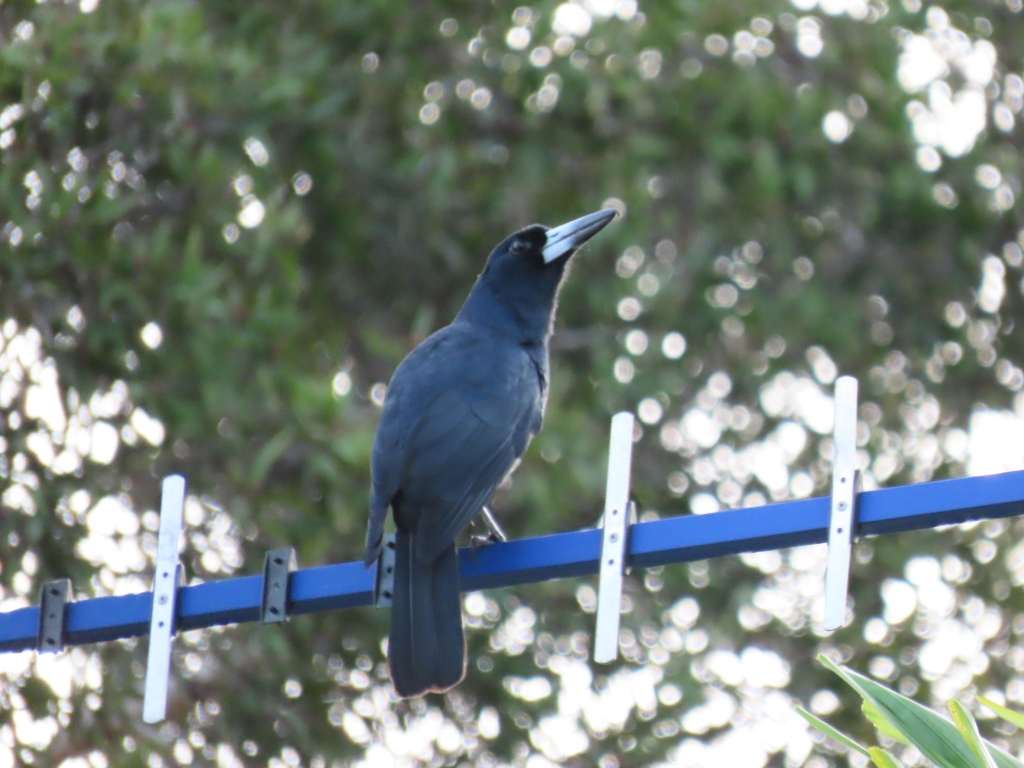
Black Butcherbirds are, as the name implies, entirely black. In Australia, they’re found only in the far north of the continent. Down near Sydney, where I’m based, I’ve only ever seen the Grey Butcherbird, which has a lot of white and grey as well as black plumage. According to my bird book, some Black Butcherbirds (the rulescens race) can be brownish as juveniles.
This is my first sighting of a Black Butcherbird! Here’s another picture of the same bird in full song:

Common name: Black Butcherbird
Scientific name: Cracticus quoyi
Approximate length: 38-44 cm
Date spotted: 17 May 2022 (autumn)
Location: Port Douglas, Far North Queensland, Australia: 16°30’42.2″S 145°27’44.2″E

Pelicans at Cairns Esplanade
I’m in Cairns for a couple of days! Cairns is in Far North Queensland, about 2,000 kilometres from Sydney as the crow flies. Early this morning, before the tropical heat set in, I took a stroll along the Esplanade.
This lovely sculpture by Brian Robinson is called Citizens Gateway to the Great Barrier Reef:

I love the way the artwork frames the bay and the entrance to the Coral Sea.
A little further along the Esplanade, two Australian Pelicans were chilling out in the shelter of the boardwalk:

Common name: Australian Pelican
Scientific name: Pelecanus conspicillatus
Approximate length: 170 cm
Approximate wingspan: 2.5m
Date spotted: 14 May 2022 (autumn)
Location: Cairns Esplanade, Far North Queensland, Australia: 16°55’05.0″S 145°46’33.3″E

Cockatoo sculpted by sunlight
It can be difficult to get a good photo of a white cockatoo, because they’re so uniformly white. My camera tends to treat them as an uninteresting blob of uniform colour, unless I can get really close to the bird. I was quite pleased with this shot. Even though the bird was high in a tree, the early morning sun glows nicely through the cockatoo’s yellow crest and adds contour to the bird’s body:

The video of the same cockie is also rather nice. The bird is screeching and waving its head around, as they often do. It’s having fun with a small pool of water in a tree hollow, dipping its beak in and throwing water droplets around:
Common name: Sulphur-crested Cockatoo
Scientific name: Cacatua galerita
Approximate length: 50 cm
Date spotted: 3 April 2022 (autumn)
Location: Angophra Track, Balgowlah Heights, New South Wales, Australia: 33°48’20.9″S 151°16’17.8″E

Big Kookaburra in Kurri Kurri
Australia is a big place. Dotted around its landscape is an array of big animal statues. (Actually, the statues are of assorted things, not just animals, but most people think of them as big animals.) A couple of weeks ago, I was in Kurri Kurri and saw the town’s big Kookaburra:

The town of Kurri Kurri lies in the east of Australia, a couple of hours’ drive north of Sydney and close to the coastal city of Newcastle.
The Kurri Kurri Kookaburra is a sculpture by Chris Fussell, erected in 2009. Here’s another view of it:

If you’d like to know more about the town of Kurri Kurri, take a look at my travelling bookmark’s post: Kurri Kurri Kookaburra and murals.

Sleepy Corellas in Newcastle
A few days ago, I was in the city of Newcastle on Australia’s east coast. The city lies about two hours’ drive north of Sydney. Like its namesake in the UK, this Newcastle too is known as a coal-shipping port. A river runs through the city. In a small green area on the river bank, in the middle of the city, a large number of Corellas roost.
When we saw them, most of the Corellas looked sleepy:

This one looks like a cuddly toy nestled in a Christmas tree:

Little Corellas are a type of cockatoo. To me, they look rather ghostly, with their pale beaks and that ring of pale blue around their eyes.
The next one looks more interested in what’s happening:

If you’d like to see more pictures of the city of Newcastle itself, take a look at my travelling bookmark’s blog.
Common name: Little Corella
Scientific name: Cacatua sanguinea
Approximate length: 36-39 cm
Date spotted: 11 March 2022 (late summer)
Location: Newcastle, New South Wales, Australia: 32°55’32.3″S 151°46’45.4″E
Crested Tern taking a bath at Newcastle Ocean Baths
Yesterday I visited the city of Newcastle for the first time. This is Newcastle on the eastern coast of Australia, not the one in the UK. While strolling along the prom, approaching the Newcastle Ocean Baths, I saw a Crested Tern enjoying a bath in the rock pool that lies on one side of the baths:
Common name: Crested Tern
Scientific name: Sterna bergii
Approximate length: 45 cm
Date spotted: 11 March 2022 (late summer)
Location: Newcastle, New South Wales, Australia: -32.929794, 151.789490
Here’s a picture of the building that you glimpse at the end of the video — the Newcastle Ocean Baths:


