Category Archives: Birds

Butcherbirds sang to me!
Early one morning, at the place I was staying at near Brisbane, two Grey Butcherbirds dropped down and sang to me.
It felt very special to have these birds come so close and sing their song. I suspect they were hoping I’d produce a snack. This is the first time I’ve had this experience, though a few magpies have sung to me in the past.
Here’s a still picture of one of the birds:
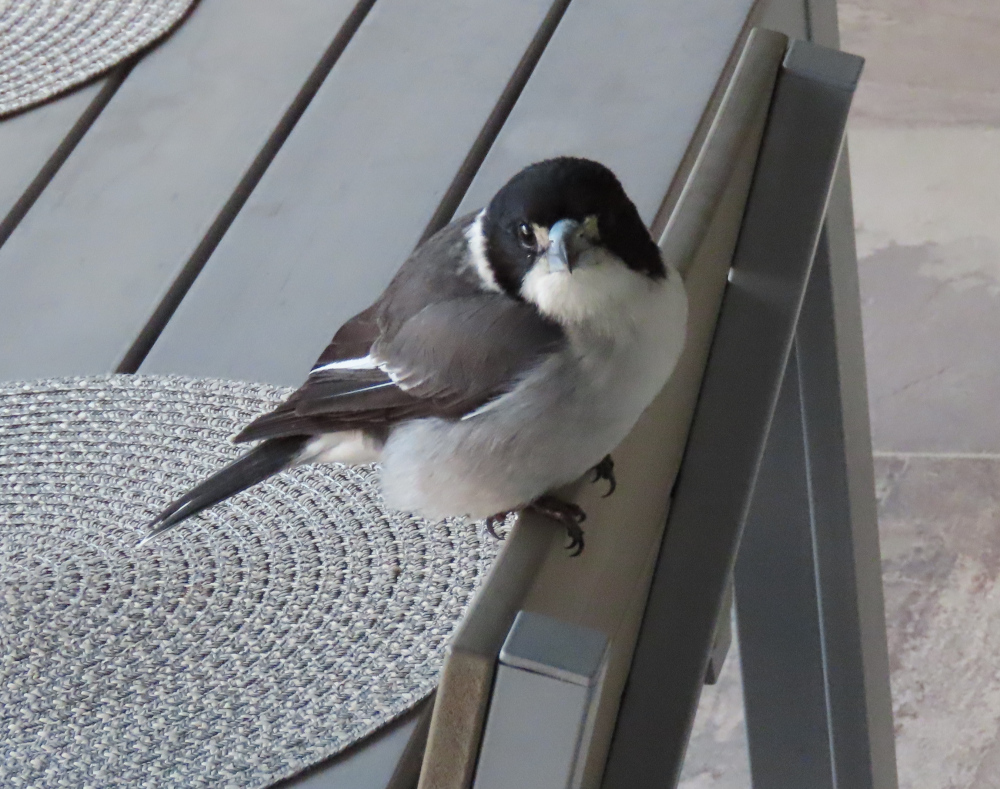
Butcherbirds are medium-sized songbirds, widely spread in Australia. They’re only distantly related to the South African shrikes that are also known as butcherbirds. Both groups of birds get their name from their habit of securing their captured prey on spikes or in crevices, to store the prey for youngsters or to make it easier to eat.
Common name: Grey Butcherbird
Scientific name: Cracticus torquatus
Approximate length: 30 cm
Date spotted: 6 July 2024 (winter)
Location: The Gap, Brisbane, Queensland, Australia: 27°26’55.3″S 152°55’50.2″E

The foot of the Coot
Coots are underrated. Their feet even more so.

Drama in monochrome and a touch of red:

How to own a reflection:

Common name: Eurasian Coot
Scientific name: Fulica atra
Approximate length: 35 cm
Date spotted: April and June 2024
Location: Manly Dam Reserve, New South Wales, Australia

Pardalotes nest-building in winter
It’s mid-winter here in Sydney: cold, wet, and grey. Yet I’ve noticed some of the birds are already preparing for breeding season. On Friday, I saw a group of Australian Ibises in breeding plumage. And a few days ago, I watched a Spotted Pardalote gathering material for its nest:

Pardalotes are tiny little birds (10 cm from head to tail). They nest in burrows in the ground, usually at around ankle level. This one was unusual, in that its nest was in the side of a low cliff, overlooking the water of Sydney Harbour. Here’s the view that the bird would see:

Some distance away on the same walk, another Spotted Pardalote stopped on a branch for a few seconds:

Even when stopped on a branch, these birds don’t stand still for any time at all! I was lucky to get some usable shots from the many that I took. Another view of the same bird:

Common name: Spotted Pardalote or Diamondbird
Scientific name: Pardalotus punctatus
Approximate length: 10 cm
Date spotted: 26 June 2024 (winter)
Location: Forty Baskets (33°48’05.7″S 151°16’09.3″E) and Dobroyd Head (33°48’35.0″S 151°16’18.8″E) in Sydney Harbour

Young Scarlet Honeyeater
It took me a while to identify this bird. The long, thin, curved beak made me think of a honeyeater or a spinebill. I’d seen Scarlet Honeyeaters in the area before, and this bird was the right sort of size and shape to be one of those. But it has no red around its head or throat, and its legs are orange instead of grey.
It’s a young Scarlet Honeyeater:

I’ve posted some pictures of previously-spotted Scarlet Honeyeaters, where you can see the lovely reds of the adult birds.
There’s a small hint of red on the back, just above the tail:

This is the view the bird was enjoying:

Common name: Scarlet Honeyeater
Scientific name: Myzomela sanguinolenta
Approximate length: 10 cm
Date spotted: 26 June 2024 (winter)
Location: Dobroyd Head, New South Wales, Australia: 33°48’34.0″S 151°16’14.8″E

Pelicans prowling around fisherman
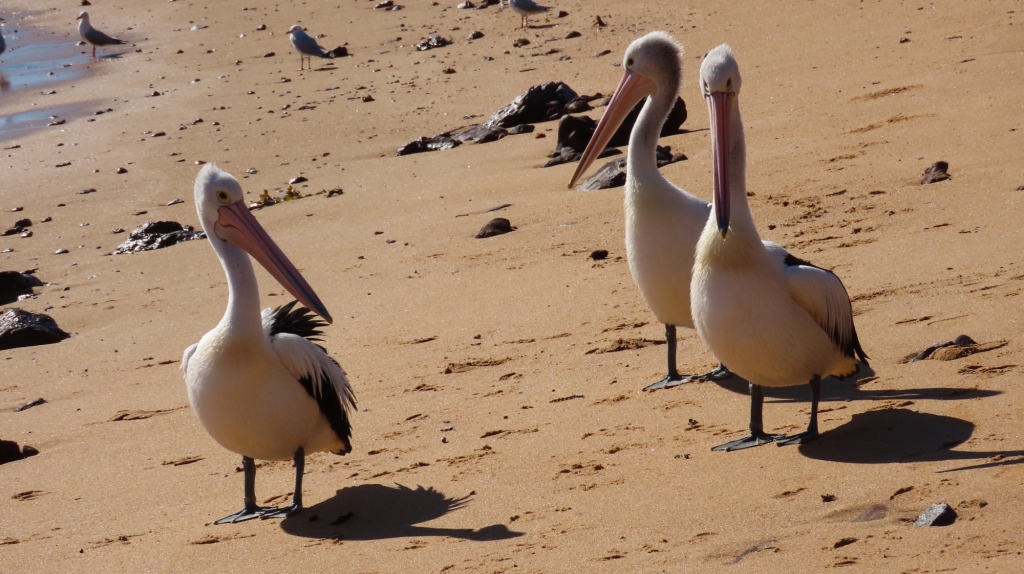
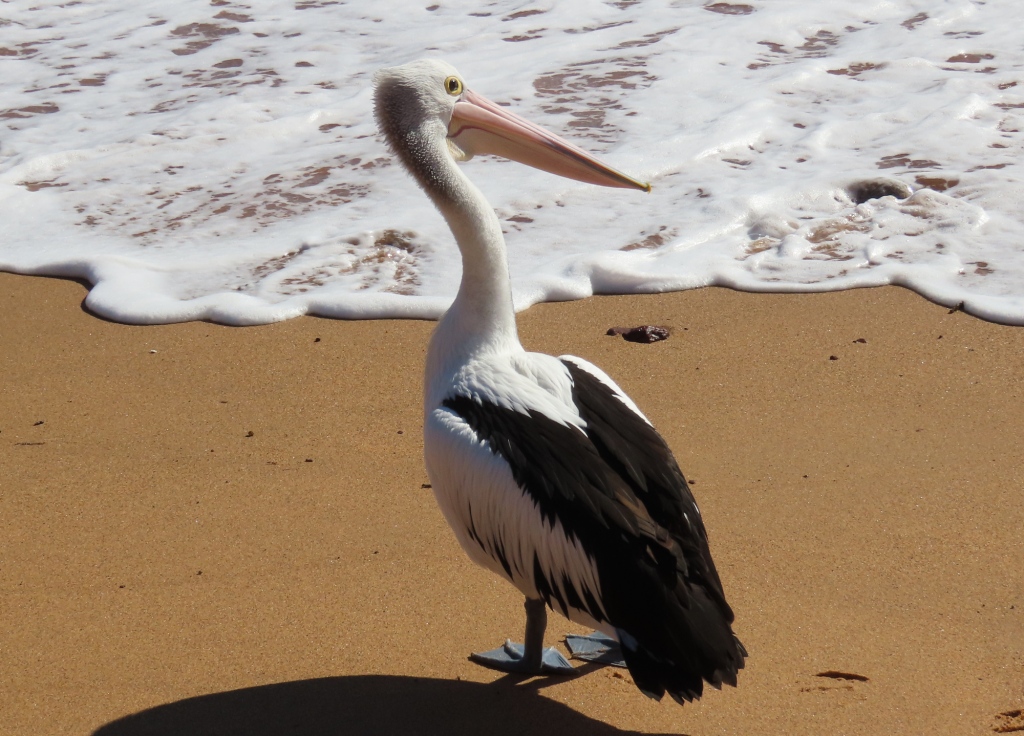
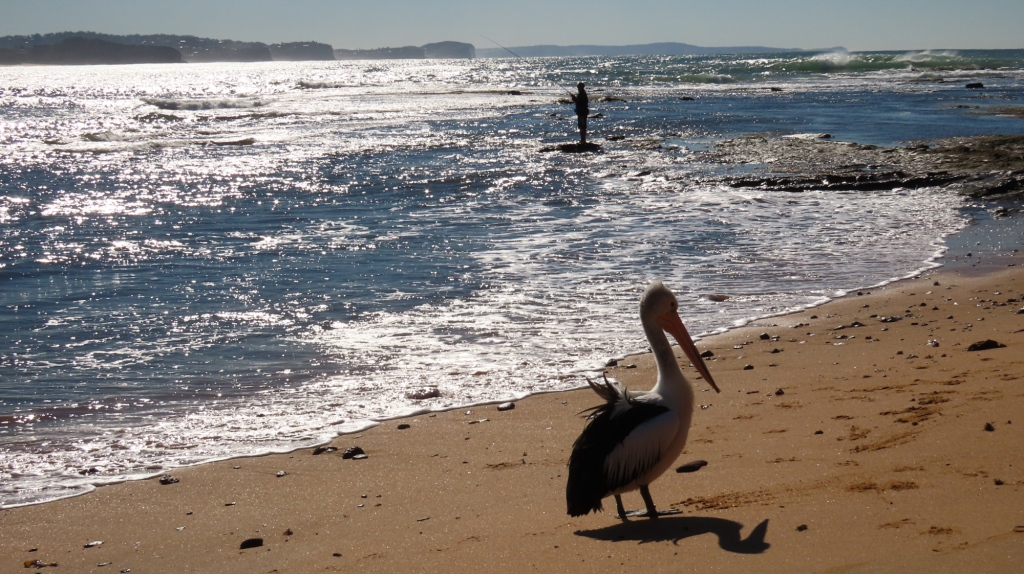
At Long Reef in Collaroy, a fisherman was washing out his bucket. Three pelicans followed in his footsteps, hoping for some tasty morsels to fall.
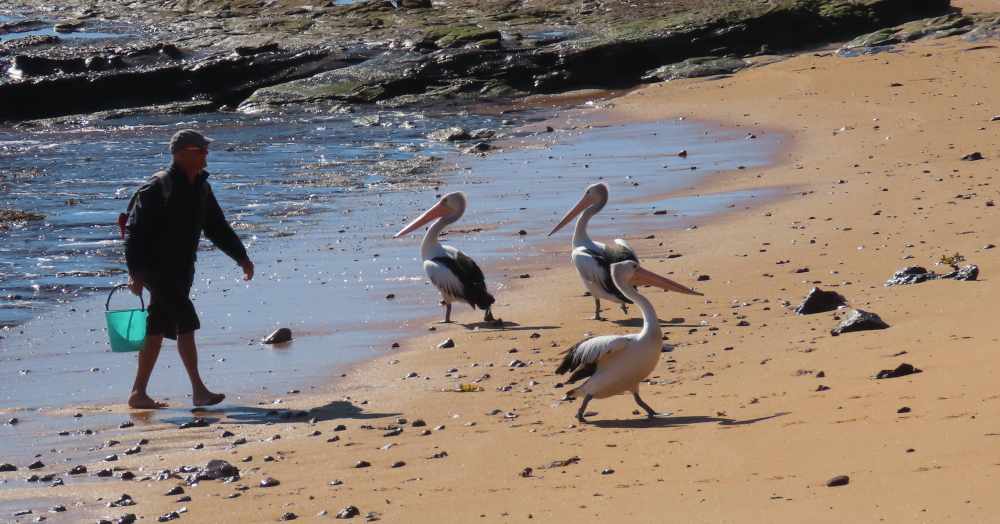
The birds weren’t too worried when I approached to take some photos.
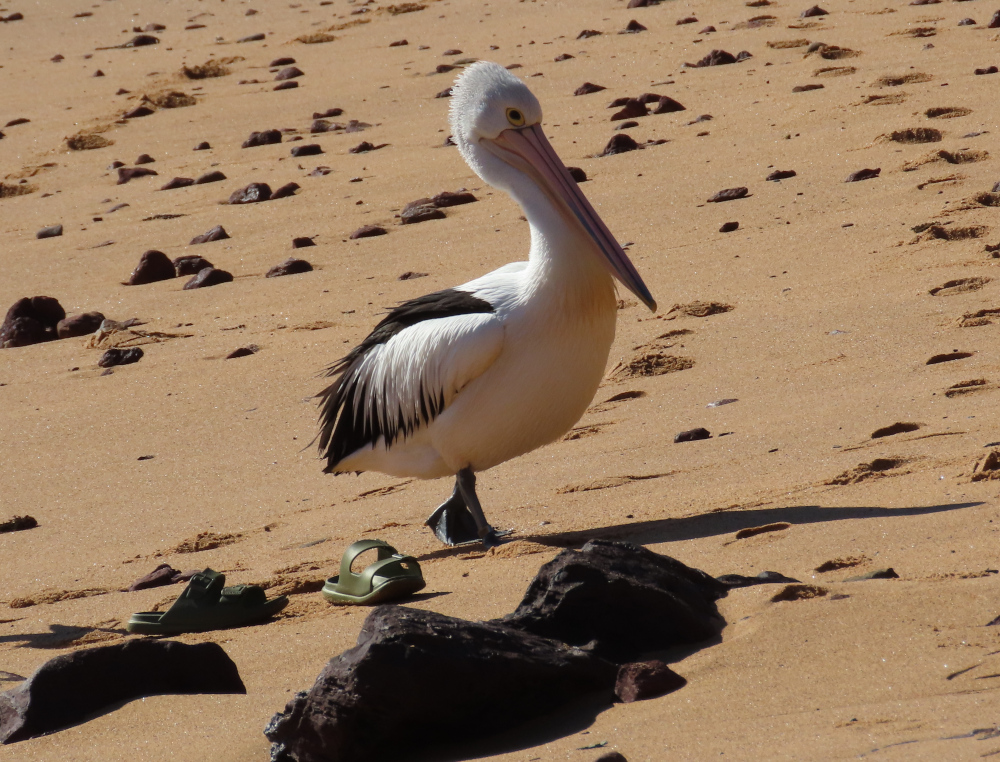
Cosying up to a pair of sandals that someone left on the beach:
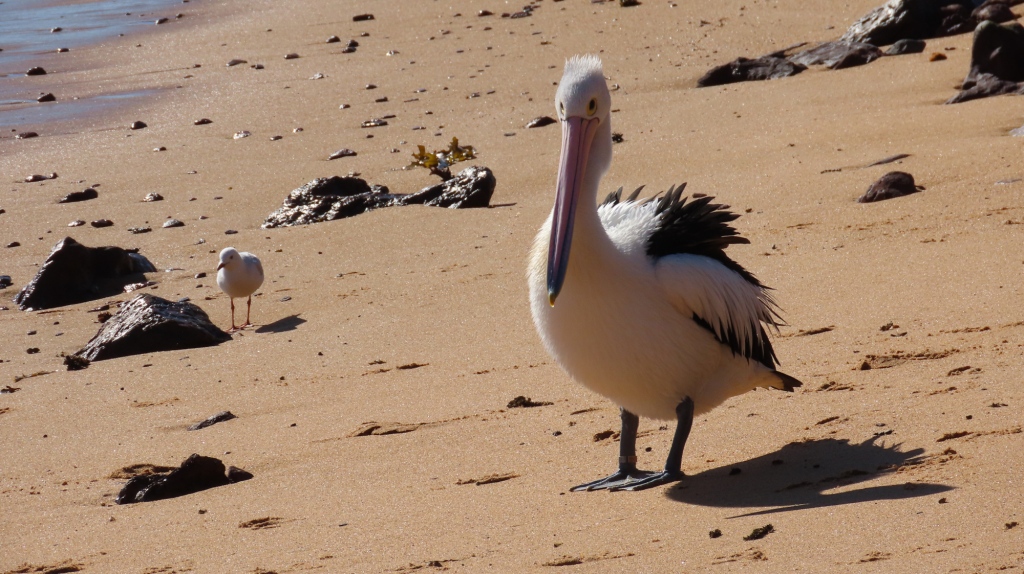
With a Silver Gull, giving some idea of scale:
Three pelicans, three poses:
Surf as a backdrop:
A moody shot of fisherman and bird:
Common name: Australian Pelican
Scientific name: Pelecanus conspicillatus
Approximate length: 170 cm
Approximate wingspan: 2.5m
Date spotted: 19 June 2024 (winter)
Location: Long Reef Aquatic Reserve, Collaroy, New South Wales, Australia: 33°44’19.7″S 151°18’42.0″E

Osprey chased off by raven and noisy miners
At Long Reef Headland today, an Eastern Osprey sat peacefully on a branch. Then an Australian Raven dived at the osprey, cawing and moaning. The resident Noisy Miners heard the fracas and joined in. After a few seconds, the Osprey decided enough was enough and took off to find a quieter spot.
Eastern Ospreys are magnificent birds. They measure up to 65 centimetres from head to tail, and have a wingspan of up to 1.7 metres. They eat fish, which they catch by diving into the water from a height and dragging the fish out of the water in their claws.
We first spotted this osprey perched on the edge of a cliff. Later, we saw it a few metres further on, in a tree high on a ledge above the beach.
Here’s the osprey enjoying the sun and the view, before the other birds arrive:
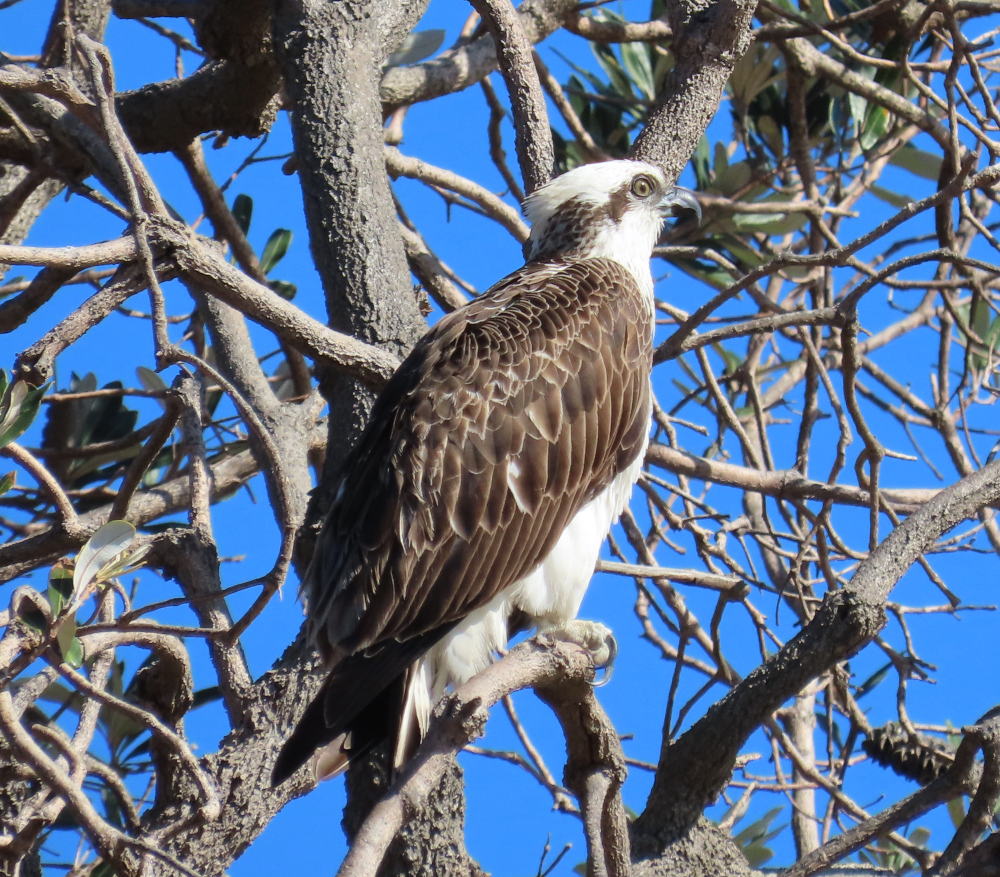
Then the Australian Raven arrived. Here the Osprey is warning the raven off:

That’s when I started the video recording, which you can watch at the top of this post.
Here’s the best picture I have of the osprey in flight:

Common name: Eastern Osprey
Scientific name: Pandion cristatus
Approximate length: 57 cm
Date spotted: 19 June 2024 (winter)
Location: Long Reef Aquatic Reserve, Collaroy, New South Wales, Australia: 33°44’19.7″S 151°18’42.0″E

Grey Fantail catching the sun
Early one morning, after some fairly ferocious rain, everyone was seeking sunlight and somewhere to dry out. This little Grey Fantail sat still on a branch for several minutes. Well, what passes for still, in a fantail’s world!
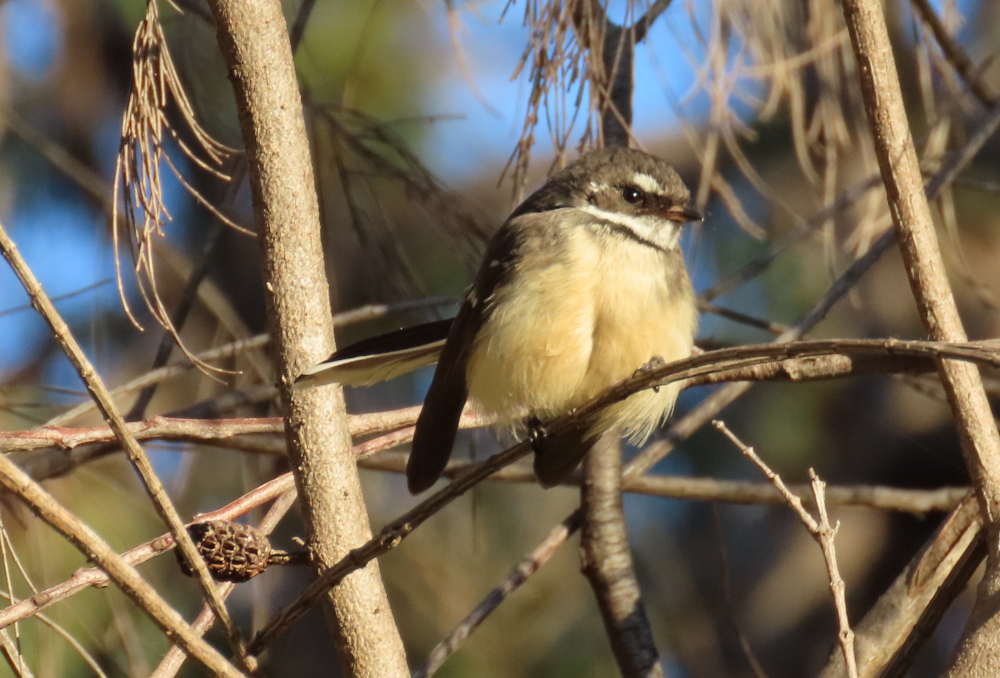
From the way it’s fluffing out its feathers and holding its wings, I’m sure it’s exposing as much of itself to the sun as possible!

Common name: Grey Fantail
Scientific name: Rhipidura fuliginosa
Approximate length: 14-17 cm
Date spotted: 3 June 2024 (winter)
Location: Manly Dam Reserve, New South Wales, Australia: 33°47’01.7″S 151°15’10.3″E

Black Cockatoo feeding a youngster
Every six months or so, a group of Yellow-tailed Black Cockatoos come to our Banksia for a feed. They come for a few days in a row, then move on to find another feeding area.
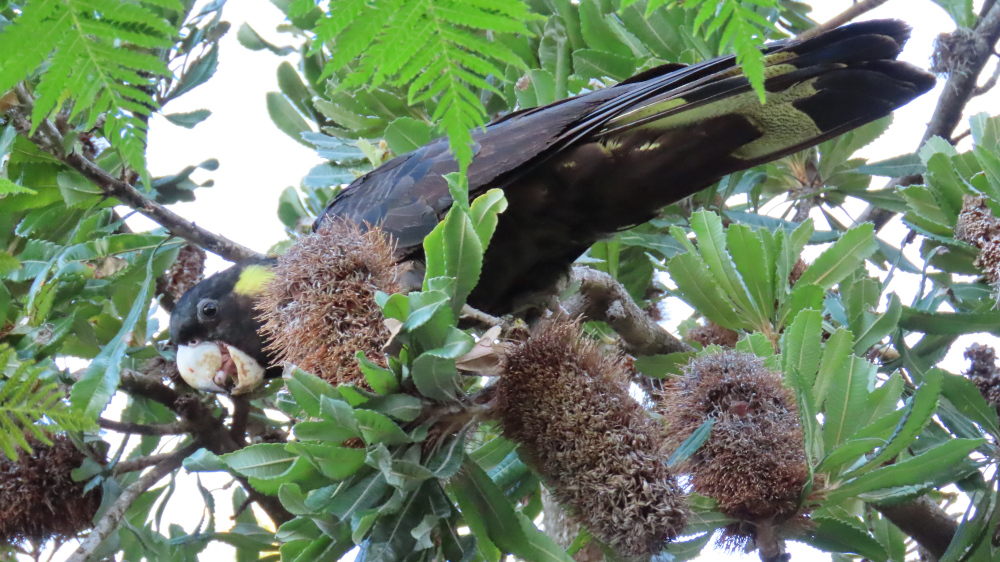
Sometimes they spend more time plucking and dropping than eating. Still, it always feels like such a privilege to have magnificent creatures like this just dropping by. I love the wild, screaming noise that they make. Some people call them the “squeaky door birds”:
The tree is a Banksia serrata, also known as Old Man Banksia.
On the birds’ second visit a day or so later, I filmed some interesting behaviour. One of the birds was making a continuous groaning noise. That’s not unusual, and I’ve wondered in the past if the bird is a youngster begging for food, or if it’s some kind of mating behaviour.
I think I have an answer! In this video, it looks like the male bird (he has a pink ring around his eye) is regurgitating food and then feeding it to the bird that’s making all the noise:
I added quite a lot of detail about these birds in a previous post: Those magnificent black cockatoos are back!
Common name: Yellow-tailed Black Cockatoo
Scientific name: Calyptorhynchus funereus or Zanda funereus
Length: 58-65 cm
Date spotted: 27th and 29th May 2024 (autumn)
Location: Allambie Heights, NSW, Australia

Incoming!
I took this photo so that I could identify the black and white birds on a far off skeleton tree. I only saw the incoming missile when I examined the photos at home:
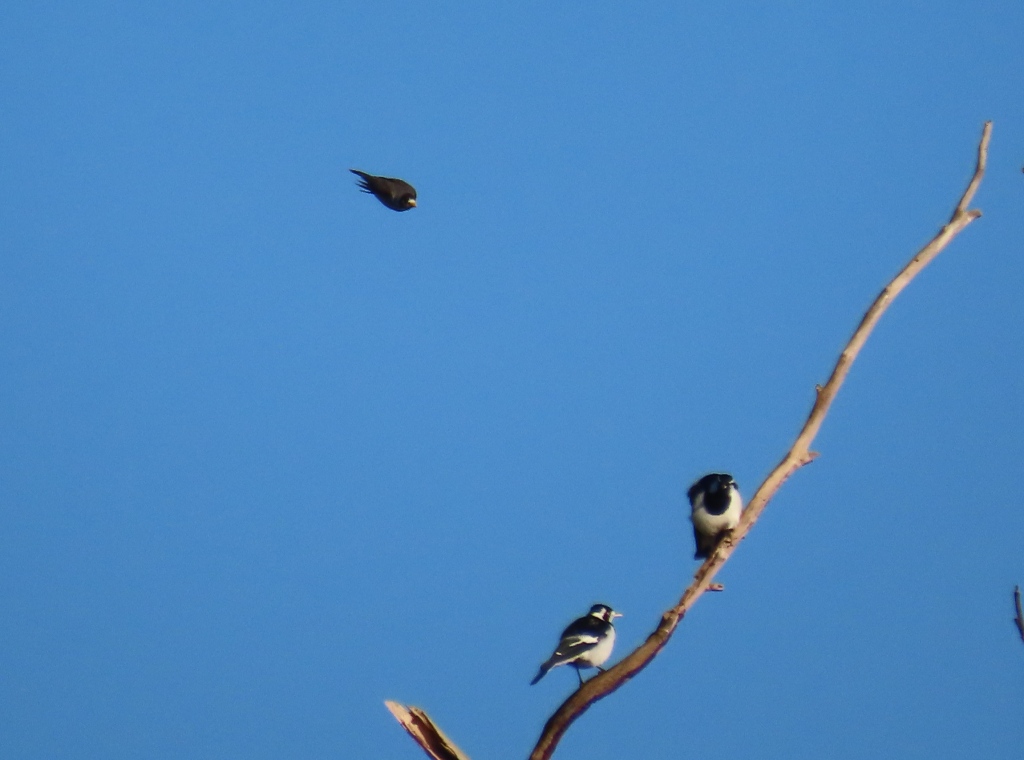
I think the missile is probably a Noisy Miner. The two birds on the tree are Magpie-larks. I’ve often seen Noisy Miners sitting on this strategically-placed dead tree branch, which has a good view over Manly Dam. I’ve seen several types of birds perched there, but the Magpie-larks are usually closer to the water rather than high in a tree.
Date spotted: 30 May 2024

Willie Wagtail enchanted by Grebe
This little Willie Wagtail seems intrigued by the way a Grebe keeps disappearing under the water and popping up again:
My camera battery died as I was taking the above video, which is a pity because the birds were quite close to me. Here’s another video, a bit noisy due to a plane flying overhead, and the birds are further away:
It’s funny how the Coot seems to be surprised by the Grebe’s disappearance too. I love Coots!
I watched the two birds for about fifteen minutes, as the Willie Wagtail tirelessly followed the Grebe around this reedy inlet of Manly Dam. I wonder if the Willie Wagtail was hoping for some insects to fly up each time the Grebe surfaced. Perhaps the Grebe’s activities would disturb a lily pad and cause an insect to jump?

Common names: Australasian Grebe and Willie Wagtail
Scientific names: Tachybaptus novaehollandiae and Rhipidura leucophrys
Approximate length: 23-25 cm and 20 cm
Date spotted: 5 June 2024 (autumn)
Location: Manly Dam Park, near Sydney, Australia: 33°46’34.8″S 151°14’49.6″E


 Sydney Birder