Author Archives: Sarah Maddox

Beautiful female Crimson Rosella
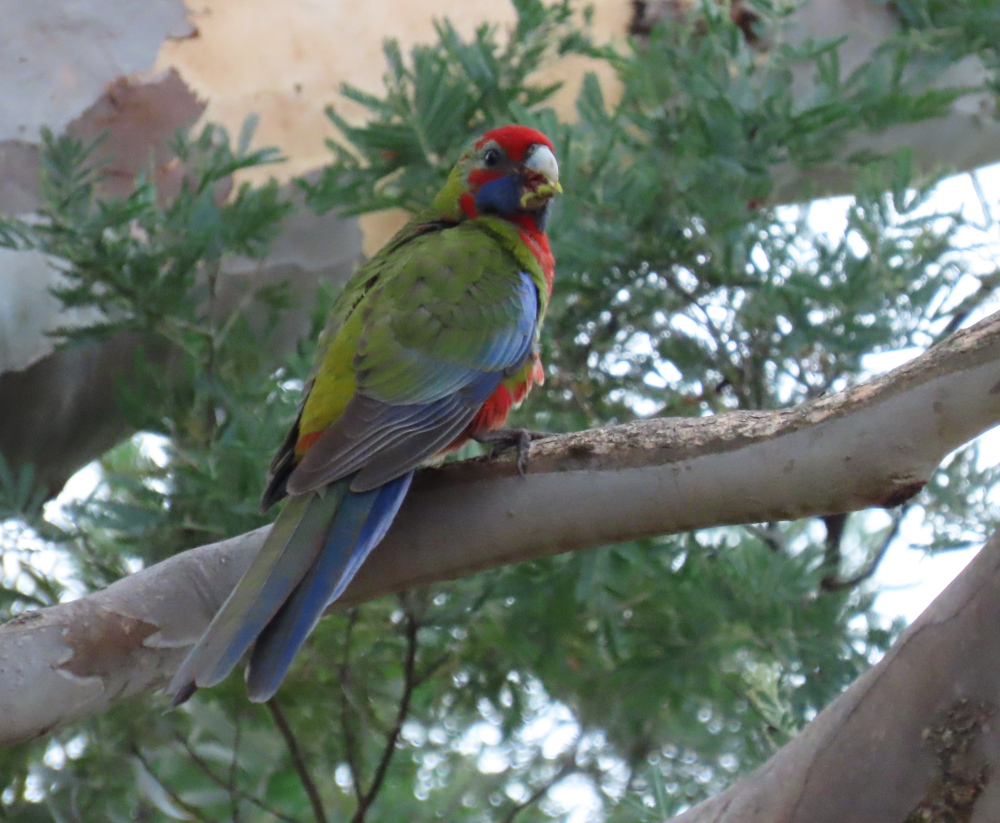
In my recent travels in the Victorian High Country, I came across a gorgeous female Crimson Rosella. She was a little coy. It was great to see her looking so colourful and smart, as the females often look a little dowdy in comparison to the males.

It was interesting to see the greyish colour around her eye, where my bird book shows a continuation of the yellow-green of the head and back.
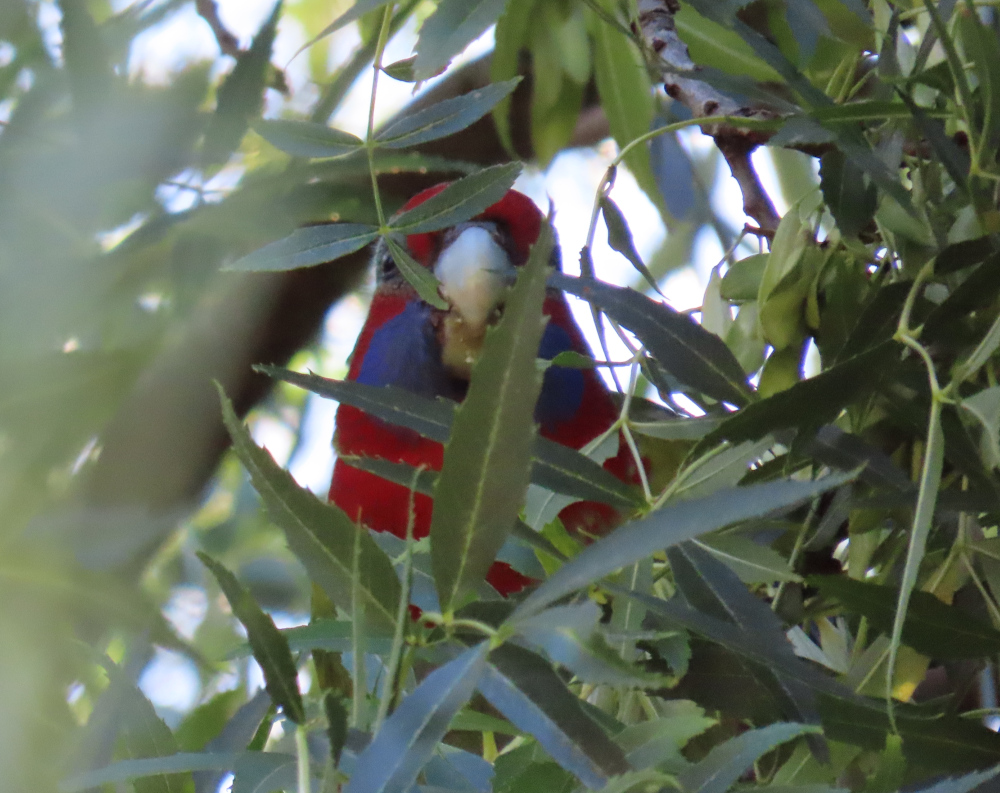
The next morning, I saw another female which might or might not have been the same bird. An early morning stretch shows off her gorgeous plumage:

Nibbling a bit of breakfast:
Common name: Crimson Rosella
Scientific name: Platycercus elegans elegans
Approximate length: 35 cm
Date spotted: 17-18 February 2025 (summer)
Location: Whitfield, Victoria, Australia: 36°45’43.2″S 146°24’53.4″E

Gang-gang Cockatoos on a river bank
I’ve been in the Victorian High Country for the last few days. This part of the state of Victoria features gorgeous countryside, steep mountain sides, deep valleys, and wide rivers.
In this lovely setting, I spotted my first Gang-gang Cockatoos. It was a great pleasure and privilege to see a group of these quiet birds feeding and chatting in the early morning. Gang-gangs are on the endangered list, considered to be at high risk of extinction in the wild.
In this video, a female Gang-gang Cockatoo stands on a rock at the edge of the Mitta Mitta River, nibbling at the water weeds. It was early morning, and the light was dim. I’d heard the odd creaky noises that this bird and her companions were making, and went to investigate. To make the video, I stood on a footbridge over the river at Taylor’s Crossing Campground.
I love the noises that these birds make. A mix of creaks and growls. It was the sound that led me to investigate, like a cross between the call of a raven and the squawk of a cockatoo. You can hear some of the bird’s soft creaks at the start of the above video.
The name “gang-gang” comes from the Wiradjuri language, and maybe from other Aboriginal Australian languages too. It’s most likely an onomatopoeic word, echoing the noises that the birds make.
It also interesting to see a cockatoo eating a water weed. She chewed through the entire long strand, consuming the whole thing with evident enjoyment.
There were four Gang-gangs at the river: two females, an adult male, and a juvenile male. My photos are a bit fuzzy, due to the early morning dimness.
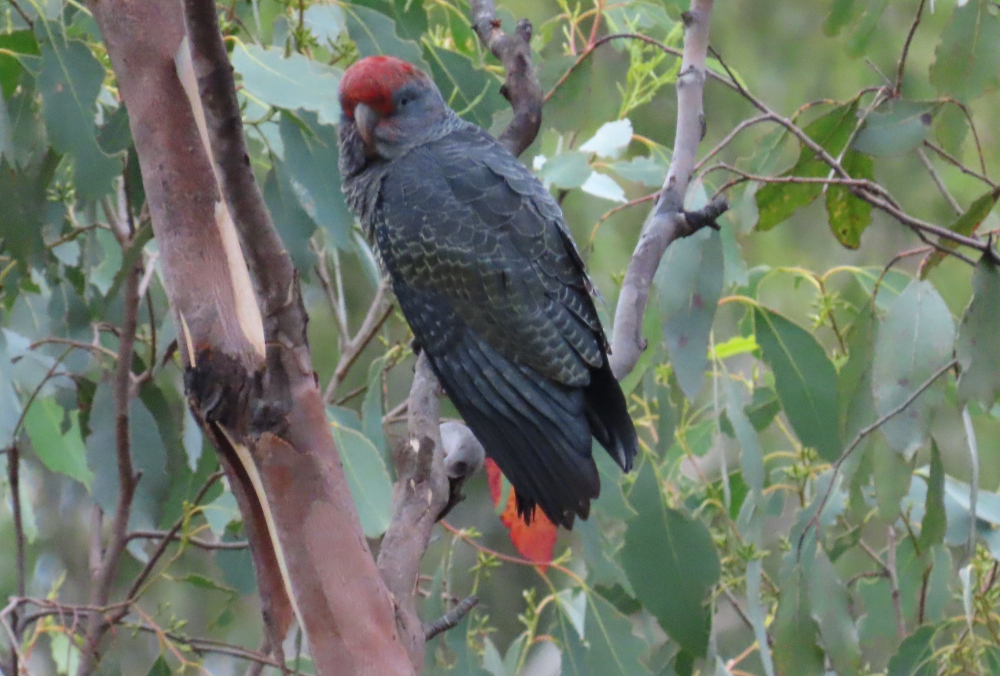
Here’s the adult male, with his bright red head and crest:

The next photo shows an immature male. The red on his head and crest is just starting to come in. (Ignore the red leaf at the end of the bird’s tail):
Here’s a photo of the female down on the river bank:
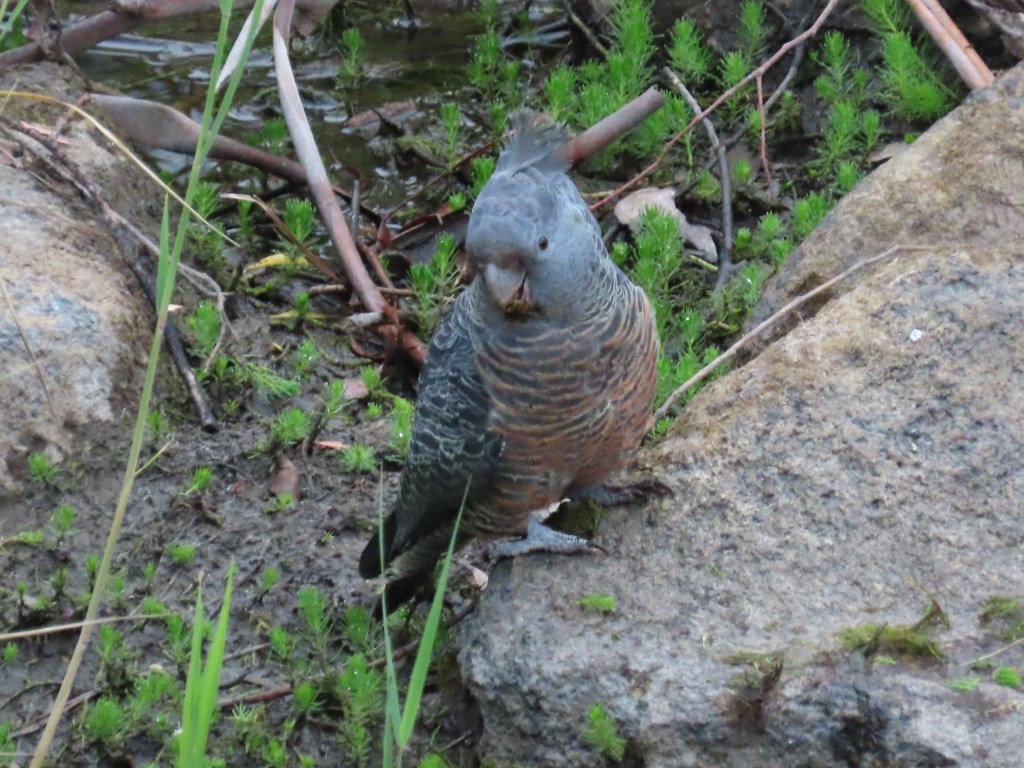
Her wispy crest is a soft grey, a bit like a feather duster:

Common name: Gang-gang Cockatoo
Scientific name: Callocephalon fimbriatum
Approximate length: 33-36 cm
Date spotted: 25 February 2025 (summer)
Location: Taylors Crossing Campground, Mitta Mitta River, Victorian High Country, Australia: 36°49’33.7″S 147°39’40.6″E

If you were a baby Brush-turkey
If you were a baby Brush-turkey strolling down The Corso in Manly …

… and you could choose between a summer hat, a list of summer reads, or something that might be a worm, which would you choose?

The baby Brush-turkey is quite cute and pretty. The adults are much larger and not very pretty, though they do have a certain dinosaur dignity. Here’s an adult male from one of my other posts about Australian Brush-turkeys.

Common name: Australian Brush-turkey
Scientific name: Alectura lathami
Approximate length of adult bird: 60-70 cm
Date spotted: 11 February 2025 (summer)
Location: The Corso, Manly, New South Wales, Australia: 33°47’51.8″S 151°17’12.9″E

Peregrine Falcon in the suburbs
It was good to see this Peregrine Falcon perched high in a tree above the rooftops in Sydney’s Northern Beaches.
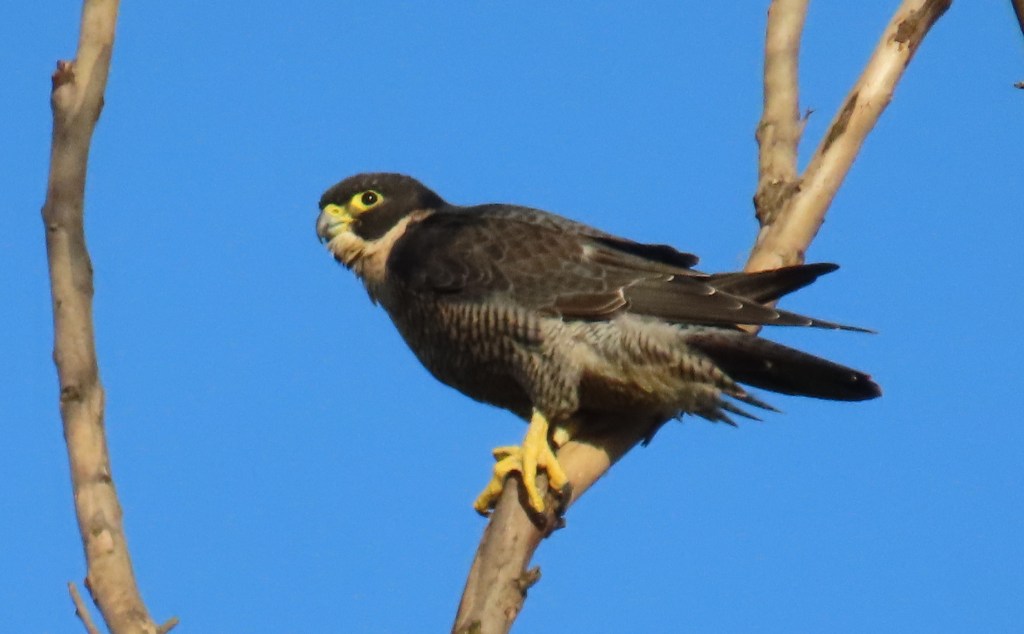
They’re beautiful birds, with that fierce eye and the contrast between yellow and black colouring. I’ve seen just a few Peregrine Falcons before, usually in a wilder setting. Check out the posts about my other sightings of Peregrine Falcons.
Common name: Peregrine Falcon
Scientific name: Falco Peregrinus
Approximate length: 42 cm
Date spotted: 15 February 2025 (summer)
Location: Allambie Heights, New South Wales, Australia. Approximate map reference: 33°46’18.2″S 151°15’39.4″E

Lost! Baby Purple Swamphen
A baby Purple Swamphen hops around the lily pads, sticking close to the safety of her mother. But where is her little brother?
I love the baby birds’ tiny little wings. They look like little arms flapping about. At first, I thought that the baby had caught a frog. No, it’s just those little wing stubs.
But where is her brother? Another tiny little Purple Swamphen is lost amongst the reeds! It’s hard to see how such a tiny thing can find his way back to his mother and sister, so far away among the giant lily pads:
I don’t know whether these birds are male or female, so I’ve just picked pronouns at random. Both sexes of Purple Swamphens look after their young, and they’re hard to tell apart.
Mother might not have the most beautiful face, but she offers safety and comfort:
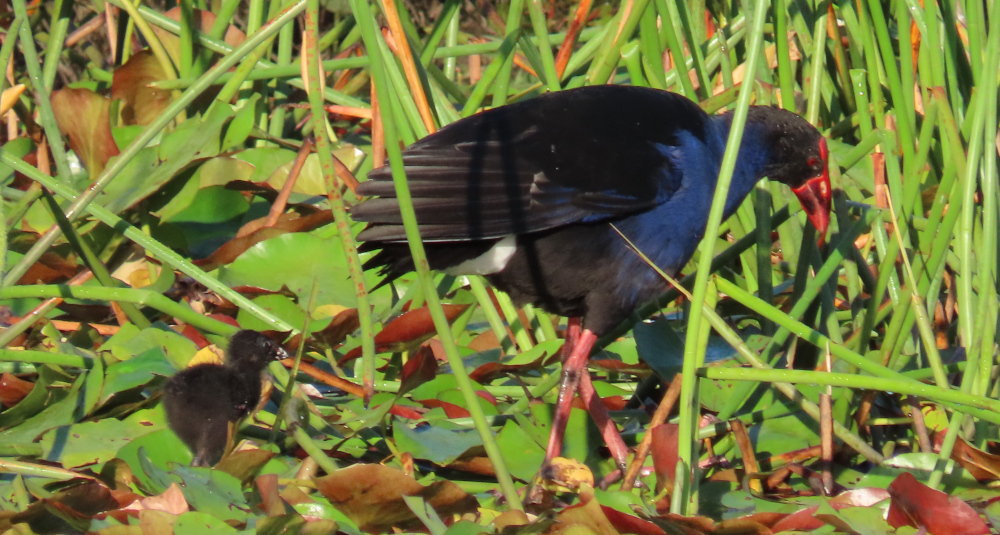
Will the little one find his way back? His sister gazes across the lily pads, as if searching for him:
At last, the wanderer spots his family and hurries across the lily pads. His sister greets him warmly, while mother looks on fondly:
Common name: Purple Swamphen
Scientific name: Porphyrio porphyrio
Approximate length of adult: 50 cm
Date spotted: 5 February 2025 (summer)
Location: Manly Dam Reserve, New South Wales, Australia: 33°46’35.4″S 151°14’49.1″E

Python has just swallowed a meal
A few days ago, I saw this Diamond Python on Manly North Head near Sydney. The snake has recently had a meal, hence the thickening in part of the body. I’ve drawn a rough outline in a copy of the picture, so that you can see the shape of the snake more clearly.


The snake’s head is resting on its body near the middle of the picture. The snake lies mostly straight, with just one bend at the bottom of the picture. It’s well camouflaged, even though it’s lying out in the open to bask in the sun and digest its meal.
Diamond Pythons are just one of several types of pythons found in Australia, and are native to south eastern New South Wales. They’re large snakes, growing up to three metres long. They aren’t venomous, though they do have teeth and can bite. They lie in wait for their prey, and kill it by squeezing it to death. They eat the animal whole, then digest it once it’s inside their stomach. That’s what’s made the large bulge in this particular snake.
If you’d like to hear the story of another of these snakes, take a look at a Diamond Python in a Banksia tree.

A rather shaggy Whipbird
This little whipbird looks as if it hasn’t combed its feathers in a while. Still, it’s a nice-looking bird. It might be a juvenile, still coming into full feather:
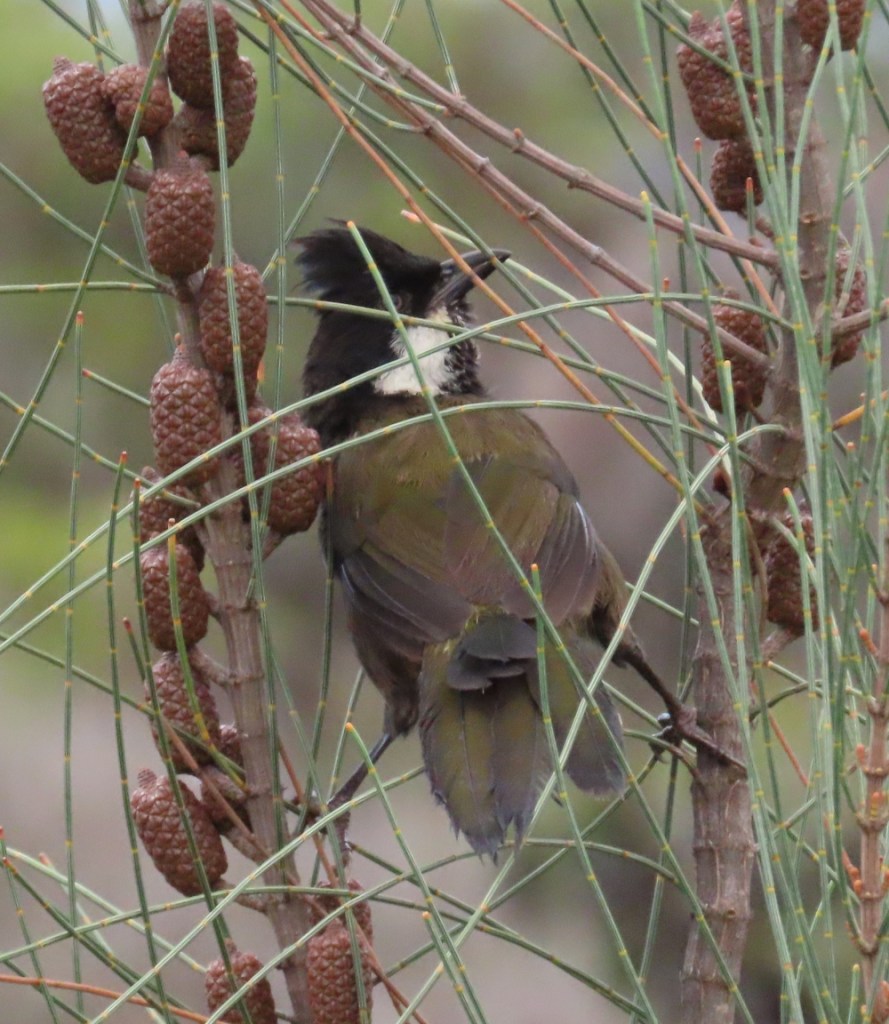
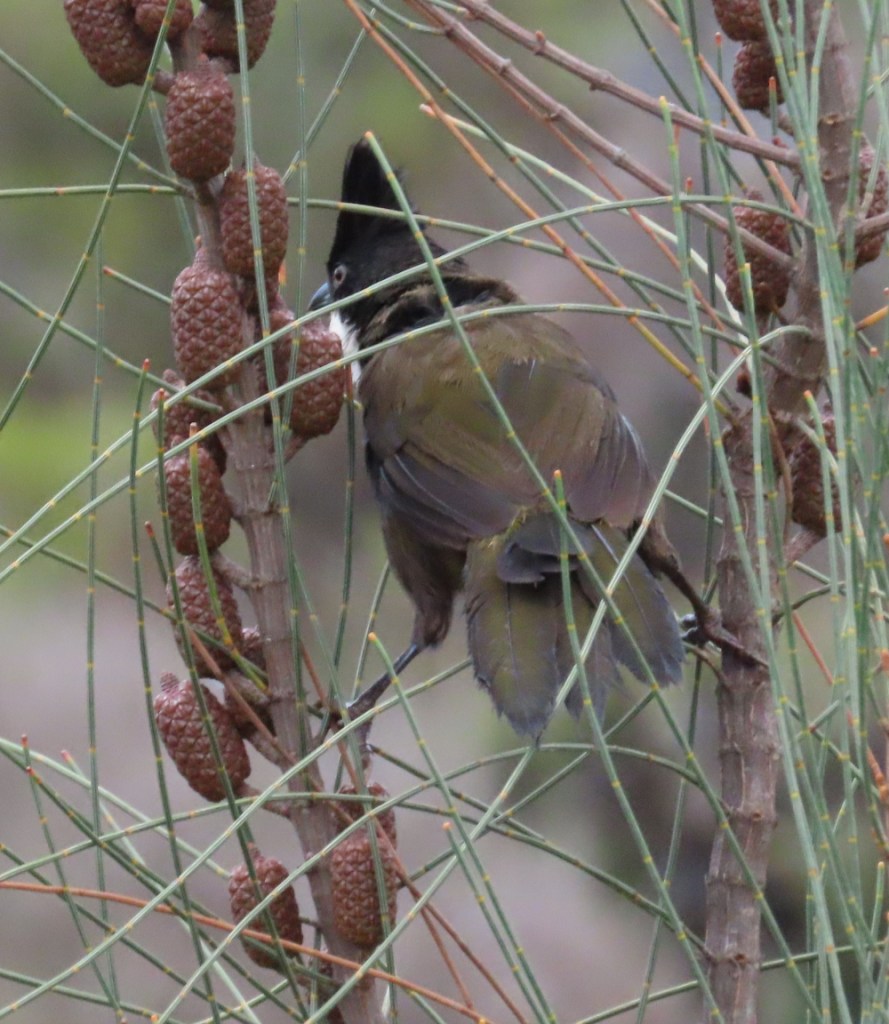
Whipbirds spend their time mostly in the low shrubbery, often rustling around in the leaves on the ground. As a result, they’re hard to spot and they usually look dark brown and black in colour. It’s nice to see one with a bit of sunlight on its feathers, bringing out the soft olive green glow on the wings and tail.
The noise that whipbirds make is strange: “eeeuuw-phwit”. It reminds people of a whip whistling and cracking, and that’s what gives the bird its name. I managed to get a good video of them calling, which I published in an earlier post.
Common name: Eastern Whipbird
Scientific name: Psophodes olivaceus
Approximate length: 30 cm
Date spotted: 16 January 2025 (summer)
Location: Dobroyd Head in Sydney Harbour, NSW, Australia: 33°48’34.0″S 151°16’25.3″E

A beautiful orange cormorant
Usually, Little Pied Cormorants have bright white and shiny black feathers. This one, though, has a lovely burnished orange head and chest. This is probably due to staining from natural iron deposits in the water.


Here’s a short video, showing the back of the bird’s head with a neat black stripe between the orange feathers of the bird’s face:
Common name: Little Pied Cormorant
Scientific name: Phalacrocorax melanoleucos
Approximate length: 60 cm
Date spotted: 20 January 2025 (summer)
Location: Manly Dam, Allambie Heights, New South Wales, Australia: 33°46’35.1″S 151°14’48.5″E

Termites and kookaburras
Termites are very active in our area of the world at the moment: the east coast of Australia just north of Sydney. When walking along a road that passes through a park area, it’s common to see low mud tunnels crossing the road. Termites build these tunnels to shelter in when they’re on their travels. Recently, I’ve also seen long trains of termites venturing out without any cover at all.
Here’s a stream of termites crossing the road. They’ve even built themselves a junction so that they can head off in different directions:
Termites’ mud tunnels often go up the outside of a tree:
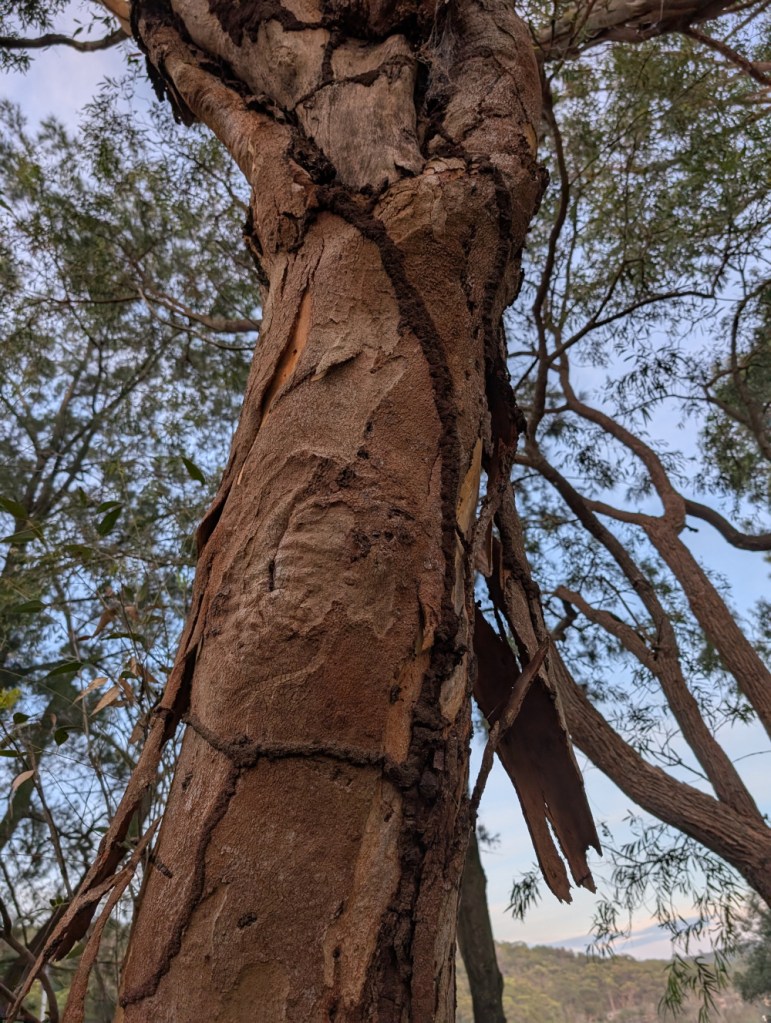
The termites in this part of Australia build their nests as large mud mounds, stuck high up in a tree:

Termite nests make a handy home for monitor lizards, kookaburras, kingfishers, and other creatures. In an earlier post, I showed pictures of a termite nest that had been adopted by kookaburras as a home for their young family: Baby kookaburras out of their nest.
In the next video, two young kookaburras attack the side of a termite nest, slowly digging a hole in the nest. They’re probably thinking ahead to the next breeding season, when such a home will come in useful:
In the video, you can hear the two kookaburras chattering, and other kookaburras giving the full laughing cackle in the background. There are also cicadas singing, and a butcherbird calls at one time too.
Common name: Laughing Kookaburra
Scientific name: Dacelo novaeguineae
Approximate length: 47 cm
Date spotted: 13 January 2025 (summer)
Location: Manly Dam near Sydney, New South Wales, Australia

Spider wasp in my house
Warning: This blog post could be scary and off-putting. Nothing bad happens to me, but by nature the wasp isn’t very nice to the spider.
Not a bird in sight, but a bird would definitely have found this sight interesting. A large, red wasp appeared in the room where I was sitting. It flew around a bit, then disappeared. A minute later, it re-appeared and dumped a paralysed huntsman spider at my feet!
The wasp is called a “spider wasp”. I think this particular variety is a tarantula hawk wasp. It injects venom into a spider, often a huntsman, which paralyses the spider. The wasp then drags the spider into its nest and lays eggs inside the spider. When the wasp eggs hatch, the larvae feed off the spider.
Now, if you’ve ever seen a huntsman, you’ll know that they’re not small as far as spiders go. I’ve seen wasps like this one in the garden, sometimes performing amazing feats with a spider in tow. One wasp crawled a vertical rock face, several metres high, dragging a spider behind it.
Fascinating as these creatures are, I didn’t really want a wasp nest with a paralysed spider as food source in my house. I feel bad for the spider. Plus, tarantula hawk wasps evidently have an extremely painful sting.
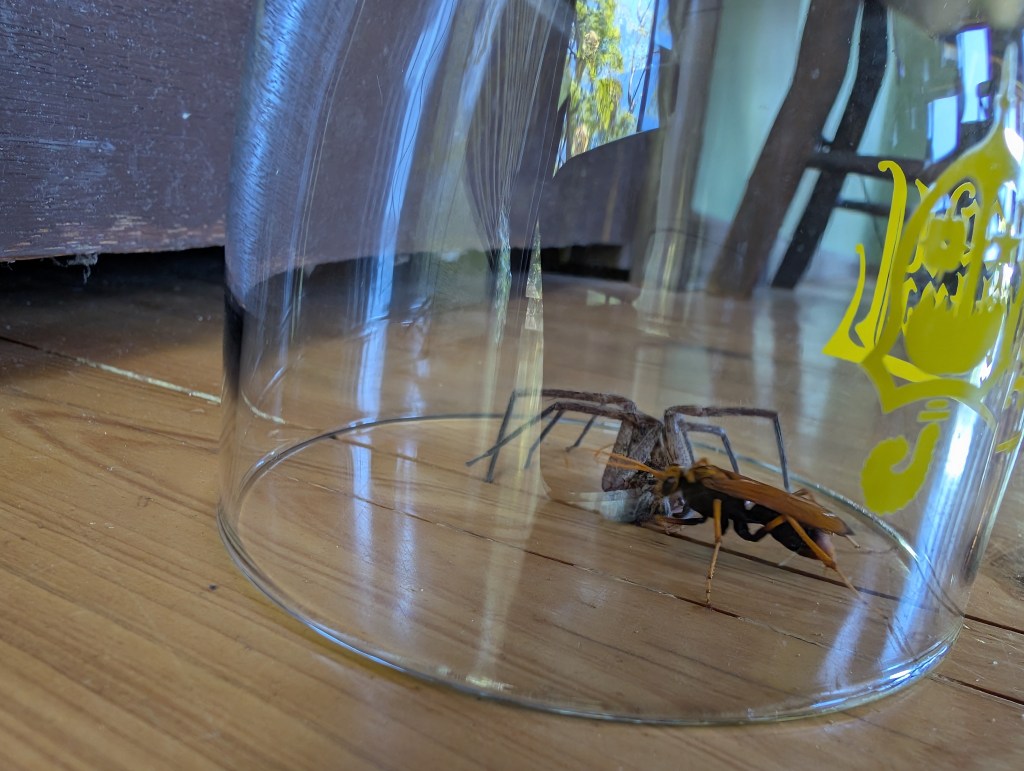
While the wasp was still pre-occupied with the spider, I managed to cover both with a large beer glass. This photo shows the wasp with its feet still partly holding the spider:
Immediately, the wasp started prowling around the edge of the glass. This photo is clearer than the one above, and has my husband’s finger for scale:
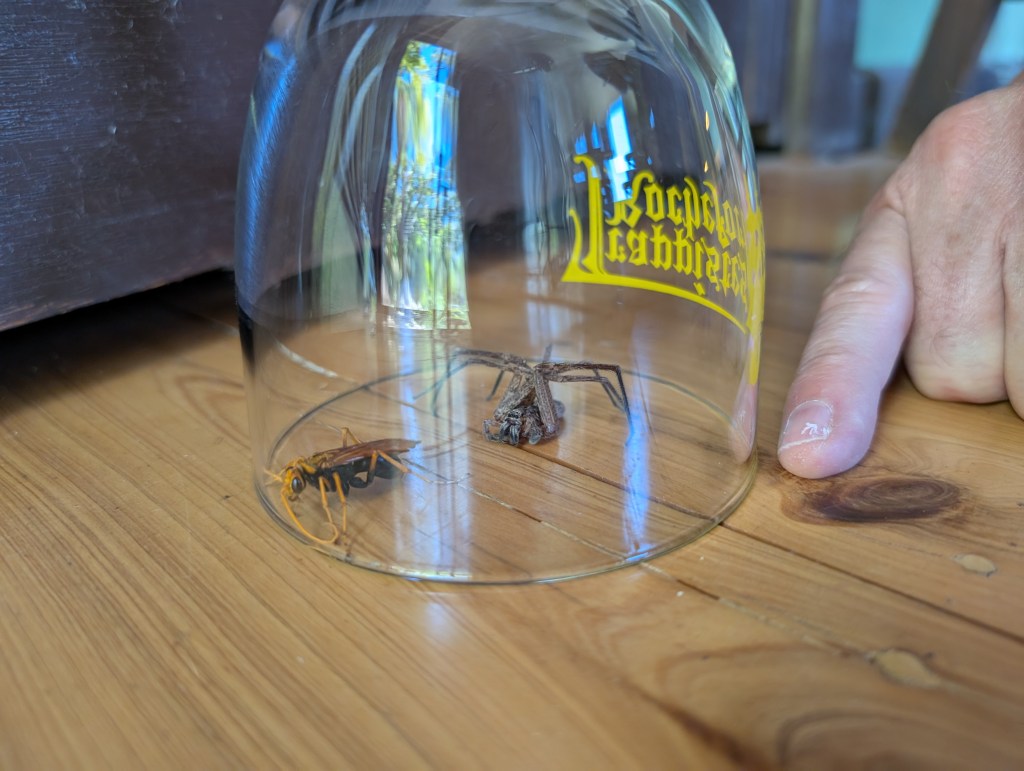
Look at that poor spider’s eyes.
We’ve had other types of wasps in the house. They come in, fly around and inspect the walls, and with any luck fly out again. Sometimes they decide to build a nest. The most common wasps that we see are dark in colour, of medium size, and build cocoons of mud to house their eggs. It’s quite astounding to see how fast they build these constructs. But I do draw the line at tarantula hawk wasps.


 Sydney Birder